

Distributed vehicular antenna system
Advances in communication technologies open up new opportunities and enable new types of services in the automotive area. These include road safety, traffic efficiency and customer services which are not specifically meant for automotive applications. As advanced V2X use cases requiring high reliability and/or high data rate are introduced, technologies such as multi-antenna solutions (e.g. massive MIMO), broadband (e.g. carrier aggregation), and FR2 solutions will be essential for V2X communications, and thus the number of required antennas mounted on vehicles will keep growing.
This study on the ‘Distributed vehicular antennas system’ provides a list of potential implementation options for vehicular-DAS with a brief analysis of impacts to 3GPP specifications and implementation costs. In addition, the potential performance gain of DAS over co-located antennas was verified through simulations, and the evaluation results and analysis were included in eCV2X WI TR.
Read the full report here.
Home
The 5G Automotive Association (5GAA) is a global, cross-industry organisation of companies from the automotive, technology, and telecommunications industries (ICT), working together to develop end-to-end solutions for future mobility and transportation services.
5GAA at a glance
+100 Members Community
+90 Completed Work Items Work Items
7 Working Groups Items
1 Objective Connected mobility
What’s new
All news

5GAA celebrates 5 years
Celebrating 5 years of digital transformations
and innovative mobility solutions
meeting today’s challenges.
5GAA leverages today’s and tomorrow’s mobility solutions
According to the World Health Organization (WHO), roughly 1.25 million road traffic fatalities worldwide in 2013, with another 20–50 million injured or disabled through traffic accidents. Vehicles sharing information make transportation safer, greener, and more enjoyable are at our doorstep. The technologies associated with this concept are collectively known as Cooperative Intelligent Transportation Systems (C-ITS). The impact on road safety alone is sufficiently significant to make C-ITS a priority.

5GAA contribution focuses on 5 pillars

Bridging the automotive & telecommunications industry

Enabling technology deployment

Contributing to standards

Advocating to policymakers and positioning 5GAA around strategic ecosystem

Leveraging innovative solutions to advance connected mobility
Latest publications



Frequently Asked Questions
General Information about 5GAA
The 5G Automotive Association (5GAA) is a global, cross-industry organisation bridging the gap between automotive, technology, and telecom industries and promoting the C-V2X technology (Cellular vehicle-to-everything), a comprehensive platform for connected vehicles, safety, and transportation.
5GAA was created in September 2016 by its eight founding members: AUDI AG, BMW Group, Daimler AG, Ericsson, Huawei, Intel, Nokia and Qualcomm Incorporated.
5GAA unites now more than 130 companies diverse both in terms of geography and expertise. These include automotive manufacturers, tier-1 suppliers, chipset/communication system providers, mobile operators and infrastructure vendors. Find the full list of members here.
5GAA’s members are committed to helping define and develop global solutions for the next generation of connected mobility and automated vehicle solutions to address the complex challenge of providing enhanced safety, sustainability, and convenience for all road users. Read more about 5GAA’s mission here.
Since its creation, 5GAA has helped transform C-V2X technology from a standard into a market reality and has established 5G as the reference for future automotive connectivity. The association is now regarded as the global lead organisation on automotive connectivity. (link to the 5th anniversary report)
Major publications, reports and white papers include:
- Safety Treatment in V2X Applications
- Environmental Benefits of C-V2X
- Cooperation Models enabling deployment and use of 5G infrastructures for CAM in Europe
- Privacy by Design Aspects of C-V2X
- Tele-Operated Driving (ToD): System Requirements Analysis and Architecture
- Tele-Operated Driving (ToD): Business Considerations
5GAA is working on the basis of 5 association pillars: as the first and overarching pillar, 5GAA aims to bring value to its members. Four main pillars help to achieve this overarching pillar: (1) enable deployment by lifting barrier and accelerating time-to-market, (2) contribute to standardisation via pre-standardisation efforts of automotive connectivity, (3) advocate policymakers by addressing regional opportunities and threats, and (4) leverage innovative solutions within the larger connected automotive community.
The association is contribution-driven and only exists through collaborations and communications between its members.
Between 2019 and 2021, 5GAA’s work focused on eight priority areas: security and privacy, road infrastructure, Vulnerable road users, positioning, interoperability, cellular network, and flexible architecture and technology evolution. All of the priority areas are contributing to the association’s vision: “connected mobility for people, vehicles, and transport infrastructure”. You can find more information on 5GAA’s work here.
The association includes an Executive Committee, a Board, and a General Assembly. The Board, composed of eighteen members elected every year by the General Assembly, supervises and advises the Executive Committee in all respects, in particular with regard to strategic guidance. The Executive Committee is the legal representative body of the association and is responsible for its day-to-day management. You can know more about the 5GAA’s leadership and Board at this link.
In order to address society’s transport needs, 5GAA has seven working groups focused on:
- Use Cases and Technical Requirements
- System Architecture and Solution Development
- Evaluation, Testbeds, and Pilots
- Standards and Spectrum
- Regulatory and Public Affairs
- Security and Privacy
5GAA Working Groups are overseeing the work done in the work programme made of a large number of Work Items. Work Items are time-limited targeted activities which may report to more than one Working Group depending on their tasks. Outputs from Work Items can take many different shapes: Technical Report, Technical Specifications, White Papers, measurements, prototypes and/or demonstrations.
5GAA believe true ecosystem cooperation must be achieved around sustainable business models. An ecosystem that would gather the whole value-chain of connected mobility, seamlessly interacting with partners and standardisation bodies.
5GAA collaborates with different actors active in many fields: Standardisation bodies, Testing, Conformance and Interoperability organisations, Promotion Groups and Think Tanks, and regional organisations. 5GAA is also part of several European and national projects related to 5G networks and connected mobility. You can discover more on 5GAA’s partnerships here.
Friends of 5GAA is a group subscribing to a global newsletter addressing issues of interest and concerns to organisations that are not members but would like to keep up-to-date on 5GAA’s activities: typically road operators, ministries, public bodies, etc. They can also engage with the 5GAA members to identify synergies and business opportunities to accelerate and streamline the deployment of connected automotive.
Questions about Cellular-Vehicle-to-Everything (C-V2X) technology
Cellular-V2X (C-V2X), as initially defined as LTE V2X in 3GPP Release 14, is a technology that allows vehicles to communicate with each other and the wider transport ecosystem.
It includes Vehicle-to-Vehicle (V2V), Vehicle-to-(Roadway) Infrastructure (V2I) and Vehicle-to-Pedestrian (V2P) direct communication without necessarily relying on network involvement for scheduling. This is complemented by the connectivity to the mobile network (V2N) using LTE.
C-V2X has a clear evolution path to 5G (also called 5G New Radio (NR)) for both modes of operation mentioned above. C-V2X direct communication has an evolution path to 5G-NR based C-V2X, and LTE- network communication has its evolution patch to 5G-NR network communication.
5GAA supports the idea that 5G will be the ultimate platform to enable C-ITS and the provision of V2X. 5G will be able to better carry mission-critical communications for safer driving, and further support enhanced V2X communications and connected mobility solutions.
V2X includes:
- V2V: Vehicle to Vehicle communications – Direct and short-range communication between Vehicles for critical safety applications – providing 360o non-line-of-sight awareness for improved safety;
- V2P: Direct and short-range communication between Vehicles and Pedestrians – including all “vulnerable” road users such as cyclists;
- V2I: Direct and short-range communication between Vehicles and Infrastructure – allowing the vehicle to connect to and receive road traffic information (signage, traffic lights etc.);
- V2N: Network communications between Vehicles and Network (i.e. the cloud) – providing vehicles with advanced traffic routing, long range information and cloud-based services, e.g. Infotainment.
C-V2X technology combines two complementary modes of communication:
Direct & short-range connectivity for safety applications without requiring network coverage or subscription. This operates in designated ITS spectrum bands (e.g. ITS 5.9 GHz) also known as “LTE-PC5”. C-V2X direct communication gives vehicles the ability to communicate with each other (V2V), to pedestrians (V2P), to roadway infrastructure (V2I), enabling safer, more autonomous vehicles of the future;
Connectivity via regular cellular networks for non-safety applications like navigation and infotainment in the car. This operates in the traditional mobile broadband licensed spectrum – also known as “LTE-Uu”. C-V2X network communication allows vehicles to communicate with the network (V2N).
In China, cars enabled with Cellular-Vehicle-to-Everything (C-V2X) technology are already available. To this date, 14 C-V2X vehicles have been commercialised so far. In the United States, Ford has committed to deploy C-V2X in all new vehicle models from early 2022. Finally, in Europe, BMW and Samsung are set to offer 5G/CV2X in their iNEXT vehicle this year, in 2021.
In 2020, 5GAA released a Visionary 2030 Roadmap outlining the vehicle-to-everything (V2X) use cases to improve traffic efficiency and road safety around the world expected in the next decade. Close to 200 million ‘connected vehicles’ are already on the roads worldwide, and a growing number of vehicles with the ability to exchange traffic and road condition information over cellular networks. Further progress in the coming years will pivot around 5G-V2X use cases for more efficient and safe driving. From 2025 onwards, 5GAA expects the mass rollout of more advanced automated driving and safety use cases supported by vehicle connectivity. Additional automated driving functionalities are anticipated from 2026.
5G for automotive has the potential to have the most revolutionary impact by saving millions of lives by reducing road accidents. Furthermore, it will have a positive impact by producing more efficient journeys, minimising travel times, traffic jams and improving environmental footprints. Unlike other competitive technologies, C-V2X leverages both cost-effective direct short-range communications and long-range cellular connectivity. This allows more cost-effective use of an integrated connectivity platform to address the broadest range of safety features.
The cost-efficiency of C-V2X is determined mainly by the three following reasons:
C-V2X integration with existing cellular modem: C-V2X can deliver both short-range safety V2X applications and long-range network communications via the one modem, which accelerates time to market and market penetration, contributing to enhanced safety and reducing cost;
For pedestrians, C-V2X will also find its way into consumer-electronics smartphones both for use by pedestrians, cyclists and unequipped vehicles due to its low power consumption and its possible integration with 4G/LTE chipsets;
Benefit from the economy of scale as it can leverage synergies between transportation and other verticals which are moving towards 5G (e.g. e-health, smart cities, industry 4.0, smart farming, etc.)
C-V2X will improve safety on roads by tremendously facilitating the flow of information between vehicles, pedestrians, and road infrastructure. This will enable connected vehicles to anticipate and avoid dangerous situations, reducing collisions and potentially saving lives.
More connected mobility with C-V2X can help address the constantly growing need for mobility while achieving lower emissions with a 5-20% estimated emission reduction potential. Connected mobility will increase transport efficiency and driving patterns, thus reducing congestion, fuel consumption and emissions. Moreover, it will allow the creation of new ways around traffic flow management and better, more localised environmental control (e.g., dynamic geofencing). 5GAA and its members are convinced the global deployment of C-V2X technology will have a sustainable impact worldwide. However, connected vehicles must reach a critical mass to impact emissions reduction significantly. Read here to have more information about the environmental benefits of C-V2X.
For more questions

Connected mobility
5G-V2X onward
5G technologies are the next generation of wireless networks. It is key to transmitting more extensive amounts of data more reliably, with lower latency and at faster speeds than ever before.
C-V2X is the next generation telematics that can support new automotive deployments and build a new transportation ecosystem for the future.
The C-V2X technology is already available but to support the autonomous vehicles of tomorrow, the technology must evolve to meet more demanding safety requirements. 5G will facilitate this evolution. Its extreme throughput, low latency, and enhanced reliability will allow vehicles to share rich, real-time data, supporting fully autonomous driving experiences.
The 5G Automotive Association (5GAA) is shaping the path to 5G by supporting C-V2X, as well as working to deliver innovations in on-device intelligence and integration in connected vehicles. The 5GAA is confident that a technically superior standards-based cost-effective and scalable access technology from the cellular industry will carry C-ITS and Connected Vehicle applications well into the 5G era and beyond.
Supporting Innovation: C-V2X Use Cases
Under its current Work Programme, 5GAA seeks to leverage today and tomorrow’s innovative C-V2X solutions
for a safer, greener and more efficient transportation system, benefiting all road users.
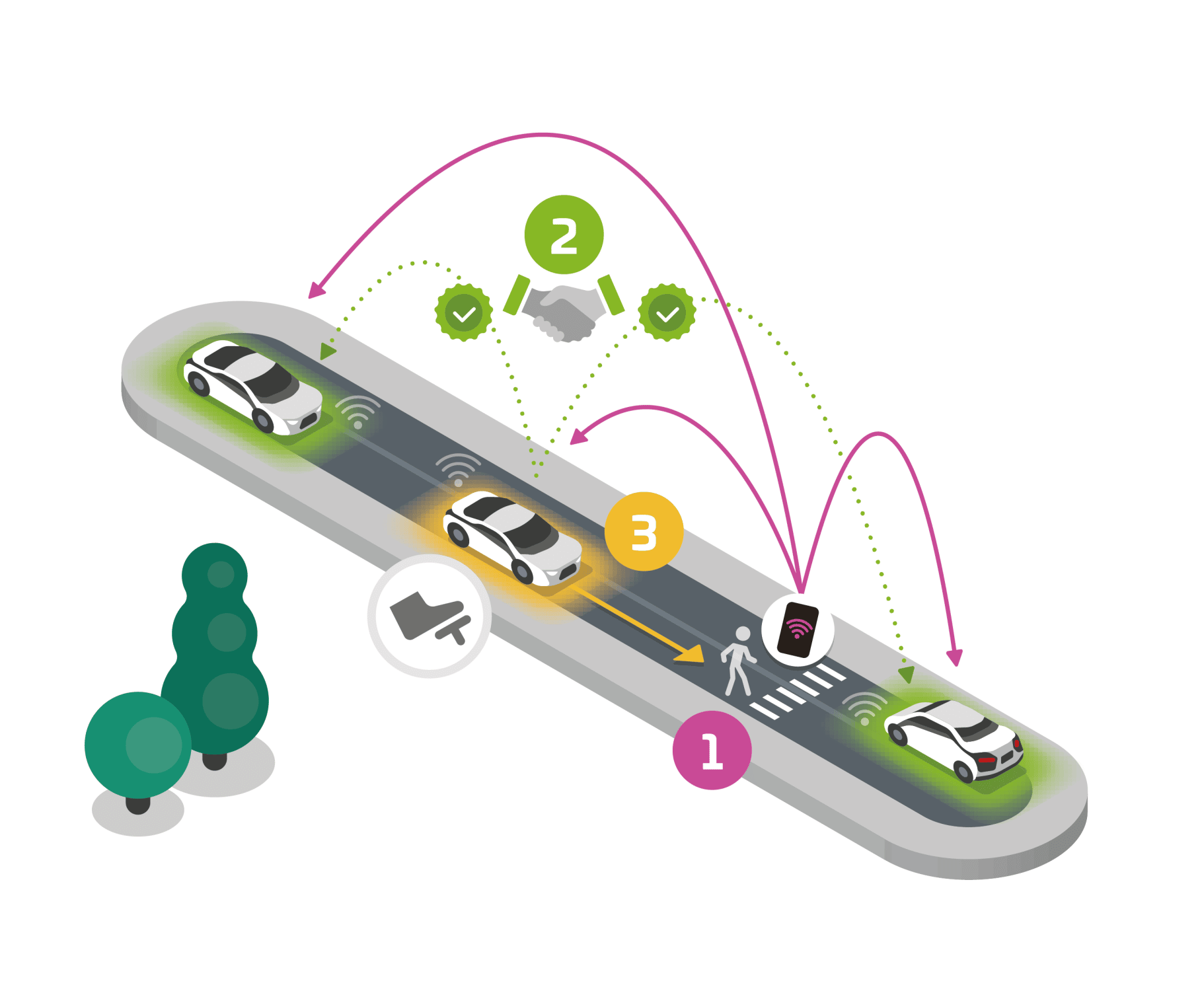
Define the next step: accelerate definition of C-V2X based on 5G-V2X or future LTE enhancements
5GAA intends to develop application-level groundwork
for the next-generation services (based on 3GPP Rel-16)
with advanced use cases involving complex message
interactions for assisted, autonomous (Level 1 – Level 5)
and automated driving (supported by infrastructure).
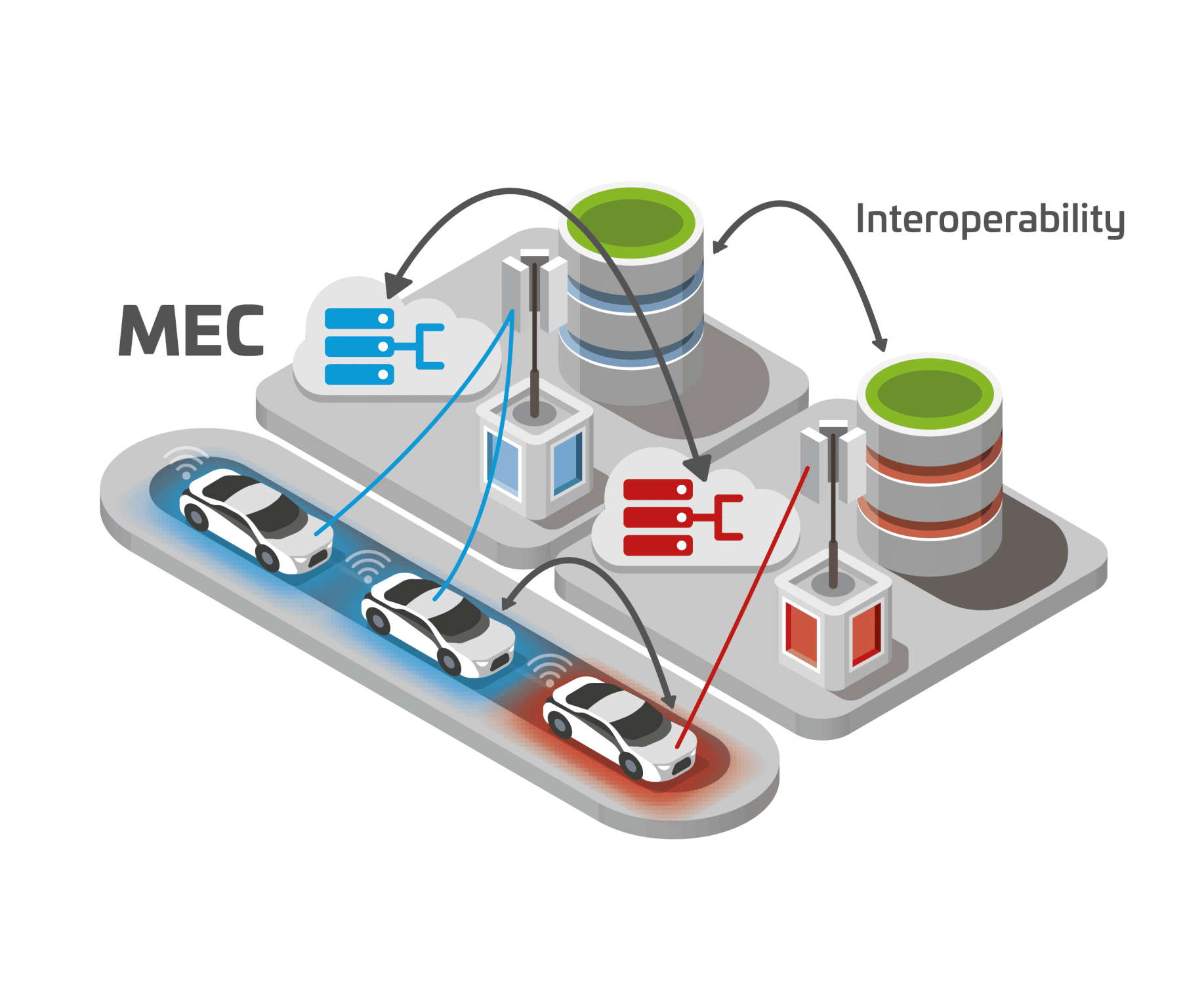
MEC technology to support automotive services in multi-OEM, multi-MNO, multi-vendor environments (MEC4AUTO)
Edge computing offers cloud computing capabilities at the edge of the network. 5GAA considers Edge computing as one of the key supporting technologies for many V2X services for connected and automated driving.
However, despite the many remaining challenges, 5GAA’s ongoing Work Item aims to demonstrate the use of MEC technology for automotive services e.g. in multi-MNO, multi-OEM, multi-MEC system environments.
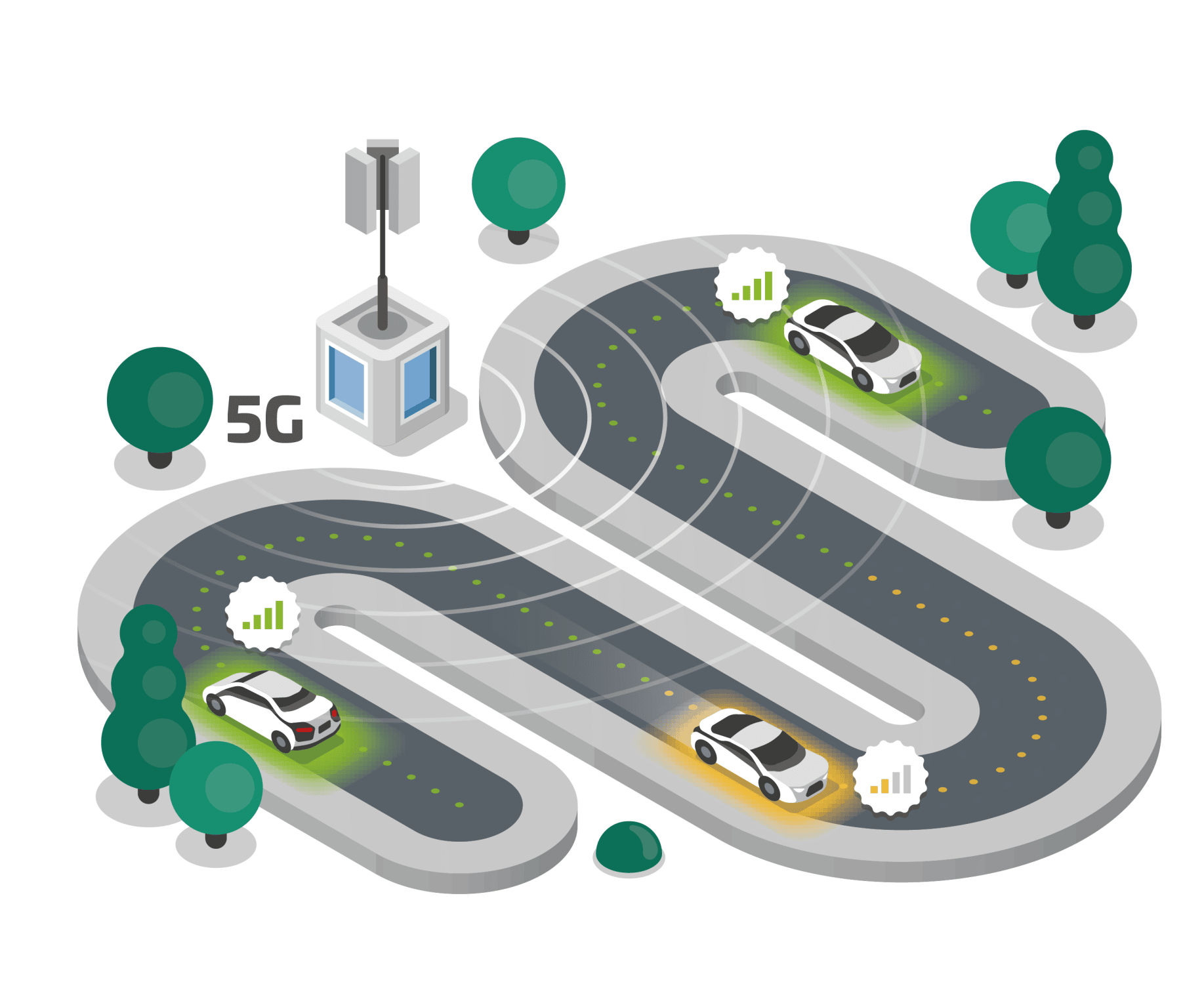
Predictive quality of service (QoS): using 5G network data analytics to enable proactive C-V2X adaptation
The study on E2E Network Slicing and Predictive QoS described an evolved QoS framework for C-V2X in 5G, called predictive QoS, which can be enable by network slicing, multi-access edge computing, and machine learning.
The enhanced C-V2X study describes how LTE-V2X and 5G-V2X will eventually complement each other for the support of different use cases.
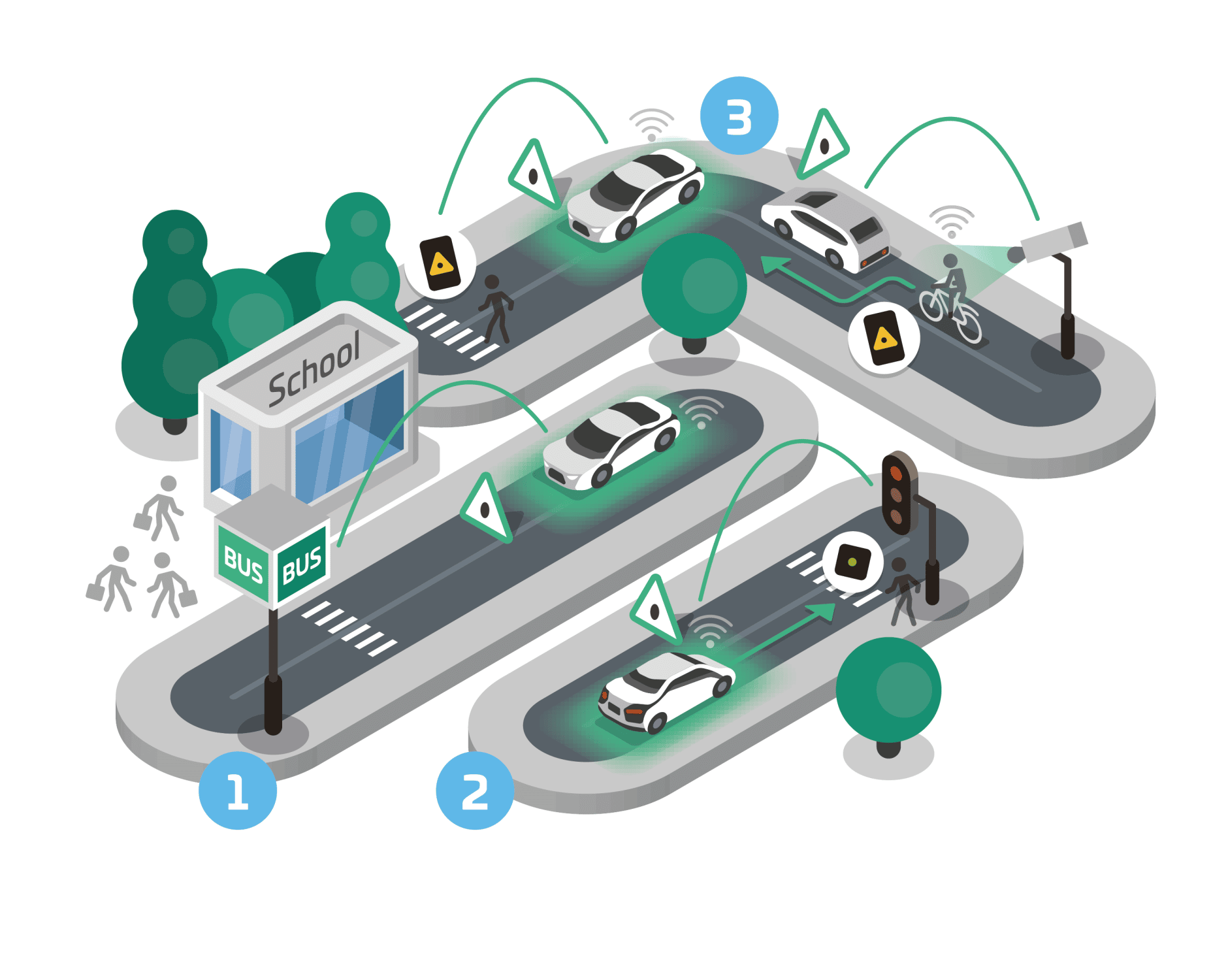
Vulnerable road user using cellular communications (VRU)
Despite technological progress and advanced safety features, VRUs still represent a large portion of road fatalities and severe injuries.
5GAA has been working on a VRU protection roadmap including use case definition, technical enablers and advanced protocols evaluation as well as a go-to-market and standardisation strategy.
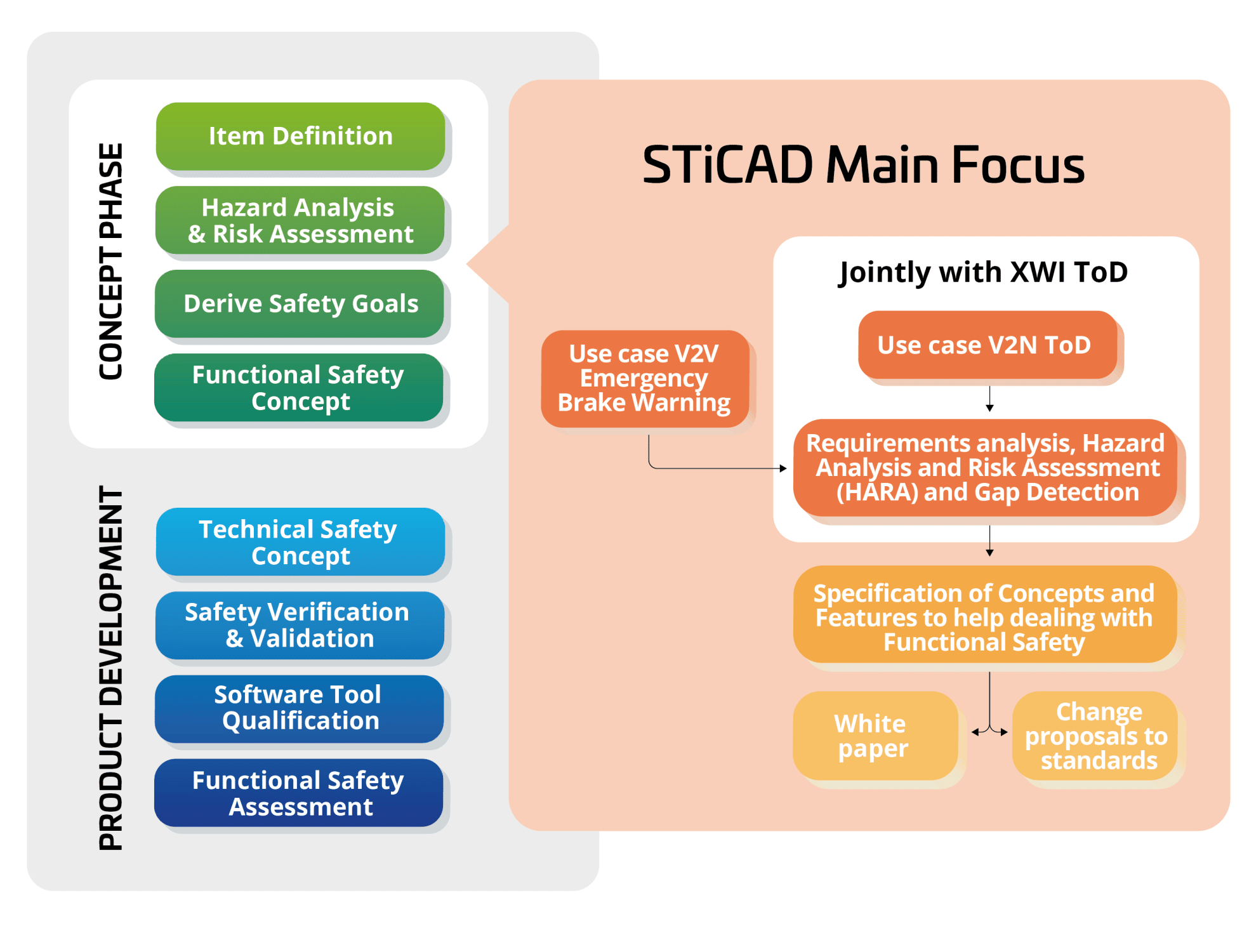
Safety treatment in connected automated driving functions (STiCAD)
More and more driver assistance functionalities, especially for automated driving, are using connectivity. When related to safety, failure of these functionalities might lead to severe danger for passengers.
GAA has been working on identifying the needs and possibilities to define appropriate requirements for connected functions to ensure a high level of functional safety.
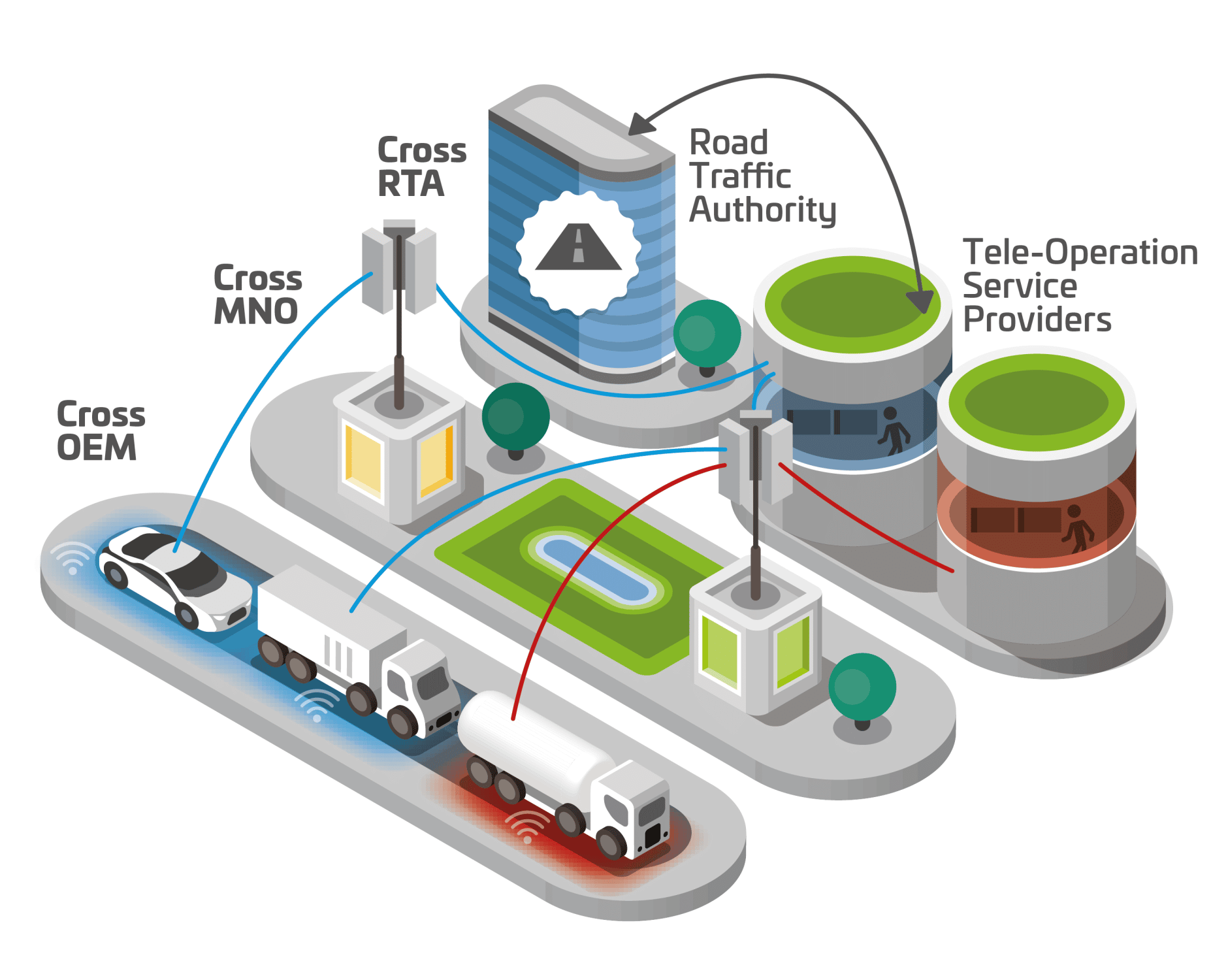
Requirements and architecture for tele-operated driving (ToD)
Tele-operation of vehicles after an incident or in difficult situations (including parking) is widely considered as a high-potential V2X service. Prior to its widescale commercial implementation, functional and architectural requirements still need to be clarified from a technical and regulatory perspective, particularly in multi-OEM, multi-MNO, and multi-Road Traffic Authority (RTA) environments.
5GAA is studying the requirements and framework needed for automated vehicle operation (tele-operation) covering the possible interfaces and stakeholders.
Our Roadmap for Advanced Driving Use Cases and Connectivity Technologies

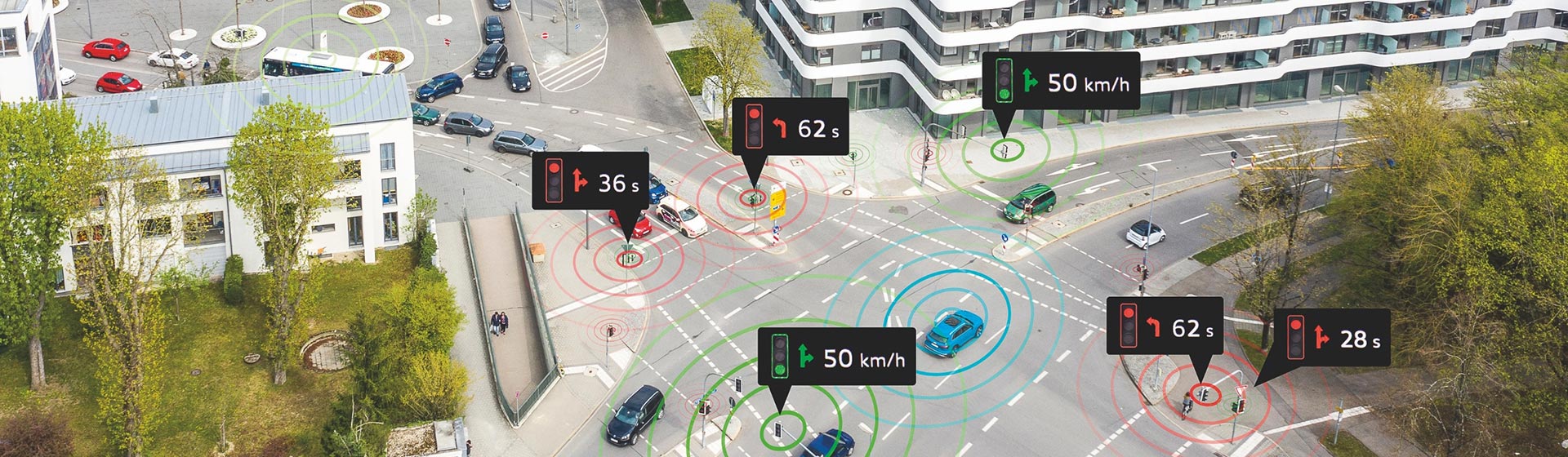
Connected mobility
C-V2X in action
Immerse yourself in the possibilities
The C-V2X technology revolutionises the mobility ecosystem and how drivers interact with the world. It is essential to redefine transportation by providing real-time, highly reliable, and actionable information flows to enable safety, mobility and environmental applications.
5GAA established C-V2X as the critical technology to achieve the level of connectivity required for V2X communication and to be a disruptive force in the automotive market.
C-V2X Testing and Deployment
Following extensive validation testing, off-the-shelf LTE-V2X chipsets, modules, On-Board Units (OBU) and RSU (Roadside Units) have been globally available from multiple vendors since 2018.
These devices feature LTE-V2X direct communications (PC5) and LTE-V2X mobile network communications (Uu). The latest generation of devices features 5G-V2X mobile network communications (Uu) based on 3GPP Release 15.
5GAA regularly compiles an overview of the C-V2X Devices, which we understand are already publicly available on the market (the latest issue in November 2021). This overview is based on publicly available information and does not necessarily include factory-fit telematics/V2X boxes directly under contract with automakers.
The start of in-vehicle commercial deployment (i.e. type-approved vehicles) has begun in 2020-2021. A significant testing schedule is already underway for 5G-V2X, the next generation for cellular technology-based communications solutions, with more than 20 trials and early deployments globally.

Europe
Since 2010, the Directive on Intelligent Transport Systems (ITS) regulates the framework for the deployment of these systems in the field of road transport and for interfaces with other modes of transport. In December 2021, the European Commission published a proposal to amend the ITS Directive. The proposal was reviewed by the European co-legislators at the end of 2022 and adopted in October 2023. The revised Directive aims to take account of technological developments including connected and automated mobility, on-demand mobility applications and multimodal transport.
European administrations have designated the bands 5855-5875 MHz and 5875-5925 MHz – for use by road ITS as specified. As is common practice in Europe, the spectrum is designated on a technology neutral basis.
2021-2027: The Connected Europe Facility (CEF) proposes 5G infrastructure along connected and automated mobility corridors. This will see a fast ramp-up of 5G network deployment along main transport paths and the private sector, with support from the CEF.

United States
In November 2020 the US Federal Communications Commission (FCC) published its 5.9 GHz ruling which points to C-V2X as technology of choice, among the following lines:
• Allows C-V2X in upper 30 MHz after an expedited waiver process
• DSRC will move to lower 10 MHz until the end of the phasing-out period (one year from the effective date of the Report & Order)
• FCC puts a spotlight on OEMs to bring V2X to the finish line
In December 2021, industry and state DOTs submitted a join request for a waiver to deploy C-V2X in upper MHz of the 5.9 GHz band; in April 2023, the FCC decided to permit initial deployments.
In August 2024, the U.S. Department of Transportation released it V2X National Deployment Plan, outlining a roadmap to accelerate the adoption of V2X technology for enhanced road safety. Developed in consultation with 5GAA and other stakeholders, the plan focuses on ensuring interoperability, encouraging investment, and prioritising privacy, and sets short-, medium-, and long-term goals to achieve widespread deployment.
In November 2024, the FCC announced final spectrum rules allowing in-vehicle and roadside units to operate Cellular-Vehicle-to-Everything (C-V2X) technology in the 5.9 GHz spectrum dedicated to ITS, and providing a two-year timeline for sunsetting the use of existing Dedicated Short Range Communications (DSRC) based technology.

China
China was the first country to have a national strategy for the Internet of Vehicles (IoV). To demonstrate the potential benefits of connected and intelligent highways and urban roads, more than 90 cities have already partnered with local wireless network operators to deploy RSUs and China has opened up over 5.000km of roads for intelligent V2X pilot demonstration.
In 2019, 13 OEMs announced mass production of C-V2X cars as of 2020. As of 2022, there are at least 12 C-V2X equipped vehicle models already launched in China.
The Ministry of Industry and Information Technology also established dedicates C-V2X spectrum in the 5905-5925 MHz band.
In 2024, the Chinese government launched a pilot project of “Vehicle-Road-Cloud Integration” Application for Intelligent Connected Vehicles. In Jully 2024, the final list of list of 20 cities was determined. The project will be implemented until 2026.

South Korea
The South Korean Government released an updated C-ITS plan in August 2021, including a plan to deploy dual mode RSUs on a trial target area of 2,400km express highway for pre-commercial service in 2023.
In South Korea, 70 MHz is allocated as ITS spectrum in the 5.9 GHz band. In March 2022, the Ministry of Science & ICT (MSIT) released the following spectrum policy for the 5.9 GHz ITS band.
- 5855-5875 (20 MHz) – LTE-V2X
- 5875-5895 (20 MHz) – Guard and Experiment band
- 5895-5925 (30 MHz) – DSRC
In December 2023, South Korea selected Cellular-Vehicle-to-Everything (C-V2X) direct communications as its technology of choice, complimenting C-V2X mobile network communications to offer a synergetic platform for connected mobility.
Following this decision, in June 2024, the Korean Ministry of Science & ICT (MSIT) released the final technical regulation standard.
- 5855-5875 (20 MHz)- LTE-V2X
- 5875-5925 (50 MHz)- Reserved for future study
- DSRC should be turned off by June 2027.

Japan
In its 2020 revisions of the Frequency Action Plan, Japan’s Ministry of Internal Affairs and Communications (MIC) developed a tangible plan toward the opening of 5.9 GHz for ITS by 2023. In 2023, the Ministry of Internal Affairs and Communications released its Frequency Reorganisation Plan, which assigns the 5.9 GHz spectrum to V2X for next-generation ITS.
This followed various studies conducted in Japan (such as the Cross-Ministerial Strategic Innovation Promotion Programme’s (SIP) study on use cases for Cooperative Driving Automation), which identified new spectrum as a requirement for automated driving.
In 2024, the Japanese government initiated a new trial for the 5.9 GHz band, focusing on an automated truck demonstration experiment on the Shin-Tomei Expressway. Building on the results of this trial, the government plans to begin standardization of 5.9 GHz V2X communication in 2026, with the goal of achieving practical implementation by 2030.

India
Over recent years, India has witnessed increasing activities related to V2X. These include updated traffic management system standards introduced by the National Highways Authority of India (NHAI) and the recommendation by the Indian government to include V2X in the Bharat NCAP. Moreover, in December 2023, the Telecommunications Standards Development Society of India (TSDSI) organized a workshop titled “Autonomous Road Transportation for Indian Scenarios.” Where they explored the global perspective on Connected Vehicles and Autonomous V2X use cases, India’s vision for Connected Autonomous V2X, and the challenges, opportunities, and readiness of the country in adopting these technologies.
The Ministry of Road Transport and Highways is actively considering the use of advanced technologies such as 5G and C-V2X to reduce road accidents.
In October 2023, the Indian Government’s Telecommunication Engineering Centre (TEC) published a report endorsing C-V2X technology. In October 2024, TEC established a dedicated Task Force to drive the development and implementation of Intelligent Transportation Systems (ITS) across India.
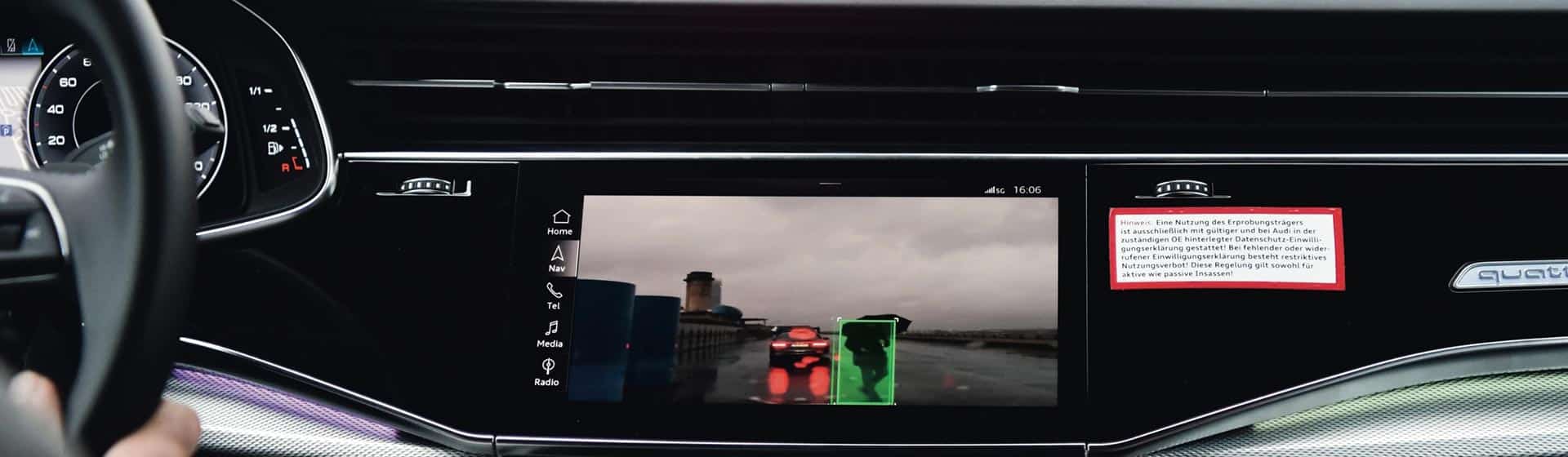
Connected Mobility
C-V2X explained
Cellular Vehicle-to-Everything, or C-V2X, is a connected mobility platform that allows vehicles to interact with their surroundings, such as other vehicles, cyclists, pedestrians, road infrastructure, or mobile networks.
To enable connectivity within the broader transport ecosystem, C-V2X uses two complementary transmission modes.
First, direct communications (PC5) works independently of cellular networks and allows vehicles to communicate with other road users (cyclists, pedestrians or other vehicles). Second, network communications (Uu) leverages conventional mobile networks to enable vehicles to receive real-time information about road conditions and local traffic.
By connecting individual vehicles and enabling the development of cooperative intelligent transport systems that reduce congestion and pollution, C-V2X can transform how we look at traffic information to enhance travel and increase road safety.
Leading the new era
of mobility
C-V2X continually evolves over multiple releases in 3GPP. Cellular-V2X (C-V2X) is the umbrella term which encapsulates all 3GPP V2X technologies, including both direct (PC5) and mobile network communications (Uu).
A major milestone was achieved in 2017 by completing LTE-V2X in Release 14, including both direct and mobile network communications delivering basic safety use cases. In 2020, 5G-V2X was completed in Release 16, also combining direct and mobile network communications to enable advanced and automated driving use cases.
Who is 3GPP?
3GPP is a worldwide Standardisation Development Organisation (SDO) developing standards for the different generations of mobile networks: GSM (2G), UMTS (3G), LTE (4G) and 5G, targeting a wide range of consumer and industry applications. When applied in a vehicle connectivity context the acronym V2X (vehicle-to-everything) is added.
C-V2X in detail
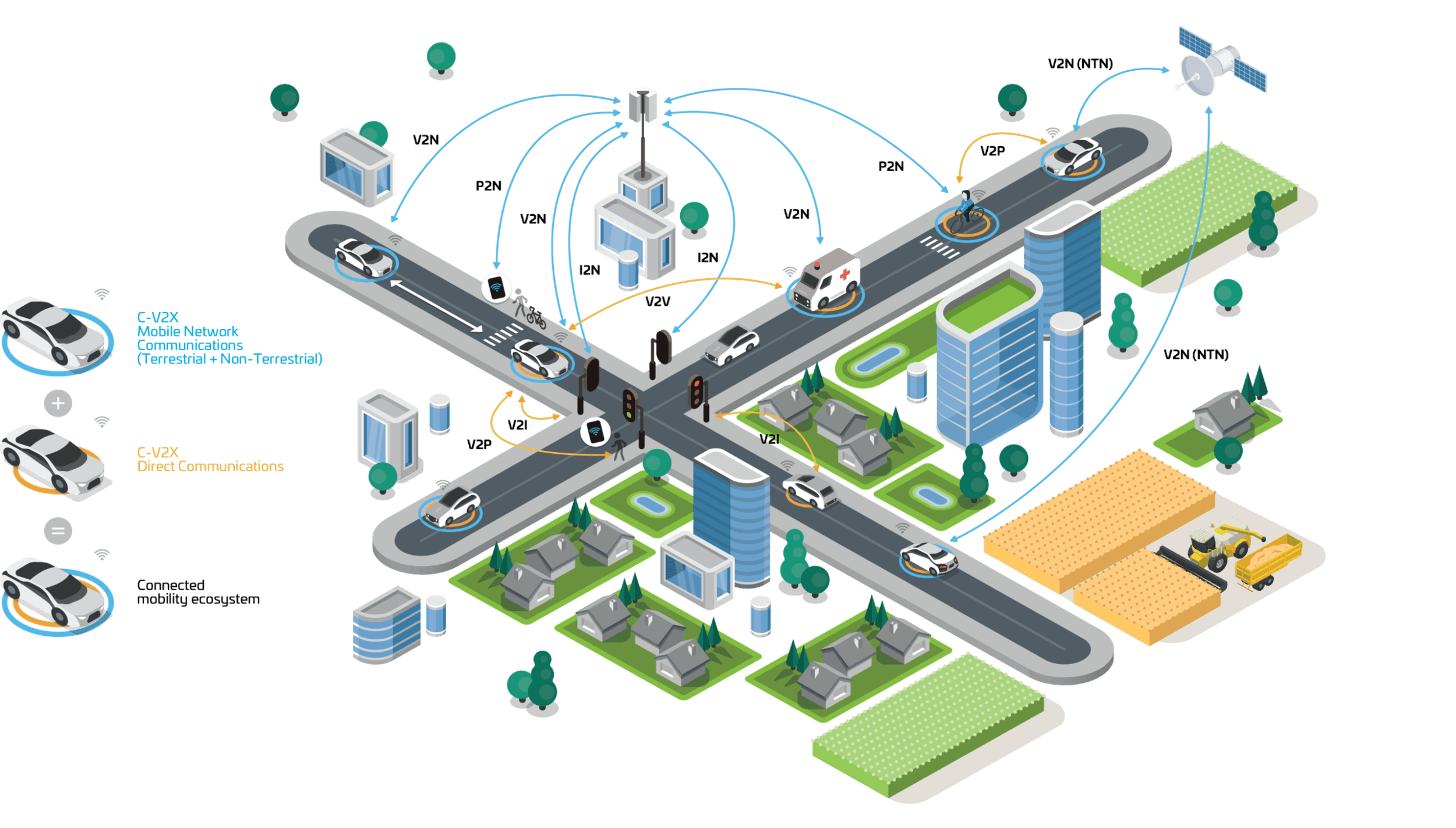
C-V2X provides one unified solution for V2V (vehicle-to-vehicle), V2I (vehicle-to-infrastructure), and V2P (vehicle-to pedestrian) operation with V2N (vehicle-to-network) by leveraging existing cellular network infrastructure.
- Device-to-device [1] is Vehicle-to-Vehicle (V2V), Vehicle-to-(Roadway) Infrastructure (V2I) and Vehicle-to-Pedestrian (V2P) direct communication without necessarily relying on network involvement for scheduling.
- Device-to-cell tower is another communications link that enables network resources and scheduling and utilises existing operator infrastructure. Device-to-cell tower communications constitute at least part of the V2I proposition and are essential to end-to-end solutions.
- Device-to-network is the V2N solution using traditional cellular links to enable cloud services to be part and parcel of the end-to-end solution.
In the device-to-device mode (V2V, V2I, V2P) operation, C-V2X does not necessarily require any network infrastructure. It can operate without a SIM, without network assistance and uses GNSS as its primary time synchronisation source.
C-V2X also supports V2N applications using existing cellular networks where other voices and data communications occur. V2N would deliver network assistance and commercial services requiring the involvement of a Mobile Network Operator (MNO).
Collectively, the transmission modes of shorter-range direct communications (V2V, V2I, V2P) and longer-range network-based communications (V2N) comprise what we call Cellular-V2X[2].
[1] Relies on the PC5 interface specified by 3GPP for device-to-device operation.
[2] See 3GPP TR 22.885 Study on LTE Support for Vehicle to Everything (V2X) Services.

Work Items
Completed Work Items – 2025
Objective:
- The White Paper introduces a dynamic trust assessment framework centred on Actual Trustworthiness Level and Required Trustworthiness Level – metrics that quantify the residual uncertainty about whether external data or system behavior can be trusted based on available evidence and how much trust is needed to meet the operational and safety requirements of the current context.
Objective:
- This second Technical Report edition provides an updated set of Use Case requirements, and a new evaluation methodology review for deployment potential using Mobile Edge Computing (MEC) infra-structure. The work is based on Use Cases (UC) and requirements developed by 5G Automotive Association’s Work Group 1 (WG1) and other organisations, such as the European Telecommunications Standards Institute (ETSI) MEC and China’s IMT 2020 PG.The newly introduced evaluation methodology presented in this TR is examined through discussion of examples and best practices. The aim of this approach is to help OEM’s better evaluate how/when to deploy vehicle features on-board, in MEC, or in a central cloud.
Objective:
- Currently, for V2X direct communication, there is no available common policy (certificate policy for Public Key Infrastructure, or PKI, operators) for Security Credential Management System (SCMS) in the U.S. or Canada.A common Certificate Policy (CP) would help facilitate an ecosystem supporting interoperability and shared trust for V2X direct communication. The Certificate Policy Proposal contributing to this Work Item (WI) evolved into a Technical Report (TR) that develops a clear CP leveraging global best practices for security PKI and practical experience securing V2X direct communication, as well as common processes to facilitate an approach to SCMS.
For V2X mobile network communication, certificates are needed to authenticate interconnected backend systems and to protect communication between the systems. This Technical Report also elaborates on how to handle those certificates.
Objective:
- Provide an overview of how security, privacy, and data quality are addressed for C-V2X using mobile network and backend communications, also known as Vehicle-to-Network-to-Everything (V2N2X) solutions.
Objectives:
- Describe an ecosystem for stakeholders on how to realise various V2X applications and use cases (UCs), using cellular network communications in combination with information sharing structures between backend systems.
- Clarify the different implementation options of the V2X application in a vehicle and their related implications.
- The report complements the V2N2X business perspectives in the 5GAA white paper ‘Road traffic operation in a digital age’ and the technical report ‘Business Perspectives on Vehicle-to-Network-to-Everything (V2N2X) Deployments’.
Objectives:
- The Work Item “Study on Integrated Sensing and Communication for C-V2X Application” aims to discuss the integration of sensing and communication systems into one system from an automotive perspective. The Work Item aims to identify key features relevant for the realization of the selected automotive use cases. The Technical Report outlines the objectives and goals of the work item, implementation descriptions of automotive use cases with ISAC and key technology trends to facilitate the application of ISAC in C-V2X scenarios. The objectives of the work item are thus:
Analysis of ISAC use cases and ISAC concept development
-
- Identify applicable ISAC use cases for connected mobility from 5GAA, academia, standards organizations (SDO) such as 3GPP SA1, etc.
-
- Define criteria/rationales to select a subset of use cases.
-
- Update use cases to identify the value and impact of ISAC technologies.
-
- Derive sensing requirements for selected use cases.
-
- Establish quantitative general metrics to evaluate and measure the performance of ISAC solutions to guide research and standardization.
-
- Describe an ISAC concept based on existing technologies in the automotive sector/field.
Study possible ISAC technology trends
-
- Do state-of-the-art study of the evolution and technology trends of new ISAC features in research and SDOs (e.g. 3GPP, ETSI) and analyze the potential impact on both communication and sensing systems from the automotive
perspective.
- Do state-of-the-art study of the evolution and technology trends of new ISAC features in research and SDOs (e.g. 3GPP, ETSI) and analyze the potential impact on both communication and sensing systems from the automotive
-
- Analyze ISAC technology features relevant for the identified automotive use cases
-
Objective:
- This Technical Report (TR) covers Vehicle-to-Everything (V2X) developments in China from 2022 to 2024. The TR explores ‘C-V2X policies and regulations in China’, ‘C-V2X standardisation in China’, and ‘C-V2X pilot and demonstration areas in China’. The results and conclusions of this report will effectively reinforce overall comprehension by 5GAA members of the state of play of V2X in China, and then provide more effective C-V2X solutions, which will affect the global development of the Internet of Vehicles.
Objective:
- As automated driving increasingly relies on connectivity, ensuring trusted information exchange is critical for functional safety. This 5GAA W hite Paper on Safety Treatment in Connected and Automated Driving (STiCAD II) builds on the initial STiCAD I guidelines, addressing open challenges in applying safety treatment to V2X-enabled automated driving functions. It explores use cases requiring safety treatment, introduces the concept of mutual trust in V2X communications, and examines potential standardisation contributions from 5GAA.
Objective:
- The 5GAA Technical Report on Safety Treatment in Connected and Automated Driving (STiCAD II) documents the latest findings on enhancing safety in V2X-enabled automated driving. Building on the first STiCAD work item, this report explores additional use cases requiring safety treatment, such as sensor sharing and automated valet parking, and introduces a simplified functional safety analysis approach. A key focus is the mutual trust concept, covering technical, organisational, and certification aspects essential for reliable V2X communication. The report also examines potential standardisation contributions and network reliability enhancements.
Objective:
- The 5GAA Technical Report on Automated Valet Parking (AVP) Type-2 outlines the technological framework and implementation details for driverless parking systems. It explores the role of Vehicle-to-Everything (V2X) communication, cellular public networks, Stand-alone Non-Public Networks (SNPN), and PC5 Direct Communication in enabling seamless and secure AVP operations. Key aspects include system architecture, interoperability, security, and deployment considerations. The report emphasises standardisation to ensure cross-vendor compatibility and provides recommendations for optimising network performance. Serving as a reference for automotive and telecommunications stakeholders, it offers actionable insights into scaling AVP solutions while addressing critical safety and operational challenges.
Objective:
- This updated document series from the 5G Automotive Association (5GAA) provides a comprehensive framework for defining and analysing C-V2X use cases and their associated Service Level Requirements (SLRs). It builds upon previous work, refining methodologies for describing use case scenarios, considering factors like road environments and involved actors.
Published in three volumes, each of them includes a curated set of C-V2X use cases, respectively detailed with specific SLRs. These use cases serve as a valuable resource for 5GAA work groups, guiding the development of C-V2X solutions, informing standardisation efforts, and supporting the creation of robust business cases for deployment.
Completed Work Items – 2024
Objectives:
- Explore use cases, system requirements, and deployment options for integrating Vehicle-to-Everything (V2X) communication technologies with infrastructure sensors.
- Outline a framework for developing interoperable, standardised solutions that can operate efficiently within existing Intelligent Transportation System (ITS) spectrums.
Objective:
- Provide an update of 5GAA’s vision for the global deployment of smarter, safer and more sustainable mobility and transportation services.
Objectives:
- Provide the state of the art including demonstrations and market status, regulation, and safety-related aspect regarding uncrewed ground robots (UGRs) as well as common analysis and system/component requirements for UGRs.
- Show the methods of communication between UGRs and road users in view of existing gaps in ITS standards, to identify a way forward to incorporate UGRs in future standards.
Objective:
- Outline a vision for integrating a Non-Terrestrial Network (NTN) connectivity layer as a complement to Terrestrial Networks (TN), enhancing coverage and services for connected vehicles.
Objectives:
- Build on previous work in 5GAA on the topic of VRUs, focussing on co-existence and interoperability between different companies’ solutions.
- Previous showcases and demonstrations have shown the functionality and safety benefits of VRU protection solutions, whereas the objective of VRU-DEMO is to show how these solutions are able to interact with each other.
Objective:
- Explore how to manage misbehaviour in Vehicle-to-Everything (V2X) communication systems, where vehicles and infrastructure directly exchange information.
Objectives:
- Provide a business perspective on the Vehicle-to-Network-to-Everything (V2N2X) market, covering market value, stakeholder needs, market growth drivers, and business models observed in various deployments.
- The report complements the high-level V2N2X architecture described in the 5GAA white paper ‘Road traffic operation in a digital age’ and the technical report ‘Vehicle-to-Network-to-Everything (V2N2X) Communications; Architecture, Solution Blueprint, and Use Case Implementation Examples.’
Objectives:
- Describe an ecosystem for stakeholders on how to realise various V2X applications and use cases (UCs), using cellular network communications in combination with information sharing structures between backend systems.
- Clarify the different implementation options of the V2X application in a vehicle and their related implications.
- The report complements the V2N2X business perspectives in the 5GAA white paper ‘Road traffic operation in a digital age’ and the technical report ‘Business Perspectives on Vehicle-to-Network-to-Everything (V2N2X) Deployments’.
Objective:
- Propose a framework for trust assessment within CAVs by defining key terms related to trust and trustworthiness, establishing a foundation for building trust between these vehicles and creating a taxonomy for classifying different trust relationships.
Objectives:
- Develop a methodology specifically for testing vehicular communication antennas and provide validation measures that account for the unique form factors and characteristics of each vehicle.
- This document is an updated version of the Vehicular Antenna Test Methodology technical report published by 5GAA in 2021, available here.
Objectives:
- Reflect the automotive and connectivity industries agreement on spectrum allocation for ITS services in the 5.9 GHz band in Europe.
- This 5GAA position paper also takes into account the updates from ETSI and CEPT and proposes a deployment band configuration for road-ITS in the 5.9 GHz band.
Objectives:
- Propose a transformative approach for automotive stakeholders, emphasizing scalable digital data exchange and a federated architecture to manage road traffic information efficiently.
- Recommend a National Roadway Digital Strategy, federated information-sharing structures, and aligned investments.
Objective:
- Provide an overview of how security, privacy, and data quality are addressed for C-V2X using mobile network and backend communications, also known as Vehicle-to-Network-to-Everything (V2N2X) solutions.
Objective:
- The overview of cellular vehicle-to-everything (C-V2X) devices provides a fresh look at the devices currently available on the market or nearing release to capture the evolving C-V2X device landscape.
Completed Work Items – 2023
Objectives:
- Work with the Connected Motorcycle Consortium (CMC) to identify potential C-V2X technology solutions for
- use cases for powered two-wheelers, focusing on safety aspects
- This includes use cases enabled by external connectivity or sensors but also covers use cases that may profit or be enabled by the presence of external computing power, representing an attractive potential market even with low V2X penetration.
Objectives:
- Identify and evaluate a selection of evolving and emerging technologies for positioning in line with the 5GAA roadmap for use automotive use cases.
- Perform a gap analysis based on automotive use cases concerning selected technologies and provide feedback to relevant SDOs.
Objectives:
- Cover a broad range of topics, ranging from the analysis of MEC-relevant use cases and requirements, both from a technical and business perspective, the collaboration with SDOs and industry groups (GSMA), the definition of a reference architecture with related deployment scenarios, an early study on security and privacy aspects, and the drafting of a plan for future experimental activities on MEC for automotive services, including public demos.
Objective:
- Highlight the vast array of new business opportunities that 5G will enable for the connected mobility ecosystem by moving the discussion beyond safety and automated driving to other innovative solutions and customer experiences.
Objective:
- Consider realistic evaluation assumptions based on a common understanding between the automotive industry and 5G-V2X technology vendors.
Objectives:
- Address the issue of trustworthiness in relation to position information exchanged in the context of V2X communication(how much trust the ITS station can place on the received V2X message containing the positioning information).
- Provide an overview of the current standards related to positioning, including the integrity of the position and confidence levels, and review the definitions and metrics used so far.
Objective:
- Develop and socialise guidance documents on C-V2X direct communications RSU deployment in the USA with a focus on Day 1 (messages, minimum performance, interoperability and certification) to foster real-world infrastructure deployments.
Objectives:
- Accelerate the understanding and adoption of VRU protection services enabled by C-V2X to meet the 5GAA-proposed roadmap for deploying those services.
- This objective is addressed by experimentation and demonstrating existing technology and standards. Exploiting and analysing the results of the experiments and demonstrations enabled an assessment of the existing standards and potential standardisation gaps, laying the ground for the mass deployment of VRU protection services.
Completed Work Items – 2022
Objectives:
- Stimulate auto industry awareness in Conformity Assessment (CA) and conduct a study of current CA schemes being developed by global industry organizations.
- Develop a framework for a harmonized conformance assessment for PC5 applicable to both roadside units and on-board units and attain support from global industry bodies and stakeholders
Objectives:
- Define use cases and align the Use Case Roadmap for mass-market deployment of advanced driving use cases, including their technology and spectrum requirements.
Objectives:
- Analyze the feasibility of distributed vehicle antennas from an implementation perspective and develop measurement strategies for the analysis.
- Analyze the specification impact and the potential necessary changes, and provide output to relevant standardization organizations for possible requirements recommendations.
Objectives:
- Secure consumer acceptance and trust in V2X technologies, and perform lawful processing of data while preserving system efficiency to deliver upon the benefits of both basic and advanced V2X services.
Objectives:
- Produce a report which describes the actions which 5GAA and its members would need to take to ensure that relevant ETSI and CEPT deliverables are created as needed to support the 5GAA C-V2X Roadmap.
Objectives:
- Provide awareness of the current state of misbehaviour developments in standards developing organizations, and propose action items to fill the existing gaps.
Objectives:
- Continue incubation of new technical enablers, both use case specific and use case agnostic, with the intent of achieving sufficient maturity for transition to standards developing organizations .
- Contribute to SDOs via a Liaison member, bringing up new developments in foundational enablers and protocols for review and consumption by TCs & TFs.
Objectives:
- Review and update the specified methodology for the use case analysis for Predictive Quality of Service (QoS) related Service Level Requirements.
- Develop potential enhancements to interfaces, signalling and architecture of the Predictive Quality of Service (QoS) system, including but not limited to the aspects related to edge cloud and interoperability.
Objectives:
- Detect, propose and evaluate possibilities for telecommunication operators, vendors and further stakeholders to provide what is necessary in order to enable the car OEM to better treat safety.
- Investigate processes and tools used to develop and operate the complete chain of the system, deriving a judgement on feasibility of those processes for safety.
Objectives:
- Monitor the activities of standards developing organizations and provide regular updates of the ecosystem to 5GAA members to enable an early identification of risks and challenges in standardization.
Objectives:
- Introduce tele-operation service provider relevant use cases and scenarios with a V2N2V nature and identify gaps and develop architecture solutions for the development of tele-operated driving services
- Study framework requirements of a tele-operation service between vehicle and remote tele-operation centre in cross-mobile network operators, cross-original equipment manufacturers and cross-authority scenarios.
Objectives:
- Produce a C-V2X tolling white paper using the experience from the technology and cost analysis to show the tolling industry how to find common benefit in C-V2X and the importance of C-V2X in the future Road Digitalization Roadmap.
Objectives:
- Establish use case implementation descriptions realizing use cases’ Service Level Requirements for Automated Valet Parking (AVP), Informative Sensor sharing (HD map Collecting and Sharing), Sensor Sharing for Automated vehicles (AVs) and HD Sensor Sharing for AVs.
- Contribute to overarching application system implementation specifications combining the respective use case implementation specifications, including potential interfaces to network layer and security layer.
Objectives:
- Update and improve use case descriptions and corresponding Service Level Requirements in already published Technical Reports and White Papers.
- Collect, harmonize, align, and integrate new use case descriptions developed in 5GAA and publish the third volume of the Technical Report on C-V2X Use Cases and Service Level Requirements.
Objectives:
- Strengthen 5GAA members’ understanding of the state of play of V2X in China and improve the cooperation with and among Chinese members.
Objectives:
- Publish an industry specification defining a system profile to enable US deployment of interoperable basic safety services using LTE-V2X direct communication over channel 183.
Objectives:
- Establish qualitative general, functional and operational requirements to describe systems for the 5G evolution and beyond that would be useful for automotive solutions.
- Provide a unified 5GAA opinion on evolving technologies and the expected transition path for the automotive ecosystem when moving from current 5G technology to its evolution, including potential threats and opportunities.
Completed Work Items – 2021
Objectives:
- Gather evidence of the environmental benefits associated with C-V2X and assist in developing this evidence into a compelling narrative.
- Assess the benefits of C-V2X deployment (both LTE-V2X and 5G-V2X direct and network-based communications) in terms of emission reduction by 2050 in Europe (and for US and Asia) considering various positive and negative externalities.
Objectives:
- Identify and investigate further potential enhancements needed to provide Predictive Quality of Service (QoS) for C-V2X, investigate interoperability of network slices, and provide relevant recommendations to standards developing organizations (SDOs) and industry forums, e.g. 3GPP, ETSI, ISO and GSMA.
Objectives:
- Demonstrate the use of multi-access edge computing (MEC) technology for automotive services, for example, when two distinct automotive vendors can truly test at least three use cases involving two distinct mobile network operators (MNOs) employing the network infrastructure provided by two distinct infrastructure vendors.
- Increase the flexibility of the current network service architecture, reduce the deployment effort, and increase the interoperability among different stakeholders in the system.
Objectives:
- Describe how existing 3GPP methods reduce and improve service interruption due to network reselection.
- Provide an original equipment manufacturer (OEM) view on current and desired network reselection.
Objective:
- Close the gap of the first spectrum needs study by analyzing several advanced use cases and consider additional items such as security overheads in a second release.
Objective:
- Prepare a report which describes the 5GAA’s 5.9 GHz radio channel deployment options for use by LTE-V2X and NR-V2X across all regions, and describe relevant changes to existing regulatory frameworks – or the introduction of new regulatory frameworks – which may be required across all regions.
Objectives:
- Update Use Case Technical Reports with updated use case descriptions and develop a white paper for the Wave 2 of use cases.
- Provide a new set of use cases with their corresponding service level requirements (SLRs) to be summarized into a new TR.
Objectives:
- Study and describe specific and technology dependent use case implementations that fulfil the service level requirements (SLRs) as defined in the technology agnostic 5GAA use case descriptions.
- Develop corresponding descriptions for three exemplary use cases: Left Turn Assist (LTA), (Electronic) Emergency Brake (light) Warning (EEBL), and Traffic Jam Warning and Route Information.
Objective:
- Define a standardized test method and metrics for vehicular antennas with the dominant emittance toward the outside of the vehicle, focusing on vehicular antennas for telecommunications (2G, 3G, 4G, 5G (< 7.125GHz)), vehicular antennas for direct communication between vehicles to road infrastructure (operating in the designated ITS frequency spectrum (5.9GHz range)), GNSS antennas and 3D-measurements (vehicle-mounted antenna element)
Objectives:
- Focus on positioning method for vehicles and vulnerable road users (VRUs) and study both positioning methods employing cellular signals (5G/LTE/C-V2X) and the positioning methods integrated with other technologies.
- Study the requirements of positioning, build the understanding of positioning system framework, and offer the corresponding technologies according to the requirements and environments.
Completed Work Items – 2020
Objective:
- Analyze V2I deployment costs, including financial, economic and market aspects, to provide guidance to regulators, policymakers and other key stakeholders.
- Analyse options with higher and lower levels of V2I-based infrastructure vs. V2N-based approach.
Objective:
- Define and analyse the automotive use case requirements in terms of Quality of Service (QoS) using network slicing and analyze business value and identify the specific features required to support the automotive use cases that cover IoT and mobile broadband services.
Objectives:
- Define use cases and align the Use Case Roadmap for mass-market deployment of advanced driving use cases, including their technology and spectrum requirements.
Map, assess and contribute to the identification of technical gaps (upper and lower layers, e.g. protocols, Rel. 18 requirements) and forward to relevant standards setting organizations (SSOs).
Objectives:
- Define all necessary details for conducting the first 5GAA C-V2X Plugfest in the first quarter of 2019.
- Define 5GAA requirements and timelines for conducting successive plugfests after the first quarter of 2019.
Objective:
- Facilitate a harmonized industrial evolution and development of enhanced cellular V2X, starting with supporting the basic use cases with the already available C-V2X technologies such as 3GPP Rel-14/15 C-V2X and adopt new technologies for the use cases which cannot be served with current C-V2X
Objectives:
- Establish a lightweight security system for C-V2X/5G-V2X communications by conducting a requirements analysis of regional privacy regulations to establish an overview of regional differences and define requirements for each region.
- Analyze concepts to simplify the architecture and its impact on regional privacy compliance.
Objectives:
- Identify structured and reasonable requirements on mobile networks relevant to spectrum auctioning to accommodate automotive use cases and enable mobile network operator (MNOs) to quantify associated investments.
- Analyze licensed spectrum auctioning frameworks and other incentivizing initiatives, such as infrastructure leasing exceptions, where additional investments required by mobile network operators (MNOs) to fulfill requirements associated to automotive use cases are appropriately recognized.
Objectives:
- Develop application-level groundwork for the next-generation services (Rel-16) with use cases involving complex message interactions for assisted and autonomous (Ll1-Ll5) and automated driving (supported by infrastructure).
- Build prototypes and demonstrate next-generation applications (Rel-16 and further) to gain hands-on experience with some use cases to help stakeholders (OEMs, suppliers, road operators, regulators) understand how 5G NR can implement the concept of connected and automated vehicles for proximal vehicle-to-X coordination and cooperation.
Objective:
- Solicit road operators’ views on their role in the deployment of ITS C-V2X services through a free form questionnaire to determine the road operator willingness to participate directly in future 5GAA discussions or events.
Objectives:
- Develop and demonstrate a phased vulnerable road user (VRU) protection approach by defining a VRU protection roadmap.
- Provide realistic paths for vulnerable road user (VRU) protection using cellular communications, differentiating C-V2X from 802.11p based technologies and set the stage for application of C-V2X to VRU protection.
Objectives:
- Define the application layer reference architecture for the V2X service and recommend the application layer reference architecture of the V2X system.
- Discuss other architecture related subjects to align with the coordinated 5GAA architecture.
Completed Work Items – 2019
Objective:
- Identify, analyze and compare the advantages and disadvantages of V2I deployment using long-range (Uu) mobile networks and RSU (PC5) from a business perspective, reflecting how C-V2X enables synergies with both the transportation and telecommunications infrastructure, which includes leveraging existing mobile network infrastructure for C-ITS.
Objectives:
- Work on the CEPT/ETSI-related activities by extending the ITS safety-related band at 5.9 GHz to allow coexistence of LTE V2X and Urban Rail to coexist with ITS-G5 within the 5,875-5,925 MHz frequency band.
- Clarify ITS “co-frequency coexistence” statements, include future 3GPP releases and evolution, engage the urban rail community, engage with national administrations.
Objectives:
- Develop a trial and interoperability testing framework that defines the deployment scenarios and uses cases, testing methodologies, key performance indicators (KPIs) to be tested.
- Develop a 5GAA trial and interoperability testing strategy to capture the 5GAA testing priorities, including setting up a 5GAA testbed environment and planning multi-partner trials covering the priority test cases.
Objective:
- Prepare input material for the work in ETSI TC ITS to amend the test specification required to use LTE-V2X as the underlying access layer technology.
Objectives:
- Identify and evaluate potential architecture enhancements needed to provide predictable Quality of Service (QoS) for C-V2X in 5G for the automotive industry, utilizing network slicing and edge computing technologies.
- Provide guidelines on the design of Network Slice Templates (NST) for the automotive industry that enable support for different categories of C-V2X use cases and 5GAA requirements.
Objectives:
- Provide an assessment of the deployment roadmap for use cases.
- Establish a mapping between use cases and potential technology candidates, e.g. 3GPP releases, sidelink and/or Uu requirements.
Objectives:
- Define a framework for classifying use cases and requirements, identify prioritized use cases, functional requirements and key performance indicators (KPIs).
- Perform a gap analysis and specify the extended set of prioritized use cases.
Objectives:
- Identify the use cases that benefited from the presence of an application server, and based on the output, explore the V2X application server features and how the application server can be used to perform these use cases.
Completed Work Items – 2018
Objectives:
- Develop consensus on operating models for system implementation, taking into account the various requirements arising from the planned networked transport services.
- Investigate architectural paradigms such as cloud-based solutions, including edge computing aspects, and analyze solutions from the perspective of verification, confidentiality and privacy, identify requirements and key performance indicators (KPIs), and recommend further actions.
Objective:
- Enable the development of a strategy for comprehensive testing, trials, demo pilots, and compliance assessment for V2X using cellular air interface specifications (i.e., including PC5 and Uu).
Objectives:
- Promote C-V2X, including existing (LTE-V2X PC5 and Uu interfaces) and future realizations, as the technology of choice for ITS and promote ITS in 5.9 GHz spectrum in some areas, and interact various regulatory organizations.
- Comment FO: This WI did not have an acronym.
Objectives:
- Promote C-V2X, including its existing (LTE-V2X) and future realizations, as the technology of choice for ITS.
- Promote appropriate availability of radio spectrum for C-V2X where necessary in addition to 5.9 GHz, and promote the use of 5.9 GHz for safety-related ITS over other applications (e.g., RLANs, CBTC).
- Comment FO: This WI did not have an acronym.
Objectives:
- Quantify the future spectrum needs for 5G short-range V2X communications in the context of safety-related ITS spectrum allocation and 5G wide range communications.
- Comment FO: This WI did not have an acronym.
Objectives:
- Develop recorded test procedures to validate various performance and functional requirements of C-V2X technology covering both the laboratory/test bed and the field test environments.
Objectives:
- Quantify future spectrum needs for 5G V2X communications related to ITS spectrum allocation for advanced use cases, including a technology assessment of the amount of radio spectrum needed to meet the key performance criteria related to the low frequency band (e.g. 5.9 GHz) as well as mmWave (e.g. 63–64 GHz) for various advanced ITS applications and a wide-area 4G/5G Uu interface.
- Comment FO: This WI did not have an acronym.
Completed Work Items – 2017
Objective:
- Establish a high-level plan for C-V2X trials in North America, including definition of trial scope and objectives, identification of suitable/preferred trial facilities, and guidance regarding preferred trial participant composition.
Objective:
- Identify existing regional V2X application specifications that have some dependency on specific radio access technologies, such as ITS-G5/11p, and determine how these specifications can be adapted to interoperate with generic radio access technologies and, in particular, with the lower layers of ITS-Cellular specified by 3GPP.
Objective:
- Develop the timeline of major functionalities and milestones describing the expected availability of monetizable items and associated business and/or operational model options.
Objectives:
- Identify sensor data sharing requirements from planned automated driving applications, including architecture options, requirements and implications.
- Conduct a gap analysis of ETSI ITS standards related to existing data objects and complete a technical report outlining the 5GAA framework for sensor data sharing for V2X applications.
Objective:
- Prepare a survey report on finalized, on-going and planned test activities, established testbeds and simulation frameworks.
Objective:
- Compile V2X communication terms and definitions to be used within the 5GAA.
Completed Work Items – 2023
Objectives:
- Work with the Connected Motorcycle Consortium (CMC) to identify potential C-V2X technology solutions for
- use cases for powered two-wheelers, focusing on safety aspects
- This includes use cases enabled by external connectivity or sensors but also covers use cases that may profit or be enabled by the presence of external computing power, representing an attractive potential market even with low V2X penetration.
Objectives:
- Identify and evaluate a selection of evolving and emerging technologies for positioning in line with the 5GAA roadmap for use automotive use cases.
- Perform a gap analysis based on automotive use cases concerning selected technologies and provide feedback to relevant SDOs.
Objectives:
- Cover a broad range of topics, ranging from the analysis of MEC-relevant use cases and requirements, both from a technical and business perspective, the collaboration with SDOs and industry groups (GSMA), the definition of a reference architecture with related deployment scenarios, an early study on security and privacy aspects, and the drafting of a plan for future experimental activities on MEC for automotive services, including public demos.
Objectives:
- Highlight the vast array of new business opportunities that 5G will enable for the connected mobility ecosystem by moving the discussion beyond safety and automated driving to other innovative solutions and customer experiences.
Objectives:
- Address the operational aspects of misbehaviour detection, explicitly looking into remediation classification, misbehaviour classification and misbehaviour remediation.
Objectives:
- Analyse and evaluate the performance of 3GPP NR-V2X sidelink and draw conclusions and recommendations for its operation, including gap analysis covering future releases and engagements with relevant SDOs.
Objectives:
- Address the issue of trustworthiness in relation to position information exchanged in the context of V2X communication(how much trust the ITS station can place on the received V2X message containing the positioning information).
- Provide an overview of the current standards related to positioning, including the integrity of the position and confidence levels, and review the definitions and metrics used so far.
Objectives:
- Develop and socialise guidance documents on C-V2X direct communications RSU deployment in the USA with a focus on Day 1 (messages, minimum performance, interoperability and certification) to foster real-world infrastructure deployments.
Objectives:
- Accelerate the understanding and adoption of VRU protection services enabled by C-V2X to meet the 5GAA-proposed roadmap for deploying those services.
- This objective is addressed by experimentation and demonstrating existing technology and standards. Exploiting and analysing the results of the experiments and demonstrations enabled an assessment of the existing standards and potential standardisation gaps, laying the ground for the mass deployment of VRU protection services.
Completed Work Items – 2022
Objectives:
- Stimulate auto industry awareness in Conformity Assessment (CA) and conduct a study of current CA schemes being developed by global industry organizations.
- Develop a framework for a harmonized conformance assessment for PC5 applicable to both roadside units and on-board units and attain support from global industry bodies and stakeholders
Objectives:
- Define use cases and align the Use Case Roadmap for mass-market deployment of advanced driving use cases, including their technology and spectrum requirements.
Objectives:
- Analyze the feasibility of distributed vehicle antennas from an implementation perspective and develop measurement strategies for the analysis.
- Analyze the specification impact and the potential necessary changes, and provide output to relevant standardization organizations for possible requirements recommendations.
Objectives:
- Secure consumer acceptance and trust in V2X technologies, and perform lawful processing of data while preserving system efficiency to deliver upon the benefits of both basic and advanced V2X services.
Objectives:
- Produce a report which describes the actions which 5GAA and its members would need to take to ensure that relevant ETSI and CEPT deliverables are created as needed to support the 5GAA C-V2X Roadmap.
Objectives:
- Provide awareness of the current state of misbehaviour developments in standards developing organizations, and propose action items to fill the existing gaps.
Objectives:
- Continue incubation of new technical enablers, both use case specific and use case agnostic, with the intent of achieving sufficient maturity for transition to standards developing organizations .
- Contribute to SDOs via a Liaison member, bringing up new developments in foundational enablers and protocols for review and consumption by TCs & TFs.
Objectives:
- Review and update the specified methodology for the use case analysis for Predictive Quality of Service (QoS) related Service Level Requirements.
- Develop potential enhancements to interfaces, signalling and architecture of the Predictive Quality of Service (QoS) system, including but not limited to the aspects related to edge cloud and interoperability.
Objectives:
- Detect, propose and evaluate possibilities for telecommunication operators, vendors and further stakeholders to provide what is necessary in order to enable the car OEM to better treat safety.
- Investigate processes and tools used to develop and operate the complete chain of the system, deriving a judgement on feasibility of those processes for safety.
Objectives:
- Monitor the activities of standards developing organizations and provide regular updates of the ecosystem to 5GAA members to enable an early identification of risks and challenges in standardization.
Objectives:
- Introduce tele-operation service provider relevant use cases and scenarios with a V2N2V nature and identify gaps and develop architecture solutions for the development of tele-operated driving services
- Study framework requirements of a tele-operation service between vehicle and remote tele-operation centre in cross-mobile network operators, cross-original equipment manufacturers and cross-authority scenarios.
Objectives:
- Produce a C-V2X tolling white paper using the experience from the technology and cost analysis to show the tolling industry how to find common benefit in C-V2X and the importance of C-V2X in the future Road Digitalization Roadmap.
Objectives:
- Establish use case implementation descriptions realizing use cases’ Service Level Requirements for Automated Valet Parking (AVP), Informative Sensor sharing (HD map Collecting and Sharing), Sensor Sharing for Automated vehicles (AVs) and HD Sensor Sharing for AVs.
- Contribute to overarching application system implementation specifications combining the respective use case implementation specifications, including potential interfaces to network layer and security layer.
Objectives:
- Update and improve use case descriptions and corresponding Service Level Requirements in already published Technical Reports and White Papers.
- Collect, harmonize, align, and integrate new use case descriptions developed in 5GAA and publish the third volume of the Technical Report on C-V2X Use Cases and Service Level Requirements.
Objectives:
- Strengthen 5GAA members’ understanding of the state of play of V2X in China and improve the cooperation with and among Chinese members.
Objectives:
- Publish an industry specification defining a system profile to enable US deployment of interoperable basic safety services using LTE-V2X direct communication over channel 183.
Objectives:
- Establish qualitative general, functional and operational requirements to describe systems for the 5G evolution and beyond that would be useful for automotive solutions.
- Provide a unified 5GAA opinion on evolving technologies and the expected transition path for the automotive ecosystem when moving from current 5G technology to its evolution, including potential threats and opportunities.
Completed Work Items – 2021
Objectives:
- Gather evidence of the environmental benefits associated with C-V2X and assist in developing this evidence into a compelling narrative.
- Assess the benefits of C-V2X deployment (both LTE-V2X and 5G-V2X direct and network-based communications) in terms of emission reduction by 2050 in Europe (and for US and Asia) considering various positive and negative externalities.
Objectives:
- Identify and investigate further potential enhancements needed to provide Predictive Quality of Service (QoS) for C-V2X, investigate interoperability of network slices, and provide relevant recommendations to standards developing organizations (SDOs) and industry forums, e.g. 3GPP, ETSI, ISO and GSMA.
Objectives:
- Demonstrate the use of multi-access edge computing (MEC) technology for automotive services, for example, when two distinct automotive vendors can truly test at least three use cases involving two distinct mobile network operators (MNOs) employing the network infrastructure provided by two distinct infrastructure vendors.
- Increase the flexibility of the current network service architecture, reduce the deployment effort, and increase the interoperability among different stakeholders in the system.
Objectives:
- Describe how existing 3GPP methods reduce and improve service interruption due to network reselection.
- Provide an original equipment manufacturer (OEM) view on current and desired network reselection.
Objective:
- Close the gap of the first spectrum needs study by analyzing several advanced use cases and consider additional items such as security overheads in a second release.
Objective:
- Prepare a report which describes the 5GAA’s 5.9 GHz radio channel deployment options for use by LTE-V2X and NR-V2X across all regions, and describe relevant changes to existing regulatory frameworks – or the introduction of new regulatory frameworks – which may be required across all regions.
Objectives:
- Update Use Case Technical Reports with updated use case descriptions and develop a white paper for the Wave 2 of use cases.
- Provide a new set of use cases with their corresponding service level requirements (SLRs) to be summarized into a new TR.
Objectives:
- Study and describe specific and technology dependent use case implementations that fulfil the service level requirements (SLRs) as defined in the technology agnostic 5GAA use case descriptions.
- Develop corresponding descriptions for three exemplary use cases: Left Turn Assist (LTA), (Electronic) Emergency Brake (light) Warning (EEBL), and Traffic Jam Warning and Route Information.
Objective:
- Define a standardized test method and metrics for vehicular antennas with the dominant emittance toward the outside of the vehicle, focusing on vehicular antennas for telecommunications (2G, 3G, 4G, 5G (< 7.125GHz)), vehicular antennas for direct communication between vehicles to road infrastructure (operating in the designated ITS frequency spectrum (5.9GHz range)), GNSS antennas and 3D-measurements (vehicle-mounted antenna element)
Objectives:
- Focus on positioning method for vehicles and vulnerable road users (VRUs) and study both positioning methods employing cellular signals (5G/LTE/C-V2X) and the positioning methods integrated with other technologies.
- Study the requirements of positioning, build the understanding of positioning system framework, and offer the corresponding technologies according to the requirements and environments.
Completed Work Items – 2020
Objective:
- Analyze V2I deployment costs, including financial, economic and market aspects, to provide guidance to regulators, policymakers and other key stakeholders.
- Analyse options with higher and lower levels of V2I-based infrastructure vs. V2N-based approach.
Objective:
- Define and analyse the automotive use case requirements in terms of Quality of Service (QoS) using network slicing and analyze business value and identify the specific features required to support the automotive use cases that cover IoT and mobile broadband services.
Objectives:
- Define use cases and align the Use Case Roadmap for mass-market deployment of advanced driving use cases, including their technology and spectrum requirements.
Map, assess and contribute to the identification of technical gaps (upper and lower layers, e.g. protocols, Rel. 18 requirements) and forward to relevant standards setting organizations (SSOs).
Objectives:
- Define all necessary details for conducting the first 5GAA C-V2X Plugfest in the first quarter of 2019.
- Define 5GAA requirements and timelines for conducting successive plugfests after the first quarter of 2019.
Objective:
- Facilitate a harmonized industrial evolution and development of enhanced cellular V2X, starting with supporting the basic use cases with the already available C-V2X technologies such as 3GPP Rel-14/15 C-V2X and adopt new technologies for the use cases which cannot be served with current C-V2X
Objectives:
- Establish a lightweight security system for C-V2X/5G-V2X communications by conducting a requirements analysis of regional privacy regulations to establish an overview of regional differences and define requirements for each region.
- Analyze concepts to simplify the architecture and its impact on regional privacy compliance.
Objectives:
- Identify structured and reasonable requirements on mobile networks relevant to spectrum auctioning to accommodate automotive use cases and enable mobile network operator (MNOs) to quantify associated investments.
- Analyze licensed spectrum auctioning frameworks and other incentivizing initiatives, such as infrastructure leasing exceptions, where additional investments required by mobile network operators (MNOs) to fulfill requirements associated to automotive use cases are appropriately recognized.
Objectives:
- Develop application-level groundwork for the next-generation services (Rel-16) with use cases involving complex message interactions for assisted and autonomous (Ll1-Ll5) and automated driving (supported by infrastructure).
- Build prototypes and demonstrate next-generation applications (Rel-16 and further) to gain hands-on experience with some use cases to help stakeholders (OEMs, suppliers, road operators, regulators) understand how 5G NR can implement the concept of connected and automated vehicles for proximal vehicle-to-X coordination and cooperation.
Objective:
- Solicit road operators’ views on their role in the deployment of ITS C-V2X services through a free form questionnaire to determine the road operator willingness to participate directly in future 5GAA discussions or events.
Objectives:
- Develop and demonstrate a phased vulnerable road user (VRU) protection approach by defining a VRU protection roadmap.
- Provide realistic paths for vulnerable road user (VRU) protection using cellular communications, differentiating C-V2X from 802.11p based technologies and set the stage for application of C-V2X to VRU protection.
Objectives:
- Define the application layer reference architecture for the V2X service and recommend the application layer reference architecture of the V2X system.
- Discuss other architecture related subjects to align with the coordinated 5GAA architecture.
Completed Work Items – 2019
Objective:
- Identify, analyze and compare the advantages and disadvantages of V2I deployment using long-range (Uu) mobile networks and RSU (PC5) from a business perspective, reflecting how C-V2X enables synergies with both the transportation and telecommunications infrastructure, which includes leveraging existing mobile network infrastructure for C-ITS.
Objectives:
- Work on the CEPT/ETSI-related activities by extending the ITS safety-related band at 5.9 GHz to allow coexistence of LTE V2X and Urban Rail to coexist with ITS-G5 within the 5,875-5,925 MHz frequency band.
- Clarify ITS “co-frequency coexistence” statements, include future 3GPP releases and evolution, engage the urban rail community, engage with national administrations.
Objectives:
- Develop a trial and interoperability testing framework that defines the deployment scenarios and uses cases, testing methodologies, key performance indicators (KPIs) to be tested.
- Develop a 5GAA trial and interoperability testing strategy to capture the 5GAA testing priorities, including setting up a 5GAA testbed environment and planning multi-partner trials covering the priority test cases.
Objective:
- Prepare input material for the work in ETSI TC ITS to amend the test specification required to use LTE-V2X as the underlying access layer technology.
Objectives:
- Identify and evaluate potential architecture enhancements needed to provide predictable Quality of Service (QoS) for C-V2X in 5G for the automotive industry, utilizing network slicing and edge computing technologies.
- Provide guidelines on the design of Network Slice Templates (NST) for the automotive industry that enable support for different categories of C-V2X use cases and 5GAA requirements.
Objectives:
- Provide an assessment of the deployment roadmap for use cases.
- Establish a mapping between use cases and potential technology candidates, e.g. 3GPP releases, sidelink and/or Uu requirements.
Objectives:
- Define a framework for classifying use cases and requirements, identify prioritized use cases, functional requirements and key performance indicators (KPIs).
- Perform a gap analysis and specify the extended set of prioritized use cases.
Objectives:
- Identify the use cases that benefited from the presence of an application server, and based on the output, explore the V2X application server features and how the application server can be used to perform these use cases.
Completed Work Items – 2018
Objectives:
- Develop consensus on operating models for system implementation, taking into account the various requirements arising from the planned networked transport services.
- Investigate architectural paradigms such as cloud-based solutions, including edge computing aspects, and analyze solutions from the perspective of verification, confidentiality and privacy, identify requirements and key performance indicators (KPIs), and recommend further actions.
Objective:
- Enable the development of a strategy for comprehensive testing, trials, demo pilots, and compliance assessment for V2X using cellular air interface specifications (i.e., including PC5 and Uu).
Objectives:
- Promote C-V2X, including existing (LTE-V2X PC5 and Uu interfaces) and future realizations, as the technology of choice for ITS and promote ITS in 5.9 GHz spectrum in some areas, and interact various regulatory organizations.
- Comment FO: This WI did not have an acronym.
Objectives:
- Promote C-V2X, including its existing (LTE-V2X) and future realizations, as the technology of choice for ITS.
- Promote appropriate availability of radio spectrum for C-V2X where necessary in addition to 5.9 GHz, and promote the use of 5.9 GHz for safety-related ITS over other applications (e.g., RLANs, CBTC).
- Comment FO: This WI did not have an acronym.
Objectives:
- Quantify the future spectrum needs for 5G short-range V2X communications in the context of safety-related ITS spectrum allocation and 5G wide range communications.
- Comment FO: This WI did not have an acronym.
Objectives:
- Develop recorded test procedures to validate various performance and functional requirements of C-V2X technology covering both the laboratory/test bed and the field test environments.
Objectives:
- Quantify future spectrum needs for 5G V2X communications related to ITS spectrum allocation for advanced use cases, including a technology assessment of the amount of radio spectrum needed to meet the key performance criteria related to the low frequency band (e.g. 5.9 GHz) as well as mmWave (e.g. 63–64 GHz) for various advanced ITS applications and a wide-area 4G/5G Uu interface.
- Comment FO: This WI did not have an acronym.
Completed Work Items – 2017
Objective:
- Establish a high-level plan for C-V2X trials in North America, including definition of trial scope and objectives, identification of suitable/preferred trial facilities, and guidance regarding preferred trial participant composition.
Objective:
- Identify existing regional V2X application specifications that have some dependency on specific radio access technologies, such as ITS-G5/11p, and determine how these specifications can be adapted to interoperate with generic radio access technologies and, in particular, with the lower layers of ITS-Cellular specified by 3GPP.
Objective:
- Develop the timeline of major functionalities and milestones describing the expected availability of monetizable items and associated business and/or operational model options.
Objectives:
- Identify sensor data sharing requirements from planned automated driving applications, including architecture options, requirements and implications.
- Conduct a gap analysis of ETSI ITS standards related to existing data objects and complete a technical report outlining the 5GAA framework for sensor data sharing for V2X applications.
Objective:
- Prepare a survey report on finalized, on-going and planned test activities, established testbeds and simulation frameworks.
Objective:
- Compile V2X communication terms and definitions to be used within the 5GAA.
Active Work Items
This work item will drive the study on the trends and evolution of current technologies. The objectives of the work item consist of:
- Establish qualitative general, functional and operational requirements that would describe systems for the5G evolution and beyond that would be useful for automotive solutions,
- Conduct a SWOT analysis with the automotive industry with respect to evolving technologies in a timeframe of 5, 10 and/or 15 years,
- Providing a unified 5GAA opinion (in the form of a white paper) on evolving technologies and the expected transition path for the Automotive
- Ecosystem when moving from current 5G to its evolution, including the potential threats and opportunities.
This Work Item assesses the required communication technology to support Automated Valet Parking (AVP) as specified by the 5GAA Use Cases T-210023, T-190139 and T-190140 and their respective Service Level Requirements (SLR).
This Work Item assesses the required communication technology to support Automated Valet Parking (AVP) as specified by the 5GAA Use Cases T-210023, T-190139 and T-190140 and their respective Service Level Requirements (SLR).
This Work Item consists of:
- Stimulate Auto Industry awareness in CA
- Study of current CA schemes being developed by global industry organisations
- Develop a framework for harmonized PC5 CA applicable to both RSUs and OBUs and attain support from global industry bodies and stakeholders
This Work Item aims at:
- Create a list of devices and update it every 6 months
- Define KPIs of the Dashboard and the format of the dashboard presentation
- Verify 5GAA’s market predictions
- Ensure legal compliance
- Create the first dashboard for publication
A joint Work Item with the Connected Motorcycle Consortium, this WI will look into CV2X enabled use cases for motorcycles mainly focusing on safety
Definition of all Use Cases and alignment of UC roadmap for mass-market deployment of advanced driving Use Cases, inc. their technology and spectrum requirements.
A comprehensive overview of the privacy and data protection regulatory framework.
A report which describes the actions which 5GAA and its members would need to take in order to ensure that relevant ETSI and CEPT deliverables are created as needed to support the 5GAA C-V2X Roadmap.
Publications
This Work Item consists of:
- Moving toward federated MEC demos/trials (global MEC);
- MEC System interoperability and test framework;
- usage of predictive edge analytics and situation awareness for closed-loop adaptation in multi-MNO and multi-OEM MEC scenarios (synergy and inputs from NESQO,eNESQO,V2XSRA PRESA);
This Work Item aims at discussing attractive selling points for CV2X for both final customers and OEMs beyond the usually discussed ADAS and safety features.
This Work Item:
- Provides awareness of current state of MBD developments in SDOs and trials/demos, and proposes action items to fill the existing gaps.
- Delivers content on: (1) concepts and terms definitions, V2X message stack, (2) overview of related/existing work and gaps, (3) Threat and Risk Assessment (TARA) and requirements for Day-1 applications, (4) determination of application domain-specific mitigation, and (5) legal aspects and recommendation of a strategy.
This Work Item aims at:
- Continue incubation of new technical enablers, both UC specific and agnostic for transition to SDOs.
- Contribute to SDOs via a Liaison member & Individual contributors from member companies will work directly on relevant standards projects on an ongoing basis.
This Work Item consists of:
- Review and update the specified methodology for the UC’ analysis for Predictive QoS related SLRs.
- Study application and system reactions.
- Develop potential enhancements to interfaces, signalling and architecture of the P-QoS system, including but not limited to the aspects related to edge cloud and interoperability.
- Provide input to SDOs.
This Work Item consists of:
- Monitor SDOs activities on and provide regular updates of the ecosystem to 5GAA members. This will enable early identification of risks and challenges in standardisation.
- Prepare contributions by 5GAA to critical SDOs.
- Support WGs and WIs intending to provide inputs to SDOs.
- Support 5GAA messaging in SDO related events.
This Work Item:
- Explore the use of C-V2X to enable electronic toll collection in China (ETC)
- Constructive advice about Investment, Performance Improvement and migration for C-V2X Tolling Implementation in China
- Find common benefits between Road Industries and 5GAA
This Work Item consists of:
- Update White Paper on C-V2X Use Cases: Methodology, Examples and Service Level Requirements [3].
- Update TRs Vol. I [1] and Vol. II [2] as needed.
- Update WP Vol. I [3] and Vol. II [4] as needed.
- Create new TR (Vol. III) with new UCs.
This Work Item consists of:
- Description of applicable measurement configurations
- Description of test procedures
- Definition of relevant metrics
Accelerate the understanding and adoption of VRU protection services enabled by C-V2X” in order to meet the 5GAA-proposed roadmap for the deployment of those services.
Completed Work Items – 2020
Lorem ipsum
Lorem ipsum
Completed Work Items – 2020
Lorem ipsum
Lorem ipsum

Working Groups
5GAA’s short and long term goals contribute to the same ambition: Connected Mobility and touch upon many of the ecosystem’s components.
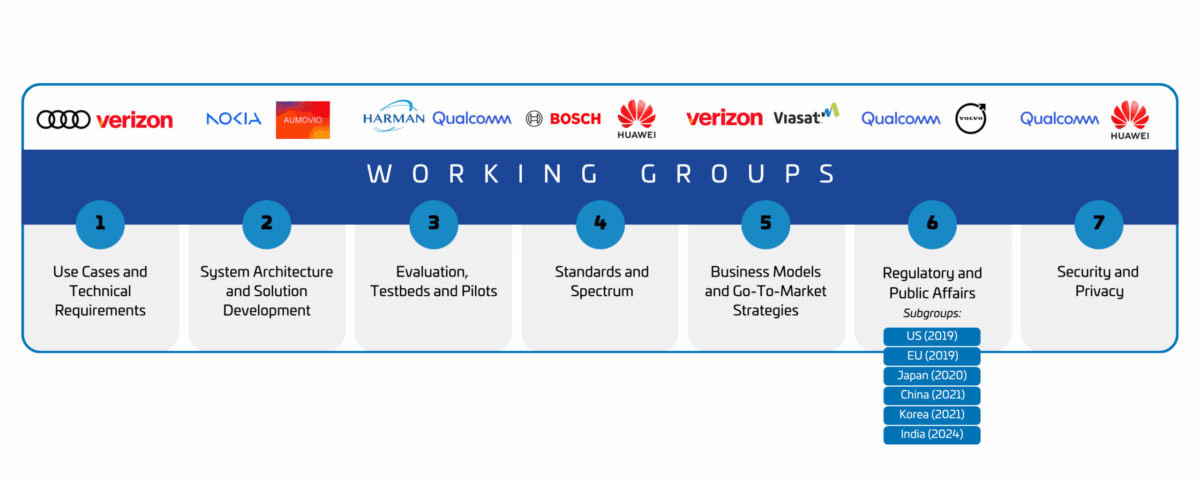
Working Groups
Define end-to-end view on use cases and derive technical requirements and performance indicators for the certification of connected mobility solutions (e.g. on communication architecture, radio protocols, radio parameters, frequency spectra and carrier aggregation combinations). Ensure interoperability for V2X and other affected technologies.
 |
 |
| Julia Rainer (Audi) |
Mu He (Verizon) |
| Chair | Vice-chair |
Define, develop and recommend system architectures and interoperable end-to-end solutions to address use cases and Services of Interest. Reviewing currently available solutions in technical areas such as wireless air interface technologies, wireless network deployment models, radio access networks and networked clouds, connectivity and device management or security, privacy and authentication.
 |
 |
| Berthold Panzner (Nokia) |
Andreas Andrae (AUMOVIO) |
| Chair | Vice-chair |
Evaluate and validate end-to-end solutions through testbeds. Globally orchestrating and harmonising conformity and interoperability assessments to ensure that new C-V2X products conform to existing standards and are interoperable with each other. Manage regional interoperability event programmes in cooperation with regionally established organisations. Promote commercialisation and standardisation via pilots and large-scale trials by selecting the use cases in conjunction with go-to-market strategies. This includes multi-phase / multi-year planning with prioritisation.
 |
 |
| Jacob Harel (Harman) |
Ralf Weber (Qualcomm) |
| Chair | Vice-chair |
Act as ‘Industry Specification Group’, providing recommendations, contributions and positions to ETSI, 3GPP and other standards development organisations. Agree on spectrum requirements for V2X in ITS, MBB and unlicensed bands. Represent the association vis-à-vis other industry organisations.
 |
 |
| Khaled Shawky Hassan (Bosch) |
Reza Karimi (Huawei) |
| Chair | Vice-chair |
Agree on criteria for business models. Identify involved organisations and companies, and prioritise them. Draft exemplary go-to-market plan as straw man function for agreed use cases under test and business models. Agree on how to best achieve a global approach to certification of the target connected mobility solutions.
 |
 |
|
| Michael Salmon (Verizon) | Damian Lewis (Viasat) |
|
| Chair | Vice-chair |
Agree on common 5GAA positions in relation to policy and regulatory matters at a national, regional and (whenever possible) global level to secure market access, foster technology innovation and investment, and support commercial deployment, developing a common policy strategy among industry stakeholders, public authorities, and subject matter expert members.
 |
 |
| Anne-Lise Thieblemont (Qualcomm) |
Kristina Olausson (Volvo Cars) |
| Chair | Vice-chair |
WG6 – Europe sub-group:
|
|
| Anne-Lise Thieblemont (Qualcomm) |
Kristina Olausson (Volvo Cars) |
| Lead | Co-Lead |
WG6 – US sub-group:
 |
 |
| Brad Stertz (Audi) |
Andres Castrillon (Qualcomm) |
| Lead | Co-Lead |
WG6 – China sub-group:
 |
 |
|
| Li Zhao (CATT) |
Yinxiang Zheng (CMCC) |
|
| Lead | Co-Lead |
WG6 – Japan sub-group:
 |
 |
| Hiroki Shibayama (NTT Docomo) |
Masakazu Shirota (Qualcomm) |
| Co-Lead | Co-Lead |
WG6 – Korea sub-group:
 |
 |
| Yunjong Kim (LG) |
Michael Park (Qualcomm) |
| Lead | Co-Lead |
WG6 – India sub-group:
 |
 |
| Divya Sachdeva (Ericsson) |
Nitin Sonar (Bosch) |
| Co-Lead | Co-Lead |
Review currently available solutions in relevant technical areas and identify gaps toward comprehensive secure end-to-end solutions and specifications for the use cases and services of interest as defined by the “Use Cases and Technical Requirements” WG.
 |
 |
| Virendra Kumar (Qualcomm) |
Ioannis Krontiris (Huawei) |
| Chair | Vice-chair |

Community
Ecosystem & Cooperation
With the numerous challenges connected and automated driving are bringing, the 5G Automotive Association (5GAA) is partnering up for the future with many different players. As building safety norms and standards play a vital role in the new era of mobility, 5GAA proactively teams up with several organisations, road operators and regulatory bodies to boost the deployment of connected cars and safer roads.
Global Partners
Standardisation

Collaboration to produce Third Generation Mobile System specifications, of globally applicable Technical Specifications and Technical Reports for a 3rd Generation Mobile System

Support to cooperation between ETSI and 5GAA, 5GAA participation in key meetings and other technical processes



Testing, Conformance and Interoperability
Cooperate in the area of multi-access edge computing, share resources, and coordinate technical, testing and deployment activities.

Support to C-V2X Conformance Testing and Certification in respective regions of operation

Support to C-V2X Conformance Testing and Certification in respective regions of operation

Promotion Groups and Think Tanks
Cooperation to boost deployment of connected cars and safer roads by working across industries to focus on privacy/security, common standards and target the 5.9GHz spectrum band specifically for the internet of vehicles

Progression of the development of Cellular-V2X, commitment to the promotion of a global unified C-V2X standard and E2E industry, building of a deeply integrated and innovated C-V2X ecosystem among automotive, telecommunication and more vertical industry partners


Enhancement and fostering of a closer cooperation in the area of 5G-based V2X solutions

Regional Partners
Europe
Cooperation towards network deployment for mobility services.

Exchange of information, seeking solutions concerning the use of radio frequencies to facilitate the development of future mobility and transportation services especially for the purpose of ITS communications

Promotion and coordination as necessary of the Baltic Sea Region 5G Ecosystem Forum with the Electronic Communication Office of Latvia

Coordination of technical, testing and deployment activities in relation to connected and automated driving, standardization priorities supporting connected and automated driving, promotion on spectrum-related issues and agreement on usage modalities of certain bands






India

Korea
Partnership to exchange of information regarding 5G mobile communication technology related to Automotive and Road Transport, analysis of technology trends, discussion of global standardization trends, promotion of 5G and C-V2X ecosystem growth

Partnership to facilitate sharing information on 5G mobile technology in Automotive and Road Transport, analysis of technology trends, discussion of global standardization trends, promotion of 5G and C-V2X ecosystem growth

China
fostering of cooperation in the field of connected and autonomous driving solutions, further conducting technical research on LTE-V2X and 5G-V2X, ensuring the promotion of the applications of 5G based V2X solution


Japan
Cooperation between 5GAA and members of XGMF with reference to the Japanese 5G ecosystem


United States





Community
Projects Advisory
The 5G Automotive Association (5GAA) is a global association with over 100 member companies from the automotive and telecommunications industries. Partners who are active in the broader telecommunications and automotive ecosystem, such as universities, research bodies, associations, and public authorities also joined the ecosystem. Each of the 5GAA members bring added value to the 5GAA mission through their contributions and visionary mindset. Together, the key partners foster collaboration and exchange to path the way towards the new mobility era.
Projects
European Projects
5GCAR

The Fifth Generation Communication Automotive Research and innovation, 5GCAR, is a 5GPPP Phase 2 project. The 5GCAR research and innovation initiative addresses the stringent requirements posed on the wireless communication system by bringing the fields of telecommunication and automotive closer together and investigating the benefit of 5G for demanding automotive use cases.
5G-DRIVE

The Horizon 2020 project 5G-DRIVE: 5G HarmoniseD Research and TrIals for serVice Evolution between EU and China (2018-2021) aims at trialling and validating the interoperability between EU & China 5G networks operating at 3.5 GHz bands for enhanced Mobile Broadband (eMBB) and 3.5 & 5.9 GHz bands for V2X scenarios.
5G-EVE

5G EVE is the European 5G validation platform for extensive trials. The goal is to implement and test advanced 5G infrastructures in Europe. The 5G-EVE concept is based on further developing and interconnecting existing European sites in Greece, Spain, France, and Italy to form a unique 5G end-to-end facility.
5G-MOBIX

The 5G-MOBIX project is co-financed by the European Commission within the framework of the Horizon 2020 programme. 5G-MOBIX will develop and test automated vehicle functionalities using 5G core technological innovations along multiple cross-border corridors and urban trial sites, under conditions of vehicular traffic, network coverage, service demand, as well as considering the inherently distinct legal, business and social local aspects.
5G ROUTES

5G-ROUTES is a 5G-PPP Phase 3 project whose aim is to validate through robust evidence the latest 5G features and 3GPP specifications (R.16 & R.17) of Connected and Automated Mobility (CAM) under realistic conditions. In particular, it will conduct advanced large-scale field trials of most representative CAM applications to demonstrate seamless functionality across a prominent 5G cross-border corridor (Via Baltica-North), traversing Latvia, Estonia and Finland.
5G-CroCo

The Fifth Generation Cross-Border Control, 5G-CroCo, is a 5G-PPP Phase 3 Innovation Action. 5GCroCo aims to trail 5G technologies in the cross-border corridor along France, Germany and Luxembourg. In addition, 5GCroCo also intends to define new business models that can be built on top of this unprecedented connectivity and service provisioning capacity. Ultimately, 5GCroCo will impact relevant standardization bodies from the telco and automotive industries.
5G-CARMEN

5G for Connected and Automated Road Mobility in the European Union, 5G-CARMEN, will build a 5G-enabled corridor from Bologna to Munich to conduct cross-border trials of 5G technologies in four major use cases: cooperative manoeuvring, situation awareness, video streaming, and green driving. Multi-tenancy and neutral host concepts will be leveraged to deliver a final platform capable of enabling new business models. 5G-CARMEN will complement C-V2X with LTE and C-ITS technologies, targeting interoperability and harnessing a hybrid network.
CONCORDA

The CONCORDA project, launched in October 2017 and funded by the Connecting Europe Facility, will contribute to the preparation of European motorways for connected and automated driving and high-density truck platooning, by providing adequate connected services and technologies in terms of interferences and interoperability.
Global5G

Global5G is a Coordination and Support Action within Europe’s 5G public and private partnership (5G PPP) that is working on both fronts through its focus on vertical industries and small cell deployments. It works closely with the private side of the 5G PPP – the 5G Infrastructure Association (5G-IA) to help boost impacts through diverse working groups and task force activities.
5G MED

5GMED is an innovative H2020-funded project that focuses on a sustainable 5G deployment model for future mobility in the cross-border corridor between Spain and France. Aside from the implementation of four different use cases, 5GMED’s trials seek to enhance roaming transitions across MNOs and neutral hosts for both Cooperative and Connected Automated Mobility (CCAM) and Future Railway Mobile Communications Systems (FRMCS).
NordicWay

NordicWay 2 is a C-ITS pilot project that enables vehicles, infrastructure and network operators to communicate safety hazards and other information from roads in the Nordic countries between different stakeholders. The project is a collaboration between public and private partners in Finland, Norway, Sweden and Denmark and builds on the achievements of the previous NordicWay project.
Ensemble

ENSEMBLE wants to communicate the economic, societal and environmental impact of decisions surrounding platoon forming and dissolving. ENSEMBLE also strives to modernize the transport system by finding an optimal balance between fuel consumption, emission level, travel times and impact on highway traffic flow, resulting in reduced impacts on climate change, air pollution, noise, health and accidents.
ARCADE

ARCADE is a Coordination and Support Action that coordinates consensus-building across stakeholders for sound and harmonised deployment of Connected, Cooperative and Automated Driving (CAD). It supports the development of a common approach to the development, testing, validation and deployment of CAD in Europe and beyond, and aims to establish a joint stakeholders forum in order to coordinate and harmonise automated road transport approaches at a European and international level.
5G BLUEPRINT

5G Blueprint is a H2020-funded project that aims to design and validate technical architecture, business models and governance for interrupted cross-border teleoperated transport based on 5G connectivity. Its objective is to provide a blueprint for operational pan-European deployment of teleoperated transport solutions in the logistics sector, and beyond. It explores the economics of 5G in cross-border transport and the issues of responsibility and accountability within the value chain.
STARDUST

Stardust is an H2020 Smart Cities project, which brings together exemplary models of smart, highly efficient, intelligent, and citizen-oriented cities. The project focuses on intelligent solutions for energy, mobility and ICT, to be integrated into cities together with innovative business models. One of its objectives is to create and deploy open city information platforms, that allows cities to engage actively with each other and to share information. The project’s results will serve as a blueprint for replication across Europe and abroad.
National Projects
ConVeX
Funded by the German Ministry of Transportation and Digital Infrastructure (BMVI) in the program “Automated and Connected Driving on Digital Test Fields in Germany”, the objective of the project ConVeX is to set up a testbed for the first field tests of 3GPP LTE Release 14 Cellular V2X (C-V2X) and validate its performance and feasibility.