
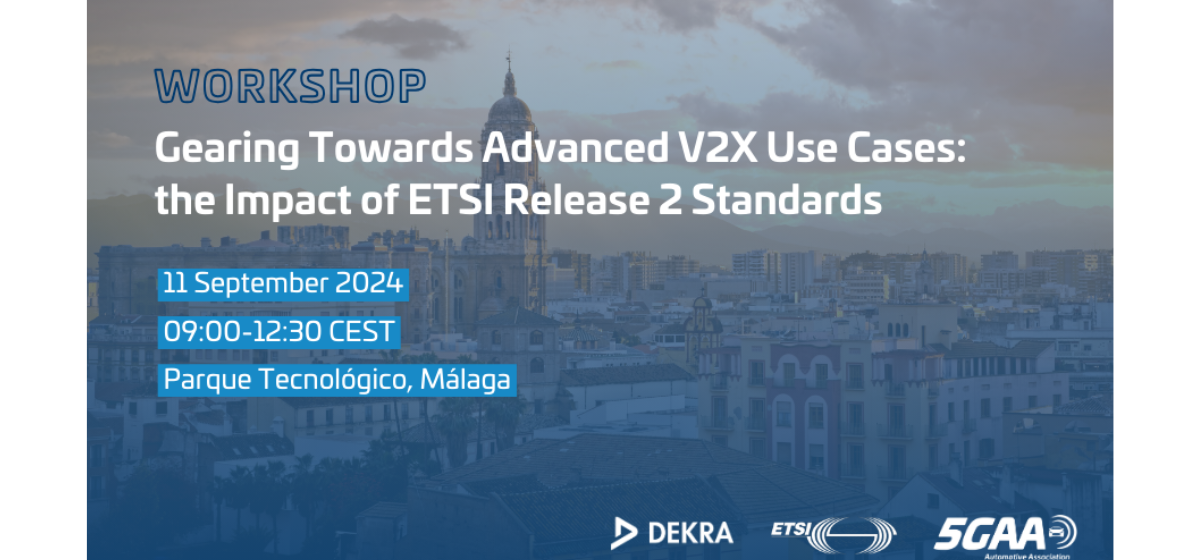
5GAA Workshop – ‘Gearing Towards Advanced V2X Use Cases: the impact of ETSI Release 2 standards’
On 11 September, the 5G Automotive Association (5GAA) will host its workshop ‘Gearing Towards Advanced V2X Use Cases: the impact of ETSI Release 2 standards’ at the ETSI C-V2X Plugtests hosted by DEKRA with the support of the European Commission and the European Free Trade Association.
During this half-day workshop, 5GAA aims to convene key players in the C-V2X ecosystem. The workshop will feature presentations and discussions on the impact of ETSI Release 2 standards, offering insights into the future of C-V2X for the automotive industry. The technical agenda will highlight advancements in 5G-V2X Direct, ETSI Release 2 messages, and security.
With five presentations followed by an open discussion, ecosystem stakeholders will have the opportunity to discuss the impact of ETSI Release 2 standards – including Collective Perception Services (CPS) and Vulnerable Road Users (VRUs).
Find the agenda here.
5G-V2X Direct Communication Evaluation Approach: An Automotive Analysis
This White Paper is considering realistic evaluation assumptions based on a common understanding between both the automotive industry and 5G-V2X technology vendors. Fifth-generation Vehicle-to-Everything (5G-V2X) technology, including the new direct communications radio technology (also called NR V2X), is moving toward deployment – starting in Europe with consensus among automotive OEMs, suppliers, and vendors.
To prepare for a massive deployment, an evaluation of NR V2X technology is indeed needed. Such an evaluation needs to be realistic enough to cope with automotive requirements, use cases, and system limitations (considering, at least, the first environment for implementation).
Find the full document here.
Reflections and findings from the WI VRU-DEMO experience and lessons learned
This technical report on 5GAA’s Work Item VRU-DEMO details the integration of system components and interface development for a cohesive user experience. It covers the selection of use cases and documents the key aspects of the VRU-DEMO WI, a 5GAA member collaboration demonstrating network-based VRU protection services’ interoperability, advancing C-V2X technology.
The report begins with the System Architecture used in demonstrations at Mcity, University of Michigan. It analyses the technical framework for VRU protection services and outlines use case selection criteria. It evaluates performance using Key Performance Indicators during trials and live showcases.
Additionally, the technical report discusses challenges, strategies, and insights gained, offering recommendations for future projects and exploring the standardisation of message types for VRU protection.
Find the full document here.
Gearing Towards Advanced V2X Use Cases: the impact of ETSI Release 2 standards
In partnership with 5GAA and with the support of the European Commission and European Free Trade Association, DEKRA is hosting the 4th ETSI C-V2X Plugtests™ event at Parque Tecnológico in Málaga, Spain from 10-13 September.
During the week, ETSI and DEKRA will enable On-Board-Units (OBUs), Roadside-Units (RSUs) and Public Key Infrastructure (PKIs) vendors to run interoperability test sessions to assess the level of interoperability of their implementation and validate the understanding of the standards. This edition of the Plugtests will focus on direct communication between devices using ETSI TC ITS Release 2 standards, including Collective Perception Services (CPS) and Vulnerable Road Users (VRUs).
5GAA will organise a half-day workshop on 11 September to bring together some key players in the C-V2X ecosystem and discuss the impact of ETSI Release 2 standards. The speakers will provide insights on the future of C-V2X for the automotive industries, while the workshop’s technical agenda will demonstrate progress made on 5G-V2X Direct, ETSI Release 2 messages and security.
To view the agenda, click here.
Misbehaviour Detection for V2X: Operational Aspects
This white paper explores how to manage misbehaviour in Vehicle-to-Everything (V2X) communication systems, where vehicles and infrastructure directly exchange information. Misbehaviour can be intentional (like sending false data) or accidental, but it can lead to bad decisions by drivers and hinder the benefits of V2X.
The core contribution lies in exploring various remediation options (e.g., software updates, certificate control) and proposing methods for classifying misbehaviour types. This classification helps define a mapping between misbehaviour severity and appropriate remediation actions.
The paper emphasises the importance of fair and proportionate remediation, highlighting the lack of current standards for determining these actions. It provides technical insights that can inform both policy development for fair and consistent consequences, and technical design of the backend misbehaviour management system.
Find the full document here.
Business Perspectives on Vehicle-to-Network-to-Everything (V2N2X) Deployments
Cellular networks are increasingly enabling data exchange within the transport ecosystem. This document provides a business perspective on the Vehicle-to-Network-to-Everything (V2N2X) market, covering market value, stakeholder needs, market growth drivers, and business models observed in various deployments. It complements the high-level V2N2X architecture described in the 5GAA white paper “Road traffic operation in a digital age” and the technical report “Vehicle-to-Network-to-Everything (V2N2X) Communications; Architecture, Solution Blueprint, and Use Case Implementation Examples.”
While the full set of V2N2X features and foundational technologies is still evolving, current implementations demonstrate that the architecture can be deployed using existing networks. Future applications are expected to leverage advancements like multi-access edge computing (MEC), network slicing, and improved 5G coverage. The annexes provide detailed descriptions of relevant legislation and deployment examples.
The report content is based on the analysis of existing V2N2X deployments, a survey of Vehicle OEMs and Infrastructure Operators and Owners (IOOs), and the experiences of 5GAA members involved in the V2N2X market.
Find the full document here.
A 5GAA online session on the V2N2X topic and reports took place on 18 June 2024. The recording of the online session can be accessed here. The slides of the presentation can be accessed here.
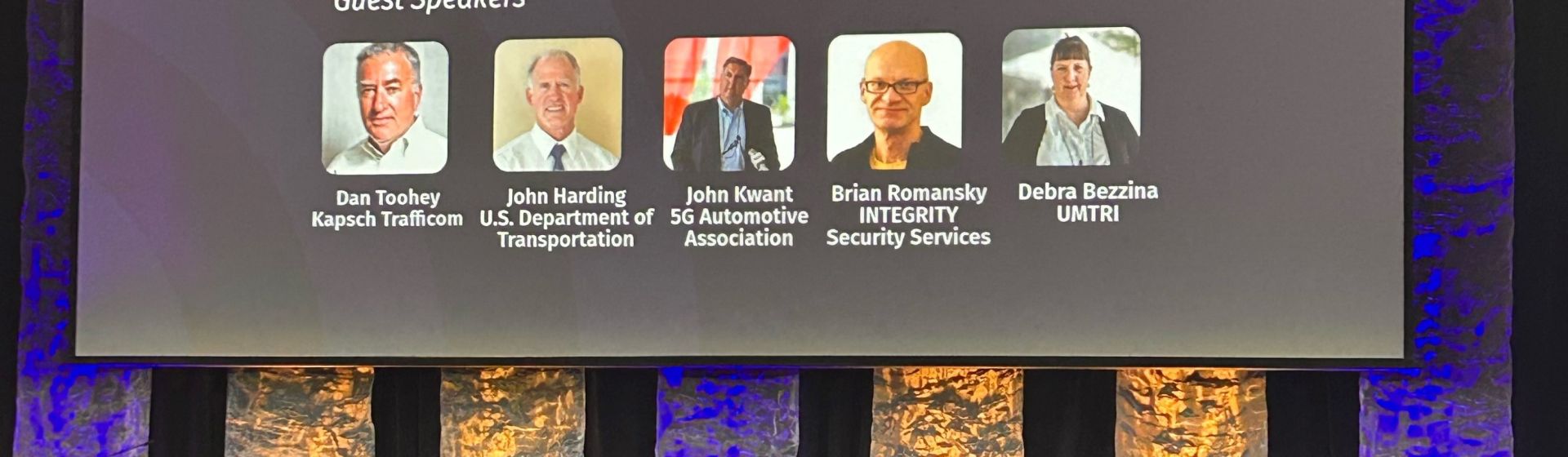
5GAA’s John Kwant Explores the Current C-V2X Regulatory Landscape in the United States at the OmniAir Plugfest
5G Automotive Association (5GAA) Executive Director, Americas John Kwant is in Ann Arbor, Michigan today to explore the current regulatory landscape for C-V2X deployment in the United States as part of a panel on connected mobility at today’s OmniAir Plugfest.
Speaking at 9:00 (UTC-4) in the panel ‘Accelerating V2X Deployment: Bridging Government Initiatives, Industry Readiness and Local Implementations’, John Kwant will bring his expertise to the table and address the state of regulation and legislation covering V2X technology in the United States, as well as explain 5GAA’s work to promote deployment and widespread technology adoption.
The OmniAir Plugfest is an annual event hosted at MCity, Michigan in partnership with the University of Michigan Transportation Research Institute. It is the world’s first purpose-built proving ground for testing the performance and safety of connected and automated vehicles and technologies under controlled and realistic conditions.
Today’s Connected Mobility Workshop offers a one-day technical deep dive into topics related to deployment, testing and future trends, along with live technology demonstrations and a networking reception.
In addition to 5GAA’s participation, attendees will have the opportunity to hear the insights of a number of experts and stakeholders including:
- John Harding, Federal Highway Administration
- Brian Romansky, INTEGRITY Security Services
- Debra Bezzina, University of Michigan Transportation Research Institute
5GAA Statement of Support for OmniAir Consortium
5GAA also wishes to express the association’s support for OmniAir Consortium’s C-V2X certification programme and appreciation for OmniAir C-V2X initiatives generally.
OmniAir Consortium’s certification programme, first established in 2021, is of significant benefit to the entire C-V2X ecosystem and contributes greatly to promoting technology development and adoption.
Certified C-V2X products, such as Onboard Units (OBUs), Road-Side Units (RSUs) and corresponding modules will allow for greater confidence regarding the ability to achieve seamless interoperability of both Vehicle-to-Vehicle (V2V) and Vehicle-to-Infrastructure (V2I) functionality for the Intelligent Transportation System (ITS). As a result, stakeholders across the C-V2X ecosystem benefit from OmniAir Consortium’s work – including vehicle manufacturers, infrastructure owner/operators, equipment suppliers and software suppliers.
5GAA and OmniAir have been partners since 2019, and the participation of our Executive Director, Americas John Kwant in today’s OmniAir Plugfest underscores the continued vitality of this collaboration.
For more information on today’s panel, see here.

5GAA Annual Report Charts Global Path for C-V2X Deployment
The 5G Automotive Association has released its annual report for 2023, highlighting significant strides made towards global deployment of cellular vehicle-to-everything (C-V2X) technology and connected mobility solutions. The report details the association’s achievements across key areas, all working towards a more connected and automated transportation ecosystem.
Strong Membership and Global Reach
5GAA grew to 126 members in 2023, including leading names from the automotive (11 out of the top 15 carmakers), mobile network operator (8 out of the top 10 MNOs), and smartphone vendor industries (2 top vendors). This diverse membership fosters strong cross-industry collaboration with a global footprint.
Beyond membership, 5GAA actively maintained partnerships with over 40 organisations, including standards development organisations, public administrations, and certification bodies. Notably, 2023 saw the signing of a cooperation agreement with ITS America and renewed Memoranda of Understanding with ITS Korea and 5G Forum.
Recognising the varying pace of V2X deployment across regions, 5GAA continued to expand its reach. In addition to existing regional regulatory-focused sub-groups, a dedicated taskforce was established for India, a promising V2X market. The association also continued to advocate for a scalable and federated approach to managing road traffic information.
Contributing to Standards
Standardisation has been a core focus of the 5GAA since its early days. In 2023, the association and its members participated in 3GPP Release-19 discussions, providing critical automotive industry input as a Market Representation Partner (MRP). This cooperation aims to ensure that C-V2X technology development aligns with global needs. Additionally, 5GAA contributed to regional standardisation efforts by giving input to bodies like ETSI, SAE, and C-SAE.
In Conversation with Policymakers
The association actively engages with policymakers and regulatory bodies around the world. In Europe, 5GAA issued a joint statement with leading European carmakers urging the deployment of 5G-V2X technology in Europe. The association also welcomed positive developments such as FCC waivers for C-V2X deployment in the US, Korea’s selection of C-V2X direct communication as its technology of choice, and Japan’s consideration of using the upper 30 MHz in the 5.9 GHz band for V2X direct communications.
These engagements play a vital role in establishing sufficient regulatory support for the mass adoption of C-V2X technology.
Two Succesful Workshops
Throughout 2023, 5GAA hosted workshops with key stakeholders to identify challenges and advance technology innovation. In The Hague, Netherlands, a workshop focused on C-V2X mass market deployment in real-life traffic. Similarly, a high-level conference, “The Future of Connected Mobility in South Korea,” was held in Seoul. Discussions centered on how connected mobility and ITS can advance road safety and automated driving in the Korean transport ecosystem.
Technical Progress
In 2023, 5GAA maintained a strong work program. The association successfully completed 12 work items, launched 28 new ones for development in 2024, and published 18 technical reports. Key areas of focus included Day 1 V2X services, Automated Valet Parking (AVP) solutions, and interoperability testing for Vulnerable Road User (VRU) protection, with a series of live demonstrations in Mcity, Michigan.
Looking Ahead
5GAA has developed a solid strategic roadmap for its activities in 2024. Over the next months, the association will focus on:
- Prioritising the execution and implementation of readily available or “Day 1” technology and services;
- Accelerating the wide-scale deployment of Day 1 V2X services over mobile network communications;
- Developing an end-to-end AVP service implementation and continuing to advance interoperability among members’ VRUs solutions;
- Tackling technical or political hurdles that prevent the mass roll-out of LTE-V2X direct communications in targeted markets, while laying the groundwork for 5G-V2X direct;
- Chartering a transition path or mitigation measures to ensure continuity of legacy services; and
- Continuing to investigate the potential of emerging technologies like positioning-as-a-service (PaaS), non-terrestrial networks (NTNs), and integrated sensing and communication for V2X applications.
The 5GAA 2023 annual report underscores the association’s vital role in shaping the future of mobility. By fostering collaboration amongst key stakeholders and driving industry progress, 5GAA paves the way for a safer, more efficient, and automated transportation ecosystem.
Creating Trust in Connected and Automated Vehicles
Connected and Automated Vehicles (CAVs) create a complex, dynamic network, where the safety and behaviour of each ‘node’ or vehicle directly affects the efficiency and safety of the entire system. These systems are vulnerable to untrustworthy actors for various reasons. Therefore, a method to assess and quantify the trustworthiness of shared data is necessary. This will establish trust between cooperating nodes, enabling them to work in collaboration.
This 5GAA white paper proposes a framework for trust assessment within CAVs. By first defining key terms related to trust and trustworthiness, it establishes a foundation for building trust between these vehicles. It then creates a taxonomy for classifying different trust relationships.
Furthermore, the paper details a list of trustworthiness properties crucial for Cooperative Intelligent Transport Systems (C-ITS) and CAVs. These properties serve as the foundation for real-time trust assessments. The paper emphasises the importance of verifiable evidence supporting these assessments, even when dealing with inherent uncertainties within the evidence itself.
Find the full document here.
Vehicular Antenna Test Methodology
The rise of connected vehicles and vehicle-to-vehicle communication necessitates a unified measurement procedure for their communication antennas. This would streamline development and ensure consistent conformity assessments across regions.
The 5GAA alliance, fostering collaboration between the automotive and telecom sectors, has developed a methodology specifically for testing vehicular communication antennas (those permanently mounted on vehicles). This methodology can act as a commonly agreed test procedure for antenna communication subsystems, improving the accuracy of conformity assurance procedures for these critical systems.
In essence, this methodology serves as a tool to optimise antenna testing and provide validation measures that account for the unique form factors and characteristics of each vehicle.
Read 5GAA’s technical report here.
This document is an updated version of the Vehicular Antenna Test Methodology technical report published by 5GAA in 2021, available here.