

Distributed vehicular antenna system
Advances in communication technologies open up new opportunities and enable new types of services in the automotive area. These include road safety, traffic efficiency and customer services which are not specifically meant for automotive applications. As advanced V2X use cases requiring high reliability and/or high data rate are introduced, technologies such as multi-antenna solutions (e.g. massive MIMO), broadband (e.g. carrier aggregation), and FR2 solutions will be essential for V2X communications, and thus the number of required antennas mounted on vehicles will keep growing.
This study on the ‘Distributed vehicular antennas system’ provides a list of potential implementation options for vehicular-DAS with a brief analysis of impacts to 3GPP specifications and implementation costs. In addition, the potential performance gain of DAS over co-located antennas was verified through simulations, and the evaluation results and analysis were included in eCV2X WI TR.
Read the full report here.
Home
The 5G Automotive Association (5GAA) is a global, cross-industry organisation of companies from the automotive, technology, and telecommunications industries (ICT), working together to develop end-to-end solutions for future mobility and transportation services.
5GAA at a glance
+100 Members Community
+90 Completed Work Items Work Items
7 Working Groups Items
1 Objective Connected mobility
What’s new
All news



5GAA celebrates 5 years
Celebrating 5 years of digital transformations
and innovative mobility solutions
meeting today’s challenges.
5GAA leverages today’s and tomorrow’s mobility solutions
According to the World Health Organization (WHO), roughly 1.25 million road traffic fatalities worldwide in 2013, with another 20–50 million injured or disabled through traffic accidents. Vehicles sharing information make transportation safer, greener, and more enjoyable are at our doorstep. The technologies associated with this concept are collectively known as Cooperative Intelligent Transportation Systems (C-ITS). The impact on road safety alone is sufficiently significant to make C-ITS a priority.

5GAA contribution focuses on 5 pillars

Bridging the automotive & telecommunications industry

Enabling technology deployment

Contributing to standards

Advocating to policymakers and positioning 5GAA around strategic ecosystem

Leveraging innovative solutions to advance connected mobility
Latest publications




Terms of Use
Ownership of Site; Agreement to Terms of Use
These Terms and Conditions of Use (the “Terms of Use”) apply to the 5GAA web site located at www.5gaa.org, and all associated sites linked to www.5gaa.org by 5GAA, its subsidiaries and affiliates, including 5GAA sites around the world (collectively, the “Site”). The Site is the property of 5GAA – 5G Automotive Association e.V. (5GAA) and its licensors.
BY USING THE SITE, YOU AGREE TO THESE TERMS OF USE; IF YOU DO NOT AGREE, DO NOT USE THE SITE.
Content
All text, graphics, user interfaces, visual interfaces, photographs, trademarks, logos, sounds, music, artwork and computer code (collectively, “Content”), including but not limited to the design, structure, selection, coordination, expression and arrangement of such Content, contained on the Site is owned, controlled or licensed by or to 5GAA, and is protected by trade dress, copyright, patent and trademark laws, and various other intellectual property rights and unfair competition laws.
Except as expressly provided in these Terms of Use, no part of the Site and no Content may be copied, reproduced, republished, uploaded, posted, publicly displayed, encoded, translated, transmitted or distributed in any way (including “mirroring”) to any other computer, server, Web site or other medium for publication or distribution or for any commercial enterprise, without 5GAA’s express prior written consent.
You may use information on 5GAA products and services (such as data sheets, knowledge base articles, and similar materials) purposely made available by 5GAA for downloading from the Site, provided that you (1) not remove any proprietary notice language in all copies of such documents, (2) use such information only for your personal, non-commercial informational purpose and do not copy or post such information on any networked computer or broadcast it in any media, (3) make no modifications to any such information, and (4) not make any additional representations or warranties relating to such documents.
Your Use of the Site
You may not use any “deep-link”, “page-scrape”, “robot”, “spider” or other automatic device, program, algorithm or methodology, or any similar or equivalent manual process, to access, acquire, copy or monitor any portion of the Site or any Content, or in any way reproduce or circumvent the navigational structure or presentation of the Site or any Content, to obtain or attempt to obtain any materials, documents or information through any means not purposely made available through the Site or allowed by law. 5GAA reserves the right to bar any such activity.
You may not attempt to gain unauthorized access to any portion or feature of the Site, or any other systems or networks connected to the Site or to any 5GAA server, or to any of the services offered on or through the Site, by hacking, password “mining” or any other illegitimate means.
You may not probe, scan or test the vulnerability of the Site or any network connected to the Site, nor breach the security or authentication measures on the Site or any network connected to the Site. You may not reverse look-up, trace or seek to trace any information on any other user of or visitor to the Site, or any other customer of 5GAA, including any 5GAA account not owned by you, to its source, or exploit the Site or any service or information made available or offered by or through the Site, in any way where the purpose is to reveal any information, including but not limited to personal identification or information, other than your own information, as provided for by the Site.
You agree that you will not take any action that imposes an unreasonable or disproportionately large load on the infrastructure of the Site or 5GAA’s systems or networks, or any systems or networks connected to the Site or to 5GAA.
You agree not to use any device, software or routine to interfere or attempt to interfere with the proper working of the Site or any transaction being conducted on the Site, or with any other person’s use of the Site.
You may not forge headers or otherwise manipulate identifiers in order to disguise the origin of any message or transmittal you send to 5GAA on or through the Site or any service offered on or through the Site. You may not pretend that you are, or that you represent, someone else, or impersonate any other individual or entity.
You may not use the Site or any Content for any purpose that is unlawful or prohibited by these Terms of Use, or to solicit the performance of any illegal activity or other activity which infringes the rights of 5GAA or others.
Accounts, Passwords and Security
Certain features or services offered on or through the Site may require you to open an account (including user ID and password). You are entirely responsible for maintaining the confidentiality of the information you hold for your account, including your password, and for any and all activity that occurs under your account as a result of your failing to keep this information secure and confidential. You agree to notify 5GAA immediately of any unauthorized use of your account or password, or any other breach of security. You may be held liable for losses incurred by 5GAA or any other user of or visitor to the Site due to someone else using your user ID, password or account as a result of your failing to keep your account information secure and confidential.
You may not use anyone else’s user ID, password or account at any time without the express permission and consent of the holder of that user ID, password or account. 5GAA cannot and will not be liable for any loss or damage arising from your failure to comply with these obligations.
Privacy / Data Protection
The information/personal data that you provide about yourself to 5GAA will be used in accordance with 5GAA Privacy Policy. Additionally, by using the Site, you acknowledge and agree that Internet transmissions are never completely private or secure. You understand that any message or information you send to the Site may be read or intercepted by others, even if there is a special notice that a particular transmission (for example, credit card information) is encrypted.
By visiting 5GAA’s website with cookies enabled, and accepting cookies via our cookie consent tool you agree to the use of cookies as explained in the Cookie policy. For more information on how we use cookies and to manage your preferences see Cookie policy.
Links to Other Sites and to the 5GAA Site
This Site may contain links to other independent third-party Web sites (“Linked Sites”). These Linked Sites are provided solely as a convenience to our visitors. Such Linked Sites are not under 5GAA’s control, and 5GAA is not responsible for and does not endorse the content of such Linked Sites, including any information or materials contained on such Linked Sites. You will need to make your own independent judgment regarding your interaction with these Linked Sites.
Disclaimers
5GAA DOES NOT PROMISE THAT THE SITE OR ANY CONTENT, SERVICE OR FEATURE OF THE SITE WILL BE ERROR-FREE OR UNINTERRUPTED, OR THAT ANY DEFECTS WILL BE CORRECTED, OR THAT YOUR USE OF THE SITE WILL PROVIDE SPECIFIC RESULTS. THE SITE AND ITS CONTENT ARE DELIVERED ON AN “AS-IS” AND “AS-AVAILABLE” BASIS. ALL INFORMATION PROVIDED ON THE SITE IS SUBJECT TO CHANGE WITHOUT NOTICE. 5GAA CANNOT ENSURE THAT ANY FILES OR OTHER DATA YOU DOWNLOAD FROM THE SITE WILL BE FREE OF VIRUSES OR CONTAMINATION OR DESTRUCTIVE FEATURES. 5GAA DISCLAIMS ALL WARRANTIES, EXPRESS OR IMPLIED, INCLUDING ANY WARRANTIES OF ACCURACY, NON-INFRINGEMENT, MERCHANTABILITY AND FITNESS FOR A PARTICULAR PURPOSE. 5GAA DISCLAIMS ANY AND ALL LIABILITY FOR THE ACTS, OMISSIONS AND CONDUCT OF ANY THIRD PARTIES IN CONNECTION WITH OR RELATED TO YOUR USE OF THE SITE. YOU ASSUME TOTAL RESPONSIBILITY FOR YOUR USE OF THE SITE AND ANY LINKED SITES. YOUR SOLE REMEDY AGAINST 5GAA FOR DISSATISFACTION WITH THE SITE OR ANY CONTENT IS TO STOP USING THE SITE OR ANY SUCH CONTENT. THIS LIMITATION OF RELIEF IS A PART OF THE BARGAIN BETWEEN THE PARTIES.
The above disclaimer applies to any damages, liability or injuries caused by any failure of performance, error, omission, interruption, deletion, defect, delay in operation or transmission, computer virus, communication line failure, theft or destruction of or unauthorized access to, alteration of, or use, whether for breach of contract, tort, negligence or any other cause of action.
5GAA reserves the right to do any of the following, at any time, without notice: (1) to modify, suspend or terminate operation of or access to the Site, or any portion of the Site, for any reason; (2) to modify or change the Site, or any portion of the Site, and any applicable policies or terms; and (3) to interrupt the operation of the Site, or any portion of the Site, as necessary to perform routine or non-routine maintenance, error correction, or other changes.
Limitation of Liability
Except where prohibited by law, in no event will 5GAA be liable to you for any indirect, consequential, exemplary, incidental or punitive damages, including lost profits, even if 5GAA has been advised of the possibility of such damages.
Indemnity
You agree to indemnify and hold 5GAA, its officers, directors, shareholders, predecessors, successors in interest, employees, agents, subsidiaries and affiliates, suppliers and licensors harmless from any demands, loss, liability, claims or expenses (including attorneys’ fees), made against 5GAA by any third party due to or arising out of or in connection with your use of the Site.
Violation of These Terms of Use
5GAA may share information 5GAA has collected about you in certain situations to comply with court orders, laws or legal processes. For further details, see our 5GAA Privacy Policy.
You agree that 5GAA may, in its sole discretion and without prior notice, terminate your access to the Site and/or block your future access to the Site if we determine that you have violated these Terms of Use or other agreements or guidelines which may be associated with your use of the Site. You also agree that any violation by you of these Terms of Use will constitute an unlawful and unfair business practice, and will cause irreparable harm to 5GAA, for which monetary damages would be inadequate, and you consent to 5GAA obtaining any injunctive or equitable relief that 5GAA deems necessary or appropriate in such circumstances. These remedies are in addition to any other remedies 5GAA may have at law.
You agree that 5GAA may, in its sole discretion and without prior notice, terminate your access to the Site, for cause, which includes (but is not limited to) (1) requests by law enforcement or other government agencies, (2) a request by you (self-initiated account deletions), (3) discontinuance or material modification of the Site or any service offered on or through the Site, or (4) unexpected technical issues or problems.
If 5GAA does take any legal action against you as a result of your violation of these Terms of Use, 5GAA will be entitled to recover from you, and you agree to pay, all reasonable attorneys’ fees and costs of such action, in addition to any other relief granted to 5GAA. You agree that 5GAA will not be liable to you or to any third party for termination of your access to the Site as a result of any violation of these Terms of Use.
Governing Law and Jurisdiction
Unless otherwise specified, the Content and services described on this Site are available only to EU residents. The information on this Site is not directed at anyone other than EU residents.
These Terms of Use shall be governed by, and construed in accordance with, German law. The parties irrevocably agree that the courts of Germany shall (subject to the paragraph below) have exclusive jurisdiction to settle any dispute which may arise out of, under, or in connection with these Terms of Use or the legal relationship established by them, and for those purposes irrevocably submit all disputes to the jurisdiction of German courts.
For the exclusive benefit of 5GAA, 5GAA shall also retain the right to bring proceedings as to the substance of the matter in the courts of the country of your residence or, where these Terms of Use are entered into in the course of your trade or profession, the country of your principal place of business.
Miscellaneous
5GAA may, in its discretion, change these Terms of Use (including those that relate to your use of the Site). Whenever the Terms of Use are changed, 5GAA will notify you by e-mail or by publishing the revised terms on the website. If you use the Site after 5GAA has published or notified you of the changes, you are agreeing to be bound by those changes. If you do not agree to be bound by those changes, you should not use the Site any further after they are published.
No delay or omission on the part of either party in requiring performance by the other party of its obligations will operate as a waiver of any right.
If any provision of these Terms of Use is invalid or unenforceable, such will not render all the Terms of Use unenforceable or invalid. Rather, the Terms of Use will then be read and construed as if the invalid or unenforceable provision(s) are not contained therein. Any cause of action of yours with respect to these Terms of Use must be filed in a court of competent jurisdiction in Germany, within one year after the cause of action has arisen, or such cause will be barred, invalid and void.
5GAA provides access to 5GAA international data and, therefore, may contain references or cross references to 5GAA products, programs and services that are not announced in your country. Such reference does not imply that 5GAA in your country intends to announce such products, programs or services.
Notices to 5GAA must be given in writing, by letter, and sent to Neumarkter Strasse 21, 81673 Munich, Germany.
Save as expressly referred to herein, any representation, warranty, term or condition not expressly set out in these Terms of Use shall not apply.
Headings in these Terms of Use are for convenience only and have no legal meaning or effect, nor shall they be taken into account in interpreting these Terms of Use.
Privacy policy
The 5GAA – 5G Automotive Association e.V. (5GAA) places great importance on the protection of your personal data and is committed to comply with all applicable data protection laws and regulations.
The following Privacy Notice will provide you with information about the personal data we collect, process and use when you visit 5GAA’s website, become a member of the association, otherwise use our services or when we interact or communicate with you in any other way. Please note that if you use services provided by third parties, only the Privacy Notice of these third parties shall apply to the personal data processed via these services.
1. Who is responsible for the processing of your personal data?
The responsible data controller, that means the entity deciding why and how to process your personal data, is:
5GAA – 5G Automotive Association e.V.
Neumarkter Str. 21
81673 Munich (Germany)
Tel.: + 49 89 54 90 96 80
Fax: + 49 89 54 90 96 85
secretariat@5gaa.org
5GAA is a global, cross-industry organization of companies from the automotive, technology, and telecommunications industries (ICT), working together to develop end-to-end solutions for future mobility and transportation services.
2. What personal data do we collect?
We collect information from you when you use our website, complete our “Contact us” form, apply to join the association or to cooperate with us in any other way, are a member of the association, join or participate in our working groups, register for an event or otherwise interact with us. We may also receive information on you from our member companies and institutions that you are associated with (for example as an employee).
The personal data we collect might include your title, first name, surname, gender, date of birth, address, email address, phone number, IP address, and information regarding what pages are accessed and when.
We may also collect information relating to your employment, including where you are currently employed, your job title, areas of interest/expertise and your job function if this is relevant to your interaction with us. In applications for some categories of membership we ask you to identify a reference by providing their name and address. Please make sure that you have obtained the consent of the reference prior to providing the contact details.
We may also collect your personal data (e.g. name, email address, organisation, function, other relevant contact data), in particular with respect to your function as policymaker or representative of the media or of a public authority, from publicly available sources or within the scope of our business activities from our external sources.
3. For which purposes do we process your personal data?
We process your personal data for the following purposes:
- Processing your application, in particular for a membership with 5GAA;
- Administering your membership, that means where we have to process your personal data to perform our relationship with you;
- Handling your requests and reacting to other interactions initiated by you;
- Processing your invitations for 5GAA or associated events to facilitate your attendance;
- Compiling statistics, insights and analyses of attendance and success of our events;
- Coordinating the activities of 5GAA, and, in particular, its working groups;
- Enabling 5GAA members, their delegates and other working group participants to communicate (e.g. via email) and to cooperate with you with regard to your working group activities or mutual interests;
- Seeking your views or comments in the context of 5GAA’s activities;
- Sending you communications which you have requested or that may be of interest to you, including newsletters, press releases, position papers, information about events and other activities of the association; requests for feedback on our events;
- Monitoring compliance with our terms and policies, for example, to prevent or detect fraud or other crimes;
- For billing purposes, where necessary.
4. Who has access to your personal data?
To support us with the administration of your membership and the coordination of our activities (such as hosting and organizing events), our service provider MCI Deutschland GmbH will access and process your personal data on our behalf.
In addition, we will disclose your personal data to our third-party service providers, agents, subcontractors and other associated organizations for the purposes of completing tasks and providing services to you on our behalf. These service providers include, for example, fulfilment providers for delivery of our digital content and newsletters; member service agencies; hosts, organizers and sponsors of our events; organizations that host our website or databases; and providers of online surveys. We may also disclose your personal data to legal consultants or similar third parties where this is necessary for our legitimate interests, for example for the prevention or detection of fraud or other crimes. However, when we share your personal data with third parties, we disclose only the personal information that is necessary to deliver the services and we have contracts that require them to keep your information secure and not to use it for their own purposes.
If you subscribe to a mailing list of a working group, we may disclose your personal data, in particular your name, the name of the organisation that you are representing, your job title and your email address to other delegates or participants of the same or similar working groups.
Where we are required by applicable laws, we will also disclose your personal data to law enforcement, government authorities or courts.
We will not sell or rent your information to third parties unless you have given your express consent for us to do so where required by law.
5. On which legal basis do we process your personal data?
We will process your personal data on the following legal bases under Article 6 of the EU General Data Protection Regulation:
- Application and membership necessity: Where the processing of your personal data is necessary to manage your application and administer your membership or any other association with 5GAA;
- Legitimate business purposes: Where the processing is necessary for our legitimate interests (such as to protect us from harm by preventing or detecting illegal activities, fraud or similar threats; to represent our interests publicly or among experts, in particular by reaching out to and communicate with media representatives, policymakers, public authorities and other associations or organizations; to exercise or defend against legal claims; to enhance the benefit of a 5GAA membership by enabling networking and cooperation activities amongst our members, their delegates and other stakeholders; to improve our future events and better meet the interests of our members by compiling statistics, insights and analyses of attendance at our events; or to analyze our website usage and services), unless we determine in a case-by-case assessment that our interests are overridden by your interests or rights;
- Legal obligation: To comply with legal obligations to which we are subject (for example, where we are requested by a court to disclose your data);
- Consent: This is where you have given us explicit permission to process personal data for a given purpose, as required under applicable data protection laws and regulations. For example, we will ask for your consent to receiving newsletters when you sign up on our website.
6. Where will your personal data be processed?
Your personal data will be processed both inside the European Union (“EU”) and the European Economic Area (EEA) and outside by the parties specified in Section 4 above.
Please note that EU / EEA Member States and other countries all have different laws regarding the protection of personal data. If we transfer your personal data from your own country to another country, the laws and rules that protect your personal data in the country to which your information is transferred to can be different (or less protective) from those in the country in which you live.
If we transfer any of your personal data outside the EU or EEA, we will, to the extent that this is required by applicable data protection laws and regulations, ensure that the recipient of the personal data provides for an adequate level of data protection, in particular, by implementing safeguards such as standard contractual clauses approved by the European Commission or by relying on an adequacy decision by the European Commission. Further information can be found here: https://ec.europa.eu/info/law/law-topic/data-protection/data-transfers-outside-eu_en.
7. Cookies
In order for this site to work properly, we sometimes place small data files called cookies on your device.
What are cookies?
A cookie is a small text file saved on your computer or mobile device by a website when you visit https://5gaa.org/. The cookie enables the website to remember your actions and preferences such as login, language, font size and other display preferences to keep you from having to reenter them on every visit to the website or when browsing from page to page.
How do we use cookies?
A number of the pages on our website use cookies to remember:
- Your display preferences, such as contrast and colour settings or font size.
- Whether or not you have already replied to a survey popup that asks you if the content was helpful or not so that you won’t be asked over and over again.
- Whether or not you have agreed to our use of cookies on this site.
In addition, some embedded videos in our pages use a cookie to anonymously gather statistics on how you got there and what videos you viewed. Although enabling these cookies is not strictly necessary for the website to work, it will provide you with a better browsing experience. Cookies can be deleted or blocked, but some features of this site may not work as intended should you do so. The cookie-related information is not used to identify you personally and the pattern data is fully under our control. The cookies on this website are not used for any purpose other than those described here.
How to control cookies
You can block and/or delete cookies as you wish using your browser settings. You can delete all cookies that are already on your computer and you can set your browser to prevent them from being placed. By doing this you may have to manually adjust some preferences every time you visit https://5gaa.org/ and some services and functionalities may not work.
8. How do we protect your personal data?
5GAA maintains appropriate technical and organizational security measures designed to protect your personal data against accidental, unlawful or unauthorized destruction, loss, alteration, access, disclosure or use.
Non-sensitive details (your email address etc.) are transmitted normally over the Internet, and this can never be guaranteed to be 100% secure. As a result, while we strive to protect your personal data, we cannot guarantee the security of any information you transmit to us, and you do so at your own risk. Once we receive your personal data, we make our best effort to ensure its security on our systems. Where we have given (or where you have chosen) a password which enables you to access certain parts of our website, you are responsible for keeping this password confidential. We ask you not to share your password with anyone.
9. How long do we store your personal data?
We will not retain your personal data longer than necessary to fulfil the purposes the data was collected for or to fulfil our legal obligations. Afterwards, we will delete your personal data.
If you wish to receive further specific information on the applicable retention periods, please contact us under the contact details mentioned in Section 11.
10. What are your rights in respect of your personal data?
To the extent permitted by applicable data protection laws and regulations, you have the right to access your personal data that we hold on you, to update or correct your data so that it is always accurate and to request the deletion of your personal data if it is no longer needed for the purposes above. Furthermore, you have the right to restrict the processing of your data in certain circumstances (for example, where you have contested the accuracy of your data, for the period enabling us to verify its accuracy) and to obtain a copy of your personal data (including in an electronic, machine-readable format).
Moreover, you have the right to withdraw your consent at any time where your personal data is processed with your consent, without affecting the lawfulness of processing based on consent before its withdrawal.
You also have a right to object to the processing of your personal data:
In the event and to the extent that we process your personal data based on our legitimate interests as mentioned above, you have the right to object to the processing on specific grounds relating to your particular situation. In such case we will no longer process your personal data unless we have compelling legitimate grounds for the processing which override your interests, rights and freedoms or for the establishment, exercise or defense of legal claims.
In the event and to the extent that we process your personal data for direct marketing purposes, you have the right to object at any time to processing of your personal data for such marketing.
Please note that legal exceptions (such as mandatory retention periods or rights of third parties) may limit your rights.
To exercise your rights, please reach out to us via the contact details mentioned in Section 11.
You also have the right to lodge a complaint with a competent data protection supervisory authority.
11. How can you contact us?
We welcome any queries and complaints you may have regarding how we process your personal data via e-mail to secretariat@5gaa.org or in written form to 5GAA – 5G Automotive Association e.V. – Head Office, Neumarkter Str. 21, 81673 Munich (Germany).
12. How often do we update this privacy notice?
This privacy notice will be updated to reflect changes either regarding the way in which we process your personal data or changes to data protection legislation. We will bring any significant changes to your attention by updating this information and making it available on our website. To make sure that you keep up to date, we suggest that you revisit this notice from time to time. In addition, we will examine whether in individual cases there is an obligation to provide other notification in the event of any changes to this information and in this case, we will comply with the existing notification obligation.
This Privacy Notice was last updated in January 2021.
Frequently Asked Questions
General Information about 5GAA
The 5G Automotive Association (5GAA) is a global, cross-industry organisation bridging the gap between automotive, technology, and telecom industries and promoting the C-V2X technology (Cellular vehicle-to-everything), a comprehensive platform for connected vehicles, safety, and transportation.
5GAA was created in September 2016 by its eight founding members: AUDI AG, BMW Group, Daimler AG, Ericsson, Huawei, Intel, Nokia and Qualcomm Incorporated.
5GAA unites now more than 130 companies diverse both in terms of geography and expertise. These include automotive manufacturers, tier-1 suppliers, chipset/communication system providers, mobile operators and infrastructure vendors. Find the full list of members here.
5GAA’s members are committed to helping define and develop global solutions for the next generation of connected mobility and automated vehicle solutions to address the complex challenge of providing enhanced safety, sustainability, and convenience for all road users. Read more about 5GAA’s mission here.
Since its creation, 5GAA has helped transform C-V2X technology from a standard into a market reality and has established 5G as the reference for future automotive connectivity. The association is now regarded as the global lead organisation on automotive connectivity. (link to the 5th anniversary report)
Major publications, reports and white papers include:
- Safety Treatment in V2X Applications
- Environmental Benefits of C-V2X
- Cooperation Models enabling deployment and use of 5G infrastructures for CAM in Europe
- Privacy by Design Aspects of C-V2X
- Tele-Operated Driving (ToD): System Requirements Analysis and Architecture
- Tele-Operated Driving (ToD): Business Considerations
5GAA is working on the basis of 5 association pillars: as the first and overarching pillar, 5GAA aims to bring value to its members. Four main pillars help to achieve this overarching pillar: (1) enable deployment by lifting barrier and accelerating time-to-market, (2) contribute to standardisation via pre-standardisation efforts of automotive connectivity, (3) advocate policymakers by addressing regional opportunities and threats, and (4) leverage innovative solutions within the larger connected automotive community.
The association is contribution-driven and only exists through collaborations and communications between its members.
Between 2019 and 2021, 5GAA’s work focused on eight priority areas: security and privacy, road infrastructure, Vulnerable road users, positioning, interoperability, cellular network, and flexible architecture and technology evolution. All of the priority areas are contributing to the association’s vision: “connected mobility for people, vehicles, and transport infrastructure”. You can find more information on 5GAA’s work here.
The association includes an Executive Committee, a Board, and a General Assembly. The Board, composed of eighteen members elected every year by the General Assembly, supervises and advises the Executive Committee in all respects, in particular with regard to strategic guidance. The Executive Committee is the legal representative body of the association and is responsible for its day-to-day management. You can know more about the 5GAA’s leadership and Board at this link.
In order to address society’s transport needs, 5GAA has seven working groups focused on:
- Use Cases and Technical Requirements
- System Architecture and Solution Development
- Evaluation, Testbeds, and Pilots
- Standards and Spectrum
- Regulatory and Public Affairs
- Security and Privacy
5GAA Working Groups are overseeing the work done in the work programme made of a large number of Work Items. Work Items are time-limited targeted activities which may report to more than one Working Group depending on their tasks. Outputs from Work Items can take many different shapes: Technical Report, Technical Specifications, White Papers, measurements, prototypes and/or demonstrations.
5GAA believe true ecosystem cooperation must be achieved around sustainable business models. An ecosystem that would gather the whole value-chain of connected mobility, seamlessly interacting with partners and standardisation bodies.
5GAA collaborates with different actors active in many fields: Standardisation bodies, Testing, Conformance and Interoperability organisations, Promotion Groups and Think Tanks, and regional organisations. 5GAA is also part of several European and national projects related to 5G networks and connected mobility. You can discover more on 5GAA’s partnerships here.
Friends of 5GAA is a group subscribing to a global newsletter addressing issues of interest and concerns to organisations that are not members but would like to keep up-to-date on 5GAA’s activities: typically road operators, ministries, public bodies, etc. They can also engage with the 5GAA members to identify synergies and business opportunities to accelerate and streamline the deployment of connected automotive.
Questions about Cellular-Vehicle-to-Everything (C-V2X) technology
Cellular-V2X (C-V2X), as initially defined as LTE V2X in 3GPP Release 14, is a technology that allows vehicles to communicate with each other and the wider transport ecosystem.
It includes Vehicle-to-Vehicle (V2V), Vehicle-to-(Roadway) Infrastructure (V2I) and Vehicle-to-Pedestrian (V2P) direct communication without necessarily relying on network involvement for scheduling. This is complemented by the connectivity to the mobile network (V2N) using LTE.
C-V2X has a clear evolution path to 5G (also called 5G New Radio (NR)) for both modes of operation mentioned above. C-V2X direct communication has an evolution path to 5G-NR based C-V2X, and LTE- network communication has its evolution patch to 5G-NR network communication.
5GAA supports the idea that 5G will be the ultimate platform to enable C-ITS and the provision of V2X. 5G will be able to better carry mission-critical communications for safer driving, and further support enhanced V2X communications and connected mobility solutions.
V2X includes:
- V2V: Vehicle to Vehicle communications – Direct and short-range communication between Vehicles for critical safety applications – providing 360o non-line-of-sight awareness for improved safety;
- V2P: Direct and short-range communication between Vehicles and Pedestrians – including all “vulnerable” road users such as cyclists;
- V2I: Direct and short-range communication between Vehicles and Infrastructure – allowing the vehicle to connect to and receive road traffic information (signage, traffic lights etc.);
- V2N: Network communications between Vehicles and Network (i.e. the cloud) – providing vehicles with advanced traffic routing, long range information and cloud-based services, e.g. Infotainment.
C-V2X technology combines two complementary modes of communication:
Direct & short-range connectivity for safety applications without requiring network coverage or subscription. This operates in designated ITS spectrum bands (e.g. ITS 5.9 GHz) also known as “LTE-PC5”. C-V2X direct communication gives vehicles the ability to communicate with each other (V2V), to pedestrians (V2P), to roadway infrastructure (V2I), enabling safer, more autonomous vehicles of the future;
Connectivity via regular cellular networks for non-safety applications like navigation and infotainment in the car. This operates in the traditional mobile broadband licensed spectrum – also known as “LTE-Uu”. C-V2X network communication allows vehicles to communicate with the network (V2N).
In China, cars enabled with Cellular-Vehicle-to-Everything (C-V2X) technology are already available. To this date, 14 C-V2X vehicles have been commercialised so far. In the United States, Ford has committed to deploy C-V2X in all new vehicle models from early 2022. Finally, in Europe, BMW and Samsung are set to offer 5G/CV2X in their iNEXT vehicle this year, in 2021.
In 2020, 5GAA released a Visionary 2030 Roadmap outlining the vehicle-to-everything (V2X) use cases to improve traffic efficiency and road safety around the world expected in the next decade. Close to 200 million ‘connected vehicles’ are already on the roads worldwide, and a growing number of vehicles with the ability to exchange traffic and road condition information over cellular networks. Further progress in the coming years will pivot around 5G-V2X use cases for more efficient and safe driving. From 2025 onwards, 5GAA expects the mass rollout of more advanced automated driving and safety use cases supported by vehicle connectivity. Additional automated driving functionalities are anticipated from 2026.
5G for automotive has the potential to have the most revolutionary impact by saving millions of lives by reducing road accidents. Furthermore, it will have a positive impact by producing more efficient journeys, minimising travel times, traffic jams and improving environmental footprints. Unlike other competitive technologies, C-V2X leverages both cost-effective direct short-range communications and long-range cellular connectivity. This allows more cost-effective use of an integrated connectivity platform to address the broadest range of safety features.
The cost-efficiency of C-V2X is determined mainly by the three following reasons:
C-V2X integration with existing cellular modem: C-V2X can deliver both short-range safety V2X applications and long-range network communications via the one modem, which accelerates time to market and market penetration, contributing to enhanced safety and reducing cost;
For pedestrians, C-V2X will also find its way into consumer-electronics smartphones both for use by pedestrians, cyclists and unequipped vehicles due to its low power consumption and its possible integration with 4G/LTE chipsets;
Benefit from the economy of scale as it can leverage synergies between transportation and other verticals which are moving towards 5G (e.g. e-health, smart cities, industry 4.0, smart farming, etc.)
C-V2X will improve safety on roads by tremendously facilitating the flow of information between vehicles, pedestrians, and road infrastructure. This will enable connected vehicles to anticipate and avoid dangerous situations, reducing collisions and potentially saving lives.
More connected mobility with C-V2X can help address the constantly growing need for mobility while achieving lower emissions with a 5-20% estimated emission reduction potential. Connected mobility will increase transport efficiency and driving patterns, thus reducing congestion, fuel consumption and emissions. Moreover, it will allow the creation of new ways around traffic flow management and better, more localised environmental control (e.g., dynamic geofencing). 5GAA and its members are convinced the global deployment of C-V2X technology will have a sustainable impact worldwide. However, connected vehicles must reach a critical mass to impact emissions reduction significantly. Read here to have more information about the environmental benefits of C-V2X.
For more questions

Media

News
Multimedia
Latest video and photos
Categories
Tags
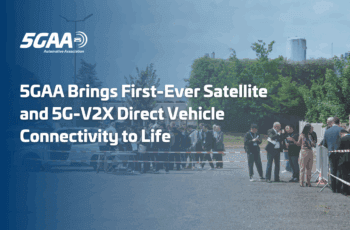
5GAA Tech Demos in Paris: 5GAA Brings First-Ever Satellite and 5G-V2X Direct Vehicle Connectivity to Life
In a global premiere in May 2025, the 5G Automotive Association (5GAA) demonstrated connected vehicles using non-terrestrial networks (NTN) complementing…

DSP Leaders World Forum: Supporting the market growth of connected vehicles
In this cross-industry panel discussion of TelecomTV’s DSP Leaders World Forum, leaders from Jaguar Land Rover, Wind River and 5GAA…

Berlin real-world use cases demonstrate game-changing C-V2X technology
On 25 October 2024 , the 5G Automotive Association (5GAA) demonstrated the latest innovations in the Cellular Vehicle-to-Everything (C-V2X) technology family…

Sustainability benefits of C-V2X
Cellular Vehicle-to-Everything, or C-V2X, communications will make transportation not only safer and smarter but also more sustainable. Sustainability has three…
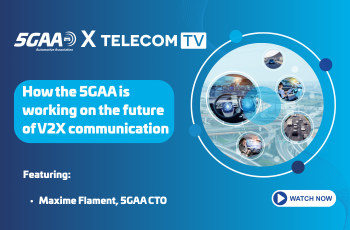
How 5GAA is working on the future of V2X communication
Video interview by TelecomTV. Our CTO Maxime Flament discusses the organisation’s technical work in advancing 5G standards for the automotive…

Transforming automotive connectivity with 5G and MEC
Jyoti Sharma, Associate Director – Network Planning, Global Networks & Technology, Verizon Video interview by TelecomTV. Jyoti Sharma discusses Verizon’s…
Transforming mobility: How 5GAA helps advance automotive connectivity and safety
Christoph Voigt, Chairman, 5GAA Video interview by TelecomTV. At the 2024 5GAA meeting week in Berlin, Christoph Voigt, chairman of…
The role of 5G in enhancing vehicle functionality and safety
Colin Lee, Principal Product Owner VCDP Strategy and Technical Specialist V2X, Digital Product Platform, JLR Video interview by TelecomTV. Colin…

5G’s transformative role in the automotive industry
Suman Sehra, Global VP, Connectivity Portfolio Management, Harman Video interview by TelecomTV. Suman Sehra highlights Harman’s role in enhancing connectivity…

How Vodafone is enhancing road safety through the STEP platform
Graham Rushton, CTO Partner Markets, Vodafone Video interview by TelecomTV. As the first mobile operator to join the 5GAA, Graham…

5G innovation and collaboration drives connected mobility
Andreas Schaller, Head V2X Technology Strategy, Bosch Mobility Video interview by TelecomTV. Andreas Schaller discusses the role of Bosch Mobility…
How Deutsche Telekom is driving innovation for smart mobility
Johannes Springer, 5GAA ex Director General & Lead 5G Automotive Program, Deutsche Telekom / T-Systems Video interview by TelecomTV. Deutsche…
V2X innovations and the role of 5G in mobility
András Váradi, Director of Research, Commsignia Video interview by TelecomTV. András Váradi highlights the work Commsignia is undertaking for the…
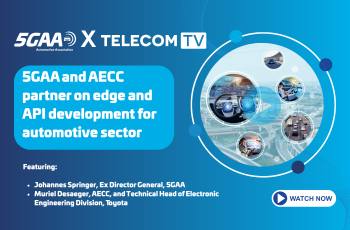
5GAA and AECC partner on edge and API development for automotive sector
Johannes Springer, 5GAA and Muriel Desaeger, AECC Video interview by TelecomTV. Since its formation in 2016, the 5GAA has been…

Real-world use cases demonstrate game-changing C-V2X technology
Cellular vehicle-to-everything (C-V2X) technology is a game-changer for automotive and transportation safety and services, helping to make mobility smarter, safer…

5GAA in Ann Arbor – Driving the Future: C-V2X Solutions for Safer Roads
In October 2023, members of the 5G Automotive Association gathered in Detroit to demonstrate the readiness of C-V2X solutions for deployment on open…

5GAA in Málaga: Symposium & Live Demos
In October 2022, sixteen members of the 5G Automotive Association gathered at the DEKRA facilities in Málaga to showcase ready-to-deploy C-V2X…

C-V2X – Future proof and compatibility
Cellular vehicle-to-everything, or C-V2X, allows vehicles to communicate with each other and everything around them. The technology is based on…

News
News Room
Latest news
Categories
Tags
Work Items

The connected mobility ecosystem lands in Barcelona for MWC 2026
Join 5GAA at Mobile World Congress (MWC) 2026, taking place 2–5 March at Fira Gran Via, Barcelona, to discover how…

5GAA Demonstrates the Future of Driving in the U.S.: From Tolling to Satellite Connectivity
Sacramento, USA, February 5, 2026 – From satellite-enabled voice calls to automated connected vehicle tolling and real-time road hazard alerts,…
5GAA welcomes the 5G Strategic Deployment Agenda for Connected and Automated Mobility on Roads
The Smart Networks and Services Joint Undertaking (SNS JU) releases the 5G Strategic Deployment Agenda for Connected and Automated Mobility…
5GAA and one6G Sign Letter of Intent to Strengthen Collaboration Towards 6G-Enabled Connected Mobility
The 5G Automotive Association (5GAA) and the one6G Association have signed a Letter of Intent (LoI) to establish a framework…
China Brings Connected Vehicles to Life in Shanghai: Advancing C-V2X Deployment including 5G-Advanced
Shanghai, 23 October 2025 — In Jiading, Shanghai, the 5G Automotive Association (5GAA) and Shanghai International Automobile City (SIAC) co-hosted…

5GAA and SIAC to present the Conference "C-V2X Implementation in China and International Cooperation 2025"
On 23 October 2025, the “C-V2X Implementation in China and International Cooperation” Conference will be held in Jiading, Shanghai, China.…
C-V2X Technology Reaches U.S. Milestone with the First “Day One Deployment District” at the ITS World Congress 2025
ATLANTA, U.S. – 3 September 2025 — The U.S. connected vehicle ecosystem took a major step forward as Atlanta became…

5GAA Members at ITS World Congress Atlanta: Advancing C-V2X for Safer, Smarter, and Greener Mobility
5GAA is proud to celebrate its members’ achievements, which will be on full display at the ITS World Congress in…
Driving Forward: 5GAA 2024 Annual Report Showcases Momentum in C-V2X Deployment
The 5G Automotive Association (5GAA) has released its 2024 Annual Report, highlighting the association’s continued progress toward the global deployment…

Driving the Future: 5GAA Brings First-Ever Satellite and 5G-V2X Direct Vehicle Connectivity to Life in Paris
PARIS, 15 May 2025 — For the first time worldwide, the 5G Automotive Association (5GAA) showcased connected vehicles using non-terrestrial…

5GAA to Host High-Level Conference and Live Demos in Paris
On 15 May 2025, the 5G Automotive Association (5GAA) will host a full day of high-level discussions and real-world demonstrations…

5GAA Launches Exclusive Marketplace for Connected Mobility Solutions
The 5G Automotive Association (5GAA) is proud to announce the launch of the 5GAA Marketplace, a dedicated platform showcasing exclusive…

5GAA Issues Statement of Intent on the Quantum Threat and Mitigation Strategies for the Automotive Sector
As part of its cooperation agreement with GSMA, 5GAA intends to work with the GSMA Post-Quantum Telco Networks (PQTN) Task…

Experience the Future of Connected Mobility at MWC 2025 with 5GAA
Join us at Mobile World Congress (MWC) 2025, taking place from March 3-6 at the Fira Gran Via in Barcelona,…
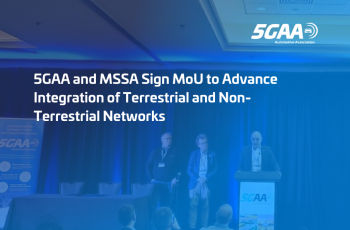
5GAA and MSSA Sign MoU to Advance Integration of Terrestrial and Non-Terrestrial Networks
The 5G Automotive Association (5GAA) has signed a Memorandum of Understanding with the Mobile Satellite Services Association (MSSA) to enhance…
Joint Technology Demonstrations with USDOT and 5GAA Members Highlight Unified Vision for Connected Mobility
Washington, D.C., 6 February 2025 – For the first time, the U.S. Department of Transportation (USDOT) and members of the…
5.9 GHz Second Report and Order: Frequently Asked Questions
To support the transportation community in navigating the FCC’s Second Report and Order on the 5.9 GHz band, 5GAA has…

Official Announcement: 5GAA Members and USDOT Partner for Live C-V2X Demonstrations
The 5G Automotive Association (5GAA) is pleased to support a joint demonstration of Cellular Vehicle-to-Everything (C-V2X) technology by the U.S.…

Contact
Get in touch
"*" indicates required fields