

5GAA Demonstrates Satellite, Safety and Cooperative Services in the Nordic Region
The 5G Automotive Association (5GAA) showcased how connected mobility services can operate at scale, presenting live demonstrations of real-time road-work safety on a Swedish highway, satellite connectivity, safety, and cooperative sensing at the AstaZero Proving Ground at RISE in Sweden.
“These demonstrations show how connected mobility and infrastructure technologies are progressing from testing to real‑world deployment,” said Christof Schmidt, Director General of 5GAA. “They offer a promising perspective for scaling these services across Europe.”
5GAA members Bosch and Cubic³ presented satellite-enabled commercial fleet management, showing how logistics and commercial vehicles can remain connected even outside terrestrial coverage. Technology partners Vedecom, Rolling Wireless, Rohde & Schwarz, Cubic³, Skylo and Qualcomm Technologies, Inc. showed how emergency voice calls can be handled via satellite, ensuring drivers can reach assistance even in areas with limited coverage.
Road safety and coordinated traffic operations were another key focus. BMW, Bosch, and RISE demonstrated how live road-work situations can be monitored in real time, allowing road operators to assess risk, adapt operations to protect workers and road users, and display hazard warnings to drivers. Building on this, Monotch showed how road-work warning data can be shared across country borders while maintaining data quality and governance. Vehicle-focused demonstrations by Ericsson, JOYNEXT, Vodafone and Qualcomm Technologies highlighted large-scale connectivity testing and interoperable V2X safety messaging. Qualcomm Technologies also demonstrated the concurrent reception of 5G-V2X and ITS-G5 messages on a single chipset.
Emergency communications demonstrations by Qualcomm Technologies and Rohde & Schwarz illustrated how hybrid eCall solutions maintain service continuity when network conditions change, and Anritsu and LG Electronics demonstrated an end-to-end hybrid eCall solution, verifying interoperability, network switching behaviour, and compliance with standards across multi-generation cellular networks.
The programme also featured two Bosch demonstrations. One, about cooperative sensing, showed how shared radar data from vehicles and infrastructure improves hazard detection in complex traffic situations. A second showed how real-time cloud-enhanced ADAS enables advanced road-sign recognition.
Together, the 5GAA Demonstrations underscore how connected mobility technologies are being applied in real-world traffic conditions and across borders, positioning the Nordic region as a reference point for scaling connected mobility across Europe.
More details are available in the 5GAA Demonstrations Brochure here.
Full Press Release available here.
Media Contact
Victoria Bech | marcom@5gaa.org | +32 472 66 61 17 | www.5gaa.org
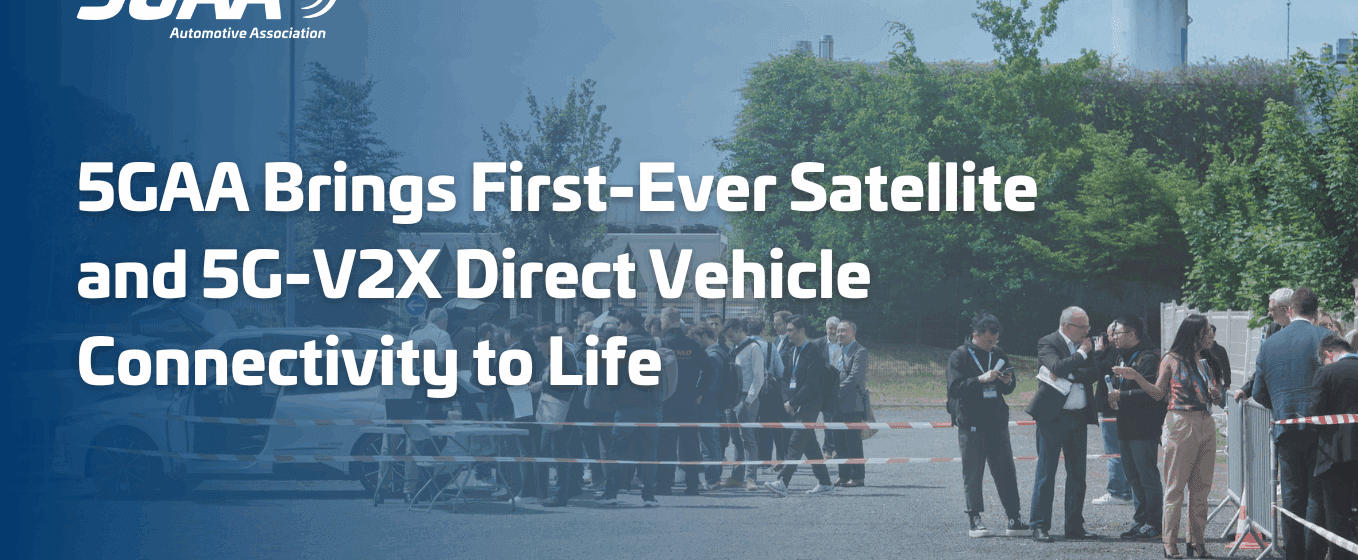
5GAA Tech Demos in Paris: 5GAA Brings First-Ever Satellite and 5G-V2X Direct Vehicle Connectivity to Life
In a global premiere in May 2025, the 5G Automotive Association (5GAA) demonstrated connected vehicles using non-terrestrial networks (NTN) complementing terrestrial 4G and 5G networks for emergency messaging. It also did the first on-the-road, live-traffic demonstration of 5G-V2X Direct technology capabilities for advanced connected-vehicle services and ready-to-deploy vehicle-to-network (V2N) technologies, which can improve road safety in real traffic conditions.
Missed the demos? No problem! Now you can see the replay of these advanced vehicle technologies! Watch the full video below to experience the demos in action!
5GAA-member vehicle manufacturers BMW Group and Stellantis and technology partners Anritsu, Cubic³, Deutsche Telekom, HARMAN, Jember, LG Electronics, Qualcomm Technologies, MediaTek, Rohde & Schwarz, Rolling Wireless, Skylo, VEDECOM Institute, and Viasat participated in the NTN satellite connectivity demonstrations. The demos focused on realising hazard warning and emergency messaging use cases in the vehicle as well as illustrating how NTN will complement terrestrial 4G and 5G networks in the future.
Demonstrations on public roads underlined how NTN can support ubiquitous automotive connectivity for connected services with seamless integration and switching between NTN and terrestrial networks to enable voice communication. In the future, car drivers may not even realise that satellite connectivity has replaced a terrestrial network. According to the 5GAA 2030 Roadmap, the initial market deployment of satellite connectivity in vehicles is expected by 2027 (based on IoT NTN 3GPP Release 17).
Anritsu, Keysight Technologies, Rohde & Schwarz, and MediaTek complemented the NTN demonstrations with parallel test equipment measurements for performance verification.
For the first time on public roads, 5GAA member Valeo, in collaboration with Marben, demonstrated 5G-V2X Direct, in which two vehicles shared sensor data, triggering a warning of a pedestrian crossing at an obstructed intersection. This demonstration illustrated how 5G-V2X Direct (based on 3GPP Release 16) will enable vulnerable road users’ advanced protection by leveraging sensors and camera feeds from other vehicles to alert drivers, paving the way for smarter mobility. As per the 5GAA Visionary 2030 Roadmap, 5G-V2X is expected to be mass-deployed in commercial vehicle models starting from the time horizon 2026-2029.
The public road demonstrations continued with V2N technology for road users’ protection. 5GAA members, including Nokia, Orange, Stellantis, Valeo, and VEDECOM Institute, showcased interoperable V2X Platforms with vehicles, mobile applications and smart intersections (equipped with cameras and connected via the 5G networks) sharing collective perception to enhance road users’ safety.
Additionally, HARMAN and u-blox showcased Emergency Electronic Brake Light (EEBL) near-real-time alerts to prevent hard braking events in line with the upcoming 2026 Euro NCAP local hazard warning requirements, and used precise positioning techniques to prevent false alerts.
5GAA members Rohde & Schwarz, S.E.A., Keysight and Orange also exhibited Next Generation Emergency Call (NG eCall) verification and network performance.
The event, hosted by Telecom-Paris, highlighted how 5GAA is driving the development of new standards for safety and innovation in automotive connectivity in Europe and globally.
Driving the Future: 5GAA Brings First-Ever Satellite and 5G-V2X Direct Vehicle Connectivity to Life in Paris
- In a global premiere, 5GAA members demonstrated connected vehicles using non-terrestrial networks (NTN), complementing terrestrial 4G and 5G networks
- The event featured the first on-the-road, live-traffic demonstration of 5G-V2X Direct technology capabilities for advanced connected mobility services
- 5GAA members showcased ready-to-deploy vehicle-to-network (V2N) technologies improving road safety in real traffic conditions
PARIS, 15 May 2025 — For the first time worldwide, the 5G Automotive Association (5GAA) showcased connected vehicles using non-terrestrial networks (NTN) for emergency messaging, as well as 5G-V2X Direct for advanced detection of vulnerable road users (VRU) in real-traffic conditions. 5GAA members also demonstrated the readily available capabilities of Vehicle-to-Network (V2N) services.
“Today, we saw real vehicles on real roads, connected through cutting-edge technologies such as satellite, 5G-V2X Direct and commercial networks. This is the future of automotive connectivity, and it’s closer than you think,” said 5GAA Chairman Christoph Voigt.
5GAA members, vehicle manufacturers BMW Group and Stellantis and technology partners Anritsu,Cubic³, Deutsche Telekom, HARMAN, Jember, LG Electronics, Qualcomm Technologies, MediaTek, Rohde & Schwarz, Rolling Wireless, Skylo, VEDECOM Institute and Viasat demonstrated NTN satellite connectivity. Demonstrations focused respectively on realising hazard warning and emergency messaging use cases in the vehicle, as well as illustrating how NTN will complement terrestrial 4G and 5G networks in the future. Demonstrations on public roads emphasised the vision of how NTN can support ubiquitous automotive connectivity for connected services with seamless integration and switching between NTN and terrestrial networks to enable voice communication. In the future, car drivers may not even realise that satellite connectivity is being established instead of using a terrestrial network. According to 5GAA 2030 Roadmap, the initial market deployment of satellite connectivity in vehicles is expected by 2027 (based on IoT NTN 3GPP Release 17).
Anritsu, Keysight Technologies, Rohde & Schwarz, and MediaTek complemented the NTN demonstrations with parallel test equipment measurements for performance verification.
For the first time on the road, 5GAA member Valeo, in collaboration with Marben, demonstrated 5G-V2X Direct, in which two vehicles shared sensor data, triggering a warning of a pedestrian crossing at an obstructed intersection. This demonstration illustrated how 5G-V2X Direct (based on 3GPP Release 16) will enable vulnerable road users’ advanced protection by leveraging sensors and camera feeds from other vehicles to alert drivers, paving the way for smarter mobility. As per the 5GAA Visionary 2030 Roadmap, 5G-V2X is expected to be mass-deployed in commercial vehicle models starting from the time horizon 2026-2029.
The public road demonstrations continued with V2N technology for road users’ protection. 5GAA members, including Nokia, Orange, Stellantis, Valeo, and VEDECOM Institute, showcased interoperable V2X Platforms with vehicles, mobile applications and smart intersections (equipped with cameras and connected via the 5G networks) sharing collective perception to enhance road users’ safety. Additionally, HARMAN and u-blox showcased Emergency Electronic Brake Light (EEBL) near-real-time alerts to prevent hard braking events, in line with the upcoming 2026 Euro NCAP local hazard requirements, and used precise positioning techniques to prevent false alerts.
5GAA members Rohde & Schwarz, S.E.A., Keysight and Orange alsoexhibited Next Generation Emergency Call (NG eCall) verification and network performance.
The event, hosted by Telecom-Paris, highlighted how 5GAA is developing new standards for safety and innovation in automotive connectivity in Europe and globally.
Please see our brochure about the Paris demonstrations here.
A French version of this press release is also available for our French-speaking audience here.
Discover What Our 5GAA Members Are Saying here.
About the 5GAA
The 5G Automotive Association (5GAA) is a global, cross-industry organisation of more than 110 members, including leading global automakers, Tier-1 suppliers, mobile operators, semiconductor companies, and test equipment vendors. 5GAA members work together to develop end-to-end solutions for future mobility and transport services. 5GAA is committed to helping define and develop the next generation of connected mobility, automated vehicles, and intelligent transport solutions based on C-V2X. For more information about 5GAA, please visit www.5gaa.org.
5GAA Publishes Comprehensive Guidance for Deployment of C-V2X Day 1 Safety Services
Detroit, October 23 – A coalition of industry leaders, including the 5G Automotive Association (5GAA) and Crash Avoidance Metrics Partners (CAMP LLC), has released a comprehensive guidance aimed at infrastructure owners and operators for the deployment of Vehicle-to-Everything (V2X) technology, specifically focused on C-V2X direct communication at 5.9 GHz in the United States (US).
The guidance, developed by 5GAA, benefitted from essential input from ITS ecosystem stakeholders and partners, including the Utah Department of Transportation, National Electrical Manufacturers Association (NEMA), OmniAir, the Intelligent Transportation Society of America (ITS America), and researchers from the University of Michigan.
The document is a valuable reference for “Day One” C-V2X deployment by gathering established requirements and new considerations, and it provides compatible guidance for several Day 1s, ranging from road infrastructure owner-operators seeking early deployment based on waivers, through Day 1 where automakers deploy. The primary target audience includes road Infrastructure Owners and Operators (IOOs), who are pivotal in taking up C-V2X technology for transportation safety and efficiency.
The 5GAA guidance report focuses on C-V2X direct communications and streamlines this complex field into commonly understood profiles, simplifying deployment timelines, and ensuring effective communication between vehicles and infrastructure.
It also provides findings from various guidelines, standards, and deployment projects to offer a straightforward guide for Vehicle-to-Vehicle (V2V) and Vehicle-to-Infrastructure (V2I) connectivity required for Day One Connected Vehicle (CV) applications. In addition, it includes guidance and a profile on the messages that can be sent.
The complementary nature of both modes of communication (C-V2X and V2N) can deliver a richer experience for end-to-end use cases by leveraging both local short-range and cloud-based long-range connectivity.
Key highlights of the report include:
- Clarifying expectations for a swift V2X roadside unit deployment, providing concise and accessible materials for all participants in safe traffic communications.
- Identifying a limited but crucial set of messages, interoperability needs, and performance requirements to expedite deployments, ensuring an orderly and safety-critical message set.
- Providing SAE J3161 communication profiles and parameters, creating a standard set of rules for optimal channel access and message usage.
The report aims to establish V2X communications that support interoperability and data integrity, delivering the necessary performance for various Day One applications. It also offers insights into potential Day Two messages, preparing the V2X community for the next deployment stage.
Find the complete report here.
About 5GAA
The 5G Automotive Association (5GAA) is a global, cross-industry organization of over 120 members, including leading global automakers, Tier-1 suppliers, mobile operators, semiconductor companies, and test equipment vendors. 5GAA members work together to develop end-to-end solutions for future mobility and transport services. 5GAA is committed to helping define and develop the next generation of connected mobility, automated vehicle, and intelligent transport solutions based on C-V2X. For more information, visit our website.
Media Contact
5GAA Communications Team: marcom@5gaa.org
5GAA Welcomes the European Parliament’s Adoption of a Forward-Looking ITS Directive Revision
Earlier today, Tuesday 3rd October, the European Parliament by an overwhelming majority voted to approve the ITS Directive Revision. 5GAA commends policymakers and rapporteur Plumb for the adoption of a forward-looking ITS Directive that promotes technological innovation, and ultimately, the large-scale deployment of intelligent transport systems across Europe. We now encourage the Council of the EU to swiftly approve the text.
5GAA further welcomes the recognition of the technology neutrality principle, now enshrined within the ITS Directive. This principle now guarantees a focus on service delivery, providing a level playing field and the opportunity to reposition the European industry in the global race for automotive connectivity.
As underlined in 5GAA’s recent open statement, the industry, including the major European carmakers, is moving beyond past technology disputes to converge towards 5G-V2X, including direct communications, as the future reference technology for automotive direct connectivity and an important enabler of automated driving.
This commitment, combined with the adoption of the ITS Directive, will give new impetus to connected cars in Europe. As per the 5GAA Visionary 2030 Roadmap, 5G-V2X is expected to be mass-deployed in commercial vehicle models starting from the time horizon 2026-2029
The European Commission will have 12 months from the Directive’s entry into force, to consult the European ITS Advisory Group and relevant stakeholders to adopt a working program through an implementing act. 5GAA stands ready to contribute to the elaboration of the new ITS Work Programme.
We look forward to continuing the collaboration between EU institutions and industry to make cooperative, connected and automated mobility a reality for a smarter, safer and more environmentally friendly European transport ecosystem.
About 5GAA
The 5G Automotive Association (5GAA) is a global, cross-industry organization of over 120 members, including leading global automakers, Tier-1 suppliers, mobile operators, semiconductor companies, and test equipment vendors. 5GAA members work together to develop end-to-end solutions for future mobility and transport services. 5GAA is committed to helping define and develop the next generation of connected mobility, automated vehicle, and intelligent transport solutions based on C-V2X. For more information, visit our website.
Media Contact
5GAA Communications Team: marcom@5gaa.org
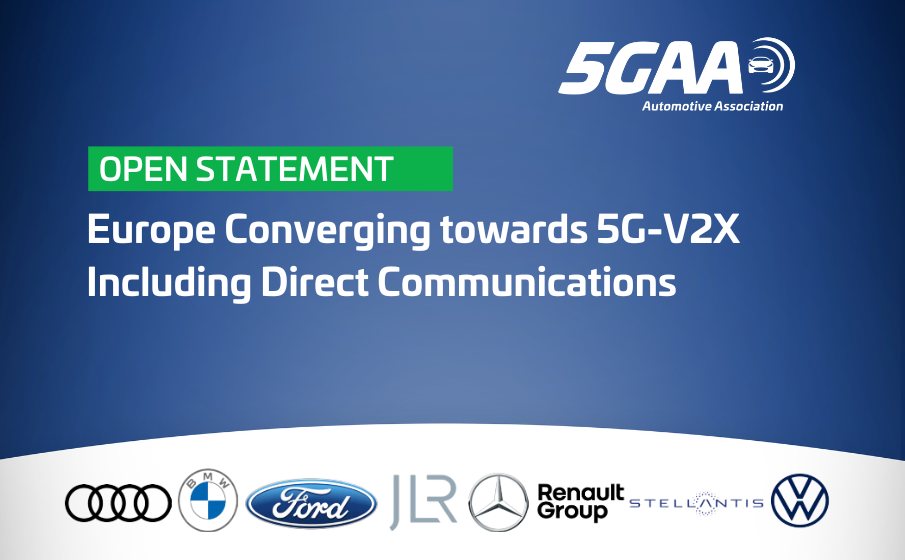
Press Release: Automotive Giants at 5GAA Unite around the Future of Connected Mobility
Brussels, 28 September 2023– 5GAA announces a ground-breaking initiative to give new impetus to connected cars in Europe, based on 5G-V2X technology including direct communications, moving beyond past technology disputes.
Ready to move forward with state-of-the-art technology, the major European carmakers, representing jointly over 70% market share[1], want to demonstrate their commitment to bridging differences and working together towards the widespread adoption of 5G-V2X.
5G-V2X includes 5G-V2X mobile network communications (already deployed in vehicles since 2021 on our roads), complemented with 5G-V2X direct communications. 5G-V2X will provide essential and advanced connected car services, enhancing road safety, especially for vulnerable road users, decreasing traffic congestion, and improving overall mobility efficiency and driver comfort.
Following the provisional deal between the Council and the Parliament in June 2023 on the revision of the Directive on Intelligent Transport Systems (ITS)[2], 5GAA looks forward to the EU institutions adopting the final text as soon as possible. The revised Directive will give the industry the necessary legal certainty to invest in 5G-V2X direct communications deployment, as it explicitly acknowledges technology neutrality.
The letter highlights the need for convergence and action to break the current stalemate and reposition the European Union in the global race for automotive connectivity as other world regions are making swift progress.
“By pledging their commitment to this open letter, leading OEMs demonstrate their commitment to bridging differences and working together towards the widespread adoption of 5G-V2X technology, the second generation of V2X technologies. This collective marks a pivotal starting point in Europe’s “race to 5G-V2X” spearheaded by 5GAA and its members. Extensive efforts are underway to tackle the technical and regulatory challenges that impede the timely deployment of 5G-V2X, aligning with the 5GAA roadmap”
Christoph Voigt, Chairman of the 5GAA Board and Head of R&D Connectivity at Audi.
With this initiative and recognising the need to strike a consensus, 5GAA and its members have charted a unified path forward for Europe in an open letter to policymakers, regulatory bodies, and industry players. The 5GAA announcement echoes the recently published position[3] of the French Automotive Industry representative body (Plateforme Automobile – PFA, representing also 5GAA members like Renault, Stellantis and Valeo) designating 5G-V2X as the technology of choice for V2X direct communication.
Our Member Vehicle Manufacturers Quotes
BMW is dedicated to investing in research and development to further harness the potential of 5G-V2X technology. By supporting the adoption of 5G-V2X technology, we aim to create a connected ecosystem that enhances the overall driving experience and contributes to a greener and smarter future.
Nicolai Kraemer, Vice President Connected Vehicle Platforms, BMW.
We look forward to the next steps the industry is taking for the broader deployment of technology to help enable a future where vehicles can ‘talk’ to similarly equipped vehicles, devices and road infrastructure which has the potential to help provide safer and more enjoyable on-road experiences.
Andre Welch, Director of Government Relations, Ford Motor Company.
JLR is committed to C-V2X delivery within its new generation of vehicles and fully supports 5GAA’s letter promoting European implementation of C-V2X.
Murray Paul, Director of Public Affairs, JLR
Renault’s approach to safety and substantial investments in safety-related R&D illustrates its transition from a traditional car manufacturer to a leading mobility services and tech company.
Arnaud Belloni, VP Renault Brand, Global Marketing
Renault’s safety vision within Human First program goes beyond designing safe cars. Renault is striving for technological advancements and driving innovation towards keeping everybody safe on the roads.
Katrin Matthes, Renault Software & System VP Innovation and Technology
Stellantis in pursuing its Dare Forward 2030 strategy encompassing the technology evolution for the connected and autonomous vehicle.
Francesco Lilli, Stellantis Global Head of Advanced Connectivity
5GAA V2X roadmap draws a common direction to enable on a global basis an efficient and safe mobility.
El Khamis Kadiri, Stellantis Connectivity & EE Expert
Media Contact
5GAA Communications Team: marcom@5gaa.org
[1] ACEA Passenger Car Registrations 2022, January 2023
[2] Council and Parliament strike a deal on the roll-out of intelligent transport systems, 08 June 2023
[3] https://pfa-auto.fr/wp-content/uploads/2023/07/PTF_V2X_short-range-radio-technology-choice_2023.pdf
5GAA Applauds FCC Action to Permit Initial C-V2X Deployments
Washington, DC, April 25 – The 5G Automotive Association (5GAA) applauds the Federal Communications Commission (FCC) for its decision to permit initial deployments of Cellular Vehicle-to-Everything (“C-V2X”) technology in the 5.9 GHz band.
“Today’s action by the FCC is an important milestone on the road towards widespread deployment of life-saving C-V2X technology in the United States,” said John F. Kwant, Executive Director, Americas for 5GAA. “These initial deployments of C-V2X technology will allow road users to begin to benefit from this state-of-the-art vehicle safety technology. 5GAA and its member companies appreciate the FCC’s efforts in this important proceeding, and we look forward to working with the FCC to ensure swift action on the other pending waiver requests to deploy C-V2X for roadway safety use-cases.”
In December 2021, a group of automakers, state departments of transportation, and equipment manufacturers jointly filed a Waiver Request asking the FCC to waive its 5.9 GHz band rules to permit them to immediately deploy C-V2X technology. In addition to the Utah and Virginia state departments of transportation, signatories to the filing included 5GAA members Ford, Audi, Jaguar Land Rover, Applied Information, Cohda Wireless, Commsignia, Danlaw, HARMAN and Panasonic. The request identified a wide range of deployment plans—from vehicular deployments to widescale road infrastructure installments—that public and private stakeholders are ready to implement.
The National Highway Traffic Safety Administration (NHTSA) estimated that 42,795 people died in motor vehicle traffic crashes in 2022, a fatality rate that remains flat but after two years of dramatic increases. Many of these deaths are avoidable with broad deployment of roadway safety technologies like C-V2X. Indeed, NHTSA has previously estimated that safety applications enabled by V2X could eliminate or mitigate the severity of more than 80 percent of light vehicle crashes. As traffic fatalities rapidly increase, the FCC’s action allows investment and innovation in C-V2X safety applications that can help reverse this troubling trend.
About 5GAA
The 5G Automotive Association (5GAA) is a global, cross-industry organization of over 120 members, including leading global automakers, Tier-1 suppliers, mobile operators, semiconductor companies, and test equipment vendors. 5GAA members work together to develop end-to-end solutions for future mobility and transport services. 5GAA is committed to helping define and develop the next generation of connected mobility, automated vehicle, and intelligent transport solutions based on C-V2X. For more information, visit our website.
Media Contact
5GAA Communications Team: marcom@5gaa.org

Teams invitation
By receiving this mail and arriving on this page, we are glad to welcome you onboard.
With your credentials, you have access to our Microsoft Teams environment.
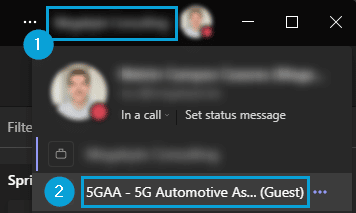
If you are using Microsoft Teams in your professional environment, you will soon notice at the upper right part of the desktop app your organization name instead of your personal name.
To switch tenants, simply click on the drop-down menu.
You will find 5GAA – 5G Automotive Association e.V. (Guest).
If there are new activities, a notification badge will show up next to the 5GAA tenant name.
You may find it more productive to use your web browser to connect to the 5GAA environment and keep your desktop app connected on your professional environment.
If you prefer to use the desktop application, in our experience the environment takes a little longer before it appears as an organization you can connect to, sometimes a reboot may be required.
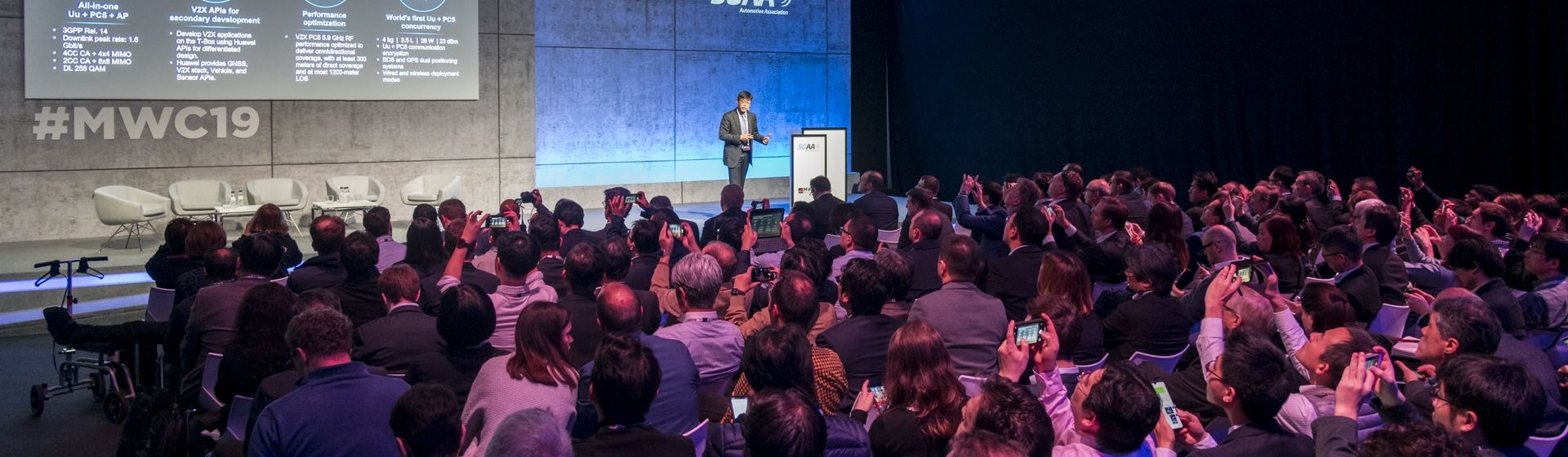
Automotive C-V2X ready to roll out globally, says 5GAA at this year’s MWC Barcelona
All presentations of the 5GAA session at MWC19 Barcelona are available down this page.
February 27th, Barcelona – During today’s well attended keynote, ‘Connecting the Mobility World with 5G’, the 5G Automotive Association (5GAA) gathered experts from the automotive, technology and telecom industries to explain how the deployment of ‘Cellular Vehicle-to-Everything’ (C-V2X) communication technology on the path to 5G is shaping the mobility of the future. Today LTE-V2X, the initial version of C-V2X, stands on the verge of its commercial launch: allowing vehicles to communicate with each other and their surroundings and, together with 5G enhancements, facilitating broad scale improvements in road safety.
“By bringing together key actors of the mobility ecosystem – across the automotive, information and communications technology industries – 5GAA continuously strives to develop forward-looking solutions for intelligent transportation services. Both for today and tomorrow.” stressed Thierry Klein, 5GAA Vice Chair and Head of the Disruptive Innovation Program at Nokia Bell Labs. “These end-to-end integrated solutions bring enhanced safety, sustainability, and convenience to all road users. 5GAA is very excited to be pioneering the revolution towards a smarter and more connected mobility world,” Thierry Klein added.
C-V2X communication is the state-of-the-art, high-speed cellular communications platform that enables vehicles to communicate with one another, with roadside infrastructure, with other road users (such as pedestrians, cyclists, and motorcyclists) using either direct short-range communications or cellular networks. While C-V2X network-based solutions are already widely deployed, direct communication solutions will be commercially available as of this year. As such the C-V2X platform delivers safety, mobility, traffic efficiency, and environmental benefits. C-V2X is designed with an evolutionary path to 5G and supports safe and efficient operations of autonomous vehicles.
5GAA members spearheading C-V2X
A number of 5GAA members are announcing ground breaking use cases at this year’ MWC. 5GAA members Telefónica, Ericsson, Ficosa and Seat show 5G connected car use cases supported by C-V2X direct communication for safer driving in a city (e.g. detection of cyclists when turning right or of a pedestrian at a zebra crossing). Another key technology bringing these use cases to life is edge computing.
In addition, 5GAA members Continental and Vodafone are working together to increase road safety and protect all road users for instance via “digital safety-shield” for cyclists and pedestrians, using C-V2X direct communication and edge computing in the first 5G deployments. The 5G-ready tests are taking place under real-life conditions at Vodafone’s 5G Mobility Lab in Aldenhoven, Germany.
Rohde & Schwarz has announced a collaboration with automotive electronics specialist Vector on a C-V2X end-to-end application layer test solution to verify safety-critical V2X scenarios. The companies’ integrated test platform is showcased for the first time at Mobile World Congress.
Deutsche Telekom has announced first C-V2X tests together with Skoda Auto in Czech as part of the European C-Roads project.
Geely also announced its plans to launch the first mass-produced C-V2X enabled vehicles in China together with Qualcomm in 2021.
Qualcomm has also announced its first 5G automotive platform, enabling both C-V2X short and long-range modes, which is expected to sample later this year and are planned for production vehicles in 2021.
C-V2X direct communication goes commercial in 2019
Mass production of C-V2X chips including direct communication from several suppliers is ongoing, and multiple radio vendors have already integrated these chips into their automotive radio offerings. 2019 is the year when C-V2X direct communication technology will be commercially available across the globe. Furthermore, full interoperability testing on C-V2X applications is ongoing among 5GAA members. The first mass-deployment in vehicles on the roads is anticipated to start in China in 2020; to be followed swiftly in other regions when local regulations allow for it.
“C-V2X is now ready to roll. At Ford, we will begin to deploy this technology in all new models launching in the US starting in 2022” confirmed Don Butler, Executive Director of Connected Vehicle & Services at Ford Motor Co.
The next milestone: 5G New Radio
C-V2X provides a clear evolution path to the family of 5G technologies for both direct and network communication. Part of this evolution is the 5G New Radio (NR).
NR-V2X will eventually ensure safe operation of autonomous driving vehicles by using 5G New Radio with Ultra Reliable Low Latency Communications (URLLC) network based communication combined with improved direct short range communications.
“The development of the NR-V2X standard is due for completion by the end of 2019; eventually hitting the road in 2023. This will enable a new generation of use cases for connected automated vehicles”, said Maxime Flament, CTO at 5GAA.
About 5GAA
The 5G Automotive Association (5GAA) is a global, cross-industry organisation with 110 members working together to develop end-to-end solutions for future mobility and transportation services. The organisation is committed to helping define and develop the next generation of connected mobility for advanced driving and automated vehicle solutions.
Presentations
- Opening speech by Thierry Klein, 5GAA Vice Chair & Nokia Bell Labs / Connecting the Mobility World with 5G-V2X
- Keynote by Friedhelm Ramme, Ericsson / 5G: From Concepts to Reality
- Keynote by Thorsten Hehn, Audi / 5G for Automotive: Key Applications
- Keynote by Jiang Wangsheng, Huawei / C-V2X Enables Intelligent Transportation
- Keynote by Nakul Duggal, Qualcomm / C-V2X Ignites Automotive Connected Revolution
- Speech by Vishnu Sudaram, Harman (Samsung) / Go-To-Market Timeline
5GAA: cellular technology is key enabler for smart mobility of the future
Industry association calls on European Commission to allow stakeholders to work collaboratively towards an agreement on the technology catalyzing the mobility of the future and warns against a “premature and cumbersome legislative decision”.
The 5G Automotive Association (5GAA) encourages the automotive, technology, and telecommunications industries and the European Commission to be ambitious when evaluating technologies for connected, autonomous vehicles. 5GAA is confident that cellular communication technology (C-V2X) has the most benefits when applied to connected, self-driving cars. It has provided its views to the Commission in a workshop and a letter with recommendations. Since its launch one year ago, over 50 industry leaders from the automotive, technology and telecommunications industries have teamed up in 5GAA to accelerate C-V2X technology development and its evolution to 5G-V2X for enhanced safety, automated driving and connected mobility.
Christoph Voigt, Chairman of 5GAA said, “5GAA is confident that cellular technology (including direct vehicle-to-vehicle communication at 5.9 GHz) has the potential to lead to the best outcomes in the long run. We are strongly relying on the European institutional support to put in place a regulatory framework allowing for an industry-driven and swift deployment of this technology. It is crucial to consider how the 5.9 GHz band, the “life blood” of wireless vehicle communication, can be used efficiently in the context of 5G technology evolution, road safety, and economic scalability. The automotive and transportation sectors, both public and private, are making significant investment commitments. Therefore, we are urging the European Commission to allow the ITS-G5 and C-V2X stakeholders to work together towards an agreement on the future of connected and automated cars, without a premature and cumbersome legislative decision.”
5GAA has recently provided its views to the Commission in a workshop and a letter with recommendations.
Christoph Voigt: “We should aim high enough when selecting the solutions to make connected, self-driving vehicles a reality. These are a catalyst to improving the quality of life globally through safer traffic, improved mobility, cleaner air in cities, and a better experience overall for drivers.”
Dino Flore, Director General of 5GAA adds, “Saving lives through improved road safety is obviously the primary positive outcome of deploying communication technology solutions. In addition, we should take into account other aspects when evaluating alternatives. We’re not only talking about reducing congestion and pollution but also optimizing the driving experience. It is our view that cellular technology, including direct vehicle-to-vehicle communication at 5.9 GHz, has the most upward potential in the long run.”
Helping vehicles “understand the environment they are navigating”
Launched in September 2016 by 8 founding members the 5GAA has in less than a year grown to include over 50 leaders from the automotive, technology and telecom industries who collaborate cross-industry on the future of transport. 5GAA’s mission is to develop, test, and promote communications solutions, initiate their standardization and accelerate their commercial availability and global market penetration. The objective is to address society’s connected mobility and road safety needs with applications such as autonomous driving, ubiquitous access to services and integration into smart city and intelligent transportation.
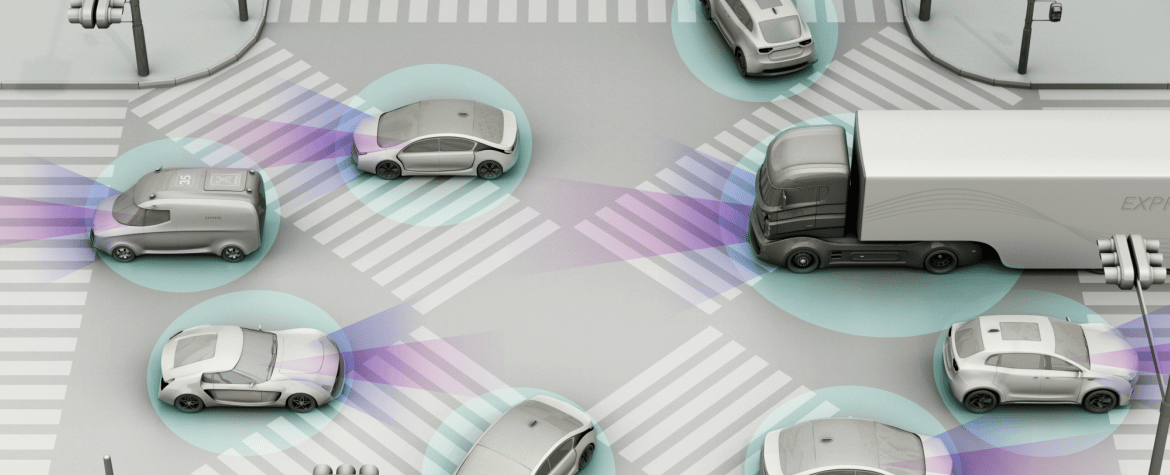
Connected vehicles use communication technology to not only communicate with other vehicles but also with road infrastructure, other road users such as pedestrians, and the Internet – e.g. to provide traffic updates and parking guidance. Use cases include collision warnings, “traffic jam ahead” warnings, green light optimal speed advisory, parking guidance, and assisting drivers in tackling treacherous traffic situations (e.g. turning left at a crossroads). Connected vehicles will eventually reduce pollution, and make traffic more efficient, reducing congestion in cities and improving the flow of goods and people.
Christoph Voigt explains, “Equipping cars with sensors and cameras is one thing, but imagine what is possible when cars use cellular technology to communicate with their entire ecosystem: other vehicles, road users, infrastructure, and central services that give real-time information.”
“It’s the difference between a car that is capable of seeing what is happening in its immediate surroundings and one that can use all available information to allow for a safer and more comfortable driving experience. After all, as drivers we do more than purely react to what’s in front of us. We listen to traffic info, we are aware of the area we’re navigating, and we are alert to traffic jams in rush hour. We use context to guide our driving.”
“This is exactly what cellular connectivity can enable vehicles to make easier, or even take over from us in the case of self-driving vehicles. Except that it will be faster and more accurate,” concludes Christoph Voigt.
-Ends
About 5GAA
The 5G Automotive Association (5GAA) is a global cross-industry organisation of companies from the automotive, technology and telecommunications industries (ICT), working together to develop end-to-end solutions for future mobility and transportation services. Created in 2016, the Association is comprised of over 50 members which mission
is to develop, test and promote communications solutions, initiate their standardization and accelerate their commercial availability and global market penetration to address societal need. For more information please visit 5gaa.org
Contacts
Robbe Libbrecht
FINN PR
robbe.libbrecht@finnpr.com
M +32 497 23 30 38
5GAA Marketing & Communications
marcom@5GAA.org