






5GAA Announces New Executive Director, Americas

5GAA Announces New Executive Director, Americas

John F. Kwant will lead 5GAA’s U.S. activities as the trade association’s first Executive Director, Americas

Washington DC, March 28th – The 5G Automotive Association (5GAA) has announced the appointment of John F. Kwant as the organization’s inaugural Executive Director, Americas. In this new role, he will serve as the principal spokesperson for 5GAA in the United States while developing and executing a public policy and communications strategy to advance the safe and timely deployment of Cellular Vehicle-to-Everything (“C-V2X”) technology.

“John is a well-known and respected thought leader and advocate for connected technology deployment, so we are thrilled to have him lead 5GAA’s efforts to facilitate connected mobility in the United States. John’s appointment as Executive Director, Americas signals how far 5GAA has progressed in recent years, and the creation of this position is a natural next step in shaping the new era of mobility and paving the way towards connected driving,” said Christoph Voigt, chairman of the 5GAA Board. “His extensive advocacy experience and knowledge of the connected mobility landscape make him uniquely suited to navigate public policy issues, build relationships, and drive 5GAA’s message in the Americas.”

John F. Kwant, 5GAA Executive Director, Americas

Prior to joining 5GAA, John spent more than 20 years with the Ford Motor Company, holding various global business, strategy, and government relations roles in Dearborn, Washington, D.C., and Shanghai. Most recently, he was Ford’s Global Director of Mobility and Advanced Technologies, leading global advocacy for autonomous and connected vehicles and mobility solutions. In this role, he was instrumental in establishing 5GAA’s U.S. Policy Taskforce, serving as its Chair for several years.

The National Highway Traffic Safety Administration (NHTSA) estimated that 42,915 people died in motor vehicle traffic crashes in 2021, a 10.5 percent increase from 2020. Many of these incidents could be avoided with the broad deployment of roadway safety technologies like C-V2X. NHTSA has previously estimated that safety applications enabled by V2X could eliminate or mitigate the severity of more than 80 percent of light vehicle crashes.

“With the right policies in place, C-V2X technology will deliver significant safety benefits and would likely help to reverse the rising number of roadway fatalities on our roadways. I believe we’re at an inflection point, with broad public and private sector consensus that now is the time to deploy,” said Kwant. “I am thrilled to be working with recognized leaders in the automotive, telecommunications, and technology industries towards broadscale deployment of C-V2X solutions.”

Kwant is a native Michigander with a Bachelor of Science in Engineering, Industrial and Operations Engineering from the University of Michigan. He also holds both a Master of Business Administration and a Master of Engineering Management degree from Northwestern University.

About 5GAA

The 5G Automotive Association (5GAA) is a global, cross-industry organization of over 130 members made of leading global automakers, Tier-1 suppliers, mobile operators, semiconductor companies, and test equipment vendors. It works together to develop end-to-end solutions for future mobility and transport services. 5GAA is committed to helping define and develop the next generation of connected mobility, automated vehicle, and intelligent transport solutions based on C-V2X. For more information, visit our website www.5gaa.org.

Press Release: Public and Private Sectors Aligned Behind V2X Deployment, 2023 a Pivotal Year

Press Release: Public and Private Sectors Aligned Behind V2X Deployment, 2023 a Pivotal Year

Brussels – Today, we join together to reaffirm our continued support for the rapid, widespread deployment of vehicle-to-everything (V2X) technologies in order to further improve safety on American roads. V2X, which allows communication between vehicles, infrastructure, and other road users such as pedestrians and bicyclists, provides drivers with crucial warnings necessary to improve safety. Our organizations represent the full breadth of the transportation stakeholder community and are aligned in our belief that the widespread deployment of V2X technologies can dramatically reduce crashes and fatalities on American roads for all road users.

We believe that 2023 will be a pivotal year for V2X deployment. Transportation stakeholders have aligned behind one V2X technology, cellular vehicle-to-everything (C-V2X), clearing the way for a unified, nationwide approach to the deployment of this tool. The U.S. Department of Transportation (USDOT) recently held a V2X Summit in which it committed to the development of a Nationwide V2X Deployment Plan, lending crucial leadership to the deployment of these technologies. The Federal Communications Commission (FCC) is poised to deliver much needed regulatory clarity for the deployment of C-V2X through the issuance of pending waivers to operate in the 5.9 GHz Band. Multiple stakeholders are making significant investments in CV2X today, and the waivers under consideration at the FCC are urgently needed to move forward with deployment plans.

We wish to express our appreciation for the work being done by USDOT, FCC, and the National Telecommunications and Information Administration to maintain interference-free dedicated spectrum and quickly establish the regulatory framework that will allow for widespread deployment of C-V2X. This includes the FCC first allowing near-term deployments to move forward under waiver authority, the FCC issuing a Second Report and Order that sets the final rules for the future of these technologies and protects the spectrum from interference, and USDOT adopting a Nationwide V2X Deployment Plan. As these steps are undertaken, our organizations will continue to work collaboratively to resolve remaining issues to deploy CV2X, giving drivers and other road users a critical tool to improve safety, reduce crashes, and decrease fatalities.


Intelligent Transportation Society of America
American Association of State Highway and Transportation Officials
Alliance for Automotive Innovation
American Highway Users Alliance
American Traffic Safety Services Association
American Trucking Association
Institute of Transportation Engineers
5G Americas
5G Automotive Association
National Electrical Manufacturers Association


About 5GAA

The 5G Automotive Association (5GAA) is a global, cross-industry organization of over 130 members made of leading global automakers, Tier-1 suppliers, mobile operators, semiconductor companies, and test equipment vendors. It works together to develop end-to-end solutions for future mobility and transport services. 5GAA is committed to helping define and develop the next generation of connected mobility, automated vehicle, and intelligent transport solutions based on C-V2X.

5GAA discusses the role of non-terrestrial networks in the connectivity of the car of the future

5GAA discusses the role of non-terrestrial networks in the connectivity of the car of the future

Ubiquitous connectivity is an essential prerequisite to achieving a full-scale digital transformation of the automotive sector. Connectivity challenges and how the seamless integration of terrestrial and non-terrestrial network solutions can foster high-capacity global connectivity were at the heart of the Connectivity for the Car of the Future Symposium, hosted by the 5G Automotive Association (5GAA).

Berlin (Germany), 16 May 2022. The 5G Automotive Association (5GAA) and the European Space Agency discussed the crucial role of ubiquitous connectivity and the opportunities for space technologies to offer future solutions for the automotive sector during its “Connectivity for the Car of the Future Symposium.”

Today, over 200 million connected vehicles worldwide are equipped with applications sharing hazard and traffic warnings on the road. The automotive sector is undergoing a significant transformation: from a focus on vehicle performance to a focus on a fully digital, tailor-made digital experience, and customers increasingly expect a fully connected car. Ubiquitous connectivity is an essential prerequisite to achieving a full-scale digital transformation of the automotive sector. Ensuring the network’s reliability can be a challenge, particularly in rural or remote areas that still experience no or poor band coverage, and non-terrestrial networks can have a crucial role in deploying hybrid connectivity solutions for the car of the future.

To explore the connectivity challenges and how space solutions can support the car industry in connected mobility, the 5G Automotive Association organised a Symposium in collaboration with the European Space Agency (ESA). What does the future car look like? Which connectivity and business models are needed to enable? What is the place of space in the mix? These were some of the questions addressed by industry representatives of car manufacturers, connectivity providers, mobile network operators, satellite connectivity providers and decision-makers.

Satellite connectivity can complement terrestrial solutions in white spots and in case of outages and congestion. In this sense, Europe must accelerate the development of assets and capacities in this field to compete globally, provide the appropriate solutions for the automotive sector and fill in any potential gaps. Therefore, it is essential to ensure that all the stakeholders and their respective innovative roadmaps are aligned, as highlighted by Joseph Aschbacher, Director-General of ESA, in his welcome messagefor the event. As such, the car industry will be able to make the most of cutting-edge developments in the connectivity domain.

“We are pleased to collaborate with 5GAA to promote and build the connected car ecosystem of the future. Vehicles are rapidly becoming fully connected devices and drive investments into new-generation connectivity. Satellites and space-based technologies are key assets to complete terrestrial networks, build smart and hybrid systems and offer ubiquitous, secure, and sustainable connectivity. We look forward to continuing this intense exchange with the automotive value chain to join forces and build a truly European connected car architecture,” added Elodie Viau, Director, Telecommunications and Integrated Applications Directorate, ESA.

During the Symposium, car manufacturers and tier-1 suppliers discussed the mobility-related technology innovations, opportunities, requirements, and challenges, highlighting the crucial role of ubiquitous connectivity for the automotive sector and the increasing number of use-cases already developed by the automotive industry for both private and commercial vehicles.

Including non-terrestrial connectivity in the mix will bring many benefits, such as extending high connectivity to rural areas at a comparatively low cost and enabling digital services and autonomous driving applications. However, space solutions need to be integrated with the existing terrestrial solutions, as they will not replace them. In addition, the seamless integration of antennas technology on the car, and the smooth handover between the networks, are just some of the challenges that still need to be addressed. Therefore, speakers pointed out that these solutions need to be included in the 3GPP standardisation system, which is currently the integrational connectivity path, defining the terrestrial connectivity requirements.

Finally, all the stakeholders engaged in a lively discussion to map how the whole ecosystem can work together to address the connectivity challenges and develop targeted R&D, demonstrators and pilots and expand them into mature business models and strategic partnerships. Indeed, to enable cross-border coordination and integration of terrestrial and satellite connectivity solutions, the cooperation and alignment of various players and investments will be essential. In this area, ESA aims to provide the European automotive sector with the necessary support and expertise to maximise its positive social, economic and environmental impact and develop competitive car connectivity solutions.

“Use cases and requirements are already there, and ubiquitous connectivity will enable their full-scale deployment. Satellite solutions can play a crucial role in achieving this,” concluded Johannes Springer, Director General, 5GAA. “It is crucial to ensure the greatest alignment and cooperation between all the stakeholders involved. Let’s continue working together to bring the 3GPP standards to the satellite solutions and seamlessly integrate them with the terrestrial networks to provide solutions for the car of the future.”

Below the presentations showcased during the first session of the event:

Andreas Schaller, V2X Technology Strategy, Robert Bosch Mobility Solutions

Olaf Eckart, Senior Expert Cooperations R&D, Industry Customers, BMW

Jörg Plechinger, Head of Mobile Connectivity Plattform / Car2X,  AUDI AG

Susanne Schulz, Head of Department Cooperative, Connected and Automated Mobility,  Autobahn GmbH

OKI Electric Industry Co., Ltd.

OKI Electric Industry Co., Ltd.

OKI is a telecommunication equipment manufacturer working to solve a host of social issues, proactively tackle the challenges of new frontiers.

Join the 5GAA

Join the 5GAA

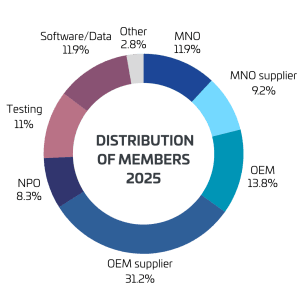
The 5G Automotive Association (5GAA) is a global association with over +110 member companies from the automotive and telecommunications industries. Partners who are active in the broader telecommunications and automotive ecosystem, such as universities, research bodies, associations, and public authorities also joined the ecosystem. Each of the 5GAA members bring added value to the 5GAA mission through their contributions and visionary mindset. Together, the key partners foster collaboration and exchange to path the way towards the new mobility era.

What our members say

Building a representative membership and driving impactful partnerships

5GAA gathers over 115 member companies from the automotive and telecommunications industries. The association has also welcomed partners who are active in the broader telecommunications and automotive ecosystem, such as universities, research bodies, associations, and public authorities.

Global footprint

Shaping the new mobility globally, powering locally

Sector

Sector

Region

Region

Map members

Map members

Join the community

PLATINUM Members

Full leadership and strategic influence: Guaranteed Board seat, decision-making, authority, and top-tier access to all 5GAA activities and events.
(Currently limited to 12 members, including 8 founding members).

GOLD Members

Strategic influence: Eligible for Board election, priority to events & demonstrations, active, participation in strategy, Working Groups, and
regional activities.

GENERAL Members

Focused participation: contribute to Working Groups & Work Items, vote at the General
Assembly and access to core 5GAA activities.

Frequently Asked Questions

General Information about 5GAA

The 5G Automotive Association (5GAA) is a global, cross-industry organisation bridging the gap between automotive, technology, and telecom industries and promoting the C-V2X technology (Cellular vehicle-to-everything), a comprehensive platform for connected vehicles, safety, and transportation.

5GAA was created in September 2016 by its eight founding members: AUDI AG, BMW Group, Daimler AG, Ericsson, Huawei, Intel, Nokia and Qualcomm Incorporated.

5GAA unites now more than 130 companies diverse both in terms of geography and expertise. These include automotive manufacturers, tier-1 suppliers, chipset/communication system providers, mobile operators and infrastructure vendors. Find the full list of members here

5GAA’s members are committed to helping define and develop global solutions for the next generation of connected mobility and automated vehicle solutions to address the complex challenge of providing enhanced safety, sustainability, and convenience for all road users. Read more about 5GAA’s mission here.

Since its creation, 5GAA has helped transform C-V2X technology from a standard into a market reality and has established 5G as the reference for future automotive connectivity. The association is now regarded as the global lead organisation on automotive connectivity. (link to the 5th anniversary report)

Major publications, reports and white papers include:

5GAA is working on the basis of 5 association pillars: as the first and overarching pillar, 5GAA aims to bring value to its members. Four main pillars help to achieve this overarching pillar: (1) enable deployment by lifting barrier and accelerating time-to-market, (2) contribute to standardisation via pre-standardisation efforts of automotive connectivity, (3) advocate policymakers by addressing regional opportunities and threats, and (4) leverage innovative solutions within the larger connected automotive community.

The association is contribution-driven and only exists through collaborations and communications between its members.

Between 2019 and 2021, 5GAA’s work focused on eight priority areas: security and privacy, road infrastructure, Vulnerable road users, positioning, interoperability, cellular network, and flexible architecture and technology evolution. All of the priority areas are contributing to the association’s vision: “connected mobility for people, vehicles, and transport infrastructure”. You can find more information on 5GAA’s work here.

The association includes an Executive Committee, a Board, and a General Assembly. The Board, composed of eighteen members elected every year by the General Assembly, supervises and advises the Executive Committee in all respects, in particular with regard to strategic guidance. The Executive Committee is the legal representative body of the association and is responsible for its day-to-day management. You can know more about the 5GAA’s leadership and Board at this link.

In order to address society’s transport needs, 5GAA has seven working groups focused on:

  • Use Cases and Technical Requirements
  • System Architecture and Solution Development
  • Evaluation, Testbeds, and Pilots
  • Standards and Spectrum
  • Regulatory and Public Affairs
  • Security and Privacy

See more

5GAA Working Groups are overseeing the work done in the work programme made of a large number of Work Items. Work Items are time-limited targeted activities which may report to more than one Working Group depending on their tasks. Outputs from Work Items can take many different shapes: Technical Report, Technical Specifications, White Papers, measurements, prototypes and/or demonstrations.

5GAA believe true ecosystem cooperation must be achieved around sustainable business models. An ecosystem that would gather the whole value-chain of connected mobility, seamlessly interacting with partners and standardisation bodies.

5GAA collaborates with different actors active in many fields: Standardisation bodies, Testing, Conformance and Interoperability organisations, Promotion Groups and Think Tanks, and regional organisations. 5GAA is also part of several European and national projects related to 5G networks and connected mobility. You can discover more on 5GAA’s partnerships here.

Friends of 5GAA is a group subscribing to a global newsletter addressing issues of interest and concerns to organisations that are not members but would like to keep up-to-date on 5GAA’s activities: typically road operators, ministries, public bodies, etc. They can also engage with the 5GAA members to identify synergies and business opportunities to accelerate and streamline the deployment of connected automotive.


Questions about Cellular-Vehicle-to-Everything (C-V2X) technology

Cellular-V2X (C-V2X), as initially defined as LTE V2X in 3GPP Release 14, is a technology that allows vehicles to communicate with each other and the wider transport ecosystem.
It includes Vehicle-to-Vehicle (V2V), Vehicle-to-(Roadway) Infrastructure (V2I) and Vehicle-to-Pedestrian (V2P) direct communication without necessarily relying on network involvement for scheduling. This is complemented by the connectivity to the mobile network (V2N) using LTE.

C-V2X has a clear evolution path to 5G (also called 5G New Radio (NR)) for both modes of operation mentioned above.  C-V2X direct communication has an evolution path to 5G-NR based C-V2X, and LTE- network communication has its evolution patch to 5G-NR network communication.

5GAA supports the idea that 5G will be the ultimate platform to enable C-ITS and the provision of V2X. 5G will be able to better carry mission-critical communications for safer driving, and further support enhanced V2X communications and connected mobility solutions.

V2X includes:

  • V2V: Vehicle to Vehicle communications – Direct and short-range communication between Vehicles for critical safety applications – providing 360o non-line-of-sight awareness for improved safety;
  • V2P: Direct and short-range communication between Vehicles and Pedestrians – including all “vulnerable” road users such as cyclists;
  • V2I: Direct and short-range communication between Vehicles and Infrastructure – allowing the vehicle to connect to and receive road traffic information (signage, traffic lights etc.);
  • V2N: Network communications between Vehicles and Network (i.e. the cloud) – providing vehicles with advanced traffic routing, long range information and cloud-based services, e.g. Infotainment.

C-V2X technology combines two complementary modes of communication:

Direct & short-range connectivity for safety applications without requiring network coverage or subscription. This operates in designated ITS spectrum bands (e.g. ITS 5.9 GHz) also known as “LTE-PC5”. C-V2X direct communication gives vehicles the ability to communicate with each other (V2V), to pedestrians (V2P), to roadway infrastructure (V2I), enabling safer, more autonomous vehicles of the future;

Connectivity via regular cellular networks for non-safety applications like navigation and infotainment in the car. This operates in the traditional mobile broadband licensed spectrum – also known as “LTE-Uu”. C-V2X network communication allows vehicles to communicate with the network (V2N).

In China, cars enabled with Cellular-Vehicle-to-Everything (C-V2X) technology are already available. To this date, 14 C-V2X vehicles have been commercialised so far. In the United States, Ford has committed to deploy C-V2X in all new vehicle models from early 2022.  Finally, in Europe, BMW and Samsung are set to offer 5G/CV2X in their iNEXT vehicle this year, in 2021.

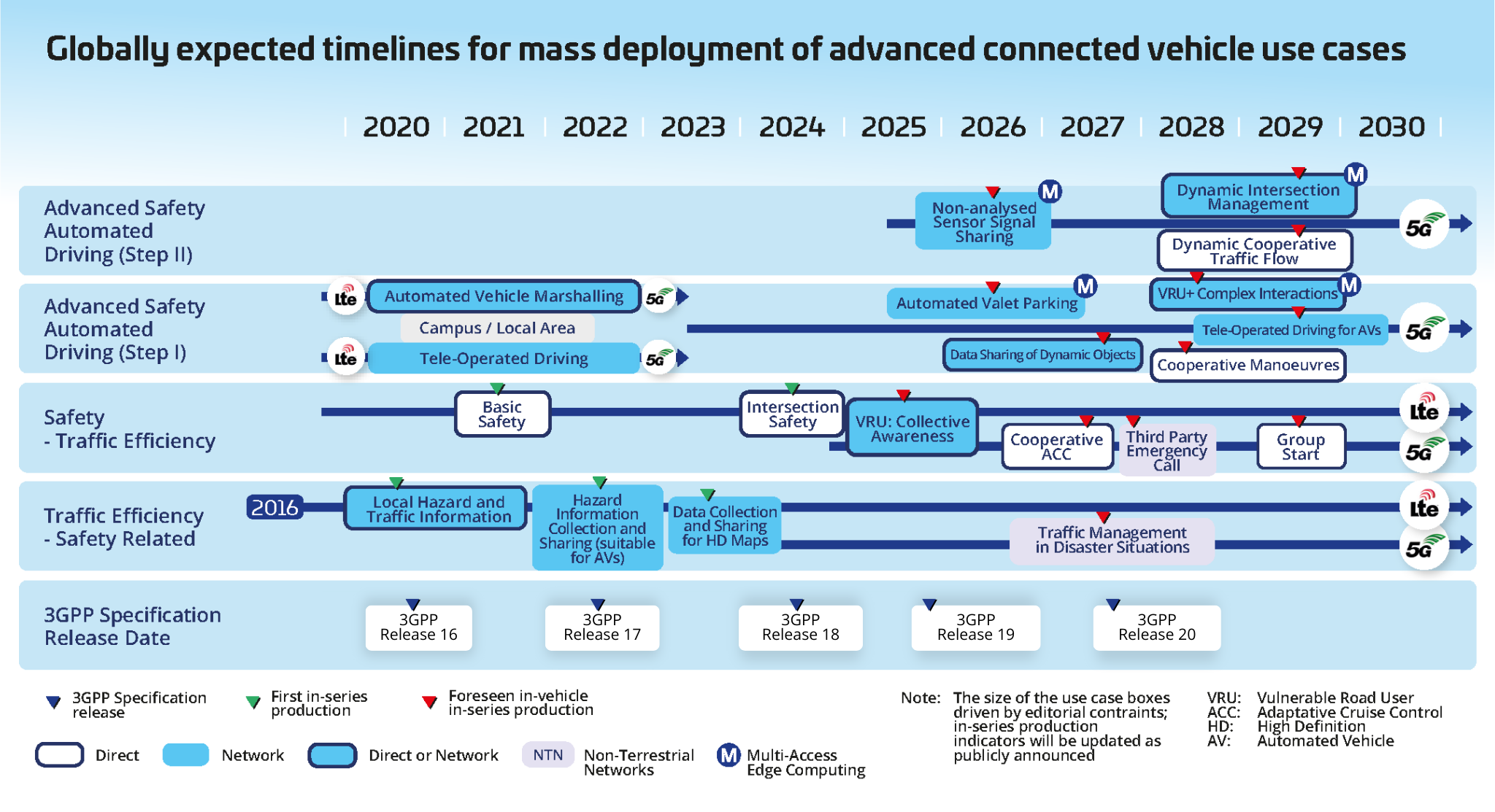
In 2020, 5GAA released a Visionary 2030 Roadmap outlining the vehicle-to-everything (V2X) use cases to improve traffic efficiency and road safety around the world expected in the next decade. Close to 200 million ‘connected vehicles’ are already on the roads worldwide, and a growing number of vehicles with the ability to exchange traffic and road condition information over cellular networks. Further progress in the coming years will pivot around 5G-V2X use cases for more efficient and safe driving. From 2025 onwards, 5GAA expects the mass rollout of more advanced automated driving and safety use cases supported by vehicle connectivity. Additional automated driving functionalities are anticipated from 2026.

5G for automotive has the potential to have the most revolutionary impact by saving millions of lives by reducing road accidents. Furthermore, it will have a positive impact by producing more efficient journeys, minimising travel times, traffic jams and improving environmental footprints. Unlike other competitive technologies, C-V2X leverages both cost-effective direct short-range communications and long-range cellular connectivity. This allows more cost-effective use of an integrated connectivity platform to address the broadest range of safety features.

The cost-efficiency of C-V2X is determined mainly by the three following reasons:

C-V2X integration with existing cellular modem: C-V2X can deliver both short-range safety V2X applications and long-range network communications via the one modem, which accelerates time to market and market penetration, contributing to enhanced safety and reducing cost;

For pedestrians, C-V2X will also find its way into consumer-electronics smartphones both for use by pedestrians, cyclists and unequipped vehicles due to its low power consumption and its possible integration with 4G/LTE chipsets;

Benefit from the economy of scale as it can leverage synergies between transportation and other verticals which are moving towards 5G (e.g. e-health, smart cities, industry 4.0, smart farming, etc.)

C-V2X will improve safety on roads by tremendously facilitating the flow of information between vehicles, pedestrians, and road infrastructure. This will enable connected vehicles to anticipate and avoid dangerous situations, reducing collisions and potentially saving lives.

More connected mobility with C-V2X can help address the constantly growing need for mobility while achieving lower emissions with a 5-20% estimated emission reduction potential. Connected mobility will increase transport efficiency and driving patterns, thus reducing congestion, fuel consumption and emissions. Moreover, it will allow the creation of new ways around traffic flow management and better, more localised environmental control (e.g., dynamic geofencing). 5GAA and its members are convinced the global deployment of C-V2X technology will have a sustainable impact worldwide. However, connected vehicles must reach a critical mass to impact emissions reduction significantly. Read here to have more information about the environmental benefits of C-V2X.

For more questions

Contact us

Connected Mobility for People, Vehicles and Transport Infrastructure

About us

Connected Mobility for People, Vehicles and Transport Infrastructure

The 5G Automotive Association (5GAA) is a global, cross-industry organisation of companies from the automotive, technology, and telecommunications industries (ICT), working together to develop end-to-end solutions for future mobility and transportation services. Created in September 2016, 5GAA has rapidly expanded to include key players with a global footprint in the automotive, technology and telecommunications industries. This includes automotive manufacturers, tier-1 suppliers, chipset/communication system providers, mobile operators and infrastructure vendors.

Christoph Voigt – 5GAA Chairman

5GAA was created to connect the telecom industry and vehicle manufacturers to develop end-to-end solutions for future mobility and transportation services.

Christoph Voigt – 5GAA Chairman

Mission

5GAA bridges the automotive and telecommunication industries in order to address society’s connected mobility needs, bringing inclusive access to smarter, safer and environmentally sustainable services and solutions, integrated into intelligent road transportation and traffic management.

A visionary roadmap

What we do

5GAA is addressing today’s mobility key challenges. With C-V2X technology, 5GAA will revolutionise the mobility ecosystem and the way drivers interact with the world. 5GAA’s ambition is to improve the overall transportation industry to make it safer, greener and more efficient for vehicles, road users and the surrounding infrastructure.

Smarter

Sustainable

Safer

5GAA has defined 4 strategic pillars designing the short and long term goals in very diverse domains contributing to the same ambition: Connected Mobility.

5GAA shares latest C-V2X developments at ITS World Congress (Hamburg)

5GAA shares latest C-V2X developments at ITS World Congress (Hamburg)

5GAA shares the latest C-V2X developments at ITS World Congress (Hamburg): “5G will have the most revolutionary impact by reducing accidents and saving millions of lives.”

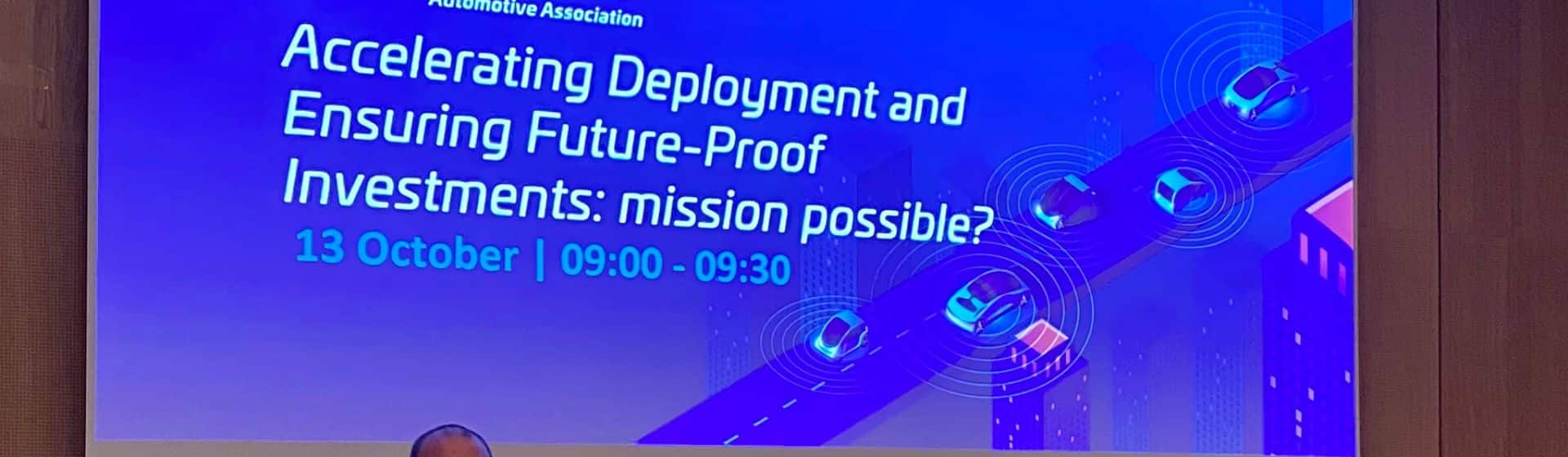
HAMBURG, 13 October 2021 – 5G-powered vehicles are foreseen to hit the market this year in Europe. More and more advanced vehicle-to-everything (V2X) use cases geared towards enhanced road safety, improved traffic efficiency, greener environmental impact and more comfortable driving are being deployed worldwide on a large scale. The 5G Automotive Association (5GAA) and its members showed the latest developments during ITS World Congress in Hamburg.

5G-V2X spearheading the path to automated driving

Today, the 5G-V2X (Vehicle-to-Everything) technology already enables fully connected and automated mobility with LTE-V2X technology. Vehicles and infrastructure can exchange relevant information via LTE-V2X through direct communication mode (not requiring network coverage) or mobile network communications mode, creating a real-time connection between all road users.

Many automotive services can be supported by the current global cellular standard LTE-4G, seen as an essential foundation for further progress.  Millions of vehicles on the continent are connected via 4G-LTE already, and industry analysts estimate that over 70% of all new vehicles sold are now 4G equipped. That said, 5G-V2X will enable more advanced connected mobility services and offer a clear path to automated driving – while maintaining service-level interoperability with pre-existing LTE-V2X vehicles.

5GAA will help prepare tomorrow with the ITS Directive revision, advocating a neutral approach on technology. Given the strong momentum in China and in the United-States, Europe needs a future-proof framework to stay in a leading role globally. Indeed, advanced driving is taking shape globally. At the moment, China is the only country that has 5G Cellular-Vehicle-to-Everything (C-V2X) enabled vehicles commercially available on the market. To this date, 14 C-V2X vehicle models are commercialized. In the United States, Ford has committed to deploy C-V2X in all new vehicle models from early 2022. In Europe, 5G-powered vehicles are foreseen to hit the market still this year thanks to BMW.

“When applied to the automotive field, 5G will have the most revolutionary impact by saving millions of lives and reducing accidents on roads”, 5GAA CTO Maxime Flament said. “The combination of long- range and short-range connectivity C-V2X offers, delivers the optimal setup for safety and efficiency of traffic, in addition to improving environmental footprints.” Global deployment of C-V2X technology will have a sustainable impact in the world.

In the next two to three years, 5GAA expects to see mass deployment of C-V2X use cases geared towards improving traffic efficiency and road safety around the world. Vehicle commercialization is not enough however: the whole ecosystem – cars, cloud, map, network, positioning but also the road – needs to be C-V2X friendly. Therefore, 5GAA offers a platform to foster collaboration between top tier automotive, technology and telecommunications companies for them to develop end-to-end connectivity solutions for future mobility and transportation services.

Cover more digital roads via enhanced digital mobility services

At ITS World Congress, the world’s largest and most prominent event focused on smart mobility and the digitalisation of transportation, 5GAA experts and member spokespersons shared their views on how to accelerate deployment of the latest technology innovations and how to ensure future-proof investments. They shared the needs of road operators for their digital infrastructure and of automakers (OEMs) for digital mobility services, and zoomed in on digital roads in urban areas and cooperation models enabling deployment and use of 5G infrastructures for connected and automated mobility.

Furthermore, key members of the 5GAA shared their latest technology developments with a focus on Vulnerable Road Users (VRUs), among which:

  • A system that warns of accidents between and help protect connected vehicles and cyclists – or other vulnerable road users such as pedelec, scooter riders and pedestrians developed by Continental and Deutsche Telekom. The solution calculates the paths taken by cars and bicycles. If they are likely to cross at the same time, the system warns both road users via mobile communications in real-time. Initial road tests have been successful.
  • A Location-as-a-Service algorithm that improves the positioning of road users, in which vehicles exchange data via simulated communication (5G) by Fraunhofer Institute FOKUS. The aim is to warn drivers of a collision with a cyclist, an e-scooter rider of road damage, or to guide a blind person to the right government office or the bus door – for which highly accurate localization is always of fundamental importance.
  • A demonstration of a connected e-bike, where Qualcomm (alongside company Spoke) is showcasing a new hardware solution designed to enable vehicles to identify VRUs using C-V2X.

And more. Request the full list of demonstrations on demand at 5GAA@teamlewis.com

Download the press release here.

Bosch booth

5GAA booth

Qualcomm

Demonstration Novatel- Valeo
Credits – Team Lewis

5GAA and GCF Announce New Agreement on C-V2X Certification Programme

5GAA and GCF Announce New Agreement on C-V2X Certification Programme

The newly announced programme will provide trusted foundation for C-V2X applications globally.

The 5G Automotive Association (5GAA) and the Global Certification Forum (GCF) have agreed on a new programme that will support the drive for interoperability, reliability, and safety of emerging cellular vehicle-to-everything (C-V2X) systems.

C-V2X – which allows direct wireless communication between vehicles, and between vehicles and the infrastructures on the roadways – is an essential enabler for a safer and more efficient intelligent transportation system. It therefore requires a certification process to ensure compliance with global standards and to provide reliability to manufacturers and users alike.

The newly established programme will enable manufacturers to certify their C-V2X capable products – including onboard units (OBU) and roadside units (RSU) – for C-V2X PC5 Mode 4 functionality.

Many actors of the C-V2X ecosystem will be able to benefit from the new programme. Tier 1 manufacturers of OBUs and RSUs can ensure their products are interoperable with each other in terms of V2V functionality; vehicle manufacturers can rely on intelligent connectivity within automobiles; and insurance companies will have the opportunity to monitor for safe driving practices. Municipal traffic authorities will also be able to trust in the potential of products to operate over their infrastructure, maintaining traffic flows, and all road users – including cyclists and pedestrians, as well as drivers – can look forward to the safer roads promised by intelligent mobility.

GCF’s certification scheme has been evolving since 1999 in alignment with developments in the wireless communication industry. This result stems from the collaboration 5GAA and GFC have reinforced since 2019, to investigate the principles and framework for a certification programme – designed specifically for C-V2X technologies.

This represents the first part of a multiphase certification programme that will evolve from radio layer certification of PC5 Mode 4 (V2V and V2I) to LTE and 5G-NR based V2X-Uu (V2N) using the 4G and 5G cellular network for communications, taking advantage of the increased functionality and performance that 5G brings.

For more information and to register your interest in the new GCF C-V2X certification programme, click here.

Read the press release here.

5GAA officialises five new MoUs during Brussels conference

5GAA officialises five new MoUs during Brussels conference

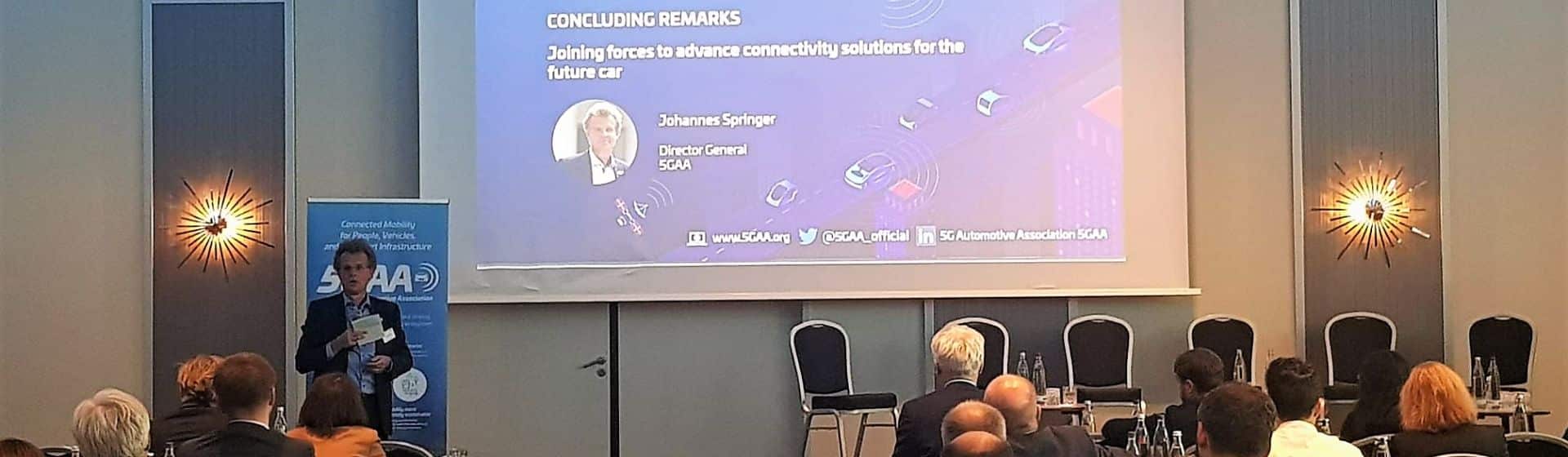
Is 5G in-car technology ready for automated driving? Are Europe’s roads up to speed for this digital revolution? Are governments, road authorities and industry on the same page? What is Europe’s strategy to secure leadership and capture markets in the field? These and other pressing questions and challenges for connected and automated mobility were addressed on 6 February, at the 5GAA-hosted event – 5G, Igniting the Connected and Automated Mobility Revolution – in Brussels’ Concert Noble. High-level representatives and experts from industry, governments and the EU explored the capabilities, deployment models and vast opportunities of the latest ‘cellular vehicle to everything’ (C-V2X) technology.

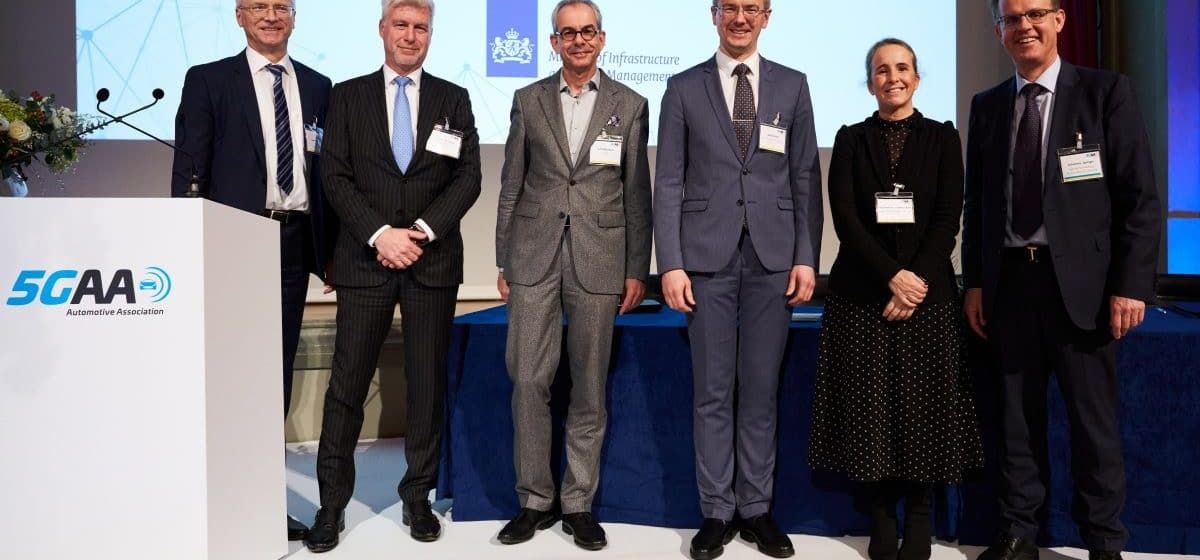
BRUSSELS, 6 February 2020 – The 5G Automotive Association (5GAA) organised a conference bringing together EU representatives and the connected automotive ecosystem to the heart of Europe, to officialise its public-private partnerships with several European authorities. Indeed, 5GAA announced extending its partnership network by signing Memoranda of Understanding with the Dutch Ministry of Infrastructure and Water Management, the Italian Ministry of Technological Innovation and Digitalisation, the Spanish Directorate-General of Traffic (DGT), the German Federal Highway Research Institute (BASt) and the Electronic Communication Office of Latvia (VASES). The ambition of the association is to strengthen the collaboration between industry and the public sector and to facilitate the dialogue to drive innovation in mobility and transport with these closer collaborations.

Some recognised speakers at the conference included BMW’s Joachim Göthel, Senior Manager in the German automaker’s ‘Project 5G Alliance’, and Dino Flore who is Vice-president of Technology at Qualcomm, the US chipmaker, as well as Robert MacDougall who heads mobile operator Vodafone Enterprise’s Public Policy Unit. They were joined by senior EU policymakers, including a message from Maria Koleva on behalf of the European Commissioner for Innovation, Research, Culture, Education and Youth Mariya Gabriel and speech by Pearse O’Donohue, Director for Future Networks, Directorate-General for Communications Networks, Content and Technology, as well as national experts from the Netherlands and Spain giving their unique perspective.

“To fulfil its potential in connected and automated mobility, Europe really needs a clear policy message reinforcing its ‘technology neutral’ approach in the future C-ITS regulations,” noted 5GAA’s CTO and spokesperson Maxime Flament.

Automated and connected driving, intelligent driver assistance and data-driven transportation network optimisation are examples of what tomorrow’s transportation will look like for people and governments.

Discussions and conclusions reached at the 5G, Igniting the Connected and Automated Mobility Revolution conference thus paint a rich picture of the work currently underway and the roadblocks and potential detours that may lie ahead. With the help of audience contributions, the event helped to chart the way for future autonomous transport that not only meets the needs of society and industry but can also make a positive contribution to meeting the global Sustainable Development Goals in terms of cleaner and safer transportation.

About 5GAA

The 5G Automotive Association (5GAA) is a global, cross-industry organisation of over 130 members comprised of leading global automakers, Tier-1 suppliers, mobile operators, semiconductor companies and test equipment vendors. It works together to develop end-to-end solutions for future mobility and transport services. 5GAA is committed to helping define and develop the next generation of connected mobility, automated vehicle and intelligent transport solutions based on C-V2X.

Learn more on the 5GAA website and follow us on Twitter and LinkedIn.

Media Contacts

Delia Voica
Tel.: +32 486 69 76 22
Email: delia.voica@5gaa.org

Marketing and Communications Team
Email: marcom@5gaa.org


PDF Document