

Connected Mobility In Europe: 5G Automotive Association Strives For Digitalized, Sustainable And Safer Roads In The Digital Age
Europe needs a harmonized, future-proof regulatory approach that stimulates innovation and recognizes the industrial timeline and evolutionary path of technologies, conducive of European competitiveness and fostering the development of innovative business models. Innovation through C-V2X technology and sustainability-related opportunities for connected mobility were at the heart of the “5G: Connected Mobility in the Digital Age” conference hosted by the 5G Automotive Association (5GAA).
BRUSSELS (BELGIUM), 29 September 2021 – The 5G Automotive Association (5GAA) organized a conference bringing together EU representatives, public authorities, and the connected automotive ecosystem to the heart of Europe at its latest event, 5G: Connected Mobility in the Digital Age. Main objective? Discuss the ongoing challenges and opportunities brought about by the digitalization of road transport on the continent.
From the latest state-of-play and capabilities of Cellular-Vehicle-to-Everything (C-V2X) to the EU regulatory framework and the importance of the 5G roll-out, the 5GAA-branded conference emphasized the ongoing momentum of the technology in Europe as it supports more and more advanced use cases to ensure safer roads and achieve lower emissions globally.
“When applied to the automotive field, 5G will have the most revolutionary impact by saving millions of lives and reducing accidents on European roads”, 5GAA CTO Maxime Flament said. “The combination of long-range and short-range connectivity C-V2X offers, delivers the optimal setup for safety and efficiency of traffic, in addition to improving environmental footprints. We believe the European Union can achieve its Green Deal climate targets for 2050, if only it boosts the digitalization of its roads – landing a rapid and efficient deployment of 5G along road networks.”
Starting today with LTE-V2X technology, 5G-V2X is paving the way for fully connected and automated mobility. Vehicles and infrastructure can exchange relevant information via LTE-V2X through direct communication mode (not requiring network coverage) or mobile network communications mode, creating a real-time connection between all road users. Many automotive services can be supported by the current global cellular standard LTE-4G, seen as an essential foundation for further progress. As a combination of LTE-V2X and 5G NR, 5G-V2X will enable more advanced connected mobility services and offer a clear path to automated driving – while maintaining service-level interoperability with pre-existing LTE-V2X vehicles. It is thus of utmost importance that the revised Intelligent Transport Systems framework encompasses this tech evolution for Connected and Automated Mobility (CAM) for Europe.
Connected vehicles must reach a critical mass to impact emissions reduction significantly. The Association reiterated that establishing an innovative and investment-friendly regulatory framework that remains technology-neutral will boost Europe’s competitiveness and the number of connected vehicles on the road. As such, a seamless interaction among all stakeholders involved will be pivotal for road operators and public authorities across Europe to meet their policy objectives and enable a smooth service experience across all value-chains – to ensure a smooth 5G roll-out and robust ecosystem cooperation in the global evolving transport ecosystem.
“Our Sustainable and Smart Mobility Strategy sets out milestones for the transformation of our transport system – and Cooperative, Connected, and Automated Mobility will play a key role: by 2030, we expect automation to be deployed at a large scale” stated Commissioner Vălean. “Automation will be a driver to help make 100 European cities climate-neutral by the same date. And we have another important milestone to reach: by 2050, the fatalities for all modes of transport in the EU should be close to zero. Automated mobility is expected to contribute immensely here. My expectations are high, but so is the potential!”
Indeed, the Association had the pleasure to have European Commissioner for Transport Adina-Ioana Vălean open the conference and address the attendees. The event welcomed high-level representatives such as Daniel Mes, Cabinet of Executive Vice-President for the European Green Deal Frans Timmermans, Charlotte Nørlund-Matthiessen, Cabinet of Commissioner for Transport Adina-Ioana Vălean, Member of European Parliament Henna Virkkunen, Peter Stuckmann, DG CONNECT Head of Unit Future Connectivity Systems, the European Cyclists’ Federation (Jill Warren, Chief Executive Office), Spain’s Directorate-General for Traffic (Ana Isabel Blanco Bergareche, Associated Deputy Director), the City of Turin (Nicola Farronato, Head of Innovation) and the Swedish Transport Administration (Hamid Zarghampour, Chief Strategist Connected and Automated Transports). It also witnessed a strong ecosystem presence, with speakers from 5GAA members BMW, Stellantis, Volvo Cars, Ford, HERE Technologies, Telefonica, TIM and Huawei.
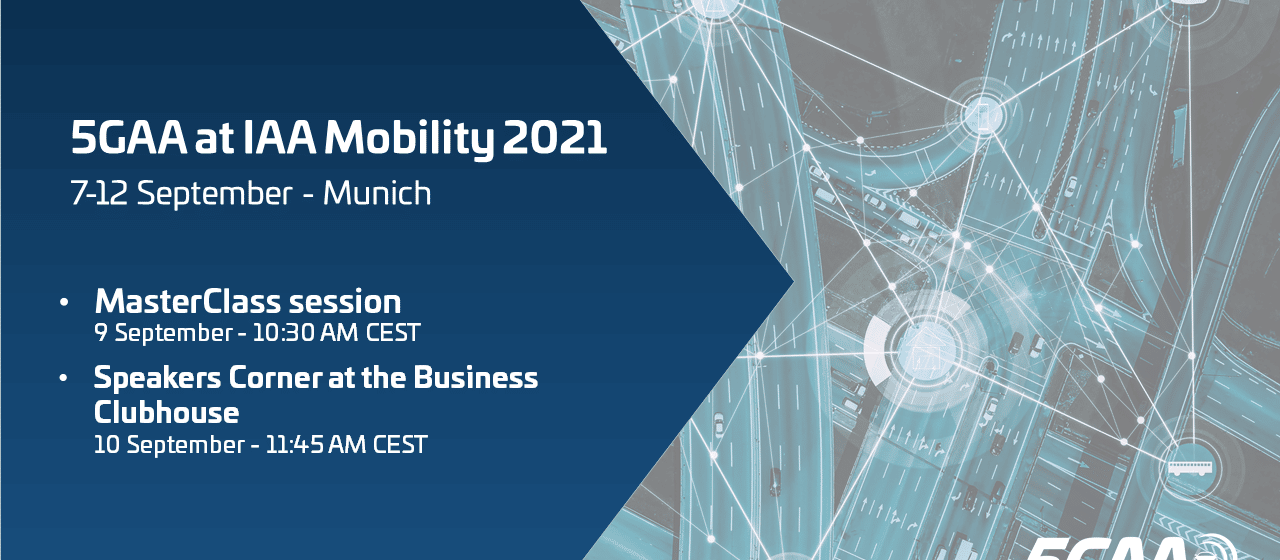
5GAA to participate in IAA Munich Mobility Conference 2021
The 5G Automotive Association (5GAA) is proud to announce its participation in the IAA Mobility Conference 2021 that will take place from 7 to 12 September in Munich. IAA Mobility is the leading global platform for the mobility industry and brings together actors from the entire mobility chain.
Following the guiding theme “What will move us next” the discussion will focus on how automation, connectivity, and smart city solutions will drive our progression to a more sustainable and effective mobility.
The event will provide an excellent platform to discuss the future of mobility with relevant stakeholders of the transport ecosystem.
5GAA will be active at two occasions:
- 9 September 2021 10.30 AM CEST
5GAA will hold a Master Class session. A great opportunity to engage in cross-industry exchange, present our expertise in an educational format, and discuss last updates and automated mobility by demonstrating the capabilities and deployment models of the Cellular Vehicle to Everything (“C-V2X”) technology.
- 10 September 2021, 11.45 AM CEST
5GAA will be present with its own Speaker Corner in the Business Club House, located in the central area of the exhibition. During 90 minutes our association and its members will have the opportunity to have speakers discuss the latest topics on connected mobility, as well as enjoy networking opportunities.
More details on the content of the sessions will come in the following weeks.

5G Automotive Association Discusses the Acceleration of 5G Deployment on European Roads at MCW Barcelona 2021
The 5G Automotive Association (5GAA) – with the engagement of EU representatives and stakeholders of the C-2VX ecosystem – has discussed the latest developments, opportunities, and challenges presented by connected mobility and 5G-V2X technology at the Mobile World Congress Barcelona 2021.
BARCELONA, 28 June 2021 – The 5G Automotive Association (5GAA) presented the latest global deployments of ‘Cellular Vehicle to everything’ (C-2VX) and 5G technologies at GSMA’s Mobile World Congress Barcelona 2021. The conference offered an overview on the broad-scale improvements that connected mobility can bring to the global automotive system, highlighting the benefits the technology brings in Europe and beyond.
The association disclosed the last global updates of 5G-V2X technology which will enable real-time connection between vehicles and their surroundings – starting today with LTE-V2X technology. 5G-powered vehicles are expected to hit the European market this year, as 5GAA members are leading C-V2X deployment through network based, direct communications on the continent. Technological progress supports more advanced use cases and the combination of long-range and short-range connectivity will grant the optimal setup for safety and efficiency of traffic.
“In the next two to three years, our association expects to see mass deployment of vehicle-to everything (V2X) use cases geared towards improving traffic efficiency and road safety around the world”, said 5GAA Director-General Johannes Springer. From 2024 onwards, 5GAA further anticipates the large-scale introduction of advanced safety and automated driving use cases supported by C-V2X. 5GAA supports the ecosystem by identifying these required use cases and services which are expected to be enabled by 5G-V2X in the coming decade. This enables European stakeholders to engage and collaborate in order to scale up V2X services and deliver societal benefits.
5GAA also underlined the strong need for a harmonised regulatory approach that will stimulate innovative business models and grant European competitiveness. The association favours a technology-neutral regulatory framework that will be focused on service delivery and will foster market-led innovation. Only an enabling and future-proof regulatory environment, conducive to C-V2X rapid deployment by OEMs and road authorities, will improve road safety and reach climate-neutrality.
The association highlighted 5G-powered vehicles are already commercialized in China. However, there are some relevant improvements in C-V2X implementation and 5G accessibility on roads in Europe. Many cities and road operators are starting to offer internet interfaces with real-time traffic information such as red light space, slippery roads and even wrong-way-drivers warning.
For one, Dieter Hötzer – Vice President Automated Driving Systems at Bosch – illustrated the Wrong Way Driver Solution developed by the 5GAA member company, as a clear example of technology that greatly impacts road safety. The software needs a GPS signal transferred to a cloud system that alerts drivers going the wrong way and warns other vehicles in the danger zone, sending out almost instant push notifications.
5G provides a revolutionary impact on the automotive system bringing several benefits and it is the result of a steady technology evolution. While it improves traffic efficiency minimising travel times and traffic jams, it also increases road safety by reducing road fatalities.
“Ensuring rapid and efficient deployment of 5G along broad networks is critically important to the future of mobility and will result in numerous safety benefits” concluded Springer.

Business Aspects and Requirements of 5G Network slicing (BARNS) Report
5G will help vertical industries to achieve the ‘internet of everything’ vision of ubiquitously connected, highly reliable, ultra-low latency services for a massive number of terminals. Network slicing is considered as one of the key features for 5G allowing in particular to support the different needs of various vertical industries, including the automotive industry. Network slicing is a concept for running multiple logical networks (which could be customised and provided with guaranteed Service Level Agreements, SLAs) as virtually independent business operations on common physical infrastructure.
To limit the scope of this work, it will initially focus on the very basic functions of a mobile network, which are to provide coverage, throughput, and latency for data transmission between the vehicle (UE) and a backend infrastructure (i.e. mobile networks) using the network slicing approach. In further steps, the scope of this work shall be extended from how to use network slicing to tackle the additional functional and operational requirements from the automotive industry and their business implications.
Read the full report

5GAA Releases New 2030 Roadmap for Advanced Driving Use Cases, Connectivity Technologies and Radio Spectrum Needs
BRUSSELS, 8 September 2020 – In the next two to three years, the 5G Automotive Association’s (5GAA) expects to see mass deployment of vehicle-to-everything (V2X) use cases geared towards improving traffic efficiency and road safety around the world. This vision is outlined in a new White Paper released by 5GAA which explores how leading automakers, mobile
network operators and their suppliers see the world of automotive connectivity evolving over the coming decade.
Vehicles talking to one another but also to roadside and telecom infrastructure and operators – so-called V2X communication – is just the tip of 5GAA’s vision for ‘advanced 5G-connected driving’. In its latest White Paper, 5GAA offers a comprehensive roadmap to guide all parties involved in this near-term market development, bringing both automotive and telecom sectors together to fulfil what 5GAA sees as a powerful digital ecosystem in this fast-moving field.
The Paper highlights selected end-to-end V2X applications factoring in the necessary technological evolution, industry readiness and spectrum needs. 5GAA has developed ‘advanced driving’ use cases such as Cooperative Manoeuvres and Sensor Sharing in conjunction with both the adoption of Cellular Vehicle-To-Everything (C-V2X) standards and the availability of the required technologies and devices. These provide a tangible account of how advanced driving is taking shape globally.
“Success in this endeavour requires to have all industry stakeholders on-board, including telecoms and automotive. Only then will new business opportunities and necessary investments be secured to fuel this ‘ecosystem’,” said 5GAA’s CTO and spokesperson Maxime Flament upon the White Paper’s launch.
With close to 200 million ‘connected vehicles’ already on the roads worldwide in 2020 and a growing number of vehicles with the ability to exchange traffic and road condition information over cellular networks, the foundations for 5G-connected driving are well established, the Paper points out. Further progress in coming years will pivot around 5G-V2X use cases for more efficient and safe driving. From 2025 onwards, 5GAA anticipates mass rollout of more advanced automated driving and safety use cases supported by vehicle connectivity. Additional automated driving functionalities are anticipated as from 2026.
Between now and 2024, ‘connected’ digital road infrastructure will pave the way for real-time or ‘dynamic’ traffic updates, hazard warnings, and high-definition mapping services. Towards 2026, advanced vehicle-to-vehicle (V2V) cooperation will further boost automated driving developments, including sharing sensor data and cooperative manoeuvring.
To fully support this evolution, 5GAA calls on national and regional administrations to make sufficient radio spectrum available for mobile communication networks in targeted low- and mid-bands, and it recommends harmonised use of the 5855-5925 MHz band for communication between road users and roadside infrastructure within the wider international digital traffic ecosystem.
Here, the White Paper acknowledges that some 5G-enabled applications may prove challenging to implement, while others will be easier and offer valuable lessons going forward: “Low-hanging fruit applications addressing OEM fleets, such as automated valet parking and tele-operated driving will open the door to more secure, safe and interoperable vehicle-to-network automotive applications across borders.”
Charting a clear way forward…
All in all, to deliver end-to-end V2X services and unlock the true value of vehicle connectivity, 5GAA considers that the realisation of its roadmap would require:
(1) sufficient spectrum for short-range direct communications at 5.9 GHz
(2) high levels of mobile network coverage along the roads
(3) sufficient service-agnostic mobile network spectrum for mobile network-based communications, in addition to the bands that are currently identified for International Mobile Telecommunications (IMT) use.
The essence and great promise of 5G is that it makes better use of the radio spectrum, boosts mobile network coverage, security and safety, while delivering environmental benefits for citizens and consumers. To chart a clear way forward, 5GAA calls on all players to work together while implementing the use cases highlighted in the Paper, as well as other measures outlined in 5GAA technical reports and papers.
About 5GAA
The 5G Automotive Association (5GAA) is a global, cross-industry organisation of companies and OEMs from the automotive, technology and telecommunications industries working together to develop end-to-end solutions for future mobility and transportation services. 5GAA is uniquely placed to support 5G-V2X advances because it unites all major automotive, chipset, technology, telecom-mobile infrastructure and mobile network operators. In less than three years, more than 135 global players, including pioneering OEMs, have signed up to 5GAA’s vision.
For more information, please contact our media team at marcom@5gaa.org
Download the Roadmap
A Visionary Roadmap for Advanced Driving Use Cases, Connectivity Technologies, and Radio Spectrum Needs
The article below and the linked document refer to an older version of the 5GAA roadmap, whose most updated version you can find here.
With this white paper, the 5G Automotive Association (5GAA) presents the results of its studies relating to the evolution of automotive connectivity for the purposes of enhanced road safety, improved traffic efficiency, greener environmental impact, and more comfortable driving.
5GAA has identified the most promising advanced driving use cases such as Cooperative Manoeuvres and Sensor Sharing, in conjunction with the adoption of Cellular Vehicle-To-Everything (C-V2X) standards as well as availability of required technologies and devices, i.e. on-board units (OBUs), road-side units (RSUs), and smartphones, integrating the latest chipsets and modules. The market trajectory of the identified use cases is described along with the expected timeline for their mass market deployment.
The white paper finally highlights the spectrum needs for basic and advanced driving use cases. For direct communication, this corresponds to between 10 and 20 MHz at 5.9 GHz for basic safety, and an additional 40 MHz or more at 5.9 GHz for advanced driving.
5GAA live demos show C-V2X as a market reality
Turin, 14 November 2019 – Smart mobility technology is a reality today, with ‘Cellular Vehicle-to-Everything’ (C-V2X) allowing connected vehicles to communicate with the cloud, directly with each other and their surroundings. Deployment plans are primarily sustained by the global trend in the automotive industry to adopt 4G LTE cellular technology, followed by the emerging 5G high-speed low latency communications. Beyond infotainment, C-V2X will capitalize on vehicular and smartphone connectivity to contribute to better safety, less congestion and reduced emissions.
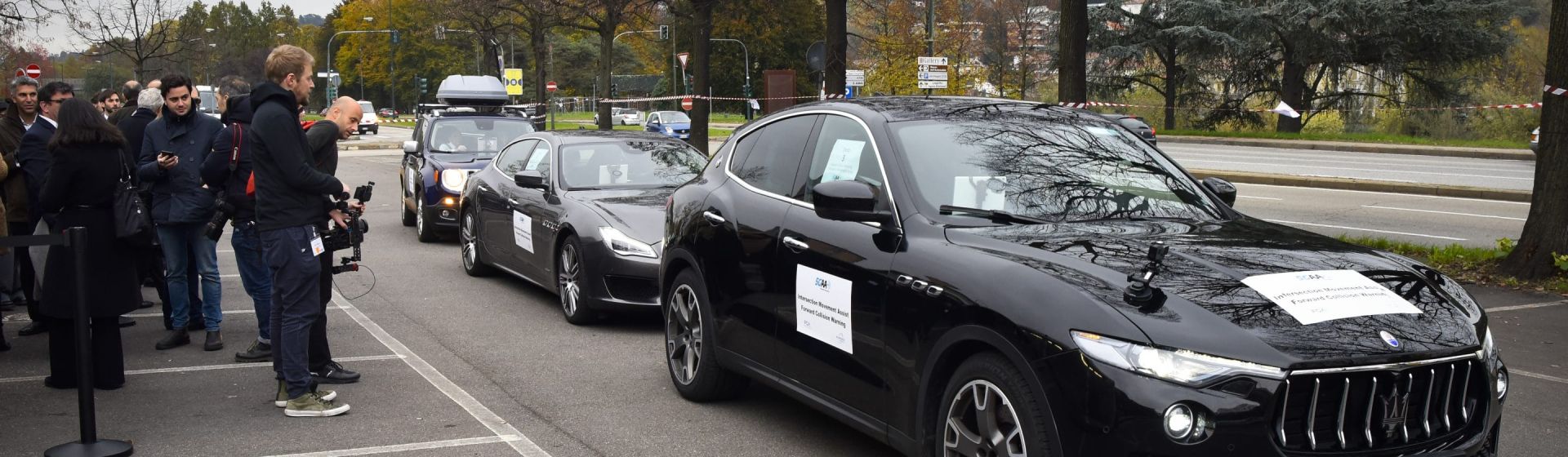
During a live demo event in Turin, the 5G Automotive Association (5GAA) showcased ready to deploy use cases in the streets of the city and a sneak preview of what the future has in store on the renowned Lingotto rooftop test track.
Prominent members and partners of the 5GAA including Audi, Continental, Ericsson, Fiat Chrysler Automobiles, Harman Samsung, Marelli, Pirelli, Qualcomm, TIM and Vodafone demonstrated the current state of C-V2X and the road to future, Vehicle-to-Vehicle (V2V), Vehicle-to-Infrastructure (V2I), and Vehicle-to-Network (V2N) applications based on 4G LTE and 5G.
“Connected mobility is a market reality.” says 5GAA Chief Technology Officer, Dr. Maxime Flament. “The use cases demonstrated in the streets of Turin are planned for deployment with a huge industry momentum based on the evolution path to 5G capabilities.”
Using both direct short-range communications and mobile networks, the open-road demonstrations showcased the extensive capabilities of today’s C-V2X technology, ready for deployment. To name a few:
- Protecting vulnerable road users, for instance, by alerting drivers about a pedestrian at a crossing using LTE-connected infrastructure.
- Smoothing traffic by allowing public authorities and road operators to provide real-time warnings to drivers in urban environments concerning roadworks or speed limits, via the network.
- Preventing incidents at dangerous intersections or in the event of unexpected braking, thanks to C-V2X direct-short range communications between vehicles.
The track demonstrations at Lingotto underlined the enhanced safety benefits that can be expected thanks to the versatility of 5G and the wide range of services it enables. To name a few:
- Vehicles will geo-tag dangerous areas for the following cars or provide ‘see-through’ functions to avoid dangerous overtaking.
- Pedestrians will be detected directly via their smartphones and surrounding vehicles will be warned.
- In case of accidents, emergency services will be able to visualize the situation live using on-board cameras of surrounding vehicles, improving response times and providing emergency responders situational awareness prior to arriving at the crash scene.
Furthermore, Intel showcased an “In Vehicle Entertainment” demo at the Museum, in collaboration with Marelli, TerraNet and Equinix, showing how Multi-Access Edge Computing (MEC) can support immersive high-definition (HD) entertainment for all occupants of a moving vehicle, including video streaming, gaming, virtual reality (VR), office work, online education, advertisement.
A short summary on each of the 5GAA C-V2X use cases, demonstrated today in Turin
Demo 1 “Vulnerable Road Users”: open road demos on safety
In this trial – which is part of Torino Smart Roads Initiative patronized by the Municipality of Turin – TIM, Links Foundation and Luxoft showed how the communication between the various actors moving along the roads can help in detecting potentially dangerous situations. The goal of the demos was to demonstrate how the 5G mobile network facilitates the protection of Vulnerable Road Users: pedestrians (“Presence of a pedestrian on a crosswalk”) and cyclists (“Presence of a connected bike on the road”). In the case of a pedestrian approaching a crosswalk, a Roadside Unit connected to the mobile network, equipped with a camera able to detect the event, sent a warning message to the nearby connected vehicles (I2V communication). In the case of a connected bike and a connected vehicle that are approaching each other, the two vehicles received a warning message about their presence when a risk of collision is detected.
Demo 2 “Urban Georeferenced Alerting” in open roads
TIM, FCA, Links Foundation, City of Turin with 5T, and Politecnico di Torino showed how the Local Traffic Authority in Turin intends to notify drivers in real time of possible dangers and special situations on the road (traffic jam, road works warning, dynamic speed limit, etc.). A standard geo-referenced warning message was dispatched to a TIM AMQP broker” at the edge of the 5G mobile network and only the involved vehicles received the geo-localized message from the AMQP Broker using the TIM 5G Network. The warning was read and displayed in an FCA vehicle through the on-board HMI and can for instance notify the driver of upcoming speed reduction. The aim of the trial was to demonstrate how the TIM 5G Network is suitable for realizing smart roads services for connected cars. The solution is compliant with the standards so it can be applied in other locations covered with mobile networks.
Demo 3 Intersection Movement Assist (IMA), Forward collision Warning (FCW)
FCA and Harman Samsung showcased two Vehicle to Vehicle (V2V) demos, by integrating C-V2X direct-short range communication into Maserati Levante and Quattroporte. The vehicles, through a direct radio link (network-less radio link), anonymously communicated basic information such as their position and related direction.
The Forward Collision Warning (FCW), detected possible frontal collision and warned the driver accordingly. The Intersection Movement Assist (IMA), assisted the driver at the cross junctions to avoid a possible lateral collision with an oncoming vehicle.
Demo 4 Emergency Electronic Brake Light (EEBL), Stationary Vehicle Warning (SVW)
FCA, Continental, and Qualcomm demonstrated fast and reliable information exchange between vehicles in emergency situations. The two demos are based on C-V2X direct-short range technology, enabling Vehicle-to-Vehicle (V2V) communication between two Jeep Renegade. There were two portions to this demo:
- “Stationary Vehicle Warning” (SVW): when the hazard lights are activated, the application broadcasted a message to all nearby vehicles so that approaching vehicles could be informed even if the hazard was not visible.
- “Emergency Electronic Brake Light warning” (EEBL): in the event of a sudden braking, the application broadcasted a message to following vehicles, such that approaching vehicles were notified of the potentially dangerous situation.
Demo 5 See-through
Vodafone, FCA, Vodafone Automotive, Marelli and Altran revealed the ‘See Through’ that uses C-V2X long-range cellular network communication to exchange streamed video in real time between vehicles, extending the driver’s visual range under obstructed visibility scenarios and to prevent accidents, especially those that may occur in an overtaking phase. The two involved Jeep Renegades vehicles were equipped with a connectivity solution (Marelli) and high frame-rate cameras (Marelli Motorsport) to detect the road lanes.
A real time tracking system and a space mapping algorithm of the vehicles, specifically developed by Vodafone Automotive, allowed Vodafone’s Multi-access Edge Computing (MEC) to dynamically manage and route the video flows on the basis of the vehicles’ relative positions and to ensure minimal end-to-end latency in the interest of drivers’ safety. Vodafone 5G ultra-low latency and high reliability were paramount to ensure the flow and synchrony of the real-time video exchange between vehicles, also under high traffic and cell saturation conditions.
Demo 6 World-first 5G-enhanced ADAS services
Audi, Ericsson, Italdesign, KTH, Pirelli, Qualcomm, TIM and Tobii showed how smart cars, commercial 5G smartphones and 5G networks jointly improve comfort, safety and efficiency. This unique collaboration combined the power of eye-tracking glasses, intelligent tires, in-vehicle augmented reality and 5G phones to work together over a live 5G network. With its high capacity and low latency, cellular 5G connectivity is ready to enable instantaneous cooperation between vehicles, the IoT ecosystem and more advanced driver assistance services. The live demonstrations at the Turin Lingotto test track were based on TIM’s commercial 5G network delivered in Turin in partnership with Ericsson. Audi cars, equipped with Pirelli Cyber Tyre, and embedded 5G modems provided by Qualcomm and available 5G smartphones were utilized to enhance pedestrian’s safety.
About 5GAA
The 5G Automotive Association (5GAA) is a global, cross-industry organisation of over 130 members comprised of leading global automakers, Tier-1 suppliers, mobile operators, semiconductor companies and test equipment vendors. It works together to develop end-to-end solutions for future mobility and transport services. 5GAA is committed to helping define and develop the next generation of connected mobility, automated vehicle and intelligent transport solutions based on C-V2X.
Learn more on the 5GAA website and follow us on Twitter and LinkedIn.
Media Contacts
5GAA Marketing & Communications
Email: marcom@5gaa.org
Official pictures: Conference – Demonstrations
Automotive C-V2X ready to roll out globally, says 5GAA at this year’s MWC Barcelona
All presentations of the 5GAA session at MWC19 Barcelona are available down this page.
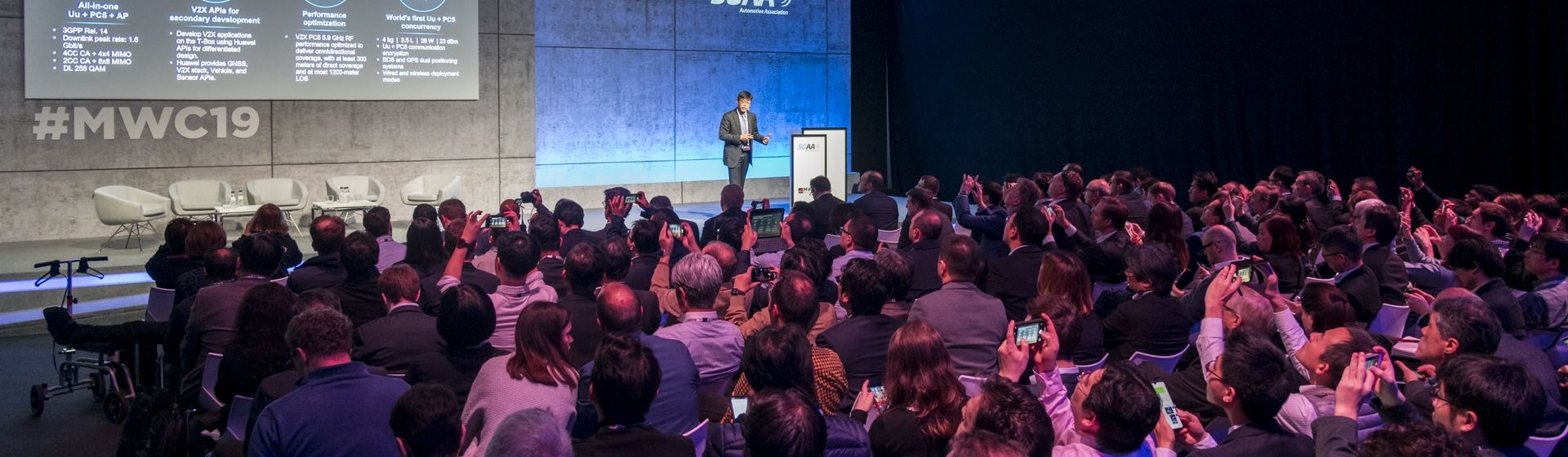
February 27th, Barcelona – During today’s well attended keynote, ‘Connecting the Mobility World with 5G’, the 5G Automotive Association (5GAA) gathered experts from the automotive, technology and telecom industries to explain how the deployment of ‘Cellular Vehicle-to-Everything’ (C-V2X) communication technology on the path to 5G is shaping the mobility of the future. Today LTE-V2X, the initial version of C-V2X, stands on the verge of its commercial launch: allowing vehicles to communicate with each other and their surroundings and, together with 5G enhancements, facilitating broad scale improvements in road safety.
“By bringing together key actors of the mobility ecosystem – across the automotive, information and communications technology industries – 5GAA continuously strives to develop forward-looking solutions for intelligent transportation services. Both for today and tomorrow.” stressed Thierry Klein, 5GAA Vice Chair and Head of the Disruptive Innovation Program at Nokia Bell Labs. “These end-to-end integrated solutions bring enhanced safety, sustainability, and convenience to all road users. 5GAA is very excited to be pioneering the revolution towards a smarter and more connected mobility world,” Thierry Klein added.
C-V2X communication is the state-of-the-art, high-speed cellular communications platform that enables vehicles to communicate with one another, with roadside infrastructure, with other road users (such as pedestrians, cyclists, and motorcyclists) using either direct short-range communications or cellular networks. While C-V2X network-based solutions are already widely deployed, direct communication solutions will be commercially available as of this year. As such the C-V2X platform delivers safety, mobility, traffic efficiency, and environmental benefits. C-V2X is designed with an evolutionary path to 5G and supports safe and efficient operations of autonomous vehicles.
5GAA members spearheading C-V2X
A number of 5GAA members are announcing ground breaking use cases at this year’ MWC. 5GAA members Telefónica, Ericsson, Ficosa and Seat show 5G connected car use cases supported by C-V2X direct communication for safer driving in a city (e.g. detection of cyclists when turning right or of a pedestrian at a zebra crossing). Another key technology bringing these use cases to life is edge computing.
In addition, 5GAA members Continental and Vodafone are working together to increase road safety and protect all road users for instance via “digital safety-shield” for cyclists and pedestrians, using C-V2X direct communication and edge computing in the first 5G deployments. The 5G-ready tests are taking place under real-life conditions at Vodafone’s 5G Mobility Lab in Aldenhoven, Germany.
Rohde & Schwarz has announced a collaboration with automotive electronics specialist Vector on a C-V2X end-to-end application layer test solution to verify safety-critical V2X scenarios. The companies’ integrated test platform is showcased for the first time at Mobile World Congress.
Deutsche Telekom has announced first C-V2X tests together with Skoda Auto in Czech as part of the European C-Roads project.
Geely also announced its plans to launch the first mass-produced C-V2X enabled vehicles in China together with Qualcomm in 2021.
Qualcomm has also announced its first 5G automotive platform, enabling both C-V2X short and long-range modes, which is expected to sample later this year and are planned for production vehicles in 2021.
C-V2X direct communication goes commercial in 2019
Mass production of C-V2X chips including direct communication from several suppliers is ongoing, and multiple radio vendors have already integrated these chips into their automotive radio offerings. 2019 is the year when C-V2X direct communication technology will be commercially available across the globe. Furthermore, full interoperability testing on C-V2X applications is ongoing among 5GAA members. The first mass-deployment in vehicles on the roads is anticipated to start in China in 2020; to be followed swiftly in other regions when local regulations allow for it.
“C-V2X is now ready to roll. At Ford, we will begin to deploy this technology in all new models launching in the US starting in 2022” confirmed Don Butler, Executive Director of Connected Vehicle & Services at Ford Motor Co.
The next milestone: 5G New Radio
C-V2X provides a clear evolution path to the family of 5G technologies for both direct and network communication. Part of this evolution is the 5G New Radio (NR).
NR-V2X will eventually ensure safe operation of autonomous driving vehicles by using 5G New Radio with Ultra Reliable Low Latency Communications (URLLC) network based communication combined with improved direct short range communications.
“The development of the NR-V2X standard is due for completion by the end of 2019; eventually hitting the road in 2023. This will enable a new generation of use cases for connected automated vehicles”, said Maxime Flament, CTO at 5GAA.
About 5GAA
The 5G Automotive Association (5GAA) is a global, cross-industry organisation with 110 members working together to develop end-to-end solutions for future mobility and transportation services. The organisation is committed to helping define and develop the next generation of connected mobility for advanced driving and automated vehicle solutions.
Presentations
- Opening speech by Thierry Klein, 5GAA Vice Chair & Nokia Bell Labs / Connecting the Mobility World with 5G-V2X
- Keynote by Friedhelm Ramme, Ericsson / 5G: From Concepts to Reality
- Keynote by Thorsten Hehn, Audi / 5G for Automotive: Key Applications
- Keynote by Jiang Wangsheng, Huawei / C-V2X Enables Intelligent Transportation
- Keynote by Nakul Duggal, Qualcomm / C-V2X Ignites Automotive Connected Revolution
- Speech by Vishnu Sudaram, Harman (Samsung) / Go-To-Market Timeline

5G Automotive Association at CES 2019: Highlighting connected mobility through 5G
The 5G Automotive Association and 47 of its members will be present at CES 2019
LAS VEGAS – January 7, 2019 – The 5G Automotive Association (5GAA), the global, cross-industry organization of companies working together on future mobility solutions, will be at CES 2019 to discuss the future of transportation through 5G – including the critical role of Cellular Vehicle-to-Everything (C-V2X) deployment.
The 5G Automotive Association (5GAA) will be present at the Consumer Electronic Show (CES) 2019 on January 8-11 in Las Vegas. The global stage for innovation that has introduced breakthrough technologies over the past 50 years will have a special focus on autonomous and smart vehicles – from safety to policy roadmaps – and highlight the future of transportation through 5G. In other words, topics that 5GAA helps shaping across the world thanks to its network of over 100 members. And 47 of these leader companies of the telecommunications and automotive industries will help spread the message at the global stage event.
With a roll-out planned as early as 2020, 5GAA is pushing for the Cellular Vehicle-to-Everything (C-V2X) technology – technology that helps making roads safer while also laying the groundwork for fully automated vehicles. The technology has also been selected as a CES 2019 Innovation Award Honoree in the “Vehicle Intelligence and Self-Driving Technology” category. Some 5GAA members, like Qualcomm, will be driving discussions on the subject at high-level CES panel conferences such as SAE’s Connect2Car conference session on 5G/DSRC, Bluetooth, Wi-Fi. Audi, Ducati, Ford and Qualcomm with the support of other C-V2X ecosystem players will demonstrate advanced use cases enabled by C-V2X. Additionally, 5GAA members will highlight the achievement of significant milestones in the commercial introduction of C-V2X products.
When it comes to the application of the technology in the telecommunication industry:
- 5GAA founding member Ericsson will showcase its latest use of the C-V2X technology, demonstrating how the 4G/5G mobile networks will enable safety services for the connected vehicle and will be used to make self-driving cars a reality.
- Samsung and its subsidiary HARMAN will also showcase their scalable 5G Telematics module designed to enable wide-scale C-V2X communications.
- Working alongside the broad automotive and telecom ecosystems, Savari, Inc. will showcase its continued momentum in the development of its C-V2X real-time direct communications technology through its RSU and software stack. As an active member of the automotive association, Savari expects the 5G cellular compatible solution to bring benefits for road safety, automated driving and traffic efficiency as soon as 2020.
- Veniam and Bosch are both showcasing their jointly developed all-in-one central control unit for V2X data management and communication – together, the Veniam and Bosch solution demonstrates how to move massive amounts of data to, from and between vehicles on the road.
- With a deep focus on the technology, Wistron NeWeb Corporation (WNC) will showcase its 5G and C-V2X system and modular solutions designed to enable eco-system partners to promptly rollout in-vehicle and infrastructure applications.
- Continental will be showcasing a flexible 5G hybrid platform that allows both mobile network communication and rapid and reliable direct exchange of data. Depending on regional requirements and customer preferences, the platform enables C-V2X as well as Dedicated Short Range Communication. These benefits are being realized with a first customer award for this 5G-Hybrid-V2X solution.
As 2019 stands for the year for the connected cars ecosystem to prepare the ground for mass roll-out of the technology in 2020, 5GAA will be driving 5G innovation at CES as an official partner at the Allied Association corner located in South Hall 1. 5GAA representatives, including CTO Maxime Flament, will be available for briefings and interviews.
About 5GAA
The 5G Automotive Association (5GAA) is a global cross-industry organization of companies from the automotive, technology and telecommunications industries (ICT) working together to develop end-to-end solutions for future mobility and transportation services.
Created in 2016, the association includes over 100 members whose mission is to develop, test and promote communications solutions, initiate their standardization and accelerate their commercial availability and global market penetration, to address society’s connected mobility and road safety needs with applications such as automated driving, ubiquitous access to services and integration into smart city and intelligent transportation. For more information, visit 5GAA’s website, LinkedIn and Twitter pages.
Contact
Margaux Demeyer – Communications & Marketing
Tel: +32 (0)25882430
Mail: margaux.demeyer@5gaa.org
Marketing and Communications Team
Email: marcom@5gaa.org
5GAA, BMW Group, Ford and Groupe PSA Exhibit First European Demonstration of C-V2X Direct Communication Interoperability Between Multiple Automakers
- Companies team up with Qualcomm and Savari to showcase C-V2X’s advanced performance for safety, traffic efficiency, and autonomy
- Exhibition includes communication between vehicles, motorcycles, and infrastructure, showing commercial readiness for industry deployments as early as 2020
Downloadable Resources |
Photos |
Infographic |
Soundbite Video Clip |
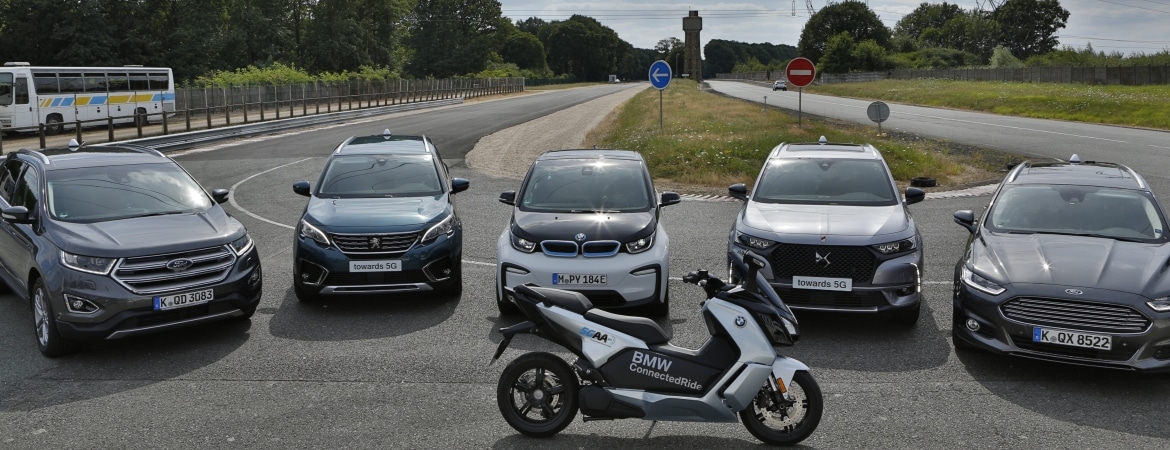
PARIS — July 11, 2018 – The 5G Automotive Association (5GAA), the BMW Group, Ford Motor Company (NYSE: F), and Groupe PSA — in association with Qualcomm Technologies, Inc., a subsidiary of Qualcomm Incorporated, and Savari, Inc. — announced today Europe’s first live demonstration of C-V2X direct communication technology operating across vehicles from multiple auto manufacturers. The live demonstration also featured a live showcase of C-V2X direct communication technology operating between passenger cars, motorcycles, and roadside infrastructure. C-V2X is a global solution for vehicle-to-everything (V2X) communication in support of improved automotive safety, automated driving and traffic efficiency.
The demonstration exhibited the road safety and traffic efficiency benefits of using C-V2X for Vehicle-to-Vehicle (V2V) collision avoidance, as well as Vehicle-to-Infrastructure (V2I) connectivity to traffic signals and Traffic Management Centers (TMC). C-V2X was operated using real-time direct communications over ITS spectrum and demonstrated its ability to work without cellular network coverage, and underscores its commercial readiness for industry deployment as early as 2020. Superior performance and cost-effectiveness compared to other V2X technologies, along with forward-compatibility with 5G, make C-V2X direct communications a preferred solution for C-ITS applications.
Six demonstrations were shown including Emergency Electronic Brake Light, Intersection Collision Warning, Across Traffic Turn Collision Risk Warning, Slow Vehicle Warning and Stationary Vehicle Warning, Signal Phase and Timing / Signal Violation Warning and Vulnerable Road User (pedestrian) Warning. The vehicles involved included two-wheel e-scooters provided by BMW Group, and automotive passenger vehicles provided by Ford, Groupe PSA, and BMW Group, all of which were equipped with C-V2X direct communication technology using the Qualcomm® 9150 C-V2X chipset solution. V2X software stack and application software, along with roadside infrastructure, were provided by industry leader, Savari.
C-V2X is globally supported by a broad automotive ecosystem, which includes the fast growing 5GAA organization. The 5GAA involves over 90 global members comprised of many leading automakers, Tier-1 suppliers, software developers, mobile operators, semiconductor companies, test equipment vendors, telecom suppliers, traffic signal suppliers and road operators.
Cellular modems will be key to the C-V2X deployment in vehicles to support telematics, eCall, connected infotainment and delivering useful driving/traffic/parking information. As C-V2X direct communication functionality is integrated into the cellular modem, C-V2X solutions are expected to be more cost-efficient and economical over competing technologies, and benefit from accelerated attach rates. C-V2X direct communication field validations are currently underway in Germany, France, Korea, China, Japan and the U.S.
C-V2X currently stands as the only V2X technology based on globally recognized 3rd Generation Partnership Project (3GPP) specifications, with ongoing evolution designed to offer forward compatibility with 5G. C-V2X also leverages and reuses the upper layer protocols defined by the automotive industry, including the European Telecommunications Standards Institute (ETSI) organization. C-V2X includes two complementary transmission modes:
- Direct communication as shown in this demonstration for V2V and V2I use cases
- V2N network communication, which leverages mobile operators for connectivity and delivers cloud-based services, including automated crash notification (ACN, as mandated by eCall), hazard warnings, weather conditions, green light optimal speed advisory (GLOSA), parking spot location, and remote tele-operation to support automated driving, to name a few.
“This demonstration builds on the successful C-V2X showcase we organised with our members Audi, Ford and Qualcomm in Washington DC in April” said Christoph Voigt, Chairman of 5GAA.
“We are excited to witness the growing momentum behind this life-saving technology and to see our members working together to deploy C-V2X, and to make it hit the road as soon as possible.”
“The BMW Group introduced the first C-ITS use cases already in 2013 with the market introduction of the BMW i3. Today most of envisaged C-ITS use-cases are already institutionalized. With the implementation of C-V2X, the BMW Group accomplishes the last set of the puzzle with a practical path to C-ITS showing quick benefits,” said Christoph Grote, Senior Vice President Electronics, BMW Group.
“With its ability to safely and securely connect vehicles, along with its evolution into 5G, C-V2X is integral to Ford’s vision for future transportation in which all cars and infrastructure talk to each other,” said Thomas Lukaszewicz, Manager Automated Driving, Ford of Europe. “We are very encouraged by preliminary test results in Europe and elsewhere which support our belief that C-V2X direct communications has superior V2X communication capabilities.”
“We’re moving forward with seamless communication between cars and their environment for enhancing road safety, as well as our customers’ safety,” said Carla Gohin, Group PSA’s Vice President for Research and Advanced Engineering. “Following the first European C-V2X direct communications demonstration we hosted with Qualcomm Technologies last March, we’re pleased to work with leading automotive and technology companies today to highlight that C-V2X interoperability is a reality.”
“This demonstration of interoperability between multiple automakers is not only another milestone achieved towards C-V2X deployment but also further validates the commercial viability and global compatibility of C-V2X direct communications for connected vehicles,” said Enrico Salvatori, senior vice president & president, Qualcomm Europe, and MEA. “We look forward in continuing to work alongside leaders in the automotive industry, like the 5GAA, BMW Group, Ford, Groupe PSA and Savari, to help advance the automotive industry’s shift towards a safer, connected and more autonomous future.”
“As one of the V2X pioneers, our company is extremely pleased to continue to help enable the next step in the V2X revolution that we helped start back in 2008,” said Ravi Puvvala, CEO of Savari. “For the last year and a half, the Savari team has worked diligently alongside the dedicated C-V2X engineers in the 5GAA partnership. The resulting string of increasingly impressive demonstrations is continuing to convince the world that C-V2X will soon be deployed around the world.”
About 5GAA
The 5G Automotive Association (5GAA) is a global cross-industry organization of companies from the automotive, technology and telecommunications industries (ICT), working together to develop end-to-end solutions for future mobility and transportation services.
Created in 2016, the Association is comprised of over 90 members whose mission is to develop, test and promote communications solutions, initiate their standardization and accelerate their commercial availability and global market penetration, to address society’s connected mobility and road safety needs with applications such as automated driving, ubiquitous access to services and integration into smart city and intelligent transportation. For more information, visit 5GAA’s website, LinkedIn and Twitter pages.
About the BMW Group
With its four brands BMW, MINI, Rolls-Royce and BMW Motorrad, the BMW Group is the world’s leading premium manufacturer of automobiles and motorcycles and also provides premium financial and mobility services. The BMW Group production network comprises 30 production and assembly facilities in 14 countries; the company has a global sales network in more than 140 countries. In 2017, the BMW Group sold over 2,463,500 passenger vehicles and more than 164,000 motorcycles worldwide. The profit before tax in the financial year 2017 was € 10.655 billion on revenues amounting to € 98.678 billion. As of 31 December 2017, the BMW Group had a workforce of 129,932 employees. The success of the BMW Group has always been based on long-term thinking and responsible action. The company has therefore established ecological and social sustainability throughout the value chain, comprehensive product responsibility and a clear commitment to conserving resources as an integral part of its strategy.
Facebook: https://www.facebook.com/BMWGroup
Twitter: https://twitter.com/BMWGroup
YouTube: https://www.youtube.com/BMWGroupview
Google+: https://googleplus.bmwgroup.com
About Ford Motor Company
Ford Motor Company is a global company based in Dearborn, Michigan. The company designs, manufactures, markets and services a full line of Ford cars, trucks, SUVs, electrified vehicles and Lincoln luxury vehicles, provides financial services through Ford Motor Credit Company and is pursuing leadership positions in electrification, autonomous vehicles and mobility solutions. Ford employs approximately 202,000 people worldwide. For more information regarding Ford, its products and Ford Motor Credit Company, please visit www.corporate.ford.com.
About Groupe PSA
Groupe PSA designs unique automotive experiences and delivers mobility solutions to meet all customer expectations. The Group has five car brands, Peugeot, Citroën, DS, Opel and Vauxhall and provides a wide array of mobility and smart services under the Free2Move brand. Its ‘Push to Pass’ strategic plan represents a first step towards the achievement of the Group’s vision to be “a global carmaker with cutting-edge efficiency and a leading mobility provider sustaining lifetime customer relationships”. An early innovator in the field of autonomous and connected cars, Groupe PSA is also involved in financing activities through Banque PSA Finance and in automotive equipment via Faurecia. Find out more at groupe-psa.com/en
Media library: medialibrary.groupe-psa.com / @GroupePSA_EN
About Qualcomm
Qualcomm invents breakthrough technologies that transform how the world connects and communicates. When we connected the phone to the Internet, the mobile revolution was born. Today, our inventions are the foundation for life-changing products, experiences, and industries. As we lead the world to 5G, we envision this next big change in cellular technology spurring a new era of intelligent, connected devices and enabling new opportunities in connected cars, remote delivery of health care services, and the IoT — including smart cities, smart homes, and wearables. Qualcomm Incorporated includes our licensing business, QTL, and the vast majority of our patent portfolio. Qualcomm Technologies, Inc., a subsidiary of Qualcomm Incorporated, operates, along with its subsidiaries, all of our engineering, research and development functions, and all of our products and services businesses, including, the QCT semiconductor business. For more information, visit Qualcomm’s website, OnQ blog, Twitter and Facebook pages.
About Savari
Savari seeks to make the world’s roadways and vehicles automated and safer by deploying advanced wireless sensor technologies and software. Savari builds software and hardware sensor solutions for automotive car manufacturers, the automotive aftermarket and smart cities. The company pioneered V2X radio technology, which is crucial for vehicles to achieve Level 4 and Level 5 of automation. The technology allows vehicles to share data with other vehicles, traffic lights and smartphones. With more than 150 man-years of V2X learning and development and 15 million-plus miles per year of public testing, Savari is a leader in V2X technology. Savari is headquartered in Santa Clara, Calif., and has offices in Detroit, Mich., Munich, Germany, Seoul, Korea and Bengaluru, India. For more information, visit savari.net.
###