

5GAA Releases New 2030 Roadmap for Advanced Driving Use Cases, Connectivity Technologies and Radio Spectrum Needs
BRUSSELS, 8 September 2020 – In the next two to three years, the 5G Automotive Association’s (5GAA) expects to see mass deployment of vehicle-to-everything (V2X) use cases geared towards improving traffic efficiency and road safety around the world. This vision is outlined in a new White Paper released by 5GAA which explores how leading automakers, mobile
network operators and their suppliers see the world of automotive connectivity evolving over the coming decade.
Vehicles talking to one another but also to roadside and telecom infrastructure and operators – so-called V2X communication – is just the tip of 5GAA’s vision for ‘advanced 5G-connected driving’. In its latest White Paper, 5GAA offers a comprehensive roadmap to guide all parties involved in this near-term market development, bringing both automotive and telecom sectors together to fulfil what 5GAA sees as a powerful digital ecosystem in this fast-moving field.
The Paper highlights selected end-to-end V2X applications factoring in the necessary technological evolution, industry readiness and spectrum needs. 5GAA has developed ‘advanced driving’ use cases such as Cooperative Manoeuvres and Sensor Sharing in conjunction with both the adoption of Cellular Vehicle-To-Everything (C-V2X) standards and the availability of the required technologies and devices. These provide a tangible account of how advanced driving is taking shape globally.
“Success in this endeavour requires to have all industry stakeholders on-board, including telecoms and automotive. Only then will new business opportunities and necessary investments be secured to fuel this ‘ecosystem’,” said 5GAA’s CTO and spokesperson Maxime Flament upon the White Paper’s launch.
With close to 200 million ‘connected vehicles’ already on the roads worldwide in 2020 and a growing number of vehicles with the ability to exchange traffic and road condition information over cellular networks, the foundations for 5G-connected driving are well established, the Paper points out. Further progress in coming years will pivot around 5G-V2X use cases for more efficient and safe driving. From 2025 onwards, 5GAA anticipates mass rollout of more advanced automated driving and safety use cases supported by vehicle connectivity. Additional automated driving functionalities are anticipated as from 2026.
Between now and 2024, ‘connected’ digital road infrastructure will pave the way for real-time or ‘dynamic’ traffic updates, hazard warnings, and high-definition mapping services. Towards 2026, advanced vehicle-to-vehicle (V2V) cooperation will further boost automated driving developments, including sharing sensor data and cooperative manoeuvring.
To fully support this evolution, 5GAA calls on national and regional administrations to make sufficient radio spectrum available for mobile communication networks in targeted low- and mid-bands, and it recommends harmonised use of the 5855-5925 MHz band for communication between road users and roadside infrastructure within the wider international digital traffic ecosystem.
Here, the White Paper acknowledges that some 5G-enabled applications may prove challenging to implement, while others will be easier and offer valuable lessons going forward: “Low-hanging fruit applications addressing OEM fleets, such as automated valet parking and tele-operated driving will open the door to more secure, safe and interoperable vehicle-to-network automotive applications across borders.”
Charting a clear way forward…
All in all, to deliver end-to-end V2X services and unlock the true value of vehicle connectivity, 5GAA considers that the realisation of its roadmap would require:
(1) sufficient spectrum for short-range direct communications at 5.9 GHz
(2) high levels of mobile network coverage along the roads
(3) sufficient service-agnostic mobile network spectrum for mobile network-based communications, in addition to the bands that are currently identified for International Mobile Telecommunications (IMT) use.
The essence and great promise of 5G is that it makes better use of the radio spectrum, boosts mobile network coverage, security and safety, while delivering environmental benefits for citizens and consumers. To chart a clear way forward, 5GAA calls on all players to work together while implementing the use cases highlighted in the Paper, as well as other measures outlined in 5GAA technical reports and papers.
About 5GAA
The 5G Automotive Association (5GAA) is a global, cross-industry organisation of companies and OEMs from the automotive, technology and telecommunications industries working together to develop end-to-end solutions for future mobility and transportation services. 5GAA is uniquely placed to support 5G-V2X advances because it unites all major automotive, chipset, technology, telecom-mobile infrastructure and mobile network operators. In less than three years, more than 135 global players, including pioneering OEMs, have signed up to 5GAA’s vision.
For more information, please contact our media team at marcom@5gaa.org
Download the Roadmap

5GAA publishes C-ITS Communication System Profiles
In light of on-going discussions on a legal framework for the European C-ITS deployment, a minimum set of specifications and configurations is needed for existing ITS standards ensuring the interoperability of C-ITS service among ITS stations using different communication technologies and systems, e.g. short-range and long-range radio communications.
While C-V2X standards are already finalised for 3GPP Rel. 14 and 5GAA published White Paper on C-V2X Use Cases: Methodology, Examples and Service Level Requirements, there are still many options on how to configure and establish parameters for C-V2X systems. In order to provide a common standard interpretation, corresponding system profiles are needed, which outline the basic system settings and environments
In Europe, Basic System Profiles (BSPs) have been developed by the Car-2-Car Communication Consortium (C2C-CC) and the EU-funded C-ROADS Platform project, assuming ITS-G5 with IEEE 802.11p as radio access technology for V2V and V2I communication. Though many aspects of the existing BSPs could be reused, there are some modifications needed for C-V2X. In addition, there would be extensions required in order to accommodate alternative communication links like V2P, V2N, and V2C.
5G Automotive Association makes publicly available the following C-ITS Communication System Profiles:
ETSI-5GAA C-V2X testing event in Europe confirms high level of interoperability
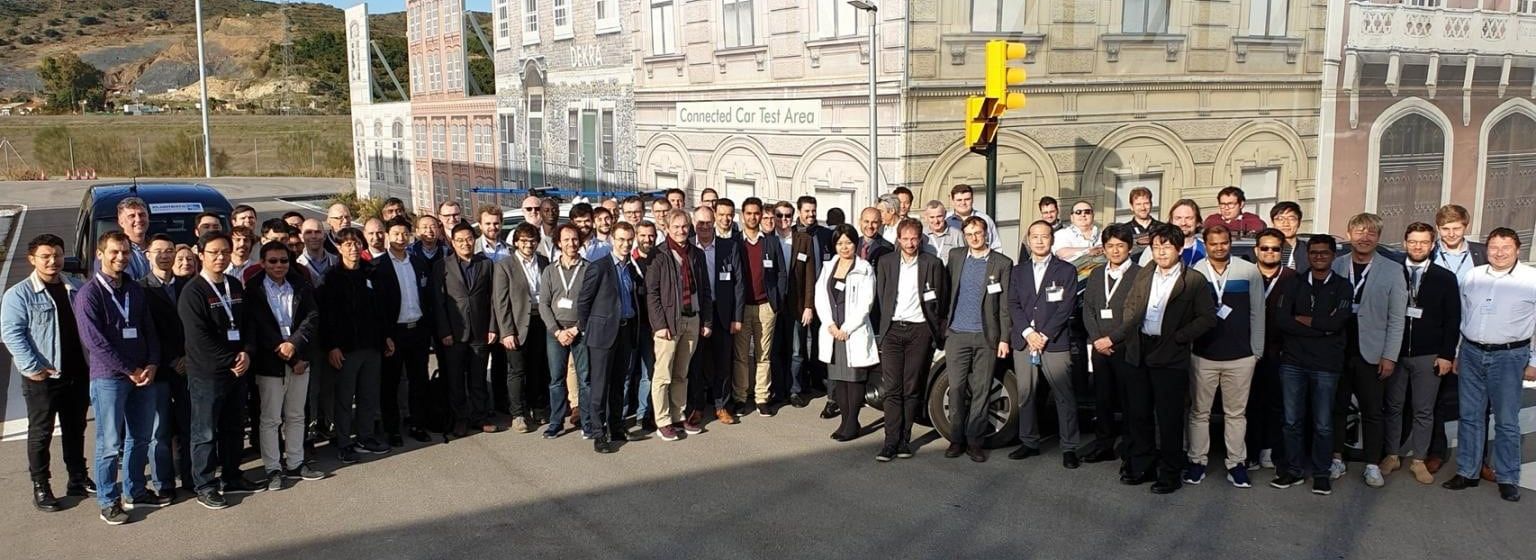
5GAA has proudly partnered with ETSI for their first C-V2X PlugtestsTM. The testing, that took place from December 2nd to 6th at the Malaga premises of the 5GAA Member DEKRA, has been concluded with a success rate of more than 95% of the executed tests, showing an extremely positive level of multi-vendor interoperability.
The event
The event demonstrated a high-level of interoperability across all participating companies employing 320 C-ITS test-cases, where devices were successfully communicating with each other directly and without network connectivity based on ETSI TC ITS and 3GPP standards, in both lab and field environments. In addition to the existing ITS upper layer interoperability test specifications from ETSI, participating companies conducted also the recently adopted 5GAA cellular vehicle-to-everything (C-V2X) IoT test specification for mode 4 operation over the PC5 direct communication access layer interface.
The positive results showed the industry’s maturity to support the commercial deployment of C-V2X solutions throughout the world, with both infrastructure and onboard units.
“Testing European LTE-V2X radios with ETSI was an important milestone on our global strategy to accelerate C-V2X time-to-market and finally deploy C-V2X on the European roads” commented 5GAA CTO Maxime Flament.
Plugtests™ represent a fundamental tool to allow vendors to evaluate the interoperability of their systems, strengthening cross-industry cooperation and the entire C-V2X ecosystem. Moreover, this event was a further milestone in the cooperation between 5GAA and DEKRA, a leader in automotive safety testing, that already had the chance to collaborate during a previous Plugfest in April 2019.
The week was viewed as very successful by participants (65% of them were 5GAA members), as it brought together roughly 70 C-ITS experts for testing and to validate that C-V2X products are both mature and commercially available today for the cooperative, connected and automated mobility ecosystem.
At the end of the event, Bob Banks, 5GAA WG3 Chair (Vodafone Group), declared “The results clearly show the maturity of not only the C-V2X technology but also the products from different vendors as crucial and available enablers for connected and safer mobility”.
“I’m glad we could successfully demonstrate again that C-V2X is working as expected and that so many companies are ready for deployment in Europe” stated Ralf Weber, 5GAA WG3 Vice Chair (Qualcomm).
The Workshop
During the event, 5GAA also organised a joint workshop on December 4th, on the latest developments related C-V2X Interoperability and Deployment. Standards experts from 3GPP and ETSI TC ITS offered thorough presentations on the ongoing developments related to standards that are already supporting the deployment of C-V2X. Subsequently, speakers from the European Commission, the Dutch Ministry of Infrastructure and the Global Certification Forum (GCF) presented updates on ITS and how C-V2X can favour its deployment.
5GAA Meets Brussels 2020: Face-to-Face Meeting and Conference
The 5G Automotive Association (5GAA) has the pleasure to announce its Conference on 6 February in Brussels.
This event is intended to advance the dialogue between high-level institutional and industry stakeholders on current challenges in the field of connected and automated mobility. Representatives from the European institutions, from local and national authorities, and 5GAA members will discuss ongoing challenges for connected and automated mobility and provide solutions by presenting the capabilities and deployment models of the Cellular Vehicle to Everything (“C-V2X”) technology.
Agenda:
09:00 – 09:30: Welcome and Introduction
09:30 – 10:30: First Session
– 5G: The Connected and Automated Automotive Revolution
– 5G in Cars: Is the Technology Ready?
– Digitalising European roads: leveraging synergies with mobile networks
10:30 – 11:00: Coffee Break
11:00 – 12:00: Second Session
– Current status of the 5G Strategic Deployment Agenda in Europe
– The Evolving Role of National Road Authorities in The Digital Era
12:00 – 12:50: ‘Ask the 5GAA experts’ Session
12:50 – 13:00: Closing Session
Confirmed speakers include:
– Mariya Gabriel, European Commissioner for Innovation, Research, Culture, Education and Youth (video message)
– Dino Flore, Vice President of Technology, Qualcomm
– Caspar de Jonge, Dutch Ministry of Infrastructure and Water Management
– Johannes Springer, CTO Connected Car T-Systems & Director General of the 5G Automotive Association
– Maxime Flament, CTO of the 5G Automotive Association
More speakers will be announced shortly.
Stay tuned for the detailed programme!
5GAA to be main supporting partner of 5G Techritory – Riga, 27-29 November 2019
5G Techritory is the annual Baltic Sea Region 5G Ecosystem Forum organised by the Electronic Communications Office (ECO) of Latvia, aiming at gathering decision makers, major representatives from industry associations, and business leaders to discuss the deployment of the earliest available commercial applications of 5G technology. Its second edition is going to be held in the Latvian capital, Riga, on 27-29 November.
Taking place in a vibrant region for 5G implementation, the 5G Automotive Association is proud to be confirmed once again as one of the main partners of this conference. 5GAA Director General Johannes Springer is going to participate as a speaker in front of an audience of up to a thousand senior professionals invited upon an attentive selection to ensure the highest quality of debate.
The Baltic Sea Region includes nine countries comprising of a population of 150 million people. Among the Baltic countries, Latvia appears in the third place of the 5G Readiness ranking according to the European Commission’s Digital Economy and Society Index (DESI) 2019 report. This result shows that the potential for international leadership in the field is highly promising and this edition has all the characteristics to be a must-visit, given the renewed interest for digital and technology of the newly appointed European Commission.
Since the objective of the programme is to focus on what is readier for commercialisation, four verticals have been identified as the main topics:
- Smart City
- Smart Mobility
- Industry 4.0
- Smart Media and Entertainment
In addition, a 5G policy hackathon, a key stakeholders’ roundtable and an exhibition are scheduled as side events.
Registration is open and all the possible interested participants are encouraged to apply.
See the official press release and leaflet.
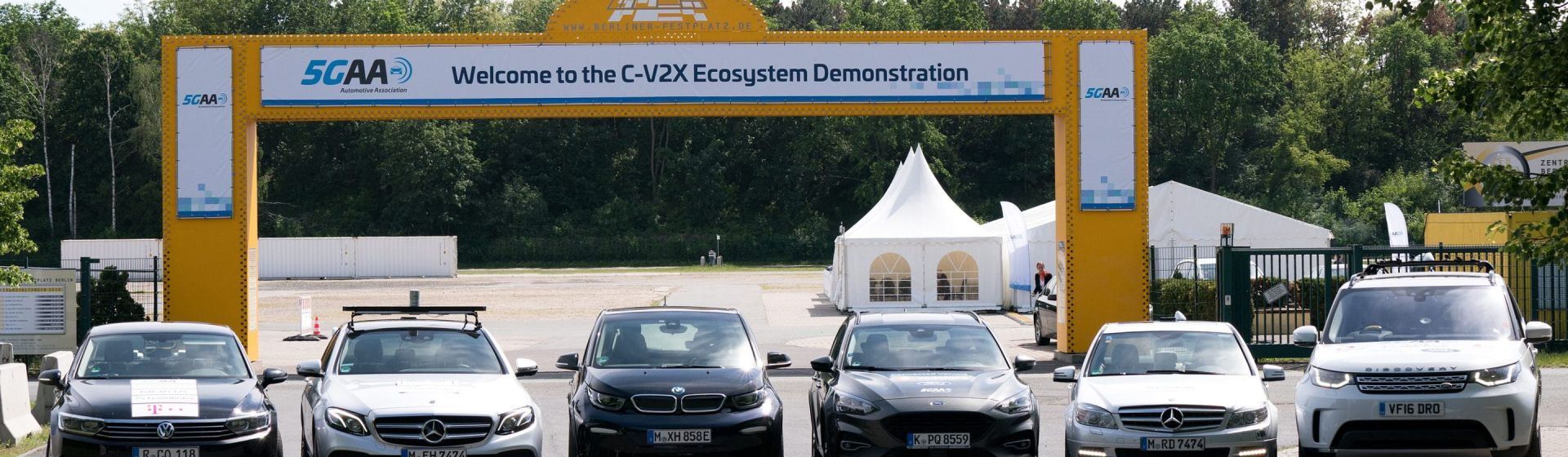
C-V2X contributes to safer roads for everyone: 5GAA live demo event in Berlin
Photos of the workshop can be found here. Click here to see the photos of the live demonstration.
Berlin, 23 May 2019 – Smart mobility technology, which we have been developing over the years, is now a reality. ‘Cellular Vehicle-to-Everything’ (C-V2X) allows vehicles to both communicate with the cloud and also directly with each other and their surroundings. Thanks to 4G LTE cellular technology, as well as the emerging 5G generation of high speed and low latency communications, traffic will be optimized, and emissions will be reduced. Emergency services will navigate smoothly and road safety for everyone, including vulnerable road users, will dramatically enhance.
At a live demo event in Berlin, the 5G Automotive Association (5GAA) presented a deep-dive into a smarter and safer mobility, giving a sneak peek of the technologies ready to be deployed. Prominent 5GAA members including BMW Group, Daimler, Deutsche Telekom, Fraunhofer Institutes FOKUS and ESK, Ford, Huawei, Jaguar Land Rover, Nokia, Qualcomm and Vodafone, demonstrated C-V2X Vehicle-to-Vehicle (V2V), Vehicle-to-Infrastructure (V2I) and Vehicle-to-Network (V2N) applications.
“Connected mobility standards are no longer a vision for the future,” says Maxime Flament, Chief Technology Officer at 5GAA. “The solutions on show are ready to be deployed today and have huge industry momentum based on the forthcoming 5G capabilities. C-V2X technology is a key foundation for a safe and sound driving environment for pedestrians, bicyclists, motorcyclists, cars and commercial heavy trucks. Global field testing is already in its very final stages and the first solutions are now commercially available from multiple suppliers.”
Using both direct short-range communications and mobile networks offers complementary capabilities as showcased in the demos, which involve tele-operated driving and the provision of emergency traffic information between vehicles using multi-access edge computing (MEC) functionality. All the demos use technology that is ready to be deployed.
A short summary on the 5GAA C-V2X use cases, showcased today at Berlin:
1. A. Traffic Management Solutions: Signal Phase and Timing (SPaT) and Red-Light Violation Warning (RLVW) to Vehicle
Waiting at the red light is not only time consuming, but idling, braking and accelerating release more pollutants. The communication between the traffic signal and vehicle is important to improve traffic flow, thus increasing road safety by preventing accidents. During the demo drive, a BMW Group vehicle equipped with a Qualcomm onboard unit running the Savari ITS software stack and the V2X use cases, communicates with a SWARCO traffic signal, showing C-V2X readiness across multiple vendors.
The use case enables the driver to monitor the upcoming traffic light. The center display of the vehicle shows the current signal phase and how long it will remain. In the Red Light Violation Warning (RLVW) use case, the application in the vehicle uses its speed and acceleration profile, along with the signal timing and geometry information from the traffic signal. If the driver is likely to run a red light he/she receives a warning in the vehicle.
B. Traffic Management Solutions: Emergency Electronic Brake light (EEBL)/ Roadworks warning (RWW)
C-V2X provides the driver with information so that he or she can adapt to the upcoming traffic situation in advance. Fraunhofer FOKUS, supported by Daimler, demonstrate an Emergency Electronic Brake Light Warning: Two vehicles equipped with Huawei onboard units are accelerating, and the car ahead brakes hard. The second car instantly receives a warning, demonstrating the advantage of the low-latency C-V2X communication. Furthermore, a Huawei roadside unit communicates ongoing roadwork via C-V2X to the vehicle. Visitors experience both use cases in the car viewing the warnings on the central display.
2. Real Time Emergency Alerts: Vehicle-to-Network and Network-to-Vehicle services
Vodafone Germany and Ford show connected vehicle technology (V2X) that could alert drivers to an accident ahead, moments after it has happened (via eCall Plus). Furthermore, the system provides early warning that emergency vehicles are approaching – and which side of the road other vehicles should move towards to avoid being an obstruction. Experts believe that survival rates for road accident victims can be improved by as much as 40% if they receive treatment just four minutes more quickly.
3. Live data capture and transmission: Expanded network/Vehicle-to-Network capacities via MEC
An ultra-fast, reliable and precise dissemination of safety-relevant information can save lives. Continental, Deutsche Telekom, Fraunhofer ESK and Nokia demonstrate how information is delivered to vehicles almost real-time via a mobile network, utilizing Multi-Access Edge Computing (MEC) technology. All data is processed at the edge of the mobile network to reduce transmission time (latency). As a result, event-related data such as emergency warnings as well as high-definition map data are transmitted in milliseconds, improving driving safety on the path to fully automated driving.
4. Combined Network and Direct solution enables the pinnacle of C-V2X technology
Vodafone Group, Huawei and Jaguar Land Rover demonstrate safety critical use cases by combining different communication modes (short direct via PC5 and longer-range network-based via Uu). The provision of a two-stage warning enables vehicles to be made aware of other vehicles approaching the same junction much earlier and allowing action to taken sooner to avoid a crash. Also, the number of road accidents because of unsafe lane changes and blind spots are significant. Using C-V2X technology helps automotive OEMs keeping the cost of implementing such warnings down by not having to install additional ‘one-off’ radio access systems for such warnings. The demos showcased the value and readiness of C-V2X and its ability to seamlessly combine both long range and short-range direct and longer-range network communication links. Specifically, it was shown that at a T-junction – a key site for accidents – connected cars benefit from longer range cellular network communication to deliver safety-related information beyond what alone can be delivered from short-range technology.
5. Remote-operated driving
Remote-Operated Driving (ROD) smooths the path to automated vehicles, anticipating situations in which remote human operator can intervene with the driving of the vehicle. ROD is enabled by low latency communication equipment e.g. by Huawei to deliver instructions or inputs to the vehicle to help it navigate challenging scenarios. Fraunhofer Institute FOKUS, supported by Daimler, showcase the reliability ROD enables already today.
_______________
Contact
Marketing and Communications Team
Email: marcom@5gaa.org
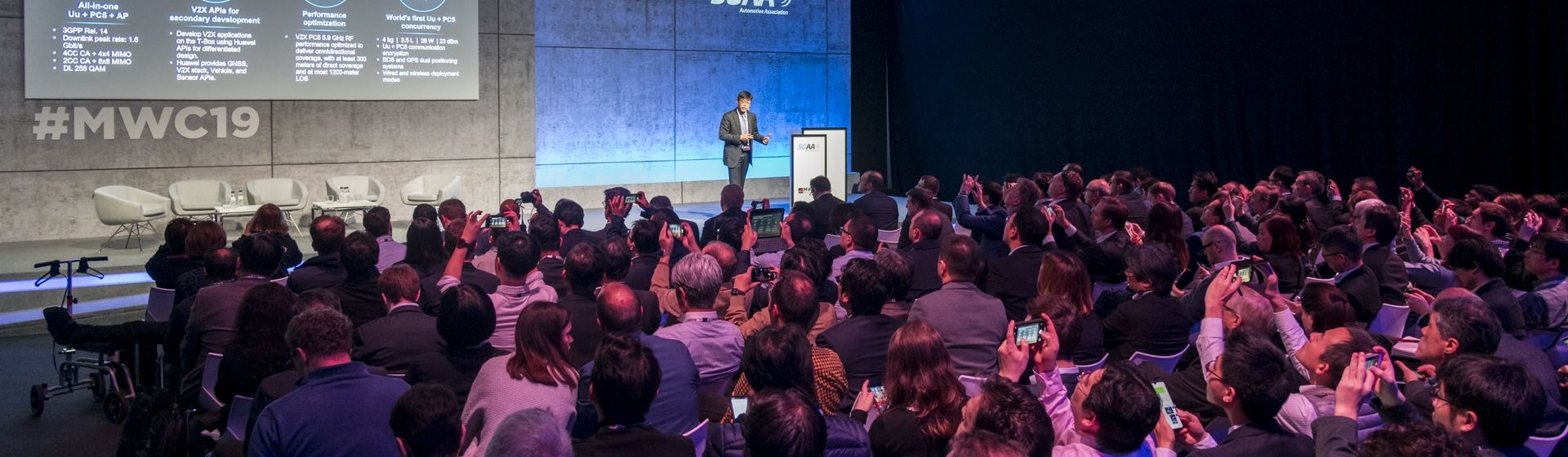
Automotive C-V2X ready to roll out globally, says 5GAA at this year’s MWC Barcelona
All presentations of the 5GAA session at MWC19 Barcelona are available down this page.
February 27th, Barcelona – During today’s well attended keynote, ‘Connecting the Mobility World with 5G’, the 5G Automotive Association (5GAA) gathered experts from the automotive, technology and telecom industries to explain how the deployment of ‘Cellular Vehicle-to-Everything’ (C-V2X) communication technology on the path to 5G is shaping the mobility of the future. Today LTE-V2X, the initial version of C-V2X, stands on the verge of its commercial launch: allowing vehicles to communicate with each other and their surroundings and, together with 5G enhancements, facilitating broad scale improvements in road safety.
“By bringing together key actors of the mobility ecosystem – across the automotive, information and communications technology industries – 5GAA continuously strives to develop forward-looking solutions for intelligent transportation services. Both for today and tomorrow.” stressed Thierry Klein, 5GAA Vice Chair and Head of the Disruptive Innovation Program at Nokia Bell Labs. “These end-to-end integrated solutions bring enhanced safety, sustainability, and convenience to all road users. 5GAA is very excited to be pioneering the revolution towards a smarter and more connected mobility world,” Thierry Klein added.
C-V2X communication is the state-of-the-art, high-speed cellular communications platform that enables vehicles to communicate with one another, with roadside infrastructure, with other road users (such as pedestrians, cyclists, and motorcyclists) using either direct short-range communications or cellular networks. While C-V2X network-based solutions are already widely deployed, direct communication solutions will be commercially available as of this year. As such the C-V2X platform delivers safety, mobility, traffic efficiency, and environmental benefits. C-V2X is designed with an evolutionary path to 5G and supports safe and efficient operations of autonomous vehicles.
5GAA members spearheading C-V2X
A number of 5GAA members are announcing ground breaking use cases at this year’ MWC. 5GAA members Telefónica, Ericsson, Ficosa and Seat show 5G connected car use cases supported by C-V2X direct communication for safer driving in a city (e.g. detection of cyclists when turning right or of a pedestrian at a zebra crossing). Another key technology bringing these use cases to life is edge computing.
In addition, 5GAA members Continental and Vodafone are working together to increase road safety and protect all road users for instance via “digital safety-shield” for cyclists and pedestrians, using C-V2X direct communication and edge computing in the first 5G deployments. The 5G-ready tests are taking place under real-life conditions at Vodafone’s 5G Mobility Lab in Aldenhoven, Germany.
Rohde & Schwarz has announced a collaboration with automotive electronics specialist Vector on a C-V2X end-to-end application layer test solution to verify safety-critical V2X scenarios. The companies’ integrated test platform is showcased for the first time at Mobile World Congress.
Deutsche Telekom has announced first C-V2X tests together with Skoda Auto in Czech as part of the European C-Roads project.
Geely also announced its plans to launch the first mass-produced C-V2X enabled vehicles in China together with Qualcomm in 2021.
Qualcomm has also announced its first 5G automotive platform, enabling both C-V2X short and long-range modes, which is expected to sample later this year and are planned for production vehicles in 2021.
C-V2X direct communication goes commercial in 2019
Mass production of C-V2X chips including direct communication from several suppliers is ongoing, and multiple radio vendors have already integrated these chips into their automotive radio offerings. 2019 is the year when C-V2X direct communication technology will be commercially available across the globe. Furthermore, full interoperability testing on C-V2X applications is ongoing among 5GAA members. The first mass-deployment in vehicles on the roads is anticipated to start in China in 2020; to be followed swiftly in other regions when local regulations allow for it.
“C-V2X is now ready to roll. At Ford, we will begin to deploy this technology in all new models launching in the US starting in 2022” confirmed Don Butler, Executive Director of Connected Vehicle & Services at Ford Motor Co.
The next milestone: 5G New Radio
C-V2X provides a clear evolution path to the family of 5G technologies for both direct and network communication. Part of this evolution is the 5G New Radio (NR).
NR-V2X will eventually ensure safe operation of autonomous driving vehicles by using 5G New Radio with Ultra Reliable Low Latency Communications (URLLC) network based communication combined with improved direct short range communications.
“The development of the NR-V2X standard is due for completion by the end of 2019; eventually hitting the road in 2023. This will enable a new generation of use cases for connected automated vehicles”, said Maxime Flament, CTO at 5GAA.
About 5GAA
The 5G Automotive Association (5GAA) is a global, cross-industry organisation with 110 members working together to develop end-to-end solutions for future mobility and transportation services. The organisation is committed to helping define and develop the next generation of connected mobility for advanced driving and automated vehicle solutions.
Presentations
- Opening speech by Thierry Klein, 5GAA Vice Chair & Nokia Bell Labs / Connecting the Mobility World with 5G-V2X
- Keynote by Friedhelm Ramme, Ericsson / 5G: From Concepts to Reality
- Keynote by Thorsten Hehn, Audi / 5G for Automotive: Key Applications
- Keynote by Jiang Wangsheng, Huawei / C-V2X Enables Intelligent Transportation
- Keynote by Nakul Duggal, Qualcomm / C-V2X Ignites Automotive Connected Revolution
- Speech by Vishnu Sudaram, Harman (Samsung) / Go-To-Market Timeline

5GAA co-organizes 5G Vertical User Workshop alongside 5G-IA, 5G-ACIA, and PSCE
On 12 and 13 February 2019, the 5G Vertical User Workshop, an initiative of 3GPP Market Representative Partners 5GAA, 5G-IA, 5G-ACIA and PSCE, was organised as a collaborative event for strategic dialogue between industries and 3GPP by exchanging on future needs and upcoming cellular standard developments. The workshop as a result, aimed to produce a report shared directly to 3GPP Project Coordination Group (PCG) as a mean to stimulate and facilitate greater involvement of the 5G Vertical Users in the 3GPP process.
The workshop held in Brussels brought together a host of experts from 5G standardization and a number vertical industries hoping to harness 5G including Automotive, Public Safety, Industry Automation, Utilities, Broadcasting, Satellites and Railways; as well as policy makers at the EU and Member State level.
Overall the event was successful in stimulating open dialogue and actions across all participants in an informal workshop setting that supported all involved to share their perspectives and experiences from their industry and standardization, and therefore how related processes may well be improved moving forward. Several possible options were discussed in terms of how to deliver improvements, and what corresponding changes to interaction could look like if required. Could this involve further workshops outside of 3GPP which could then drive action within the established channels? Or should there be alteration to vertical and MRP orientated rules of procedure to foster greater contributions?
Moreover, several open tools were discussed for better tracking activity and on-going work to make 3GPP more accessible to those joining, and those already, involved that may experience difficulties in contributing during this important period in the standardization of 5G. The need for such improvements are especially pronounced due to the forthcoming TSG#84 in December 2019, during which the completion of both Rel. 16 upon which 5G will be so dependent, and finalization of the scope for Rel. 17 are both scheduled.
There was a clear consensus among organizational partners and participants that an informal workshop and forum of this type was of use to help stimulate productive discussion on how to proceed with inter-MRP interaction in future.
In light of this, it was proposed that a second event with more focus on practical steps to be taken by 5G vertical industries and SDOs to improve vertical input would be of value, however the setting of this event is yet to be determined; interested Market Representational Partners will be coordinating to decide on the most effective next steps to convert what was valuable dialogue into impactful actions.
Until then, all involved expressed their great thanks to all who contributed to a workshop filled with rich dialogue, and hope based on continuing collaboration that this progress can be built upon over the coming months.
You can find all presentations here:
- 5GAA – 5G Automative Association, pioneering digital transformation in the automotive industry
- PSCE – Public Safety Communication Europe, National plans and roadmaps towards broadband
- 5GIA – 5G Alliance for Connected Industries and Automation
- ESOA – EMEA Satellite Operators Association, 3GPP Market Representation Partners
- EBU – European Broadcasting Union, Native 5G broadcasting
- EUTC – European Utilities Telecom Council
- 5GIA, 5G PPP Projects focusing on standardisation Verticals and Standards Tracker Tool + Pan-European 5G Trials Roadmap, and International Trials
- 5G-PPP, Prestandards WG Status update
- 3GPP, Verticals in 3GPP + Mission Critical Comms + Industrial Automation + V2X learnings in 3GPP
NGMN Publish white paper on V2X
The Next Generation Mobile Networks (NGMN) recently published a White Paper demonstrating their views on Vehicle-To-Everything (V2X) technologies as a key component to reduce the number of road accidents and enhance safety on our roads.
In the study, eight V2X use cases were chosen to reflect the three ITS application types: 1) road safety, 2) traffic management & efficiency and 3) infotainment. They encompassed various C-V2X communication methods such as Vehicle-To-Vehicle (V2V), Vehicle-To-Infrastructure (V2I), Vehicle-To-Pedestrian (V2P), Infrastructure-To-Vehicle (I2V), Vehicle-To-Network-To-Vehicle (V2N2V), and Network-To-Vehicle (N2V).
Here are some of the key findings and conclusions of the NGMN as highlighted in the paper:
- To date, NGMN members have provided cellular connectivity to more than 30 million vehicles worldwide which are used for a variety of safety-related use cases (e.g. distribution safety-related jam warning, black ice warnings, etc.). It is expected that in the near future every vehicle will be equipped with cellular connectivity. This is a good and market-driven basis for further deployment of further C-V2X technology and services.
- With the finalization of 3GPP Rel. 14 specifications at the beginning of 2017, NGMN members now have a 3GPP standardized solution, which supports both long-range as well short-range communication, and which fulfills all the requirements of a C-ITS eco-system.
- After already ongoing tests, the technology will be deployed by 2020.
- NGMN believes that C-V2X is not only able to enhance safety features for vehicles, but also supports use cases for other traffic participants, like pedestrians and cyclists.
- NGMN has investigated and concluded that C-V2X technology is superior to IEEE 802.11p standards, technically, economically, and eco-system wise, and can well satisfy the basic safety applications…
5GAA, BMW Group, Ford and Groupe PSA Exhibit First European Demonstration of C-V2X Direct Communication Interoperability Between Multiple Automakers
- Companies team up with Qualcomm and Savari to showcase C-V2X’s advanced performance for safety, traffic efficiency, and autonomy
- Exhibition includes communication between vehicles, motorcycles, and infrastructure, showing commercial readiness for industry deployments as early as 2020
Downloadable Resources |
Photos |
Infographic |
Soundbite Video Clip |
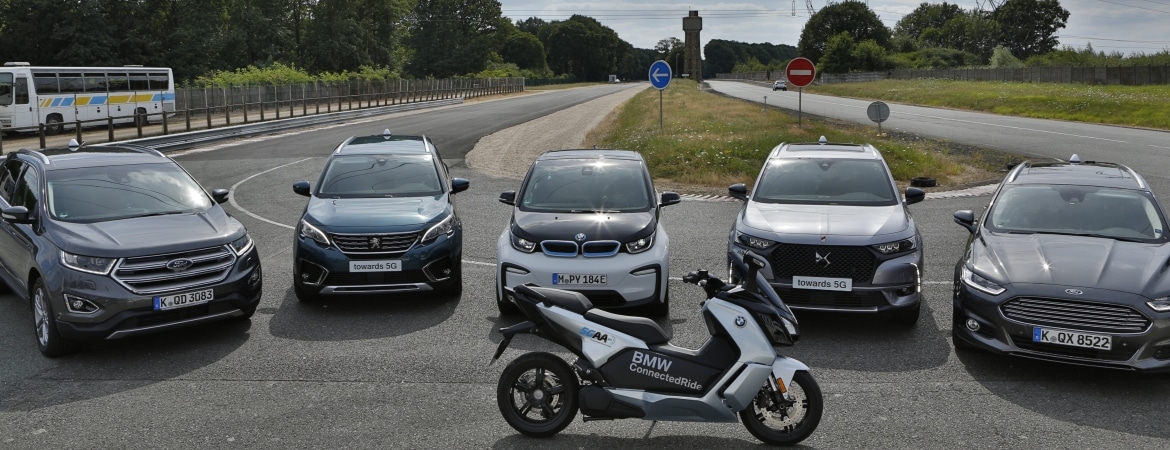
PARIS — July 11, 2018 – The 5G Automotive Association (5GAA), the BMW Group, Ford Motor Company (NYSE: F), and Groupe PSA — in association with Qualcomm Technologies, Inc., a subsidiary of Qualcomm Incorporated, and Savari, Inc. — announced today Europe’s first live demonstration of C-V2X direct communication technology operating across vehicles from multiple auto manufacturers. The live demonstration also featured a live showcase of C-V2X direct communication technology operating between passenger cars, motorcycles, and roadside infrastructure. C-V2X is a global solution for vehicle-to-everything (V2X) communication in support of improved automotive safety, automated driving and traffic efficiency.
The demonstration exhibited the road safety and traffic efficiency benefits of using C-V2X for Vehicle-to-Vehicle (V2V) collision avoidance, as well as Vehicle-to-Infrastructure (V2I) connectivity to traffic signals and Traffic Management Centers (TMC). C-V2X was operated using real-time direct communications over ITS spectrum and demonstrated its ability to work without cellular network coverage, and underscores its commercial readiness for industry deployment as early as 2020. Superior performance and cost-effectiveness compared to other V2X technologies, along with forward-compatibility with 5G, make C-V2X direct communications a preferred solution for C-ITS applications.
Six demonstrations were shown including Emergency Electronic Brake Light, Intersection Collision Warning, Across Traffic Turn Collision Risk Warning, Slow Vehicle Warning and Stationary Vehicle Warning, Signal Phase and Timing / Signal Violation Warning and Vulnerable Road User (pedestrian) Warning. The vehicles involved included two-wheel e-scooters provided by BMW Group, and automotive passenger vehicles provided by Ford, Groupe PSA, and BMW Group, all of which were equipped with C-V2X direct communication technology using the Qualcomm® 9150 C-V2X chipset solution. V2X software stack and application software, along with roadside infrastructure, were provided by industry leader, Savari.
C-V2X is globally supported by a broad automotive ecosystem, which includes the fast growing 5GAA organization. The 5GAA involves over 90 global members comprised of many leading automakers, Tier-1 suppliers, software developers, mobile operators, semiconductor companies, test equipment vendors, telecom suppliers, traffic signal suppliers and road operators.
Cellular modems will be key to the C-V2X deployment in vehicles to support telematics, eCall, connected infotainment and delivering useful driving/traffic/parking information. As C-V2X direct communication functionality is integrated into the cellular modem, C-V2X solutions are expected to be more cost-efficient and economical over competing technologies, and benefit from accelerated attach rates. C-V2X direct communication field validations are currently underway in Germany, France, Korea, China, Japan and the U.S.
C-V2X currently stands as the only V2X technology based on globally recognized 3rd Generation Partnership Project (3GPP) specifications, with ongoing evolution designed to offer forward compatibility with 5G. C-V2X also leverages and reuses the upper layer protocols defined by the automotive industry, including the European Telecommunications Standards Institute (ETSI) organization. C-V2X includes two complementary transmission modes:
- Direct communication as shown in this demonstration for V2V and V2I use cases
- V2N network communication, which leverages mobile operators for connectivity and delivers cloud-based services, including automated crash notification (ACN, as mandated by eCall), hazard warnings, weather conditions, green light optimal speed advisory (GLOSA), parking spot location, and remote tele-operation to support automated driving, to name a few.
“This demonstration builds on the successful C-V2X showcase we organised with our members Audi, Ford and Qualcomm in Washington DC in April” said Christoph Voigt, Chairman of 5GAA.
“We are excited to witness the growing momentum behind this life-saving technology and to see our members working together to deploy C-V2X, and to make it hit the road as soon as possible.”
“The BMW Group introduced the first C-ITS use cases already in 2013 with the market introduction of the BMW i3. Today most of envisaged C-ITS use-cases are already institutionalized. With the implementation of C-V2X, the BMW Group accomplishes the last set of the puzzle with a practical path to C-ITS showing quick benefits,” said Christoph Grote, Senior Vice President Electronics, BMW Group.
“With its ability to safely and securely connect vehicles, along with its evolution into 5G, C-V2X is integral to Ford’s vision for future transportation in which all cars and infrastructure talk to each other,” said Thomas Lukaszewicz, Manager Automated Driving, Ford of Europe. “We are very encouraged by preliminary test results in Europe and elsewhere which support our belief that C-V2X direct communications has superior V2X communication capabilities.”
“We’re moving forward with seamless communication between cars and their environment for enhancing road safety, as well as our customers’ safety,” said Carla Gohin, Group PSA’s Vice President for Research and Advanced Engineering. “Following the first European C-V2X direct communications demonstration we hosted with Qualcomm Technologies last March, we’re pleased to work with leading automotive and technology companies today to highlight that C-V2X interoperability is a reality.”
“This demonstration of interoperability between multiple automakers is not only another milestone achieved towards C-V2X deployment but also further validates the commercial viability and global compatibility of C-V2X direct communications for connected vehicles,” said Enrico Salvatori, senior vice president & president, Qualcomm Europe, and MEA. “We look forward in continuing to work alongside leaders in the automotive industry, like the 5GAA, BMW Group, Ford, Groupe PSA and Savari, to help advance the automotive industry’s shift towards a safer, connected and more autonomous future.”
“As one of the V2X pioneers, our company is extremely pleased to continue to help enable the next step in the V2X revolution that we helped start back in 2008,” said Ravi Puvvala, CEO of Savari. “For the last year and a half, the Savari team has worked diligently alongside the dedicated C-V2X engineers in the 5GAA partnership. The resulting string of increasingly impressive demonstrations is continuing to convince the world that C-V2X will soon be deployed around the world.”
About 5GAA
The 5G Automotive Association (5GAA) is a global cross-industry organization of companies from the automotive, technology and telecommunications industries (ICT), working together to develop end-to-end solutions for future mobility and transportation services.
Created in 2016, the Association is comprised of over 90 members whose mission is to develop, test and promote communications solutions, initiate their standardization and accelerate their commercial availability and global market penetration, to address society’s connected mobility and road safety needs with applications such as automated driving, ubiquitous access to services and integration into smart city and intelligent transportation. For more information, visit 5GAA’s website, LinkedIn and Twitter pages.
About the BMW Group
With its four brands BMW, MINI, Rolls-Royce and BMW Motorrad, the BMW Group is the world’s leading premium manufacturer of automobiles and motorcycles and also provides premium financial and mobility services. The BMW Group production network comprises 30 production and assembly facilities in 14 countries; the company has a global sales network in more than 140 countries. In 2017, the BMW Group sold over 2,463,500 passenger vehicles and more than 164,000 motorcycles worldwide. The profit before tax in the financial year 2017 was € 10.655 billion on revenues amounting to € 98.678 billion. As of 31 December 2017, the BMW Group had a workforce of 129,932 employees. The success of the BMW Group has always been based on long-term thinking and responsible action. The company has therefore established ecological and social sustainability throughout the value chain, comprehensive product responsibility and a clear commitment to conserving resources as an integral part of its strategy.
Facebook: https://www.facebook.com/BMWGroup
Twitter: https://twitter.com/BMWGroup
YouTube: https://www.youtube.com/BMWGroupview
Google+: https://googleplus.bmwgroup.com
About Ford Motor Company
Ford Motor Company is a global company based in Dearborn, Michigan. The company designs, manufactures, markets and services a full line of Ford cars, trucks, SUVs, electrified vehicles and Lincoln luxury vehicles, provides financial services through Ford Motor Credit Company and is pursuing leadership positions in electrification, autonomous vehicles and mobility solutions. Ford employs approximately 202,000 people worldwide. For more information regarding Ford, its products and Ford Motor Credit Company, please visit www.corporate.ford.com.
About Groupe PSA
Groupe PSA designs unique automotive experiences and delivers mobility solutions to meet all customer expectations. The Group has five car brands, Peugeot, Citroën, DS, Opel and Vauxhall and provides a wide array of mobility and smart services under the Free2Move brand. Its ‘Push to Pass’ strategic plan represents a first step towards the achievement of the Group’s vision to be “a global carmaker with cutting-edge efficiency and a leading mobility provider sustaining lifetime customer relationships”. An early innovator in the field of autonomous and connected cars, Groupe PSA is also involved in financing activities through Banque PSA Finance and in automotive equipment via Faurecia. Find out more at groupe-psa.com/en
Media library: medialibrary.groupe-psa.com / @GroupePSA_EN
About Qualcomm
Qualcomm invents breakthrough technologies that transform how the world connects and communicates. When we connected the phone to the Internet, the mobile revolution was born. Today, our inventions are the foundation for life-changing products, experiences, and industries. As we lead the world to 5G, we envision this next big change in cellular technology spurring a new era of intelligent, connected devices and enabling new opportunities in connected cars, remote delivery of health care services, and the IoT — including smart cities, smart homes, and wearables. Qualcomm Incorporated includes our licensing business, QTL, and the vast majority of our patent portfolio. Qualcomm Technologies, Inc., a subsidiary of Qualcomm Incorporated, operates, along with its subsidiaries, all of our engineering, research and development functions, and all of our products and services businesses, including, the QCT semiconductor business. For more information, visit Qualcomm’s website, OnQ blog, Twitter and Facebook pages.
About Savari
Savari seeks to make the world’s roadways and vehicles automated and safer by deploying advanced wireless sensor technologies and software. Savari builds software and hardware sensor solutions for automotive car manufacturers, the automotive aftermarket and smart cities. The company pioneered V2X radio technology, which is crucial for vehicles to achieve Level 4 and Level 5 of automation. The technology allows vehicles to share data with other vehicles, traffic lights and smartphones. With more than 150 man-years of V2X learning and development and 15 million-plus miles per year of public testing, Savari is a leader in V2X technology. Savari is headquartered in Santa Clara, Calif., and has offices in Detroit, Mich., Munich, Germany, Seoul, Korea and Bengaluru, India. For more information, visit savari.net.
###