
C-V2X Use Cases and Service Level Requirements (Vols. I, II and III)
This updated document series from the 5G Automotive Association (5GAA) provides a comprehensive framework for defining and analysing C-V2X use cases and their associated Service Level Requirements (SLRs). It builds upon previous work, refining methodologies for describing use case scenarios, considering factors like road environments and involved actors.
Published in three volumes, each of them includes a curated set of C-V2X use cases, respectively detailed with specific SLRs. These use cases serve as a valuable resource for 5GAA work groups, guiding the development of C-V2X solutions, informing standardisation efforts, and supporting the creation of robust business cases for deployment.
Intersection Safety via Infrastructure Sensor-Sharing
Intersections are a hotspot for traffic fatalities and injuries globally, with nearly a quarter of U.S. traffic fatalities and half of all injuries occurring in these high-risk areas. To address this, the 5GAA has developed a technical report on the ‘InterSafe Service,’ an approach leveraging infrastructure sensor-sharing to increase intersection safety for all road users, especially Vulnerable Road Users (VRUs) like pedestrians and cyclists.
This report explores key use cases, system requirements, and deployment options for integrating Vehicle-to-Everything (V2X) communication technologies with infrastructure sensors. It outlines a framework for developing interoperable, standardised solutions that can operate efficiently within existing Intelligent Transportation System (ITS) spectrums. Crucially, the service is designed to deliver safety benefits even during the early stages of V2X adoption, when only a fraction of vehicles are equipped with these technologies.
The document also provides recommendations for global standards organisations, such as SAE International and ETSI, to expedite the development of system-level profiles. By fostering collaboration across stakeholders, the InterSafe Service has the potential to significantly reduce intersection-related incidents and accelerate the adoption of life-saving technologies worldwide.
5G Automotive Association’s Position Paper on the eCall Legacy Fleet
5GAA welcomes the renewed attention and subsequent discussions on Next Generation eCall (NG eCall) and the legacy fleet, following the second phase of the IDIADA study, presented on 12 December 2023. Whilst the opportunity to address the critical issue of the legacy fleet is welcome, we wish to draw attention to some key industry concerns.
In this position paper, we underline that industry cannot be held liable for the lack of service continuity of 112-based eCall for the legacy fleet, which result from obsolete legislative requirements. Since both retrofit as well as the extension of 2G/3G networks are implausible, we call for public authorities to take responsibility in informing users in the event of eCall failure, in instances outside industry control. We also encourage further research to be carried out to revise the current eCall regulatory framework so that it becomes future proof and does not lead to the same situation in the future as we have now once NG eCall becomes obsolete, or 4G networks are being transitioned to other technologies. This should be based on a transparent dialogue between authorities and industry to find the right solution.
Read about 5GAA’s position here.

Connected Mobility
Sustainability
Sustainability benefits of C-V2X
Cellular Vehicle-to-Everything, or C-V2X, communications will make transportation not only safer and smarter but also more sustainable.
Sustainability has three dimensions: environmental, social and economic.
C-V2X ticks all three boxes:
- Environmental: By helping to make every trip smarter, safer and more efficient, C-V2X helps reduce congestion and accidents, thereby reducing air pollution, noise pollution and energy use.
- Social: Saving lives and avoiding injuries are clear social benefits. By enabling real-time communication between pedestrians, cyclists, traffic infrastructure and moving vehicles, including motorcycles and electric scooters, C-V2X will help avoid accidents that otherwise would result in injuries and deaths.
- Economic: By enabling more efficient mobility, C-V2X will save people and employers billions of man-hours currently wasted in traffic jams. Those man-hours can then be dedicated to more rewarding activities.
C-V2X also enables the growth of autonomous mobility, which in turn offers even greater sustainability benefits, for example mobility-as-a-service offerings.
To learn more, watch the short video or scroll down for more details.
C-V2X and Sustainability in detail
ENVIRONMENTAL BENEFITS

- Transport still represents about 25% of Europe’s total CO2 emissions. By helping to make every trip smarter, safer and more efficient, C-V2X helpsreduce congestion and accidents, thereby reducing energy use, noise pollution and air pollution.
- C-V2X can help all vehicles operate and deliver people and goods more efficiently, thereby reducing pollution and optimizing the use of valuable energy resources.
- INRIX calculated that each second of reduced delays at traffic signals across the United States would translate to an annual reduction of 800,000 metric tons of CO2.
- Connected vehicle technology can help electric cars calculate an energy-optimised route to a charging station that’s not necessarily the fastest or nearest but requires the least energy to reach.
- Examples of environmental benefits enabled by C-V2X technologies include:
- Current technology permitting smarter routing for all vehicles in both urban and rural areas, for example via automated traffic routing, road, bridge, tunnel and parking availability updates and smart parking.
- Future technology permitting “green waves” for emergency vehicles, cars, trucks, lorries and other vehicles instead of stop-and-go traffic.
- Future technology facilitating manoeuvres and cooperation in traffic.
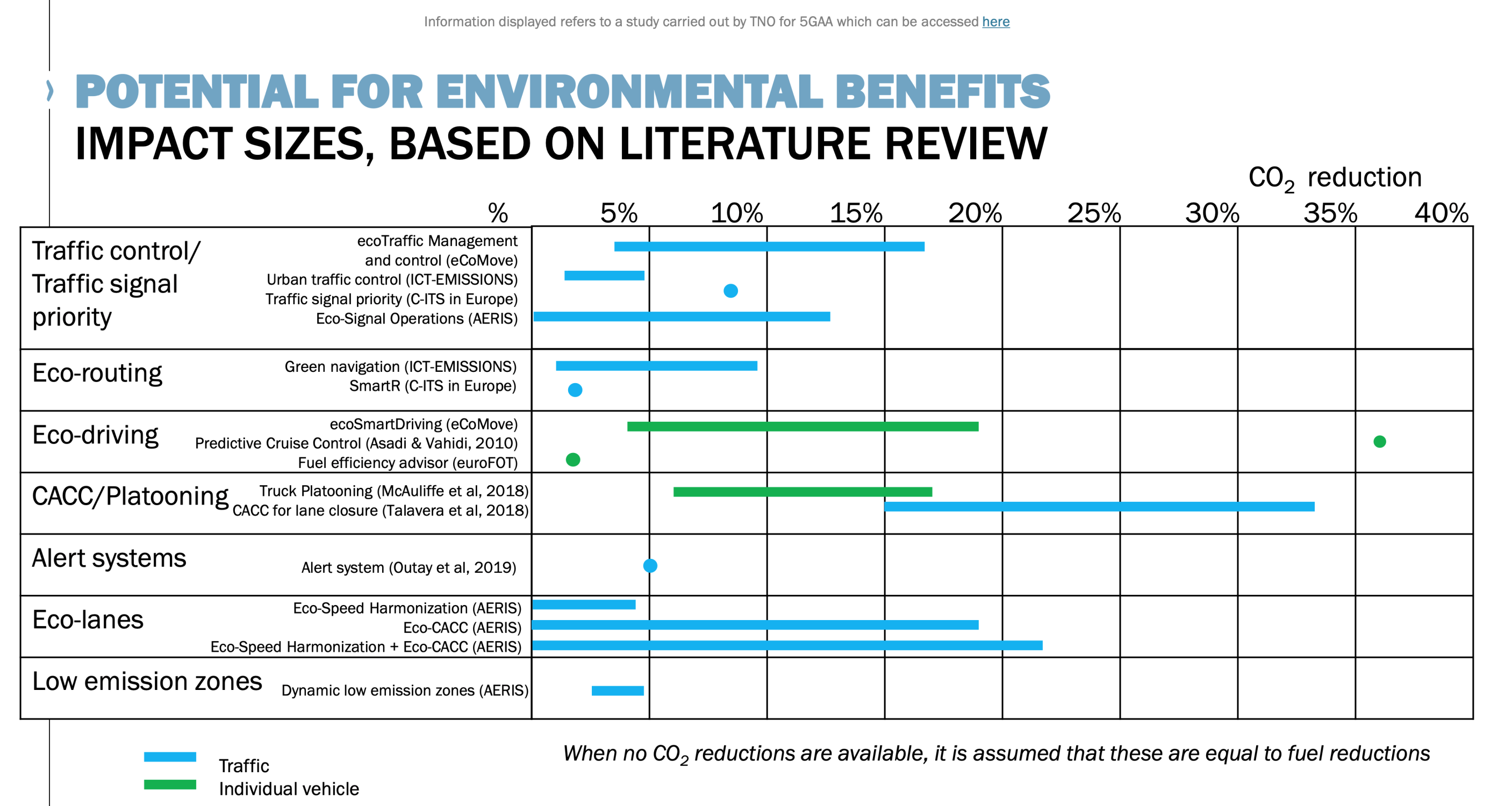
- For more detailed information, please see TNO’s report for 5GAA on the Environmental Benefits of C-V2X.
SOCIAL BENEFITS

- By enabling real-time communication between pedestrians, cyclists, traffic infrastructure and moving vehicles, including motorcycles, C-V2X will help avoid accidents that otherwise would result in injuries and deaths.
- According to the World Health Organisation, there were 1.35 million traffic deaths globally in 2016, the latest year for which global data are available. Road traffic deaths are a leading cause of death among young people, in particular.
- In the European Union, there were about 20,608 road deaths in 2023, or about 46 road deaths per million inhabitants.
- In the United States, an estimated 40,990 people died in road accidents in 2023. The United States Department of Transportation has set an ambitious goal of zero traffic deaths, in part by leveraging advanced technologies to prevent accidents in the first place.
- It says: “The U.S. Department of Transportation’s National Roadway Safety Strategy specifies that zero is the only acceptable number of deaths and serious injuries on our roadways. USDOT is committed to taking substantial, comprehensive action to achieve this goal.”
- By providing real-time hazard notifications and enabling connected cooperative driving, C-V2X makes transportation safer for all road users, including cyclists. As C-V2X makes the roads safer, more people may feel confident in choosing cycling as their primary mode of transportation.
- A U.S. DOT pilot study demonstrated that C-V2X technology can prevent accidents and injury for vulnerable road users.
- Green waves and corridors for emergency vehicles can help save lives and reduce injuries, allowing people to lead longer, healthier and more fulfilling lives.
- Response times are critical for emergency vehicles and first responders to save lives. A 2020 study showed that “green waves” at traffic lights could reduce response times by as much as 30% with little impact on overall traffic conditions.
- By enabling more efficient mobility, C-V2X will save commuters billions of man-hours currently wasted in stressful traffic jams.Those man-hours can be dedicated to more enjoyable and rewarding activities such as doing sports, hobbies, volunteering, education or spending time with friends and family.
- In Europe, the average driver in some cities loses more than 150 hours per year stuck in traffic jams.
- Americans lost as much as 3.4 billion hours in traffic in total in 2021.
- C-V2X helps connect other modes of transport with one another to facilitate a real multi-modal transportation system.
ECONOMIC BENEFITS

- By enabling automated driving and mobility as a service, C-V2X will help create new products and services that help drive more sustainable economic growth.
- For example, anonymous data collected through C-V2X can help governments and policymakers develop more effective infrastructure maintenance programmes and traffic plans.
- By enabling more efficient mobility, C-V2X will save employers and entrepreneurs billions of man-hours currently wasted in traffic jams.Those man-hours can then be dedicated to more rewarding activities.
- For commercial vehicles, C-V2X can help optimise delivery routes and schedules and reduce the number of empty or partially loaded trips. Efficient route management reduces energy use and pollution.
- The deployment of C-V2X technologies in vehicles can increase demand for 5G and future networks, each of which will be more energy-efficient than the technologies they replace.
Want to learn more?
If you want to learn more about the timeline for the introduction of next-generation C-V2X communications technologies, including those with clear environmental benefits, please see our latest C-V2X technology Roadmap here.

Meet Our Members – Interview with Jyoti Sharma, Verizon
In our ongoing “Meet Our Members” series, we explore the unique journeys and expertise of the individuals who make the 5G Automotive Association. Each interview sheds light onto the incredible work, vision, and passion of the people behind our organisation. You can check out our last conversation with Menno Malta, CEO of Monotch, here.
This time, we introduce Jyoti Sharma, Associate Director of Network Planning at Verizon and alternate board member at 5GAA since 2021. Jyoti has brought her deep industry insight to a range of work items, including Vehicle-to-Network-to-Everything (V2N2X) and has led initiatives such as the Vulnerable Road User (VRU) Demo. Her commitment to accelerating the large-scale deployment of V2X technologies make her a valuable contributor to the 5GAA, and we’re excited to learn more about her perspective on the future of 5G and MEC in transportation.
Could you tell us briefly about Verizon’s involvement in 5GAA and how your company benefits from being a member?
Verizon has been an active member of 5GAA since its inception. We started out as a general member and initially contributed at the working group level. We saw tremendous value in taking a leadership role in 5GAA as a major U.S. telecommunications provider and were elected by the members as a gold board member in 2021. Currently, Verizon is a platinum board member of 5GAA and we are playing a critical strategic role as one of the key stakeholders in the V2X ecosystem.
When did you first become part of the 5GAA board? What are some of your responsibilities, and what has been your most rewarding experience so far?
I represent Verizon on the 5GAA board as an alternate board member since 2021. In my role as a board member I have the privilege and responsibility to ensure 5GAA remains focused on key strategic focus areas which will accelerate a large-scale deployment of Vehicle-to-Everything (V2X) across the globe. My most rewarding experience has been to collaborate with other 5GAA members who are leaders from auto OEM customers, their tier 1 suppliers, chipset and module providers and other ecosystem partners. This technical collaboration between all the stakeholders is the key to drive innovation and unlock the full potential of V2X communications at scale and make it a reality.
Can you share any recent examples of how Verizon has collaborated with other 5GAA members to drive innovation in the industry?
Verizon has taken a leadership role in bringing the V2X ecosystem partners together under the 5GAA umbrella. We have demonstrated thought leadership in defining the network architecture to solve challenging V2X requirements leveraging key technology enablers such as 5G, multi-access edge computing (MEC) and Hyper Precise Location. Our recent V2X VRU (Vulnerable Road User) demo in Detroit showcasing interoperability between different network operators and application providers generated a very positive response and engagement from auto OEMs, Departments of Transportation and road operators. The demo was successful due to close collaboration with several 5GAA member companies.
As the lead of the VRU DEMO Work Item, could you elaborate on the significance of demonstrating interoperability in the context of Vulnerable Road User protection solutions?
VRU DEMO is one of the key strategic focus areas at the 5GAA board level that the industry has been trying to address for many decades. We believe the C-V2X and other technology enablers (5G, MEC, Hyper Precise Location) are ready to mitigate the number of road accidents involving vulnerable road users such as pedestrians and cyclists. In order to deploy such a VRU solution at scale it needs to work across multiple operators, multiple auto OEMs, multiple application providers and multiple cloud providers. We reached a significant milestone by demonstrating interoperability amongst different stakeholders and showcased the technology is ready to deploy at scale with existing networks. The learnings from the demo are being replicated in other parts of the world and are informing U.S. DOT V2X Deployment plans.
What criteria were used to select the specific use cases for demonstration in VRU DEMO? How did these use cases represent real-world scenarios and challenges?
There has been extensive discussion within 5GAA to define different VRU scenarios. Different flavors of VRU use cases have been documented in published technical reports. The demo team carefully selected most common real world VRU scenarios such as active pedestrian crossing alert and using roadside cameras and artificial intelligence, machine learning logic in the MEC to detect pedestrians and alert the drivers to avoid potential collision.
Verizon participated in the demos with a showcase of its network solution using multi-access edge computing. How does MEC differ from traditional network-based computing in terms of its benefits for VRU protection applications?
MEC allows us to bring traditional cloud compute and storage within the mobile network closer to the edge where the data is generated reducing the end to end latency. It is well established that MEC is a key differentiator and technology enabler for latency critical use cases such as VRU protection. Verizon has already deployed public MEC across the United States in partnership with cloud providers. We continue to drive innovation by developing standard MEC and Network APIs for application providers. During the VRU demo we demonstrated near real time VRU alerts over 5G and applications hosted on Verizon’s Detroit MEC.
Meet Our Members – Interview with Menno Malta, Monotch CEO
The 5G Automotive Association (5GAA) thrives on the collective expertise and collaborative spirit of its members. Over 110 organisations strong, our membership represents a global network of market leaders and innovators shaping the future of connected mobility.
We are kicking off a new series, “Meet Our Members,” to delve deeper into the stories of the individuals who make up the backbone of 5GAA. First up, we will be featuring Menno Malta, CEO of Monotch, who has been actively involved in one of 5GAA’s most recent and exciting areas of work – Vehicle-to-Network-to-Everything (V2N2X) communication.
This interview series will showcase a diverse range of profiles, highlighting their contributions, challenges, and predictions for the exciting world of 5G-connected transportation. Get ready to be inspired by the passion and ingenuity of our members as we meet the people who make 5GAA.
Menno, you are the CEO of Monotch, a 5GAA member company. How does Monotch’s work relate to 5GAA’s, and what keeps you engaged with our association?
Monotch operates at the forefront of the V2N2X market. Our proven TLEX platform is used by cities and road authorities all over the world to connect mobility and digital infrastructure bringing substantial societal benefits and increased cost-effectiveness.
The initial interest that drew us to 5GAA was the opportunity to engage with OEMs, mobile network operators, and related industries. This is still of interest! We really appreciate the possibilities to discuss developments and work jointly on progressing the market. The networking opportunities are also great for us.
Monotch is based in the Netherlands. Last year, your views were instrumental in the organisation of 5GAA’s workshop in the Hague, where we looked at C-V2X deployment in the Low Countries. Two years later, what is the state of play for C-V2X and connected mobility in the Netherlands, and how do you see it unfolding?
In the Netherlands, we see a steady growth of smart and connected roadside infrastructure as well as new use cases such as emergency vehicle warnings that are now available on a large scale. This leads to more connected parties, including the first vehicle OEMs. On top of this, there is a push on urban challenges and use cases, which will lead to even more data and impact in the next few years. The Netherlands is truly a lighthouse deployment, and authorities from other countries come here often to see what’s happening and how they can apply learnings in their own jurisdiction.
One of 5GAA’s recent areas of work has been vehicle-to-network-to-everything (V2N2X) communications, and you’ve been one of its main contributors. What is V2N2X, what makes this such an important topic, and what are some of the biggest hurdles to overcome in achieving its widespread adoption?
V2N2X is a subset of overall V2X, where the cellular network and cloud components are used to realise connected mobility. It allows the ecosystem to get to scale with many use cases in a relatively short term, as it leverages existing technology such as apps, onboard units and, of course, the 4G/5G network! I think it’s hugely important for 5GAA as it shows the value of a connected ecosystem to the main stakeholders and can kickstart overall C-V2X deployment.
The V2N2X work item has been concluded with the publication of a white paper, ‘Road Traffic Operation in a Digital Age,’ and two associated reports. What is the objective of these publications, and how do they complement each other?
The white paper can be seen as a summary of the Technical V2N2X Architecture report. It’s a great read for everyone involved in this market, whether you’re an authority or a private sector executive. The Technical V2N2X Architecture report offers detailed insights into the blueprint architecture, and I recommend it to subject matter experts.
The other technical report is of a different nature. It describes the V2N2X market from a business perspective—for example, the market size, the kinds of business models we see, and which factors drive the market. It also contains descriptions of large-scale example deployments, taking away whatever doubts people might have about the feasibility of V2N2X..
The upcoming online session on 18 June will present the findings of these publications. What are you most excited about sharing with the audience?
So much to share! I can promise the session will be packed with insights, but I’m probably most excited to share the OEM and IOO (Infrastructure Owner and Operator) customer profiles we created. It’s about their goals, pains and gains, and for this, we did a survey and an analysis of large-scale deployments. I’m so excited about it because it really ties to the why of our work.
5GAA’s John Kwant Explores the Current C-V2X Regulatory Landscape in the United States at the OmniAir Plugfest
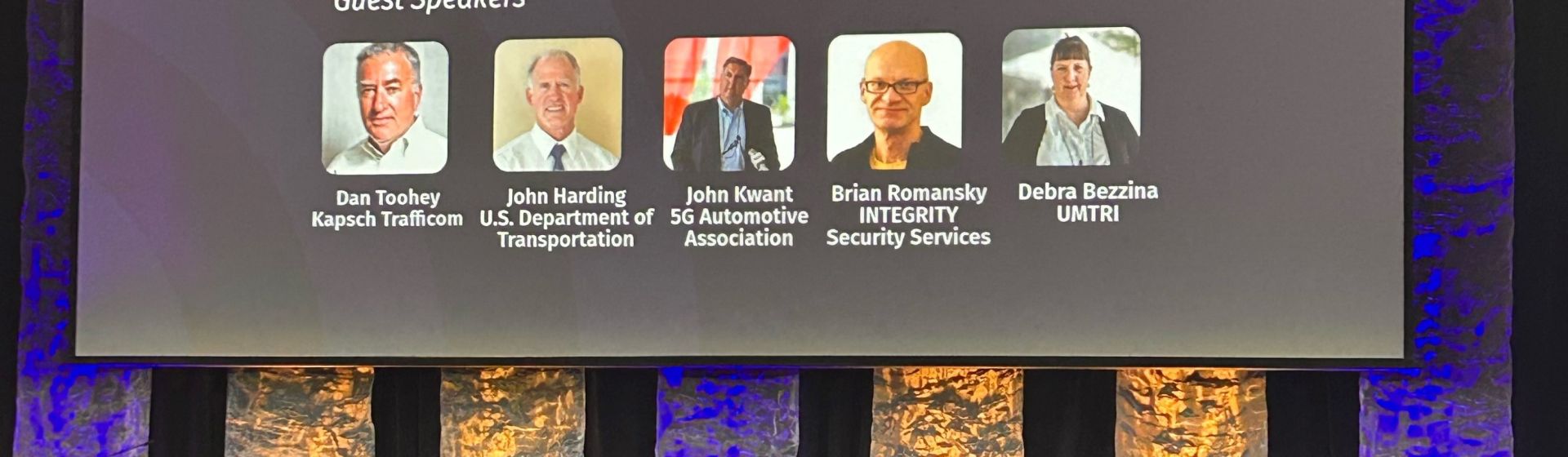
5G Automotive Association (5GAA) Executive Director, Americas John Kwant is in Ann Arbor, Michigan today to explore the current regulatory landscape for C-V2X deployment in the United States as part of a panel on connected mobility at today’s OmniAir Plugfest.
Speaking at 9:00 (UTC-4) in the panel ‘Accelerating V2X Deployment: Bridging Government Initiatives, Industry Readiness and Local Implementations’, John Kwant will bring his expertise to the table and address the state of regulation and legislation covering V2X technology in the United States, as well as explain 5GAA’s work to promote deployment and widespread technology adoption.
The OmniAir Plugfest is an annual event hosted at MCity, Michigan in partnership with the University of Michigan Transportation Research Institute. It is the world’s first purpose-built proving ground for testing the performance and safety of connected and automated vehicles and technologies under controlled and realistic conditions.
Today’s Connected Mobility Workshop offers a one-day technical deep dive into topics related to deployment, testing and future trends, along with live technology demonstrations and a networking reception.
In addition to 5GAA’s participation, attendees will have the opportunity to hear the insights of a number of experts and stakeholders including:
- John Harding, Federal Highway Administration
- Brian Romansky, INTEGRITY Security Services
- Debra Bezzina, University of Michigan Transportation Research Institute
5GAA Statement of Support for OmniAir Consortium
5GAA also wishes to express the association’s support for OmniAir Consortium’s C-V2X certification programme and appreciation for OmniAir C-V2X initiatives generally.
OmniAir Consortium’s certification programme, first established in 2021, is of significant benefit to the entire C-V2X ecosystem and contributes greatly to promoting technology development and adoption.
Certified C-V2X products, such as Onboard Units (OBUs), Road-Side Units (RSUs) and corresponding modules will allow for greater confidence regarding the ability to achieve seamless interoperability of both Vehicle-to-Vehicle (V2V) and Vehicle-to-Infrastructure (V2I) functionality for the Intelligent Transportation System (ITS). As a result, stakeholders across the C-V2X ecosystem benefit from OmniAir Consortium’s work – including vehicle manufacturers, infrastructure owner/operators, equipment suppliers and software suppliers.
5GAA and OmniAir have been partners since 2019, and the participation of our Executive Director, Americas John Kwant in today’s OmniAir Plugfest underscores the continued vitality of this collaboration.
For more information on today’s panel, see here.
Real-world use cases demonstrate game-changing C-V2X technology
Cellular vehicle-to-everything (C-V2X) technology is a game-changer for automotive and transportation safety and services, helping to make mobility smarter, safer and more sustainable for all road users, including pedestrians.
C-V2X relies on both mobile and direct communications to enable seamless communication between vehicles, road infrastructure, and other road users, unlocking a wide range of life-saving, fuel-saving and time-saving applications. From real-time collision warnings and lane merge assistance to enhanced traffic management, pedestrian safety and automated valet parking, the C-V2X use cases shown in the video demonstrate the transformative power of connected vehicles and road infrastructure. Whether navigating urban environments or cruising along highways or country roads, C-V2X empowers smarter, safer, and more efficient journeys.
Vehicle manufacturers and road and traffic infrastructure managers are already investing in the tech that is turning these visions into reality world-wide.
Uniting the automotive, technology and communications industries in common cause, the 5G Automotive Association (5GAA) is helping to drive the development and deployment of C-V2X technology as it evolves.
2024: Updated List of C-V2X Devices
Disclaimer: This list reflects the status as of 2024. For the most up-to-date overview of 5GAA members’ C-V2X technology devices and solutions, please visit the 5GAA Marketplace.
The 5GAA is proud to present the first-of-its-kind update to our comprehensive overview of cellular vehicle-to-everything (C-V2X) devices! Since our initial report in 2021, the C-V2X landscape has continued to evolve rapidly. This new edition reflects this progress, providing a fresh look at the devices currently available on the market or nearing release. This information is especially valuable for those in the transportation industry, infrastructure development, and road safety initiatives.
The report, compiled through extensive research of publicly available information, provides a clear picture of the evolving C-V2X device landscape. It highlights various types of available devices and those on the horizon. Please note that, in its current from, the document excludes factory-installed telematics/V2X boxes directly contracted by automakers.
Find the list here.
5GAA, Partner Associations Issue Statement on US Department of Commerce’s Inquiry into Connected Vehicles
WASHINGTON D.C., March 7, 2024 – Our organizations, representing the full breadth of the U.S. transportation stakeholder community, fully share the Biden Administration’s commitment to ensuring that connected vehicle technologies operate in a way that is safe and secure, and which protects users’ privacy. We applaud the Department of Commerce and Bureau of Industry and Security for recognizing the many benefits of connected vehicles and noting that its recent Advanced Notice of Proposed Rulemaking does not intend to imply that lifesaving technologies such as vehicle-to-everything (V2X) communications are unsafe for use in the United States. According to the latest estimates from the National Highway Traffic Safety Administration, 42,795 people died in motor vehicle traffic crashes in 2022. We continue to face a national crisis of traffic deaths on U.S. roadways, and we firmly believe that V2X technologies, which allow communication between vehicles, infrastructure, and other road users including pedestrians and bicyclists, can dramatically reduce crashes and resulting fatalities. V2X technology can also help advance climate and sustainability goals by increasing traffic flow and efficiency. We reaffirm our continued support for the rapid, widespread deployment of V2X technologies.
We note that all V2X systems have been designed from the outset with privacy and security in mind, and that V2X has been deployed for a wide variety of use cases in states across the country without incident. Our members have worked closely with U.S. Department of Transportation (USDOT) for several years to proactively develop a robust message security solution for V2X communications. This collaboration has produced a security system that ensures V2X safety messages contain no personal or equipment-identifying information and that utilizes encryption and certificate management methods to limit data collection and prevent unauthorized vehicle manipulation. Privacy and security are also key pillars of our members’ ongoing collaboration with USDOT on the development of a National V2X Deployment Plan. We also note that the supply chain for connected vehicle technology, including V2X direct, is mature, geographically diverse, and not dependent on any particular region or country.
The United States is currently a leader in V2X innovation, but risks falling behind if the government hampers broadscale deployment. We urge the Department of Commerce to work closely with transportation stakeholders to ensure that any resulting regulations that address national security risks are narrowly tailored to minimize unintended consequences or significantly disrupt industry efforts to deploy lifesaving safety technologies.
We look forward to working collaboratively with all stakeholders on this matter to ensure the safe and effective deployment of V2X technologies.
Participating associations: 5G Automotive Association (5GAA), Institute of Transportation Engineers (ITE), Intelligent Transportation Society of America (ITS America), National Electrical Manufacturers Association (NEMA).
Download the joint statement here.
About 5GAA
The 5G Automotive Association (5GAA) is a global, cross-industry organization of over 120 members, including leading global automakers, Tier-1 suppliers, mobile operators, semiconductor companies, and test equipment vendors. 5GAA members work together to develop end-to-end solutions for future mobility and transport services. 5GAA is committed to helping define and develop the next generation of connected mobility, automated vehicles, and intelligent transport solutions based on C-V2X. For more information, visit our website.
Media Contact
John F. Kwant
Executive Director, Americas, 5GAA
john.kwant@5gaa.org