

5GAA to organise a first-ever C-V2X Plugtests™ event with ETSI, 02-06 December, Malaga (Spain)
The 5G Automotive Association (5GAA) is proud to be a partner of the European Telecommunications Standard Institute (ETSI) in the first C-V2X-only Plugtests™ event, to take place in Malaga, Spain, from 02 to 06 December 2019. This interoperability test is being held with the support of the European Commission and hosted by DEKRA, member of 5GAA, in its Connected Vehicle Test Development Centre, where trials will be carried out both in lab and field environments.
Plugtests™ represent an important tool to allow vendors to evaluate the interoperability of their systems and provide precious feedback to independent experts in order to improve the standard-making process. Moreover, this event is a further milestone in the cooperation between 5GAA and DEKRA, a leader in automotive safety testing, that already had the chance to collaborate during a previous plugfest in April 2019.
On 04 December, an ETSI-5GAA Plugtests™ conference is scheduled, focused on nowadays achievements and challenges in the connected automotive sector, to offer the audience a complete update on the opportunities and implementation models of C-V2X technology.
Registrations are open until 15 November. For any further information, please consult the official event page.
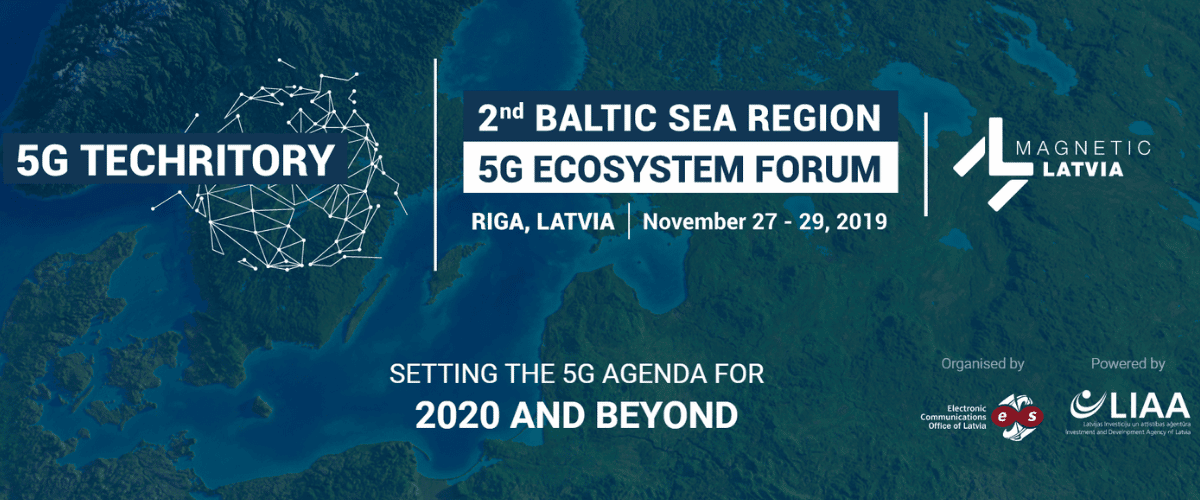
5GAA to be main supporting partner of 5G Techritory – Riga, 27-29 November 2019
5G Techritory is the annual Baltic Sea Region 5G Ecosystem Forum organised by the Electronic Communications Office (ECO) of Latvia, aiming at gathering decision makers, major representatives from industry associations, and business leaders to discuss the deployment of the earliest available commercial applications of 5G technology. Its second edition is going to be held in the Latvian capital, Riga, on 27-29 November.
Taking place in a vibrant region for 5G implementation, the 5G Automotive Association is proud to be confirmed once again as one of the main partners of this conference. 5GAA Director General Johannes Springer is going to participate as a speaker in front of an audience of up to a thousand senior professionals invited upon an attentive selection to ensure the highest quality of debate.
The Baltic Sea Region includes nine countries comprising of a population of 150 million people. Among the Baltic countries, Latvia appears in the third place of the 5G Readiness ranking according to the European Commission’s Digital Economy and Society Index (DESI) 2019 report. This result shows that the potential for international leadership in the field is highly promising and this edition has all the characteristics to be a must-visit, given the renewed interest for digital and technology of the newly appointed European Commission.
Since the objective of the programme is to focus on what is readier for commercialisation, four verticals have been identified as the main topics:
- Smart City
- Smart Mobility
- Industry 4.0
- Smart Media and Entertainment
In addition, a 5G policy hackathon, a key stakeholders’ roundtable and an exhibition are scheduled as side events.
Registration is open and all the possible interested participants are encouraged to apply.
See the official press release and leaflet.
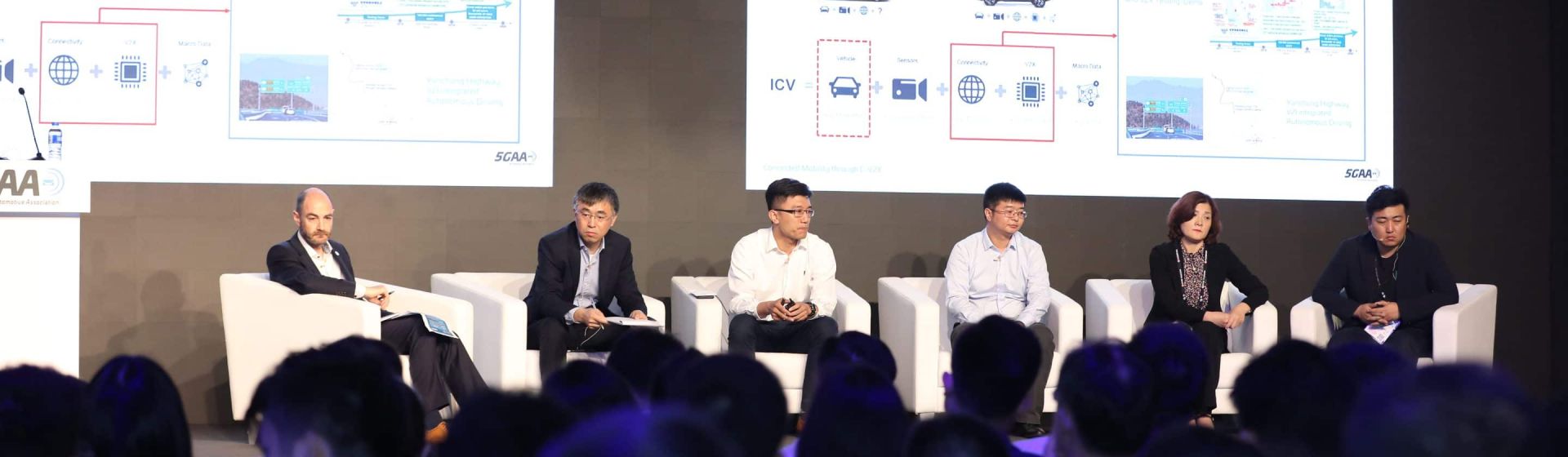
5GAA brings together key actors to share advances on C-V2X deployment in China at MWC Shanghai 2019
SHANGHAI, CHINA, 27 June 2019 – The 5G Automotive Association, with the engagement of relevant ecosystem actors in China, from Government officials to telecom and automaker companies and the larger 5GAA community, took stage today at the MWC Shanghai 2019 to explain the state of deployment of the ‘Cellular Vehicle-to-Everything’ (C-V2X) technology in this region.
“5GAA is instrumental in supporting the implementation of C-V2X technology in different parts of the world including China. The momentum in China reflects the fact that C-V2X is the verified, mature and preferred future proof technology for connected vehicles”, said Luke Ibbetson, 5GAA board member and Vodafone Group’s Head of Research and Development.
C-V2X as part of Chinese C-ITS standards
Representatives from different Chinese public institutions underlined during the conference that after issuing the three-year Industry Development Plans on Intelligent Connected Cars (ICV) and releasing C-V2X 5.9GHz ITS spectrum last year, ministries now accelerate standards system of ICV in order to solve the issue of interoperability in various scenarios. Meanwhile, the definition of smart highway standard has started in terms of infrastructure digitalization, Road-Transport unity, “Internet Plus” comprehensive services and new generation transport control network which will be enabled by C-V2X infrastructure and devices for both long range and short-range communication.
C-V2X Eco-system
There was strong engagement from industry stakeholders in China as well. It has been shared that 15 chipset/modules vendors are committed to support C-V2X for the Chinese market, 35 manufacturers are able to provide C-V2X infrastructure hardware or software, and in particular 15 car OEMs have recently announced the roll-out of C-V2X from 2020 H2 to 2021 H1. In order to improve C-V2X industry maturity, IMT2020’s C-V2X Working Group last year organized a “Three-Cross” interoperability tests for three Chipset vendors and 12 OEMs. Furthermore, an interoperability test called “Four-Cross” will be hosted to address more stakeholders and security by testing and verifying certification and authority system.
C-V2X Trial and Pre-commercial pilot
Many voices from the business side also explained the details for C-V2X deployment on the roads and vehicles in China, to be followed in other regions. There are more than 20 trials and pilot projects taking place where 100KM roads across 10 provinces will be digitalized with C-V2X.
Wuxi has been designated as national ICV pilot certificated by MIIT. C-V2X deployment in Wuxi will be extended from 240 intersections to 400 this year, focusing mainly on use cases of autonomous driving assistance and green waves for buses. It is estimated that 1-2 bus lanes will be completed with green wave deployment by end of this year, so as to improve punctuality, reduce emergent stop and waiting time of red light for buses.
Yanchong Highway will be deployed with C-V2X to embrace the 2022 Winter Olympic Games.
Other regions in China start deploying C-V2X by 2020, for instance, 40KM in Beijing Shunyi district and the international exhibition centre, 42KM in Shanghai Yangshan port, 4.5KM in Xiongan New Area, and the 30KM highway around Hainan province.
On top of showing the strong consolidation of C-V2X in China, the 5GAA event successfully underlined the progress of C-V2X application and services in terms of readiness of the ecosystem and commercialisation. However, China is not alone: 5GAA underlined its dedication to standardization, the eco-system and commercialisation of C-V2X in America, Europe, Japan and South Korea. Once again, 5GAA’s presence at MWC Shanghai successfully outlined the association’s vision in being a global player, and facilitating thought leadership platforms for relevant stakeholders driving towards building a better mobility ecosystem.
About 5GAA
The 5G Automotive Association (5GAA) is a global, cross-industry organisation of 115 members comprised of leading global automakers, Tier-1 suppliers, mobile operators, semiconductor companies, test equipment vendors, etc. working together to develop end-to-end solutions for future mobility and transportation services.
5GAA is committed to helping define and develop the next generation of connected mobility for autonomous based on Cellular-V2X (C-V2X), the family of cellular technology-based communications.
Contact
Marketing and Communications Team
Email: marcom@5gaa.org
Web: www.5gaa.org

5GAA publishes test results in support to C-V2X FCC petition for waiver
Recently, the 5G Automotive Association (5GAA) filed a petition for waiver with the Federal Communications Commission of the United States requesting that C-V2X be allowed to operate in the upper 20 MHz (5905 MHz – 5925 MHz) of the US ITS band.
In support of this petition, 5GAA member companies have performed a series of tests in an attempt to address anticipated technical questions related to the favourable implementation of this petition. The report describes the test procedures and results that were undertaken to support the 5GAA C-V2X FCC petition for waiver in the 5.9 GHz band.
The report presents results of testing C-V2X in 20-MHz wide CH183 – the channel that has been recently proposed for C-V2X deployment in the ITS band and is referred to as basic C-V2X Channel and it allows for V2V and V2X messages such as basic safety message (BSM), signal phase and timing (SPaT), signal request message (SRM), signal status message (SSM), and others covered by the Road Safety Message under development in SAE standards. The upper part of the ITS band was chosen to minimize impact to DSRC channels, especially CH172.
The viability of C-V2X in 10 MHz has been demonstrated in a preceding report in which C-V2X has been shown to outperform DSRC in terms of reliability, resilience to out-of-band interference and range. This report extends these results by showing that a BSM message sent in 20‑MHz CH183 has the same reliability as previously shown in 10-MHz CH184.
Both lab and field data included in the report demonstrate consistent results:
- C-V2X communication in 20-MHz CH183 has the same reliability performance (Packet Reception Ratio vs. distance) as the identical BSM-like message transmission in 10-MHz CH184.
- Impact of C-V2X high load transmissions in CH183 on DSRC basic safety transmissions in CH172 is negligible up to a 1.4-km range in LOS conditions
- Impact of C-V2X high load transmissions in CH183 on V2I and I2V transmissions in CH178 is negligible up to a 1.4‑km range in LOS conditions
- Impact of C-V2X high load transmissions in CH183 on V2I and I2V transmissions in CH180 is negligible up to 1 km in LOS Conditions
Read the full report here.

Joint Industry Statement On Protecting And Supporting Connected And Automated Driving Made in EU
Brussels, 15 April 2019 – The European Parliament and the Council are currently debating a Delegated Regulation on Cooperative Intelligent Transport Systems (C-ITS). The European Parliament Transport committee has this week called to halt the approval of this delegated act. We agree.
ETNO, GSMA, the GSA and 5GAA – bringing together the global and European leaders in ICT and automotive – would like to express their highest concern as to the content of this Delegated Regulation. We believe it will downsize safety gains, negatively impact the competitiveness of our automotive sector and the development of 5G technology in Europe. For this reason, we call the European Parliament and the Council to reject the Delegated Regulation in its current form and ensure a revised, tech-neutral and growth-friendly text is put to vote instead, as soon as possible.
Europe risks to be stuck in the slow lane
With technology moving fast, we believe it is of essence that all new rules are future-proof, innovation-oriented in order to maximize C-ITS safety benefits. Currently, the Delegated Regulation fails this test, as it mandates the old Wi-Fi standard 802.11p and it excludes other mature technologies, such as Cellular-Vehicle to Everything (C-V2X), based today on LTE and tomorrow on 5G.
In doing so, it also effectively harms the development of 5G technology in the EU, despite rising global market competition, and it directly contradicts the goals set out in the European Commission “5G Action Plan” and “Digital Single Market Strategy”. Moreover, a technology mandate is a critical political decision, which should remain a sole competence of co-legislators instead of imposing it by a non-legislative act.
Cellular technology is crucial to citizens’ safety
C-V2X is a game-changer for safety. It enables both long-range communications via mobile networks and direct short-range connectivity for time-critical information – without subscription or network coverage. C-V2X offers a unique capability to make vulnerable road users safer by being integrated into smartphones but also holds the potential to connect older cars. Very simply put: cellular technologies can protect pedestrians and cyclists carrying a phone, while Wi-Fi technology is not suitable for this use.
5G technology is tested and it boosts the Single Market
The ConVeX Consortium (gathering global technology leaders such as Audi, Ericsson and Qualcomm) have recently demonstrated that mobile-based technology is ready and it is tested across European borders. This is of essence to ensure a functioning and harmonised European Single Market, as some Member States have already declared they do not have the resources – or do not intend – to deploy Wi-Fi-based solutions. This would create fragmentation where 5G could create harmonisation across EU markets.
Backwards compatibility just does not work
Some voices in the debate claimed that a clause in the Delegated Act would allow for a later revision, hence ensuring backwards compatibility of C-V2X with the mandated Wi-Fi 802.11p technology. Engineers and experts explain that Wi-Fi-based and 5G-based solutions are entirely different technologies using radio waves incompatibly. “Backwards compatibility” would be like expecting a DVD to work in VHS player. This means that unless the Delegated Regulation is made technology-neutral to allow also 5G-based technologies, it will de facto be locked out: European citizens will be relegated to an inferior technology that only a very limited amount of car manufacturers are planning to deploy, while other world regions have already taken steps towards C-V2X deployment.
About Our Associations
ETNO, European Telecommunication Network Operators’ Association – www.etno.eu
GSA, Global mobile Suppliers Association – www.gsacom.com
GSMA, Representing the interests of mobile operators and the broader mobile ecosystem worldwide – www.gsma.com
5GAA, 5G Automotive Association – www.5gaa.org

5GAA presents 5.9 GHz Band Plan to the FCC that will enable evolution of C-V2X from LTE to 5G
The 5G Automotive Association (5GAA) has recently filed a letter to the Federal Communications Commission (FCC) presenting the content of its band plan for the 5.9 GHz band.
The filing, which was submitted last 3rd April, positions C-V2X as the best opportunity to further the vision of ITS in the 5.9 GHz band, outlining that the FCC should pursue a forward-looking approach for licensed ITS operations in the 5.9 GHz band towards facilitating the evolution path towards 5G.
Moreover, the filing also follows-up on 5GAA’s waiver request, filed with the objective of enabling initial deployments of this potentially life-saving technology as soon as possible.
Just on February major stakeholders from the automobile, wireless, and technology industries filed comments to the FCC in support of the 5G Automotive Association’s waiver request seeking permission to deploy Cellular Vehicle-to-Everything (C-V2X) technology in a portion of the 5.9 GHz band.

5GAA and GCF announce collaboration on the certification and testing of C-V2X technologies
GCF certification programme addresses market needs for LTE-based V2V and V2X communications technologies.
The 5G Automotive Association (5GAA) and Global Certification Forum (GCF) have agreed a collaborative framework under which they will combine their resources and expertise to accelerate the global introduction of Cellular Vehicle-to-Everything (C-V2X) products. The new partnership aims to address the current gap in certification capabilities and processes, thereby harmonizing C-V2X at a global level and reducing the time-to-market of C-V2X products.
C-V2X is set to become a disruptive forward-looking force in the automotive market, providing the platform which will enable vehicles to communicate with each other and with everything around them. Originally defined as LTE V2X in 3GPP Release 14, C-V2X provides one solution for integrated V2V, V2I and V2P and V2N operation. The shorter-range V2V, V2I and V2P modes support direct communication without necessarily relying on network involvement for scheduling, whilst the longer range V2N mode will deliver network assistance and commercial services requiring the involvement of a Mobile Network Operator (MNO). The data throughputs and latencies provided by 5G are critical to the performance of autonomous vehicle applications and hence C-V2X is designed to be fully compatible with 5G technologies.
With the C-V2X specifications due to be finalised in 3GPP Release 16, car manufacturers and their suppliers in the key markets of the USA, Asia and Europe have been working on products which will come to market in 2019.
“We are extremely pleased to partner with GCF as a further step towards safe and successful C-V2X deployment,” said Maxime Flament, CTO at 5GAA. “This aligns perfectly with our mission to accelerate the global deployment of intelligent transport and communications solutions and make transportation of the future safer and more reliable.”
“As always, with the introduction of new and disruptive technology, standards and certification are critical to ensuring successful deployment,” said Lars Nielsen, General Manager at GCF. “Our partnership with 5GAA means that together we are achieving the evolution into 5G with a proven success factor for self-driving and connected vehicles.”
The 5G Automotive Association (5GAA) is a global, cross-industry organisation bridging the gap between automotive, technology and telecom industries, promoting the C-V2X technology (Cellular vehicle-to-everything) as a comprehensive platform for connected vehicles, safety and transportation. With 110 members, the organisation is committed to helping define and develop the next generation of connected mobility and automated vehicle solutions.
The GCF certification scheme has been running since 1999 and has constantly evolved in alignment with developments in mobile technologies and the changing needs of the industry. GCF’s certification portfolio already covers LTE sidelink, a key technology for automotive applications, supporting vehicle-to-vehicle (V2V) and vehicle-to-everything (V2X) use cases, and GCF is therefore the natural partner for 5GAA on C-V2X certification.
The framework agreed by the two organisations will enable 5GAA and GCF to work together to ensure the certification needs of the C-V2X industry are identified and prioritised and that test cases and associated capabilities are developed in-line with the needs of this rapidly emerging market.
For more information on GCF see: https://www.globalcertificationforum.org
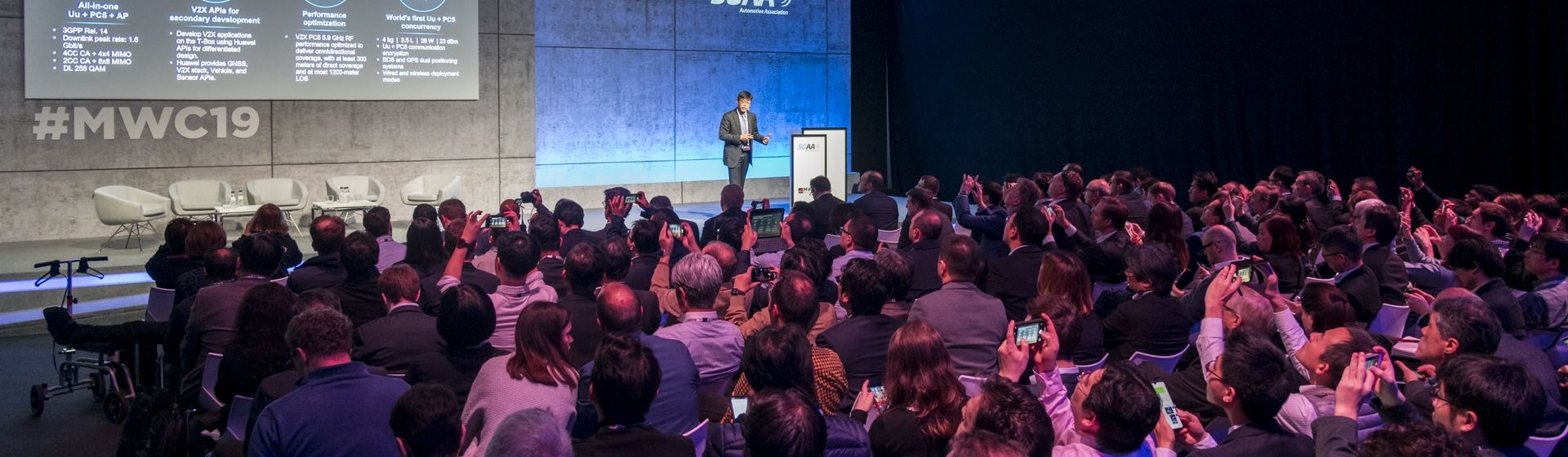
Automotive C-V2X ready to roll out globally, says 5GAA at this year’s MWC Barcelona
All presentations of the 5GAA session at MWC19 Barcelona are available down this page.
February 27th, Barcelona – During today’s well attended keynote, ‘Connecting the Mobility World with 5G’, the 5G Automotive Association (5GAA) gathered experts from the automotive, technology and telecom industries to explain how the deployment of ‘Cellular Vehicle-to-Everything’ (C-V2X) communication technology on the path to 5G is shaping the mobility of the future. Today LTE-V2X, the initial version of C-V2X, stands on the verge of its commercial launch: allowing vehicles to communicate with each other and their surroundings and, together with 5G enhancements, facilitating broad scale improvements in road safety.
“By bringing together key actors of the mobility ecosystem – across the automotive, information and communications technology industries – 5GAA continuously strives to develop forward-looking solutions for intelligent transportation services. Both for today and tomorrow.” stressed Thierry Klein, 5GAA Vice Chair and Head of the Disruptive Innovation Program at Nokia Bell Labs. “These end-to-end integrated solutions bring enhanced safety, sustainability, and convenience to all road users. 5GAA is very excited to be pioneering the revolution towards a smarter and more connected mobility world,” Thierry Klein added.
C-V2X communication is the state-of-the-art, high-speed cellular communications platform that enables vehicles to communicate with one another, with roadside infrastructure, with other road users (such as pedestrians, cyclists, and motorcyclists) using either direct short-range communications or cellular networks. While C-V2X network-based solutions are already widely deployed, direct communication solutions will be commercially available as of this year. As such the C-V2X platform delivers safety, mobility, traffic efficiency, and environmental benefits. C-V2X is designed with an evolutionary path to 5G and supports safe and efficient operations of autonomous vehicles.
5GAA members spearheading C-V2X
A number of 5GAA members are announcing ground breaking use cases at this year’ MWC. 5GAA members Telefónica, Ericsson, Ficosa and Seat show 5G connected car use cases supported by C-V2X direct communication for safer driving in a city (e.g. detection of cyclists when turning right or of a pedestrian at a zebra crossing). Another key technology bringing these use cases to life is edge computing.
In addition, 5GAA members Continental and Vodafone are working together to increase road safety and protect all road users for instance via “digital safety-shield” for cyclists and pedestrians, using C-V2X direct communication and edge computing in the first 5G deployments. The 5G-ready tests are taking place under real-life conditions at Vodafone’s 5G Mobility Lab in Aldenhoven, Germany.
Rohde & Schwarz has announced a collaboration with automotive electronics specialist Vector on a C-V2X end-to-end application layer test solution to verify safety-critical V2X scenarios. The companies’ integrated test platform is showcased for the first time at Mobile World Congress.
Deutsche Telekom has announced first C-V2X tests together with Skoda Auto in Czech as part of the European C-Roads project.
Geely also announced its plans to launch the first mass-produced C-V2X enabled vehicles in China together with Qualcomm in 2021.
Qualcomm has also announced its first 5G automotive platform, enabling both C-V2X short and long-range modes, which is expected to sample later this year and are planned for production vehicles in 2021.
C-V2X direct communication goes commercial in 2019
Mass production of C-V2X chips including direct communication from several suppliers is ongoing, and multiple radio vendors have already integrated these chips into their automotive radio offerings. 2019 is the year when C-V2X direct communication technology will be commercially available across the globe. Furthermore, full interoperability testing on C-V2X applications is ongoing among 5GAA members. The first mass-deployment in vehicles on the roads is anticipated to start in China in 2020; to be followed swiftly in other regions when local regulations allow for it.
“C-V2X is now ready to roll. At Ford, we will begin to deploy this technology in all new models launching in the US starting in 2022” confirmed Don Butler, Executive Director of Connected Vehicle & Services at Ford Motor Co.
The next milestone: 5G New Radio
C-V2X provides a clear evolution path to the family of 5G technologies for both direct and network communication. Part of this evolution is the 5G New Radio (NR).
NR-V2X will eventually ensure safe operation of autonomous driving vehicles by using 5G New Radio with Ultra Reliable Low Latency Communications (URLLC) network based communication combined with improved direct short range communications.
“The development of the NR-V2X standard is due for completion by the end of 2019; eventually hitting the road in 2023. This will enable a new generation of use cases for connected automated vehicles”, said Maxime Flament, CTO at 5GAA.
About 5GAA
The 5G Automotive Association (5GAA) is a global, cross-industry organisation with 110 members working together to develop end-to-end solutions for future mobility and transportation services. The organisation is committed to helping define and develop the next generation of connected mobility for advanced driving and automated vehicle solutions.
Presentations
- Opening speech by Thierry Klein, 5GAA Vice Chair & Nokia Bell Labs / Connecting the Mobility World with 5G-V2X
- Keynote by Friedhelm Ramme, Ericsson / 5G: From Concepts to Reality
- Keynote by Thorsten Hehn, Audi / 5G for Automotive: Key Applications
- Keynote by Jiang Wangsheng, Huawei / C-V2X Enables Intelligent Transportation
- Keynote by Nakul Duggal, Qualcomm / C-V2X Ignites Automotive Connected Revolution
- Speech by Vishnu Sudaram, Harman (Samsung) / Go-To-Market Timeline

5GAA co-organizes 5G Vertical User Workshop alongside 5G-IA, 5G-ACIA, and PSCE
On 12 and 13 February 2019, the 5G Vertical User Workshop, an initiative of 3GPP Market Representative Partners 5GAA, 5G-IA, 5G-ACIA and PSCE, was organised as a collaborative event for strategic dialogue between industries and 3GPP by exchanging on future needs and upcoming cellular standard developments. The workshop as a result, aimed to produce a report shared directly to 3GPP Project Coordination Group (PCG) as a mean to stimulate and facilitate greater involvement of the 5G Vertical Users in the 3GPP process.
The workshop held in Brussels brought together a host of experts from 5G standardization and a number vertical industries hoping to harness 5G including Automotive, Public Safety, Industry Automation, Utilities, Broadcasting, Satellites and Railways; as well as policy makers at the EU and Member State level.
Overall the event was successful in stimulating open dialogue and actions across all participants in an informal workshop setting that supported all involved to share their perspectives and experiences from their industry and standardization, and therefore how related processes may well be improved moving forward. Several possible options were discussed in terms of how to deliver improvements, and what corresponding changes to interaction could look like if required. Could this involve further workshops outside of 3GPP which could then drive action within the established channels? Or should there be alteration to vertical and MRP orientated rules of procedure to foster greater contributions?
Moreover, several open tools were discussed for better tracking activity and on-going work to make 3GPP more accessible to those joining, and those already, involved that may experience difficulties in contributing during this important period in the standardization of 5G. The need for such improvements are especially pronounced due to the forthcoming TSG#84 in December 2019, during which the completion of both Rel. 16 upon which 5G will be so dependent, and finalization of the scope for Rel. 17 are both scheduled.
There was a clear consensus among organizational partners and participants that an informal workshop and forum of this type was of use to help stimulate productive discussion on how to proceed with inter-MRP interaction in future.
In light of this, it was proposed that a second event with more focus on practical steps to be taken by 5G vertical industries and SDOs to improve vertical input would be of value, however the setting of this event is yet to be determined; interested Market Representational Partners will be coordinating to decide on the most effective next steps to convert what was valuable dialogue into impactful actions.
Until then, all involved expressed their great thanks to all who contributed to a workshop filled with rich dialogue, and hope based on continuing collaboration that this progress can be built upon over the coming months.
You can find all presentations here:
- 5GAA – 5G Automative Association, pioneering digital transformation in the automotive industry
- PSCE – Public Safety Communication Europe, National plans and roadmaps towards broadband
- 5GIA – 5G Alliance for Connected Industries and Automation
- ESOA – EMEA Satellite Operators Association, 3GPP Market Representation Partners
- EBU – European Broadcasting Union, Native 5G broadcasting
- EUTC – European Utilities Telecom Council
- 5GIA, 5G PPP Projects focusing on standardisation Verticals and Standards Tracker Tool + Pan-European 5G Trials Roadmap, and International Trials
- 5G-PPP, Prestandards WG Status update
- 3GPP, Verticals in 3GPP + Mission Critical Comms + Industrial Automation + V2X learnings in 3GPP
5GAA joins EU ARCADE Project as Associated Partner
The 5G Automotive Association (5GAA) has become an Associate Partner of the Aligning Research & Innovation for Connected and Automated Driving in Europe (ARCADE) funded by the European Commission. The project aims at building consensus across stakeholders to enable a smooth deployment of connected and automated driving (CAD) on European roads and beyond.
By joining this project, 5GAA reinforces its commitment to the efforts made by the European Commission, Member States and other industry actors to create a common approach to ensure the further development testing, validation and deployment of CAD in Europe and beyond.
5GAA will use the collective expertise of the association to participate and contribute knowledge at both the European and international level. 5GAA look forward to exchanging views and experiences with the wide range of other expert groups and stakeholders involved as partners of the project.
The ARCADE project will run for three years and aims to establish a joint stakeholders forum to coordinate and harmonise automated road transport approaches at both the European and the international level (in particular with the US and Japan). Towards this objective, ARCADE will organise the Second European CAD conference in April 2019 in Brussels, in which 5GAA will be actively involved. Further details on the project can be found here.
5GAA members BMW Group, Bosch and Volvo Cars are among the principal partners already involved in this project funded under the Research and Innovation Framework Program of the European Commission (H2020) and 5GAA look forward to building upon these efforts.
See the list of all the ARCADE associated partners.