General Assembly
The General Assembly ensures a diverse Board composition regarding geographic regions and industry sectors.


The 5G Automotive Association (5GAA) is a global association with over 100 member companies from the automotive and telecommunications industries. Partners who are active in the broader telecommunications and automotive ecosystem, such as universities, research bodies, associations, and public authorities also joined the ecosystem. Each of the 5GAA members bring added value to the 5GAA mission through their contributions and visionary mindset. Together, the key partners foster collaboration and exchange to path the way towards the new mobility era.

The Fifth Generation Communication Automotive Research and innovation, 5GCAR, is a 5GPPP Phase 2 project. The 5GCAR research and innovation initiative addresses the stringent requirements posed on the wireless communication system by bringing the fields of telecommunication and automotive closer together and investigating the benefit of 5G for demanding automotive use cases.

The Horizon 2020 project 5G-DRIVE: 5G HarmoniseD Research and TrIals for serVice Evolution between EU and China (2018-2021) aims at trialling and validating the interoperability between EU & China 5G networks operating at 3.5 GHz bands for enhanced Mobile Broadband (eMBB) and 3.5 & 5.9 GHz bands for V2X scenarios.

5G EVE is the European 5G validation platform for extensive trials. The goal is to implement and test advanced 5G infrastructures in Europe. The 5G-EVE concept is based on further developing and interconnecting existing European sites in Greece, Spain, France, and Italy to form a unique 5G end-to-end facility.

The 5G-MOBIX project is co-financed by the European Commission within the framework of the Horizon 2020 programme. 5G-MOBIX will develop and test automated vehicle functionalities using 5G core technological innovations along multiple cross-border corridors and urban trial sites, under conditions of vehicular traffic, network coverage, service demand, as well as considering the inherently distinct legal, business and social local aspects.

5G-ROUTES is a 5G-PPP Phase 3 project whose aim is to validate through robust evidence the latest 5G features and 3GPP specifications (R.16 & R.17) of Connected and Automated Mobility (CAM) under realistic conditions. In particular, it will conduct advanced large-scale field trials of most representative CAM applications to demonstrate seamless functionality across a prominent 5G cross-border corridor (Via Baltica-North), traversing Latvia, Estonia and Finland.

The Fifth Generation Cross-Border Control, 5G-CroCo, is a 5G-PPP Phase 3 Innovation Action. 5GCroCo aims to trail 5G technologies in the cross-border corridor along France, Germany and Luxembourg. In addition, 5GCroCo also intends to define new business models that can be built on top of this unprecedented connectivity and service provisioning capacity. Ultimately, 5GCroCo will impact relevant standardization bodies from the telco and automotive industries.

5G for Connected and Automated Road Mobility in the European Union, 5G-CARMEN, will build a 5G-enabled corridor from Bologna to Munich to conduct cross-border trials of 5G technologies in four major use cases: cooperative manoeuvring, situation awareness, video streaming, and green driving. Multi-tenancy and neutral host concepts will be leveraged to deliver a final platform capable of enabling new business models. 5G-CARMEN will complement C-V2X with LTE and C-ITS technologies, targeting interoperability and harnessing a hybrid network.

The CONCORDA project, launched in October 2017 and funded by the Connecting Europe Facility, will contribute to the preparation of European motorways for connected and automated driving and high-density truck platooning, by providing adequate connected services and technologies in terms of interferences and interoperability.

Global5G is a Coordination and Support Action within Europe’s 5G public and private partnership (5G PPP) that is working on both fronts through its focus on vertical industries and small cell deployments. It works closely with the private side of the 5G PPP – the 5G Infrastructure Association (5G-IA) to help boost impacts through diverse working groups and task force activities.

5GMED is an innovative H2020-funded project that focuses on a sustainable 5G deployment model for future mobility in the cross-border corridor between Spain and France. Aside from the implementation of four different use cases, 5GMED’s trials seek to enhance roaming transitions across MNOs and neutral hosts for both Cooperative and Connected Automated Mobility (CCAM) and Future Railway Mobile Communications Systems (FRMCS).

NordicWay 2 is a C-ITS pilot project that enables vehicles, infrastructure and network operators to communicate safety hazards and other information from roads in the Nordic countries between different stakeholders. The project is a collaboration between public and private partners in Finland, Norway, Sweden and Denmark and builds on the achievements of the previous NordicWay project.

ENSEMBLE wants to communicate the economic, societal and environmental impact of decisions surrounding platoon forming and dissolving. ENSEMBLE also strives to modernize the transport system by finding an optimal balance between fuel consumption, emission level, travel times and impact on highway traffic flow, resulting in reduced impacts on climate change, air pollution, noise, health and accidents.

ARCADE is a Coordination and Support Action that coordinates consensus-building across stakeholders for sound and harmonised deployment of Connected, Cooperative and Automated Driving (CAD). It supports the development of a common approach to the development, testing, validation and deployment of CAD in Europe and beyond, and aims to establish a joint stakeholders forum in order to coordinate and harmonise automated road transport approaches at a European and international level.

5G Blueprint is a H2020-funded project that aims to design and validate technical architecture, business models and governance for interrupted cross-border teleoperated transport based on 5G connectivity. Its objective is to provide a blueprint for operational pan-European deployment of teleoperated transport solutions in the logistics sector, and beyond. It explores the economics of 5G in cross-border transport and the issues of responsibility and accountability within the value chain.

Stardust is an H2020 Smart Cities project, which brings together exemplary models of smart, highly efficient, intelligent, and citizen-oriented cities. The project focuses on intelligent solutions for energy, mobility and ICT, to be integrated into cities together with innovative business models. One of its objectives is to create and deploy open city information platforms, that allows cities to engage actively with each other and to share information. The project’s results will serve as a blueprint for replication across Europe and abroad.
Funded by the German Ministry of Transportation and Digital Infrastructure (BMVI) in the program “Automated and Connected Driving on Digital Test Fields in Germany”, the objective of the project ConVeX is to set up a testbed for the first field tests of 3GPP LTE Release 14 Cellular V2X (C-V2X) and validate its performance and feasibility.

The 5G Automotive Association (5GAA) is comprised of the Executive Committee, the Board, the General Assembly, and the Working Groups. Together, the different bodies ensure the successful running and operations of the association.
The General Assembly ensures a diverse Board composition regarding geographic regions and industry sectors.
The 5GAA Board supervises and advises the Executive Committee in all material respects, particularly concerning strategic considerations. The Board is composed of eighteen members, elected by the General Assembly every year, out of which:
– twelve seats are reserved to platinum members (the highest member category);
– six seats are reserved to candidates elected among the gold members.

REPRESENTED BY
Christoph Voigt
Jörg Plechinger

REPRESENTED BY
Joachim Göthel
Georg Schmitt

REPRESENTED BY
Andreas Schaller
Frank Hofmann

REPRESENTED BY
Gerry McQuaid
André Schlufter

REPRESENTED BY
Tim Leinmüller
Lutz-Peter Breyer

REPRESENTED BY
Fazli Erbas
Michaela Blanchet

REPRESENTED BY
Friedhelm Ramme
Tomas Nylander

REPRESENTED BY
Ivan Vukovic
Todd Konet

REPRESENTED BY
Yingpei Lin
Chan Zhou

REPRESENTED BY
Colin Lee
Subhamoy Ghosh

REPRESENTED BY
Rainer Krumrein
Osman Aydin

REPRESENTED BY
Berthold Panzner
Stephan Miller

REPRESENTED BY
Vince Park
Yuval Lachman

REPRESENTED BY
Suman A. Sehra
Amine Taleb

REPRESENTED BY
Antonio Fernández
Gurudutt Venkatesh

REPRESENTED BY
Mark Custodio
Jyoti Sharma

REPRESENTED BY
Luke Ibbetson
Tony Sammut
The 5GAA Board is led by a Chair and a Vice Chair, elected amongst its members.
Reporting to the Board, the Executive Committee is the legal representative body of the association and is responsible for the day-to-day management of the 5GAA. The Executive Committee consists of three persons —Director General, Secretary, and Treasurer—, supported by the Chief Technology Officer as a non-statutory member.

Chairman
Christoph Voigt

Vice Chair
Tim Leinmüller

Director General
Christof Schmidt

Secretary
Markus Dillinger

Treasurer
Ryan Dickens

CTO
Maxime Flament

The 5G Automotive Association (5GAA) is a global, cross-industry organisation of companies from the automotive, technology, and telecommunications industries (ICT), working together to develop end-to-end solutions for future mobility and transportation services. Created in September 2016, 5GAA has rapidly expanded to include key players with a global footprint in the automotive, technology and telecommunications industries. This includes automotive manufacturers, tier-1 suppliers, chipset/communication system providers, mobile operators and infrastructure vendors.

5GAA was created to connect the telecom industry and vehicle manufacturers to develop end-to-end solutions for future mobility and transportation services.
5GAA unites the automotive, telecommunication, and technology industries globally, turning collaboration into real-world, scalable connectivity solutions that deliver smart, safe, secure, and efficient mobility for all road users, now and in the future.
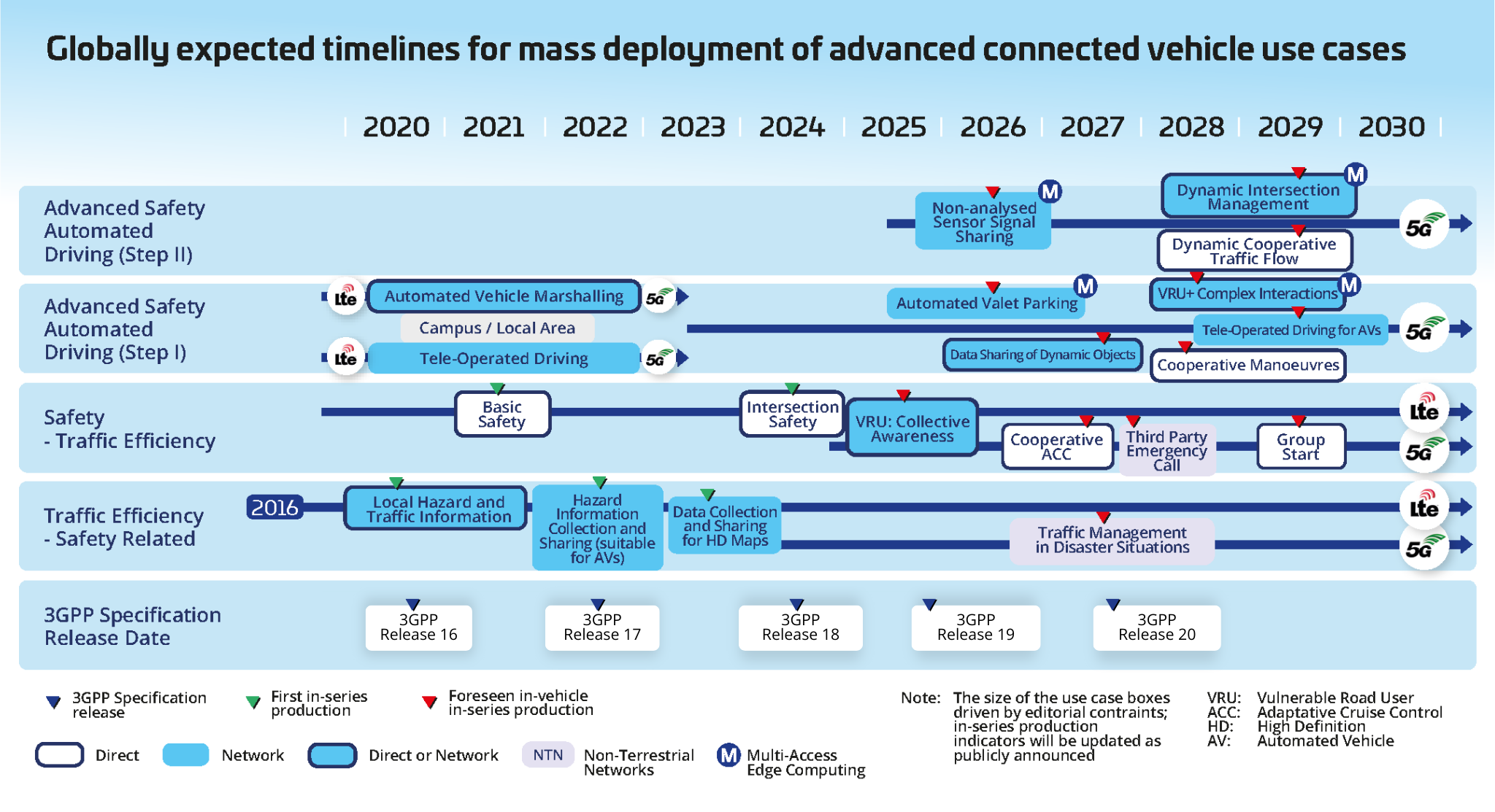
5GAA is addressing today’s mobility key challenges. With C-V2X technology, 5GAA will revolutionise the mobility ecosystem and the way drivers interact with the world. 5GAA’s ambition is to improve the overall transportation industry to make it safer, greener and more efficient for vehicles, road users and the surrounding infrastructure.




5GAA has defined 4 strategic pillars designing the short and long term goals in very diverse domains contributing to the same ambition: Connected Mobility.

The international collaboration of tech leaders and public sector on a live connected car trial will pilot new roaming technology for traffic safety on 2 December 2021.
2 DECEMBER 2021, Turin (ITALY) – On 2 December, the City of Turin (Italy) will host a live trial of new driver and pedestrian safety technology allowing near-real-time notification of roadway hazards through 5G-Edge networks. This trial is one of a series conducted internationally by a historic public-private collaboration over the next few years, organized by the 5G Automotive Association (5GAA) and eight member companies representing leading technology companies from around the globe.
“This collaboration between the 5G Automotive Association and its member companies is the perfect example of how we can secure safety on roads and build the future of connected mobility,” said Maxime Flament, CTO of 5GAA. “This time, demonstrated use-cases take place in Europe through 5G and Edge networks—I look forward to seeing more in the future in the United States and other continents.”
The promise of 5G and Edge technology has long been anticipated to deliver new connected services that will revolutionize daily life, with the estimated new economic opportunity stretching into the trillions USD over the next 10-years1. The global connected car market size alone is projected to reach USD 191.83 billion by 2028.
5G transmission speeds and so-called “Edge” servers—locally installed, high-powered computers capable of running Artificial Intelligence programs—open the door to smart city technologies like near real-time traffic management and innumerable other business applications. The connected car concept uses this high-speed and Edge computing technology to communicate with car sensors and pedestrian smartphones, via a user-authorized mobile app—about traffic hazards, like accidents and road construction—to Pedestrian and in-vehicle driver safety and efficient navigation.
“The connected car concept is an important validation of the combined value of Edge, of 5G and IOT,” said Paolo Campoli, Head of Global Service Provider sector at Cisco, “We are so excited to take part in this event that creates a platform for innovation in 5G IOT. The integration of 5G mobility, applications and data processing at the Edge requires expertise from very different domains—expertise that Cisco and Partners can bring. It includes elements of automation, intelligent infrastructure and workloads control, cybersecurity protection and end-to-end application observability. The live trial in Turin is a great opportunity to show how the intersection of Edge, 5G and IOT based on Standards creates a platform to connect Service Providers and Industries.”
This live international trial attempts to solve one of the more technical challenges of making the connected car concept a daily reality. The 5G networks underpinning the concept are managed by communication service providers (CoSPs) according to geography, each with different edge solutions that must be able to communicate without interruption of the V2X applications as drivers cross borders. Roaming services—the ability to make a call regardless of the network—is one early success of multi-mobile network operators (MNO). Demonstrating the connected car concept can work in a roaming scenario is the core objective of the live trial and represents the first of any such attempt in Europe.
“Telecom operators will have to play a major role by enabling applications and services for the connected car ecosystem,” says Shamik Mishra, CTO Connectivity, Capgemini Engineering. He further adds: “Capgemini is excited to bring its innovative federated MEC (Multi-Access Edge Computing) platform and applications to this 5GAA trial to demonstrate the true value of intelligent industry, leveraging data in the vehicles and edge-cloud. The trials serve as a stepping-stone for realizing the potential for automakers to provide services to their connected cars from the network”. The trial will demonstrate how the car manufacturers, MNOs and technology providers come together to help overcome the challenge of when a vehicle moves from one network boundary to another or Inter-MNO handover of MEC service.
The Turin live trial addresses three objectives:
One of the key benefits of the trial is the value demonstrated by bringing in a large ecosystem to help develop not only the technology but also build the business case and model that will help drive the market adoption for 5G and C-V2X to help into the digital transformation of smart cities of the future. To succeed in this endeavor, it will need a village and investment from both public and private sectors to help adopt this new technology to provide a quality of life for all citizens.
The city of Turin is delighted to facilitate the 5GAA Multi Operator MEC Trial with its Smart Road infrastructure and the technical support of 5T. We see – Chiara Foglietta, Deputy Mayor for Mobility, Ecological and Digital transition, Innovation says – C-V2X services as fundamental to develop a sustainable and safe mobility for all the citizens, whatever transport means they use. In the future, Turin wants to continue the collaboration with 5GAA and offer its Smart Road infrastructure for further scale in the live traffic within Torino City Lab and the new project “ Turin House of emerging Technologies – CTE NEXT”
“As TIM, we are honored to be hosting in Turin such a challenging trial by leveraging our Innovation Lab competencies and our pre-commercial instances of Edge Cloud,” says Daniele Franceschini TIM VP Innovation, Standard and Portfolio. “The federation model implemented with our partners enables a ‘continuum’ between Edge Cloud instances allowing players from the automotive industry and beyond to benefit from a seamless cloud experience across country boundaries.”
“Greater connectivity speeds, improved hardware and expanded software expertise have opened new opportunities for Stellantis with safety systems being one of the many areas we focus on,” said Mamatha Chamarthi, Head of Software Business and Product Management. “Through smart and strategic partnerships such as 5GAA, we will capitalize on next-generation systems and prove out the technology.”
The demonstration brings new learnings for various players across the value chain and creates a testbed for trying out new 5G connected car services at the Edge in subsequent phases. The Turin Live Trial will run throughout the day on 2 December 2021.
BACKGROUND
In this live trial, Telecom Italia (TIM), Telefonica, BT/EE will demonstrate the NSA 5G networking capabilities and the Edge Cloud solution to deliver connected car use cases at the Edge of their networks for their customers. TIM makes its Innovation Lab facilities available and its commercial 5G network with pre-commercial Edge Cloud specific features such as Local Break Out, that together with the federation of edge platforms in TIM, BT/EE and Telefonica make the use cases available for roaming users from BT/EE and Telefonica.
The three companies are hosting Capgemini’s ENSCONCE MEC platform, built upon the Intel Smart Edge Open toolkit, the Intel® Distribution of OpenVINO toolkit, and Intel hardware to enable connected car use cases at the Edge on 2nd Gen Intel Xeon Scalable processor equipped Cisco Servers. Intel Smart Edge Open (formerly known as OpenNESS) is a royalty-free edge computing software toolkit for building optimized and performant edge platforms.
“The international live trial of building and provisioning Connected Car edge services in a multi-operator scenario is a transformative 5G and Edge use case,” said Renu Navale, Vice President and General Manager of Smart Edge Platforms Division at Intel. “This trial demonstrates the possibilities that 5G connectivity and edge computing can bring to connected car solutions, when the broad ecosystem collaborates and uses Intel technologies such as Xeon processors, Smart Edge Open and OpenVINO.”
Capgemini’s ENSCONCE MEC Platform provides multi-tenancy and multi-MNO MEC federation capabilities. The visual compute applications for pedestrian detection and tracking supported by Capgemini’s Orbital Car Situational Awareness V2X platform. To realize the Active and Passive Vulnerable Road User (VRU) use cases, Cisco provides the Edge infrastructure based on CISCO UCS Servers (the Unified Computing Systems that combines computing, network and management in a cohesive architecture) hosting the ESCONCE platform, used to demonstrate Virtual-RSU and host V2X applications that are based on the Intel Xeon Scalable Processors and Intel HDDL-R Visual Accelerators. Harman International and Capgemini provide the Virtual-RSU and RSE solutions respectively to realize various V2X use cases with location-aware and AI inferencing technologies. Harman also offers V2X Application Server and a 5G enabled TCU that integrates seamlessly with Stellantis/FCA car and hosts V2X applications.
“It is key that operators and industry partners collaborate to explore the technical feasibility and benefits to unlock the new business opportunities and services to our customers. In this project, we are jointly evaluating the potential to federate edge cloud compute capabilities across multiple geographies to support low latency use cases, including key connected car use cases being delivered as 5G edge services in a multi-MNO, multi-OEM environment,” said Sunil Joshi, Senior Manager, Global Roaming Products at BT/EE.
“Telecom operators will have a key role in supporting V2X services and this trial demonstrates the value of leveraging mobile architecture, federating edge platforms and allowing local break out in visited network. Such an approach as defined in the GSMA Operator Platform Group allows customers and developers to deploy their applications across multiple operator domains, and our end users to have the best latency and customer experience when accessing their services,” said Juan Carlos Garcia, Senior Vice-President of technology innovation and ecosystems, Telefonica.
“At Harman, we are focused on building connectivity solutions at the intersection of 5G, V2X and Edge Computing that will build more equity on the road for all users,” said Mahsa Nakhjiri, Director, Product Management. “While these technologies can unlock many new use cases and experiences, the most important element of any solution in this space is safety. As programs such as this one fueled by the collaboration of industry leaders and organizations like 5GAA bring a new degree of safety to users, they will also lead to a higher level of confidence in autonomous vehicles.”
Download the event visual here
Watch the video of the event here

The present document aims to study the requirements of positioning, build understanding of the positioning system framework, and offer the corresponding technologies according to the requirements and environments, as well as some demonstrations in High-Accuracy Positioning for Vehicle-to-Everything (V2XHAP) services.
With the evolution of V2X services from assisted driving to automated driving, the use case requirements are also changing in terms of the availability of network coverage, level of uncertainty, availability of features for simultaneous localisation and mapping (SLAM)-based positioning techniques, reliability, latency, speed, data rate, communication range, as well as positioning accuracy, which is changing from metre level to sub-metre level. Different from other services, positioning information is one of the essentials to guarantee the safety of Internet of Vehicles (IoV). Some important KPIs for positioning have been described in 3GPP, such as positioning accuracy, latency, update rate, power consumption, etc. Furthermore, there are some specific needs in terms of V2X service scenarios, such as continuity, reliability, and security/privacy, etc. All positioning KPIs for V2X mentioned above need to be clarified, especially positioning accuracy which is the most basic requirement in V2X service. In some use cases, such as automated driving, remote driving and platooning, centimetre-level positioning with stable performance provides the necessary accuracy and safety assurance.

After last year’s cancellation, 5GAA is happy to bring again a Partner Programme to MWC Shanghai 2021 on Wednesday, 24 February, 9.30 AM-12.30 PM (CST).
Smart mobility technology is already here. C-V2X technology now allows connected vehicles to communicate with the cloud, directly with each other and with their surroundings. Thanks to 4G LTE cellular technology, as well as the emerging 5th generation of high speed and low latency communications, 5G, traffic will be optimised, and emissions will be reduced. Prominent members will update you on how C-V2X fuels the automotive connected revolution, with a comprehensive overview of its latest development in China including the valuable perspective of Chinese regulators.
Further information will be shared shortly!

Road safety is a crucial aspect of mobility both for individuals as well as for policymakers. Road fatalities, in the European Union (EU), for example, have decreased by approximately half between 2001 and 2018 from 54,000 to 25,100 per year. However, in recent years, the number of fatalities has been on a stable level, and additional efforts are needed to further reduce the number of deaths and severe injuries.
5GAA has made VRU protection a priority area and this White Paper therefore aims at shedding light on the safety benefit that selected V2X use cases offer, which can have a significant impact on the protection of the most vulnerable traffic participants. Ultimately, this also has a positive impact on health-sector costs incurred, by reducing the number of people suffering serious injuries with life-changing consequences.

The NESQO Work Item (WI) kicked off in February 2018 with input from car makers, in order to address key automotive requirements on a selected set of identified use cases. The main objective of the study was to provide Predictive QoS for C-V2X in 5G, utilising technologies including End-to-End Network Slicing, Multi-Access Edge Computing (MEC), an evolved QoS framework and Machine Learning.
Upon conclusion of the NESQO WI, the need for a follow-up WI was put forward; some of the topics already identified in the original WID were not fully covered in the NESQO TR and needed further study. Additionally, new requirements had been identified, that were relevant to the agreed scope but not included in NESQO.
This document addresses the 5GAA WG2 Work Item ‘Enhanced End-to-End Network Slicing and Predictive QoS’.

In light of on-going discussions on a legal framework for the European C-ITS deployment, a minimum set of specifications and configurations is needed for existing ITS standards ensuring the interoperability of C-ITS service among ITS stations using different communication technologies and systems, e.g. short-range and long-range radio communications.
While C-V2X standards are already finalised for 3GPP Rel. 14 and 5GAA published White Paper on C-V2X Use Cases: Methodology, Examples and Service Level Requirements, there are still many options on how to configure and establish parameters for C-V2X systems. In order to provide a common standard interpretation, corresponding system profiles are needed, which outline the basic system settings and environments
In Europe, Basic System Profiles (BSPs) have been developed by the Car-2-Car Communication Consortium (C2C-CC) and the EU-funded C-ROADS Platform project, assuming ITS-G5 with IEEE 802.11p as radio access technology for V2V and V2I communication. Though many aspects of the existing BSPs could be reused, there are some modifications needed for C-V2X. In addition, there would be extensions required in order to accommodate alternative communication links like V2P, V2N, and V2C.
5G Automotive Association makes publicly available the following C-ITS Communication System Profiles:

Turin, 14 November 2019 – Smart mobility technology is a reality today, with ‘Cellular Vehicle-to-Everything’ (C-V2X) allowing connected vehicles to communicate with the cloud, directly with each other and their surroundings. Deployment plans are primarily sustained by the global trend in the automotive industry to adopt 4G LTE cellular technology, followed by the emerging 5G high-speed low latency communications. Beyond infotainment, C-V2X will capitalize on vehicular and smartphone connectivity to contribute to better safety, less congestion and reduced emissions.
During a live demo event in Turin, the 5G Automotive Association (5GAA) showcased ready to deploy use cases in the streets of the city and a sneak preview of what the future has in store on the renowned Lingotto rooftop test track.
Prominent members and partners of the 5GAA including Audi, Continental, Ericsson, Fiat Chrysler Automobiles, Harman Samsung, Marelli, Pirelli, Qualcomm, TIM and Vodafone demonstrated the current state of C-V2X and the road to future, Vehicle-to-Vehicle (V2V), Vehicle-to-Infrastructure (V2I), and Vehicle-to-Network (V2N) applications based on 4G LTE and 5G.
“Connected mobility is a market reality.” says 5GAA Chief Technology Officer, Dr. Maxime Flament. “The use cases demonstrated in the streets of Turin are planned for deployment with a huge industry momentum based on the evolution path to 5G capabilities.”
Using both direct short-range communications and mobile networks, the open-road demonstrations showcased the extensive capabilities of today’s C-V2X technology, ready for deployment. To name a few:
The track demonstrations at Lingotto underlined the enhanced safety benefits that can be expected thanks to the versatility of 5G and the wide range of services it enables. To name a few:
Furthermore, Intel showcased an “In Vehicle Entertainment” demo at the Museum, in collaboration with Marelli, TerraNet and Equinix, showing how Multi-Access Edge Computing (MEC) can support immersive high-definition (HD) entertainment for all occupants of a moving vehicle, including video streaming, gaming, virtual reality (VR), office work, online education, advertisement.
Demo 1 “Vulnerable Road Users”: open road demos on safety
In this trial – which is part of Torino Smart Roads Initiative patronized by the Municipality of Turin – TIM, Links Foundation and Luxoft showed how the communication between the various actors moving along the roads can help in detecting potentially dangerous situations. The goal of the demos was to demonstrate how the 5G mobile network facilitates the protection of Vulnerable Road Users: pedestrians (“Presence of a pedestrian on a crosswalk”) and cyclists (“Presence of a connected bike on the road”). In the case of a pedestrian approaching a crosswalk, a Roadside Unit connected to the mobile network, equipped with a camera able to detect the event, sent a warning message to the nearby connected vehicles (I2V communication). In the case of a connected bike and a connected vehicle that are approaching each other, the two vehicles received a warning message about their presence when a risk of collision is detected.
Demo 2 “Urban Georeferenced Alerting” in open roads
TIM, FCA, Links Foundation, City of Turin with 5T, and Politecnico di Torino showed how the Local Traffic Authority in Turin intends to notify drivers in real time of possible dangers and special situations on the road (traffic jam, road works warning, dynamic speed limit, etc.). A standard geo-referenced warning message was dispatched to a TIM AMQP broker” at the edge of the 5G mobile network and only the involved vehicles received the geo-localized message from the AMQP Broker using the TIM 5G Network. The warning was read and displayed in an FCA vehicle through the on-board HMI and can for instance notify the driver of upcoming speed reduction. The aim of the trial was to demonstrate how the TIM 5G Network is suitable for realizing smart roads services for connected cars. The solution is compliant with the standards so it can be applied in other locations covered with mobile networks.
Demo 3 Intersection Movement Assist (IMA), Forward collision Warning (FCW)
FCA and Harman Samsung showcased two Vehicle to Vehicle (V2V) demos, by integrating C-V2X direct-short range communication into Maserati Levante and Quattroporte. The vehicles, through a direct radio link (network-less radio link), anonymously communicated basic information such as their position and related direction.
The Forward Collision Warning (FCW), detected possible frontal collision and warned the driver accordingly. The Intersection Movement Assist (IMA), assisted the driver at the cross junctions to avoid a possible lateral collision with an oncoming vehicle.
Demo 4 Emergency Electronic Brake Light (EEBL), Stationary Vehicle Warning (SVW)
FCA, Continental, and Qualcomm demonstrated fast and reliable information exchange between vehicles in emergency situations. The two demos are based on C-V2X direct-short range technology, enabling Vehicle-to-Vehicle (V2V) communication between two Jeep Renegade. There were two portions to this demo:
Demo 5 See-through
Vodafone, FCA, Vodafone Automotive, Marelli and Altran revealed the ‘See Through’ that uses C-V2X long-range cellular network communication to exchange streamed video in real time between vehicles, extending the driver’s visual range under obstructed visibility scenarios and to prevent accidents, especially those that may occur in an overtaking phase. The two involved Jeep Renegades vehicles were equipped with a connectivity solution (Marelli) and high frame-rate cameras (Marelli Motorsport) to detect the road lanes.
A real time tracking system and a space mapping algorithm of the vehicles, specifically developed by Vodafone Automotive, allowed Vodafone’s Multi-access Edge Computing (MEC) to dynamically manage and route the video flows on the basis of the vehicles’ relative positions and to ensure minimal end-to-end latency in the interest of drivers’ safety. Vodafone 5G ultra-low latency and high reliability were paramount to ensure the flow and synchrony of the real-time video exchange between vehicles, also under high traffic and cell saturation conditions.
Demo 6 World-first 5G-enhanced ADAS services
Audi, Ericsson, Italdesign, KTH, Pirelli, Qualcomm, TIM and Tobii showed how smart cars, commercial 5G smartphones and 5G networks jointly improve comfort, safety and efficiency. This unique collaboration combined the power of eye-tracking glasses, intelligent tires, in-vehicle augmented reality and 5G phones to work together over a live 5G network. With its high capacity and low latency, cellular 5G connectivity is ready to enable instantaneous cooperation between vehicles, the IoT ecosystem and more advanced driver assistance services. The live demonstrations at the Turin Lingotto test track were based on TIM’s commercial 5G network delivered in Turin in partnership with Ericsson. Audi cars, equipped with Pirelli Cyber Tyre, and embedded 5G modems provided by Qualcomm and available 5G smartphones were utilized to enhance pedestrian’s safety.
The 5G Automotive Association (5GAA) is a global, cross-industry organisation of over 130 members comprised of leading global automakers, Tier-1 suppliers, mobile operators, semiconductor companies and test equipment vendors. It works together to develop end-to-end solutions for future mobility and transport services. 5GAA is committed to helping define and develop the next generation of connected mobility, automated vehicle and intelligent transport solutions based on C-V2X.
Learn more on the 5GAA website and follow us on Twitter and LinkedIn.
Media Contacts
5GAA Marketing & Communications
Email: marcom@5gaa.org
Official pictures: Conference – Demonstrations