
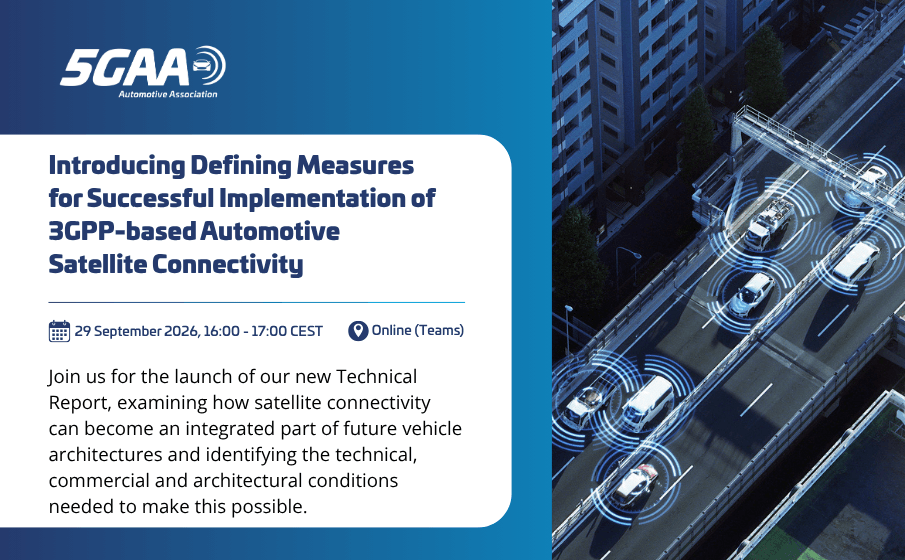
5GAA Online Session: Introducing Defining Measures for Successful Implementation of 3GPP-based Automotive Satellite Connectivity
As connected vehicles become increasingly software-defined and reliant on continuous connectivity, terrestrial networks alone cannot guarantee seamless service availability everywhere. Non-terrestrial networks (NTN) are therefore emerging as a strategic complement to cellular infrastructure, with the potential to extend connectivity into areas beyond terrestrial coverage and provide additional resilience when networks are disrupted.
Join 5GAA for the launch of its new Technical Report, “Defining Measures for Successful Implementation of 3GPP-Based Automotive Satellite Connectivity,” which examines how satellite connectivity can become an integrated part of future vehicle architectures and identifies the technical, commercial and architectural conditions needed to make this possible.
During the session, experts from 5GAA will present the report’s key findings, including the different roles that NB-IoT NTN, 5G NR-NTN and broadband satellite connectivity could play across the automotive ecosystem. The discussion will explore how the requirements of future use cases — from emergency communications and hazard warnings to HD map distribution, teleoperated driving and other data-intensive services — will shape the evolution of automotive satellite connectivity.
The session will also address the importance of integrating terrestrial and non-terrestrial networks, enabling seamless mobility between connectivity technologies and ensuring continuity of service. Particular attention will be given to the potential of 3GPP-based direct-to-device connectivity, the development of higher-capacity NR-NTN solutions, and the technological challenges associated with integrating satellite terminals into vehicles.
Drawing on industry analysis, OEM feedback and live demonstrations conducted by 5GAA members, the report provides a roadmap for moving automotive satellite connectivity from successful demonstrations towards scalable deployment.
Join our speakers and document leads Olaf Eckart (BMW) and Damian Lewis (Viasat) on 29 September to explore what it will take to make satellite connectivity a scalable and integrated component of the connected vehicle ecosystem.
5GAA response to the MoRTH draft notification introducing V2V requirements for type approval of L, M, N category vehicles in India
5GAA would like to thank MoRTH for the opportunity to comment on the draft notification introducing V2V requirements for type approval of L, M, N category vehicles in India.
5GAA applauds the Government of India’s commitment to improving road safety and accelerating the deployment of connected vehicle technologies. 5GAA welcomes the objective to establish a regulatory framework that enables interoperable V2X services and contributes to safer and more efficient transport systems.
5GAA strongly supports the development of a standard that establishes interoperable implementation of V2X applications in India. In this context, 5GAA congratulates MoRTH and TEC (Dept. of Telecommunication) on the progress made in the Task Force on ITS and endorses that the proposed standardization activity will carry forward with the agreements on ETSI TC ITS Rel 2 stack with 20 MHz for LTE-V2X Direct as a starting point.
The proposed mandatory fitment is closely linked to compliance with AIS-230, a standard that is still under development and not yet finalised [1]. 5GAA recognizes that category-L may need additional consideration in the AIS-230 standard development.
5GAA therefore encourages a multi-phased deployment approach that considers the time required for finalisation of technical specification, product development, testing, certification, validation, security credential management system readiness, supply chain preparation, broad availability of hardware and software and vehicle production planning.
As an initial basis for discussion, 5GAA suggests:
- Maintaining the proposed voluntary deployment milestone of 1 October 2027 for vehicle categories L, M and N that are voluntarily equipped with V2V technologies. This first phase provides an opportunity to gather real-world deployment experience under Indian traffic conditions and learn from coordinated initial large-scale deployment, with particular attention to category L vehicles.
- Maintaining an initial milestone of 1 October 2028 to introduce the mandate for V2V. Consideration should be given on a stepwise approach, potentially suggesting multiple milestones with a split between new type-approved vehicles and new manufactured vehicles, as well as, differentiating the timelines between vehicle categories. The timelines should take into account the finalisation of AIS-230, the outcomes of the initial large-scale deployment (especially for L-vehicle category) and the readiness of the broader V2X ecosystem, including interoperability, certification and security credential management.
- Clarifying the fitment of aftermarket devices, which has a clear potential role to accelerate the penetration rate of V2V-equipped vehicles, especially on legacy fleet, during a transition period.
This multi-phase approach would preserve the momentum created by the proposed voluntary deployment milestone while providing manufacturers with the regulatory certainty and lead time needed to develop, validate, certify and industrialise compliant solutions at scale. In particular, given that AIS-230 is under active development, industry would need some time following its finalisation to transpose the specifications into future vehicle programmes.
From 5GAA’s global experience, connected vehicle deployment typically include both direct and network V2X solutions and is accompanied by complementary digital road and data platform policy initiatives. 5GAA encourages India to consider complementary policies to support the broader ITS and road safety data-sharing adoption and maximise the benefits of connected mobility.
5GAA remains committed to supporting the Government of India and relevant stakeholders in developing a practical, interoperable and scalable deployment roadmap for V2X services.
[1] Subject to be “amended from time to time” as mentioned in the proposed G.S.R. 665(E).
5GAA and the China Society of Automotive Engineers (China-SAE) renew MoU to advance intelligent and connected vehicles
The 5G Automotive Association (5GAA) and the China Society of Automotive Engineers (China-SAE) have renewed their Memorandum of Understanding, reinforcing their long-standing collaboration to accelerate the deployment of connected vehicle solutions, particularly in C-V2X.
The renewed agreement marks a new phase of joint work in several strategic domains critical to the future of intelligent mobility. Building on previous cooperation, both organisations will focus on advancing the C-V2X ecosystem, spanning application development, safety assurance, future service innovation, and contributions to international standards.
By renewing the MoU, 5GAA and China-SAE reaffirm their shared commitment to shaping a harmonised global ecosystem for connected vehicles.
Cellular-V2X (C-V2X) is an umbrella term which encapsulates all 3GPP V2X technologies, including both direct (PC5) and mobile network communications (Uu).
About 5GAA
5GAA unites the automotive, telecommunication, and technology industries globally, turning collaboration into real-world, scalable connectivity solutions that deliver smart, safe, secure, and efficient mobility for all road users, now and in the future.
Three-quarters of drivers willing to pay for satellite-connected car services
High proportion of drivers report hitting signal ‘dead zones’ every week, with 75% willing to pay for satellite-connected services.
Survey, conducted by Viasat and 5G Automotive Association, also shows drivers heavily prioritize safety services, including real-time hazard warnings and emergency calls.
CARLSBAD, Calif., Aug, 6, 2026 – A new study from Viasat Inc., a global leader in satellite communications, and the 5G Automotive Association (5GAA) has revealed drivers around the world say they regularly experience coverage ‘black spots’ and are willing to pay for satellite-powered services – especially when it comes to safety.
The number of ‘connected cars’ has grown in recent years, usually using 4G or 5G cellular connections to enable features like emergency calls, entertainment, and breakdown assistance. With road traffic injuries leaving between 20-50 million people with non-fatal injuries every year [1], automotive makers have continued to introduce new connected-safety features, for example SOS services which can detect serious collisions and automatically alert authorities via cellular.
Drivers want satellite-enabled safety services
Around three-quarters (76%) of drivers surveyed say they experience mobile signal losses every week, with some frequent drivers saying they spend more than four hours a week on the road without signal. When assessing connected services, 75% of drivers say they would be willing to pay for satellite-based connectivity.
The report shows that having an emergency call system was the top priority for many drivers, with 43% selecting it as their most desirable satellite-enabled service. Similarly, real-time alerts for local hazards and traffic problems were seen as indispensable by 17% of respondents, while traffic management during disaster situations was reported as crucial by 10%.
Regional differences in driver attitudes
The study also reveals critical regional differences. In Indonesia, for example, 66% of drivers spend at least an hour a week outside of mobile coverage – double that observed in France (33%). Similar challenges were reported in India and Brazil. This directly correlates with a heightened demand for dependable connectivity. Respondents in India, Indonesia, and Brazil show the highest willingness to pay for a satellite-based connection.
Interest in future applications
Looking ahead, drivers show willingness to pay more than a standard satellite bundle for premium broadband features, including 4K/8K video streaming or automated software updates. A substantial 45% of respondents also showed interest in these higher data broadband satellite services.
Andy Kessler, Vice President, Enterprise at Viasat said: “This research shows drivers do have to deal with long periods without coverage and are excited about the possibilities of the satellite-connected car. Safety will be the first and primary benefit, but a huge range of futuristic applications could be unlocked by consistent, reliable, global connectivity. We’re determined to work with the automotive industry and the wider ecosystem to bring standards-based solutions to market and open those benefits to drivers as soon as possible.”
“Drivers are eager for satellite-based safety services that provide features such as emergency calls and real-time hazard alerts,” said Olaf Eckart, 5GAA WI Non-Terrestrial Network (NTN) Lead. “We take pride in our collaboration with top automakers, telecom providers, and technology partners, as we work together to advance the future of connected vehicles and improve safety, connectivity, and mobility for both drivers and communities.”
About the report
The report – The Great Connectivity Convergence: NTN in automotive – surveys 1,606 drivers across 10 countries, including the UK, USA, Indonesia, France, India, Canada, Japan, Germany, Brazil, and France, between October and November 2025. The survey asked drivers their views on possible satellite communication services, how important different connected car features are to them, and whether they would be willing to pay for these new satellite-powered options.
The report is part three of a series surveying consumers and industrial users about new standards-based Non-Terrestrial Network (NTN) services in various markets. The first report – The Great Connectivity Convergence: NTN in Consumer Mobile – was conducted by Viasat and GSMA Intelligence and surveyed more than 12,000 mobile phone users to ask mobile customers about direct-to-device satellite services. The second report – NTN in Industrial IoT – assesses the use of NTN for industrial IoT applications across five major industries.
About The 5G Automotive Association
The 5G Automotive Association (5GAA) is a global, cross-industry of more than 100 members, including leading global automakers, Tier-1 suppliers, mobile operators, semiconductor companies, and test equipment vendors. 5GAA members work together to develop end-to-end solutions for future mobility and transport services. 5GAA is committed to helping define and develop the next generation of connected mobility, automated vehicles, and intelligent transport solutions based on C-V2X. For more information about 5GAA, please visit www.5gaa.org or follow us on LinkedIn, X and YouTube.
Copyright © 2026 5GAA. All Rights Reserved. No part may be reproduced except as authorised by written permission. The copyright and the foregoing restriction extend to reproduction in all media.
About Viasat
Viasat is a global communications company that believes everyone and everything in the world can be connected. With offices in 24 countries around the world, our mission shapes how consumers, businesses, governments and militaries around the world communicate and connect. Viasat is developing the ultimate global communications network to power high-quality, reliable, secure, affordable, fast connections to positively impact people’s lives anywhere they are – on the ground, in the air or at sea, while building a sustainable future in space. In May 2023, Viasat completed its acquisition of Inmarsat, combining the teams, technologies and resources of the two companies to create a new global communications partner. Learn more at www.viasat.com, the Viasat News Room or follow us on LinkedIn, X, Instagram, Facebook, Bluesky, Threads, and YouTube.
Copyright © 2026 Viasat, Inc. All rights reserved. Viasat, the Viasat logo and the Viasat Signal are registered trademarks in the U.S. and in other countries of Viasat, Inc. All other product or company names mentioned are used for identification purposes only and may be trademarks of their respective owners.
Viasat, Inc. Contacts
Richard Jones, External Communications, Corporate & Commercial Services, +44 7843 819 611, Richard.Jones@viasat.com
Lisa Curran/Peter Lopez, Investor Relations, IR@viasat.com
Forward-Looking Statements
This press release contains forward-looking statements that are subject to the safe harbors created under the Securities Act of 1933 and the Securities Exchange Act of 1934. Forward-looking statements include, among others, statements that refer to the pace of adoption of D2D and NTN services and Viasat’s ability to capitalize on market opportunities. Readers are cautioned that actual results could differ materially from those expressed in any forward-looking statements. Factors that could cause actual results to differ include: risks associated with the construction, launch and operation of satellites, including the effect of any anomaly, operational failure or degradation in satellite performance; our ability to successfully develop, introduce and sell new technologies, products and services; changes in relationships with, or the financial condition of, key customers or suppliers; our reliance on third parties to supply our services; and the effect of adverse regulatory changes . In addition, please refer to the risk factors contained in our SEC filings available at www.sec.gov, including our most recent Annual Report on Form 10-K and Quarterly Reports on Form 10-Q. Readers are cautioned not to place undue reliance on any forward-looking statements, which speak only as of the date on which they are made. We undertake no obligation to update or revise any forward-looking statements for any reason.
[1] World Health Organization | Road Traffic Injuries | https://www.who.int/news-room/fact-sheets/detail/road-traffic-injuries

Space42

Onomondo
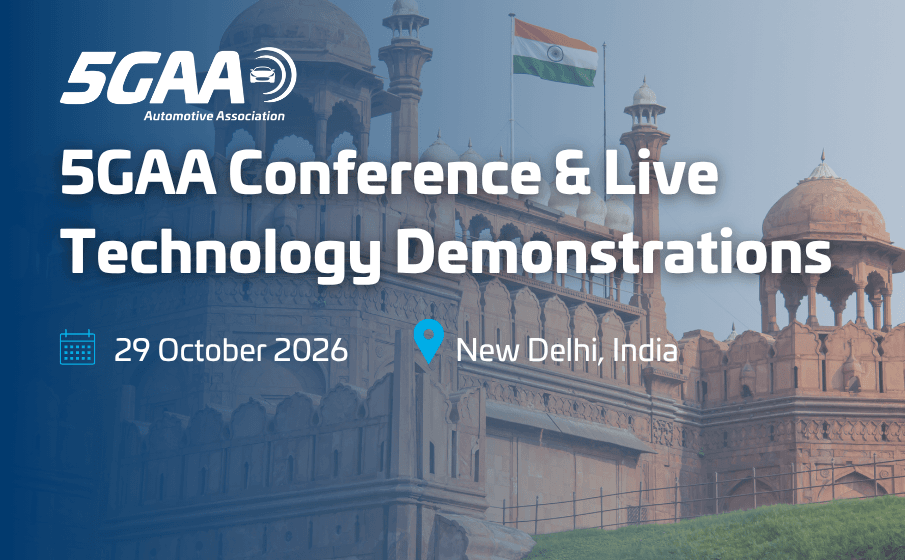
5GAA Conference & Live Technology Demonstrations in New Delhi 2026
As part of the 39th 5GAA Meeting Week, 5GAA is hosting the Conference “Connecting India for Safer Roads: Advancing Mobility for All” and Live Technology Demonstrations on 29 October 2026 in New Delhi, India.
This half-day, in-person event offers a unique opportunity for policymakers, regulators, industry representatives, and mobility stakeholders to engage directly with over 100 leading voices from the automotive, telecommunication, and technology sectors in India and worldwide.
Don’t miss the opportunity to discuss how C-V2X and connected mobility solutions can enhance safety, improve traffic efficiency and support the future of transportation in India and beyond.
Conference Topics
- The state of play and roadmap for C-V2X deployment in India
- The role of connectivity in supporting road safety, traffic efficiency, and automated driving
- Policy, regulatory, and spectrum considerations for large-scale deployment
- Cross-industry collaboration between the automotive, telecom, and infrastructure ecosystems
- Lessons learned from global deployments and their relevance for regional implementation
Preliminary Agenda available here.
Registration is open!
If you would like to attend the 5GAA Conference & Live Technology Demonstrations, please contact us at secretariat@5gaa.org
Places are limited, and we encourage you to register as soon as possible to secure your participation.
Registration will close on 28 October 2026.
More information coming soon!
Study on Dynamic V2X Use Cases
The 5G Automotive Association (5GAA) is pleased to release its new Technical Report “A Study on Dynamic V2X Use Cases”, exploring how C-V2X technologies can support a range of dynamic road safety use cases beyond basic awareness services, including intersection safety, vulnerable road users, soft intersections, and high-speed rear-end collisions.
By combining analytical models, simulations, and real-world data, the report examines how direct (PC5) and network-based (Uu) communications can work together to extend situational awareness, especially in complex or non-line-of-sight scenarios.
With V2X increasingly reflected in NCAP discussions, this paper also touch on what these findings mean for the path toward deployment and real-world implementation.
Read and download the full Technical Report here.

WSP

39th 5GAA F2F Meeting Week
The 39th 5GAA Meeting Week will be held in New Delhi, India, from 26–29 October 2026!
Our gathering later this year will bring together 5GAA members, partners, and key industry stakeholders to exchange insights, explore the latest advancements in connected mobility, and collaborate on shaping the future of C-V2X in India and worldwide.
5GAA Members, get ready to connect, collaborate, and innovate as we advance the future of mobility.
Registration is open for 5GAA members and partners!
If you would like to attend the full 5GAA Meeting Week, please contact us at secretariat@5gaa.org before 12 October.
Places are limited, and we encourage you to register as soon as possible to secure your participation.
5GAA Side Activities
As part of the 39th 5GAA Meeting Week, 5GAA is hosting the Conference “Connecting India for Safer Roads: Advancing Mobility for All” and Live Technology Demonstrations on 29 October 2026 in New Delhi, India.
This half-day, in-person event offers a unique opportunity for policymakers, regulators, industry representatives, and mobility stakeholders to engage directly with over 100 leading voices from the automotive, telecommunication, and technology sectors in India and worldwide.
Registration is open to guests and interested participants. To secure your place, register before the deadline of 28 October 2026.
If you would like to attend the 5GAA Conference & Live Technology Demonstrations, please contact us at secretariat@5gaa.org
Find out more information about the Side Activities and the Preliminary Agenda here.
5GAA Policy Conferences and Live Technology Demonstrations convene key decision-makers, industry leaders, and ecosystem partners across major regions to advance the deployment of connected mobility. Held in the US, Europe, and Asia, these events provide a dedicated platform to align on regulatory priorities, share regional insights, and showcase real-world progress through live demonstrations and use cases.