ITS America Congress & Expo
5GAA will be present at the ITS America Congress & Expo, taking place in Detroit from 9 to 12 June…



The international collaboration of tech leaders and public sector on a live connected car trial will pilot new roaming technology for traffic safety.
March 24th, 2022 – (Blacksburg, VA) On March 24th the Commonwealth of Virginia will host a live trial of new driver and pedestrian safety concept that allows near-real-time notification of roadway hazards through 5G and edge technologies. This trial is one of three conducted internationally by a historic public-private collaboration, organized by the 5G Automotive Association (5GAA) and eight member companies representing leading technology companies from around the globe. A related European live-trial was conducted in the city of Turin, Italy. The North American live trial will be conducted on the Virginia Smart Road operated by the Virginia Tech Transportation Institute in Blacksburg, VA. It is the first of its kind in North America.
“The 5G Automotive Association lives out of cooperation between its members. In this case, eight members led by Intel and Verizon give a perfect example of how we can use connected mobility to increase safety on our roads,” said Maxime Flament, CTO of 5GAA. “5GAA is also global and we are happy that use cases demonstrated here in United States can readily be adapted in any other country supporting 5G and Edge networks.”
5G transmission speeds and so-called “Edge” servers—locally installed, high-powered computers capable of running Artificial Intelligence programs—open the door to smart city technologies like near real-time traffic management and innumerable other business applications. The connected car concept uses this high-speed and Edge computing technology to communicate with car sensors and pedestrian smartphones, via a user-authorized mobile app—about traffic hazards, like accidents and road construction—for Pedestrian and in-vehicle driver safety and efficient navigation.
This live international trial attempts to solve one of the more technical challenges of making the connected car concept a daily reality. The 5G networks underpinning the concept are managed by Communication Service Providers (CoSPs) according to geography, each with different edge solutions that must be able to communicate without interruption of the V2X applications as drivers cross borders. Roaming services—the ability to make a call regardless of the network—is one early success of multi-mobile network operators (MNO). Demonstrating the connected car concept can work in a roaming scenario is the core objective of the live trial and represents the first of any such attempt in the United States.
“Telecom operators will have to play a major role by enabling applications and services for the connected car ecosystem,” says Shamik Mishra, CTO Connectivity, Capgemini Engineering. He further adds: “Capgemini is excited to bring its innovative federated MEC (Multi-Access Edge Computing) platform and applications to this 5GAA trial to demonstrate the true value of intelligent industry, leveraging data in the vehicles and edge-cloud. The trials serve as a stepping-stone for realizing the potential for automakers to provide services to their connected cars from the network.”
The Virginia live trial addresses three objectives:
One of the key benefits of the trial is the value demonstrated by bringing in a large ecosystem to help develop not only the technology but also build the business case and model that will help drive the potential market adoption for 5G and C-V2X to help into the digital transformation of smart cities of the future. To succeed in this endeavor, it will need a village and investment from both public and private sectors to help adopt this new technology to provide a quality of life for all citizens.
The demonstration brings new learnings for various players across the value chain and creates a testbed for trying out new 5G connected car services at the Edge in subsequent phases. The U.S. Live Trial will take place in Blacksburg, VA, on March 24th, 2022.
BACKGROUND
In this live trial, Verizon and TELUS are exhibiting the Ultra-reliable low-latency communication (URLLC) 5G networking capabilities, such as hosting Capgemini’s ENSCONCE MEC platform, built upon the Intel Smart Edge Open toolkit, to enable connected car use cases at the edge on Intel Architecture-based EC2 instances on AWS Wavelength. Intel Smart Edge Open (formerly known as OpenNESS) is a royalty-free edge computing software toolkit for building optimized and performant edge platforms.
“Intel is proud to be a leading member of this live trial to build and provision Infrastructure to enhance Connected Vehicle experience in multi-operator scenarios,” said Sameer Sharma, General Manager of Cities & Transportation Business Unit at Intel. “This demonstration shows how cloud service providers and communication service providers can advance road infrastructure deployments at the 5G network edge when powered by Intel technologies. This is just the beginning, as future trial phases will demonstrate additional exciting services”
Capgemini’s ENSCONCE MEC Platform also enables multi-tenancy and multi-MNO MEC federation capabilities based on GSMA Operator Platform requirements and comes with Capgemini V2X Stack built-in support. To realize the Active and Passive Vulnerable Road User (VRU) use cases, the AWS Wavelength EC2 instances are used to demonstrate Virtual-RSU and host V2X applications that are based on the Intel Xeon Scalable Processors. Harman International and Capgemini provide the Virtual-RSU and RSE solutions respectively to realize various V2X use cases with location aware and AI inferencing technologies. Harman also offers a 5G enabled OBU that integrates seamlessly with Stellantis/FCA car and hosts V2X applications. American Tower in collaboration with VTTI is providing the test bed infrastructure at the VTTI intersection where the trial for V-DOT will be performed.
“Since joining 5GAA in 2018, we have worked with public and private partners to help define the ecosystem for scalable cellular-based roadside infrastructure to serve the 5G connected vehicle.” Said Ed Knapp, CTO of American Tower. “By deploying C-V2X in combination with roadside sensors processed at shared multi-access edge computing facilities, also known as MEC4auto, American Tower hopes to enable deployments of seamless multi-operator MEC services to support low latency use cases.”
“The Virginia Tech Transportation Institute (VTTI), along with our Virginia Department of Transportation partners, is excited to support the demonstration of the MEC4Auto solution on the Virginia Smart Roads. The connected car concept provides reliable, low latency communications that can enable a variety of transportation safety use cases. This V2X technology takes a big step towards scalable deployment by demonstrating the seamless transfer of V2X services between operators and geographic locations with no change in performance, functionality, and reliability.” Said Dr. Michael Mollenhauer, Director, Division of Technology Implementation at VTTI.
“The Virginia Department of Transportation (VDOT) has a mission to ensure the safe, efficient, and accessible travel of people and goods across the Commonwealth,” explained Amanda Hamm, VDOT’s Connected and Automated Vehicle Program Manager. “To achieve this mission, VDOT supports innovative solutions and partnerships, like this historic trial, to bring the connected vehicle ecosystem to fruition, as this environment could one day save lives by providing actionable, real-time information to all roadway users so that they better navigate our roadways.”
“Making roads safer for drivers and pedestrians is the ultimate goal of developing these next generation technologies,” said Ned Curic, Stellantis Chief Technology Officer. “The Jeep® Wrangler 4xe plug-in hybrid is the perfect vehicle for these live tests, equipped with vehicle-to-everything (V2X) technologies and driver safety alert. With 5GAA, we are working with industry leaders across the globe to help pave the way for autonomous technology to benefit our products and, ultimately, our customers”
“Verizon 5G Edge with AWS Wavelength brings AWS compute and storage services to the edge of Verizon’s wireless network minimizing the latency and network hops required to connect from an application hosted on AWS to the end user’s device,” said Jyoti Sharma, Senior Manager of Network Planning at Verizon. “Through our partnership with AWS, we are helping customers unlock the true potential of 5G and edge computing which together will enable innovative applications involving computer vision, augmented and virtual reality, and machine learning.”
Connected mobility is quickly becoming a reality, and thanks to ultra-low latency of 5G and power of edge computing, it will deliver on important safety outcomes for everyone on our roads in a near future,” said Ibrahim Gedeon, Chief Technology Officer, TELUS. “TELUS is proud to offer our world-leading connectivity, alongside this prestigious group of partners, in order to realize this trial and maximize our learning for the future.”
“At HARMAN, we are focused on building connectivity solutions at the intersection of 5G, V2X & Edge Computing that will build more equity on the road for all users,” said Mahsa Nakhjiri, Director, Product Management at HARMAN. “While these technologies can unlock many new use cases and experiences, the most important element of any solution in this space is safety. As programs such as this one fueled by the collaboration of industry leaders and organizations like 5GAA bring a new degree of safety to users, they will also lead to a higher level of confidence in autonomous vehicles.”
Source: Harbor Research1.
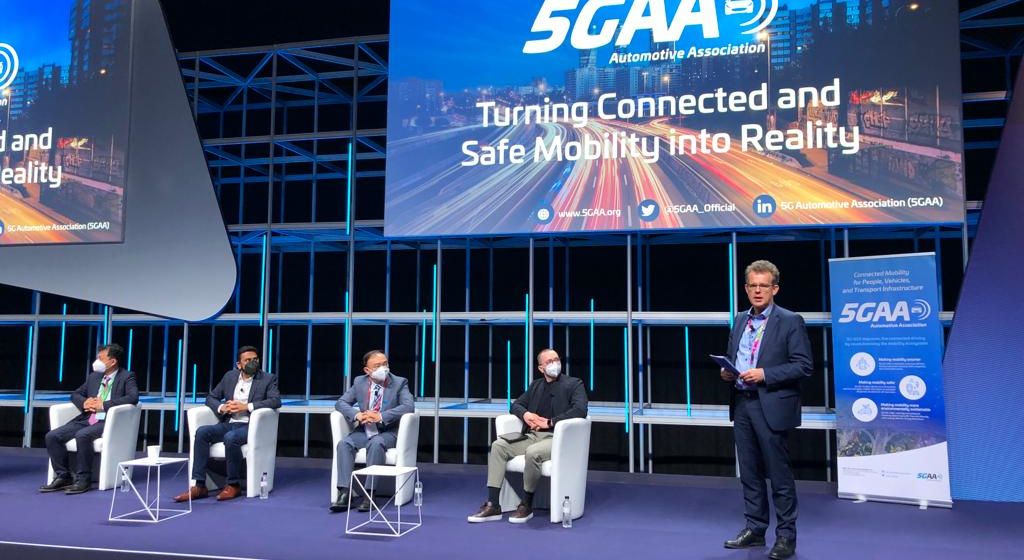
On 2nd March, 5GAA experts and member spokespersons shared their views on how the deployment of C-V2X technologies is turning connected and safe mobility into reality from now and in the next few years, during the conference “Turning Connected and Safe Mobility into Reality” at the Barcelona edition of GSMA’s Mobile World Congress.
The conference, moderated by Freddie Holmes, Special Correspondent at Automotive World, offered an overview of the broad-scale improvements that connected mobility can bring to the global automotive system, starting with a first session on the 5G-V2X deployment landscape in different regions, such as Europe, China, and the US. Speakers underlined the need for increased ecosystem cooperation and cross-border projects to ensure reliable access to 5G networks to all users. The second session focused on the safety aspects and benefits brought by the technology, including protecting vulnerable road users.
The event concluded with an insightful panel discussion on mobility data, with the participation of representatives from the entire ecosystem value chain. Panellists discussed how smart cities and infrastructure could help make data-driven decisions that inform how we pave the path for the future of mobility and the crucial role of data standardisation and reliability and new business models to foster investments.
The event welcomed, in person or through virtual messages, high-level representatives of 5GAA’s member companies Deutsche Telekom, Verizon, China Mobile, Harman, Continental, Telefonica, Qualcomm, BMW, Huawei, Intel , ZTE, Stellantis.
In case you didn’t have the possibility to attend the conference in Barcelona, here you can find some of the insightful materials presented by our members.
Bringing 5G Consumer Experiences to Automotive Industry At Scale
Ramaswamy Iyer, Senior Vice-President and Head of Connectivity SBU, Harman
Vishnu Sundaram, Senior Vice President, Stellantis
5G + C-V2X: Pave the way for C-ITS and Auto-Driving
Xu Ling, Standard Director, ZTE
China overview
Wai Chen, Chief Scientist, China Mobile
Presentations:
The Digital Guardian Angel -A Cellular-assisted VRU protection solution
Frank Foersterling, Head of Government, Liaison & Engagement, Continental
Driving the Smart Mobility Revolution
Leticia Lopez Domingo, Technology Innovation Expert, Telefonica
5G capabilities as a game changer for automotive connectivity
Dennis Nikles, Vice-President IOT, Deutsche Telekom

The 5G Automotive Association (5GAA) is proud to partner again with the European Telecommunications Standard Institute (ETSI) and for the third ETSI C-V2X Plugtests™ event hosted by DEKRA at its Automobil Test Center in Klettwitz, Germany.
From 28 March to 1 April 2022, ETSI and DEKRA will enable On-Board-Unites (OBUs), Roadside-Units (RSUs) and public key infrastructure (PKIs) vendors to run interoperability test sessions to assess the level of interoperability of their implementation and validate the understanding of the standards.
Additionally, 5GAA organises a workshop on “C-V2X Interoperability and Deployment” to bring together some key players in the C-V2X deployment and interoperability ecosystem. The workshop will take place on Thursday 31 March, from 09:00 to 12:30 CEST at the Dekra Testing Site. The discussion will focus on the future of C-V2X for the automotive industries and the role of certification for the deployment of the technology.
Participants will also have the great opportunity to join live interoperability demonstration on DEKRA’s outside testing area and discover ETSI’s ITS Test Scenarios use cases showcased by various companies.
Interested in attending the C-V2X PlugtestsTM event? Registrations are open until 21 March. Due to the Covid restrictions, capacity on-site is limited.
For any further information, please contact marcom@5GAA.org
5GAA WORKSHOP AGENDA
Please see the full agenda here:
9:00 – 09:30 – Opening session
Welcome to DEKRA Automotive Test Center Klettwitz
Thomas Jaeger, Head of Technology Technical Service Management, Senior Vice-President, Service Division Product Testing, DEKRA
Welcome to Plugtests Event
Ultan Mulligan, Director, ETSI Centre for Testing and Interoperability (CTI)
5GAA welcome and introduction to the workshop
Maxime Flament, Chief Technology Officer, 5G Automotive Association
09:30 – 09:50 – Session 1
Debrief of Klettwitz plugtests activities
Saurav Arora, Technical Project Manager, PlugtestsTM Event
10:20 – 11:35 – Session 2
Road operator perspective: “German Perspective on C-ITS Deployment”
Farzin Godarzi, Scientific Officer, Federal Highway Research Institute (BASt, Bundesanstalt für Straßenwesen)
The future of C-V2X: “Commercial deployment of C-V2X vehicles”
Johannes Springer, Chief Technology Officer Connected Cars, Deutsche Telekom
Certification: “The importance of Certification for 5G Automotive”
Thomas Jaeger, Head of Technology Technical Service Management, Senior Vice-President, Service Division Product Testing, DEKRA
Testing Network V2X platform: “Vodafone’s V2X Safer Transport for Europe Platform (STEP)”
Robert Banks, Technology Development Manager, Vodafone
11:35 – 12:10 Moderated discussion – Bringing C-V2X on the Roads: the Role of Interoperability for Deployment
Moderator, Maxime Flament, Chief Technology Officer, 5G Automotive Association
12:10 – 12:30 Closing Remarks
Saurav Arora, Technical Project Manager, PlugtestsTM Event
Maxime Flament, Chief Technology Officer, 5G Automotive Association
Download the agenda here.
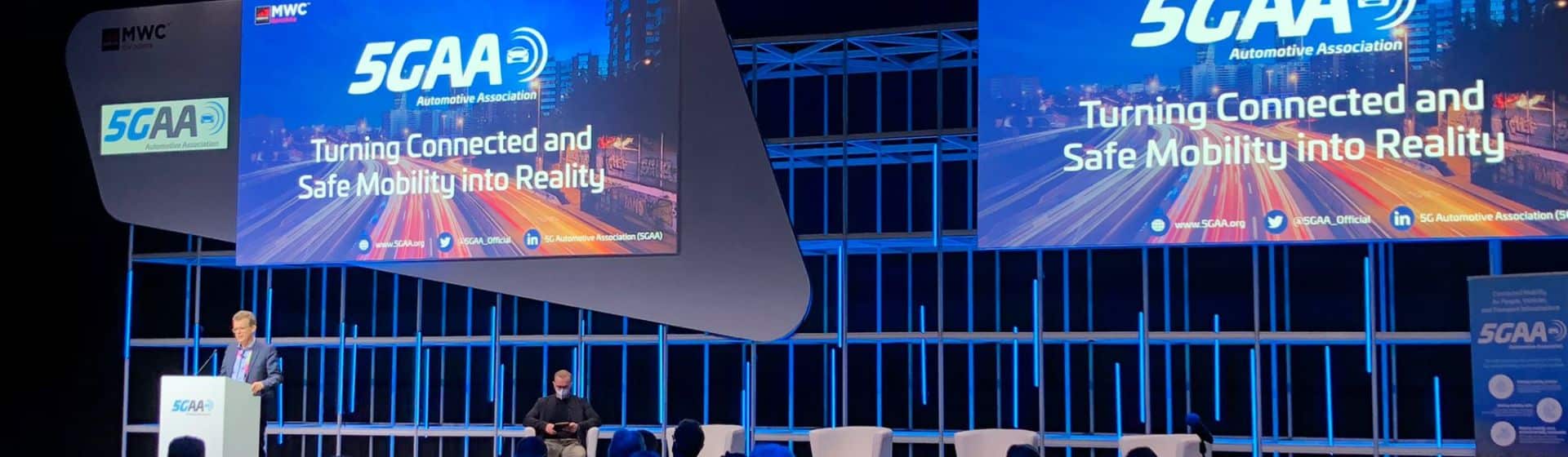
Barcelona, 3 March 2022 – The 5G Automotive Association (5GAA), alongside its members, disclosed the latest global deployments of C-V2X technology, highlighting how 5G data will deeply transform the mobility system by making it safer and more efficient at GSMA’s Mobile World Congress 2022 in Barcelona on Wednesday 2 March 2022.
The 5G Automotive Association was back this year at Barcelona’s edition of the Mobile World Congress, the world’s leading exhibition for the connectivity industry, to disclose the cellular technology shaping the future of mobility alongside its member.
Today, connected driving is a reality. Over 200 million connected vehicles are equipped with C-V2X applications sharing hazard and traffic warnings on the road. Applied to the automotive sector, 5G is upgrading revolutionary in-car connectivity, allowing seamless and cooperative communication between vehicles, infrastructure, and surroundings.
On 2nd March, 5GAA experts and member spokespersons shared their views on how the deployment of C-V2X technologies is turning connected and safe mobility into reality from now and in the next few years. Moreover, the association had the pleasure to have Peter Stuckmann, Head of Unit, Future Connectivity Systems, DG CONNECT, European Commission, addressing the participants and highlighting the crucial role of investments in 5G and infrastructures to foster the European green and digital transition.
As noted by Johannes Springer, 5GAA Director-General, the association that celebrates its 5th Anniversary has been working intensely to bridge the gap between automotive, technology, and telecom industries and promote the 5G-V2X (vehicle-to-everything) technology as a comprehensive and integrated platform for connected vehicles, embracing digital transformations as opportunities for mobility innovations.
The conference, moderated by Freddie Holmes, Special Correspondent at Automotive World, offered an overview on the broad-scale improvements that connected mobility can bring to the global automotive system, starting with a first session on the 5G-V2X deployment landscape in different regions, such as Europe, China, and the US. Speakers underlined the need for increased ecosystem cooperation and cross-border projects to ensure reliable access to 5G networks to all users. The second session focused on the safety aspects and benefits brought by the technology, including protecting vulnerable road users.
The event concluded with an insightful panel discussion on mobility data, with the participation of representatives from the entire ecosystem value chain. Panellists discussed how smart cities and infrastructure could help make data-driven decisions that inform how we pave the path for the future of mobility and the crucial role of data standardisation and reliability and new business models to foster investments.
The event welcomed, in person or through virtual messages, high-level representatives of 5GAA’s member companies Deutsche Telekom, Verizon, China Mobile, Harman, Continental, Telefonica, Qualcomm, BMW, Huawei, Intel , ZTE, Stellantis.
In addition,5GAA hosted a Press & Industry guided tour across the booths of key member companies to share their latest C-V2X technology developments with journalists and industry analysts, focusing on road safety and digital infrastructures.
Companies featured in the tour included:
We would like to thank all our participants, member companies and speakers, for making it such an insightful event, clearly demonstrated the added value of ecosystem cooperation for the future of the transportation system.
Download the agenda of the event here.
For additional information, please get in touch at marcom@5gaa.org.
Please find the video contribution from Ramaswamy Iyer, Senior Vice-President and Head of Connectivity SBU, Harman that unfortunately, we have not been able to show during the conference due to technical problems.



BARCELONA, 24 FEBRUARY 2022 – The 5G Automotive Association (5GAA) will present the latest global advancements of ‘Cellular-Vehicle-to-Everything’ (C-V2X) in the journey towards 5G-V2X on 02 March 2022 at GSMA’s Mobile World Congress Barcelona 2022. The 5GAA conference will gather senior executives to bring perspective on how C-V2X revolutionises the driving experience to make mobility smart, safe and sustainable, as C-V2X powered vehicles are now hitting the market in Europe and beyond. Journalists are invited to join our media tour of 5GAA members’ booths to exchange with experts and witness the latest technology developments.
This year, the 5G Automotive Association will be back at the Barcelona edition of the Mobile World Congress to address today’s mobility key challenges.
The association will hold a “Turning Connected and Safe Mobility into Reality” conference on Wednesday 02 March 2022 at 09:00am-12:35pm CET (Theatre 4, Hall 7).
Senior executives from automotive and telecommunications member companies (including China Mobile, Continental, Deutsche Telekom, Harman, Huawei, Intel, Qualcomm, Telefónica, Verizon, ZTE and more) will offer their perspective on C-V2X global market landscape and technology evolution towards 5G-V2X.
A networking lunch is foreseen 12:15-01:00pm CET.
To get prime access to C-V2X industry experts and latest demonstrations of the technology, 5GAA is calling on journalists and industry experts to join the 5GAA tour taking place on 02 March at 02:00-03:00pm.
The onsite tour will explore the evolution of automotive connectivity for the purposes of enhanced road safety, improved traffic efficiency, greener environmental impact and more comfortable driving alongside members such as Anritsu, Deutsche Telekom, Intel, Qualcomm, Rohde & Schwarz and ZTE.
Europe is keen to play a leading role in future developments, in close collaboration with policymakers and road authorities, and 5GAA is uniquely placed to support C-V2X advances as it unites cross-sector players in this field.
To book your seat at the 5GAA conference or networking lunch, please register your interest here. If you are interested in joining the press and industry tour, please send an email to marcom@5gaa.org.


These past years have seen revolutionising digital transformations and challenging innovative mobility solutions. 5GAA keeps on shaping the new era of mobility and paves the way towards connected driving.
As individuals, in teams, and together with our members, we have embraced digital transformations as opportunities for transportation innovations. Today, we celebrate five years of intense activities, global cooperation, partnerships and demonstrations that resulted in remarkable achievements.
Our purpose is to develop end-to-end solutions for future mobility and transportation services for road safety, improved traffic efficiency, sustainable impact and more comfortable driving. While our purpose is not new, it is more relevant than ever. It reminds us that 5GAA exists to ensure future generations’ wellbeing in a safe and sustainable transportation ecosystem.
For five years, our vision has been guiding the association, gathering eight early co-founding members with the same ambition, and quickly bringing together more than 110 members from the automotive, technology, and telecommunications industry. This rapid expansion generated a genuinely global platform and connected community for cross-industry cooperation.
Members include 13 of the top fifteen global automakers and 9 of the top ten global mobile network operators. The exponential geographical reach of the association allows 5GAA to exert some influence on the connected driving stage. 5GAA is seen as a leader and enabler at a global level. It has successfully established C-V2X (cellular vehicle-to-everything) and 5G as the technology of choice in the market through numerous partnerships, bringing the expertise of manufacturers to develop 360-degree solutions for safer and more sustainable mobility. Thanks to these partnerships, 5GAA has established more than mobile broadband connectivity, integrating the multiple facets of connected mobility such as interoperability and standardisation.
People bring our purpose and vision to life. We have taken the future of mobility to a new level these past years, accelerating research and organising live demonstrations worldwide, which focused on interoperability tests. The Shanghai, Washington, Paris, Berlin and Turin demonstrations prove that a connected ecosystem holds the unlimited possibilities of investing in C-V2X and 5G. I also take this opportunity to thank our members for their hospitality and for showcasing these crucial innovations’ outstanding performance.
We have continued to stand firm on our purpose throughout the years, regularly positioning the association and sharing our members’ concerns with institutional bodies. Even though a set of challenges remains to be resolved, we hope to keep seamless exchanges with the institutional actors to unleash the potential of a connected ecosystem.
Today, I am proud to be part of an innovative and ambitious association that strives for a better future as it bridges cultural and technical differences. In this 5th-anniversary special publication, we have gathered some of the greatest stories of impact and success in relation to C-V2X in some regions, such as China and the US, as well as insightful interviews.
To advance the dialogue between high-level institutional and industry stakeholders on current challenges in the field of connected and automated mobility, the 5G Automotive Association (5GAA) is organising an online conference on 28 September 2021, from 9:15 AM to 3 PM CEST.
Representatives from the European institutions, local and national authorities as well as 5GAA members will discuss ongoing challenges for connected and automated mobility and provide solutions by presenting the capabilities and deployment models of the Cellular-Vehicle-to-Everything (“C-V2X”) technology.
If you have any questions, please get in touch at secretariat@5gaa.org.

With multiple engagement platforms and tailored content, US IOOs and the overall road infrastructure operators community can learn more about the superior safety benefits of C-V2X technology and engage with a growing ecosystem of telecom providers, chipset makers, and auto OEMs to identify synergies, opportunities, and potential business models to accelerate and streamline deployment of this life-saving technology.
Membership will allow 5GAA, road operators community to continue the productive conversations initiated e.g. with US IOOs during the C-V2X Workshop for North American Transportation Planning and North American Road Operators in Washington D.C (April 2018), where 5GAA presented a vision for a connected future (here) or European National Road Administrations (NRAs) and road infrastructure operators during a similar C-V2X Workshop and Demonstration in Paris, France (July 2018).
Download the complete FAQ list here.
For any questions regarding our future activities and future engagement opportunities, please email us at liaison@5gaa.org.
5GAA will be present at the ITS America Congress & Expo, taking place in Detroit from 9 to 12 June…
5GAA will be represented at AutoTech 2026, taking place in Novi from 2 to 4 June 2026. As part of…
5GAA will take part in the DSP Leaders World Forum, organised by TelecomTV, taking place from 19 to 20 May…
5GAA will be represented at Network X Americas 2026, taking place in Dallas from 18 to 20 May 2026, by…
Special Interest Session: “From data to deployment: accelerating CCAM and C-ITS through connectivity and collaboration” 5GAA is organising the Special…
In collaboration with our local host, RISE Research Institutes of Sweden, the 5GAA Conference “From the Nordics to Europe: Scaling…
The 37th 5GAA Meeting Week will be held in Gothenburg, Sweden from 20–23 April 2026. Our next gathering will bring together 5GAA…
Join 5GAA at Mobile World Congress (MWC) 2026, taking place 2–5 March at Fira Gran Via, Barcelona, to discover how connected-vehicle technologies…
The 5G Automotive Association (5GAA) presents a new Technical Report titled “Enhanced Positioning Accuracy and Coherent Situational Awareness by Connected Sensors…
On 5 February 2026, the Conference “Advancing Connected Mobility in California: C-V2X and Connected Vehicle Infrastructure” will take place in…
The next 5GAA Meeting Week is heading to Sacramento, California, from 2–5 February 2026! Our next gathering will bring together…
Meet with 5GAA and discover how 5GAA members are shaping the future of connected mobility at CES 2026! From 6…

Advances in communication technologies open up new opportunities and enable new types of services in the automotive area. These include road safety, traffic efficiency and customer services which are not specifically meant for automotive applications. As advanced V2X use cases requiring high reliability and/or high data rate are introduced, technologies such as multi-antenna solutions (e.g. massive MIMO), broadband (e.g. carrier aggregation), and FR2 solutions will be essential for V2X communications, and thus the number of required antennas mounted on vehicles will keep growing.
This study on the ‘Distributed vehicular antennas system’ provides a list of potential implementation options for vehicular-DAS with a brief analysis of impacts to 3GPP specifications and implementation costs. In addition, the potential performance gain of DAS over co-located antennas was verified through simulations, and the evaluation results and analysis were included in eCV2X WI TR.
Read the full report here.
The 5G Automotive Association (5GAA) is a global, cross-industry organisation of companies from the automotive, technology, and telecommunications industries (ICT), working together to develop end-to-end solutions for future mobility and transportation services.
+100 Members Community
+90 Completed Work Items Work Items
6 Working Groups Items
1 Objective Connected mobility
According to the World Health Organization (WHO), roughly 1.25 million road traffic fatalities worldwide in 2013, with another 20–50 million injured or disabled through traffic accidents. Vehicles sharing information make transportation safer, greener, and more enjoyable are at our doorstep. The technologies associated with this concept are collectively known as Cooperative Intelligent Transportation Systems (C-ITS). The impact on road safety alone is sufficiently significant to make C-ITS a priority.