
5G Automotive Association’s Position Paper on the eCall Legacy Fleet
5GAA welcomes the renewed attention and subsequent discussions on Next Generation eCall (NG eCall) and the legacy fleet, following the second phase of the IDIADA study, presented on 12 December 2023. Whilst the opportunity to address the critical issue of the legacy fleet is welcome, we wish to draw attention to some key industry concerns.
In this position paper, we underline that industry cannot be held liable for the lack of service continuity of 112-based eCall for the legacy fleet, which result from obsolete legislative requirements. Since both retrofit as well as the extension of 2G/3G networks are implausible, we call for public authorities to take responsibility in informing users in the event of eCall failure, in instances outside industry control. We also encourage further research to be carried out to revise the current eCall regulatory framework so that it becomes future proof and does not lead to the same situation in the future as we have now once NG eCall becomes obsolete, or 4G networks are being transitioned to other technologies. This should be based on a transparent dialogue between authorities and industry to find the right solution.
Read about 5GAA’s position here.

5GAA Annual Report Charts Global Path for C-V2X Deployment
The 5G Automotive Association has released its annual report for 2023, highlighting significant strides made towards global deployment of cellular vehicle-to-everything (C-V2X) technology and connected mobility solutions. The report details the association’s achievements across key areas, all working towards a more connected and automated transportation ecosystem.
Strong Membership and Global Reach
5GAA grew to 126 members in 2023, including leading names from the automotive (11 out of the top 15 carmakers), mobile network operator (8 out of the top 10 MNOs), and smartphone vendor industries (2 top vendors). This diverse membership fosters strong cross-industry collaboration with a global footprint.
Beyond membership, 5GAA actively maintained partnerships with over 40 organisations, including standards development organisations, public administrations, and certification bodies. Notably, 2023 saw the signing of a cooperation agreement with ITS America and renewed Memoranda of Understanding with ITS Korea and 5G Forum.
Recognising the varying pace of V2X deployment across regions, 5GAA continued to expand its reach. In addition to existing regional regulatory-focused sub-groups, a dedicated taskforce was established for India, a promising V2X market. The association also continued to advocate for a scalable and federated approach to managing road traffic information.
Contributing to Standards
Standardisation has been a core focus of the 5GAA since its early days. In 2023, the association and its members participated in 3GPP Release-19 discussions, providing critical automotive industry input as a Market Representation Partner (MRP). This cooperation aims to ensure that C-V2X technology development aligns with global needs. Additionally, 5GAA contributed to regional standardisation efforts by giving input to bodies like ETSI, SAE, and C-SAE.
In Conversation with Policymakers
The association actively engages with policymakers and regulatory bodies around the world. In Europe, 5GAA issued a joint statement with leading European carmakers urging the deployment of 5G-V2X technology in Europe. The association also welcomed positive developments such as FCC waivers for C-V2X deployment in the US, Korea’s selection of C-V2X direct communication as its technology of choice, and Japan’s consideration of using the upper 30 MHz in the 5.9 GHz band for V2X direct communications.
These engagements play a vital role in establishing sufficient regulatory support for the mass adoption of C-V2X technology.
Two Succesful Workshops
Throughout 2023, 5GAA hosted workshops with key stakeholders to identify challenges and advance technology innovation. In The Hague, Netherlands, a workshop focused on C-V2X mass market deployment in real-life traffic. Similarly, a high-level conference, “The Future of Connected Mobility in South Korea,” was held in Seoul. Discussions centered on how connected mobility and ITS can advance road safety and automated driving in the Korean transport ecosystem.
Technical Progress
In 2023, 5GAA maintained a strong work program. The association successfully completed 12 work items, launched 28 new ones for development in 2024, and published 18 technical reports. Key areas of focus included Day 1 V2X services, Automated Valet Parking (AVP) solutions, and interoperability testing for Vulnerable Road User (VRU) protection, with a series of live demonstrations in Mcity, Michigan.
Looking Ahead
5GAA has developed a solid strategic roadmap for its activities in 2024. Over the next months, the association will focus on:
- Prioritising the execution and implementation of readily available or “Day 1” technology and services;
- Accelerating the wide-scale deployment of Day 1 V2X services over mobile network communications;
- Developing an end-to-end AVP service implementation and continuing to advance interoperability among members’ VRUs solutions;
- Tackling technical or political hurdles that prevent the mass roll-out of LTE-V2X direct communications in targeted markets, while laying the groundwork for 5G-V2X direct;
- Chartering a transition path or mitigation measures to ensure continuity of legacy services; and
- Continuing to investigate the potential of emerging technologies like positioning-as-a-service (PaaS), non-terrestrial networks (NTNs), and integrated sensing and communication for V2X applications.
The 5GAA 2023 annual report underscores the association’s vital role in shaping the future of mobility. By fostering collaboration amongst key stakeholders and driving industry progress, 5GAA paves the way for a safer, more efficient, and automated transportation ecosystem.
The 5G Automotive Association’s position on the Commission Draft Regulation for an update of eCall standards
The European Commission’s proposed upgrade to the 112-based eCall in-vehicle system (eCall) standards is welcomed by 5GAA on behalf of its more than 120 members.
We firmly believe that the Commission should work to resolve the problems related to the legacy fleet concurrently with its efforts to ensure that future vehicles are designed with Next-Generation eCall (NG eCall) specifications in mind as soon as possible.
It should be mentioned that all of the uncertainties must be resolved together as soon as feasible for the industry to be able to establish and implement its strategy for production, development, and investments.
5GAA and its members stand willing and ready to support the Commission in expediting the process to achieve its goal.
Read the complete position paper here.
CTAG – Fundación para la Promoción de la Innovación, la Investigación y el Desarrollo Tecnológico en la industria de automación de Galicia
vPlesk is a hosting control panel with simple and secure web server, website and web apps management tools. It is specially designed to help web professionals manage web, DNS, mail and other services.

Bright Regulatory Trends of C-V2X in Asia Pacific Region
Shanghai, China – On 16 November, The 5G Automotive Association (5GAA) hosted its Second General Assembly. Following announcements of the association’s progress and growth worldwide, 5GAA inaugurated the Asia Pacific Roundtable. Here, regulators from China and South Korea joined the discussion, sharing industry trends for the Internet of Vehicles and future Intelligent Transport Systems, as well as a number of real-life demonstrations of technology that is being developed in this region.
5GAA is a unique organisation on the global stage: with leading members of the automotive and telecommunications industry as founders. The association aims to pioneer digital transformation on our roads, creating a safer and more sustainable road environment for all.
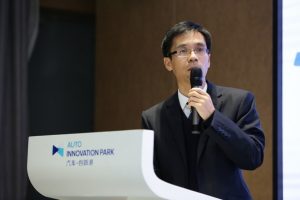
At the Asia Pacific Roundtable, Mr. He Guangjin from the Chinese TMRI (Traffic Management Research Institution) of MPS (Ministry of Public Security), presented the demonstration made at WIOT 2017 (World Internet of Things Expo) in Wuxi. This was the first demonstration from the Chinese public security industry where the LTE-V2X technology was employed. Additionally, it was so a premiere for the official traffic management system to be opened to vehicles on open roads. TMR also announced its plan to build a larger LTE-V2X pre-commercial trial including 20 to 50 intersections in 2018, to verify the broadcasting of real-time traffic conditions of intersections and the reception of information transmitted from vehicles. Additionally, TMRI is actively working on industry and national standards such as “Road Traffic Signal Controller I2V Information Distribution Interface Specifications”, “Adaptive Verification Management Regulation of Intelligent & Connected Vehicles (ICV) on Public Roads”, etc.
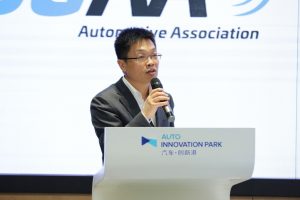
Dr. Cen Yanqing from the Chinese RIOH (Research Institution of Highway) of the MOT (Ministry of Transport) shared the important progress of the MOT. The ministry is paying close attention to automated driving and has already set up a dedicated working group to coordinate the corresponding ministries and guide the work on automated driving technology. In order to achieve automated driving, it is not sufficient to equip autonomous vehicles but it’s also needed to have an intelligent reformation of the road infrastructure and vehicle-to-road, vehicle-to-vehicle, vehicle-to-person communication and interaction in an effective way. To further promote the automated driving, the Ministry of Transport has built test zone for commercial vehicles verification in Tongzhou, Beijing, including specific scenarios e.g. ramps, intersections, and traffic lights.
When Dr. Cen was asked about whether MOT will mandate any technical specifications, he clarified there is no mandatory regulation so far. The MOT – as a department which uses technology – is opened to the utilisation of the V2X technology, but will select the best and most efficient technology eventually, he said. He also claimed that the MOT would support some of the Chinese telecommunication corporate contributions such as CMCC, Huawei, and Datang. Finally, he declared “we cannot implement two technologies but only one”.
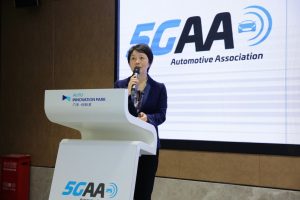
•Vice President of the China Academy of Information and Communications Technology, Ministry of Industry and Information Technology, China
•Chairman of the IMT-2020 (5G) Promotion Group
Ms. Wang Zhiqin, from CAICT (China Academy of Information and Communications Technology) of MIIT(Ministry of Industry and Information Technology), explained that the national CAV (Connected and Automated Vehicles) industry development committee advises to promote the LTE-V2X technology deployment and application, and its evolution to 5G and internet of vehicles integration development. He also announced the release of the Guide to the Construction of Standard Architecture for CAV Industry Development jointly developed by MIIT and NSC (National Standardization Administration), in which the LTE-V2X and 5G technologies are greatly highlighted in the information and communications volume. When asked about the spectrum of the Internet of Vehicles in China, Ms. Wang expressed that the government attaches great importance to it and needs prompt issuance and release of a positive guidance to the industry. She believes China should release this C-V2X spectrum relatively soon.
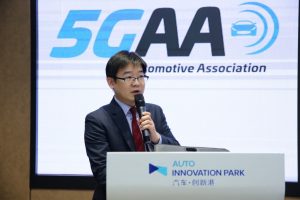
Deputy Director, ITS and Road Safety Division, Road Bureau, Ministry of Land, Infrastructure and Transport, South Korea
Mr. Chang-ki Kim, from the MOLIT (Ministry of Land, Infrastructure, and Transport) explained that his division in Korea is implementing two strategies to promote the commercialisation of Internet of Vehicles. The first strategy consists of focusing on the C-ITS safety aspect by developing and commercialising the RoDAS (Road Driving Assistant Systems) by 2020 in accordance with the National ITS Master Plan. As CAV (Connected and Automated Vehicles) will improve road safety issues under the mixed condition of AV (Automated Vehicles) and LV (Legacy Vehicles) in both highway and urban areas. MOLIT will launch, as its second strategy, the transportation renovation program by promoting and integrating the C-ITS and CAV technologies under their CAD (Connected and Automated Driving) Test-beds. Additionally, he emphasised that deploying those Test-beds in Korea would include the verification of various communication techniques, e.g., C-V2X (LTE, 5G), under the real and dynamic road environment. Mr. Kim expressed his intention to invite all ICT and CAD testing companies to conduct their service applications and to develop their cooperation and sharing models by joining those Test-beds.