
5GAA live demos show C-V2X as a market reality
Turin, 14 November 2019 – Smart mobility technology is a reality today, with ‘Cellular Vehicle-to-Everything’ (C-V2X) allowing connected vehicles to communicate with the cloud, directly with each other and their surroundings. Deployment plans are primarily sustained by the global trend in the automotive industry to adopt 4G LTE cellular technology, followed by the emerging 5G high-speed low latency communications. Beyond infotainment, C-V2X will capitalize on vehicular and smartphone connectivity to contribute to better safety, less congestion and reduced emissions.
During a live demo event in Turin, the 5G Automotive Association (5GAA) showcased ready to deploy use cases in the streets of the city and a sneak preview of what the future has in store on the renowned Lingotto rooftop test track.
Prominent members and partners of the 5GAA including Audi, Continental, Ericsson, Fiat Chrysler Automobiles, Harman Samsung, Marelli, Pirelli, Qualcomm, TIM and Vodafone demonstrated the current state of C-V2X and the road to future, Vehicle-to-Vehicle (V2V), Vehicle-to-Infrastructure (V2I), and Vehicle-to-Network (V2N) applications based on 4G LTE and 5G.
“Connected mobility is a market reality.” says 5GAA Chief Technology Officer, Dr. Maxime Flament. “The use cases demonstrated in the streets of Turin are planned for deployment with a huge industry momentum based on the evolution path to 5G capabilities.”
Using both direct short-range communications and mobile networks, the open-road demonstrations showcased the extensive capabilities of today’s C-V2X technology, ready for deployment. To name a few:
- Protecting vulnerable road users, for instance, by alerting drivers about a pedestrian at a crossing using LTE-connected infrastructure.
- Smoothing traffic by allowing public authorities and road operators to provide real-time warnings to drivers in urban environments concerning roadworks or speed limits, via the network.
- Preventing incidents at dangerous intersections or in the event of unexpected braking, thanks to C-V2X direct-short range communications between vehicles.
The track demonstrations at Lingotto underlined the enhanced safety benefits that can be expected thanks to the versatility of 5G and the wide range of services it enables. To name a few:
- Vehicles will geo-tag dangerous areas for the following cars or provide ‘see-through’ functions to avoid dangerous overtaking.
- Pedestrians will be detected directly via their smartphones and surrounding vehicles will be warned.
- In case of accidents, emergency services will be able to visualize the situation live using on-board cameras of surrounding vehicles, improving response times and providing emergency responders situational awareness prior to arriving at the crash scene.
Furthermore, Intel showcased an “In Vehicle Entertainment” demo at the Museum, in collaboration with Marelli, TerraNet and Equinix, showing how Multi-Access Edge Computing (MEC) can support immersive high-definition (HD) entertainment for all occupants of a moving vehicle, including video streaming, gaming, virtual reality (VR), office work, online education, advertisement.
A short summary on each of the 5GAA C-V2X use cases, demonstrated today in Turin
Demo 1 “Vulnerable Road Users”: open road demos on safety
In this trial – which is part of Torino Smart Roads Initiative patronized by the Municipality of Turin – TIM, Links Foundation and Luxoft showed how the communication between the various actors moving along the roads can help in detecting potentially dangerous situations. The goal of the demos was to demonstrate how the 5G mobile network facilitates the protection of Vulnerable Road Users: pedestrians (“Presence of a pedestrian on a crosswalk”) and cyclists (“Presence of a connected bike on the road”). In the case of a pedestrian approaching a crosswalk, a Roadside Unit connected to the mobile network, equipped with a camera able to detect the event, sent a warning message to the nearby connected vehicles (I2V communication). In the case of a connected bike and a connected vehicle that are approaching each other, the two vehicles received a warning message about their presence when a risk of collision is detected.
Demo 2 “Urban Georeferenced Alerting” in open roads
TIM, FCA, Links Foundation, City of Turin with 5T, and Politecnico di Torino showed how the Local Traffic Authority in Turin intends to notify drivers in real time of possible dangers and special situations on the road (traffic jam, road works warning, dynamic speed limit, etc.). A standard geo-referenced warning message was dispatched to a TIM AMQP broker” at the edge of the 5G mobile network and only the involved vehicles received the geo-localized message from the AMQP Broker using the TIM 5G Network. The warning was read and displayed in an FCA vehicle through the on-board HMI and can for instance notify the driver of upcoming speed reduction. The aim of the trial was to demonstrate how the TIM 5G Network is suitable for realizing smart roads services for connected cars. The solution is compliant with the standards so it can be applied in other locations covered with mobile networks.
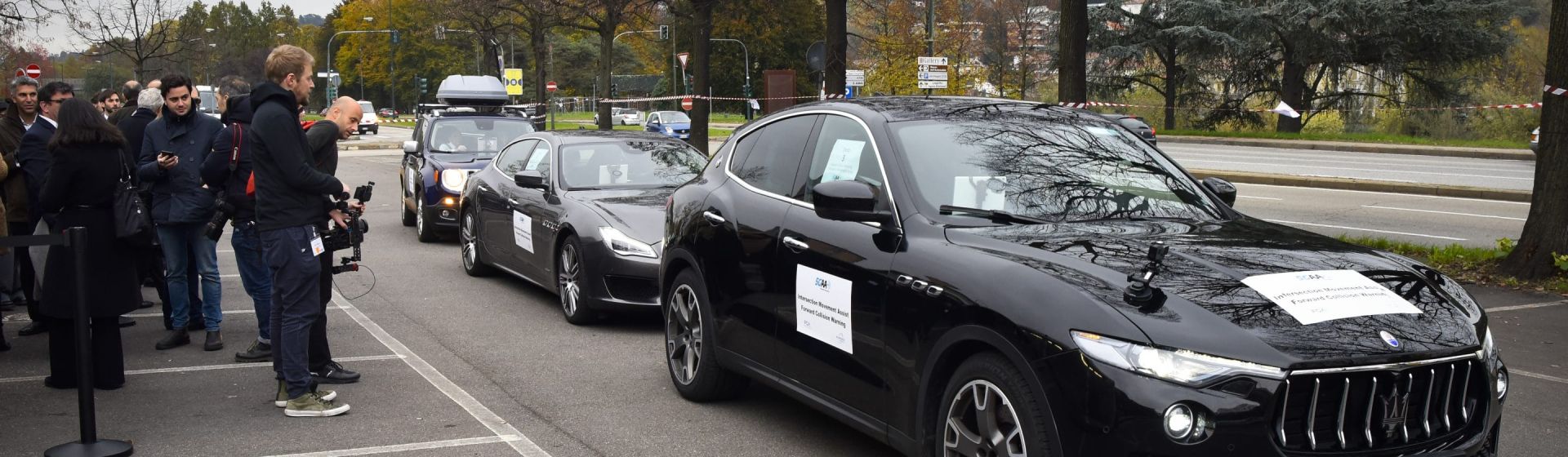
Demo 3 Intersection Movement Assist (IMA), Forward collision Warning (FCW)
FCA and Harman Samsung showcased two Vehicle to Vehicle (V2V) demos, by integrating C-V2X direct-short range communication into Maserati Levante and Quattroporte. The vehicles, through a direct radio link (network-less radio link), anonymously communicated basic information such as their position and related direction.
The Forward Collision Warning (FCW), detected possible frontal collision and warned the driver accordingly. The Intersection Movement Assist (IMA), assisted the driver at the cross junctions to avoid a possible lateral collision with an oncoming vehicle.
Demo 4 Emergency Electronic Brake Light (EEBL), Stationary Vehicle Warning (SVW)
FCA, Continental, and Qualcomm demonstrated fast and reliable information exchange between vehicles in emergency situations. The two demos are based on C-V2X direct-short range technology, enabling Vehicle-to-Vehicle (V2V) communication between two Jeep Renegade. There were two portions to this demo:
- “Stationary Vehicle Warning” (SVW): when the hazard lights are activated, the application broadcasted a message to all nearby vehicles so that approaching vehicles could be informed even if the hazard was not visible.
- “Emergency Electronic Brake Light warning” (EEBL): in the event of a sudden braking, the application broadcasted a message to following vehicles, such that approaching vehicles were notified of the potentially dangerous situation.
Demo 5 See-through
Vodafone, FCA, Vodafone Automotive, Marelli and Altran revealed the ‘See Through’ that uses C-V2X long-range cellular network communication to exchange streamed video in real time between vehicles, extending the driver’s visual range under obstructed visibility scenarios and to prevent accidents, especially those that may occur in an overtaking phase. The two involved Jeep Renegades vehicles were equipped with a connectivity solution (Marelli) and high frame-rate cameras (Marelli Motorsport) to detect the road lanes.
A real time tracking system and a space mapping algorithm of the vehicles, specifically developed by Vodafone Automotive, allowed Vodafone’s Multi-access Edge Computing (MEC) to dynamically manage and route the video flows on the basis of the vehicles’ relative positions and to ensure minimal end-to-end latency in the interest of drivers’ safety. Vodafone 5G ultra-low latency and high reliability were paramount to ensure the flow and synchrony of the real-time video exchange between vehicles, also under high traffic and cell saturation conditions.
Demo 6 World-first 5G-enhanced ADAS services
Audi, Ericsson, Italdesign, KTH, Pirelli, Qualcomm, TIM and Tobii showed how smart cars, commercial 5G smartphones and 5G networks jointly improve comfort, safety and efficiency. This unique collaboration combined the power of eye-tracking glasses, intelligent tires, in-vehicle augmented reality and 5G phones to work together over a live 5G network. With its high capacity and low latency, cellular 5G connectivity is ready to enable instantaneous cooperation between vehicles, the IoT ecosystem and more advanced driver assistance services. The live demonstrations at the Turin Lingotto test track were based on TIM’s commercial 5G network delivered in Turin in partnership with Ericsson. Audi cars, equipped with Pirelli Cyber Tyre, and embedded 5G modems provided by Qualcomm and available 5G smartphones were utilized to enhance pedestrian’s safety.
About 5GAA
The 5G Automotive Association (5GAA) is a global, cross-industry organisation of over 130 members comprised of leading global automakers, Tier-1 suppliers, mobile operators, semiconductor companies and test equipment vendors. It works together to develop end-to-end solutions for future mobility and transport services. 5GAA is committed to helping define and develop the next generation of connected mobility, automated vehicle and intelligent transport solutions based on C-V2X.
Learn more on the 5GAA website and follow us on Twitter and LinkedIn.
Media Contacts
5GAA Marketing & Communications
Email: marcom@5gaa.org
Official pictures: Conference – Demonstrations

5GAA feedback on the call for inputs on the impact of 5G on regulation from the BEREC
The 5G Automotive Association (5GAA) is a global, cross-industry organisation of more than 120 companies from the automotive, technology, and telecommunications industries (ICT), working together to develop end-to-end connectivity solutions for future mobility and transportation services.
5GAA welcomes the opportunity to give feedback on the call for inputs on the impact of 5G on regulation from the Body of European regulators for Electronic Communications (BEREC).
Following the assessment by the BEREC on the list of regulatory aspects impacted by the development of the 5G technology, 5GAA would take this opportunity to add potential missing regulatory aspects as well as to highlight 5GAA’s view on BEREC’s priorities for the coming three years.
-
- 5GAA considers the availability of spectrum for digital communications to be critical for road safety using 5.9 GHz ITS spectrum. It is therefore essential that any regulatory framework provides certainty to the industry to invest in today’s technology for Day 1 services as well as a robust roadmap for advanced safety (5GAA is currently working on a related Work Item on New Radio V2X).
- Beside the direct communication means in the 5.9 GHz band enabling V2V and V2I communication, 5GAA stresses the need for the development of mobile network coverage alongside the road network, and calls for the adoption of regulation which stimulates investments in mobile network coverage (5GAA is currently working on a related Work Item on Strategic Deployment Agenda), to enable the full range of capabilities provided by cellular V2X.
- 5GAA highlights the need for continuous coverage and seamless handover of 5G connectivity for vehicles crossing country borders in Europe. Further work is needed, notably in collaboration with standardisation bodies, to establish the right conditions to stimulate continuous coverage and seamless handover across borders. (5GAA is currently working on a Work Item on Network Selection for this very purpose). However, it should be noted that despite the importance of cross-border handover with 5G networks, given use of ITS spectrum, it is not a concern for the 5G sidelink case.
- 5GAA stresses the required investments into connected intelligent traffic infrastructures to assure safe and efficient mobility. Significant investments can be ensured by stimulating synergies of mobile network infrastructure and intelligent road infrastructure along with cohesive funding mechanisms (e.g. CEF Transport/Digital) (5GAA is currently working on a Work Item on Road Side Unit).
On this point, 5GAA would like to add that CEF transport needs to remain technological neutral while CEF Digital should be focused on Mobile Networks. - As road safety and automated driving are prominent example of Quality of Service needs, 5GAA calls for regulation which focuses on social benefits, outcomes and market adoption to position Europe as a global leader in the field. (e.g. enables prioritization of different service classes) (5GAA is currently working on a Work Item on this matter, Business Aspects of Network Slicing (BARNS)).
- 5GAA would like to draw attention to CCAM’s needs in terms of direct communications for critical road safety use cases as well as complementary network based communication and calls for the adoption of regulation which considers various ways of connectivity and keep regulation technology neutral.
- As CCAM goes beyond automotive sector, 5GAA would like to point that there is an opportunity to address the digital transformation of the transportation sectors by stimulating synergies with other transportation sectors (as pedestrians, bikes, motorcycles, esp. in urban environments, as well as rail and tolling).
The next years are crucial to set Europe at the forefront of the development of 5G and of Connected and Automated Mobility, to guarantee the safe and sustainable mobility of citizens while maintaining a global competitive edge in 5G development. Effective synergy between the development of the 5G ecosystem and European regulation is a precondition to ensuring that the benefits of 5G are indeed fulfilled.

5GAA to organise a first-ever C-V2X Plugtests™ event with ETSI, 02-06 December, Malaga (Spain)
The 5G Automotive Association (5GAA) is proud to be a partner of the European Telecommunications Standard Institute (ETSI) in the first C-V2X-only Plugtests™ event, to take place in Malaga, Spain, from 02 to 06 December 2019. This interoperability test is being held with the support of the European Commission and hosted by DEKRA, member of 5GAA, in its Connected Vehicle Test Development Centre, where trials will be carried out both in lab and field environments.
Plugtests™ represent an important tool to allow vendors to evaluate the interoperability of their systems and provide precious feedback to independent experts in order to improve the standard-making process. Moreover, this event is a further milestone in the cooperation between 5GAA and DEKRA, a leader in automotive safety testing, that already had the chance to collaborate during a previous plugfest in April 2019.
On 04 December, an ETSI-5GAA Plugtests™ conference is scheduled, focused on nowadays achievements and challenges in the connected automotive sector, to offer the audience a complete update on the opportunities and implementation models of C-V2X technology.
Registrations are open until 15 November. For any further information, please consult the official event page.

5GAA Meets Toronto 2019: Face-to-Face Meeting and Workshop
Toronto is hosting the next quarterly 5G Automotive Association (5GAA) Face-to-Face meeting. The event spans over five days focused on cellular-to-everything (C-V2X) technology.
The first three days will be dedicated to meetings on Working and Cross-Working Group Items. Days four and five will kick off with board and executive level discussions and a workshop on connected and automated driving in North America. These exciting events will be coupled with live demonstrations, hosted by 5GAA Canada-based members.
The 5GAA Workshop
5GAA will be hosting a workshop around ‘C-V2X: The Future of Connected and Automated Driving in North America’. With over 200 attendees expected, the event targets North American transport stakeholders, including policymakers, road traffic authorities, road operators and an array of interest groups and industry representatives. The primary objective is to raise awareness of C-V2X and the opportunity it provides to drive its adoption in North America.
The workshop will be divided in two parts, the first part will focus on an update to C-V2X development, including an overview of the European Road Map, as well as examples of recent innovation in Europe and North America. The second part will embark on a broader path, concentrating on future connected mobility. Key figures from Intelligent Transportation Systems (ITS) in North America will be presenting and take part in the day’s discussions. See workshop programme here.
Due to limited capacity, the workshop is by invitation only. Please contact liaison@5gaa.org for more information.
Live Demonstrations
5GAA members, Bell Canada and Huawei Canada, will organise two separate demonstrations of C-V2X 5G technology, 6-8 August 2019.
One demonstration, HD Mapping and Vulnerable Road User (VRU) Vehicle to Network, will take approximately 30 minutes and feature an in-vehicle live HD Map/VRU system.
The other demonstration will centre on Tele-operated Driving (ToD) Vehicle to Network technology. It will last approximately three hours at the Bell campus in Mississauga, Canada. There will be lunch served and a shuttle service to and from the Metro Toronto Convention Centre. Delegates can register here.

5GAA Supports the 3GPP 2nd 5G Vertical User Workshop
Following the first session held in Brussels on 12-13 February 2019, 5GAA returned to the second 5G Vertical User Workshop, which was in Rome on 9-10 July 2019. This initiative, launched by 3GPP Market Representative Partners (5GAA, 5G-IA, 5G-ACIA and PSCE) was organised as a collaborative event for strategic dialogue between vertical industries (technology, automotive and transport, health and public safety ) and 3GPP by exchanging on future needs and upcoming cellular standard developments.
5G networks are intended to bring a new innovative ecosystem, where actors from the vertical industries will be involved alongside the telecom operators, manufacturers, SMEs and research institutes. There is an increasing need to involve this wider range of industries to optimally capture end-user requirements and contribute to the 3GPP standardisation process. The working groups of 3GPP operate on a bottom-up basis focusing on partners contributions. As such, 3GPP notably benefits from further developing the role and usefulness of 5G vertical industries as Market Representation Partners.
The agenda for the 2nd 5G Vertical Users Workshop can be found here. The Workshop focused on 5G vertical technical viewpoints, common requirements and common interests with lively interactive discussions. 5GAA members Huawei, Nokia and Orange supported the workshop. The 5GAA CTO, Maxime Flament, had seized the opportunity to address:
- The 5GAA vision for 3GPP rel-17 as part of C-V2X and intelligent transport systems (available here)
- Predictive QoS, an innovative mechanism to provide in-advance QoS notifications from the network to the V2X application (available here)
5GAA enthusiastically supports the initiative and to enhance collaboration with partners such as 5G-IA, 5G-ACIA and PSCE.
5GAA brings together key actors to share advances on C-V2X deployment in China at MWC Shanghai 2019
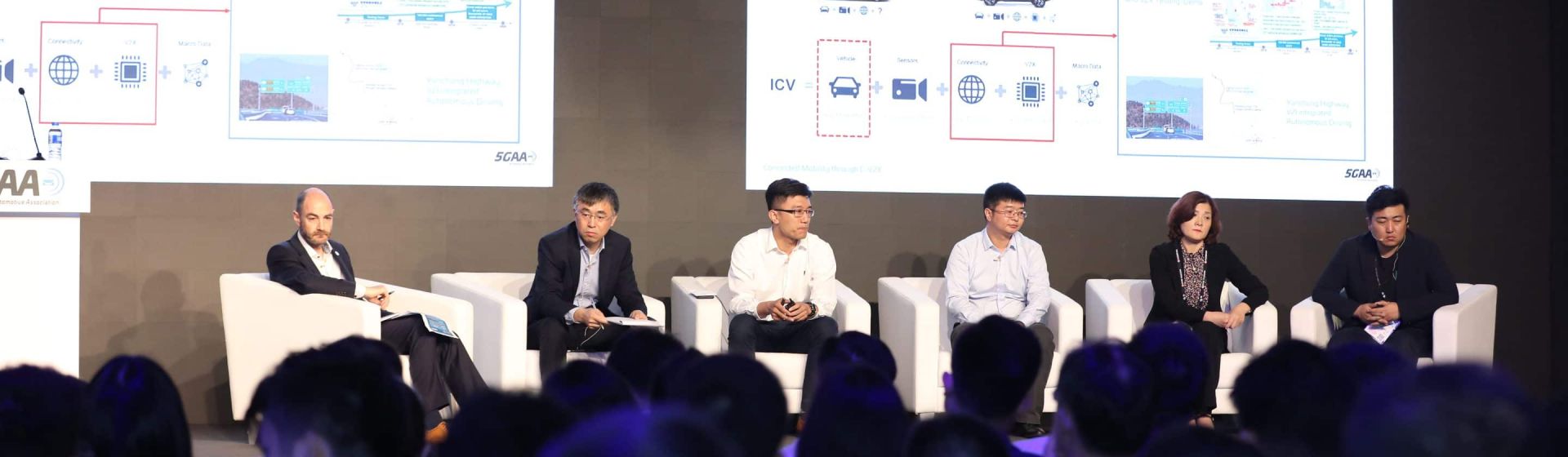
SHANGHAI, CHINA, 27 June 2019 – The 5G Automotive Association, with the engagement of relevant ecosystem actors in China, from Government officials to telecom and automaker companies and the larger 5GAA community, took stage today at the MWC Shanghai 2019 to explain the state of deployment of the ‘Cellular Vehicle-to-Everything’ (C-V2X) technology in this region.
“5GAA is instrumental in supporting the implementation of C-V2X technology in different parts of the world including China. The momentum in China reflects the fact that C-V2X is the verified, mature and preferred future proof technology for connected vehicles”, said Luke Ibbetson, 5GAA board member and Vodafone Group’s Head of Research and Development.
C-V2X as part of Chinese C-ITS standards
Representatives from different Chinese public institutions underlined during the conference that after issuing the three-year Industry Development Plans on Intelligent Connected Cars (ICV) and releasing C-V2X 5.9GHz ITS spectrum last year, ministries now accelerate standards system of ICV in order to solve the issue of interoperability in various scenarios. Meanwhile, the definition of smart highway standard has started in terms of infrastructure digitalization, Road-Transport unity, “Internet Plus” comprehensive services and new generation transport control network which will be enabled by C-V2X infrastructure and devices for both long range and short-range communication.
C-V2X Eco-system
There was strong engagement from industry stakeholders in China as well. It has been shared that 15 chipset/modules vendors are committed to support C-V2X for the Chinese market, 35 manufacturers are able to provide C-V2X infrastructure hardware or software, and in particular 15 car OEMs have recently announced the roll-out of C-V2X from 2020 H2 to 2021 H1. In order to improve C-V2X industry maturity, IMT2020’s C-V2X Working Group last year organized a “Three-Cross” interoperability tests for three Chipset vendors and 12 OEMs. Furthermore, an interoperability test called “Four-Cross” will be hosted to address more stakeholders and security by testing and verifying certification and authority system.
C-V2X Trial and Pre-commercial pilot
Many voices from the business side also explained the details for C-V2X deployment on the roads and vehicles in China, to be followed in other regions. There are more than 20 trials and pilot projects taking place where 100KM roads across 10 provinces will be digitalized with C-V2X.
Wuxi has been designated as national ICV pilot certificated by MIIT. C-V2X deployment in Wuxi will be extended from 240 intersections to 400 this year, focusing mainly on use cases of autonomous driving assistance and green waves for buses. It is estimated that 1-2 bus lanes will be completed with green wave deployment by end of this year, so as to improve punctuality, reduce emergent stop and waiting time of red light for buses.
Yanchong Highway will be deployed with C-V2X to embrace the 2022 Winter Olympic Games.
Other regions in China start deploying C-V2X by 2020, for instance, 40KM in Beijing Shunyi district and the international exhibition centre, 42KM in Shanghai Yangshan port, 4.5KM in Xiongan New Area, and the 30KM highway around Hainan province.
On top of showing the strong consolidation of C-V2X in China, the 5GAA event successfully underlined the progress of C-V2X application and services in terms of readiness of the ecosystem and commercialisation. However, China is not alone: 5GAA underlined its dedication to standardization, the eco-system and commercialisation of C-V2X in America, Europe, Japan and South Korea. Once again, 5GAA’s presence at MWC Shanghai successfully outlined the association’s vision in being a global player, and facilitating thought leadership platforms for relevant stakeholders driving towards building a better mobility ecosystem.
About 5GAA
The 5G Automotive Association (5GAA) is a global, cross-industry organisation of 115 members comprised of leading global automakers, Tier-1 suppliers, mobile operators, semiconductor companies, test equipment vendors, etc. working together to develop end-to-end solutions for future mobility and transportation services.
5GAA is committed to helping define and develop the next generation of connected mobility for autonomous based on Cellular-V2X (C-V2X), the family of cellular technology-based communications.
Contact
Marketing and Communications Team
Email: marcom@5gaa.org
Web: www.5gaa.org
C-V2X contributes to safer roads for everyone: 5GAA live demo event in Berlin
Photos of the workshop can be found here. Click here to see the photos of the live demonstration.
Berlin, 23 May 2019 – Smart mobility technology, which we have been developing over the years, is now a reality. ‘Cellular Vehicle-to-Everything’ (C-V2X) allows vehicles to both communicate with the cloud and also directly with each other and their surroundings. Thanks to 4G LTE cellular technology, as well as the emerging 5G generation of high speed and low latency communications, traffic will be optimized, and emissions will be reduced. Emergency services will navigate smoothly and road safety for everyone, including vulnerable road users, will dramatically enhance.
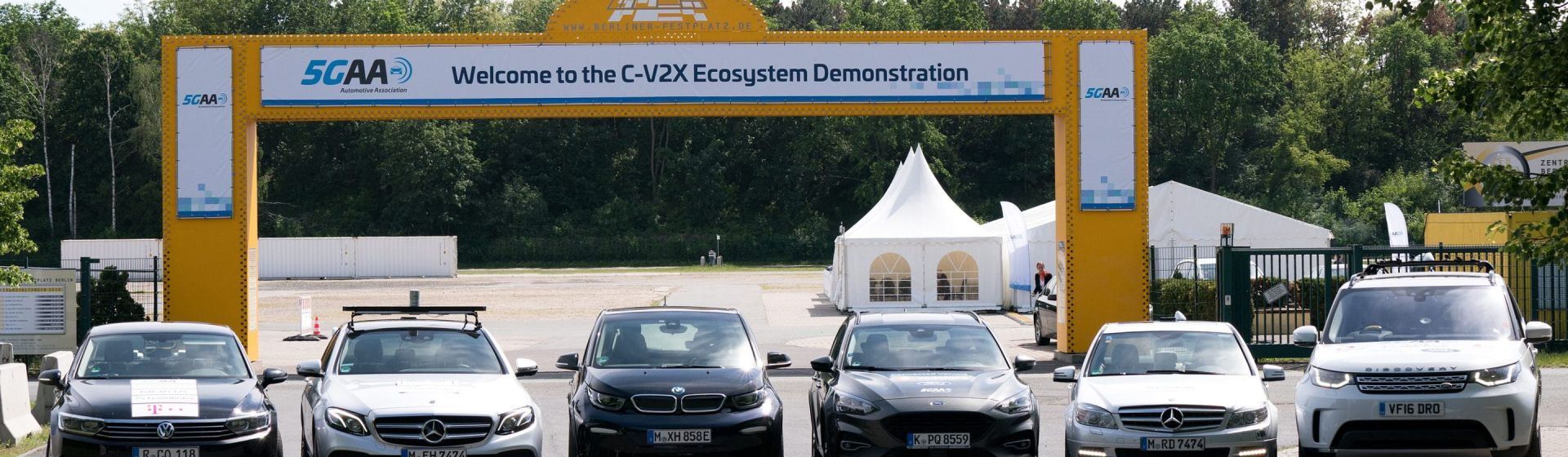
At a live demo event in Berlin, the 5G Automotive Association (5GAA) presented a deep-dive into a smarter and safer mobility, giving a sneak peek of the technologies ready to be deployed. Prominent 5GAA members including BMW Group, Daimler, Deutsche Telekom, Fraunhofer Institutes FOKUS and ESK, Ford, Huawei, Jaguar Land Rover, Nokia, Qualcomm and Vodafone, demonstrated C-V2X Vehicle-to-Vehicle (V2V), Vehicle-to-Infrastructure (V2I) and Vehicle-to-Network (V2N) applications.
“Connected mobility standards are no longer a vision for the future,” says Maxime Flament, Chief Technology Officer at 5GAA. “The solutions on show are ready to be deployed today and have huge industry momentum based on the forthcoming 5G capabilities. C-V2X technology is a key foundation for a safe and sound driving environment for pedestrians, bicyclists, motorcyclists, cars and commercial heavy trucks. Global field testing is already in its very final stages and the first solutions are now commercially available from multiple suppliers.”
Using both direct short-range communications and mobile networks offers complementary capabilities as showcased in the demos, which involve tele-operated driving and the provision of emergency traffic information between vehicles using multi-access edge computing (MEC) functionality. All the demos use technology that is ready to be deployed.
A short summary on the 5GAA C-V2X use cases, showcased today at Berlin:
1. A. Traffic Management Solutions: Signal Phase and Timing (SPaT) and Red-Light Violation Warning (RLVW) to Vehicle
Waiting at the red light is not only time consuming, but idling, braking and accelerating release more pollutants. The communication between the traffic signal and vehicle is important to improve traffic flow, thus increasing road safety by preventing accidents. During the demo drive, a BMW Group vehicle equipped with a Qualcomm onboard unit running the Savari ITS software stack and the V2X use cases, communicates with a SWARCO traffic signal, showing C-V2X readiness across multiple vendors.
The use case enables the driver to monitor the upcoming traffic light. The center display of the vehicle shows the current signal phase and how long it will remain. In the Red Light Violation Warning (RLVW) use case, the application in the vehicle uses its speed and acceleration profile, along with the signal timing and geometry information from the traffic signal. If the driver is likely to run a red light he/she receives a warning in the vehicle.
B. Traffic Management Solutions: Emergency Electronic Brake light (EEBL)/ Roadworks warning (RWW)
C-V2X provides the driver with information so that he or she can adapt to the upcoming traffic situation in advance. Fraunhofer FOKUS, supported by Daimler, demonstrate an Emergency Electronic Brake Light Warning: Two vehicles equipped with Huawei onboard units are accelerating, and the car ahead brakes hard. The second car instantly receives a warning, demonstrating the advantage of the low-latency C-V2X communication. Furthermore, a Huawei roadside unit communicates ongoing roadwork via C-V2X to the vehicle. Visitors experience both use cases in the car viewing the warnings on the central display.
2. Real Time Emergency Alerts: Vehicle-to-Network and Network-to-Vehicle services
Vodafone Germany and Ford show connected vehicle technology (V2X) that could alert drivers to an accident ahead, moments after it has happened (via eCall Plus). Furthermore, the system provides early warning that emergency vehicles are approaching – and which side of the road other vehicles should move towards to avoid being an obstruction. Experts believe that survival rates for road accident victims can be improved by as much as 40% if they receive treatment just four minutes more quickly.
3. Live data capture and transmission: Expanded network/Vehicle-to-Network capacities via MEC
An ultra-fast, reliable and precise dissemination of safety-relevant information can save lives. Continental, Deutsche Telekom, Fraunhofer ESK and Nokia demonstrate how information is delivered to vehicles almost real-time via a mobile network, utilizing Multi-Access Edge Computing (MEC) technology. All data is processed at the edge of the mobile network to reduce transmission time (latency). As a result, event-related data such as emergency warnings as well as high-definition map data are transmitted in milliseconds, improving driving safety on the path to fully automated driving.
4. Combined Network and Direct solution enables the pinnacle of C-V2X technology
Vodafone Group, Huawei and Jaguar Land Rover demonstrate safety critical use cases by combining different communication modes (short direct via PC5 and longer-range network-based via Uu). The provision of a two-stage warning enables vehicles to be made aware of other vehicles approaching the same junction much earlier and allowing action to taken sooner to avoid a crash. Also, the number of road accidents because of unsafe lane changes and blind spots are significant. Using C-V2X technology helps automotive OEMs keeping the cost of implementing such warnings down by not having to install additional ‘one-off’ radio access systems for such warnings. The demos showcased the value and readiness of C-V2X and its ability to seamlessly combine both long range and short-range direct and longer-range network communication links. Specifically, it was shown that at a T-junction – a key site for accidents – connected cars benefit from longer range cellular network communication to deliver safety-related information beyond what alone can be delivered from short-range technology.
5. Remote-operated driving
Remote-Operated Driving (ROD) smooths the path to automated vehicles, anticipating situations in which remote human operator can intervene with the driving of the vehicle. ROD is enabled by low latency communication equipment e.g. by Huawei to deliver instructions or inputs to the vehicle to help it navigate challenging scenarios. Fraunhofer Institute FOKUS, supported by Daimler, showcase the reliability ROD enables already today.
_______________
Contact
Marketing and Communications Team
Email: marcom@5gaa.org

5GAA presents 5.9 GHz Band Plan to the FCC that will enable evolution of C-V2X from LTE to 5G
The 5G Automotive Association (5GAA) has recently filed a letter to the Federal Communications Commission (FCC) presenting the content of its band plan for the 5.9 GHz band.
The filing, which was submitted last 3rd April, positions C-V2X as the best opportunity to further the vision of ITS in the 5.9 GHz band, outlining that the FCC should pursue a forward-looking approach for licensed ITS operations in the 5.9 GHz band towards facilitating the evolution path towards 5G.
Moreover, the filing also follows-up on 5GAA’s waiver request, filed with the objective of enabling initial deployments of this potentially life-saving technology as soon as possible.
Just on February major stakeholders from the automobile, wireless, and technology industries filed comments to the FCC in support of the 5G Automotive Association’s waiver request seeking permission to deploy Cellular Vehicle-to-Everything (C-V2X) technology in a portion of the 5.9 GHz band.

5GAA and GCF announce collaboration on the certification and testing of C-V2X technologies
GCF certification programme addresses market needs for LTE-based V2V and V2X communications technologies.
The 5G Automotive Association (5GAA) and Global Certification Forum (GCF) have agreed a collaborative framework under which they will combine their resources and expertise to accelerate the global introduction of Cellular Vehicle-to-Everything (C-V2X) products. The new partnership aims to address the current gap in certification capabilities and processes, thereby harmonizing C-V2X at a global level and reducing the time-to-market of C-V2X products.
C-V2X is set to become a disruptive forward-looking force in the automotive market, providing the platform which will enable vehicles to communicate with each other and with everything around them. Originally defined as LTE V2X in 3GPP Release 14, C-V2X provides one solution for integrated V2V, V2I and V2P and V2N operation. The shorter-range V2V, V2I and V2P modes support direct communication without necessarily relying on network involvement for scheduling, whilst the longer range V2N mode will deliver network assistance and commercial services requiring the involvement of a Mobile Network Operator (MNO). The data throughputs and latencies provided by 5G are critical to the performance of autonomous vehicle applications and hence C-V2X is designed to be fully compatible with 5G technologies.
With the C-V2X specifications due to be finalised in 3GPP Release 16, car manufacturers and their suppliers in the key markets of the USA, Asia and Europe have been working on products which will come to market in 2019.
“We are extremely pleased to partner with GCF as a further step towards safe and successful C-V2X deployment,” said Maxime Flament, CTO at 5GAA. “This aligns perfectly with our mission to accelerate the global deployment of intelligent transport and communications solutions and make transportation of the future safer and more reliable.”
“As always, with the introduction of new and disruptive technology, standards and certification are critical to ensuring successful deployment,” said Lars Nielsen, General Manager at GCF. “Our partnership with 5GAA means that together we are achieving the evolution into 5G with a proven success factor for self-driving and connected vehicles.”
The 5G Automotive Association (5GAA) is a global, cross-industry organisation bridging the gap between automotive, technology and telecom industries, promoting the C-V2X technology (Cellular vehicle-to-everything) as a comprehensive platform for connected vehicles, safety and transportation. With 110 members, the organisation is committed to helping define and develop the next generation of connected mobility and automated vehicle solutions.
The GCF certification scheme has been running since 1999 and has constantly evolved in alignment with developments in mobile technologies and the changing needs of the industry. GCF’s certification portfolio already covers LTE sidelink, a key technology for automotive applications, supporting vehicle-to-vehicle (V2V) and vehicle-to-everything (V2X) use cases, and GCF is therefore the natural partner for 5GAA on C-V2X certification.
The framework agreed by the two organisations will enable 5GAA and GCF to work together to ensure the certification needs of the C-V2X industry are identified and prioritised and that test cases and associated capabilities are developed in-line with the needs of this rapidly emerging market.
For more information on GCF see: https://www.globalcertificationforum.org
Automotive C-V2X ready to roll out globally, says 5GAA at this year’s MWC Barcelona
All presentations of the 5GAA session at MWC19 Barcelona are available down this page.
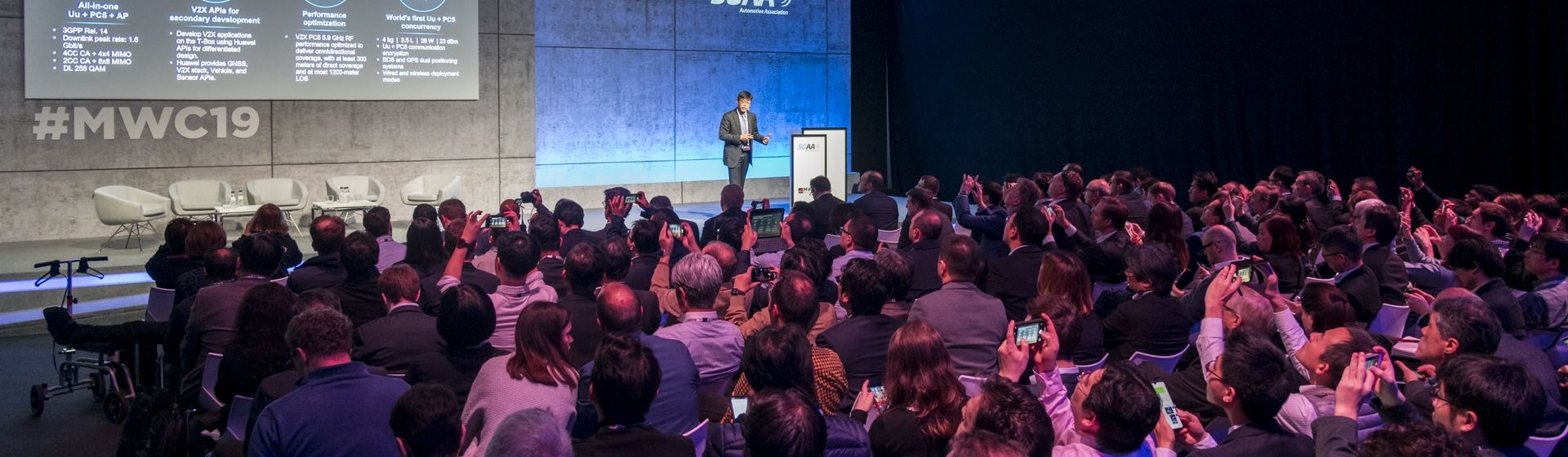
February 27th, Barcelona – During today’s well attended keynote, ‘Connecting the Mobility World with 5G’, the 5G Automotive Association (5GAA) gathered experts from the automotive, technology and telecom industries to explain how the deployment of ‘Cellular Vehicle-to-Everything’ (C-V2X) communication technology on the path to 5G is shaping the mobility of the future. Today LTE-V2X, the initial version of C-V2X, stands on the verge of its commercial launch: allowing vehicles to communicate with each other and their surroundings and, together with 5G enhancements, facilitating broad scale improvements in road safety.
“By bringing together key actors of the mobility ecosystem – across the automotive, information and communications technology industries – 5GAA continuously strives to develop forward-looking solutions for intelligent transportation services. Both for today and tomorrow.” stressed Thierry Klein, 5GAA Vice Chair and Head of the Disruptive Innovation Program at Nokia Bell Labs. “These end-to-end integrated solutions bring enhanced safety, sustainability, and convenience to all road users. 5GAA is very excited to be pioneering the revolution towards a smarter and more connected mobility world,” Thierry Klein added.
C-V2X communication is the state-of-the-art, high-speed cellular communications platform that enables vehicles to communicate with one another, with roadside infrastructure, with other road users (such as pedestrians, cyclists, and motorcyclists) using either direct short-range communications or cellular networks. While C-V2X network-based solutions are already widely deployed, direct communication solutions will be commercially available as of this year. As such the C-V2X platform delivers safety, mobility, traffic efficiency, and environmental benefits. C-V2X is designed with an evolutionary path to 5G and supports safe and efficient operations of autonomous vehicles.
5GAA members spearheading C-V2X
A number of 5GAA members are announcing ground breaking use cases at this year’ MWC. 5GAA members Telefónica, Ericsson, Ficosa and Seat show 5G connected car use cases supported by C-V2X direct communication for safer driving in a city (e.g. detection of cyclists when turning right or of a pedestrian at a zebra crossing). Another key technology bringing these use cases to life is edge computing.
In addition, 5GAA members Continental and Vodafone are working together to increase road safety and protect all road users for instance via “digital safety-shield” for cyclists and pedestrians, using C-V2X direct communication and edge computing in the first 5G deployments. The 5G-ready tests are taking place under real-life conditions at Vodafone’s 5G Mobility Lab in Aldenhoven, Germany.
Rohde & Schwarz has announced a collaboration with automotive electronics specialist Vector on a C-V2X end-to-end application layer test solution to verify safety-critical V2X scenarios. The companies’ integrated test platform is showcased for the first time at Mobile World Congress.
Deutsche Telekom has announced first C-V2X tests together with Skoda Auto in Czech as part of the European C-Roads project.
Geely also announced its plans to launch the first mass-produced C-V2X enabled vehicles in China together with Qualcomm in 2021.
Qualcomm has also announced its first 5G automotive platform, enabling both C-V2X short and long-range modes, which is expected to sample later this year and are planned for production vehicles in 2021.
C-V2X direct communication goes commercial in 2019
Mass production of C-V2X chips including direct communication from several suppliers is ongoing, and multiple radio vendors have already integrated these chips into their automotive radio offerings. 2019 is the year when C-V2X direct communication technology will be commercially available across the globe. Furthermore, full interoperability testing on C-V2X applications is ongoing among 5GAA members. The first mass-deployment in vehicles on the roads is anticipated to start in China in 2020; to be followed swiftly in other regions when local regulations allow for it.
“C-V2X is now ready to roll. At Ford, we will begin to deploy this technology in all new models launching in the US starting in 2022” confirmed Don Butler, Executive Director of Connected Vehicle & Services at Ford Motor Co.
The next milestone: 5G New Radio
C-V2X provides a clear evolution path to the family of 5G technologies for both direct and network communication. Part of this evolution is the 5G New Radio (NR).
NR-V2X will eventually ensure safe operation of autonomous driving vehicles by using 5G New Radio with Ultra Reliable Low Latency Communications (URLLC) network based communication combined with improved direct short range communications.
“The development of the NR-V2X standard is due for completion by the end of 2019; eventually hitting the road in 2023. This will enable a new generation of use cases for connected automated vehicles”, said Maxime Flament, CTO at 5GAA.
About 5GAA
The 5G Automotive Association (5GAA) is a global, cross-industry organisation with 110 members working together to develop end-to-end solutions for future mobility and transportation services. The organisation is committed to helping define and develop the next generation of connected mobility for advanced driving and automated vehicle solutions.
Presentations
- Opening speech by Thierry Klein, 5GAA Vice Chair & Nokia Bell Labs / Connecting the Mobility World with 5G-V2X
- Keynote by Friedhelm Ramme, Ericsson / 5G: From Concepts to Reality
- Keynote by Thorsten Hehn, Audi / 5G for Automotive: Key Applications
- Keynote by Jiang Wangsheng, Huawei / C-V2X Enables Intelligent Transportation
- Keynote by Nakul Duggal, Qualcomm / C-V2X Ignites Automotive Connected Revolution
- Speech by Vishnu Sudaram, Harman (Samsung) / Go-To-Market Timeline