

NGMN Publish white paper on V2X
The Next Generation Mobile Networks (NGMN) recently published a White Paper demonstrating their views on Vehicle-To-Everything (V2X) technologies as a key component to reduce the number of road accidents and enhance safety on our roads.
In the study, eight V2X use cases were chosen to reflect the three ITS application types: 1) road safety, 2) traffic management & efficiency and 3) infotainment. They encompassed various C-V2X communication methods such as Vehicle-To-Vehicle (V2V), Vehicle-To-Infrastructure (V2I), Vehicle-To-Pedestrian (V2P), Infrastructure-To-Vehicle (I2V), Vehicle-To-Network-To-Vehicle (V2N2V), and Network-To-Vehicle (N2V).
Here are some of the key findings and conclusions of the NGMN as highlighted in the paper:
- To date, NGMN members have provided cellular connectivity to more than 30 million vehicles worldwide which are used for a variety of safety-related use cases (e.g. distribution safety-related jam warning, black ice warnings, etc.). It is expected that in the near future every vehicle will be equipped with cellular connectivity. This is a good and market-driven basis for further deployment of further C-V2X technology and services.
- With the finalization of 3GPP Rel. 14 specifications at the beginning of 2017, NGMN members now have a 3GPP standardized solution, which supports both long-range as well short-range communication, and which fulfills all the requirements of a C-ITS eco-system.
- After already ongoing tests, the technology will be deployed by 2020.
- NGMN believes that C-V2X is not only able to enhance safety features for vehicles, but also supports use cases for other traffic participants, like pedestrians and cyclists.
- NGMN has investigated and concluded that C-V2X technology is superior to IEEE 802.11p standards, technically, economically, and eco-system wise, and can well satisfy the basic safety applications…
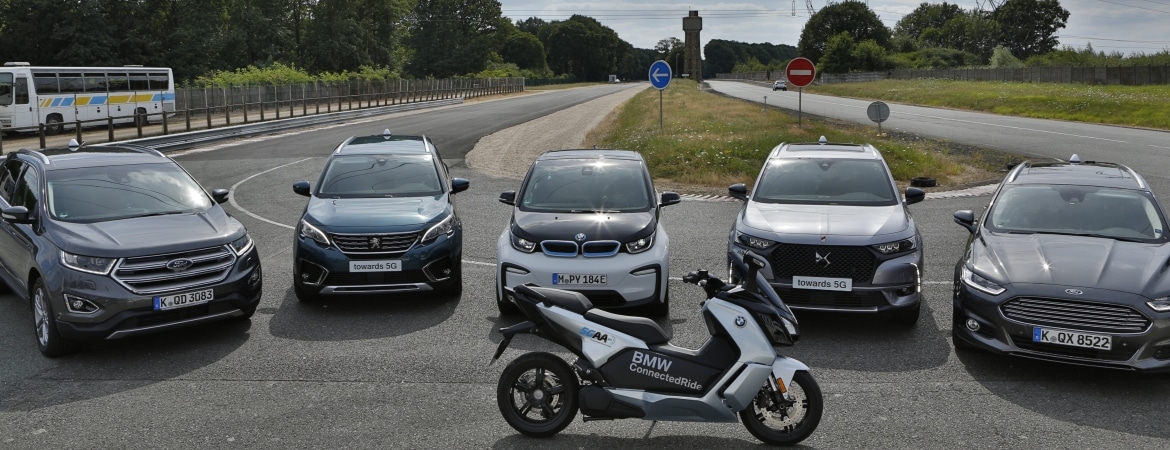
5GAA, BMW Group, Ford and Groupe PSA Exhibit First European Demonstration of C-V2X Direct Communication Interoperability Between Multiple Automakers
- Companies team up with Qualcomm and Savari to showcase C-V2X’s advanced performance for safety, traffic efficiency, and autonomy
- Exhibition includes communication between vehicles, motorcycles, and infrastructure, showing commercial readiness for industry deployments as early as 2020
Downloadable Resources |
Photos |
Infographic |
Soundbite Video Clip |
PARIS — July 11, 2018 – The 5G Automotive Association (5GAA), the BMW Group, Ford Motor Company (NYSE: F), and Groupe PSA — in association with Qualcomm Technologies, Inc., a subsidiary of Qualcomm Incorporated, and Savari, Inc. — announced today Europe’s first live demonstration of C-V2X direct communication technology operating across vehicles from multiple auto manufacturers. The live demonstration also featured a live showcase of C-V2X direct communication technology operating between passenger cars, motorcycles, and roadside infrastructure. C-V2X is a global solution for vehicle-to-everything (V2X) communication in support of improved automotive safety, automated driving and traffic efficiency.
The demonstration exhibited the road safety and traffic efficiency benefits of using C-V2X for Vehicle-to-Vehicle (V2V) collision avoidance, as well as Vehicle-to-Infrastructure (V2I) connectivity to traffic signals and Traffic Management Centers (TMC). C-V2X was operated using real-time direct communications over ITS spectrum and demonstrated its ability to work without cellular network coverage, and underscores its commercial readiness for industry deployment as early as 2020. Superior performance and cost-effectiveness compared to other V2X technologies, along with forward-compatibility with 5G, make C-V2X direct communications a preferred solution for C-ITS applications.
Six demonstrations were shown including Emergency Electronic Brake Light, Intersection Collision Warning, Across Traffic Turn Collision Risk Warning, Slow Vehicle Warning and Stationary Vehicle Warning, Signal Phase and Timing / Signal Violation Warning and Vulnerable Road User (pedestrian) Warning. The vehicles involved included two-wheel e-scooters provided by BMW Group, and automotive passenger vehicles provided by Ford, Groupe PSA, and BMW Group, all of which were equipped with C-V2X direct communication technology using the Qualcomm® 9150 C-V2X chipset solution. V2X software stack and application software, along with roadside infrastructure, were provided by industry leader, Savari.
C-V2X is globally supported by a broad automotive ecosystem, which includes the fast growing 5GAA organization. The 5GAA involves over 90 global members comprised of many leading automakers, Tier-1 suppliers, software developers, mobile operators, semiconductor companies, test equipment vendors, telecom suppliers, traffic signal suppliers and road operators.
Cellular modems will be key to the C-V2X deployment in vehicles to support telematics, eCall, connected infotainment and delivering useful driving/traffic/parking information. As C-V2X direct communication functionality is integrated into the cellular modem, C-V2X solutions are expected to be more cost-efficient and economical over competing technologies, and benefit from accelerated attach rates. C-V2X direct communication field validations are currently underway in Germany, France, Korea, China, Japan and the U.S.
C-V2X currently stands as the only V2X technology based on globally recognized 3rd Generation Partnership Project (3GPP) specifications, with ongoing evolution designed to offer forward compatibility with 5G. C-V2X also leverages and reuses the upper layer protocols defined by the automotive industry, including the European Telecommunications Standards Institute (ETSI) organization. C-V2X includes two complementary transmission modes:
- Direct communication as shown in this demonstration for V2V and V2I use cases
- V2N network communication, which leverages mobile operators for connectivity and delivers cloud-based services, including automated crash notification (ACN, as mandated by eCall), hazard warnings, weather conditions, green light optimal speed advisory (GLOSA), parking spot location, and remote tele-operation to support automated driving, to name a few.
“This demonstration builds on the successful C-V2X showcase we organised with our members Audi, Ford and Qualcomm in Washington DC in April” said Christoph Voigt, Chairman of 5GAA.
“We are excited to witness the growing momentum behind this life-saving technology and to see our members working together to deploy C-V2X, and to make it hit the road as soon as possible.”
“The BMW Group introduced the first C-ITS use cases already in 2013 with the market introduction of the BMW i3. Today most of envisaged C-ITS use-cases are already institutionalized. With the implementation of C-V2X, the BMW Group accomplishes the last set of the puzzle with a practical path to C-ITS showing quick benefits,” said Christoph Grote, Senior Vice President Electronics, BMW Group.
“With its ability to safely and securely connect vehicles, along with its evolution into 5G, C-V2X is integral to Ford’s vision for future transportation in which all cars and infrastructure talk to each other,” said Thomas Lukaszewicz, Manager Automated Driving, Ford of Europe. “We are very encouraged by preliminary test results in Europe and elsewhere which support our belief that C-V2X direct communications has superior V2X communication capabilities.”
“We’re moving forward with seamless communication between cars and their environment for enhancing road safety, as well as our customers’ safety,” said Carla Gohin, Group PSA’s Vice President for Research and Advanced Engineering. “Following the first European C-V2X direct communications demonstration we hosted with Qualcomm Technologies last March, we’re pleased to work with leading automotive and technology companies today to highlight that C-V2X interoperability is a reality.”
“This demonstration of interoperability between multiple automakers is not only another milestone achieved towards C-V2X deployment but also further validates the commercial viability and global compatibility of C-V2X direct communications for connected vehicles,” said Enrico Salvatori, senior vice president & president, Qualcomm Europe, and MEA. “We look forward in continuing to work alongside leaders in the automotive industry, like the 5GAA, BMW Group, Ford, Groupe PSA and Savari, to help advance the automotive industry’s shift towards a safer, connected and more autonomous future.”
“As one of the V2X pioneers, our company is extremely pleased to continue to help enable the next step in the V2X revolution that we helped start back in 2008,” said Ravi Puvvala, CEO of Savari. “For the last year and a half, the Savari team has worked diligently alongside the dedicated C-V2X engineers in the 5GAA partnership. The resulting string of increasingly impressive demonstrations is continuing to convince the world that C-V2X will soon be deployed around the world.”
About 5GAA
The 5G Automotive Association (5GAA) is a global cross-industry organization of companies from the automotive, technology and telecommunications industries (ICT), working together to develop end-to-end solutions for future mobility and transportation services.
Created in 2016, the Association is comprised of over 90 members whose mission is to develop, test and promote communications solutions, initiate their standardization and accelerate their commercial availability and global market penetration, to address society’s connected mobility and road safety needs with applications such as automated driving, ubiquitous access to services and integration into smart city and intelligent transportation. For more information, visit 5GAA’s website, LinkedIn and Twitter pages.
About the BMW Group
With its four brands BMW, MINI, Rolls-Royce and BMW Motorrad, the BMW Group is the world’s leading premium manufacturer of automobiles and motorcycles and also provides premium financial and mobility services. The BMW Group production network comprises 30 production and assembly facilities in 14 countries; the company has a global sales network in more than 140 countries. In 2017, the BMW Group sold over 2,463,500 passenger vehicles and more than 164,000 motorcycles worldwide. The profit before tax in the financial year 2017 was € 10.655 billion on revenues amounting to € 98.678 billion. As of 31 December 2017, the BMW Group had a workforce of 129,932 employees. The success of the BMW Group has always been based on long-term thinking and responsible action. The company has therefore established ecological and social sustainability throughout the value chain, comprehensive product responsibility and a clear commitment to conserving resources as an integral part of its strategy.
Facebook: https://www.facebook.com/BMWGroup
Twitter: https://twitter.com/BMWGroup
YouTube: https://www.youtube.com/BMWGroupview
Google+: https://googleplus.bmwgroup.com
About Ford Motor Company
Ford Motor Company is a global company based in Dearborn, Michigan. The company designs, manufactures, markets and services a full line of Ford cars, trucks, SUVs, electrified vehicles and Lincoln luxury vehicles, provides financial services through Ford Motor Credit Company and is pursuing leadership positions in electrification, autonomous vehicles and mobility solutions. Ford employs approximately 202,000 people worldwide. For more information regarding Ford, its products and Ford Motor Credit Company, please visit www.corporate.ford.com.
About Groupe PSA
Groupe PSA designs unique automotive experiences and delivers mobility solutions to meet all customer expectations. The Group has five car brands, Peugeot, Citroën, DS, Opel and Vauxhall and provides a wide array of mobility and smart services under the Free2Move brand. Its ‘Push to Pass’ strategic plan represents a first step towards the achievement of the Group’s vision to be “a global carmaker with cutting-edge efficiency and a leading mobility provider sustaining lifetime customer relationships”. An early innovator in the field of autonomous and connected cars, Groupe PSA is also involved in financing activities through Banque PSA Finance and in automotive equipment via Faurecia. Find out more at groupe-psa.com/en
Media library: medialibrary.groupe-psa.com / @GroupePSA_EN
About Qualcomm
Qualcomm invents breakthrough technologies that transform how the world connects and communicates. When we connected the phone to the Internet, the mobile revolution was born. Today, our inventions are the foundation for life-changing products, experiences, and industries. As we lead the world to 5G, we envision this next big change in cellular technology spurring a new era of intelligent, connected devices and enabling new opportunities in connected cars, remote delivery of health care services, and the IoT — including smart cities, smart homes, and wearables. Qualcomm Incorporated includes our licensing business, QTL, and the vast majority of our patent portfolio. Qualcomm Technologies, Inc., a subsidiary of Qualcomm Incorporated, operates, along with its subsidiaries, all of our engineering, research and development functions, and all of our products and services businesses, including, the QCT semiconductor business. For more information, visit Qualcomm’s website, OnQ blog, Twitter and Facebook pages.
About Savari
Savari seeks to make the world’s roadways and vehicles automated and safer by deploying advanced wireless sensor technologies and software. Savari builds software and hardware sensor solutions for automotive car manufacturers, the automotive aftermarket and smart cities. The company pioneered V2X radio technology, which is crucial for vehicles to achieve Level 4 and Level 5 of automation. The technology allows vehicles to share data with other vehicles, traffic lights and smartphones. With more than 150 man-years of V2X learning and development and 15 million-plus miles per year of public testing, Savari is a leader in V2X technology. Savari is headquartered in Santa Clara, Calif., and has offices in Detroit, Mich., Munich, Germany, Seoul, Korea and Bengaluru, India. For more information, visit savari.net.
###
Qualcomm is a trademark of Qualcomm Incorporated, registered in the United States and other countries. Other product and brand names may be trademarks or registered trademarks of their respective owners.
Qualcomm 9150 C-V2X chipset is product of Qualcomm Technologies, Inc. and/or its subsidiaries
5GAA C-V2X Workshop and Demonstration
On 10 July in Paris, The 5G Automotive Association (5GAA) organised a Workshop with the support of PSA Groupe, Ford, BMW to present and showcase Cellular-Vehicle-to-Everything (C-V2X) technology to European transport stakeholders including EU Member States Ministries, Road Traffic Authorities & Road Operators, as well as a wide array of interest groups and industry representatives. The Workshop was followed by a Demonstration of C-V2X Direct Communication Interoperability Between Multiple Automakers (BMW Group, Ford, and Groupe PSA).
With the support of UTAC-CERAM, this interactive Workshop and Demonstration was intended to advance the dialogue between automakers, technology providers, mobile network operators and the overall transportation community on the capabilities, timeline and deployment models for Cooperative Intelligent Transport Systems (C-ITS) in Europe. This event also showcased the most recent developments and deployment initiatives around C-V2X, paving the way towards 5G for the uptake of Cooperative, Connected and Automated Mobility (CCAM).
The presentations made during the workshop are downloadable here below:
- 5GAA Opening – 5GAA
- The Automotive Value Proposition of Cellular-V2X – BMW Group
- Future-Proof Infrastructure: Planning & Executing Technology Transition – Commsignia
- Now, Near and Far: The Case For C-V2X – Ford Motor Company
- Why C-V2X: A Global OEM Perspective – PSA Groupe
- Leveraging Mobile Network Infrastructure for C-ITS – Orange
- Synergies in Connected Mobility of Tomorrow: C-V2X & Railways Case Study – SNCF
The presentations made during the demonstration are downloadable here below:
- 5GAA Opening – 5GAA
- C-V2X Direct Communications Multi-Vehicle Interoperability – PSA Group, BMW, Ford, Savari, Qualcomm

5GAA Supports Accelerated Deployment of C-V2X in China at MWC Shanghai 2018
28 June, Shanghai, China – The 5G Automotive Association (5GAA), with the strong support of the telecommunications and automotive industries and senior Chinese government officials, presented the latest progress to deploy Cellular-Vehicle-To-Everything (C-V2X) on China’s roads, as well as across the globe, leading the efforts to deliver future connected mobility solutions. The discussion took place during a 5GAA roundtable at the Mobile World Congress in Shanghai.
China’s government officials support immediate deployment of C-V2X
China has been a trailblazer in adopting C-V2X, remaining at the global forefront of rolling out the technology. At the 5GAA “Connected Mobility in Action” roundtable, Ce Zhao, Director of High-Tech Department of Science & Technology Division of MIIT, delivered a keynote address on China’s strong commitment in ensuring the investment, testing, and development of C-V2X. Mr. Zhao announced China’s initial spectrum planning for LTE-based C-V2X in 5905~5925MHZ, and provided updates on the country’s national industry strategy, onsite testing, and deployment plan, as well as the country’s national level cooperation for C-V2X.
The Ministry of Transport’s (MOT) Vice Director of Research Institute of Highway, Mr. Lin Wang, also made a presentation providing updates on China’s intelligent highway progress, as well as test environments and scenarios.
Mr. Zhiqin Wang, Vice President of the China Academy of Information and Communications Technology (CAICT) and Chairman of IMT 2020 highlighted the fruitful progress on China’s standards, test framework and verification plan for C-V2X, stating, “Both standard and industry progress shows China’s readiness for full-scale deployment of C-V2X.”
Strong engagement from industry stakeholders as well
China’s industry stakeholders are also strongly committed to making C-V2X on roads a reality. Leading telecommunications and automotive companies in China are conducting product testing to prepare for the commercial deployment of C-V2X. With commercial chipsets ready to hit the road and various demonstration in the making this year, the path towards the deployment of C-V2X is imminent.
Dr. Dang Xiang, Deputy General Manager of Research and Advanced Technology Department at SAIC Motor and Alternate Board Member of 5GAA, presented during a keynote speech the latest industry advances for the deployment of the technology, including the current leading development of C-V2X and architecture of future mobility with the fusion of internet, transportation and vehicles based on C-V2X.
“SAIC Motor is currently transforming from the traditional OEM to the green smart mobility service provider. C-V2X is one of the key technologies to future mobility and SAIC Motor will cooperate with other C-V2X eco-system partners to accelerate the commercialization of C-V2X,” said Dr. Dang Xiang.
In addition to the progress made at a corporate level, companies such as SAIC Motor and China Mobile have been actively involved in 5GAA in developing the framework, required standards, and the business case for C-V2X and 5G future connected mobility services.
“China Mobile is proud to be part of the 5G Automotive Association. We are an active member of the association and strongly believe that by collaborating with the World’s largest Telecommunications and Automotive companies under the same roof, we will create solutions that will better address society’s transport needs and will help pave the way for a more connected mobility World,” said Gang Huang, Vice President of China Mobile Government and Enterprise Service Company.
Accelerating the deployment of C-V2X around the globe
C-V2X presents an unprecedented opportunity: the ability for vehicles to share real-time safety information and “communicate” with other vehicles, pedestrian, city infrastructure, and the networks will ultimately make transportation safer and more enjoyable.
5GAA member companies demonstrated the many benefits of C-V2X during an exciting panel discussion. The panel was comprised of: Julius Marchwicki, Director, Asia-Pacific, Connected Vehicles and Services at Ford Motor Company; Luke Ibbetson, Senior Director of Vodafone and member of the 5GAA Board; Thierry Klein, Head of Disruptive Innovation Program at Nokia Bell Labs and Vice Chair of the 5GAA Board; and Ed Tiedemann, SVP of Engineering, Qualcomm Technologies, Inc.
All panelists shared their views on the current challenges, opportunities, and next steps in the continued development of C-V2X in other regions such as Europe and North America. They also discussed how C-V2X and its evolution to 5G will play a critical role across the automotive and other industries.
Ed Tiedemann, SVP of Engineering, Qualcomm Technologies, Inc. discussed C-V2X trials in the US. He presented the C-V2X direct communication demonstration organised with 5GAA, Audi, Ford and Qualcomm Technologies this April in Washington D.C. The demonstration showcased the benefit of using C-V2X real-time direct communications for vehicle-to-vehicle (V2V) collision avoidance and vehicle-to-infrastructure (V2I) for improved road safety and traffic efficiency by using 3GPP Release 14 C-V2X direct communications and upper layers as developed by SAE to transmit messages in support of six use cases.
“C-V2X is ready for deployment: China is giving the green light, now it is up to the other regions to accelerate as well,” concluded the panel moderator, Dr. Maxime Flament, Chief Technology Officer of 5GAA.
5GAA provider of a platform for debate for key stakeholders
5GAA presence at this year’s MWC Shanghai last week was successful in outlining the association’s vision in being a global player in facilitating thought leadership platforms for relevant stakeholders driving towards building a better mobility ecosystem.
Join the connected mobility conversation on Twitter @5GAA_Official
5GAA C-V2X Workshop and Demonstration – 10 July 2018 – Paris, France
SAVE THE DATE
5GAA C-V2X Workshop and Demonstration
10 July 2018
Paris, France

The 5G Automotive Association (5GAA) are pleased to announce our next Workshop and Demonstration with the support of PSA, Ford and BMW. to present and showcase Cellular-Vehicle-to-Everything (C-V2X) technology to European transport stakeholders including EU Member States Ministries, Road Traffic Authorities & Road Operators, as well as a wide array of interest groups and industry representatives.
With the support of UTAC-CERAM, this interactive Workshop and Demonstration is intended to advance the dialogue between automakers, technology providers, mobile network operators and the overall transportation community on the capabilities, timeline and deployment models for Cooperative Intelligent Transport Systems (C-ITS) in Europe.
This event will also showcase the most recent developments and deployment initiatives around C-V2X, paving the way towards 5G for the uptake of Cooperative, Connected and Automated Mobility (CCAM).
About 5GAA
The 5G Automotive Association (5GAA) is a global cross-industry organisation of companies from the automotive, technology and telecommunications industries (ICT), working together to develop end-to-end solutions for future mobility and transportation services.
Created in 2016, the Association is comprised of over 80 members whose mission is to develop, test and promote communications solutions, initiate their standardisation and accelerate their commercial availability and global market penetration, to address society’s connected mobility and road safety needs with applications such as automated driving, ubiquitous access to services and integration into smart city and intelligent transportation.

5GAA | Presents C-V2X Workshop for North American Transportation Planning and North American Road Operators
On the 26th April in Washington D.C, the 5G Automotive Association presented its vision for a connected future during a C-V2X Workshop for North American transportation planning and road operations communities (State DOTs, MPOs, and local agencies).
The main objective of the workshop was to helped jumpstart the dialogue between technology providers, cellular network operators and the transportation community on the capabilities, timeline and the potential role of cellular technologies in transportation systems management and operations (TSMO).
During the workshop, questions from stakeholders and technology providers were addressed and the 5GAA presented the next steps to realize the promise of C-V2X on our roads.
The presentations made during the Workshop are downloadable here below:
1. C-V2X Workshop and Demonstration for North American Transportation Planning and Road Operator Community– Qualcomm
2. 5GAA pioneering digital transformation in the automotive industry – 5GAA Chairman
3. The C-V2X Proposition – Ford
4. 5G Perspective on Connecting Cars – Strategy Analytics, Inc
5. Connected Vehicle Implementation Activity in Northern Virginia – Virgina Tech Transport Tech
6. V2X Product Life Cycle Management– Savari
7. Economics of C-V2X The Mobile Network Operator and Support for Alternative Deployment Models – AT&T
8. Six C-V2X Demonstrations
5GAA appoints CTO Dr. Maxime Flament
April 17, Brussels, Belgium – Dr. Flament will help advance the 5GAA mission of developing the framework to support next-generation connected mobility solutions
Since its creation in September 2016, 5GAA has benefited from an accelerated growth including key players with a global footprint in the automotive, technology and telecommunications industries. 5GAA now represents more than 80 members and is globally recognised as a driving force towards the deployment of the C-V2X technology and the future 5G network. This is the right time to bring in a CTO to support 5GAA’s global position. Dr. Flament’s starting date is April 22nd.
Dr. Flament comes from ERTICO – ITS Europe, the European association promoting research and deployment on Intelligent Transportation Systems. For more than a decade, he has been a leading contributor to many European activities on road safety, connected vehicles, automated driving, large-scale pilots, and digital mapping. In his latest role as Head of Department for Connected & Automated Driving (CAD), he worked with the public, private and research sectors to successfully shape the European expert CAD community. His position led him to develop strong collaboration ties with US DOT and the Japan MLIT as well as governments in China, Korea, Singapore, Australia and Canada. As a telecom engineer, ITS and CAD expert, Dr. Flament is the perfect fit for the position of CTO at 5GAA. Dr. Flament’s hire as the 5GAA CTO is a pivotal moment in the associations’ progress.
5GAA Chairman, Christoph Voigt, is confident that Dr. Flament will raise the organisation to the next level:
Maxime Flament’s contribution will be threefold: his experience and knowledge in Intelligent Transport Systems (ITS) will play a major role in bringing new possibilities to 5GAA. He will also broaden our collaboration with the wider mobility ecosystem. Thirdly, he will facilitate our mission to develop the next-generation of connected mobility solutions. We look forward to working in close co-operation with Maxime.
Dr. Flament is excited to join a team of experts at 5GAA:
5GAA is a growing and dynamic association with a promising path ahead. It is with great honour that I take on the challenge to serve as CTO and develop the communication technology that will connect all vehicles in the future. To do so is not a straightforward undertaking; there are numerous technical and non-technical challenges still to be addressed. This is why I am very excited to join a great team of experts involving all 5GAA members.
About 5GAA
The 5G Automotive Association (5GAA) is a global cross-industry organization of companies from the automotive, technology and telecommunications industries (ICT), working together to develop end-to-end solutions for future mobility and transportation services.
Created in 2016, the Association is comprised of over 75 members whose mission is to develop, test and promote communications solutions, initiate their standardisation and accelerate their commercial availability and global market penetration, to address society’s connected mobility and road safety needs with applications such as automated driving, ubiquitous access to services and integration into smart city and intelligent transportation.
Media contact:
Lisa Boch-Andersen
Senior Director, Strategic Communication and Marketing, 5GAA
Email: lisa.boch-andersen@5GAA.org / Mobile phone: +32(0)475450972
MWC 2018: 5GAA Gaining Speed Toward C-V2X commercialization
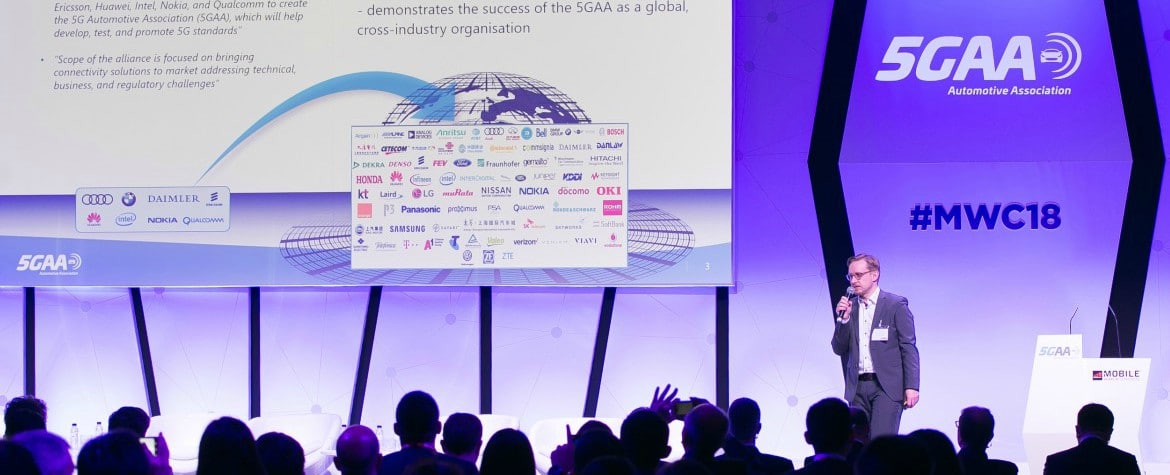
March 2nd, Barcelona, Spain – The 5G Automotive Association (5GAA) presented – during a session at the Mobile World Congress 2018 – the acceleration of C-V2X technology implementation through the widespread support of leading telecommunications and automotive companies. This advanced technology will serve as the lynchpin that will create a connected vehicle ecosystem and enable future mobility solutions. March 1st, Barcelona, Spain – The 5G Automotive Association (5GAA) presented – during a session at the Mobile World Congress 2018 – the acceleration of C-V2X technology implementation through the widespread support of leading telecommunications and automotive companies. This advanced technology will serve as the lynchpin that will create a connected vehicle ecosystem and enable future mobility solutions.
The value of C-V2X technology lies in the fact that it is a unified technology – it can provide short-range and long-range communications. C-V2X technology can, for example, alert drivers of a cyclist around the corner or a traffic jam that is 25 kilometers away.
Christoph Voigt, 5GAA Chairman and Head of R&D Connectivity at Audi announced that: “This effort is now ‘all hands on deck’, meaning that telecommunications and automotive leaders are all working hand-in-hand to deploy C-V2X and to make it hit the road as soon as possible.”
During its session, 5GAA focused on the growing support that C-V2X technology is enjoying among leading companies in the telecommunications and automotive industries and presented the importance that 5G cellular technology will play in enabling smart mobility of the future.
C-V2X gains wide ecosystem support
During the presentation, 5GAA members Qualcomm and Huawei emphasized the growing C-V2X ecosystem support and presented their integrated chipsets that will enable C-V2X commercialization. The start of C-V2X mass market series deployment is predicted to begin as early as 2019/2020.
“We see a growing appetite across the industry for the commercialization of our C-V2X chipset with automakers, Tier-1 suppliers, cellular module manufacturers, ITS providers, integrators, and automakers ready to drive change,” said Jason Ellis, Director of Automotive Business Development at Qualcomm.
Veni Shone, President of LTE product line at Huawei, highlighted that the momentum of C-V2X in China is encouraging – ministries have put their full support behind C-V2X technology on strategy and standardization. Mr. Shone also detailed Huawei’s commitment to accelerate C-V2X, specifically pointing at the releases of its LTE-V2X chipset, T-box prototype, and roadside units.
5GAA plans to support and advocate the work of this technology by speeding up the deployment of C-V2X for the automotive sector while creating a joint ecosystem and implementing key functionalities such as vehicle-to-smart-device.
5G as an enabler for life-saving solutions & new business applications
5GAA members Ericsson and Ford also highlighted exciting use cases and growing business applications for 5G technology in the automotive sector.
Don Butler, Executive Director of Connected Vehicles and Services at Ford stated that: “Creating safer and more personalized journeys through automated driving is the long-term vision of mobility’s future. We believe 5G will enable this by maximizing the in-vehicle experience thanks to high reliability, fast-paced communications. We will create new, compelling experiences and capabilities saving more lives with patient transport monitoring or teleoperated driving.”
With the advancement of 5G technology and its application to connected vehicles, the amount of data created will continue to expand exponentially.
Stefano Sorrentino, Master Researcher at Ericsson presented the fact that: “Connected & automated driving will lead to a data explosion that will definitely challenge the network capacities. This challenge could be remedied through the deployment of scalable and integrated networks and cloud architectures as well as the continuous evolution of radio technology into 5G.”
“We think of 5G as an end-to-end solution starting with the wireless connectivity but also including edge computing, the transport network, artificial intelligence and machine learning. Together they power the applications and the services for intelligent transportation and smart mobility, and ultimately, the ways humans interact with connected and self-driving cars of the future. It is an exciting area for 5GAA to work on and we invite any stakeholder to join us and contribute on this journey.” concluded Thierry Klein, Head of Disruptive Innovation Program at Nokia Bell Labs and Vice Chair of 5GAA Board.
About 5GAA
The 5G Automotive Association (5GAA) is a global cross-industry organization of companies from the automotive, technology and telecommunications industries (ICT), working together to develop end-to-end solutions for future mobility and transportation services. Created in 2016, the Association is comprised of over 75 members whose mission is to develop, test and promote communications solutions, initiate their standardisation and accelerate their commercial availability and global market penetration, to address society’s connected mobility and road safety needs with applications such as automated driving, ubiquitous access to services and integration into smart city and intelligent transportation.
Peaceful coexistence of C-V2X and ITS-G5 technology offers the highest net benefits for Europe
5GAA and EU policymakers discuss future of 5G for connected and automated vehicles
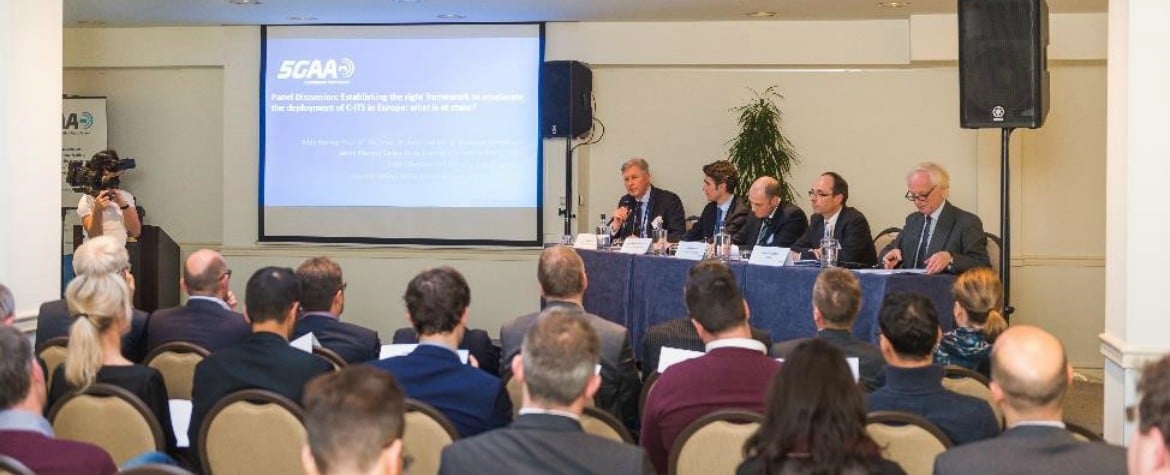
12 December 2017, Brussels, Belgium – The 5G Automotive Association (5GAA), a cross-industry association of the telecoms and automotive industry, held a policy debate on Tuesday 5 December in Brussels to discuss the concrete actions necessary to implement 5G connected and automated vehicles in Europe. A recurring theme in Tuesday’s debate was the cohesive development and implementation of cellular “vehicle to everything” (C-V2X) technology, the technology that will enable automobiles to communicate via cellular networks to other connected devices but also the possibility of ad-hoc communication without any cellular network involvement (e.g. in case of weak coverage). Policymakers and industry face the ongoing challenge of creating a cohesive framework that enables private sector innovation while ensuring a safe and economically viable rollout of new technologies.
Attendees heard from a wide range from various European political and administrative representatives, including Eddy Hartog, EC Head of Unit Smart Mobility and Living, Attila Benedek (Adviser to István Ujhelyi MEP, rapporteur on European C-ITS Strategy), Jaime Moreno García-Cano of the Spanish traffic authority or Andreas Geiss, EC Head of Unit for Spectrum Policy. 5GAA was represented by its Secretary, Markus Dillinger of Huawei and board members, Luke Ibbetson of Vodafone, Joachim Göthel of BMW, Rainer Krumrein of Daimler, and Friedhelm Ramme of Ericsson.
The debate coincides with the Commission’s ongoing public consultation on its European Strategy on Cooperative Intelligent Transport Systems (C-ITS), which runs through January 5, 2018. C-V2X technology stands to significantly improve road safety and facilitate traffic flows in the EU. Ultimately, the benefits of this technology across the EU could save the several billion euros that are lost every year to traffic accidents and congested roadways.
Markus Dillinger, 5GAA Secretary and Member of the Executive Committee: “5GAA was founded to underscore the urgency in developing technology that makes our roads safer and smarter. Today’s debate brought together public and private sector stakeholders to discuss the capabilities of such technology as well as the acceleration of creating a regulatory framework in which the industry can work.”
During the event, analysts from Analysys Mason and SBD Automotive presented the findings of a cost-benefit analysis of implementing the C-V2X technology. The socio-economic returns of deployment of C-ITS systems may amount to EUR 43 billion by 2035 in Europe, if both C-V2X and the Wi-Fi Standard IEEE 802.11p are able to co-exist in the 5.9GHz spectrum band. The 5GAA also presented a study assessing the road safety benefits of LTE–V2X (PC-5) and IEEE 802.11p in the EU, which indicates that LTE-V2X (PC5) outperforms 802.11p in reducing fatalities and serious injuries. In addition, it demonstrates that the absence of interoperability between technologies is unlikely to present a substantive barrier to the reduction of road accidents in the short to medium term. Bill McKinley, 5GAA rapporteur on tests and trials, and Rainer Krumrein of Daimler also presented 5GAA’s perspective on C-V2X performance and future capabilities.
The event culminated in a panel discussion to discuss the right framework to accelerate the deployment of the C-ITS across Europe. Particular attention was given to short-range communications in the 5.9 GHz band and the four guiding policy principles established by the European Commission: uncompromised safety services for all users in case of multiple technologies implementation, technology neutrality of spectrum regulation, efficient spectrum use and introduction in the longer-term of 5G for the further development of cooperative, connected and automated mobility.
Luke Ibbetson, R&D Director Vodafone Group and member of 5GAA: “Both C-V2X and ITS-G5 technologies should peacefully co-exist in the 5.9 GHz band. The socio-economic and road safety studies presented at this event indicate that co-existence offers the highest net benefits for the European economy, amounting to EUR 43 billion by 2035.”
Joachim Göthel, Senior Manager Project 5G-Alliance of BMW and member of 5GAA: “C-V2X offers a strong evolution path to 5G which is absolutely essential to enable full connected and automated driving in the future, while enabling a fast roll-out for many functionalities in the very short-term, utilizing existing cellular networks.”

The presentations made during the Workshop are downloadable here below:
1. Introductory 5GAA Presentation
2. Presentation on cellular V2X socio-economic benefit study
3. LTE-V2X (PC5) and road safety in the EU
4. 5GAA Presentation Trials
5. Daimler view on V2X – 5GAA Policy Debate
About the 5GAA
The 5GAA is a cross-industry association between the cellular and automotive industries to develop, test and promote communications solutions, initiate their standardisation and accelerate their commercial availability and global market penetration, to address society’s connected mobility and road safety needs with applications such as automated driving, ubiquitous access to services and integration into smart city and intelligent transportation.
Pictures credit © Thomas Blairon, 2017. Reproduction of this image is authorised, provided the source is acknowledged

Bright Regulatory Trends of C-V2X in Asia Pacific Region
Shanghai, China – On 16 November, The 5G Automotive Association (5GAA) hosted its Second General Assembly. Following announcements of the association’s progress and growth worldwide, 5GAA inaugurated the Asia Pacific Roundtable. Here, regulators from China and South Korea joined the discussion, sharing industry trends for the Internet of Vehicles and future Intelligent Transport Systems, as well as a number of real-life demonstrations of technology that is being developed in this region.
5GAA is a unique organisation on the global stage: with leading members of the automotive and telecommunications industry as founders. The association aims to pioneer digital transformation on our roads, creating a safer and more sustainable road environment for all.
At the Asia Pacific Roundtable, Mr. He Guangjin from the Chinese TMRI (Traffic Management Research Institution) of MPS (Ministry of Public Security), presented the demonstration made at WIOT 2017 (World Internet of Things Expo) in Wuxi. This was the first demonstration from the Chinese public security industry where the LTE-V2X technology was employed. Additionally, it was so a premiere for the official traffic management system to be opened to vehicles on open roads. TMR also announced its plan to build a larger LTE-V2X pre-commercial trial including 20 to 50 intersections in 2018, to verify the broadcasting of real-time traffic conditions of intersections and the reception of information transmitted from vehicles. Additionally, TMRI is actively working on industry and national standards such as “Road Traffic Signal Controller I2V Information Distribution Interface Specifications”, “Adaptive Verification Management Regulation of Intelligent & Connected Vehicles (ICV) on Public Roads”, etc.
Dr. Cen Yanqing from the Chinese RIOH (Research Institution of Highway) of the MOT (Ministry of Transport) shared the important progress of the MOT. The ministry is paying close attention to automated driving and has already set up a dedicated working group to coordinate the corresponding ministries and guide the work on automated driving technology. In order to achieve automated driving, it is not sufficient to equip autonomous vehicles but it’s also needed to have an intelligent reformation of the road infrastructure and vehicle-to-road, vehicle-to-vehicle, vehicle-to-person communication and interaction in an effective way. To further promote the automated driving, the Ministry of Transport has built test zone for commercial vehicles verification in Tongzhou, Beijing, including specific scenarios e.g. ramps, intersections, and traffic lights.
When Dr. Cen was asked about whether MOT will mandate any technical specifications, he clarified there is no mandatory regulation so far. The MOT – as a department which uses technology – is opened to the utilisation of the V2X technology, but will select the best and most efficient technology eventually, he said. He also claimed that the MOT would support some of the Chinese telecommunication corporate contributions such as CMCC, Huawei, and Datang. Finally, he declared “we cannot implement two technologies but only one”.
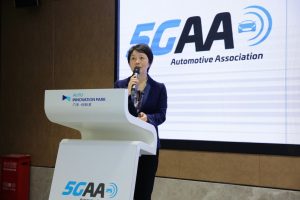
•Vice President of the China Academy of Information and Communications Technology, Ministry of Industry and Information Technology, China
•Chairman of the IMT-2020 (5G) Promotion Group
Ms. Wang Zhiqin, from CAICT (China Academy of Information and Communications Technology) of MIIT(Ministry of Industry and Information Technology), explained that the national CAV (Connected and Automated Vehicles) industry development committee advises to promote the LTE-V2X technology deployment and application, and its evolution to 5G and internet of vehicles integration development. He also announced the release of the Guide to the Construction of Standard Architecture for CAV Industry Development jointly developed by MIIT and NSC (National Standardization Administration), in which the LTE-V2X and 5G technologies are greatly highlighted in the information and communications volume. When asked about the spectrum of the Internet of Vehicles in China, Ms. Wang expressed that the government attaches great importance to it and needs prompt issuance and release of a positive guidance to the industry. She believes China should release this C-V2X spectrum relatively soon.
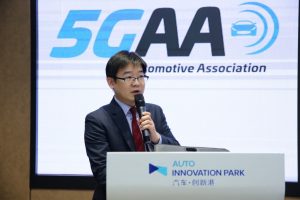
Deputy Director, ITS and Road Safety Division, Road Bureau, Ministry of Land, Infrastructure and Transport, South Korea
Mr. Chang-ki Kim, from the MOLIT (Ministry of Land, Infrastructure, and Transport) explained that his division in Korea is implementing two strategies to promote the commercialisation of Internet of Vehicles. The first strategy consists of focusing on the C-ITS safety aspect by developing and commercialising the RoDAS (Road Driving Assistant Systems) by 2020 in accordance with the National ITS Master Plan. As CAV (Connected and Automated Vehicles) will improve road safety issues under the mixed condition of AV (Automated Vehicles) and LV (Legacy Vehicles) in both highway and urban areas. MOLIT will launch, as its second strategy, the transportation renovation program by promoting and integrating the C-ITS and CAV technologies under their CAD (Connected and Automated Driving) Test-beds. Additionally, he emphasised that deploying those Test-beds in Korea would include the verification of various communication techniques, e.g., C-V2X (LTE, 5G), under the real and dynamic road environment. Mr. Kim expressed his intention to invite all ICT and CAD testing companies to conduct their service applications and to develop their cooperation and sharing models by joining those Test-beds.