
5GAA C-V2X Workshop and Demonstration – 10 July 2018 – Paris, France
SAVE THE DATE
5GAA C-V2X Workshop and Demonstration
10 July 2018
Paris, France

The 5G Automotive Association (5GAA) are pleased to announce our next Workshop and Demonstration with the support of PSA, Ford and BMW. to present and showcase Cellular-Vehicle-to-Everything (C-V2X) technology to European transport stakeholders including EU Member States Ministries, Road Traffic Authorities & Road Operators, as well as a wide array of interest groups and industry representatives.
With the support of UTAC-CERAM, this interactive Workshop and Demonstration is intended to advance the dialogue between automakers, technology providers, mobile network operators and the overall transportation community on the capabilities, timeline and deployment models for Cooperative Intelligent Transport Systems (C-ITS) in Europe.
This event will also showcase the most recent developments and deployment initiatives around C-V2X, paving the way towards 5G for the uptake of Cooperative, Connected and Automated Mobility (CCAM).
About 5GAA
The 5G Automotive Association (5GAA) is a global cross-industry organisation of companies from the automotive, technology and telecommunications industries (ICT), working together to develop end-to-end solutions for future mobility and transportation services.
Created in 2016, the Association is comprised of over 80 members whose mission is to develop, test and promote communications solutions, initiate their standardisation and accelerate their commercial availability and global market penetration, to address society’s connected mobility and road safety needs with applications such as automated driving, ubiquitous access to services and integration into smart city and intelligent transportation.

5GAA | Presents C-V2X Workshop for North American Transportation Planning and North American Road Operators
On the 26th April in Washington D.C, the 5G Automotive Association presented its vision for a connected future during a C-V2X Workshop for North American transportation planning and road operations communities (State DOTs, MPOs, and local agencies).
The main objective of the workshop was to helped jumpstart the dialogue between technology providers, cellular network operators and the transportation community on the capabilities, timeline and the potential role of cellular technologies in transportation systems management and operations (TSMO).
During the workshop, questions from stakeholders and technology providers were addressed and the 5GAA presented the next steps to realize the promise of C-V2X on our roads.
The presentations made during the Workshop are downloadable here below:
1. C-V2X Workshop and Demonstration for North American Transportation Planning and Road Operator Community– Qualcomm
2. 5GAA pioneering digital transformation in the automotive industry – 5GAA Chairman
3. The C-V2X Proposition – Ford
4. 5G Perspective on Connecting Cars – Strategy Analytics, Inc
5. Connected Vehicle Implementation Activity in Northern Virginia – Virgina Tech Transport Tech
6. V2X Product Life Cycle Management– Savari
7. Economics of C-V2X The Mobile Network Operator and Support for Alternative Deployment Models – AT&T
8. Six C-V2X Demonstrations
5GAA appoints CTO Dr. Maxime Flament
April 17, Brussels, Belgium – Dr. Flament will help advance the 5GAA mission of developing the framework to support next-generation connected mobility solutions
Since its creation in September 2016, 5GAA has benefited from an accelerated growth including key players with a global footprint in the automotive, technology and telecommunications industries. 5GAA now represents more than 80 members and is globally recognised as a driving force towards the deployment of the C-V2X technology and the future 5G network. This is the right time to bring in a CTO to support 5GAA’s global position. Dr. Flament’s starting date is April 22nd.
Dr. Flament comes from ERTICO – ITS Europe, the European association promoting research and deployment on Intelligent Transportation Systems. For more than a decade, he has been a leading contributor to many European activities on road safety, connected vehicles, automated driving, large-scale pilots, and digital mapping. In his latest role as Head of Department for Connected & Automated Driving (CAD), he worked with the public, private and research sectors to successfully shape the European expert CAD community. His position led him to develop strong collaboration ties with US DOT and the Japan MLIT as well as governments in China, Korea, Singapore, Australia and Canada. As a telecom engineer, ITS and CAD expert, Dr. Flament is the perfect fit for the position of CTO at 5GAA. Dr. Flament’s hire as the 5GAA CTO is a pivotal moment in the associations’ progress.
5GAA Chairman, Christoph Voigt, is confident that Dr. Flament will raise the organisation to the next level:
Maxime Flament’s contribution will be threefold: his experience and knowledge in Intelligent Transport Systems (ITS) will play a major role in bringing new possibilities to 5GAA. He will also broaden our collaboration with the wider mobility ecosystem. Thirdly, he will facilitate our mission to develop the next-generation of connected mobility solutions. We look forward to working in close co-operation with Maxime.
Dr. Flament is excited to join a team of experts at 5GAA:
5GAA is a growing and dynamic association with a promising path ahead. It is with great honour that I take on the challenge to serve as CTO and develop the communication technology that will connect all vehicles in the future. To do so is not a straightforward undertaking; there are numerous technical and non-technical challenges still to be addressed. This is why I am very excited to join a great team of experts involving all 5GAA members.
About 5GAA
The 5G Automotive Association (5GAA) is a global cross-industry organization of companies from the automotive, technology and telecommunications industries (ICT), working together to develop end-to-end solutions for future mobility and transportation services.
Created in 2016, the Association is comprised of over 75 members whose mission is to develop, test and promote communications solutions, initiate their standardisation and accelerate their commercial availability and global market penetration, to address society’s connected mobility and road safety needs with applications such as automated driving, ubiquitous access to services and integration into smart city and intelligent transportation.
Media contact:
Lisa Boch-Andersen
Senior Director, Strategic Communication and Marketing, 5GAA
Email: lisa.boch-andersen@5GAA.org / Mobile phone: +32(0)475450972
MWC 2018: 5GAA Gaining Speed Toward C-V2X commercialization
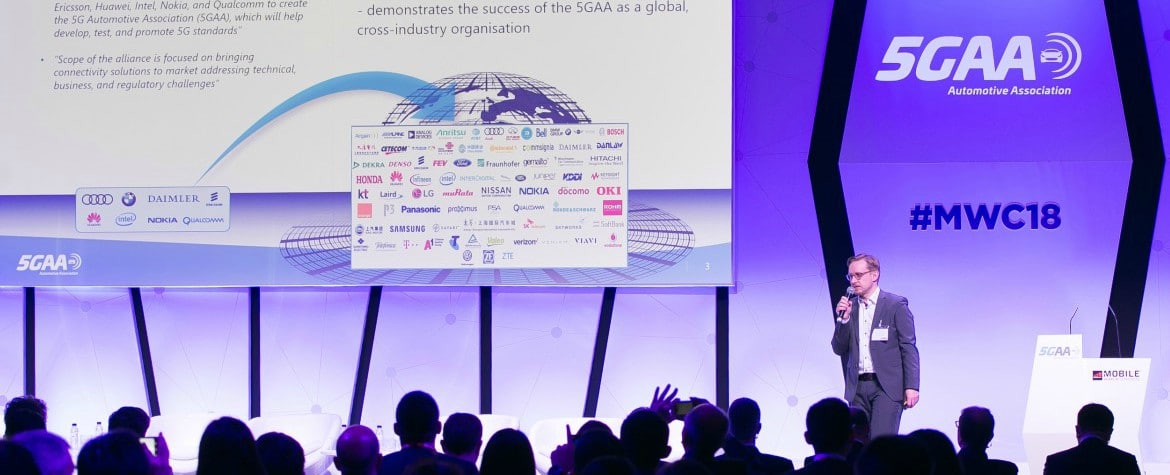
March 2nd, Barcelona, Spain – The 5G Automotive Association (5GAA) presented – during a session at the Mobile World Congress 2018 – the acceleration of C-V2X technology implementation through the widespread support of leading telecommunications and automotive companies. This advanced technology will serve as the lynchpin that will create a connected vehicle ecosystem and enable future mobility solutions. March 1st, Barcelona, Spain – The 5G Automotive Association (5GAA) presented – during a session at the Mobile World Congress 2018 – the acceleration of C-V2X technology implementation through the widespread support of leading telecommunications and automotive companies. This advanced technology will serve as the lynchpin that will create a connected vehicle ecosystem and enable future mobility solutions.
The value of C-V2X technology lies in the fact that it is a unified technology – it can provide short-range and long-range communications. C-V2X technology can, for example, alert drivers of a cyclist around the corner or a traffic jam that is 25 kilometers away.
Christoph Voigt, 5GAA Chairman and Head of R&D Connectivity at Audi announced that: “This effort is now ‘all hands on deck’, meaning that telecommunications and automotive leaders are all working hand-in-hand to deploy C-V2X and to make it hit the road as soon as possible.”
During its session, 5GAA focused on the growing support that C-V2X technology is enjoying among leading companies in the telecommunications and automotive industries and presented the importance that 5G cellular technology will play in enabling smart mobility of the future.
C-V2X gains wide ecosystem support
During the presentation, 5GAA members Qualcomm and Huawei emphasized the growing C-V2X ecosystem support and presented their integrated chipsets that will enable C-V2X commercialization. The start of C-V2X mass market series deployment is predicted to begin as early as 2019/2020.
“We see a growing appetite across the industry for the commercialization of our C-V2X chipset with automakers, Tier-1 suppliers, cellular module manufacturers, ITS providers, integrators, and automakers ready to drive change,” said Jason Ellis, Director of Automotive Business Development at Qualcomm.
Veni Shone, President of LTE product line at Huawei, highlighted that the momentum of C-V2X in China is encouraging – ministries have put their full support behind C-V2X technology on strategy and standardization. Mr. Shone also detailed Huawei’s commitment to accelerate C-V2X, specifically pointing at the releases of its LTE-V2X chipset, T-box prototype, and roadside units.
5GAA plans to support and advocate the work of this technology by speeding up the deployment of C-V2X for the automotive sector while creating a joint ecosystem and implementing key functionalities such as vehicle-to-smart-device.
5G as an enabler for life-saving solutions & new business applications
5GAA members Ericsson and Ford also highlighted exciting use cases and growing business applications for 5G technology in the automotive sector.
Don Butler, Executive Director of Connected Vehicles and Services at Ford stated that: “Creating safer and more personalized journeys through automated driving is the long-term vision of mobility’s future. We believe 5G will enable this by maximizing the in-vehicle experience thanks to high reliability, fast-paced communications. We will create new, compelling experiences and capabilities saving more lives with patient transport monitoring or teleoperated driving.”
With the advancement of 5G technology and its application to connected vehicles, the amount of data created will continue to expand exponentially.
Stefano Sorrentino, Master Researcher at Ericsson presented the fact that: “Connected & automated driving will lead to a data explosion that will definitely challenge the network capacities. This challenge could be remedied through the deployment of scalable and integrated networks and cloud architectures as well as the continuous evolution of radio technology into 5G.”
“We think of 5G as an end-to-end solution starting with the wireless connectivity but also including edge computing, the transport network, artificial intelligence and machine learning. Together they power the applications and the services for intelligent transportation and smart mobility, and ultimately, the ways humans interact with connected and self-driving cars of the future. It is an exciting area for 5GAA to work on and we invite any stakeholder to join us and contribute on this journey.” concluded Thierry Klein, Head of Disruptive Innovation Program at Nokia Bell Labs and Vice Chair of 5GAA Board.
About 5GAA
The 5G Automotive Association (5GAA) is a global cross-industry organization of companies from the automotive, technology and telecommunications industries (ICT), working together to develop end-to-end solutions for future mobility and transportation services. Created in 2016, the Association is comprised of over 75 members whose mission is to develop, test and promote communications solutions, initiate their standardisation and accelerate their commercial availability and global market penetration, to address society’s connected mobility and road safety needs with applications such as automated driving, ubiquitous access to services and integration into smart city and intelligent transportation.
Peaceful coexistence of C-V2X and ITS-G5 technology offers the highest net benefits for Europe
5GAA and EU policymakers discuss future of 5G for connected and automated vehicles
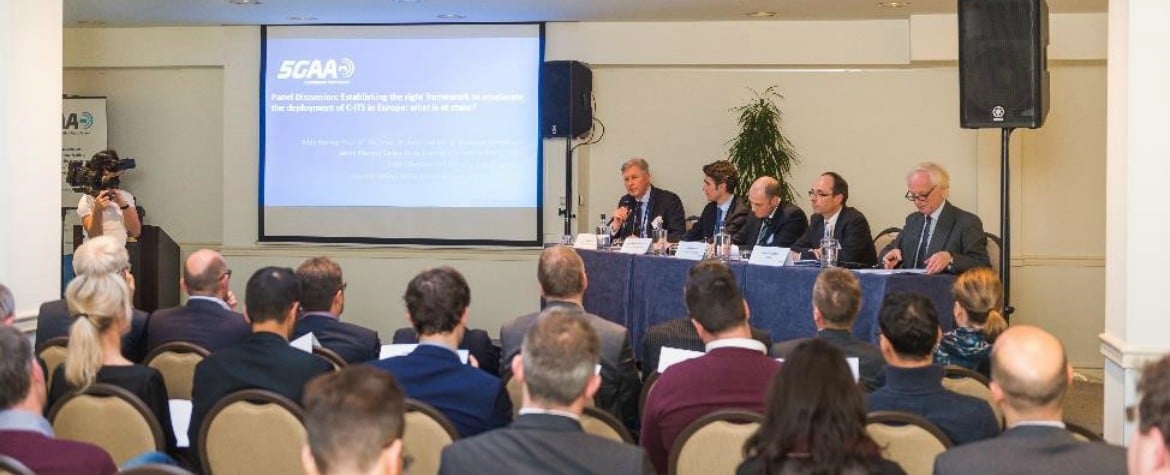
12 December 2017, Brussels, Belgium – The 5G Automotive Association (5GAA), a cross-industry association of the telecoms and automotive industry, held a policy debate on Tuesday 5 December in Brussels to discuss the concrete actions necessary to implement 5G connected and automated vehicles in Europe. A recurring theme in Tuesday’s debate was the cohesive development and implementation of cellular “vehicle to everything” (C-V2X) technology, the technology that will enable automobiles to communicate via cellular networks to other connected devices but also the possibility of ad-hoc communication without any cellular network involvement (e.g. in case of weak coverage). Policymakers and industry face the ongoing challenge of creating a cohesive framework that enables private sector innovation while ensuring a safe and economically viable rollout of new technologies.
Attendees heard from a wide range from various European political and administrative representatives, including Eddy Hartog, EC Head of Unit Smart Mobility and Living, Attila Benedek (Adviser to István Ujhelyi MEP, rapporteur on European C-ITS Strategy), Jaime Moreno García-Cano of the Spanish traffic authority or Andreas Geiss, EC Head of Unit for Spectrum Policy. 5GAA was represented by its Secretary, Markus Dillinger of Huawei and board members, Luke Ibbetson of Vodafone, Joachim Göthel of BMW, Rainer Krumrein of Daimler, and Friedhelm Ramme of Ericsson.
The debate coincides with the Commission’s ongoing public consultation on its European Strategy on Cooperative Intelligent Transport Systems (C-ITS), which runs through January 5, 2018. C-V2X technology stands to significantly improve road safety and facilitate traffic flows in the EU. Ultimately, the benefits of this technology across the EU could save the several billion euros that are lost every year to traffic accidents and congested roadways.
Markus Dillinger, 5GAA Secretary and Member of the Executive Committee: “5GAA was founded to underscore the urgency in developing technology that makes our roads safer and smarter. Today’s debate brought together public and private sector stakeholders to discuss the capabilities of such technology as well as the acceleration of creating a regulatory framework in which the industry can work.”
During the event, analysts from Analysys Mason and SBD Automotive presented the findings of a cost-benefit analysis of implementing the C-V2X technology. The socio-economic returns of deployment of C-ITS systems may amount to EUR 43 billion by 2035 in Europe, if both C-V2X and the Wi-Fi Standard IEEE 802.11p are able to co-exist in the 5.9GHz spectrum band. The 5GAA also presented a study assessing the road safety benefits of LTE–V2X (PC-5) and IEEE 802.11p in the EU, which indicates that LTE-V2X (PC5) outperforms 802.11p in reducing fatalities and serious injuries. In addition, it demonstrates that the absence of interoperability between technologies is unlikely to present a substantive barrier to the reduction of road accidents in the short to medium term. Bill McKinley, 5GAA rapporteur on tests and trials, and Rainer Krumrein of Daimler also presented 5GAA’s perspective on C-V2X performance and future capabilities.
The event culminated in a panel discussion to discuss the right framework to accelerate the deployment of the C-ITS across Europe. Particular attention was given to short-range communications in the 5.9 GHz band and the four guiding policy principles established by the European Commission: uncompromised safety services for all users in case of multiple technologies implementation, technology neutrality of spectrum regulation, efficient spectrum use and introduction in the longer-term of 5G for the further development of cooperative, connected and automated mobility.
Luke Ibbetson, R&D Director Vodafone Group and member of 5GAA: “Both C-V2X and ITS-G5 technologies should peacefully co-exist in the 5.9 GHz band. The socio-economic and road safety studies presented at this event indicate that co-existence offers the highest net benefits for the European economy, amounting to EUR 43 billion by 2035.”
Joachim Göthel, Senior Manager Project 5G-Alliance of BMW and member of 5GAA: “C-V2X offers a strong evolution path to 5G which is absolutely essential to enable full connected and automated driving in the future, while enabling a fast roll-out for many functionalities in the very short-term, utilizing existing cellular networks.”

The presentations made during the Workshop are downloadable here below:
1. Introductory 5GAA Presentation
2. Presentation on cellular V2X socio-economic benefit study
3. LTE-V2X (PC5) and road safety in the EU
4. 5GAA Presentation Trials
5. Daimler view on V2X – 5GAA Policy Debate
About the 5GAA
The 5GAA is a cross-industry association between the cellular and automotive industries to develop, test and promote communications solutions, initiate their standardisation and accelerate their commercial availability and global market penetration, to address society’s connected mobility and road safety needs with applications such as automated driving, ubiquitous access to services and integration into smart city and intelligent transportation.
Pictures credit © Thomas Blairon, 2017. Reproduction of this image is authorised, provided the source is acknowledged

Bright Regulatory Trends of C-V2X in Asia Pacific Region
Shanghai, China – On 16 November, The 5G Automotive Association (5GAA) hosted its Second General Assembly. Following announcements of the association’s progress and growth worldwide, 5GAA inaugurated the Asia Pacific Roundtable. Here, regulators from China and South Korea joined the discussion, sharing industry trends for the Internet of Vehicles and future Intelligent Transport Systems, as well as a number of real-life demonstrations of technology that is being developed in this region.
5GAA is a unique organisation on the global stage: with leading members of the automotive and telecommunications industry as founders. The association aims to pioneer digital transformation on our roads, creating a safer and more sustainable road environment for all.
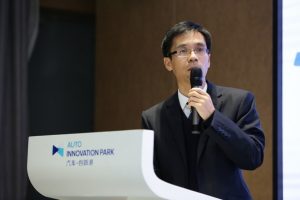
At the Asia Pacific Roundtable, Mr. He Guangjin from the Chinese TMRI (Traffic Management Research Institution) of MPS (Ministry of Public Security), presented the demonstration made at WIOT 2017 (World Internet of Things Expo) in Wuxi. This was the first demonstration from the Chinese public security industry where the LTE-V2X technology was employed. Additionally, it was so a premiere for the official traffic management system to be opened to vehicles on open roads. TMR also announced its plan to build a larger LTE-V2X pre-commercial trial including 20 to 50 intersections in 2018, to verify the broadcasting of real-time traffic conditions of intersections and the reception of information transmitted from vehicles. Additionally, TMRI is actively working on industry and national standards such as “Road Traffic Signal Controller I2V Information Distribution Interface Specifications”, “Adaptive Verification Management Regulation of Intelligent & Connected Vehicles (ICV) on Public Roads”, etc.
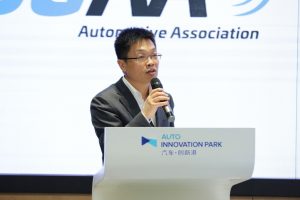
Dr. Cen Yanqing from the Chinese RIOH (Research Institution of Highway) of the MOT (Ministry of Transport) shared the important progress of the MOT. The ministry is paying close attention to automated driving and has already set up a dedicated working group to coordinate the corresponding ministries and guide the work on automated driving technology. In order to achieve automated driving, it is not sufficient to equip autonomous vehicles but it’s also needed to have an intelligent reformation of the road infrastructure and vehicle-to-road, vehicle-to-vehicle, vehicle-to-person communication and interaction in an effective way. To further promote the automated driving, the Ministry of Transport has built test zone for commercial vehicles verification in Tongzhou, Beijing, including specific scenarios e.g. ramps, intersections, and traffic lights.
When Dr. Cen was asked about whether MOT will mandate any technical specifications, he clarified there is no mandatory regulation so far. The MOT – as a department which uses technology – is opened to the utilisation of the V2X technology, but will select the best and most efficient technology eventually, he said. He also claimed that the MOT would support some of the Chinese telecommunication corporate contributions such as CMCC, Huawei, and Datang. Finally, he declared “we cannot implement two technologies but only one”.
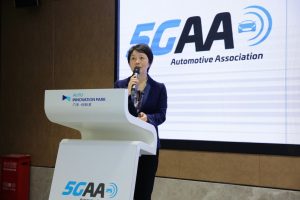
•Vice President of the China Academy of Information and Communications Technology, Ministry of Industry and Information Technology, China
•Chairman of the IMT-2020 (5G) Promotion Group
Ms. Wang Zhiqin, from CAICT (China Academy of Information and Communications Technology) of MIIT(Ministry of Industry and Information Technology), explained that the national CAV (Connected and Automated Vehicles) industry development committee advises to promote the LTE-V2X technology deployment and application, and its evolution to 5G and internet of vehicles integration development. He also announced the release of the Guide to the Construction of Standard Architecture for CAV Industry Development jointly developed by MIIT and NSC (National Standardization Administration), in which the LTE-V2X and 5G technologies are greatly highlighted in the information and communications volume. When asked about the spectrum of the Internet of Vehicles in China, Ms. Wang expressed that the government attaches great importance to it and needs prompt issuance and release of a positive guidance to the industry. She believes China should release this C-V2X spectrum relatively soon.
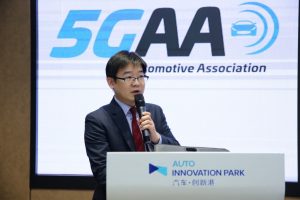
Deputy Director, ITS and Road Safety Division, Road Bureau, Ministry of Land, Infrastructure and Transport, South Korea
Mr. Chang-ki Kim, from the MOLIT (Ministry of Land, Infrastructure, and Transport) explained that his division in Korea is implementing two strategies to promote the commercialisation of Internet of Vehicles. The first strategy consists of focusing on the C-ITS safety aspect by developing and commercialising the RoDAS (Road Driving Assistant Systems) by 2020 in accordance with the National ITS Master Plan. As CAV (Connected and Automated Vehicles) will improve road safety issues under the mixed condition of AV (Automated Vehicles) and LV (Legacy Vehicles) in both highway and urban areas. MOLIT will launch, as its second strategy, the transportation renovation program by promoting and integrating the C-ITS and CAV technologies under their CAD (Connected and Automated Driving) Test-beds. Additionally, he emphasised that deploying those Test-beds in Korea would include the verification of various communication techniques, e.g., C-V2X (LTE, 5G), under the real and dynamic road environment. Mr. Kim expressed his intention to invite all ICT and CAD testing companies to conduct their service applications and to develop their cooperation and sharing models by joining those Test-beds.

5GAA participates in Testbed Visit in Shanghai
Shanghai, China – 16 November 2017 – following the 5G Automotive Association General Assembly Meeting, 5GAA leadership, delegates as well as representatives from Chinese and South Korean government participated in a testbed visit. This practice case was then followed by eight use-cases, demonstrating the success of the LTE-V2X advances. Both of these actions took place at the purpose-built Shanghai district – Testbed F-zone and T-Zone – where the latest developments in vehicle technology are assessed.
1. Realizing LTE-V2X’s capacity: Visit to F-Zone
Huawei LTE-V leader for Research & Development, Mr. Yangyongchao, opened the visit by showcasing LTE-V2X testing reports as well as running a live test result. This series of LTE-V2X performance tests were measured in terms of the technology’s capacity to manage two variables (link level and system level). This analysis was managed by the partnership of China Mobile (CMCC), SIAC and SAIC Motor.
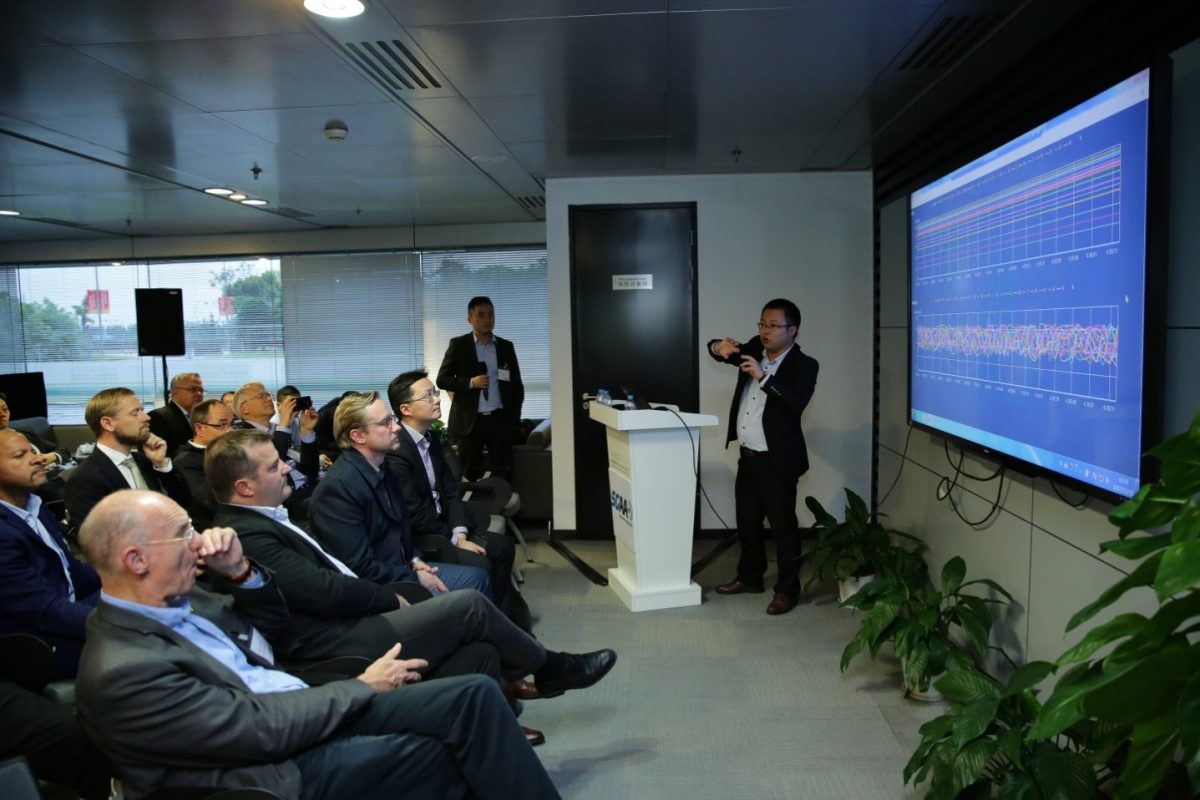
- Link Level Testing: LTE-V2X can support relative vehicle speeds of up to 500km/h, even with correction for timing and frequency errors. LTE-V2X shows excellent link performance with different packet size. The maximum RSU coverage range reaches more than 1km from the test vehicle.
- System Level Testing: 400 vehicles were analysed in this trial environment. Based on this, the capacity and of Vehicle-to-Vehicle and Vehicle- to-Infrastructure is smaller is functional in a range of 20 metres. Messages were transmitted at a success rate of 90% within the demanded communication range in high-density scenarios.
Right after this presentation, SIAC led the delegates to visit the site of F-Zone. Mr. Lilin, director of SIAC explained that F-zone is an enclosed area conducting different scenarios such as parks, urban roads with intersections, simulated highway and related road facilities. Additionally, F-zone is the national level Intelligent and Connected Vehicles test zone equipped with background vehicles, positioning capability and telecommunication infrastructure, including LTE-V2X based RSU, base stations that support both LTE and LTE-V2X, and assisted by operation system.
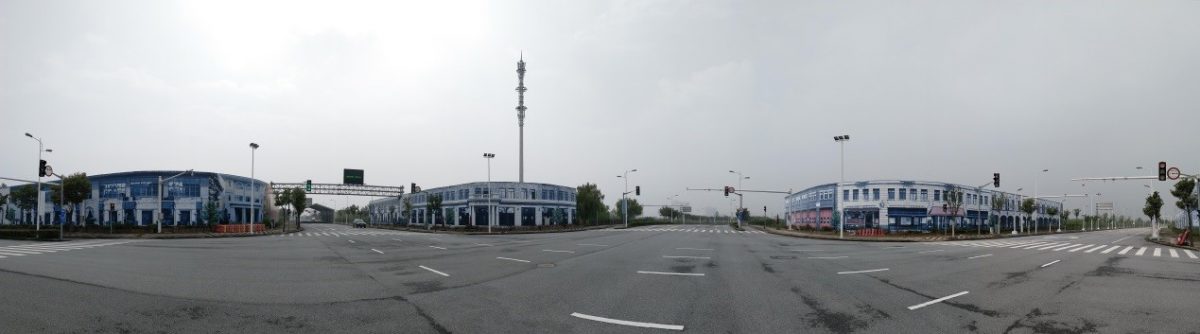
2. T-Zone visit
After the inspection of F-Zone, delegates visited C-V2X demonstration in T-Zone and observed eight cases in SAIC Motor’s intelligent connected vehicle operated with China Mobile and Huawei. The technology showcased was powered by 5G-V2X. This opened the vehicle up to possibilities such as Tele-Operated Driving, LTE-V2X based Platooning, Forward collision warning, Traffic light speed advisory and Vulnerable Road user warning. Dr. Liu Fen, also explained that with the abundant communications environment in T-zone and more C-V2X functionality can be realised in the future.
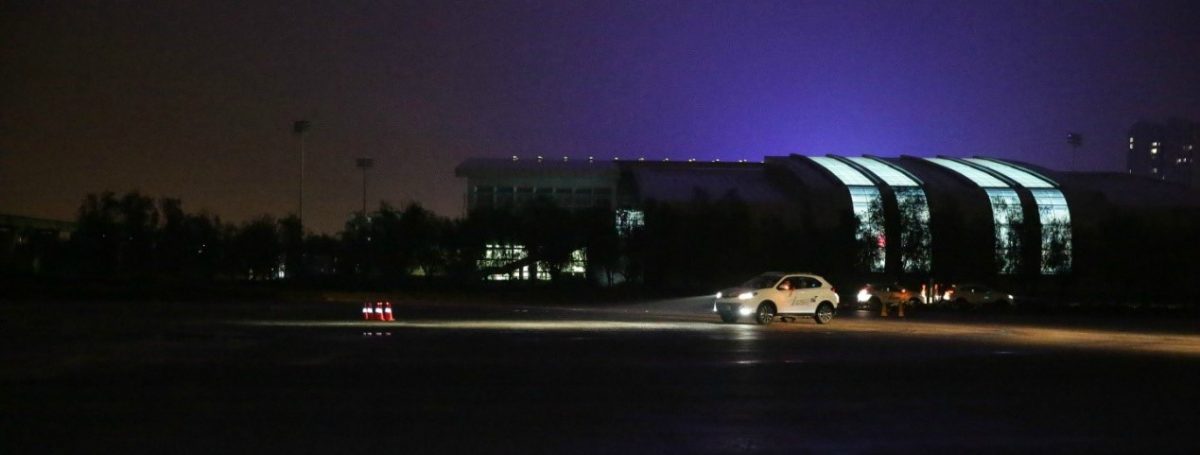
Christoph Voigt, Chairman of 5GAA, views these advances with optimism: “Today’s opportunity to see the fantastic progress from SIAC, SAIC Motor, China Mobile and Huawei is a demonstration of the unlimited possibilities that investing in 5G and LTE -V2X technologies hold. We know that C-V2X technology has the capacity for high-speed, high-density communication between vehicles, infrastructure, and pedestrians. Following further research and collaboration with our members and policy makers in governments around the world, 5GAA is looking forward to introducing this technology globally.”
Dino Flore, Director General of 5GAA is proud of the extensive partnerships that the association has fostered: “5GAA’s aim is to act as a bridge between the automotive and telecommunications industries. I would like to thank our hosts today in Shanghai for their hospitality and proudly showcasing the possibilities promised by C-V2X and 5G. Our organisation is focused on accelerating research and delivering solutions to society to build safer and more sustainable transport for our citizens. Today’s demonstrations are proof of what future holds.”
About the 5GAA
The 5G Automotive Association (5GAA) is a global cross-industry organisation of companies from the automotive, technology and telecommunications industries (ICT), working together to develop end-to-end solutions for future mobility and transportation services. Created in 2016, the Association is comprised of over 67 members which mission is to develop, test and promote communications solutions, initiate their standardization and accelerate their commercial availability and global market penetration to address societal need.
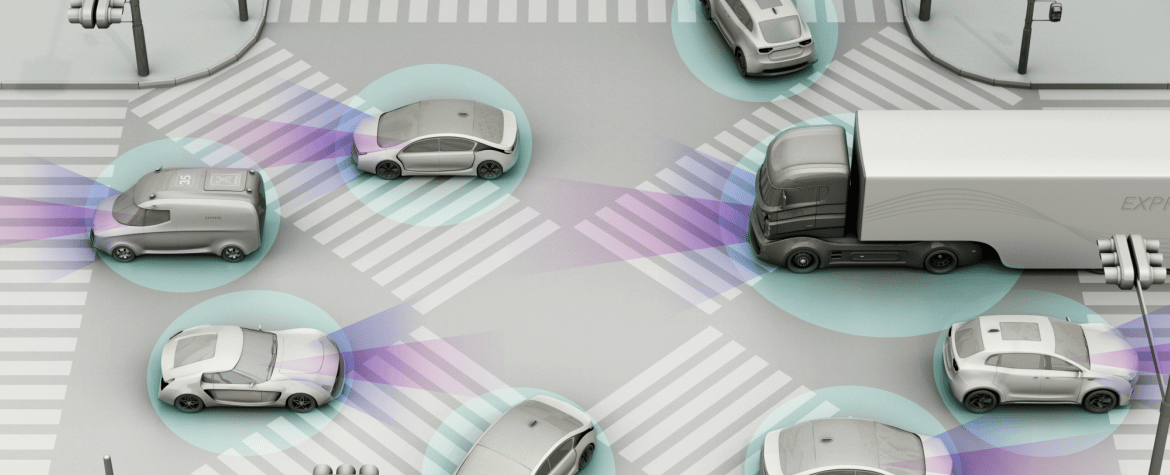
5GAA: cellular technology is key enabler for smart mobility of the future
Industry association calls on European Commission to allow stakeholders to work collaboratively towards an agreement on the technology catalyzing the mobility of the future and warns against a “premature and cumbersome legislative decision”.
The 5G Automotive Association (5GAA) encourages the automotive, technology, and telecommunications industries and the European Commission to be ambitious when evaluating technologies for connected, autonomous vehicles. 5GAA is confident that cellular communication technology (C-V2X) has the most benefits when applied to connected, self-driving cars. It has provided its views to the Commission in a workshop and a letter with recommendations. Since its launch one year ago, over 50 industry leaders from the automotive, technology and telecommunications industries have teamed up in 5GAA to accelerate C-V2X technology development and its evolution to 5G-V2X for enhanced safety, automated driving and connected mobility.
Christoph Voigt, Chairman of 5GAA said, “5GAA is confident that cellular technology (including direct vehicle-to-vehicle communication at 5.9 GHz) has the potential to lead to the best outcomes in the long run. We are strongly relying on the European institutional support to put in place a regulatory framework allowing for an industry-driven and swift deployment of this technology. It is crucial to consider how the 5.9 GHz band, the “life blood” of wireless vehicle communication, can be used efficiently in the context of 5G technology evolution, road safety, and economic scalability. The automotive and transportation sectors, both public and private, are making significant investment commitments. Therefore, we are urging the European Commission to allow the ITS-G5 and C-V2X stakeholders to work together towards an agreement on the future of connected and automated cars, without a premature and cumbersome legislative decision.”
5GAA has recently provided its views to the Commission in a workshop and a letter with recommendations.
Christoph Voigt: “We should aim high enough when selecting the solutions to make connected, self-driving vehicles a reality. These are a catalyst to improving the quality of life globally through safer traffic, improved mobility, cleaner air in cities, and a better experience overall for drivers.”
Dino Flore, Director General of 5GAA adds, “Saving lives through improved road safety is obviously the primary positive outcome of deploying communication technology solutions. In addition, we should take into account other aspects when evaluating alternatives. We’re not only talking about reducing congestion and pollution but also optimizing the driving experience. It is our view that cellular technology, including direct vehicle-to-vehicle communication at 5.9 GHz, has the most upward potential in the long run.”
Helping vehicles “understand the environment they are navigating”
Launched in September 2016 by 8 founding members the 5GAA has in less than a year grown to include over 50 leaders from the automotive, technology and telecom industries who collaborate cross-industry on the future of transport. 5GAA’s mission is to develop, test, and promote communications solutions, initiate their standardization and accelerate their commercial availability and global market penetration. The objective is to address society’s connected mobility and road safety needs with applications such as autonomous driving, ubiquitous access to services and integration into smart city and intelligent transportation.
Connected vehicles use communication technology to not only communicate with other vehicles but also with road infrastructure, other road users such as pedestrians, and the Internet – e.g. to provide traffic updates and parking guidance. Use cases include collision warnings, “traffic jam ahead” warnings, green light optimal speed advisory, parking guidance, and assisting drivers in tackling treacherous traffic situations (e.g. turning left at a crossroads). Connected vehicles will eventually reduce pollution, and make traffic more efficient, reducing congestion in cities and improving the flow of goods and people.
Christoph Voigt explains, “Equipping cars with sensors and cameras is one thing, but imagine what is possible when cars use cellular technology to communicate with their entire ecosystem: other vehicles, road users, infrastructure, and central services that give real-time information.”
“It’s the difference between a car that is capable of seeing what is happening in its immediate surroundings and one that can use all available information to allow for a safer and more comfortable driving experience. After all, as drivers we do more than purely react to what’s in front of us. We listen to traffic info, we are aware of the area we’re navigating, and we are alert to traffic jams in rush hour. We use context to guide our driving.”
“This is exactly what cellular connectivity can enable vehicles to make easier, or even take over from us in the case of self-driving vehicles. Except that it will be faster and more accurate,” concludes Christoph Voigt.
-Ends
About 5GAA
The 5G Automotive Association (5GAA) is a global cross-industry organisation of companies from the automotive, technology and telecommunications industries (ICT), working together to develop end-to-end solutions for future mobility and transportation services. Created in 2016, the Association is comprised of over 50 members which mission
is to develop, test and promote communications solutions, initiate their standardization and accelerate their commercial availability and global market penetration to address societal need. For more information please visit 5gaa.org
Contacts
Robbe Libbrecht
FINN PR
robbe.libbrecht@finnpr.com
M +32 497 23 30 38
5GAA Marketing & Communications
marcom@5GAA.org

5GAA welcomes AT&T, Jaguar Land Rover, NTT DOCOMO and Samsung Electronics as elected Board members
The 5G Automotive Association announced today the election of its new Board members following the General Assembly held on May 11, 2017. Continuing members AUDI AG, BMW Group, China Mobile, Daimler AG, Ericsson, Ford, Huawei, Intel, Nokia, SAIC Motor, Vodafone Group and Qualcomm Incorporated will be joined by AT&T, Jaguar Land Rover, NTT DOCOMO and Samsung Electronics.
The election of AT&T, Jaguar Land Rover, NTT DOCOMO and Samsung Electronics as Board members will strengthen the position of 5GAA as a global, cross-industry association of automotive, technology and telecommunications companies. It reflects the diversity of 5GAA’s membership, both in terms of geographical spread and expertise.
The Chairperson is Christoph Voigt (Audi) and the Vice Chairperson is Thierry Klein (Nokia), both elected to their second term. The Board of the Association renewed the mandate of the outgoing Executive Committee: Dino Flore (Qualcomm) will continue to serve as Director General, Markus Dillinger (Huawei) as Secretary, and Fathi Arafat Husein El-Dwaik (BMW) as Treasurer. The Board also confirmed the appointment of elected Working Groups Chairs and Vice-Chairs.
“We are very pleased that AT&T, Jaguar Land Rover, NTT DOCOMO and Samsung Electronics have joined the 5GAA Board,” said Christoph Voigt, Chairman of the 5GAA Board. “With their global footprint and diverse expertise, they will contribute to further connect communication and the automotive industry to develop end-to-end solutions for future mobility and transportation services.”
5GAA submitted comments to the National Highway Traffic Safety Administration
The 5G Automotive Association (5GAA) submitted comments to the National Highway Traffic Safety Administration (NHTSA) notice of proposed rulemaking (NPRM), “Federal Motor Vehicle Safety Standards; V2V Communications.” The proposed rule is to mandate new light-duty vehicles to be equipped with dedicated short range communications (DSRC).
The 5GAA is a new global cross-industry association of automotive, technology and telecommunications companies and includes 42 members, of which 8 are founding members (AUDI AG, BMW Group, Daimler AG, Ericsson, Huawei, Intel, Nokia, Qualcomm). Our mission is to enable communications solutions that address society’s connected mobility and road safety needs.
In our submission, 5GAA applauds the concept behind the rule, as V2V safety is important to our technology deployment mission. 5GAA urges NHTSA to not consider just the best technology of today, but also to consider the best technologies of tomorrow. Such an approach will promote innovation and competitive market-based outcomes, ensuring that American drivers and passengers benefit from the best and most advanced safety solutions available as technology evolves. Rigid technology mandates such as specifying DSRC, whether direct or de facto, freeze technology solutions to a past point in time. NS will significantly impede the innovation and evolution path for Vehicle-to-Vehicle (V2V) safety, and positions the US to lag behind the rest of the world in V2V communications specifically as well as V2X broadly. 5GAA elaborates on the following points:
Similar to DSRC, Cellular-V2X technology for V2V safety can transmit BSM in an ad hoc manner without cellular network coverage.
Cellular-V2X technology for V2V safety communications can operate without a SIM card and offers the tools to adopt, evolve or innovate any privacy-preserving security management system including SCRM.
Cellular-V2X technology for V2V safety benefits from a significantly larger link budget than DSRC (e.g., 8 dB at high speeds), corresponding to twice the range of DSRC and higher reliability.
Cellular-V2X technology for V2V safety can support up to 50 messages per second with less than 20 msec latency.
Cellular-V2X enables V2V, and for that matter Vehicle-to-Infrastructure (V2I), Vehicle-to-Pedestrian (V2P) and Vehicle-to-Network (V2N), safety applications to take advantage of the widespread cellular network coverage in the US.
5GAA notes also that the impending launch of 5G will only widen the performance gap between Cellular- V2X and DSRC.
5GAA believes that Rather than moving forward with the proposed regulation, NHTSA should instead undertake an updated, comprehensive technology neutral analysis of V2V solutions, including DSRC and Cellular-V2X, against the performance requirements in the NPRM. If this review indicates that regulatory action is necessary, the U.S. Department of Transportation should move forward with a technology neutral regulation that sets forth minimum V2V safety performance requirements only.