
5GAA C-V2X Workshop and Demonstration
On 10 July in Paris, The 5G Automotive Association (5GAA) organised a Workshop with the support of PSA Groupe, Ford, BMW to present and showcase Cellular-Vehicle-to-Everything (C-V2X) technology to European transport stakeholders including EU Member States Ministries, Road Traffic Authorities & Road Operators, as well as a wide array of interest groups and industry representatives. The Workshop was followed by a Demonstration of C-V2X Direct Communication Interoperability Between Multiple Automakers (BMW Group, Ford, and Groupe PSA).
With the support of UTAC-CERAM, this interactive Workshop and Demonstration was intended to advance the dialogue between automakers, technology providers, mobile network operators and the overall transportation community on the capabilities, timeline and deployment models for Cooperative Intelligent Transport Systems (C-ITS) in Europe. This event also showcased the most recent developments and deployment initiatives around C-V2X, paving the way towards 5G for the uptake of Cooperative, Connected and Automated Mobility (CCAM).
The presentations made during the workshop are downloadable here below:
- 5GAA Opening – 5GAA
- The Automotive Value Proposition of Cellular-V2X – BMW Group
- Future-Proof Infrastructure: Planning & Executing Technology Transition – Commsignia
- Now, Near and Far: The Case For C-V2X – Ford Motor Company
- Why C-V2X: A Global OEM Perspective – PSA Groupe
- Leveraging Mobile Network Infrastructure for C-ITS – Orange
- Synergies in Connected Mobility of Tomorrow: C-V2X & Railways Case Study – SNCF
The presentations made during the demonstration are downloadable here below:
- 5GAA Opening – 5GAA
- C-V2X Direct Communications Multi-Vehicle Interoperability – PSA Group, BMW, Ford, Savari, Qualcomm

5GAA | Safety of Life Study
The aim of this study is to explore the impact of different technical solutions for Cooperative Intelligent Transport Systems (C-ITS) communication solutions on EU road safety over time. Three different communication solutions are assessed independently and consist of:
- Cellular vehicle-to-everything (C-V2X) communication based on the evolved LTE technology as defined by 3GPP (a global cellular specifications body), divided into two solutions:
- LTE-PC5: Communication solution that uses direct-mode communication between vehicles, road users and infrastructure operating in ITS bands (e.g. ITS 5.9 GHz) independent of cellular network;
- LTE-Uu (cellular): Network-based communications interface (Uu) operating in the traditional mobile broadband licensed spectrum;
- 802.11p a Wi-Fi technology that supports Vehicle-to-vehicle (V2V) and Vehicle-to-Infrastructure (V2I) communications based on IEEE 802.11p and uses direct-mode communication operating in the ITS band of 5.9 GHz.
 For the purpose of this study, LTE-PC5 and LTE-Uu will be modelled separately. However, it should be noted that these would likely co-exist. When assessing the results presented in this study, it should be considered that in reality, these two technical solutions could complement each other.
A key motivation for introducing C-ITS is the major potential to help improve road safety and decrease the number, as well as the severity, of accidents. For this study we have focused on two specific C-ITS use cases with high accident reduction potential that are on the European Commission’s list of priority C-ITS services. The selected services address vehicle-to-infrastructure (V2I) and pedestrian/cyclist to vehicle (V2P) communications:
- Red signal violation/intersection safety;
- Vulnerable Road User (VRU) protection.
The approach taken in this study separately models the penetration of new vehicles with C-ITS through built-in systems and that of additional equipment in existing vehicles through the driver’s smartphone (referred to as retrofitting).
We consider, as a baseline, the existing statistics of road traffic fatalities in the EU and then evaluate the potential reduction in the number of fatalities resulting from the deployment of each technical solution.
The modelling framework is kept in line with a previous 5GAA study and considers:
- The likelihood that any two ITS stations (vehicles, VRUs, roadside units (RSUs)) involved in a potential accident will be equipped with the same C-ITS communication solution.
- The fraction of fatalities which could be addressed and mitigated by the considered C-ITS communication solution.
- The likelihood that data transmitted from an ITS station via a given C-ITS communication solution is successfully communicated to its intended recipient.
- The effectiveness of a received alert/warning message inappropriately affecting the behaviour of the driver of a vehicle travelling towards a potential accident.
To account for the uncertainty in predicting the extent of future deployment and reliability of C-ITS technologies, we have developed “high” and “low” scenarios showing the sensitivity to key input parameters.
Main results:
The aggregated results for both use cases (without the additional benefit arising from retrofitting of C ITS services through apps on smartphones used in vehicles) illustrate that in the high scenario LTE-Uu shows the highest benefits in terms of the number of avoided fatalities and serious injuries. By 2040 the number of fatalities and serious injuries avoided through the use of the LTE-Uu solution reaches 114,066, compared to 90,380 for LTE-PC5. For the 802.11p solution, the values are significantly lower at 27,144 as VRU protection is not supported through smartphones, leading to a low level of VRU protection (where VRUs are expected be equipped with C-ITS technology through their smartphones). Research carried out for this study showed that the integration of 802.11p into smartphones is highly unlikely; thus, the penetration in smartphones for this technical solution was set to zero.
5GAA takes the stage at the MWC Shanghai 2018
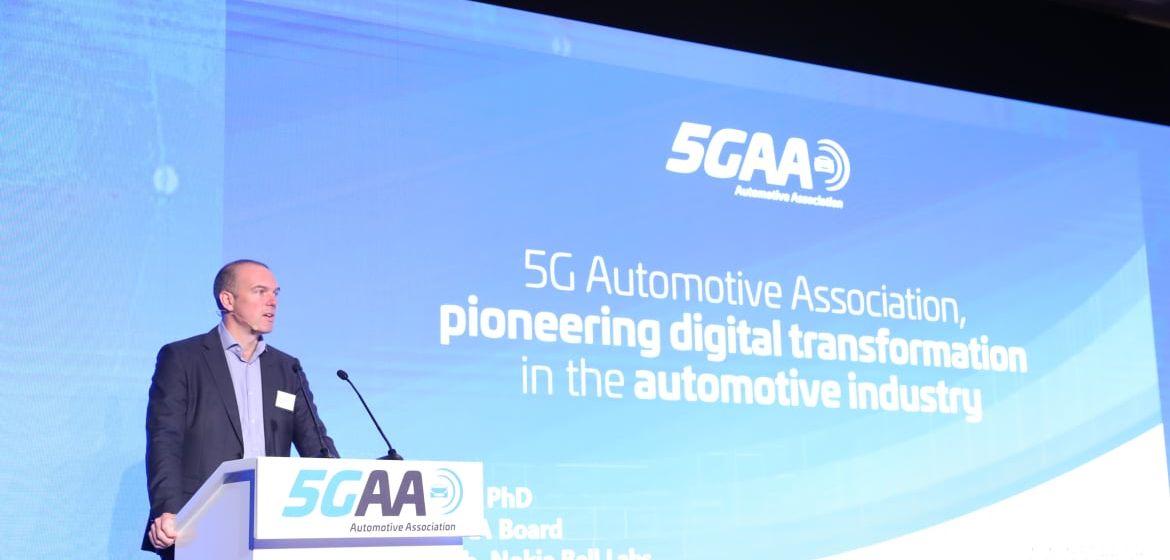
On Thursday 28 June, the 5G Automotive Association organised a roundtable discussion with senior Chinese government officials and member companies from the automotive and the telecommunications industries.
More than 120 attendees joined the sessions and discovered the latest progress made in China and around the globe for the commercialisation of the Cellular-Vehicle-to-Everything (C-V2X) technology on roads.
Beyond discussing the accelerated launch of C-V2X, the roundtable provided a good platform to highlight the continuous support of 5GAA in the implementation of connected mobility with cellular-based technologies in China and worldwide.
The presentations made during the roundtable are downloadable here below:
- 5GAA Opening Speech – Thierry Klein
- Industry perspective and insights on C-V2X in China
- Global industry perspective:

5GAA Supports Accelerated Deployment of C-V2X in China at MWC Shanghai 2018
28 June, Shanghai, China – The 5G Automotive Association (5GAA), with the strong support of the telecommunications and automotive industries and senior Chinese government officials, presented the latest progress to deploy Cellular-Vehicle-To-Everything (C-V2X) on China’s roads, as well as across the globe, leading the efforts to deliver future connected mobility solutions. The discussion took place during a 5GAA roundtable at the Mobile World Congress in Shanghai.
China’s government officials support immediate deployment of C-V2X
China has been a trailblazer in adopting C-V2X, remaining at the global forefront of rolling out the technology. At the 5GAA “Connected Mobility in Action” roundtable, Ce Zhao, Director of High-Tech Department of Science & Technology Division of MIIT, delivered a keynote address on China’s strong commitment in ensuring the investment, testing, and development of C-V2X. Mr. Zhao announced China’s initial spectrum planning for LTE-based C-V2X in 5905~5925MHZ, and provided updates on the country’s national industry strategy, onsite testing, and deployment plan, as well as the country’s national level cooperation for C-V2X.
The Ministry of Transport’s (MOT) Vice Director of Research Institute of Highway, Mr. Lin Wang, also made a presentation providing updates on China’s intelligent highway progress, as well as test environments and scenarios.
Mr. Zhiqin Wang, Vice President of the China Academy of Information and Communications Technology (CAICT) and Chairman of IMT 2020 highlighted the fruitful progress on China’s standards, test framework and verification plan for C-V2X, stating, “Both standard and industry progress shows China’s readiness for full-scale deployment of C-V2X.”
Strong engagement from industry stakeholders as well
China’s industry stakeholders are also strongly committed to making C-V2X on roads a reality. Leading telecommunications and automotive companies in China are conducting product testing to prepare for the commercial deployment of C-V2X. With commercial chipsets ready to hit the road and various demonstration in the making this year, the path towards the deployment of C-V2X is imminent.
Dr. Dang Xiang, Deputy General Manager of Research and Advanced Technology Department at SAIC Motor and Alternate Board Member of 5GAA, presented during a keynote speech the latest industry advances for the deployment of the technology, including the current leading development of C-V2X and architecture of future mobility with the fusion of internet, transportation and vehicles based on C-V2X.
“SAIC Motor is currently transforming from the traditional OEM to the green smart mobility service provider. C-V2X is one of the key technologies to future mobility and SAIC Motor will cooperate with other C-V2X eco-system partners to accelerate the commercialization of C-V2X,” said Dr. Dang Xiang.
In addition to the progress made at a corporate level, companies such as SAIC Motor and China Mobile have been actively involved in 5GAA in developing the framework, required standards, and the business case for C-V2X and 5G future connected mobility services.
“China Mobile is proud to be part of the 5G Automotive Association. We are an active member of the association and strongly believe that by collaborating with the World’s largest Telecommunications and Automotive companies under the same roof, we will create solutions that will better address society’s transport needs and will help pave the way for a more connected mobility World,” said Gang Huang, Vice President of China Mobile Government and Enterprise Service Company.
Accelerating the deployment of C-V2X around the globe
C-V2X presents an unprecedented opportunity: the ability for vehicles to share real-time safety information and “communicate” with other vehicles, pedestrian, city infrastructure, and the networks will ultimately make transportation safer and more enjoyable.
5GAA member companies demonstrated the many benefits of C-V2X during an exciting panel discussion. The panel was comprised of: Julius Marchwicki, Director, Asia-Pacific, Connected Vehicles and Services at Ford Motor Company; Luke Ibbetson, Senior Director of Vodafone and member of the 5GAA Board; Thierry Klein, Head of Disruptive Innovation Program at Nokia Bell Labs and Vice Chair of the 5GAA Board; and Ed Tiedemann, SVP of Engineering, Qualcomm Technologies, Inc.
All panelists shared their views on the current challenges, opportunities, and next steps in the continued development of C-V2X in other regions such as Europe and North America. They also discussed how C-V2X and its evolution to 5G will play a critical role across the automotive and other industries.
Ed Tiedemann, SVP of Engineering, Qualcomm Technologies, Inc. discussed C-V2X trials in the US. He presented the C-V2X direct communication demonstration organised with 5GAA, Audi, Ford and Qualcomm Technologies this April in Washington D.C. The demonstration showcased the benefit of using C-V2X real-time direct communications for vehicle-to-vehicle (V2V) collision avoidance and vehicle-to-infrastructure (V2I) for improved road safety and traffic efficiency by using 3GPP Release 14 C-V2X direct communications and upper layers as developed by SAE to transmit messages in support of six use cases.
“C-V2X is ready for deployment: China is giving the green light, now it is up to the other regions to accelerate as well,” concluded the panel moderator, Dr. Maxime Flament, Chief Technology Officer of 5GAA.
5GAA provider of a platform for debate for key stakeholders
5GAA presence at this year’s MWC Shanghai last week was successful in outlining the association’s vision in being a global player in facilitating thought leadership platforms for relevant stakeholders driving towards building a better mobility ecosystem.
Join the connected mobility conversation on Twitter @5GAA_Official
5GAA @ Mobile World Congress Shanghai 2018
5GAA C-V2X Workshop and Demonstration – 10 July 2018 – Paris, France
SAVE THE DATE
5GAA C-V2X Workshop and Demonstration
10 July 2018
Paris, France

The 5G Automotive Association (5GAA) are pleased to announce our next Workshop and Demonstration with the support of PSA, Ford and BMW. to present and showcase Cellular-Vehicle-to-Everything (C-V2X) technology to European transport stakeholders including EU Member States Ministries, Road Traffic Authorities & Road Operators, as well as a wide array of interest groups and industry representatives.
With the support of UTAC-CERAM, this interactive Workshop and Demonstration is intended to advance the dialogue between automakers, technology providers, mobile network operators and the overall transportation community on the capabilities, timeline and deployment models for Cooperative Intelligent Transport Systems (C-ITS) in Europe.
This event will also showcase the most recent developments and deployment initiatives around C-V2X, paving the way towards 5G for the uptake of Cooperative, Connected and Automated Mobility (CCAM).
About 5GAA
The 5G Automotive Association (5GAA) is a global cross-industry organisation of companies from the automotive, technology and telecommunications industries (ICT), working together to develop end-to-end solutions for future mobility and transportation services.
Created in 2016, the Association is comprised of over 80 members whose mission is to develop, test and promote communications solutions, initiate their standardisation and accelerate their commercial availability and global market penetration, to address society’s connected mobility and road safety needs with applications such as automated driving, ubiquitous access to services and integration into smart city and intelligent transportation.

C-ITSEU
The Delegated Act currently being drafted by the European Commission will have a significant impact on the future deployment of Cooperative Connected and Automated Mobility in Europe. It will regulate the deployment of Cooperative Intelligent Transport Systems (C-ITS), which enable the communication between vehicles, infrastructure and with other road users.
5GAA is a proponent of Cellular-Vehicle-to-Everything (C-V2X), a unified technology platform for connected vehicles, including connectivity to vulnerable road users and infrastructure, encompassing LTE-V2X and 5G-V2X. C-V2X technology thus offers a direct evolution path to 5G.
As illustrated below, C-V2X includes both direct short-range communication in the 5.9 GHz ITS spectrum band (not requiring network coverage or subscription) and long-range communication in licensed spectrum allocated for 4G and 5G, into a single, cost-effective platform.

While 5GAA fully shares the European Commission’s objective to “make Europe a world leader in the deployment of connected and automated mobility”[1], 5GAA is very concerned that the Delegated Act will rule out C-V2X, the most recent technology for C-ITS.
5GAA strongly advocates for a forward-looking C-ITS regulatory framework, allowing technology neutrality and evolution. The future requirements should ensure an effective, cost-beneficial and proportionate regulatory framework, as per the Commission’s Better Regulation guidelines, ultimately improving road safety, traffic efficiency and air quality, while fostering innovation.
5GAA believes that the future Delegated Act should abide in all its dimensions by the technology neutrality principle to prevent unfair market distortion. This principle should be respected in letter and spirit: requirements, standards or specifications governing the deployment of C-ITS should be non-discriminatory, avoiding any technology lock-in.
The deployment of different connectivity solutions, including C-V2X, should be allowed and embraced by the Delegated Act, on par with any other technology.
[1] “On the road to automated mobility: An EU strategy for mobility of the future” COM(2018) 283
Washington Wrap-Up video – 05 May 2018
5GAA to introduce “Connected Mobility in Action” at the Mobile World Congress – Shanghai 2018
The 5G Automotive Association (5GAA) will lead the field of connected mobility in the upcoming Mobile World Congress in Shanghai, from 27-29 June 2018.
On Thursday 28 June, the association will host a roundtable discussion with preeminent Chinese government officials. The focus of this forum will be to present their progress in preparing the commercialisation of the Cellular-Vehicle-to-Everything (C-V2X) technology on China’s roads and to discuss the advances in other regions. This event provides a great opportunity to get updates on the current situation and get important insights from both officials and key industry players.
China has been a trailblazer in adopting C-V2X, remaining at the global forefront of rolling out the technology. Since its founding in 2016, 5GAA has collaborated extensively with Chinese organisations and regulators, leading to a strong working relationship and a large representation of Chinese members within the association.
Beyond discussing the accelerated launch of C-V2X in the Chinese market, the roundtable will further reinforce this relationship, supporting the implementation of connected mobility with cellular-based technologies including the future 5G network.
The MWC Shanghai is the premier industry event in Asia for mobile technology advancement. Following the association’s participation at MWC Barcelona this February, 5GAA is proud to continue the facilitation of such thought leadership platform for relevant stakeholders, driving towards building a better mobility ecosystem.
Join us on Thursday 28th June from 09:00 to 13:00 at the Kerry Hotel Pudong at the MWC Shanghai.
Apply here to attend the session

5GAA | Presents C-V2X Workshop for North American Transportation Planning and North American Road Operators
On the 26th April in Washington D.C, the 5G Automotive Association presented its vision for a connected future during a C-V2X Workshop for North American transportation planning and road operations communities (State DOTs, MPOs, and local agencies).
The main objective of the workshop was to helped jumpstart the dialogue between technology providers, cellular network operators and the transportation community on the capabilities, timeline and the potential role of cellular technologies in transportation systems management and operations (TSMO).
During the workshop, questions from stakeholders and technology providers were addressed and the 5GAA presented the next steps to realize the promise of C-V2X on our roads.
The presentations made during the Workshop are downloadable here below:
1. C-V2X Workshop and Demonstration for North American Transportation Planning and Road Operator Community– Qualcomm
2. 5GAA pioneering digital transformation in the automotive industry – 5GAA Chairman
3. The C-V2X Proposition – Ford
4. 5G Perspective on Connecting Cars – Strategy Analytics, Inc
5. Connected Vehicle Implementation Activity in Northern Virginia – Virgina Tech Transport Tech
6. V2X Product Life Cycle Management– Savari
7. Economics of C-V2X The Mobile Network Operator and Support for Alternative Deployment Models – AT&T
8. Six C-V2X Demonstrations