
Roadmap to 5G Connected Driving – Financial Times Digital Dialogue sponsored by 5GAA
On 20 October 2020, the 5G Automotive Association took part in one of the Financial Times Digital Dialogues moderated by Michael Pooler, Manufacturing Editor at Financial Times.
A successful and insightful session focused on the “Roadmap towards 5G Connected Driving”.
Oliver Bahns, Senior Vice-President Connected Mobility Deutsche Telecom AG, T-Systems, Digital Solutions; Kelei Shen, CTO Harman; and Stephan Durach, Senior Vice President, Connected Company Development, Technical Operations, BMW Group, highlighted the most critical issues around V2X Services.
Some of the topics covered were:
- What are the most prevalent and common features of connectivity currently available in the field of vehicles-to-everything?
- Why is the automotive sector such an attractive prospect for 5G? Why does full connectivity of cars with everything require 5G as opposed to 4G?
- What are the most exciting emerging technological advances in 5G and V2X?
- What are the technological obstacles and how are they being overcome?
Rewatch the full session below.

Environmental Benefits of C-V2X
There is increased interest in the potential environmental benefits of C-V2X, given that substantial transport emissions reductions are required to help mitigate climate change, and the upcoming EC Strategy on Sustainable and Smart Mobility which intends to propose matching measures to the “unprecedented ambition to achieve 90% reduction in emissions by 2050”. The question is to what extent connected driving, with increasing levels of automation, can lead to environmental benefits. 5GAA, the 5G Automotive Association, asked TNO to conduct a study into the environmental effects of V2X communication as it is currently used in transport and as it can be used in future implementations.
Read the full study
Presentation of the study

5GAA Releases New 2030 Roadmap for Advanced Driving Use Cases, Connectivity Technologies and Radio Spectrum Needs
BRUSSELS, 8 September 2020 – In the next two to three years, the 5G Automotive Association’s (5GAA) expects to see mass deployment of vehicle-to-everything (V2X) use cases geared towards improving traffic efficiency and road safety around the world. This vision is outlined in a new White Paper released by 5GAA which explores how leading automakers, mobile
network operators and their suppliers see the world of automotive connectivity evolving over the coming decade.
Vehicles talking to one another but also to roadside and telecom infrastructure and operators – so-called V2X communication – is just the tip of 5GAA’s vision for ‘advanced 5G-connected driving’. In its latest White Paper, 5GAA offers a comprehensive roadmap to guide all parties involved in this near-term market development, bringing both automotive and telecom sectors together to fulfil what 5GAA sees as a powerful digital ecosystem in this fast-moving field.
The Paper highlights selected end-to-end V2X applications factoring in the necessary technological evolution, industry readiness and spectrum needs. 5GAA has developed ‘advanced driving’ use cases such as Cooperative Manoeuvres and Sensor Sharing in conjunction with both the adoption of Cellular Vehicle-To-Everything (C-V2X) standards and the availability of the required technologies and devices. These provide a tangible account of how advanced driving is taking shape globally.
“Success in this endeavour requires to have all industry stakeholders on-board, including telecoms and automotive. Only then will new business opportunities and necessary investments be secured to fuel this ‘ecosystem’,” said 5GAA’s CTO and spokesperson Maxime Flament upon the White Paper’s launch.
With close to 200 million ‘connected vehicles’ already on the roads worldwide in 2020 and a growing number of vehicles with the ability to exchange traffic and road condition information over cellular networks, the foundations for 5G-connected driving are well established, the Paper points out. Further progress in coming years will pivot around 5G-V2X use cases for more efficient and safe driving. From 2025 onwards, 5GAA anticipates mass rollout of more advanced automated driving and safety use cases supported by vehicle connectivity. Additional automated driving functionalities are anticipated as from 2026.
Between now and 2024, ‘connected’ digital road infrastructure will pave the way for real-time or ‘dynamic’ traffic updates, hazard warnings, and high-definition mapping services. Towards 2026, advanced vehicle-to-vehicle (V2V) cooperation will further boost automated driving developments, including sharing sensor data and cooperative manoeuvring.
To fully support this evolution, 5GAA calls on national and regional administrations to make sufficient radio spectrum available for mobile communication networks in targeted low- and mid-bands, and it recommends harmonised use of the 5855-5925 MHz band for communication between road users and roadside infrastructure within the wider international digital traffic ecosystem.
Here, the White Paper acknowledges that some 5G-enabled applications may prove challenging to implement, while others will be easier and offer valuable lessons going forward: “Low-hanging fruit applications addressing OEM fleets, such as automated valet parking and tele-operated driving will open the door to more secure, safe and interoperable vehicle-to-network automotive applications across borders.”
Charting a clear way forward…
All in all, to deliver end-to-end V2X services and unlock the true value of vehicle connectivity, 5GAA considers that the realisation of its roadmap would require:
(1) sufficient spectrum for short-range direct communications at 5.9 GHz
(2) high levels of mobile network coverage along the roads
(3) sufficient service-agnostic mobile network spectrum for mobile network-based communications, in addition to the bands that are currently identified for International Mobile Telecommunications (IMT) use.
The essence and great promise of 5G is that it makes better use of the radio spectrum, boosts mobile network coverage, security and safety, while delivering environmental benefits for citizens and consumers. To chart a clear way forward, 5GAA calls on all players to work together while implementing the use cases highlighted in the Paper, as well as other measures outlined in 5GAA technical reports and papers.
About 5GAA
The 5G Automotive Association (5GAA) is a global, cross-industry organisation of companies and OEMs from the automotive, technology and telecommunications industries working together to develop end-to-end solutions for future mobility and transportation services. 5GAA is uniquely placed to support 5G-V2X advances because it unites all major automotive, chipset, technology, telecom-mobile infrastructure and mobile network operators. In less than three years, more than 135 global players, including pioneering OEMs, have signed up to 5GAA’s vision.
For more information, please contact our media team at marcom@5gaa.org
Download the Roadmap
5GAA officialises five new MoUs during Brussels conference
Is 5G in-car technology ready for automated driving? Are Europe’s roads up to speed for this digital revolution? Are governments, road authorities and industry on the same page? What is Europe’s strategy to secure leadership and capture markets in the field? These and other pressing questions and challenges for connected and automated mobility were addressed on 6 February, at the 5GAA-hosted event – 5G, Igniting the Connected and Automated Mobility Revolution – in Brussels’ Concert Noble. High-level representatives and experts from industry, governments and the EU explored the capabilities, deployment models and vast opportunities of the latest ‘cellular vehicle to everything’ (C-V2X) technology.
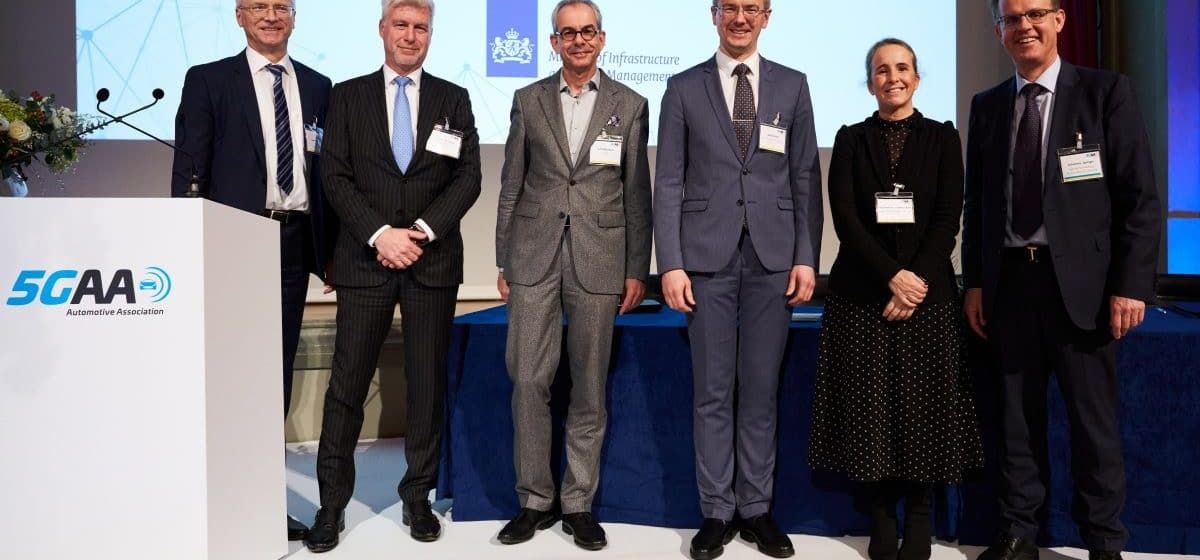
BRUSSELS, 6 February 2020 – The 5G Automotive Association (5GAA) organised a conference bringing together EU representatives and the connected automotive ecosystem to the heart of Europe, to officialise its public-private partnerships with several European authorities. Indeed, 5GAA announced extending its partnership network by signing Memoranda of Understanding with the Dutch Ministry of Infrastructure and Water Management, the Italian Ministry of Technological Innovation and Digitalisation, the Spanish Directorate-General of Traffic (DGT), the German Federal Highway Research Institute (BASt) and the Electronic Communication Office of Latvia (VASES). The ambition of the association is to strengthen the collaboration between industry and the public sector and to facilitate the dialogue to drive innovation in mobility and transport with these closer collaborations.
Some recognised speakers at the conference included BMW’s Joachim Göthel, Senior Manager in the German automaker’s ‘Project 5G Alliance’, and Dino Flore who is Vice-president of Technology at Qualcomm, the US chipmaker, as well as Robert MacDougall who heads mobile operator Vodafone Enterprise’s Public Policy Unit. They were joined by senior EU policymakers, including a message from Maria Koleva on behalf of the European Commissioner for Innovation, Research, Culture, Education and Youth Mariya Gabriel and speech by Pearse O’Donohue, Director for Future Networks, Directorate-General for Communications Networks, Content and Technology, as well as national experts from the Netherlands and Spain giving their unique perspective.
“To fulfil its potential in connected and automated mobility, Europe really needs a clear policy message reinforcing its ‘technology neutral’ approach in the future C-ITS regulations,” noted 5GAA’s CTO and spokesperson Maxime Flament.
Automated and connected driving, intelligent driver assistance and data-driven transportation network optimisation are examples of what tomorrow’s transportation will look like for people and governments.
Discussions and conclusions reached at the 5G, Igniting the Connected and Automated Mobility Revolution conference thus paint a rich picture of the work currently underway and the roadblocks and potential detours that may lie ahead. With the help of audience contributions, the event helped to chart the way for future autonomous transport that not only meets the needs of society and industry but can also make a positive contribution to meeting the global Sustainable Development Goals in terms of cleaner and safer transportation.
About 5GAA
The 5G Automotive Association (5GAA) is a global, cross-industry organisation of over 130 members comprised of leading global automakers, Tier-1 suppliers, mobile operators, semiconductor companies and test equipment vendors. It works together to develop end-to-end solutions for future mobility and transport services. 5GAA is committed to helping define and develop the next generation of connected mobility, automated vehicle and intelligent transport solutions based on C-V2X.
Learn more on the 5GAA website and follow us on Twitter and LinkedIn.
Media Contacts
Delia Voica
Tel.: +32 486 69 76 22
Email: delia.voica@5gaa.org
Marketing and Communications Team
Email: marcom@5gaa.org

Turin Demonstrations Wrap-up Video – 14 November 2019
On 14 November 2019, the 5G Automotive Association (5GAA) showcased ready-to-deploy use-cases in the streets of Turin, Italy during a live demo event. A sneak preview of what the future has in store took place on the renowned Lingotto rooftop test track.
Prominent members and partners of the 5GAA including Fiat Chrysler Automobiles, Audi, Continental, Ericsson, Harman Samsung, Marelli, Pirelli, Qualcomm, TIM and Vodafone demonstrated the current state of C-V2X and the road to future, Vehicle-to-Vehicle (V2V), Vehicle-to-Infrastructure (V2I), and Vehicle-to-Network (V2N) applications based on 4G LTE and 5G.
Turin Demonstrations Wrap-up Video – 14 November 2019
On 14 November 2019, the 5G Automotive Association (5GAA) showcased ready-to-deploy use-cases in the streets of Turin, Italy during a live demo event. A sneak preview of what the future has in store took place on the renowned Lingotto rooftop test track.
Prominent members and partners of the 5GAA including Fiat Chrysler Automobiles, Audi, Continental, Ericsson, Harman Samsung, Marelli, Pirelli, Qualcomm, TIM and Vodafone demonstrated the current state of C-V2X and the road to future, Vehicle-to-Vehicle (V2V), Vehicle-to-Infrastructure (V2I), and Vehicle-to-Network (V2N) applications based on 4G LTE and 5G.

5GAA Releases White Paper on Making 5G Proactive and Predictive for the Automotive Industry
We are at the dawn of a new era of mobility. Future intelligent transportation systems will provide tremendous benefits to people and society in terms of lives saved, increased time and money efficiencies, reduced environmental impact, as well as better utilization of the global road and highway networks. Automated and connected driving, intelligent driver assistance and data-driven transportation network optimisation are examples of what tomorrow’s transportation will mean for people and governments. A key enabler of this development is that mobile networks fulfil the requirements of future transportation.
5G Automotive Association (5GAA) has developed the concept of predictive Quality of Service (QoS), which is a mechanism enabling mobile networks to provide advance notifications about predicted QoS changes to interested consumers. This makes it possible to adjust application behaviour before the predicted QoS change takes effect, which is important to certain automotive use cases, such as remote and autonomous driving.
The concept of predictive QoS is spreading in the industry and among standards- developing organizations (SDO). It is, therefore, of interest to achieve a common understanding of what predictive QoS is – what problems it addresses, as well as how they are addressed.
This White Paper describes predictive QoS in order to reach a common understanding.
You can find the white paper here.

5GAA in Action
The 5G Automotive Association (5GAA) is a global, cross-industry organisation of 128 members made of leading global automakers, Tier-1 suppliers, mobile operators, semiconductor companies and test equipment vendors. It works together to develop end-to-end solutions for future mobility and transport services.
5GAA is committed to defining and developing the next generation of connected mobility, automated vehicle and intelligent transport solutions based on C-V2X.
Learn more about what actions the associations are taking in the video.
5GAA in Action
The 5G Automotive Association (5GAA) is a global, cross-industry organisation of 128 members made of leading global automakers, Tier-1 suppliers, mobile operators, semiconductor companies and test equipment vendors. It works together to develop end-to-end solutions for future mobility and transport services.
5GAA is committed to defining and developing the next generation of connected mobility, automated vehicle and intelligent transport solutions based on C-V2X.
Learn more about what actions the associations are taking in the video.
5GAA live demos show C-V2X as a market reality
Turin, 14 November 2019 – Smart mobility technology is a reality today, with ‘Cellular Vehicle-to-Everything’ (C-V2X) allowing connected vehicles to communicate with the cloud, directly with each other and their surroundings. Deployment plans are primarily sustained by the global trend in the automotive industry to adopt 4G LTE cellular technology, followed by the emerging 5G high-speed low latency communications. Beyond infotainment, C-V2X will capitalize on vehicular and smartphone connectivity to contribute to better safety, less congestion and reduced emissions.
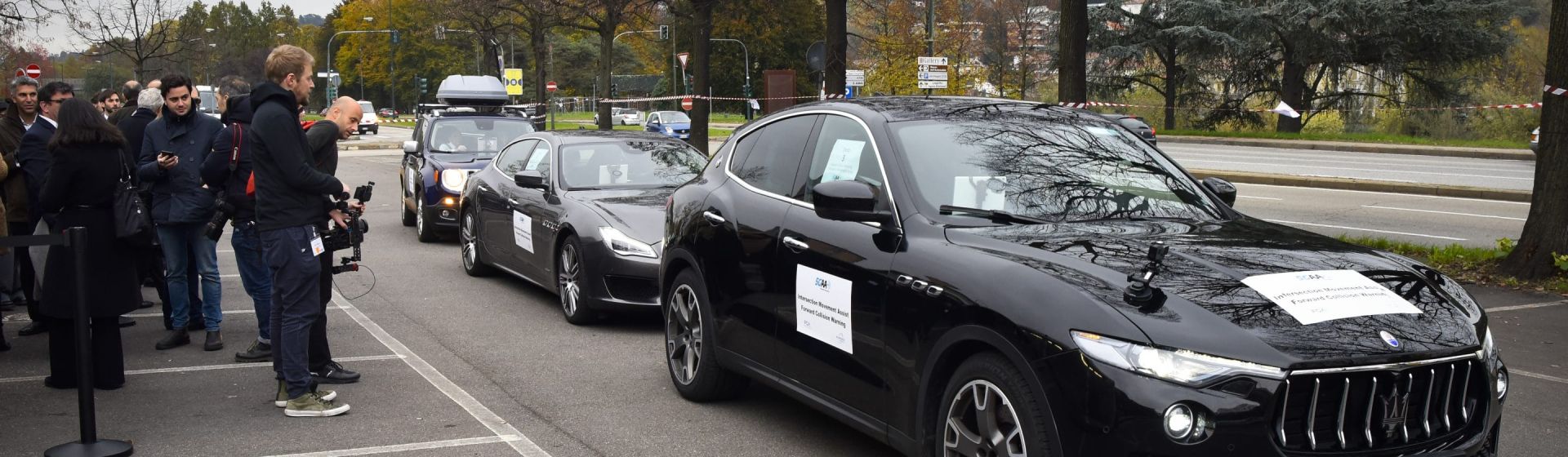
During a live demo event in Turin, the 5G Automotive Association (5GAA) showcased ready to deploy use cases in the streets of the city and a sneak preview of what the future has in store on the renowned Lingotto rooftop test track.
Prominent members and partners of the 5GAA including Audi, Continental, Ericsson, Fiat Chrysler Automobiles, Harman Samsung, Marelli, Pirelli, Qualcomm, TIM and Vodafone demonstrated the current state of C-V2X and the road to future, Vehicle-to-Vehicle (V2V), Vehicle-to-Infrastructure (V2I), and Vehicle-to-Network (V2N) applications based on 4G LTE and 5G.
“Connected mobility is a market reality.” says 5GAA Chief Technology Officer, Dr. Maxime Flament. “The use cases demonstrated in the streets of Turin are planned for deployment with a huge industry momentum based on the evolution path to 5G capabilities.”
Using both direct short-range communications and mobile networks, the open-road demonstrations showcased the extensive capabilities of today’s C-V2X technology, ready for deployment. To name a few:
- Protecting vulnerable road users, for instance, by alerting drivers about a pedestrian at a crossing using LTE-connected infrastructure.
- Smoothing traffic by allowing public authorities and road operators to provide real-time warnings to drivers in urban environments concerning roadworks or speed limits, via the network.
- Preventing incidents at dangerous intersections or in the event of unexpected braking, thanks to C-V2X direct-short range communications between vehicles.
The track demonstrations at Lingotto underlined the enhanced safety benefits that can be expected thanks to the versatility of 5G and the wide range of services it enables. To name a few:
- Vehicles will geo-tag dangerous areas for the following cars or provide ‘see-through’ functions to avoid dangerous overtaking.
- Pedestrians will be detected directly via their smartphones and surrounding vehicles will be warned.
- In case of accidents, emergency services will be able to visualize the situation live using on-board cameras of surrounding vehicles, improving response times and providing emergency responders situational awareness prior to arriving at the crash scene.
Furthermore, Intel showcased an “In Vehicle Entertainment” demo at the Museum, in collaboration with Marelli, TerraNet and Equinix, showing how Multi-Access Edge Computing (MEC) can support immersive high-definition (HD) entertainment for all occupants of a moving vehicle, including video streaming, gaming, virtual reality (VR), office work, online education, advertisement.
A short summary on each of the 5GAA C-V2X use cases, demonstrated today in Turin
Demo 1 “Vulnerable Road Users”: open road demos on safety
In this trial – which is part of Torino Smart Roads Initiative patronized by the Municipality of Turin – TIM, Links Foundation and Luxoft showed how the communication between the various actors moving along the roads can help in detecting potentially dangerous situations. The goal of the demos was to demonstrate how the 5G mobile network facilitates the protection of Vulnerable Road Users: pedestrians (“Presence of a pedestrian on a crosswalk”) and cyclists (“Presence of a connected bike on the road”). In the case of a pedestrian approaching a crosswalk, a Roadside Unit connected to the mobile network, equipped with a camera able to detect the event, sent a warning message to the nearby connected vehicles (I2V communication). In the case of a connected bike and a connected vehicle that are approaching each other, the two vehicles received a warning message about their presence when a risk of collision is detected.
Demo 2 “Urban Georeferenced Alerting” in open roads
TIM, FCA, Links Foundation, City of Turin with 5T, and Politecnico di Torino showed how the Local Traffic Authority in Turin intends to notify drivers in real time of possible dangers and special situations on the road (traffic jam, road works warning, dynamic speed limit, etc.). A standard geo-referenced warning message was dispatched to a TIM AMQP broker” at the edge of the 5G mobile network and only the involved vehicles received the geo-localized message from the AMQP Broker using the TIM 5G Network. The warning was read and displayed in an FCA vehicle through the on-board HMI and can for instance notify the driver of upcoming speed reduction. The aim of the trial was to demonstrate how the TIM 5G Network is suitable for realizing smart roads services for connected cars. The solution is compliant with the standards so it can be applied in other locations covered with mobile networks.
Demo 3 Intersection Movement Assist (IMA), Forward collision Warning (FCW)
FCA and Harman Samsung showcased two Vehicle to Vehicle (V2V) demos, by integrating C-V2X direct-short range communication into Maserati Levante and Quattroporte. The vehicles, through a direct radio link (network-less radio link), anonymously communicated basic information such as their position and related direction.
The Forward Collision Warning (FCW), detected possible frontal collision and warned the driver accordingly. The Intersection Movement Assist (IMA), assisted the driver at the cross junctions to avoid a possible lateral collision with an oncoming vehicle.
Demo 4 Emergency Electronic Brake Light (EEBL), Stationary Vehicle Warning (SVW)
FCA, Continental, and Qualcomm demonstrated fast and reliable information exchange between vehicles in emergency situations. The two demos are based on C-V2X direct-short range technology, enabling Vehicle-to-Vehicle (V2V) communication between two Jeep Renegade. There were two portions to this demo:
- “Stationary Vehicle Warning” (SVW): when the hazard lights are activated, the application broadcasted a message to all nearby vehicles so that approaching vehicles could be informed even if the hazard was not visible.
- “Emergency Electronic Brake Light warning” (EEBL): in the event of a sudden braking, the application broadcasted a message to following vehicles, such that approaching vehicles were notified of the potentially dangerous situation.
Demo 5 See-through
Vodafone, FCA, Vodafone Automotive, Marelli and Altran revealed the ‘See Through’ that uses C-V2X long-range cellular network communication to exchange streamed video in real time between vehicles, extending the driver’s visual range under obstructed visibility scenarios and to prevent accidents, especially those that may occur in an overtaking phase. The two involved Jeep Renegades vehicles were equipped with a connectivity solution (Marelli) and high frame-rate cameras (Marelli Motorsport) to detect the road lanes.
A real time tracking system and a space mapping algorithm of the vehicles, specifically developed by Vodafone Automotive, allowed Vodafone’s Multi-access Edge Computing (MEC) to dynamically manage and route the video flows on the basis of the vehicles’ relative positions and to ensure minimal end-to-end latency in the interest of drivers’ safety. Vodafone 5G ultra-low latency and high reliability were paramount to ensure the flow and synchrony of the real-time video exchange between vehicles, also under high traffic and cell saturation conditions.
Demo 6 World-first 5G-enhanced ADAS services
Audi, Ericsson, Italdesign, KTH, Pirelli, Qualcomm, TIM and Tobii showed how smart cars, commercial 5G smartphones and 5G networks jointly improve comfort, safety and efficiency. This unique collaboration combined the power of eye-tracking glasses, intelligent tires, in-vehicle augmented reality and 5G phones to work together over a live 5G network. With its high capacity and low latency, cellular 5G connectivity is ready to enable instantaneous cooperation between vehicles, the IoT ecosystem and more advanced driver assistance services. The live demonstrations at the Turin Lingotto test track were based on TIM’s commercial 5G network delivered in Turin in partnership with Ericsson. Audi cars, equipped with Pirelli Cyber Tyre, and embedded 5G modems provided by Qualcomm and available 5G smartphones were utilized to enhance pedestrian’s safety.
About 5GAA
The 5G Automotive Association (5GAA) is a global, cross-industry organisation of over 130 members comprised of leading global automakers, Tier-1 suppliers, mobile operators, semiconductor companies and test equipment vendors. It works together to develop end-to-end solutions for future mobility and transport services. 5GAA is committed to helping define and develop the next generation of connected mobility, automated vehicle and intelligent transport solutions based on C-V2X.
Learn more on the 5GAA website and follow us on Twitter and LinkedIn.
Media Contacts
5GAA Marketing & Communications
Email: marcom@5gaa.org
Official pictures: Conference – Demonstrations