
Community
Projects Advisory
The 5G Automotive Association (5GAA) is a global association with over 100 member companies from the automotive and telecommunications industries. Partners who are active in the broader telecommunications and automotive ecosystem, such as universities, research bodies, associations, and public authorities also joined the ecosystem. Each of the 5GAA members bring added value to the 5GAA mission through their contributions and visionary mindset. Together, the key partners foster collaboration and exchange to path the way towards the new mobility era.
Projects
European Projects
5GCAR

The Fifth Generation Communication Automotive Research and innovation, 5GCAR, is a 5GPPP Phase 2 project. The 5GCAR research and innovation initiative addresses the stringent requirements posed on the wireless communication system by bringing the fields of telecommunication and automotive closer together and investigating the benefit of 5G for demanding automotive use cases.
5G-DRIVE

The Horizon 2020 project 5G-DRIVE: 5G HarmoniseD Research and TrIals for serVice Evolution between EU and China (2018-2021) aims at trialling and validating the interoperability between EU & China 5G networks operating at 3.5 GHz bands for enhanced Mobile Broadband (eMBB) and 3.5 & 5.9 GHz bands for V2X scenarios.
5G-EVE

5G EVE is the European 5G validation platform for extensive trials. The goal is to implement and test advanced 5G infrastructures in Europe. The 5G-EVE concept is based on further developing and interconnecting existing European sites in Greece, Spain, France, and Italy to form a unique 5G end-to-end facility.
5G-MOBIX

The 5G-MOBIX project is co-financed by the European Commission within the framework of the Horizon 2020 programme. 5G-MOBIX will develop and test automated vehicle functionalities using 5G core technological innovations along multiple cross-border corridors and urban trial sites, under conditions of vehicular traffic, network coverage, service demand, as well as considering the inherently distinct legal, business and social local aspects.
5G ROUTES

5G-ROUTES is a 5G-PPP Phase 3 project whose aim is to validate through robust evidence the latest 5G features and 3GPP specifications (R.16 & R.17) of Connected and Automated Mobility (CAM) under realistic conditions. In particular, it will conduct advanced large-scale field trials of most representative CAM applications to demonstrate seamless functionality across a prominent 5G cross-border corridor (Via Baltica-North), traversing Latvia, Estonia and Finland.
5G-CroCo

The Fifth Generation Cross-Border Control, 5G-CroCo, is a 5G-PPP Phase 3 Innovation Action. 5GCroCo aims to trail 5G technologies in the cross-border corridor along France, Germany and Luxembourg. In addition, 5GCroCo also intends to define new business models that can be built on top of this unprecedented connectivity and service provisioning capacity. Ultimately, 5GCroCo will impact relevant standardization bodies from the telco and automotive industries.
5G-CARMEN

5G for Connected and Automated Road Mobility in the European Union, 5G-CARMEN, will build a 5G-enabled corridor from Bologna to Munich to conduct cross-border trials of 5G technologies in four major use cases: cooperative manoeuvring, situation awareness, video streaming, and green driving. Multi-tenancy and neutral host concepts will be leveraged to deliver a final platform capable of enabling new business models. 5G-CARMEN will complement C-V2X with LTE and C-ITS technologies, targeting interoperability and harnessing a hybrid network.
CONCORDA

The CONCORDA project, launched in October 2017 and funded by the Connecting Europe Facility, will contribute to the preparation of European motorways for connected and automated driving and high-density truck platooning, by providing adequate connected services and technologies in terms of interferences and interoperability.
Global5G

Global5G is a Coordination and Support Action within Europe’s 5G public and private partnership (5G PPP) that is working on both fronts through its focus on vertical industries and small cell deployments. It works closely with the private side of the 5G PPP – the 5G Infrastructure Association (5G-IA) to help boost impacts through diverse working groups and task force activities.
5G MED

5GMED is an innovative H2020-funded project that focuses on a sustainable 5G deployment model for future mobility in the cross-border corridor between Spain and France. Aside from the implementation of four different use cases, 5GMED’s trials seek to enhance roaming transitions across MNOs and neutral hosts for both Cooperative and Connected Automated Mobility (CCAM) and Future Railway Mobile Communications Systems (FRMCS).
NordicWay

NordicWay 2 is a C-ITS pilot project that enables vehicles, infrastructure and network operators to communicate safety hazards and other information from roads in the Nordic countries between different stakeholders. The project is a collaboration between public and private partners in Finland, Norway, Sweden and Denmark and builds on the achievements of the previous NordicWay project.
Ensemble

ENSEMBLE wants to communicate the economic, societal and environmental impact of decisions surrounding platoon forming and dissolving. ENSEMBLE also strives to modernize the transport system by finding an optimal balance between fuel consumption, emission level, travel times and impact on highway traffic flow, resulting in reduced impacts on climate change, air pollution, noise, health and accidents.
ARCADE

ARCADE is a Coordination and Support Action that coordinates consensus-building across stakeholders for sound and harmonised deployment of Connected, Cooperative and Automated Driving (CAD). It supports the development of a common approach to the development, testing, validation and deployment of CAD in Europe and beyond, and aims to establish a joint stakeholders forum in order to coordinate and harmonise automated road transport approaches at a European and international level.
5G BLUEPRINT

5G Blueprint is a H2020-funded project that aims to design and validate technical architecture, business models and governance for interrupted cross-border teleoperated transport based on 5G connectivity. Its objective is to provide a blueprint for operational pan-European deployment of teleoperated transport solutions in the logistics sector, and beyond. It explores the economics of 5G in cross-border transport and the issues of responsibility and accountability within the value chain.
STARDUST

Stardust is an H2020 Smart Cities project, which brings together exemplary models of smart, highly efficient, intelligent, and citizen-oriented cities. The project focuses on intelligent solutions for energy, mobility and ICT, to be integrated into cities together with innovative business models. One of its objectives is to create and deploy open city information platforms, that allows cities to engage actively with each other and to share information. The project’s results will serve as a blueprint for replication across Europe and abroad.
National Projects
ConVeX
Funded by the German Ministry of Transportation and Digital Infrastructure (BMVI) in the program “Automated and Connected Driving on Digital Test Fields in Germany”, the objective of the project ConVeX is to set up a testbed for the first field tests of 3GPP LTE Release 14 Cellular V2X (C-V2X) and validate its performance and feasibility.

About us
Driving the Future of Connected Mobility Solutions Together
The 5G Automotive Association (5GAA) is a global, cross-industry organisation of companies from the automotive, technology, and telecommunications industries (ICT), working together to develop end-to-end solutions for future mobility and transportation services. Created in September 2016, 5GAA has rapidly expanded to include key players with a global footprint in the automotive, technology and telecommunications industries. This includes automotive manufacturers, tier-1 suppliers, chipset/communication system providers, mobile operators and infrastructure vendors.

5GAA was created to connect the telecom industry and vehicle manufacturers to develop end-to-end solutions for future mobility and transportation services.
Mission
5GAA unites the automotive, telecommunication, and technology industries globally, turning collaboration into real-world, scalable connectivity solutions that deliver smart, safe, secure, and efficient mobility for all road users, now and in the future.
A visionary roadmap
What we do
5GAA is addressing today’s mobility key challenges. With C-V2X technology, 5GAA will revolutionise the mobility ecosystem and the way drivers interact with the world. 5GAA’s ambition is to improve the overall transportation industry to make it safer, greener and more efficient for vehicles, road users and the surrounding infrastructure.

Smarter

Sustainable

Safer

5GAA has defined 4 strategic pillars designing the short and long term goals in very diverse domains contributing to the same ambition: Connected Mobility.
Latest publications



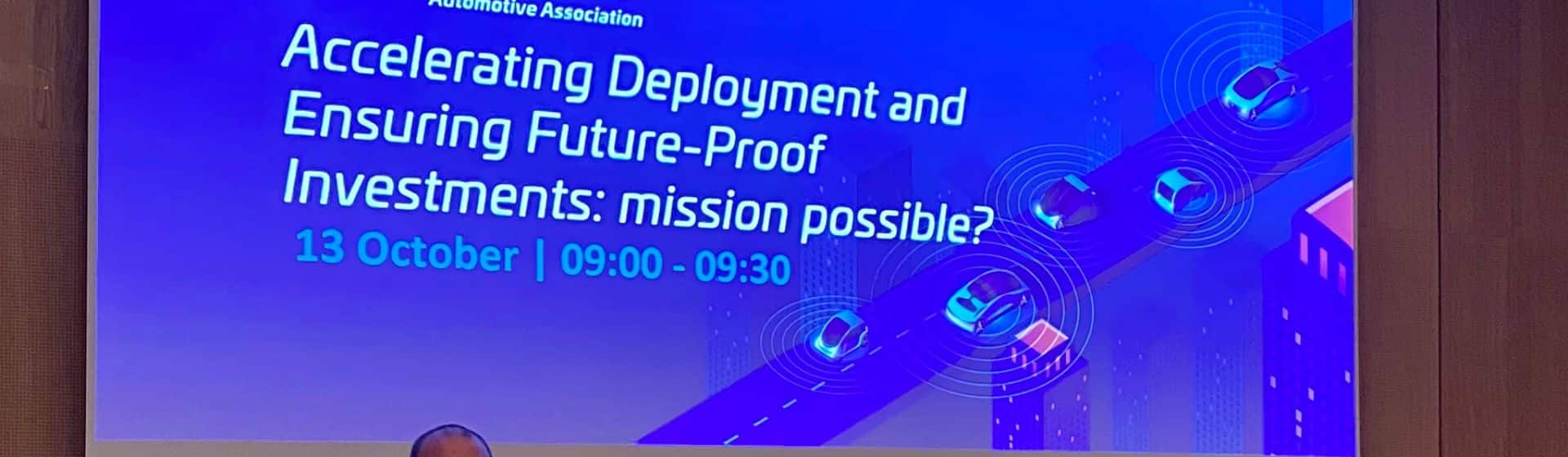
5GAA shares latest C-V2X developments at ITS World Congress (Hamburg)
5GAA shares the latest C-V2X developments at ITS World Congress (Hamburg): “5G will have the most revolutionary impact by reducing accidents and saving millions of lives.”
HAMBURG, 13 October 2021 – 5G-powered vehicles are foreseen to hit the market this year in Europe. More and more advanced vehicle-to-everything (V2X) use cases geared towards enhanced road safety, improved traffic efficiency, greener environmental impact and more comfortable driving are being deployed worldwide on a large scale. The 5G Automotive Association (5GAA) and its members showed the latest developments during ITS World Congress in Hamburg.
5G-V2X spearheading the path to automated driving
Today, the 5G-V2X (Vehicle-to-Everything) technology already enables fully connected and automated mobility with LTE-V2X technology. Vehicles and infrastructure can exchange relevant information via LTE-V2X through direct communication mode (not requiring network coverage) or mobile network communications mode, creating a real-time connection between all road users.
Many automotive services can be supported by the current global cellular standard LTE-4G, seen as an essential foundation for further progress. Millions of vehicles on the continent are connected via 4G-LTE already, and industry analysts estimate that over 70% of all new vehicles sold are now 4G equipped. That said, 5G-V2X will enable more advanced connected mobility services and offer a clear path to automated driving – while maintaining service-level interoperability with pre-existing LTE-V2X vehicles.
5GAA will help prepare tomorrow with the ITS Directive revision, advocating a neutral approach on technology. Given the strong momentum in China and in the United-States, Europe needs a future-proof framework to stay in a leading role globally. Indeed, advanced driving is taking shape globally. At the moment, China is the only country that has 5G Cellular-Vehicle-to-Everything (C-V2X) enabled vehicles commercially available on the market. To this date, 14 C-V2X vehicle models are commercialized. In the United States, Ford has committed to deploy C-V2X in all new vehicle models from early 2022. In Europe, 5G-powered vehicles are foreseen to hit the market still this year thanks to BMW.
“When applied to the automotive field, 5G will have the most revolutionary impact by saving millions of lives and reducing accidents on roads”, 5GAA CTO Maxime Flament said. “The combination of long- range and short-range connectivity C-V2X offers, delivers the optimal setup for safety and efficiency of traffic, in addition to improving environmental footprints.” Global deployment of C-V2X technology will have a sustainable impact in the world.
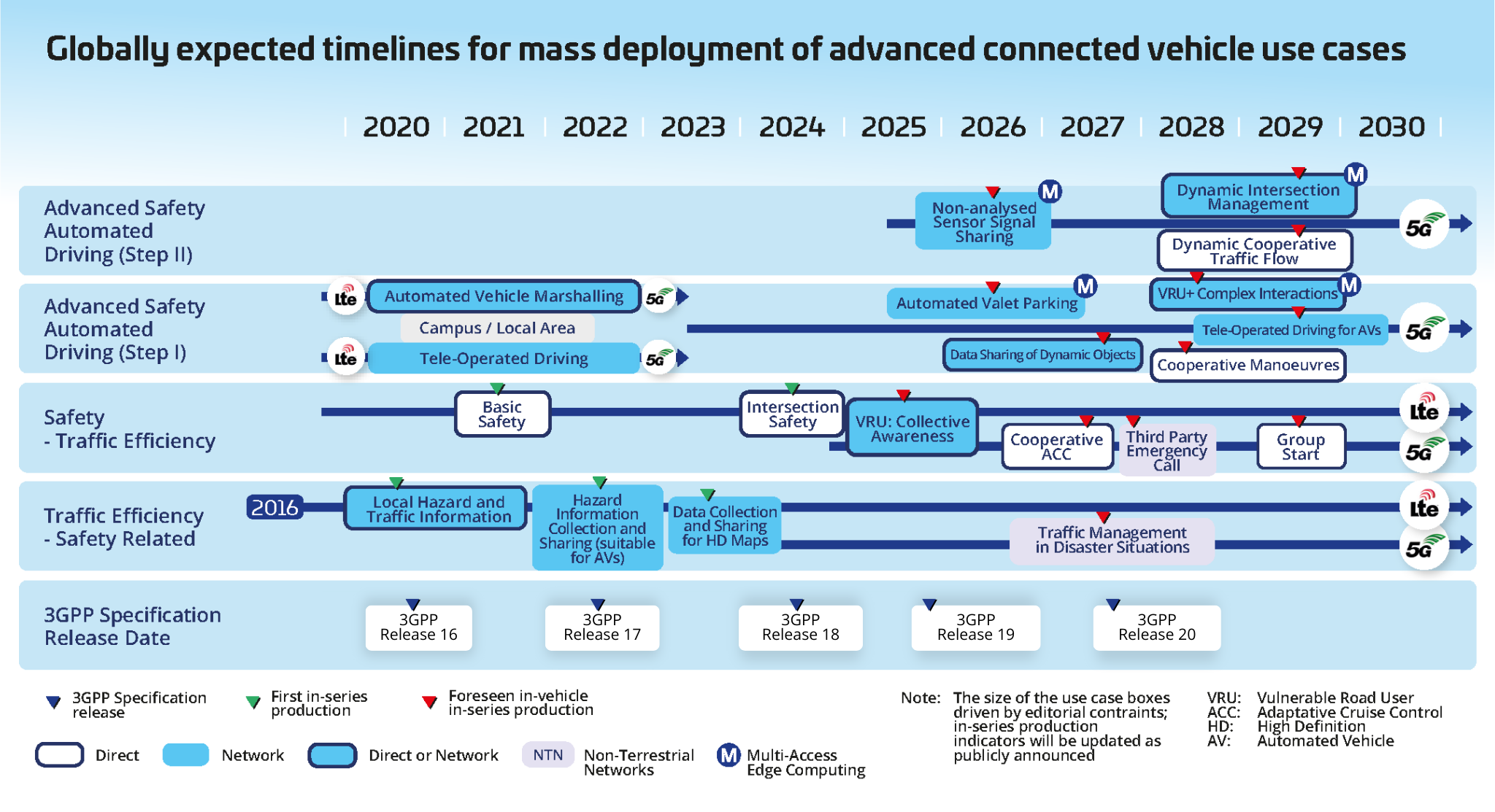
In the next two to three years, 5GAA expects to see mass deployment of C-V2X use cases geared towards improving traffic efficiency and road safety around the world. Vehicle commercialization is not enough however: the whole ecosystem – cars, cloud, map, network, positioning but also the road – needs to be C-V2X friendly. Therefore, 5GAA offers a platform to foster collaboration between top tier automotive, technology and telecommunications companies for them to develop end-to-end connectivity solutions for future mobility and transportation services.
Cover more digital roads via enhanced digital mobility services
At ITS World Congress, the world’s largest and most prominent event focused on smart mobility and the digitalisation of transportation, 5GAA experts and member spokespersons shared their views on how to accelerate deployment of the latest technology innovations and how to ensure future-proof investments. They shared the needs of road operators for their digital infrastructure and of automakers (OEMs) for digital mobility services, and zoomed in on digital roads in urban areas and cooperation models enabling deployment and use of 5G infrastructures for connected and automated mobility.
Furthermore, key members of the 5GAA shared their latest technology developments with a focus on Vulnerable Road Users (VRUs), among which:
- A system that warns of accidents between and help protect connected vehicles and cyclists – or other vulnerable road users such as pedelec, scooter riders and pedestrians developed by Continental and Deutsche Telekom. The solution calculates the paths taken by cars and bicycles. If they are likely to cross at the same time, the system warns both road users via mobile communications in real-time. Initial road tests have been successful.
- A Location-as-a-Service algorithm that improves the positioning of road users, in which vehicles exchange data via simulated communication (5G) by Fraunhofer Institute FOKUS. The aim is to warn drivers of a collision with a cyclist, an e-scooter rider of road damage, or to guide a blind person to the right government office or the bus door – for which highly accurate localization is always of fundamental importance.
- A demonstration of a connected e-bike, where Qualcomm (alongside company Spoke) is showcasing a new hardware solution designed to enable vehicles to identify VRUs using C-V2X.
And more. Request the full list of demonstrations on demand at 5GAA@teamlewis.com
Download the press release here.



Reducing EU Transport Emissions: Can C-V2X Deployment Play a Significant Role?
On 24 November, Euractiv hosted a debate to assess and discuss the benefits of C-V2X deployment in terms of emission reduction by 2050 in Europe.
TNO, a not-for-profit Dutch research institute, presented new research related to traffic efficiency, and the specific C-V2X functionalities that offer the biggest emission reductions and therefore a contribution to the EU’s climate goals ahead of the comprehensive Strategy for a Sustainable and Smart Mobility (part of the European Green Deal).
The Strategy proposes to match measures to the “ambition to achieve the 90% reduction in emissions by 2050” leveraging “digitalisation and automation, enhancing connectivity to the next level and last, but not least, it will ensure safety and accessibility”.
Read the Study
Watch the highlights
Watch the full event
Reducing EU Transport Emissions: Can C-V2X Deployment Play a Significant Role?
On 24 November, Euractiv hosted a debate to assess and discuss the benefits of C-V2X deployment in terms of emission reduction by 2050 in Europe.
TNO, a not-for-profit Dutch research institute, presented new research related to traffic efficiency, and the specific C-V2X functionalities that offer the biggest emission reductions and therefore a contribution to the EU’s climate goals ahead of the comprehensive Strategy for a Sustainable and Smart Mobility (part of the European Green Deal).
The Strategy proposes to match measures to the “ambition to achieve the 90% reduction in emissions by 2050” leveraging “digitalisation and automation, enhancing connectivity to the next level and last, but not least, it will ensure safety and accessibility”.
Read the Study
Watch the highlights
Watch the full event

5GAA supports the European Strategic Deployment Agenda for Connected and Automated Mobility
The 5G Automotive Association (5GAA) is proud to announce the publication of the 5G Strategic Deployment Agenda for Connected and Automated Mobility in Europe (EU 5G SDA for CAM), by the 5G Infrastructure Public Private Partnership (5G PPP), a joint European Commission and European ICT industry initiative.
5GAA was among the key contributors to this document which outlines the shared view of a industry and public stakeholders, including other relevant European associations (ACEA, CEDR and GSMA) and experts of the three 5G corridors trial projects, based on eight common principles to stimulate investment in 5G-ecosystems in the field of Connected and Automated Mobility:
- Deployment of the 5G infrastructure for CAM should follow an evolutionary path to cope with future market developments and technological progress.
- The infrastructure should aim at providing boundless connectivity with continuity of service across borders, Mobile Network Operators, vendors/OEMs, as well as traffic managers, road operators and service providers.
- The CAM infrastructure, including vehicles and road equipment, needs to have a very high level of cybersecurity.
- The 5G infrastructure for CAM will need to be a multi-service/multi-application platform using standardised specifications and/or data interfaces.
- The deployment of 5G infrastructure for CAM in Europe should be extensively coordinated with public and private actors in charge of delivering V2X services.
- Road operators, road authorities and mobile network operators should collaborate to create synergies for connectivity deployment along CAM corridors.
- It is a necessity to deliver future networks innovatively and with optimal economics.
- The digital transformation of industry verticals must be accelerated.
- As recognised by the European Commission, 5G is a critical enabler of future mobility solutions and its deployment in transport, including both network and direct communication modes, is a European public policy priority. To that end a strategic partnership with road and transportation stakeholders is critical to fully address society’s connected mobility and road safety needs, as per 5GAA mission and the European Commission’s objectives.
To accelerate the infrastructure rollout, the stakeholders recognised several key drivers, such as the need for appropriate cooperation models to enable the initial deployment of 5G highways corridors, stabilising the technology roadmap through standardisation, ensuring a high level of cybersecurity, regulatory innovation, data access and data sharing, harmonisation of spectrum, and coordination of deployment initiatives.
Read the full document here
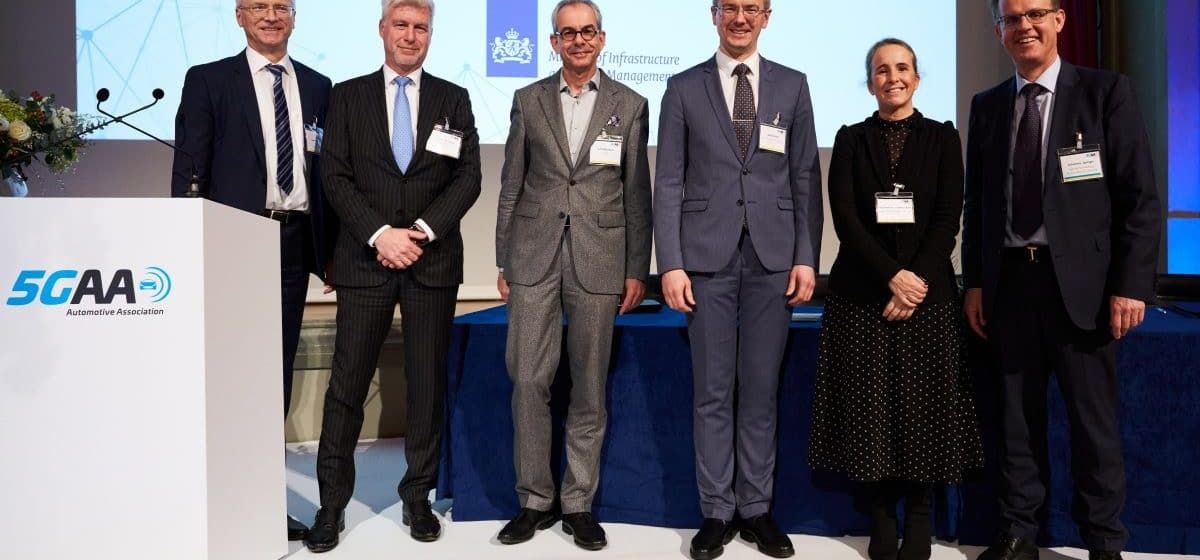
5GAA officialises five new MoUs during Brussels conference
Is 5G in-car technology ready for automated driving? Are Europe’s roads up to speed for this digital revolution? Are governments, road authorities and industry on the same page? What is Europe’s strategy to secure leadership and capture markets in the field? These and other pressing questions and challenges for connected and automated mobility were addressed on 6 February, at the 5GAA-hosted event – 5G, Igniting the Connected and Automated Mobility Revolution – in Brussels’ Concert Noble. High-level representatives and experts from industry, governments and the EU explored the capabilities, deployment models and vast opportunities of the latest ‘cellular vehicle to everything’ (C-V2X) technology.
BRUSSELS, 6 February 2020 – The 5G Automotive Association (5GAA) organised a conference bringing together EU representatives and the connected automotive ecosystem to the heart of Europe, to officialise its public-private partnerships with several European authorities. Indeed, 5GAA announced extending its partnership network by signing Memoranda of Understanding with the Dutch Ministry of Infrastructure and Water Management, the Italian Ministry of Technological Innovation and Digitalisation, the Spanish Directorate-General of Traffic (DGT), the German Federal Highway Research Institute (BASt) and the Electronic Communication Office of Latvia (VASES). The ambition of the association is to strengthen the collaboration between industry and the public sector and to facilitate the dialogue to drive innovation in mobility and transport with these closer collaborations.
Some recognised speakers at the conference included BMW’s Joachim Göthel, Senior Manager in the German automaker’s ‘Project 5G Alliance’, and Dino Flore who is Vice-president of Technology at Qualcomm, the US chipmaker, as well as Robert MacDougall who heads mobile operator Vodafone Enterprise’s Public Policy Unit. They were joined by senior EU policymakers, including a message from Maria Koleva on behalf of the European Commissioner for Innovation, Research, Culture, Education and Youth Mariya Gabriel and speech by Pearse O’Donohue, Director for Future Networks, Directorate-General for Communications Networks, Content and Technology, as well as national experts from the Netherlands and Spain giving their unique perspective.
“To fulfil its potential in connected and automated mobility, Europe really needs a clear policy message reinforcing its ‘technology neutral’ approach in the future C-ITS regulations,” noted 5GAA’s CTO and spokesperson Maxime Flament.
Automated and connected driving, intelligent driver assistance and data-driven transportation network optimisation are examples of what tomorrow’s transportation will look like for people and governments.
Discussions and conclusions reached at the 5G, Igniting the Connected and Automated Mobility Revolution conference thus paint a rich picture of the work currently underway and the roadblocks and potential detours that may lie ahead. With the help of audience contributions, the event helped to chart the way for future autonomous transport that not only meets the needs of society and industry but can also make a positive contribution to meeting the global Sustainable Development Goals in terms of cleaner and safer transportation.
About 5GAA
The 5G Automotive Association (5GAA) is a global, cross-industry organisation of over 130 members comprised of leading global automakers, Tier-1 suppliers, mobile operators, semiconductor companies and test equipment vendors. It works together to develop end-to-end solutions for future mobility and transport services. 5GAA is committed to helping define and develop the next generation of connected mobility, automated vehicle and intelligent transport solutions based on C-V2X.
Learn more on the 5GAA website and follow us on Twitter and LinkedIn.
Media Contacts
Delia Voica
Tel.: +32 486 69 76 22
Email: delia.voica@5gaa.org
Marketing and Communications Team
Email: marcom@5gaa.org
5GAA live demos show C-V2X as a market reality
Turin, 14 November 2019 – Smart mobility technology is a reality today, with ‘Cellular Vehicle-to-Everything’ (C-V2X) allowing connected vehicles to communicate with the cloud, directly with each other and their surroundings. Deployment plans are primarily sustained by the global trend in the automotive industry to adopt 4G LTE cellular technology, followed by the emerging 5G high-speed low latency communications. Beyond infotainment, C-V2X will capitalize on vehicular and smartphone connectivity to contribute to better safety, less congestion and reduced emissions.
During a live demo event in Turin, the 5G Automotive Association (5GAA) showcased ready to deploy use cases in the streets of the city and a sneak preview of what the future has in store on the renowned Lingotto rooftop test track.
Prominent members and partners of the 5GAA including Audi, Continental, Ericsson, Fiat Chrysler Automobiles, Harman Samsung, Marelli, Pirelli, Qualcomm, TIM and Vodafone demonstrated the current state of C-V2X and the road to future, Vehicle-to-Vehicle (V2V), Vehicle-to-Infrastructure (V2I), and Vehicle-to-Network (V2N) applications based on 4G LTE and 5G.
“Connected mobility is a market reality.” says 5GAA Chief Technology Officer, Dr. Maxime Flament. “The use cases demonstrated in the streets of Turin are planned for deployment with a huge industry momentum based on the evolution path to 5G capabilities.”
Using both direct short-range communications and mobile networks, the open-road demonstrations showcased the extensive capabilities of today’s C-V2X technology, ready for deployment. To name a few:
- Protecting vulnerable road users, for instance, by alerting drivers about a pedestrian at a crossing using LTE-connected infrastructure.
- Smoothing traffic by allowing public authorities and road operators to provide real-time warnings to drivers in urban environments concerning roadworks or speed limits, via the network.
- Preventing incidents at dangerous intersections or in the event of unexpected braking, thanks to C-V2X direct-short range communications between vehicles.
The track demonstrations at Lingotto underlined the enhanced safety benefits that can be expected thanks to the versatility of 5G and the wide range of services it enables. To name a few:
- Vehicles will geo-tag dangerous areas for the following cars or provide ‘see-through’ functions to avoid dangerous overtaking.
- Pedestrians will be detected directly via their smartphones and surrounding vehicles will be warned.
- In case of accidents, emergency services will be able to visualize the situation live using on-board cameras of surrounding vehicles, improving response times and providing emergency responders situational awareness prior to arriving at the crash scene.
Furthermore, Intel showcased an “In Vehicle Entertainment” demo at the Museum, in collaboration with Marelli, TerraNet and Equinix, showing how Multi-Access Edge Computing (MEC) can support immersive high-definition (HD) entertainment for all occupants of a moving vehicle, including video streaming, gaming, virtual reality (VR), office work, online education, advertisement.
A short summary on each of the 5GAA C-V2X use cases, demonstrated today in Turin
Demo 1 “Vulnerable Road Users”: open road demos on safety
In this trial – which is part of Torino Smart Roads Initiative patronized by the Municipality of Turin – TIM, Links Foundation and Luxoft showed how the communication between the various actors moving along the roads can help in detecting potentially dangerous situations. The goal of the demos was to demonstrate how the 5G mobile network facilitates the protection of Vulnerable Road Users: pedestrians (“Presence of a pedestrian on a crosswalk”) and cyclists (“Presence of a connected bike on the road”). In the case of a pedestrian approaching a crosswalk, a Roadside Unit connected to the mobile network, equipped with a camera able to detect the event, sent a warning message to the nearby connected vehicles (I2V communication). In the case of a connected bike and a connected vehicle that are approaching each other, the two vehicles received a warning message about their presence when a risk of collision is detected.
Demo 2 “Urban Georeferenced Alerting” in open roads
TIM, FCA, Links Foundation, City of Turin with 5T, and Politecnico di Torino showed how the Local Traffic Authority in Turin intends to notify drivers in real time of possible dangers and special situations on the road (traffic jam, road works warning, dynamic speed limit, etc.). A standard geo-referenced warning message was dispatched to a TIM AMQP broker” at the edge of the 5G mobile network and only the involved vehicles received the geo-localized message from the AMQP Broker using the TIM 5G Network. The warning was read and displayed in an FCA vehicle through the on-board HMI and can for instance notify the driver of upcoming speed reduction. The aim of the trial was to demonstrate how the TIM 5G Network is suitable for realizing smart roads services for connected cars. The solution is compliant with the standards so it can be applied in other locations covered with mobile networks.
Demo 3 Intersection Movement Assist (IMA), Forward collision Warning (FCW)
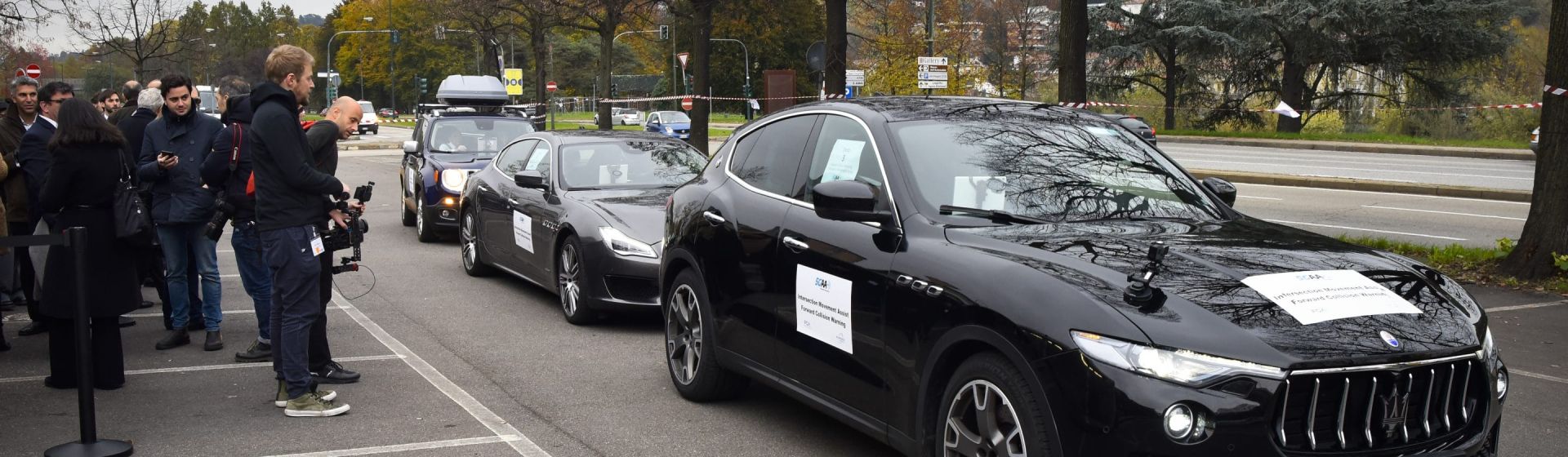
FCA and Harman Samsung showcased two Vehicle to Vehicle (V2V) demos, by integrating C-V2X direct-short range communication into Maserati Levante and Quattroporte. The vehicles, through a direct radio link (network-less radio link), anonymously communicated basic information such as their position and related direction.
The Forward Collision Warning (FCW), detected possible frontal collision and warned the driver accordingly. The Intersection Movement Assist (IMA), assisted the driver at the cross junctions to avoid a possible lateral collision with an oncoming vehicle.
Demo 4 Emergency Electronic Brake Light (EEBL), Stationary Vehicle Warning (SVW)
FCA, Continental, and Qualcomm demonstrated fast and reliable information exchange between vehicles in emergency situations. The two demos are based on C-V2X direct-short range technology, enabling Vehicle-to-Vehicle (V2V) communication between two Jeep Renegade. There were two portions to this demo:
- “Stationary Vehicle Warning” (SVW): when the hazard lights are activated, the application broadcasted a message to all nearby vehicles so that approaching vehicles could be informed even if the hazard was not visible.
- “Emergency Electronic Brake Light warning” (EEBL): in the event of a sudden braking, the application broadcasted a message to following vehicles, such that approaching vehicles were notified of the potentially dangerous situation.
Demo 5 See-through
Vodafone, FCA, Vodafone Automotive, Marelli and Altran revealed the ‘See Through’ that uses C-V2X long-range cellular network communication to exchange streamed video in real time between vehicles, extending the driver’s visual range under obstructed visibility scenarios and to prevent accidents, especially those that may occur in an overtaking phase. The two involved Jeep Renegades vehicles were equipped with a connectivity solution (Marelli) and high frame-rate cameras (Marelli Motorsport) to detect the road lanes.
A real time tracking system and a space mapping algorithm of the vehicles, specifically developed by Vodafone Automotive, allowed Vodafone’s Multi-access Edge Computing (MEC) to dynamically manage and route the video flows on the basis of the vehicles’ relative positions and to ensure minimal end-to-end latency in the interest of drivers’ safety. Vodafone 5G ultra-low latency and high reliability were paramount to ensure the flow and synchrony of the real-time video exchange between vehicles, also under high traffic and cell saturation conditions.
Demo 6 World-first 5G-enhanced ADAS services
Audi, Ericsson, Italdesign, KTH, Pirelli, Qualcomm, TIM and Tobii showed how smart cars, commercial 5G smartphones and 5G networks jointly improve comfort, safety and efficiency. This unique collaboration combined the power of eye-tracking glasses, intelligent tires, in-vehicle augmented reality and 5G phones to work together over a live 5G network. With its high capacity and low latency, cellular 5G connectivity is ready to enable instantaneous cooperation between vehicles, the IoT ecosystem and more advanced driver assistance services. The live demonstrations at the Turin Lingotto test track were based on TIM’s commercial 5G network delivered in Turin in partnership with Ericsson. Audi cars, equipped with Pirelli Cyber Tyre, and embedded 5G modems provided by Qualcomm and available 5G smartphones were utilized to enhance pedestrian’s safety.
About 5GAA
The 5G Automotive Association (5GAA) is a global, cross-industry organisation of over 130 members comprised of leading global automakers, Tier-1 suppliers, mobile operators, semiconductor companies and test equipment vendors. It works together to develop end-to-end solutions for future mobility and transport services. 5GAA is committed to helping define and develop the next generation of connected mobility, automated vehicle and intelligent transport solutions based on C-V2X.
Learn more on the 5GAA website and follow us on Twitter and LinkedIn.
Media Contacts
5GAA Marketing & Communications
Email: marcom@5gaa.org
Official pictures: Conference – Demonstrations
5GAA C-V2X testing event in Europe successfully demonstrates exceptional level of interoperability
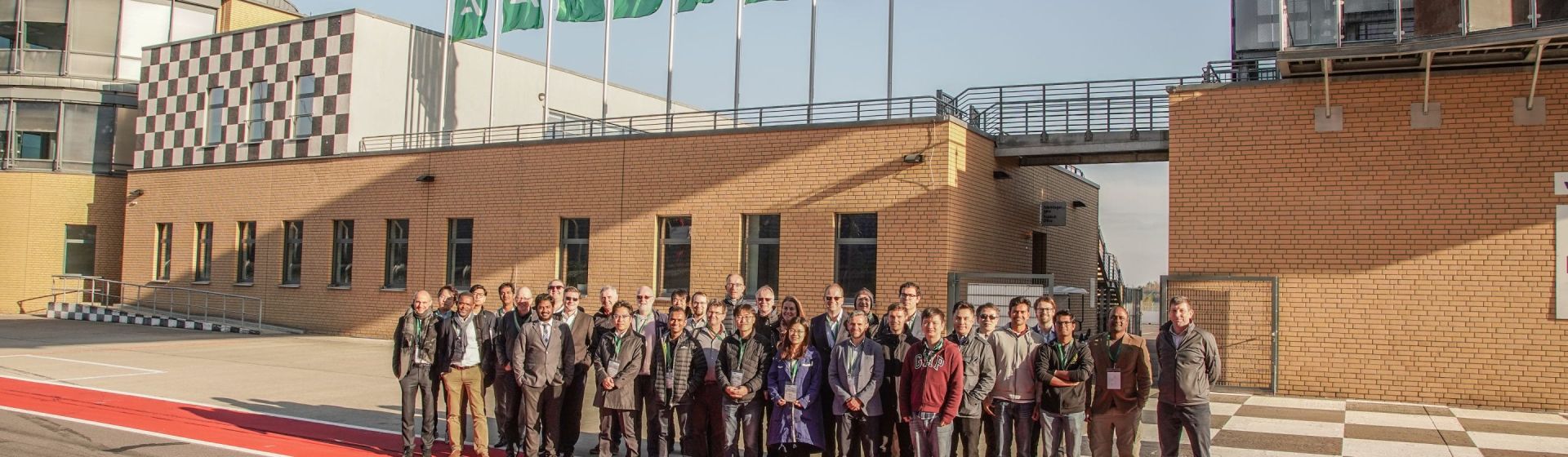
KLETTWITZ, GERMANY, 15 April 2019 – 5GAA announced today that multiple technology providers of Cellular-V2X (C-V2X) have achieved successful results showing multi-vendor interoperability. Companies from across the global 5GAA community came together in Klettwitz, Germany, last week to conduct multi-vendor C-V2X interoperability tests at the automotive proving ground of host and 5GAA member DEKRA, a global leader in automotive safety testing.
The event demonstrated a high-level of interoperability across all participating companies with 96% of the 249 C-ITS safety test-cases successfully communicated based on both the ETSI ITS specifications and IEEE/SAE ITS standards for vehicle-to-vehicle (V2V) and vehicle-to-infrastructure (V2I) use cases. As a result, the event validated the automotive industry’s maturity to support the commercial deployment this year of C-V2X solutions throughout the world, with both infrastructure and onboard units.
“Interoperability tests represent a unique opportunity for C-V2X vendors to refine their software implementation. This event has shown very satisfying results and prove the technology readiness of the radios,” stated 5GAA CTO Maxime Flament.
Samsung’s (Harman) leadership within 5GAA as rapporteur was vital in bringing together many of the foremost automotive C-V2X companies and their commercial C-V2X solutions and test equipment from across the globe including Cohda Wireless, Commsignia, Huawei, Qualcomm Technologies, Keysight Technologies, Rohde & Schwarz, Savari, WNC and Vodafone Automotive. Ford, LG Electronics, Neusoft and Sumitomo Electric also attended the event.
Trilateral Interoperability
The event showcased multi-vendor interoperability testing by utilizing commercial C-V2X chipset products from Harman, Huawei and Qualcomm Technologies, marking an important milestone.
The week was viewed as highly successful by all participants, as it brought together many of 5GAA’s C-ITS experts for testing and to validate that C-V2X products are both mature and commercially available today for the cooperative, connected and automated mobility ecosystem.
“I’m delighted that the positive results obtained at the 1st European 5GAA C-V2X Interoperability Test derive from the effective collaboration of global players. With our V2X stack we are now amongst the small group of companies worldwide that are ready to deliver state of the art services in connected, cooperative and digital mobility,” said Gion Baker, CEO Vodafone Automotive.
“DEKRA has been delighted to host this historical 5GAA C-V2X interoperability event. We are very proud to be part of this important development contributing with our technical expertise and unique testing capabilities,” stated Fernando E. Hardasmal, Executive Vice President and Head of the Service Division Product Testing.
“It was a pleasure to support 5GAA in testing C-V2X from radio frequency to region specific ITS applications, forming the basis for interoperability and conformity assessment in a global market,” said Holger Rosier, Technology Manager at Rohde & Schwarz.
“We believe that C-V2X is a cornerstone technology for connected, assisted, and autonomous driving and for seamless user experiences, and is why Harman has launched 3GPP C-V2X globally in all its commercial telematics platforms from 2019″, said Mike Peters, President, Connected Car division, Samsung (Harman).
“5GAA’s C-V2X interoperability event provided an ideal stage to solidify the interworking of various C-V2X solutions, which is essential to realize the full potential of C-V2X,” said Ashok Tipirneni, director of product management, Qualcomm Technologies.
“Together with other participating companies, we are confident to have contributed to the worldwide and European C-V2X ecosystem building. This successful Plugfest has shown the readiness of C-V2X products which will be an important ingredient for the advanced connected and automated mobility.” concluded William Lu, C-V2X Product Line General Manager, Huawei Technologies.
About 5GAA
The 5G Automotive Association (5GAA) is a global, cross-industry organisation of 115 members comprised of leading global automakers, Tier-1 suppliers, mobile operators, semiconductor companies, test equipment vendors, etc. working together to develop end-to-end solutions for future mobility and transportation services.
5GAA is committed to helping define and develop the next generation of connected mobility for autonomous based on Cellular-V2X (C-V2X), the family of cellular technology-based communications.
C-V2X enables both long-range communications via mobile networks as well as direct short-range connectivity for time-critical information (without subscription or network coverage). C-V2X is currently based on 4G/LTE but offers a clear evolution path to 5G.
Contact
Marketing and Communications Team
Email: marcom@5gaa.org
Web: www.5gaa.org
Europe’s leadership in connected and automated driving depends on technology-neutral, innovation-oriented policies
Dear Minister,
Serious concern has arisen in the telecoms and transport industries over the restrictive content of the forthcoming Delegated Act on Cooperative Intelligent Transport Systems (C-ITS). Although it is close to completion, the text still does not lay down the technology-neutral framework urged by the CEOs of 24 members of our associations (signatories included BMW, Daimler, Deutsche Telekom, Ericsson, Ford, Groupe PSA, Nokia, Telefonica and Vodafone) in their letter to President Juncker in July 2018[1].
Despite a welcome acknowledgement of cellular technologies, the draft Delegated Act only contemplates the Cellular Vehicle-to-Everything (C-V2X) technology family in the framework of a future revision of the Act in up to three years’ time, with no guarantee to date that a level playing field will be ensured with respect to compatibility and interoperability requirements.
The current draft effectively endorses Wi-Fi based communication (known as “ITS-G5”) as the baseline technology for connected cars in the EU, at the expense of a mature and standardised alternative[1]: LTE-V2X (which is the current realisation of C-V2X). We believe this contradicts the principle of technology neutrality and will prove to be a very costly missed opportunity for Europe.
Indeed, LTE-V2X is regarded internationally as the foundation stone which will pave the way towards the most advanced safety services enabled by 5G, in particular for vulnerable road users. Only C-V2X offers such a clear evolutionary roadmap starting with LTE-V2X today and evolving into 5G-V2X tomorrow, making it the only future-proof technology.
A decision exclusively favouring Wi-Fi technology today should thus be carefully considered. It would bear negative long-term consequences for Europe, since Wi-Fi offers no prospect of compatibility with 5G. A costly migration path would be required, resulting in significant sunk costs. It would stall C-V2X roll-out and investments in 5G for automotive and alongside the road network would be adversely affected.
LTE-V2X must be allowed to succeed as the first building block en route to the full realisation of 5G potential, ensuring the competitiveness of key industry verticals such as automotive as well as the telecom sector. A wrong decision at this critical juncture would put in jeopardy Europe’s leadership and investment in 5G.
Connected vehicle and roadside infrastructure technology is evolving at a very fast pace. LTE-V2X field tests and deployment projects are under way in many EU countries as well as globally with the first market introductions foreseen in 2019, within the same timeframe as the Delegated Act publication.
Leveraging all the previous work from European standardisation organisations, C-V2X offers unique benefits as a single technology platform, combining both direct short-range (not requiring network coverage or a subscription) and long-range modes.
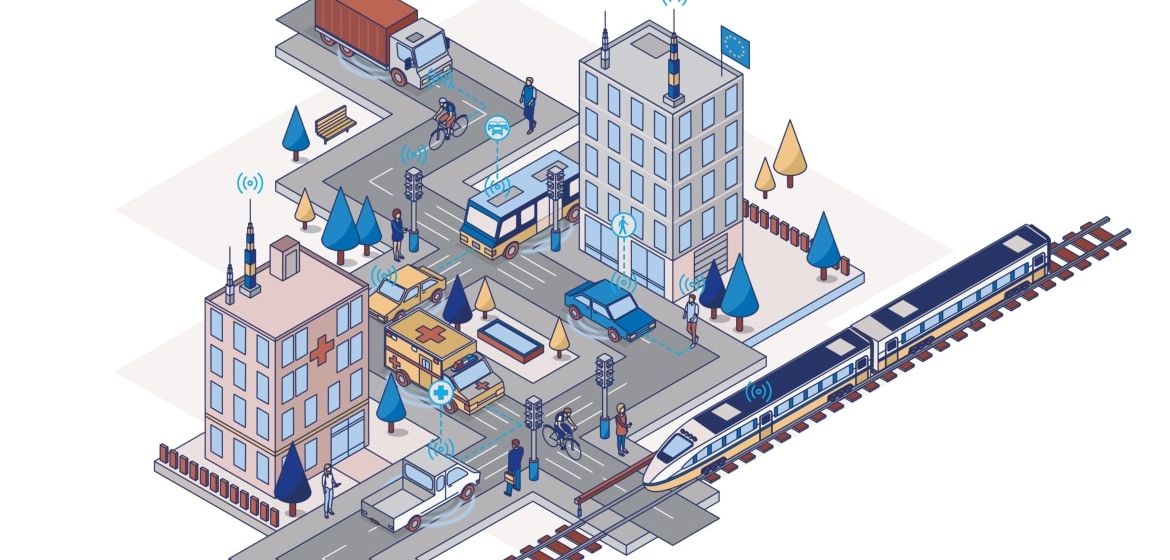
It will, unhindered, significantly improve road safety in Europe through direct vehicle-to-vehicle, vehicle-to-infrastructure and, vehicle-to-network communication, but also provide new vehicle-to-pedestrian applications owing to its unique smartphone integration capacity, thereby reducing vulnerable road users’ casualties (43% of EU road fatalities in 2017)[1].
C-V2X also provides the fastest way to reach large-scale penetration of C-ITS: all new vehicles are expected to feature embedded cellular connectivity by 2021-2022. Many OEMs have already deployed some Day 1 C-ITS services using existing 3G/4G networks and LTE-V2X long-range mode.
We strongly believe that Europe should capitalise on these early deployments and would gain substantial economic benefits by maximising the synergies between transport and telecom network infrastructures. Today, LTE network population coverage averages 97.9% in Europe (89.9% of rural EU households) with a rapid year-on-year increase[2], whereas ITS-G5 deployment has not yet begun.
In addition, consumer 5G is rapidly moving from trials to early commercialisation. Between 2018 and 2020, 48 countries will launch 5G mobile services across North America, Europe, the Middle East and Asia-Pacific.[3]
This is not about promoting individual companies that are about to launch their respective products. It is about creating the right framework which will support Europe to make the best technology choices in the future, to achieve our common objective: making the roads safer for all.
We encourage you to support a truly technology neutral approach to C-ITS through a Delegated Act inclusive of LTE-V2X, as it holds the promise of better safety. C-V2X is close to deployment in every world region as our entire ecosystem has stepped up its efforts to be market-ready in the upcoming months. However, it is absolutely critical for our industries that the EU regulatory framework provides sufficient legal certainty in order to pursue and accelerate current roll-out plans for C-V2X.
Afke Schaart Johannes Springer Lise Fuhr
VP and Head of Europe, Director General, 5GAA Director General, ETNO
Russia and CIS, GSMA
[1] CEO Letter to President Juncker on connected car legislation
[2] Cf. Annex to this document
[3] Road Safety in the EU – Trends, statistics and main challenges
[4] Broadband Coverage in Europe 2017, European Commission
[5] GSMA intelligence