

5GAA supports the European Strategic Deployment Agenda for Connected and Automated Mobility
The 5G Automotive Association (5GAA) is proud to announce the publication of the 5G Strategic Deployment Agenda for Connected and Automated Mobility in Europe (EU 5G SDA for CAM), by the 5G Infrastructure Public Private Partnership (5G PPP), a joint European Commission and European ICT industry initiative.
5GAA was among the key contributors to this document which outlines the shared view of a industry and public stakeholders, including other relevant European associations (ACEA, CEDR and GSMA) and experts of the three 5G corridors trial projects, based on eight common principles to stimulate investment in 5G-ecosystems in the field of Connected and Automated Mobility:
- Deployment of the 5G infrastructure for CAM should follow an evolutionary path to cope with future market developments and technological progress.
- The infrastructure should aim at providing boundless connectivity with continuity of service across borders, Mobile Network Operators, vendors/OEMs, as well as traffic managers, road operators and service providers.
- The CAM infrastructure, including vehicles and road equipment, needs to have a very high level of cybersecurity.
- The 5G infrastructure for CAM will need to be a multi-service/multi-application platform using standardised specifications and/or data interfaces.
- The deployment of 5G infrastructure for CAM in Europe should be extensively coordinated with public and private actors in charge of delivering V2X services.
- Road operators, road authorities and mobile network operators should collaborate to create synergies for connectivity deployment along CAM corridors.
- It is a necessity to deliver future networks innovatively and with optimal economics.
- The digital transformation of industry verticals must be accelerated.
- As recognised by the European Commission, 5G is a critical enabler of future mobility solutions and its deployment in transport, including both network and direct communication modes, is a European public policy priority. To that end a strategic partnership with road and transportation stakeholders is critical to fully address society’s connected mobility and road safety needs, as per 5GAA mission and the European Commission’s objectives.
To accelerate the infrastructure rollout, the stakeholders recognised several key drivers, such as the need for appropriate cooperation models to enable the initial deployment of 5G highways corridors, stabilising the technology roadmap through standardisation, ensuring a high level of cybersecurity, regulatory innovation, data access and data sharing, harmonisation of spectrum, and coordination of deployment initiatives.
Read the full document here

5GAA Accelerates Connected Vehicle Development with First ETSI-Approved LTE-V2X System Profile
ETSI specifications ensure interoperability, safety, and security of C-V2X technology development
In July 2020, the 5G Automotive Association (5GAA) partnered with global ICT standards organisation ETSI to organise a remote cellular-vehicle-to-everything (C-V2X) Plugtest. The LTE-V2X System Profile is the first of its kind to be specified by an independent, accredited standards organisation in Europe (ETSI TS 103 723).
The system profile provides industry wide upper layer configuration guidelines for C-V2X deployment and employs C-V2X technology from 3GPP Release 14. The system profile and the global standard it represents will lay the foundations for standardised direct cellular communications technology in the automotive sector; making product development faster and ensuring that safety and security are at the core of all new technologies.
“LTE-V2X provides a seamless evolution path towards 5G employing new radio V2X (NR-V2X). The latter will allow even better performance and further enhanced features, while keeping backward compatibility with LTE-V2X”, said Maxime Flament, CTO, 5GAA. “OEMs will especially benefit as the technology will allow long life cycles, which are essential for automotive products.”
Several automotive LTE-V2X devices were successfully tested during the second ETSI C-V2X Plugtest™ in addition to Intelligent Transport Systems (ITS) stations and Public Key Infrastructure (PKI) vendors in order to assess the level of interoperability of their implementation and to validate the ETSI ITS specifications. An overall interoperability success rate of 94% was achieved during the second ETSI C-V2X Plugtest.
To read the full report from the Plugtest, please click here.

5GAA Releases New 2030 Roadmap for Advanced Driving Use Cases, Connectivity Technologies and Radio Spectrum Needs
BRUSSELS, 8 September 2020 – In the next two to three years, the 5G Automotive Association’s (5GAA) expects to see mass deployment of vehicle-to-everything (V2X) use cases geared towards improving traffic efficiency and road safety around the world. This vision is outlined in a new White Paper released by 5GAA which explores how leading automakers, mobile
network operators and their suppliers see the world of automotive connectivity evolving over the coming decade.
Vehicles talking to one another but also to roadside and telecom infrastructure and operators – so-called V2X communication – is just the tip of 5GAA’s vision for ‘advanced 5G-connected driving’. In its latest White Paper, 5GAA offers a comprehensive roadmap to guide all parties involved in this near-term market development, bringing both automotive and telecom sectors together to fulfil what 5GAA sees as a powerful digital ecosystem in this fast-moving field.
The Paper highlights selected end-to-end V2X applications factoring in the necessary technological evolution, industry readiness and spectrum needs. 5GAA has developed ‘advanced driving’ use cases such as Cooperative Manoeuvres and Sensor Sharing in conjunction with both the adoption of Cellular Vehicle-To-Everything (C-V2X) standards and the availability of the required technologies and devices. These provide a tangible account of how advanced driving is taking shape globally.
“Success in this endeavour requires to have all industry stakeholders on-board, including telecoms and automotive. Only then will new business opportunities and necessary investments be secured to fuel this ‘ecosystem’,” said 5GAA’s CTO and spokesperson Maxime Flament upon the White Paper’s launch.
With close to 200 million ‘connected vehicles’ already on the roads worldwide in 2020 and a growing number of vehicles with the ability to exchange traffic and road condition information over cellular networks, the foundations for 5G-connected driving are well established, the Paper points out. Further progress in coming years will pivot around 5G-V2X use cases for more efficient and safe driving. From 2025 onwards, 5GAA anticipates mass rollout of more advanced automated driving and safety use cases supported by vehicle connectivity. Additional automated driving functionalities are anticipated as from 2026.
Between now and 2024, ‘connected’ digital road infrastructure will pave the way for real-time or ‘dynamic’ traffic updates, hazard warnings, and high-definition mapping services. Towards 2026, advanced vehicle-to-vehicle (V2V) cooperation will further boost automated driving developments, including sharing sensor data and cooperative manoeuvring.
To fully support this evolution, 5GAA calls on national and regional administrations to make sufficient radio spectrum available for mobile communication networks in targeted low- and mid-bands, and it recommends harmonised use of the 5855-5925 MHz band for communication between road users and roadside infrastructure within the wider international digital traffic ecosystem.
Here, the White Paper acknowledges that some 5G-enabled applications may prove challenging to implement, while others will be easier and offer valuable lessons going forward: “Low-hanging fruit applications addressing OEM fleets, such as automated valet parking and tele-operated driving will open the door to more secure, safe and interoperable vehicle-to-network automotive applications across borders.”
Charting a clear way forward…
All in all, to deliver end-to-end V2X services and unlock the true value of vehicle connectivity, 5GAA considers that the realisation of its roadmap would require:
(1) sufficient spectrum for short-range direct communications at 5.9 GHz
(2) high levels of mobile network coverage along the roads
(3) sufficient service-agnostic mobile network spectrum for mobile network-based communications, in addition to the bands that are currently identified for International Mobile Telecommunications (IMT) use.
The essence and great promise of 5G is that it makes better use of the radio spectrum, boosts mobile network coverage, security and safety, while delivering environmental benefits for citizens and consumers. To chart a clear way forward, 5GAA calls on all players to work together while implementing the use cases highlighted in the Paper, as well as other measures outlined in 5GAA technical reports and papers.
About 5GAA
The 5G Automotive Association (5GAA) is a global, cross-industry organisation of companies and OEMs from the automotive, technology and telecommunications industries working together to develop end-to-end solutions for future mobility and transportation services. 5GAA is uniquely placed to support 5G-V2X advances because it unites all major automotive, chipset, technology, telecom-mobile infrastructure and mobile network operators. In less than three years, more than 135 global players, including pioneering OEMs, have signed up to 5GAA’s vision.
For more information, please contact our media team at marcom@5gaa.org
Download the Roadmap
A Visionary Roadmap for Advanced Driving Use Cases, Connectivity Technologies, and Radio Spectrum Needs
The article below and the linked document refer to an older version of the 5GAA roadmap, whose most updated version you can find here.
With this white paper, the 5G Automotive Association (5GAA) presents the results of its studies relating to the evolution of automotive connectivity for the purposes of enhanced road safety, improved traffic efficiency, greener environmental impact, and more comfortable driving.
5GAA has identified the most promising advanced driving use cases such as Cooperative Manoeuvres and Sensor Sharing, in conjunction with the adoption of Cellular Vehicle-To-Everything (C-V2X) standards as well as availability of required technologies and devices, i.e. on-board units (OBUs), road-side units (RSUs), and smartphones, integrating the latest chipsets and modules. The market trajectory of the identified use cases is described along with the expected timeline for their mass market deployment.
The white paper finally highlights the spectrum needs for basic and advanced driving use cases. For direct communication, this corresponds to between 10 and 20 MHz at 5.9 GHz for basic safety, and an additional 40 MHz or more at 5.9 GHz for advanced driving.
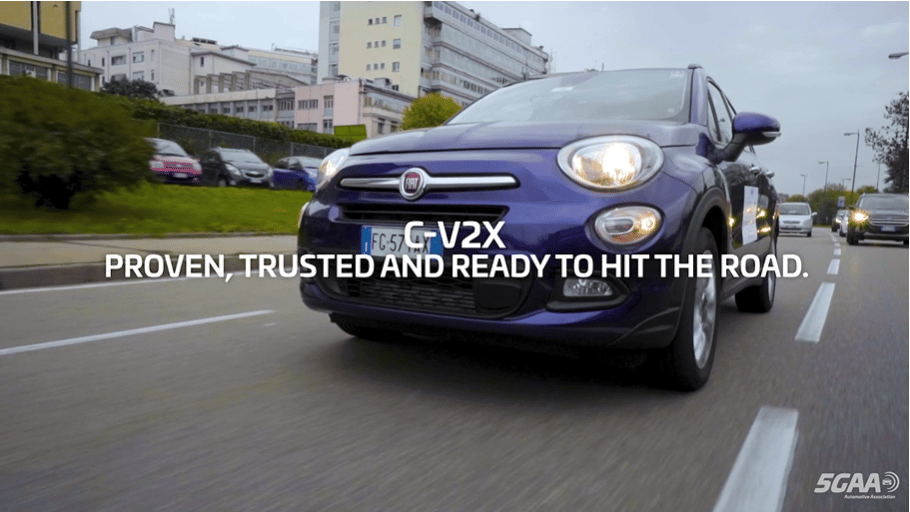
C-V2X Readiness
Millions of vehicles are already connected via cellular networks, thus exchanging valuable data on road safety and traffic efficiency,
This is the result of decades of research and innovation on Intelligent Transport Systems
C-V2X is proven, trusted and ready to hit the road!
Watch the video below to discover more about C-V2X technology.

Vulnerable Road User Protection
Road safety is a crucial aspect of mobility both for individuals as well as for policymakers. Road fatalities, in the European Union (EU), for example, have decreased by approximately half between 2001 and 2018 from 54,000 to 25,100 per year. However, in recent years, the number of fatalities has been on a stable level, and additional efforts are needed to further reduce the number of deaths and severe injuries.
5GAA has made VRU protection a priority area and this White Paper therefore aims at shedding light on the safety benefit that selected V2X use cases offer, which can have a significant impact on the protection of the most vulnerable traffic participants. Ultimately, this also has a positive impact on health-sector costs incurred, by reducing the number of people suffering serious injuries with life-changing consequences.

V2X Application Layer Reference Architecture
This document describes an Application Layer Reference Architecture for the operational part of the automotive ecosystem, both from a functional view and from several deployment views.
The Application Layer Reference Architecture may be used to describe various deployments, from small proof-of-concept deployments with just a few functions, to large scale deployments with all functions in the automotive ecosystem. In addition, the Reference Architecture facilitates identification of application layer protocols and an understanding of the need for new standardisation.
This document addresses the 5GAA WG2 work item ‘V2X Application Layer Reference Architecture (V2XSRA)’.

5GS Enhancements for Providing Predictive QoS in C-V2X
The NESQO Work Item (WI) kicked off in February 2018 with input from car makers, in order to address key automotive requirements on a selected set of identified use cases. The main objective of the study was to provide Predictive QoS for C-V2X in 5G, utilising technologies including End-to-End Network Slicing, Multi-Access Edge Computing (MEC), an evolved QoS framework and Machine Learning.
Upon conclusion of the NESQO WI, the need for a follow-up WI was put forward; some of the topics already identified in the original WID were not fully covered in the NESQO TR and needed further study. Additionally, new requirements had been identified, that were relevant to the agreed scope but not included in NESQO.
This document addresses the 5GAA WG2 Work Item ‘Enhanced End-to-End Network Slicing and Predictive QoS’.

5GAA Efficient Security Provisioning System
Vehicle-to-everything (V2X) communication is at our doorsteps. It is a key part of the future of connected vehicles and autonomous driving as it enables infrastructure, pedestrians and vehicles to interact, thus taking the transportation ecosystem to the next level. Security plays an important role in building trust in V2X, protecting users’ privacy, and enabling safety, efficiency and comfort.
Efforts to reinforce trust in this ecosystem are driving global initiatives to develop, standardise and implement Security Credential Management Systems (SCMS). As a consequence, different stakeholders have put forward their requirements leading to differing, non-interoperable regional designs. The 5G Automotive Association (5GAA) has evaluated existing system designs and their regulatory requirements, as well as identified some new ‘advanced’ features. The resulting recommendations for improved design fulfilling these security and privacy requirements in a large-scale system are outlined in this white paper.
With the objective to integrate new technical opportunities in the automotive world, as afforded by widespread cellular connectivity, and to identify potential design simplifications, an analysis and evaluation of existing system designs has been completed over the last year. These existing designs are region-specific and not fully interoperable due to differing security and privacy requirements. Some ecosystem stakeholders within 5GAA challenged this status quo on several levels and evaluated these regional V2X security approaches.
The paper summarises the design simplifications, discusses their rationale and impact, and proposes an updated design for large-scale deployment and cross-regional interoperability called the ‘Efficient Security Provisioning System’ (ESPS). The paper outlines potential simplifications to the existing V2X credential management systems.

5GAA to organise its first remote C-V2X Plugtests™ event with ETSI, 20-31 July
The 5G Automotive Association (5GAA) is proud to be again a partner of the European Telecommunications Standard Institute (ETSI) in the second C-V2X-only Plugtests™ event, to take place remotely from 20 to 31 July 2020. This interoperability test will be held with the support of the European Commission and the European Free Trade Association (EFTA).
Building on the extremely positive results of the interoperability events of 2019 in Klettwitz and Malaga, this second edition of the C-V2X Plugtests™ will focus on testing ITS Security features (EU ITS Security Policy and EU ITS Certificate Policy) in order to support the C-V2X ecosystem in the C-ITS deployment according to the highest security standards, crucial for the creation of a single European trust domain. The interoperability test specification for ITS security ETSI TS 103 600 v1.1.1 will represent the basis of the test plan for the testing event.
Registrations are open until 12 June. For any further information, please consult the official event page.