
MWC 2018: 5GAA Gaining Speed Toward C-V2X commercialization
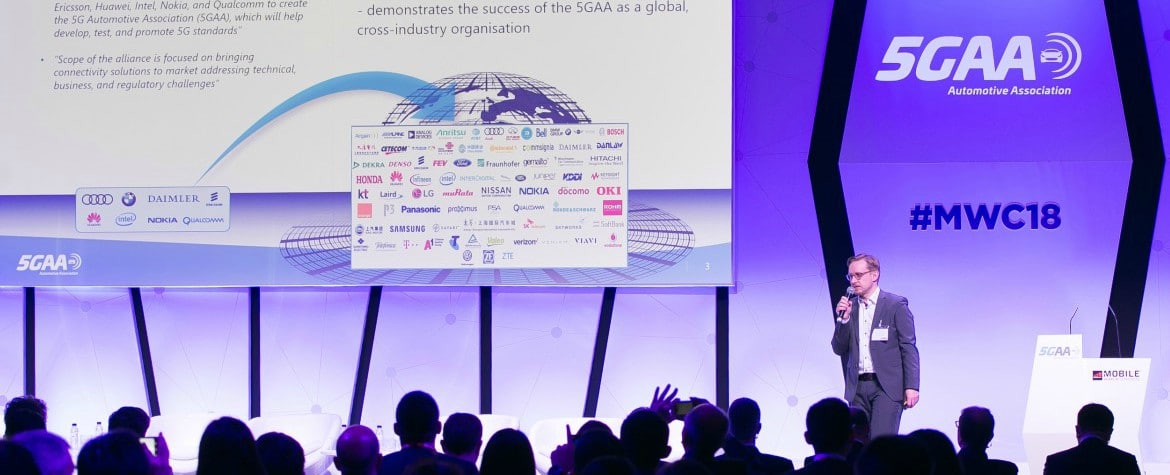
March 2nd, Barcelona, Spain – The 5G Automotive Association (5GAA) presented – during a session at the Mobile World Congress 2018 – the acceleration of C-V2X technology implementation through the widespread support of leading telecommunications and automotive companies. This advanced technology will serve as the lynchpin that will create a connected vehicle ecosystem and enable future mobility solutions. March 1st, Barcelona, Spain – The 5G Automotive Association (5GAA) presented – during a session at the Mobile World Congress 2018 – the acceleration of C-V2X technology implementation through the widespread support of leading telecommunications and automotive companies. This advanced technology will serve as the lynchpin that will create a connected vehicle ecosystem and enable future mobility solutions.
The value of C-V2X technology lies in the fact that it is a unified technology – it can provide short-range and long-range communications. C-V2X technology can, for example, alert drivers of a cyclist around the corner or a traffic jam that is 25 kilometers away.
Christoph Voigt, 5GAA Chairman and Head of R&D Connectivity at Audi announced that: “This effort is now ‘all hands on deck’, meaning that telecommunications and automotive leaders are all working hand-in-hand to deploy C-V2X and to make it hit the road as soon as possible.”
During its session, 5GAA focused on the growing support that C-V2X technology is enjoying among leading companies in the telecommunications and automotive industries and presented the importance that 5G cellular technology will play in enabling smart mobility of the future.
C-V2X gains wide ecosystem support
During the presentation, 5GAA members Qualcomm and Huawei emphasized the growing C-V2X ecosystem support and presented their integrated chipsets that will enable C-V2X commercialization. The start of C-V2X mass market series deployment is predicted to begin as early as 2019/2020.
“We see a growing appetite across the industry for the commercialization of our C-V2X chipset with automakers, Tier-1 suppliers, cellular module manufacturers, ITS providers, integrators, and automakers ready to drive change,” said Jason Ellis, Director of Automotive Business Development at Qualcomm.
Veni Shone, President of LTE product line at Huawei, highlighted that the momentum of C-V2X in China is encouraging – ministries have put their full support behind C-V2X technology on strategy and standardization. Mr. Shone also detailed Huawei’s commitment to accelerate C-V2X, specifically pointing at the releases of its LTE-V2X chipset, T-box prototype, and roadside units.
5GAA plans to support and advocate the work of this technology by speeding up the deployment of C-V2X for the automotive sector while creating a joint ecosystem and implementing key functionalities such as vehicle-to-smart-device.
5G as an enabler for life-saving solutions & new business applications
5GAA members Ericsson and Ford also highlighted exciting use cases and growing business applications for 5G technology in the automotive sector.
Don Butler, Executive Director of Connected Vehicles and Services at Ford stated that: “Creating safer and more personalized journeys through automated driving is the long-term vision of mobility’s future. We believe 5G will enable this by maximizing the in-vehicle experience thanks to high reliability, fast-paced communications. We will create new, compelling experiences and capabilities saving more lives with patient transport monitoring or teleoperated driving.”
With the advancement of 5G technology and its application to connected vehicles, the amount of data created will continue to expand exponentially.
Stefano Sorrentino, Master Researcher at Ericsson presented the fact that: “Connected & automated driving will lead to a data explosion that will definitely challenge the network capacities. This challenge could be remedied through the deployment of scalable and integrated networks and cloud architectures as well as the continuous evolution of radio technology into 5G.”
“We think of 5G as an end-to-end solution starting with the wireless connectivity but also including edge computing, the transport network, artificial intelligence and machine learning. Together they power the applications and the services for intelligent transportation and smart mobility, and ultimately, the ways humans interact with connected and self-driving cars of the future. It is an exciting area for 5GAA to work on and we invite any stakeholder to join us and contribute on this journey.” concluded Thierry Klein, Head of Disruptive Innovation Program at Nokia Bell Labs and Vice Chair of 5GAA Board.
About 5GAA
The 5G Automotive Association (5GAA) is a global cross-industry organization of companies from the automotive, technology and telecommunications industries (ICT), working together to develop end-to-end solutions for future mobility and transportation services. Created in 2016, the Association is comprised of over 75 members whose mission is to develop, test and promote communications solutions, initiate their standardisation and accelerate their commercial availability and global market penetration, to address society’s connected mobility and road safety needs with applications such as automated driving, ubiquitous access to services and integration into smart city and intelligent transportation.
Peaceful coexistence of C-V2X and ITS-G5 technology offers the highest net benefits for Europe
5GAA and EU policymakers discuss future of 5G for connected and automated vehicles
12 December 2017, Brussels, Belgium – The 5G Automotive Association (5GAA), a cross-industry association of the telecoms and automotive industry, held a policy debate on Tuesday 5 December in Brussels to discuss the concrete actions necessary to implement 5G connected and automated vehicles in Europe. A recurring theme in Tuesday’s debate was the cohesive development and implementation of cellular “vehicle to everything” (C-V2X) technology, the technology that will enable automobiles to communicate via cellular networks to other connected devices but also the possibility of ad-hoc communication without any cellular network involvement (e.g. in case of weak coverage). Policymakers and industry face the ongoing challenge of creating a cohesive framework that enables private sector innovation while ensuring a safe and economically viable rollout of new technologies.
Attendees heard from a wide range from various European political and administrative representatives, including Eddy Hartog, EC Head of Unit Smart Mobility and Living, Attila Benedek (Adviser to István Ujhelyi MEP, rapporteur on European C-ITS Strategy), Jaime Moreno García-Cano of the Spanish traffic authority or Andreas Geiss, EC Head of Unit for Spectrum Policy. 5GAA was represented by its Secretary, Markus Dillinger of Huawei and board members, Luke Ibbetson of Vodafone, Joachim Göthel of BMW, Rainer Krumrein of Daimler, and Friedhelm Ramme of Ericsson.
The debate coincides with the Commission’s ongoing public consultation on its European Strategy on Cooperative Intelligent Transport Systems (C-ITS), which runs through January 5, 2018. C-V2X technology stands to significantly improve road safety and facilitate traffic flows in the EU. Ultimately, the benefits of this technology across the EU could save the several billion euros that are lost every year to traffic accidents and congested roadways.
Markus Dillinger, 5GAA Secretary and Member of the Executive Committee: “5GAA was founded to underscore the urgency in developing technology that makes our roads safer and smarter. Today’s debate brought together public and private sector stakeholders to discuss the capabilities of such technology as well as the acceleration of creating a regulatory framework in which the industry can work.”
During the event, analysts from Analysys Mason and SBD Automotive presented the findings of a cost-benefit analysis of implementing the C-V2X technology. The socio-economic returns of deployment of C-ITS systems may amount to EUR 43 billion by 2035 in Europe, if both C-V2X and the Wi-Fi Standard IEEE 802.11p are able to co-exist in the 5.9GHz spectrum band. The 5GAA also presented a study assessing the road safety benefits of LTE–V2X (PC-5) and IEEE 802.11p in the EU, which indicates that LTE-V2X (PC5) outperforms 802.11p in reducing fatalities and serious injuries. In addition, it demonstrates that the absence of interoperability between technologies is unlikely to present a substantive barrier to the reduction of road accidents in the short to medium term. Bill McKinley, 5GAA rapporteur on tests and trials, and Rainer Krumrein of Daimler also presented 5GAA’s perspective on C-V2X performance and future capabilities.
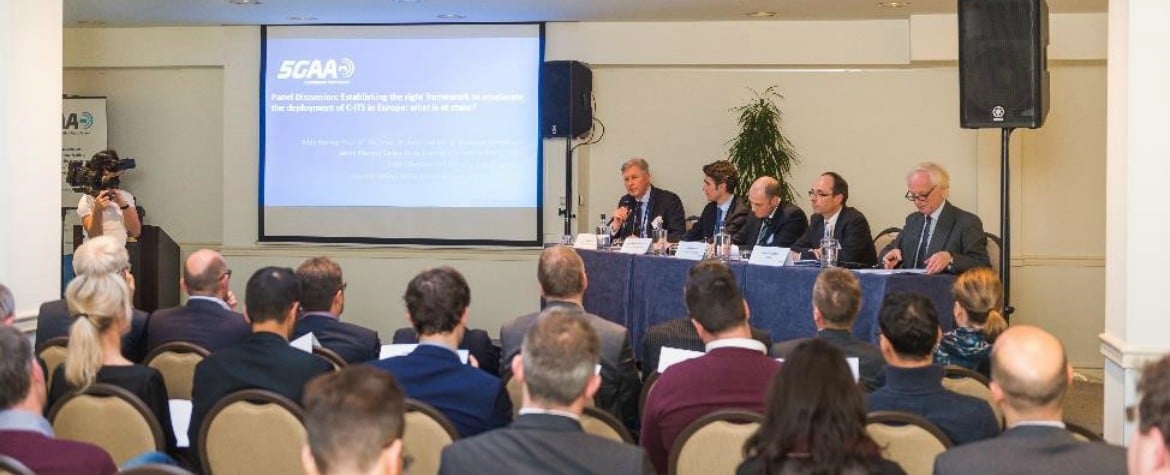
The event culminated in a panel discussion to discuss the right framework to accelerate the deployment of the C-ITS across Europe. Particular attention was given to short-range communications in the 5.9 GHz band and the four guiding policy principles established by the European Commission: uncompromised safety services for all users in case of multiple technologies implementation, technology neutrality of spectrum regulation, efficient spectrum use and introduction in the longer-term of 5G for the further development of cooperative, connected and automated mobility.
Luke Ibbetson, R&D Director Vodafone Group and member of 5GAA: “Both C-V2X and ITS-G5 technologies should peacefully co-exist in the 5.9 GHz band. The socio-economic and road safety studies presented at this event indicate that co-existence offers the highest net benefits for the European economy, amounting to EUR 43 billion by 2035.”
Joachim Göthel, Senior Manager Project 5G-Alliance of BMW and member of 5GAA: “C-V2X offers a strong evolution path to 5G which is absolutely essential to enable full connected and automated driving in the future, while enabling a fast roll-out for many functionalities in the very short-term, utilizing existing cellular networks.”

The presentations made during the Workshop are downloadable here below:
1. Introductory 5GAA Presentation
2. Presentation on cellular V2X socio-economic benefit study
3. LTE-V2X (PC5) and road safety in the EU
4. 5GAA Presentation Trials
5. Daimler view on V2X – 5GAA Policy Debate
About the 5GAA
The 5GAA is a cross-industry association between the cellular and automotive industries to develop, test and promote communications solutions, initiate their standardisation and accelerate their commercial availability and global market penetration, to address society’s connected mobility and road safety needs with applications such as automated driving, ubiquitous access to services and integration into smart city and intelligent transportation.
Pictures credit © Thomas Blairon, 2017. Reproduction of this image is authorised, provided the source is acknowledged

5GAA Study | The cost-benefit analysis on cellular vehicle-to-everything (C-V2X) technology and its evolution to 5G-V2X
This report, authored by independent telecoms, media and technology consultants Analysys Mason together with automotive consultancy SBD Automotive, assesses the benefits of cellular vehicle to everything (C‑V2X) technology for delivery of vehicle-to-everything (V2X) communication. The report, which has a focus on the benefits of such solutions in Europe, uses qualitative evidence, and describes quantitative cost–benefit analysis that the consultants have undertaken, relating to deployment of C‑V2X.
The purpose of the study has been to examine qualitative evidence and perform quantitative analysis, regarding the net benefits of C‑V2X. Quantitative analysis is focused on the European market, where the European Commission (EC) is currently undertaking a public consultation on the deployment of cooperative intelligent transport systems (C‑ITS).
Read the full study here.
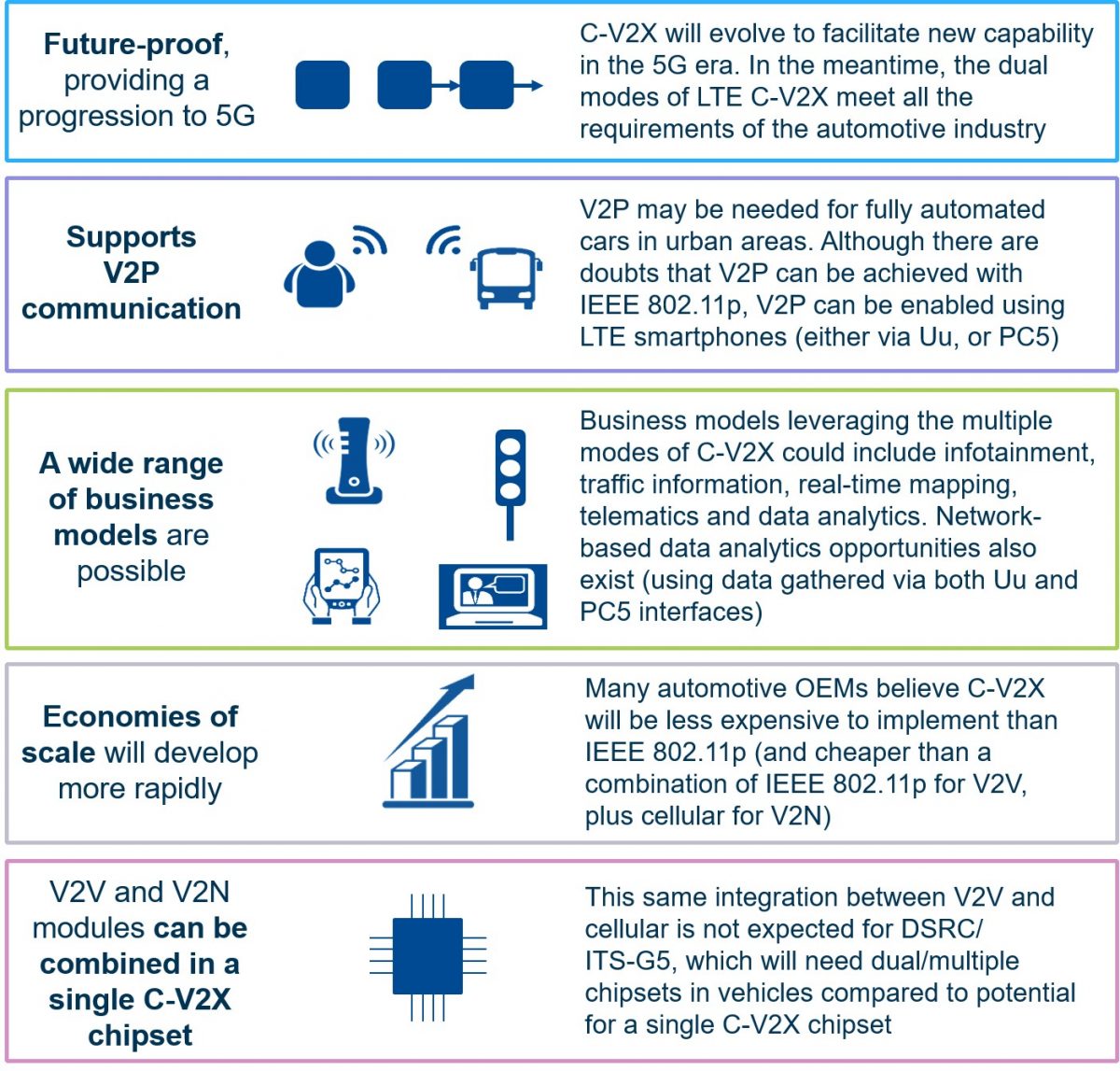
As part of this study, primary research has been conducted to elicit views from the mobile and automotive industries on the benefits of C‑V2X. One-to-one interviews with companies involved in the 5GAA were held, in order to identify several key benefits, as summarised in Figure 1.1 below.
A snippet from the report featuring the benefits of C-V2X [Source: Analysys Mason, 2017]

Socio-economic benefits of cellular vehicle-to-everything could amount to 43 Billion Euros by 2035
Brussels, 05th December 2017 – The 5GAA today published a report, authored by independent telecoms, media and technology consultants Analysys Mason together with automotive consultancy SBD Automotive, which assesses the benefits of cellular vehicle to everything (C‑V2X) technology for delivery of vehicle-to-everything (V2X) communication. The report, which has a focus on the benefits of such solutions in Europe, uses qualitative evidence, and describes quantitative cost–benefit analysis that the consultants have undertaken, relating to deployment of C‑V2X.
Publication of the report coincides with policy development on V2X, and use of the 5.9GHz band, in the European Union, where the European Commission is currently undertaking a public consultation on deployment of cooperative intelligent transport systems (C‑ITS).
The study concludes that the deployment of C-ITS systems is beneficial at the European Union level. Net benefits that could be accrued in Europe are estimated to be in the range of EUR20 billion to EUR43 billion in 2035 (with the highest benefits coming from increased road safety, and traffic efficiency), across the four scenarios modelled.
The most favourable scenario of those modelled in the study (amounting to EUR 43 billion net benefits) is where the potential for rapid penetration and economies of scale for C-V2X is maximised and both C-V2X and the Wi-Fi Standard IEEE 802.11p are able to co-exist in the 5.9GHz spectrum band. Such benefits do not arise in a scenario where the use of IEEE 802.11p is mandated for C-ITS services, which would result in less than half these expected net benefits (EUR 20 billion).
The study also indicates benefits of C-V2X for the European market lie in its deployment flexibility, with the ability to provide coverage for both short range and wide area applications, and certainty of future evolution to 5G, potentially facilitating earlier deployment as well as after-market deployment (e.g. V2X services provided in vehicles via a smartphone or other after-market device with C-V2X connectivity).
Reduced infrastructure deployment costs are a further key benefit of C-V2X, from the potential to re-use existing mobile infrastructure, and thus leveraging cellular technology integration and economies of scale, rather than building independently operated roadside infrastructure.
Christoph Voigt, 5GAA Chairman comments: “C-V2X will be fundamental to the deployment of cooperative intelligent transport systems. The benefits highlighted is this report indisputably demonstrate that this technology will lead to major improvements in driving and road safety. It further highlights that the European Commission should take a technology neutral approach and not limit these benefits by mandating the use of the Wi-Fi standard IEEE 802.11p”
The socio-economic benefits study on C-V2X can be found here.
Separately, the 5GAA has also today published a study which carries out a quantitative analysis of LTE–V2X (PC-5) and IEEE 802.11p technologies for short-range ad hoc/direct communications in reducing fatalities and serious injuries caused by motoring accidents in the EU. The modelling underlying this report was peer-reviewed and validated by the technology and policy consultancy, Ricardo. The study find that LTE-V2X (PC5) outperforms 802.11p in reducing fatalities and serious injuries on the EU’s roads. The 5GAA’s study on an assessment of LTE-V2X (PC5) and 802.11p direct communications technologies for improved road safety in the EU can be found here.
About C-V2X
V2X allows vehicles to communicate with each other and the wider transport ecosystem. It will potentially complement on-board sensors by providing enhanced information (such as data from other vehicles) over a longer range.
C‑V2X is a technology developed by the Third Generation Partnership Project (3GPP) to deliver V2X services, using two modes of communication:
- a direct vehicle-to-vehicle mode (called ‘PC5’ in 3GPP specifications) and
- a network communications interface (called ‘Uu’ in 3GPP specifications) for vehicle-to-network (V2N) communication via existing mobile networks.
Download Press Release here.

Bright Regulatory Trends of C-V2X in Asia Pacific Region
Shanghai, China – On 16 November, The 5G Automotive Association (5GAA) hosted its Second General Assembly. Following announcements of the association’s progress and growth worldwide, 5GAA inaugurated the Asia Pacific Roundtable. Here, regulators from China and South Korea joined the discussion, sharing industry trends for the Internet of Vehicles and future Intelligent Transport Systems, as well as a number of real-life demonstrations of technology that is being developed in this region.
5GAA is a unique organisation on the global stage: with leading members of the automotive and telecommunications industry as founders. The association aims to pioneer digital transformation on our roads, creating a safer and more sustainable road environment for all.
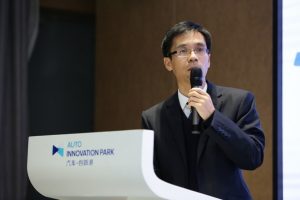
At the Asia Pacific Roundtable, Mr. He Guangjin from the Chinese TMRI (Traffic Management Research Institution) of MPS (Ministry of Public Security), presented the demonstration made at WIOT 2017 (World Internet of Things Expo) in Wuxi. This was the first demonstration from the Chinese public security industry where the LTE-V2X technology was employed. Additionally, it was so a premiere for the official traffic management system to be opened to vehicles on open roads. TMR also announced its plan to build a larger LTE-V2X pre-commercial trial including 20 to 50 intersections in 2018, to verify the broadcasting of real-time traffic conditions of intersections and the reception of information transmitted from vehicles. Additionally, TMRI is actively working on industry and national standards such as “Road Traffic Signal Controller I2V Information Distribution Interface Specifications”, “Adaptive Verification Management Regulation of Intelligent & Connected Vehicles (ICV) on Public Roads”, etc.
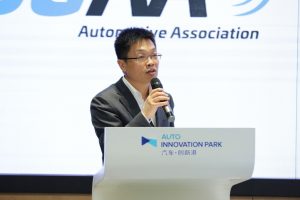
Dr. Cen Yanqing from the Chinese RIOH (Research Institution of Highway) of the MOT (Ministry of Transport) shared the important progress of the MOT. The ministry is paying close attention to automated driving and has already set up a dedicated working group to coordinate the corresponding ministries and guide the work on automated driving technology. In order to achieve automated driving, it is not sufficient to equip autonomous vehicles but it’s also needed to have an intelligent reformation of the road infrastructure and vehicle-to-road, vehicle-to-vehicle, vehicle-to-person communication and interaction in an effective way. To further promote the automated driving, the Ministry of Transport has built test zone for commercial vehicles verification in Tongzhou, Beijing, including specific scenarios e.g. ramps, intersections, and traffic lights.
When Dr. Cen was asked about whether MOT will mandate any technical specifications, he clarified there is no mandatory regulation so far. The MOT – as a department which uses technology – is opened to the utilisation of the V2X technology, but will select the best and most efficient technology eventually, he said. He also claimed that the MOT would support some of the Chinese telecommunication corporate contributions such as CMCC, Huawei, and Datang. Finally, he declared “we cannot implement two technologies but only one”.
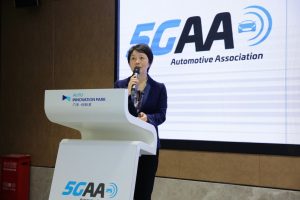
•Vice President of the China Academy of Information and Communications Technology, Ministry of Industry and Information Technology, China
•Chairman of the IMT-2020 (5G) Promotion Group
Ms. Wang Zhiqin, from CAICT (China Academy of Information and Communications Technology) of MIIT(Ministry of Industry and Information Technology), explained that the national CAV (Connected and Automated Vehicles) industry development committee advises to promote the LTE-V2X technology deployment and application, and its evolution to 5G and internet of vehicles integration development. He also announced the release of the Guide to the Construction of Standard Architecture for CAV Industry Development jointly developed by MIIT and NSC (National Standardization Administration), in which the LTE-V2X and 5G technologies are greatly highlighted in the information and communications volume. When asked about the spectrum of the Internet of Vehicles in China, Ms. Wang expressed that the government attaches great importance to it and needs prompt issuance and release of a positive guidance to the industry. She believes China should release this C-V2X spectrum relatively soon.
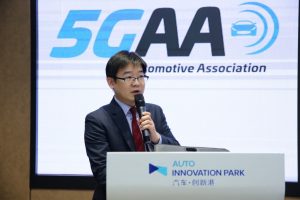
Deputy Director, ITS and Road Safety Division, Road Bureau, Ministry of Land, Infrastructure and Transport, South Korea
Mr. Chang-ki Kim, from the MOLIT (Ministry of Land, Infrastructure, and Transport) explained that his division in Korea is implementing two strategies to promote the commercialisation of Internet of Vehicles. The first strategy consists of focusing on the C-ITS safety aspect by developing and commercialising the RoDAS (Road Driving Assistant Systems) by 2020 in accordance with the National ITS Master Plan. As CAV (Connected and Automated Vehicles) will improve road safety issues under the mixed condition of AV (Automated Vehicles) and LV (Legacy Vehicles) in both highway and urban areas. MOLIT will launch, as its second strategy, the transportation renovation program by promoting and integrating the C-ITS and CAV technologies under their CAD (Connected and Automated Driving) Test-beds. Additionally, he emphasised that deploying those Test-beds in Korea would include the verification of various communication techniques, e.g., C-V2X (LTE, 5G), under the real and dynamic road environment. Mr. Kim expressed his intention to invite all ICT and CAD testing companies to conduct their service applications and to develop their cooperation and sharing models by joining those Test-beds.

5GAA & GSMA Letter to EU Commission
The 5G Automotive Association (5GAA) represents the automotive and telecom industry’s alignment for the global connected and autonomous vehicle, supported by more than 50 member companies including many world class car manufacturers. 5GAA’s mission is to develop, test and promote communication solutions for the future of the 5G automotive economy in Europe and globally. The 5GAA is actively contributing to ETSI, 3GPP and ITU in the fields of standardisation and spectrum-related matters. The 5GAA is committed to accelerating Cellular-V2X (C-V2X) standards seamlessly embracing 4G and 5G, and would like to call on the European Commission to support stakeholders in this collaborative process by providing leadership and timely regulatory support.
The GSMA, which represents the Mobile Network Operators globally, has succeddfully collaborated with the Automotive Industry for many years. Together we have created secure solutions that have advanced the Connected Car market with major benefits to consumers. Cellular V2X will enable further cross-industry collaboration with government agencies in cities and transport. The GSMA believes that C-V2X will contribute to safer vehicles, reduce congestion and pollution. It will build upon the existing 23 million existing Cellular Connected Car market in Europe and drive the deployment of Digital Europe.
The 5GAA is keenly aware of the imperative for road safety and the need for Europe to assert 5G leadership while ensuring spectrum efficiency. Given the longevity of vehicles and the significant industry investment in cellular technologies, C-V2X will be of utmost importance as Europe and the world transitions to 5G in supporting mission critical applications and the massive opportunities associated with the introduction of a new global standard.
We therefore urge the European Commission to allow the ITS-G5 and C-V2X stakeholders to work collaboratively toward an agreement on the future of connected and automated cars, without a premature and cumbersome legislative decision.
The 5GAA is confident that the industry will ultimately align with a pragmatic solution that saves the most lives while embracing technology evolution, and managing complexity and cost. We firmly believe in and pledge to collaboratively work with other stakeholders on solutions that ultimately benefit the European Union. We encourage the European Commission to support technology neutrality, mitigating a significant risk that 5G in the key automotive vertical will struggle, thus impacting the European automotive industry and the future growth and global competitiveness of the EU economy.
Europe is an important pillar for members of the 5GAA and is leading the world in the development of smart transportation solutions. A considerable part of C-V2X innovation occurs in Europe, and will contribute to road safety, the development of smart cities and trans-border corridors, to achieve the efficiency and environmental objectives that ultimately benefit European citizens. 5GAA members are accelerating C-V2X with pre-commercial trials in Europe, and will culminate in global deployments.
We are strongly supportive of 3GPP technologies for direct communications over ITS spectrum to enable vehicle-to-vehicle, vehicle-to-infrastructure, vehicle-to-pedestrian (and other vulnerable road users), i.e. C-V2X, while also leveraging vehicle-to-network over mobile operator spectrum. An important part of the ongoing 5GAA work is to support the European Commission’s policies laid out in the C-ITS Masterplan, as well as Gear2030 for Highly Automated Vehicles and the 5G Action Plan. We strongly rely on the European institutional support to enable a regulatory framework conducive to an industry-driven and swift deployment of the platform of their choice.
The 5GAA looks forward to continuing the dialogue with the European Commission and the various industry stakeholders in order to lay the foundation for a 5G automotive future in Europe.
Download the letter here

LG, Ford, Verizon, Denso and Gemalto join the 5G Automotive Association
5GAA (www.5gaa.org) welcomes LG, Ford, Verizon, Denso and Gemalto as new members of the association.
“We are very pleased that LG, Ford, Verizon, Denso and Gemalto have joined the association. With their global footprint and diverse expertise across the communications and automotive ecosystems, these companies will contribute to the definition and development of next generation connected mobility and automated vehicle solutions” Dino Flore, Director General of 5GAA, said.
Kookyeon Kwak, Executive Vice President, Head of LG’s Advanced Standard R&D Lab, said, “Cellular communication will play a pivotal role to meet the requirement of safety, convenience, and infotainment for future smart cars. The trend is now being accelerated by the completion of LTE-V2X, the first cellular- based vehicle-communication standard. As a manufacturer in mobile communication and vehicle component areas, LG Electronics would like to contribute to 5GAA for connecting communication and automotive industries”.
“We are excited to work together with other automotive and technology providers to define a future that envisions new and empowering mobility services and solutions. We see the 5GAA as a key enabler to the development of a sustainable connected vehicle ecosystem.” Don Butler, Executive Director of Connected Vehicle and Services at Ford Motor Company, said.
DENSO CTO for the European region, Masato (Max) Nakagawa, commented: “Extending DENSO’s global efforts in the area of vehicular connectivity is strategically aligned to our policy ‘Protecting Lives, Preserving the Planet, and Preparing a Bright Future for Generations to Come’. Reinforcing this
direction, DENSO AUTOMOTIVE Deutschland GmbH has decided to join the 5GAA. We are proud to be accepted as 5GAA member and are looking forward to collaborating in the 5GAA. DENSO considers this engagement viable to complement our long term ongoing global support of 700MHz/5.9GHz V2X safety communication. 5GAA provides the environment for the cross-industry collaboration required to define corresponding future mobile communication systems. In collaboration with the 5GAA partners we plan to explore, define and develop multi-spectral connectivity to support future mobility demands, especially in the area of connected and automated driving.”
“Gemalto is thrilled to join 5GAA and work within this prestigious group of global leaders to enable the world of new mobility that will revolutionize the automotive sector,” says Frederic Vasnier, EVP
Embedded Software and Products. “Gemalto has demonstrated its unrivaled expertise to ensure simple, seamless and ubiquitous connectivity with robust security mechanisms inside the vehicle, between vehicles and with the connected ecosystem of devices, pedestrians, and the cloud.”
5GAA was created to bridge automotive and communication industries in order to develop, test and promote connected mobility solutions, initiate their standardization and accelerate the commercial availability and global market penetration.
Since its inception, 5GAA has been experiencing rapid expansion to include key players with a global footprint in the communication and automotive industries, including car manufacturers, tier-1 suppliers, chipset/communication system providers, mobile operators and infrastructure vendors.
To achieve its long-term goals, the association is creating five Working Groups to address the following areas of work: Use Cases and Technical Requirements; System Architecture and Solution Development; Evaluation, Testbeds and Pilots; Standard & Spectrum; Business Models and Go-To-Market Strategies. In addition, the board is planning the needed policy and advocacy efforts to join the relevant discussions in this space with different regulators, policymakers, and administrations around the world.

FT Future of the Car Summit USA
The automotive industry faces massive disruption from advances in autonomy and connectivity as well as the shift towards electric vehicles. Emerging technologies combined with changing customer preferences could reshape the whole market. Taking place in Detroit, the seat of the US car industry, the FT Future of the Car Summit USA will throw light on the new strategies and partnerships turning the forces of disruption into engines for growth.
5GAA will participate in the programme for this conference. To apply as a 5GAA speaker, please contact marcom@5gaa.org
IAA Mobility 2021 Munich
The 5G Automotive Association (5GAA) will participate in the IAA Mobility Conference 2021 that will take place from 7 to 12 September in Munich. IAA Mobility is the leading global platform for the mobility industry and brings together actors from the entire mobility chain.
Following the guiding theme “What will move us next” the discussion will focus on how automation, connectivity, and smart city solutions will drive our progression to a more sustainable and effective mobility.
The event will provide an excellent platform to discuss the future of mobility with relevant stakeholders of the transport ecosystem.
5GAA will be active at two occasions:
9 September 2021 10.30 AM CEST
5GAA will hold a Master Class session. A great opportunity to engage in cross-industry exchange, present our expertise in an educational format, and discuss last updates and automated mobility by demonstrating the capabilities and deployment models of the Cellular Vehicle to Everything (“C-V2X”) technology.
10 September 2021, 11.45 AM CEST
5GAA will be present with its own Speaker Corner in the Business Club House, located in the central area of the exhibition. During 90 minutes our association and its members will have the opportunity to have speakers discuss the latest topics on connected mobility, as well as enjoy networking opportunities.
More information to follow.