

5GAA Statement on FCC Chairman’s Proposal for the 5.9 GHz Band
In response to Federal Communications Commission Chairman Ajit Pai’s proposal for the 5.9 GHz band, the 5G Automotive Association issues the following statement:
The 5G Automotive Association applauds Chairman Ajit Pai for proposing to dedicate a portion of the automotive safety spectrum for the use of Cellular Vehicle-to-Everything (C-V2X). Extensive crash avoidance testing continues to demonstrate that C-V2X technology will deliver safety benefits to the American public. We look forward to working with all stakeholders throughout this process to ensure that spectrum regulations adequately address the needs of transportation safety.
You can find the official FCC chairman speech here.
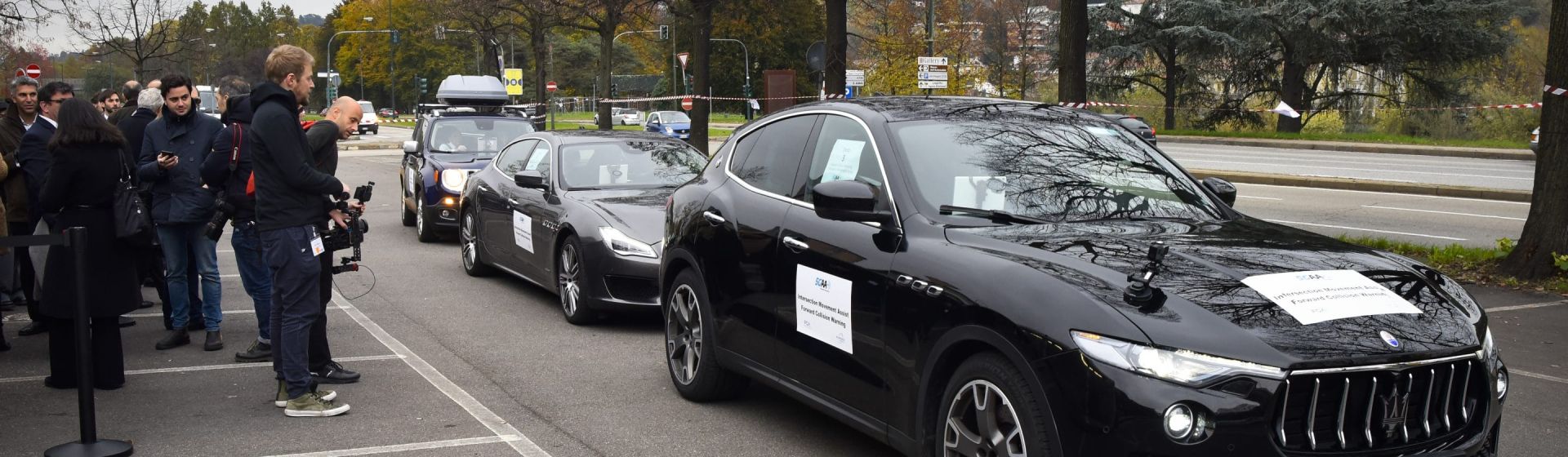
5GAA live demos show C-V2X as a market reality
Turin, 14 November 2019 – Smart mobility technology is a reality today, with ‘Cellular Vehicle-to-Everything’ (C-V2X) allowing connected vehicles to communicate with the cloud, directly with each other and their surroundings. Deployment plans are primarily sustained by the global trend in the automotive industry to adopt 4G LTE cellular technology, followed by the emerging 5G high-speed low latency communications. Beyond infotainment, C-V2X will capitalize on vehicular and smartphone connectivity to contribute to better safety, less congestion and reduced emissions.
During a live demo event in Turin, the 5G Automotive Association (5GAA) showcased ready to deploy use cases in the streets of the city and a sneak preview of what the future has in store on the renowned Lingotto rooftop test track.
Prominent members and partners of the 5GAA including Audi, Continental, Ericsson, Fiat Chrysler Automobiles, Harman Samsung, Marelli, Pirelli, Qualcomm, TIM and Vodafone demonstrated the current state of C-V2X and the road to future, Vehicle-to-Vehicle (V2V), Vehicle-to-Infrastructure (V2I), and Vehicle-to-Network (V2N) applications based on 4G LTE and 5G.
“Connected mobility is a market reality.” says 5GAA Chief Technology Officer, Dr. Maxime Flament. “The use cases demonstrated in the streets of Turin are planned for deployment with a huge industry momentum based on the evolution path to 5G capabilities.”
Using both direct short-range communications and mobile networks, the open-road demonstrations showcased the extensive capabilities of today’s C-V2X technology, ready for deployment. To name a few:
- Protecting vulnerable road users, for instance, by alerting drivers about a pedestrian at a crossing using LTE-connected infrastructure.
- Smoothing traffic by allowing public authorities and road operators to provide real-time warnings to drivers in urban environments concerning roadworks or speed limits, via the network.
- Preventing incidents at dangerous intersections or in the event of unexpected braking, thanks to C-V2X direct-short range communications between vehicles.
The track demonstrations at Lingotto underlined the enhanced safety benefits that can be expected thanks to the versatility of 5G and the wide range of services it enables. To name a few:
- Vehicles will geo-tag dangerous areas for the following cars or provide ‘see-through’ functions to avoid dangerous overtaking.
- Pedestrians will be detected directly via their smartphones and surrounding vehicles will be warned.
- In case of accidents, emergency services will be able to visualize the situation live using on-board cameras of surrounding vehicles, improving response times and providing emergency responders situational awareness prior to arriving at the crash scene.
Furthermore, Intel showcased an “In Vehicle Entertainment” demo at the Museum, in collaboration with Marelli, TerraNet and Equinix, showing how Multi-Access Edge Computing (MEC) can support immersive high-definition (HD) entertainment for all occupants of a moving vehicle, including video streaming, gaming, virtual reality (VR), office work, online education, advertisement.
A short summary on each of the 5GAA C-V2X use cases, demonstrated today in Turin
Demo 1 “Vulnerable Road Users”: open road demos on safety
In this trial – which is part of Torino Smart Roads Initiative patronized by the Municipality of Turin – TIM, Links Foundation and Luxoft showed how the communication between the various actors moving along the roads can help in detecting potentially dangerous situations. The goal of the demos was to demonstrate how the 5G mobile network facilitates the protection of Vulnerable Road Users: pedestrians (“Presence of a pedestrian on a crosswalk”) and cyclists (“Presence of a connected bike on the road”). In the case of a pedestrian approaching a crosswalk, a Roadside Unit connected to the mobile network, equipped with a camera able to detect the event, sent a warning message to the nearby connected vehicles (I2V communication). In the case of a connected bike and a connected vehicle that are approaching each other, the two vehicles received a warning message about their presence when a risk of collision is detected.
Demo 2 “Urban Georeferenced Alerting” in open roads
TIM, FCA, Links Foundation, City of Turin with 5T, and Politecnico di Torino showed how the Local Traffic Authority in Turin intends to notify drivers in real time of possible dangers and special situations on the road (traffic jam, road works warning, dynamic speed limit, etc.). A standard geo-referenced warning message was dispatched to a TIM AMQP broker” at the edge of the 5G mobile network and only the involved vehicles received the geo-localized message from the AMQP Broker using the TIM 5G Network. The warning was read and displayed in an FCA vehicle through the on-board HMI and can for instance notify the driver of upcoming speed reduction. The aim of the trial was to demonstrate how the TIM 5G Network is suitable for realizing smart roads services for connected cars. The solution is compliant with the standards so it can be applied in other locations covered with mobile networks.
Demo 3 Intersection Movement Assist (IMA), Forward collision Warning (FCW)
FCA and Harman Samsung showcased two Vehicle to Vehicle (V2V) demos, by integrating C-V2X direct-short range communication into Maserati Levante and Quattroporte. The vehicles, through a direct radio link (network-less radio link), anonymously communicated basic information such as their position and related direction.
The Forward Collision Warning (FCW), detected possible frontal collision and warned the driver accordingly. The Intersection Movement Assist (IMA), assisted the driver at the cross junctions to avoid a possible lateral collision with an oncoming vehicle.
Demo 4 Emergency Electronic Brake Light (EEBL), Stationary Vehicle Warning (SVW)
FCA, Continental, and Qualcomm demonstrated fast and reliable information exchange between vehicles in emergency situations. The two demos are based on C-V2X direct-short range technology, enabling Vehicle-to-Vehicle (V2V) communication between two Jeep Renegade. There were two portions to this demo:
- “Stationary Vehicle Warning” (SVW): when the hazard lights are activated, the application broadcasted a message to all nearby vehicles so that approaching vehicles could be informed even if the hazard was not visible.
- “Emergency Electronic Brake Light warning” (EEBL): in the event of a sudden braking, the application broadcasted a message to following vehicles, such that approaching vehicles were notified of the potentially dangerous situation.
Demo 5 See-through
Vodafone, FCA, Vodafone Automotive, Marelli and Altran revealed the ‘See Through’ that uses C-V2X long-range cellular network communication to exchange streamed video in real time between vehicles, extending the driver’s visual range under obstructed visibility scenarios and to prevent accidents, especially those that may occur in an overtaking phase. The two involved Jeep Renegades vehicles were equipped with a connectivity solution (Marelli) and high frame-rate cameras (Marelli Motorsport) to detect the road lanes.
A real time tracking system and a space mapping algorithm of the vehicles, specifically developed by Vodafone Automotive, allowed Vodafone’s Multi-access Edge Computing (MEC) to dynamically manage and route the video flows on the basis of the vehicles’ relative positions and to ensure minimal end-to-end latency in the interest of drivers’ safety. Vodafone 5G ultra-low latency and high reliability were paramount to ensure the flow and synchrony of the real-time video exchange between vehicles, also under high traffic and cell saturation conditions.
Demo 6 World-first 5G-enhanced ADAS services
Audi, Ericsson, Italdesign, KTH, Pirelli, Qualcomm, TIM and Tobii showed how smart cars, commercial 5G smartphones and 5G networks jointly improve comfort, safety and efficiency. This unique collaboration combined the power of eye-tracking glasses, intelligent tires, in-vehicle augmented reality and 5G phones to work together over a live 5G network. With its high capacity and low latency, cellular 5G connectivity is ready to enable instantaneous cooperation between vehicles, the IoT ecosystem and more advanced driver assistance services. The live demonstrations at the Turin Lingotto test track were based on TIM’s commercial 5G network delivered in Turin in partnership with Ericsson. Audi cars, equipped with Pirelli Cyber Tyre, and embedded 5G modems provided by Qualcomm and available 5G smartphones were utilized to enhance pedestrian’s safety.
About 5GAA
The 5G Automotive Association (5GAA) is a global, cross-industry organisation of over 130 members comprised of leading global automakers, Tier-1 suppliers, mobile operators, semiconductor companies and test equipment vendors. It works together to develop end-to-end solutions for future mobility and transport services. 5GAA is committed to helping define and develop the next generation of connected mobility, automated vehicle and intelligent transport solutions based on C-V2X.
Learn more on the 5GAA website and follow us on Twitter and LinkedIn.
Media Contacts
5GAA Marketing & Communications
Email: marcom@5gaa.org
Official pictures: Conference – Demonstrations

Environmental benefits of Cooperative, Connected and Automated Mobility (CCAM)
The new European Commission recently outlined its political priorities, based on two fundamental and complementary pillars: environmental protection through the European Green Deal, and the digitalisation of Europe. Transport still represents around 25% of Europe’s total CO2 emissions. Road-based travel is responsible for the largest share of these emissions, which are expected[1] to double by 2050. Therefore, decisive actions need to be taken by policymakers and stakeholders to ensure that the objective laid out by the European Union[2] of cutting greenhouse gas emission by more than 80% in 2050 compared to 1990’s level is met.
5G technology enables a fully connected and automated mobility which begins with the availability of the LTE-V2X technology today. Vehicles and infrastructure are able to exchange relevant information via LTE-V2X either through direct short-range communication, which does not require network coverage, or long-range communication via the network, creating a real-time connection between all actors of road mobility. The upcoming 5G revolution will reinforce those interactions and spark a whole new set of services, dramatically changing the mobility landscape.
Read 5GAA’s Position Paper on the matter.

5GAA feedback on the call for inputs on the impact of 5G on regulation from the BEREC
The 5G Automotive Association (5GAA) is a global, cross-industry organisation of more than 120 companies from the automotive, technology, and telecommunications industries (ICT), working together to develop end-to-end connectivity solutions for future mobility and transportation services.
5GAA welcomes the opportunity to give feedback on the call for inputs on the impact of 5G on regulation from the Body of European regulators for Electronic Communications (BEREC).
Following the assessment by the BEREC on the list of regulatory aspects impacted by the development of the 5G technology, 5GAA would take this opportunity to add potential missing regulatory aspects as well as to highlight 5GAA’s view on BEREC’s priorities for the coming three years.
-
- 5GAA considers the availability of spectrum for digital communications to be critical for road safety using 5.9 GHz ITS spectrum. It is therefore essential that any regulatory framework provides certainty to the industry to invest in today’s technology for Day 1 services as well as a robust roadmap for advanced safety (5GAA is currently working on a related Work Item on New Radio V2X).
- Beside the direct communication means in the 5.9 GHz band enabling V2V and V2I communication, 5GAA stresses the need for the development of mobile network coverage alongside the road network, and calls for the adoption of regulation which stimulates investments in mobile network coverage (5GAA is currently working on a related Work Item on Strategic Deployment Agenda), to enable the full range of capabilities provided by cellular V2X.
- 5GAA highlights the need for continuous coverage and seamless handover of 5G connectivity for vehicles crossing country borders in Europe. Further work is needed, notably in collaboration with standardisation bodies, to establish the right conditions to stimulate continuous coverage and seamless handover across borders. (5GAA is currently working on a Work Item on Network Selection for this very purpose). However, it should be noted that despite the importance of cross-border handover with 5G networks, given use of ITS spectrum, it is not a concern for the 5G sidelink case.
- 5GAA stresses the required investments into connected intelligent traffic infrastructures to assure safe and efficient mobility. Significant investments can be ensured by stimulating synergies of mobile network infrastructure and intelligent road infrastructure along with cohesive funding mechanisms (e.g. CEF Transport/Digital) (5GAA is currently working on a Work Item on Road Side Unit).
On this point, 5GAA would like to add that CEF transport needs to remain technological neutral while CEF Digital should be focused on Mobile Networks. - As road safety and automated driving are prominent example of Quality of Service needs, 5GAA calls for regulation which focuses on social benefits, outcomes and market adoption to position Europe as a global leader in the field. (e.g. enables prioritization of different service classes) (5GAA is currently working on a Work Item on this matter, Business Aspects of Network Slicing (BARNS)).
- 5GAA would like to draw attention to CCAM’s needs in terms of direct communications for critical road safety use cases as well as complementary network based communication and calls for the adoption of regulation which considers various ways of connectivity and keep regulation technology neutral.
- As CCAM goes beyond automotive sector, 5GAA would like to point that there is an opportunity to address the digital transformation of the transportation sectors by stimulating synergies with other transportation sectors (as pedestrians, bikes, motorcycles, esp. in urban environments, as well as rail and tolling).
The next years are crucial to set Europe at the forefront of the development of 5G and of Connected and Automated Mobility, to guarantee the safe and sustainable mobility of citizens while maintaining a global competitive edge in 5G development. Effective synergy between the development of the 5G ecosystem and European regulation is a precondition to ensuring that the benefits of 5G are indeed fulfilled.
5GAA publishes test results in support to C-V2X FCC petition for waiver
Recently, the 5G Automotive Association (5GAA) filed a petition for waiver with the Federal Communications Commission of the United States requesting that C-V2X be allowed to operate in the upper 20 MHz (5905 MHz – 5925 MHz) of the US ITS band.
In support of this petition, 5GAA member companies have performed a series of tests in an attempt to address anticipated technical questions related to the favourable implementation of this petition. The report describes the test procedures and results that were undertaken to support the 5GAA C-V2X FCC petition for waiver in the 5.9 GHz band.
The report presents results of testing C-V2X in 20-MHz wide CH183 – the channel that has been recently proposed for C-V2X deployment in the ITS band and is referred to as basic C-V2X Channel and it allows for V2V and V2X messages such as basic safety message (BSM), signal phase and timing (SPaT), signal request message (SRM), signal status message (SSM), and others covered by the Road Safety Message under development in SAE standards. The upper part of the ITS band was chosen to minimize impact to DSRC channels, especially CH172.
The viability of C-V2X in 10 MHz has been demonstrated in a preceding report in which C-V2X has been shown to outperform DSRC in terms of reliability, resilience to out-of-band interference and range. This report extends these results by showing that a BSM message sent in 20‑MHz CH183 has the same reliability as previously shown in 10-MHz CH184.
Both lab and field data included in the report demonstrate consistent results:
- C-V2X communication in 20-MHz CH183 has the same reliability performance (Packet Reception Ratio vs. distance) as the identical BSM-like message transmission in 10-MHz CH184.
- Impact of C-V2X high load transmissions in CH183 on DSRC basic safety transmissions in CH172 is negligible up to a 1.4-km range in LOS conditions
- Impact of C-V2X high load transmissions in CH183 on V2I and I2V transmissions in CH178 is negligible up to a 1.4‑km range in LOS conditions
- Impact of C-V2X high load transmissions in CH183 on V2I and I2V transmissions in CH180 is negligible up to 1 km in LOS Conditions
Read the full report here.

Joint Industry Statement On Protecting And Supporting Connected And Automated Driving Made in EU
Brussels, 15 April 2019 – The European Parliament and the Council are currently debating a Delegated Regulation on Cooperative Intelligent Transport Systems (C-ITS). The European Parliament Transport committee has this week called to halt the approval of this delegated act. We agree.
ETNO, GSMA, the GSA and 5GAA – bringing together the global and European leaders in ICT and automotive – would like to express their highest concern as to the content of this Delegated Regulation. We believe it will downsize safety gains, negatively impact the competitiveness of our automotive sector and the development of 5G technology in Europe. For this reason, we call the European Parliament and the Council to reject the Delegated Regulation in its current form and ensure a revised, tech-neutral and growth-friendly text is put to vote instead, as soon as possible.
Europe risks to be stuck in the slow lane
With technology moving fast, we believe it is of essence that all new rules are future-proof, innovation-oriented in order to maximize C-ITS safety benefits. Currently, the Delegated Regulation fails this test, as it mandates the old Wi-Fi standard 802.11p and it excludes other mature technologies, such as Cellular-Vehicle to Everything (C-V2X), based today on LTE and tomorrow on 5G.
In doing so, it also effectively harms the development of 5G technology in the EU, despite rising global market competition, and it directly contradicts the goals set out in the European Commission “5G Action Plan” and “Digital Single Market Strategy”. Moreover, a technology mandate is a critical political decision, which should remain a sole competence of co-legislators instead of imposing it by a non-legislative act.
Cellular technology is crucial to citizens’ safety
C-V2X is a game-changer for safety. It enables both long-range communications via mobile networks and direct short-range connectivity for time-critical information – without subscription or network coverage. C-V2X offers a unique capability to make vulnerable road users safer by being integrated into smartphones but also holds the potential to connect older cars. Very simply put: cellular technologies can protect pedestrians and cyclists carrying a phone, while Wi-Fi technology is not suitable for this use.
5G technology is tested and it boosts the Single Market
The ConVeX Consortium (gathering global technology leaders such as Audi, Ericsson and Qualcomm) have recently demonstrated that mobile-based technology is ready and it is tested across European borders. This is of essence to ensure a functioning and harmonised European Single Market, as some Member States have already declared they do not have the resources – or do not intend – to deploy Wi-Fi-based solutions. This would create fragmentation where 5G could create harmonisation across EU markets.
Backwards compatibility just does not work
Some voices in the debate claimed that a clause in the Delegated Act would allow for a later revision, hence ensuring backwards compatibility of C-V2X with the mandated Wi-Fi 802.11p technology. Engineers and experts explain that Wi-Fi-based and 5G-based solutions are entirely different technologies using radio waves incompatibly. “Backwards compatibility” would be like expecting a DVD to work in VHS player. This means that unless the Delegated Regulation is made technology-neutral to allow also 5G-based technologies, it will de facto be locked out: European citizens will be relegated to an inferior technology that only a very limited amount of car manufacturers are planning to deploy, while other world regions have already taken steps towards C-V2X deployment.
About Our Associations
ETNO, European Telecommunication Network Operators’ Association – www.etno.eu
GSA, Global mobile Suppliers Association – www.gsacom.com
GSMA, Representing the interests of mobile operators and the broader mobile ecosystem worldwide – www.gsma.com
5GAA, 5G Automotive Association – www.5gaa.org
5GAA co-organizes 5G Vertical User Workshop alongside 5G-IA, 5G-ACIA, and PSCE
On 12 and 13 February 2019, the 5G Vertical User Workshop, an initiative of 3GPP Market Representative Partners 5GAA, 5G-IA, 5G-ACIA and PSCE, was organised as a collaborative event for strategic dialogue between industries and 3GPP by exchanging on future needs and upcoming cellular standard developments. The workshop as a result, aimed to produce a report shared directly to 3GPP Project Coordination Group (PCG) as a mean to stimulate and facilitate greater involvement of the 5G Vertical Users in the 3GPP process.
The workshop held in Brussels brought together a host of experts from 5G standardization and a number vertical industries hoping to harness 5G including Automotive, Public Safety, Industry Automation, Utilities, Broadcasting, Satellites and Railways; as well as policy makers at the EU and Member State level.
Overall the event was successful in stimulating open dialogue and actions across all participants in an informal workshop setting that supported all involved to share their perspectives and experiences from their industry and standardization, and therefore how related processes may well be improved moving forward. Several possible options were discussed in terms of how to deliver improvements, and what corresponding changes to interaction could look like if required. Could this involve further workshops outside of 3GPP which could then drive action within the established channels? Or should there be alteration to vertical and MRP orientated rules of procedure to foster greater contributions?
Moreover, several open tools were discussed for better tracking activity and on-going work to make 3GPP more accessible to those joining, and those already, involved that may experience difficulties in contributing during this important period in the standardization of 5G. The need for such improvements are especially pronounced due to the forthcoming TSG#84 in December 2019, during which the completion of both Rel. 16 upon which 5G will be so dependent, and finalization of the scope for Rel. 17 are both scheduled.
There was a clear consensus among organizational partners and participants that an informal workshop and forum of this type was of use to help stimulate productive discussion on how to proceed with inter-MRP interaction in future.
In light of this, it was proposed that a second event with more focus on practical steps to be taken by 5G vertical industries and SDOs to improve vertical input would be of value, however the setting of this event is yet to be determined; interested Market Representational Partners will be coordinating to decide on the most effective next steps to convert what was valuable dialogue into impactful actions.
Until then, all involved expressed their great thanks to all who contributed to a workshop filled with rich dialogue, and hope based on continuing collaboration that this progress can be built upon over the coming months.
You can find all presentations here:
- 5GAA – 5G Automative Association, pioneering digital transformation in the automotive industry
- PSCE – Public Safety Communication Europe, National plans and roadmaps towards broadband
- 5GIA – 5G Alliance for Connected Industries and Automation
- ESOA – EMEA Satellite Operators Association, 3GPP Market Representation Partners
- EBU – European Broadcasting Union, Native 5G broadcasting
- EUTC – European Utilities Telecom Council
- 5GIA, 5G PPP Projects focusing on standardisation Verticals and Standards Tracker Tool + Pan-European 5G Trials Roadmap, and International Trials
- 5G-PPP, Prestandards WG Status update
- 3GPP, Verticals in 3GPP + Mission Critical Comms + Industrial Automation + V2X learnings in 3GPP
5GAA releases updated white paper on C-V2X Deployment Timeline
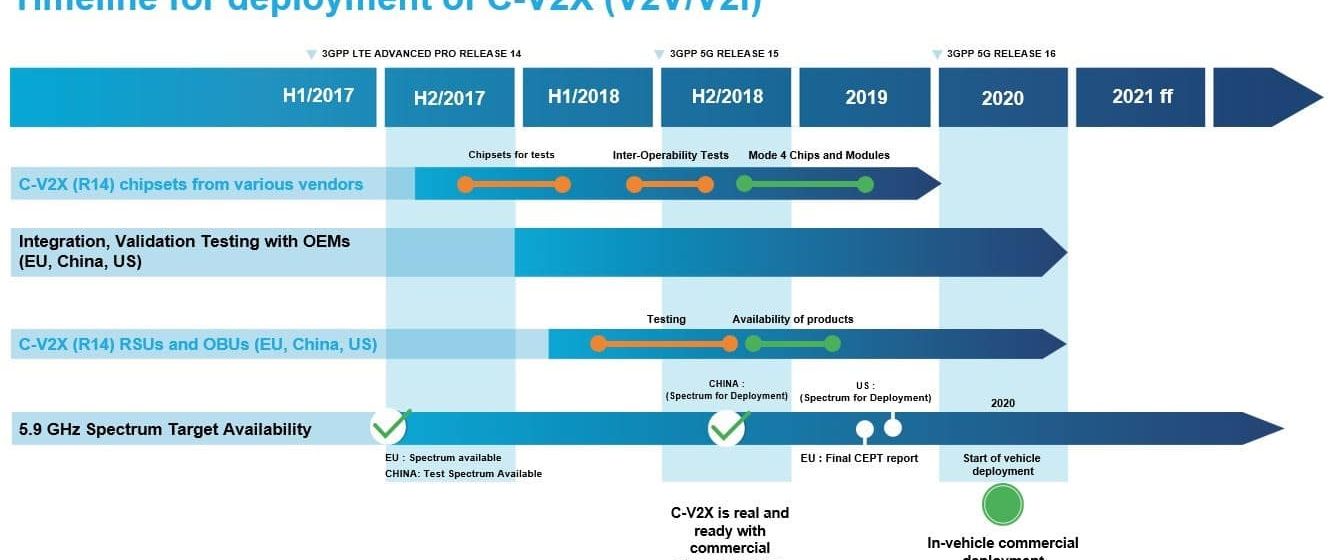
In December 2017 5GAA published the white paper “Timeline for deployment of LTE-V2X (V2V/V2I)” focusing on the introduction of direct communications with LTE 3GPP Rel.14. Since then Cellular-V2X (C-V2X) has gained a lot of momentum in the eco-system and we are at the verge of deploying the next generation of mobile network technology – 5G.
This updated timeline of the introduction of C-V2X covers the following topics:
- The extended use of V2N for safety-oriented services in vehicles deployed on the roads
- The comprehensive test and evaluation activities undertaken by the ecosystem consisting of OEMs, tier-1s, chip vendors, road operators, mobile operators as well as their suppliers and test equipment providers
- Outlook on the evolution towards 5G including backward compatibility
- C-V2X use cases for railways and respective test activities
- Progress on regulatory aspects
The inclusion of 2G, 3G and 4G cellular communication technologies (V2N – Vehicle2Network) into vehicles (i.e. “Connected Cars”) has been extremely successful in delivering benefits for the vehicle, the driver, the automaker and other participants in the transportation and emergency services ecosystem.
At present, more than 100 million Vehicles connected to cellular networks (V2N) are on the roads. This V2N connection is used for a wide variety of services including telematics, connected infotainment, real time navigation and traffic optimization, as well as for safety services including automatic crash notification (ACN) such as eCall, the recognition of slow or stationary vehicle(s) and informational alerts for events including traffic jams, road works and other traffic infrastructure related information, inclement weather conditions and other hazardous conditions. Several OEMs[i] share safety related warnings between their vehicles and have started to exchange this information across OEMs using e.g. services from HERE Technologies. Other initiatives to share information by interconnected backend systems are the EU financed projects ‘Nordic Way’, Talking Traffic’ and the ‘Drive Sweden projects. These projects also interconnect Road Traffic Authorities, Road operators, OEMs and smartphone applications to share traffic related info. The current understanding, also based on the European C-ITS Platform Final Report, is that the nature of these warning messages is informational, and the driver is always responsible.
C-V2X is a recent term introduced for cellular technologies optimized for transportation and connected vehicles. In particular, the C refers to both 4G LTE and 5G NR (new radio) releases of specifications, whereas X refers to multiple things’ vehicles may connect with. C-V2X includes both network-based communications that have been in use for decades, such as vehicle-to-network (V2N), as well as a new complementary mode of operation first defined in the 3GPP Release 14 specifications and approved in June 2017, which allows direct communications between vehicles (V2V), as well as between vehicle and road side infrastructure (V2I and I2V) without requiring any cellular network coverage or subscription. It can further support vulnerable road users (e.g. vehicle to pedestrian, or V2P) by integrating the direct communications technology into mobile and other devices. The direct communications functionality is used to specifically support safety critical services to reduce collisions, support automated driving, and improve traffic efficiency. LTE-V2X is the 3GPP nomenclature for direct communications as specified in releases 14 and 15, whereas 5G NR-V2X is from Release 16 onward. 3GPP R14 also added network communications improvements, delivering increased data volumes, managing greater scale of connected devices, and can further reduce latency and provide for higher levels of reliability in V2N. V2N is also technically known as Uu and refers to an endpoint such as a vehicle communicating with network infrastructure over operator licensed spectrum, whereas V2V/V2I/V2P is supported by direct communications operating on the ITS spectrum (e.g. 5.9GHz) and is known technically as PC5.
Click here to read the full version of this updated White Paper.
[i] https://www.autoblog.com/2018/05/07/volvo-cars-volvo-trucks-share-data/?guccounter=1#slide-7324246

5GAA releases white paper on the benefits of using existing cellular networks for the delivery of C-ITS
In this white paper, 5GAA provides analysis on the benefits of using existing cellular networks for the delivery of Cooperative Intelligent Transport Systems (C-ITS) services, in combination with RSU deployments. The analysis describes deployment options in terms of expenditures over a ten-year timeframe for the deployment of ITS services for vehicles communicating with infrastructure. For each option, the deployment costs, operation and maintenance cost, and connectivity costs are evaluated. The analysis highlights complementarity between cellular long-range technologies, i.e., mobile networks, using the cellular (Uu) interface and sidelink (PC5) technologies.
The paper defines the scope of services that can be reasonably delivered over cellular networks, and which services would require road side units (RSU) as an integral part of the solution. It also explains the state of the industry, highlighting examples where infrastructure services are already being provided over cellular networks today, as well as the architectural and technical considerations that are important to delivery of these services, such as spectrum, coverage, multi-operator and roaming agreements. The document details two different technical approaches: either build-out of dedicated RSU-based communication V2I infrastructure (C-V2X PC5 or 802.11p based ITS-G5/DSRC), or a mix of RSU and cellular based deployment. The cost models of these approaches are also analyzed, including the capital (CAPEX) and operational (OPEX) considerations that are important for road operators. These different models are applied to a variety of road scenarios to clearly show that the cost of delivering ITS services with existing cellular networks is significantly lower compared to widespread RSU rollout – to the extent that without this approach, it may not be reasonable to deploy V2I services in some areas at all.

Multi-stakeholder Statement on Preserving 5.9 GHz
The Association of Global Automakers, The Alliance of Automobile Manufacturers, 5G Automotive Association, Intelligent Transportation Society of America, and the American Association of State Highway and Transportation Officials issued the following statement in response to the recent filing by NCTA-The Internet & Television Association suggesting that spectrum reserved for transportation safety services should be repurposed:
The Association of Global Automakers, The Alliance of Automobile Manufacturers, The Intelligent Transportation Society of America, The 5G Automotive Association and The American Association of State Highway and Transportation Officials strongly support preserving the full 5.9 GHz band for transportation safety use, as it has been allocated.
Our members are actively developing technologies, and own and operate critical highway and other transportation infrastructure that connects vehicles to vehicles, to other road users, and to their environment to help reduce crashes. Connected vehicle and infrastructure technology includes vehicle communication with bicyclists, pedestrians, traffic lights, and advanced alerts of hazards like ice on roadways, commonly known as vehicle-to-everything (V2X). Additionally, they can enhance automated driving systems, which hold the promise to provide numerous economic, environmental, and societal benefits, such as decreased congestion and fuel consumption, and increased access for the elderly and disabled.
The entire 5.9 GHz band is needed to achieve the full benefit of these communication technologies in the years to come. These safety innovations require dedicated spectrum to ensure they work right every time without signal interference. Millions of dollars have already been invested in this effort, including incorporating connected vehicle technologies into infrastructure.
We are on the cusp of a major breakthrough in vehicle connectivity and safety innovations. With significant past and present investments in connected vehicle innovations, V2X technologies are already being deployed for the purposes of improving road safety. This will only continue moving forward. With 37,133 deaths on U.S. roadways last year alone, we must take every opportunity to save the lives of road users. Connected vehicle technologies offer the U.S. a powerful set of tools to save lives, but only if these technologies are given the ability to progress. We support protecting the entire 5.9 GHz band for transportation safety applications. Any unlicensed use in the band should be done without harmful interference to the incumbent technology or other intelligent transportation systems technologies.