Privacy by Design Aspects of C-V2X

Privacy by Design Aspects of C-V2X

Connected vehicles, as part of the emerging Cooperative Intelligent Transportation Systems (C-ITS) are positioned to transform the future of mobility – a change enabled by the exchange of messages between vehicles and between vehicles and transport infrastructure. As these messages are constantly broadcasting data, including vehicle speed and location, this raises potential concern about how to address privacy and data protection.

In this document, we take a fresh look at the latest technological architectures that feature Privacy by Design. We focus specifically on Cooperative Awareness Messages (CAM) and Decentralised Environmental Notification Messages (DENM), where privacy protection is offered by using pseudonym certificates that do not contain any identifying information. A Public Key Infrastructure (PKI) system takes care of the provision and overall management of the corresponding cryptographic keys. In this document, we review how current PKI system design can help address the risk of tracking from outside and inside attackers, and we identify challenges and privacy risks that remain unresolved. We give some suggestions in terms of future research and conclude the document with general recommendations.

Read the full White Paper

Virtual Showcase | C-V2X Deployment on US Roads

Virtual Showcase | C-V2X Deployment on US Roads

The 5G Automotive Association (5GAA) is delighted to invite you to the virtual showcase of “C-V2X Deployment on US Roads” on Tuesday, October 27 at 02:00 PM – 03:30 PM EDT / 11:00 AM – 12:30 PM PDT.

We invite you to :
•  See and hear more about existing C-V2X projects in the roads of Virginia, Georgia, Texas, and Michigan
•  Listen to our on-site correspondents from the companies and local authorities involved
•  Join our panel discussion focused on the state of play and future of ITS in the US with a mix of industry, state & local representatives

The virtual showcase will be moderated by industry expert Roger Lanctot while the panel discussion will be lead by Jim Misener, 5GAA Board Member and Senior Director & Global C-V2X Ecosystem Lead for Qualcomm.

Find the full programme here

Watch the recording here

5GAA Accelerates Connected Vehicle Development with First ETSI-Approved LTE-V2X System Profile

5GAA Accelerates Connected Vehicle Development with First ETSI-Approved LTE-V2X System Profile

ETSI specifications ensure interoperability, safety, and security of C-V2X technology development

In July 2020, the 5G Automotive Association (5GAA) partnered with global ICT standards organisation ETSI to organise a remote cellular-vehicle-to-everything (C-V2X) Plugtest. The LTE-V2X System Profile is the first of its kind to be specified by an independent, accredited standards organisation in Europe (ETSI TS 103 723).

The system profile provides industry wide upper layer configuration guidelines for C-V2X deployment and employs C-V2X technology from 3GPP Release 14. The system profile and the global standard it represents will lay the foundations for standardised direct cellular communications technology in the automotive sector; making product development faster and ensuring that safety and security are at the core of all new technologies.

LTE-V2X provides a seamless evolution path towards 5G employing new radio V2X (NR-V2X). The latter will allow even better performance and further enhanced features, while keeping backward compatibility with LTE-V2X”, said Maxime Flament, CTO, 5GAA. OEMs will especially benefit as the technology will allow long life cycles, which are essential for automotive products.”

Several automotive LTE-V2X devices were successfully tested during the second ETSI C-V2X Plugtest™ in addition to Intelligent Transport Systems (ITS) stations and Public Key Infrastructure (PKI) vendors in order to assess the level of interoperability of their implementation and to validate the ETSI ITS specifications. An overall interoperability success rate of 94% was achieved during the second ETSI C-V2X Plugtest.

To read the full report from the Plugtest, please click here.

New report released to support vehicle to infrastructure connectivity deployment

New report released to support vehicle to infrastructure connectivity deployment

5GAA, a global cross-industry consortium working to develop end-to-end solutions for future mobility and transportation services, commissioned Ricardo to develop the report to help improve understanding of the costs, challenges and opportunities of different communication technology approaches to Vehicle to Infrastructure (V2I) use cases.

V2I is not a new technology consideration, with research and development activities related to connected vehicle applications ongoing for over two decades. However, there is now growing momentum for wider scale deployment of communication technologies in both vehicles and road infrastructure.

To date deployment activities have been fragmented and relatively slow, due to continued emphasis on research, no common vision of communication technologies and market uncertainty, making it challenging for most stakeholders to develop suitable business cases.

To help support a greater understanding of financial viability of the communication approaches implemented in the EU and US V2I market, Ricardo transport and mobility experts, supported by technical experts from Roke Manor Research, analysed a range options which include the use of a pure cellular network system and using a combination of the cellular network with direct communication interfaces via the radio spectrum.

Using outputs from extensive research and engagement with key ecosystem players, the study weighs up strengths, weaknesses and complementarity of the different communications technologies in terms of their technical performance and costs, aligning them with the different use cases. For example, the cost analysis highlights that a pure cellular deployment approach in Europe and US is 40-45% lower cost compared with deployments that include direct communication roadside units.

To recognise the opportunities and benefits identified, Ricardo’s experts have made a number of recommendations that include increased cooperation and communication of roadmaps between vehicle manufacturers, central government, road operators and cellular technology providers – in particular with the consideration of interoperability of technology solutions. Central government are also identified as playing a key role through effective implementation of financial instruments to leverage private sector investment and support wider deployment.

Denis Naberezhnykh, Ricardo’s transport technical director commented:  “Increased communication and connectivity between vehicle and infrastructure have the potential to create significant benefit, not only to the user of the vehicle, but also through wide-ranging societal benefits that will positively impact the economy, community mobility and the environment. The current fragmentation of technical approaches and stakeholders has the potential to significantly slow V2I market adoption and so we’re proud to develop this report, on behalf of 5GAA, to create greater understanding of financial viability and how that aligns with technology choices, as well as to help identify where increased collaboration is needed”.

Read the full study

Ricardo plc is a global, world-class, multi-industry consultancy for engineering, technology, project innovation and strategy. Our people are committed to providing outstanding value through quality engineering solutions focused on high efficiency, low emission, class-leading product innovation and robust strategic implementation. With a century of delivering excellence and value through technology, our client list includes the world’s major transportation original equipment manufacturers, supply chain organizations, energy companies, financial institutions and governments. Guided by our corporate values of respect, integrity, creativity & innovation and passion, we enable our customers to achieve sustainable growth and commercial success. Ricardo is listed in the FTSE4Good Index, which identifies global companies that demonstrate strong environmental, social and governance (ESG) practices. For more information, visit www.ricardo.com.

Ricardo Energy & Environment is a leading sustainability consultancy, helping clients to respond to environmental challenges and opportunities around the world. Its team of over 450 staff draws on an impressive heritage supporting governments and businesses for over 40 years. The consultancy is an operating division of Ricardo plc. For more information, visit https://ee.ricardo.com/.


Media contacts:

Trevor Glue
Ricardo Energy & Environment
Tel:        +44 (0) 1235 753429
E-mail:   trevor.glue@ricardo.com


Anthony Smith
Ricardo Media Office
Tel:        +44 (0)1273 382710
E-mail:   media@ricardo.com

5GAA Releases New 2030 Roadmap for Advanced Driving Use Cases, Connectivity Technologies and Radio Spectrum Needs

5GAA Releases New 2030 Roadmap for Advanced Driving Use Cases, Connectivity Technologies and Radio Spectrum Needs

BRUSSELS, 8 September 2020  In the next two to three years, the 5G Automotive Association’s (5GAA) expects to see mass deployment of vehicle-to-everything (V2X) use cases geared towards improving traffic efficiency and road safety around the world. This vision is outlined in a new White Paper released by 5GAA which explores how leading automakersmobile
network operators and their suppliers see the world of automotive connectivity evolving over the coming decade. 

Vehicles talking to one another but also to roadside and telecom infrastructure and operators – so-called V2X communication – is just the tip of 5GAA’s vision for ‘advanced 5G-connected driving’. In its latest White Paper, 5GAA offers a comprehensive roadmap to guide all parties involved in this near-term market developmentbringing both automotive and telecom sectors together to fulfil what 5GAA sees as a powerful digital ecosystem in this fast-moving field.  

The Paper highlights selected end-to-end V2X applications factoring in the necessary technological evolution, industry readiness and spectrum needs. 5GAA has developed advanced driving use cases such as Cooperative Manoeuvres and Sensor Sharing in conjunction with both the adoption of Cellular Vehicle-To-Everything (C-V2X) standards and the availability of the required technologies and devices. These provide a tangible account of how advanced driving is taking shape globally 

Success in this endeavour requires to have all industry stakeholders on-board, including telecoms and automotive. Only then will new business opportunities and necessary investments be secured to fuel this ‘ecosystem’,” said 5GAA’s CTO and spokesperson Maxime Flament upon the White Paper’s launch 

With close to 200 million connected vehicles already on the roads worldwide in 2020 and a growing number of vehicles with the ability to exchange traffic and road condition information over cellular networks, the foundations for 5G-connected driving are well established, the Paper points out. Further progress in coming years will pivot around 5G-V2X use cases for more efficient and safe drivingFrom 2025 onwards, 5GAA anticipates mass rollout of more advanced automated driving and safety use cases supported by vehicle connectivityAdditional automated driving functionalities are anticipated as from 2026.  

Between now and 2024, ‘connected’ digital road infrastructure will pave the way for real-time or ‘dynamic’ traffic updates, hazard warnings, and high-definition mapping services. Towards 2026, advanced vehicle-to-vehicle (V2V) cooperation will further boost automated driving developmentsincluding sharing sensor data and cooperative manoeuvring 

To fully support this evolution, 5GAA calls on national and regional administrations to make sufficient radio spectrum available for mobile communication networks in targeted low- and mid-bands, and it recommends harmonised use of the 5855-5925 MHz band for communication between road users and roadside infrastructure within the wider international digital traffic ecosystem.  

Here, the White Paper acknowledges that some 5G-enabled applications may prove challenging to implement, while others will be easier and offer valuable lessons going forward: “Low-hanging fruit applications addressing OEM fleets, such as automated valet parking and tele-operated driving will open the door to more secure, safe and interoperable vehicle-to-network automotive applications across borders.”  

Charting a clear way forward… 

All in all, to deliver end-to-end V2X services and unlock the true value of vehicle connectivity, 5GAA considers that the realisation of its roadmap would require:  

(1) sufficient spectrum for short-range direct communications at 5.9 GHz 

(2) high levels of mobile network coverage along the roads 

(3) sufficient service-agnostic mobile network spectrum for mobile network-based communications, in addition to the bands that are currently identified for International Mobile Telecommunications (IMT) use. 

The essence and great promise of 5G is that it makes better use of the radio spectrum, boosts mobile network coveragesecurity and safety, while delivering environmental benefits for citizens and consumersTo chart a clear way forward5GAA calls on all players to work together while implementing the use cases highlighted in the Paper, as well as other measures outlined in 5GAA technical reports and papers.  

About 5GAA 

The 5G Automotive Association (5GAA) is a global, cross-industry organisation of companies and OEMs from the automotive, technology and telecommunications industries working together to develop end-to-end solutions for future mobility and transportation services. 5GAA is uniquely placed to support 5G-V2X advances because it unites all major automotive, chipset, technology, telecom-mobile infrastructure and mobile network operators. In less than three years, more than 135 global players, including pioneering OEMs, have signed up to 5GAA’s vision. 

For more information, please contact our media team at marcom@5gaa.org  

Download the Roadmap

Press Briefing slide deck

A Visionary Roadmap for Advanced Driving Use Cases, Connectivity Technologies, and Radio Spectrum Needs

A Visionary Roadmap for Advanced Driving Use Cases, Connectivity Technologies, and Radio Spectrum Needs

The article below and the linked document refer to an older version of the 5GAA roadmap, whose most updated version you can find here

With this white paper, the 5G Automotive Association (5GAA) presents the results of its studies relating to the evolution of automotive connectivity for the purposes of enhanced road safety, improved traffic efficiency, greener environmental impact, and more comfortable driving.

5GAA has identified the most promising advanced driving use cases such as Cooperative Manoeuvres and Sensor Sharing, in conjunction with the adoption of Cellular Vehicle-To-Everything (C-V2X) standards as well as availability of required technologies and devices, i.e. on-board units (OBUs), road-side units (RSUs), and smartphones, integrating the latest chipsets and modules. The market trajectory of the identified use cases is described along with the expected timeline for their mass market deployment.

The white paper finally highlights the spectrum needs for basic and advanced driving use cases. For direct communication, this corresponds to between 10 and 20 MHz at 5.9 GHz for basic safety, and an additional 40 MHz or more at 5.9 GHz for advanced driving.

Read the full roadmap here

5GAA Efficient Security Provisioning System

5GAA Efficient Security Provisioning System

Vehicle-to-everything (V2X) communication is at our doorsteps. It is a key part of the future of connected vehicles and autonomous driving as it enables infrastructure, pedestrians and vehicles to interact, thus taking the transportation ecosystem to the next level. Security plays an important role in building trust in V2X, protecting users’ privacy, and enabling safety, efficiency and comfort.

Efforts to reinforce trust in this ecosystem are driving global initiatives to develop, standardise and implement Security Credential Management Systems (SCMS). As a consequence, different stakeholders have put forward their requirements leading to differing, non-interoperable regional designs. The 5G Automotive Association (5GAA) has evaluated existing system designs and their regulatory requirements, as well as identified some new ‘advanced’ features. The resulting recommendations for improved design fulfilling these security and privacy requirements in a large-scale system are outlined in this white paper.

With the objective to integrate new technical opportunities in the automotive world, as afforded by widespread cellular connectivity, and to identify potential design simplifications, an analysis and evaluation of existing system designs has been completed over the last year. These existing designs are region-specific and not fully interoperable due to differing security and privacy requirements.  Some ecosystem stakeholders within 5GAA challenged this status quo on several levels and evaluated these regional V2X security approaches.

The paper summarises the design simplifications, discusses their rationale and impact, and proposes an updated design for large-scale deployment and cross-regional interoperability called the ‘Efficient Security Provisioning System’ (ESPS). The paper outlines potential simplifications to the existing V2X credential management systems.

Read the White Paper

Recommended LTE-V2X Related Amendments to ETSI ITS Test Specifications

Recommended LTE-V2X Related Amendments to ETSI ITS Test Specifications

Many specifications and standards previously defined by ETSI TC ITS include details and dependencies based on an assumption of using ITS-G5 (which is based on 802.11) as the underlying access layer technology.

Relevant protocol specifications and standards within ETSI TC ITS have been enabled in support of LTE-V2X as the underlying access layer technology.

As the amended protocol specifications and standards are finalised and approved, the corresponding test specifications must also be amended as needed.

This Technical Report documents the 5GAA recommended amendments to ETSI ITS test specifications.

Read the document

5GAA publishes C-ITS Communication System Profiles

5GAA publishes C-ITS Communication System Profiles

In light of on-going discussions on a legal framework for the European C-ITS deployment, a minimum set of specifications and configurations is needed for existing ITS standards ensuring the interoperability of C-ITS service among ITS stations using different communication technologies and systems, e.g. short-range and long-range radio communications.

While C-V2X standards are already finalised for 3GPP Rel. 14 and 5GAA published White Paper on C-V2X Use Cases: Methodology, Examples and Service Level Requirements, there are still many options on how to configure and establish parameters for C-V2X systems. In order to provide a common standard interpretation, corresponding system profiles are needed, which outline the basic system settings and environments

In Europe, Basic System Profiles (BSPs) have been developed by the Car-2-Car Communication Consortium (C2C-CC) and the EU-funded C-ROADS Platform project, assuming ITS-G5 with IEEE 802.11p as radio access technology for V2V and V2I communication. Though many aspects of the existing BSPs could be reused, there are some modifications needed for C-V2X. In addition, there would be extensions required in order to accommodate alternative communication links like V2P, V2N, and V2C.

5G Automotive Association makes publicly available the following  C-ITS Communication System Profiles:

5GAA officialises five new MoUs during Brussels conference

5GAA officialises five new MoUs during Brussels conference

Is 5G in-car technology ready for automated driving? Are Europe’s roads up to speed for this digital revolution? Are governments, road authorities and industry on the same page? What is Europe’s strategy to secure leadership and capture markets in the field? These and other pressing questions and challenges for connected and automated mobility were addressed on 6 February, at the 5GAA-hosted event – 5G, Igniting the Connected and Automated Mobility Revolution – in Brussels’ Concert Noble. High-level representatives and experts from industry, governments and the EU explored the capabilities, deployment models and vast opportunities of the latest ‘cellular vehicle to everything’ (C-V2X) technology.

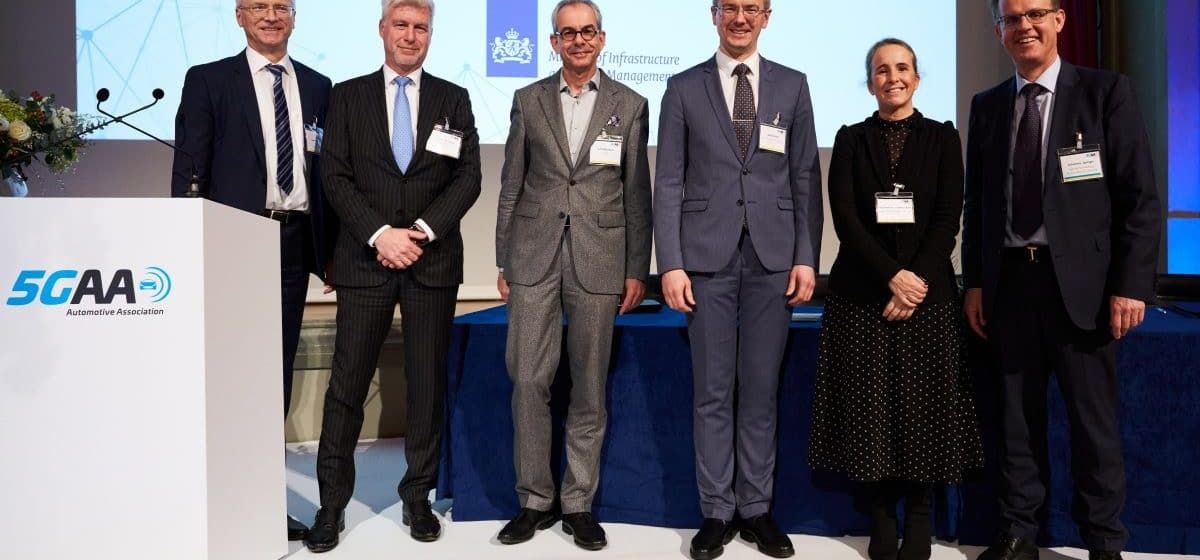
BRUSSELS, 6 February 2020 – The 5G Automotive Association (5GAA) organised a conference bringing together EU representatives and the connected automotive ecosystem to the heart of Europe, to officialise its public-private partnerships with several European authorities. Indeed, 5GAA announced extending its partnership network by signing Memoranda of Understanding with the Dutch Ministry of Infrastructure and Water Management, the Italian Ministry of Technological Innovation and Digitalisation, the Spanish Directorate-General of Traffic (DGT), the German Federal Highway Research Institute (BASt) and the Electronic Communication Office of Latvia (VASES). The ambition of the association is to strengthen the collaboration between industry and the public sector and to facilitate the dialogue to drive innovation in mobility and transport with these closer collaborations.

Some recognised speakers at the conference included BMW’s Joachim Göthel, Senior Manager in the German automaker’s ‘Project 5G Alliance’, and Dino Flore who is Vice-president of Technology at Qualcomm, the US chipmaker, as well as Robert MacDougall who heads mobile operator Vodafone Enterprise’s Public Policy Unit. They were joined by senior EU policymakers, including a message from Maria Koleva on behalf of the European Commissioner for Innovation, Research, Culture, Education and Youth Mariya Gabriel and speech by Pearse O’Donohue, Director for Future Networks, Directorate-General for Communications Networks, Content and Technology, as well as national experts from the Netherlands and Spain giving their unique perspective.

“To fulfil its potential in connected and automated mobility, Europe really needs a clear policy message reinforcing its ‘technology neutral’ approach in the future C-ITS regulations,” noted 5GAA’s CTO and spokesperson Maxime Flament.

Automated and connected driving, intelligent driver assistance and data-driven transportation network optimisation are examples of what tomorrow’s transportation will look like for people and governments.

Discussions and conclusions reached at the 5G, Igniting the Connected and Automated Mobility Revolution conference thus paint a rich picture of the work currently underway and the roadblocks and potential detours that may lie ahead. With the help of audience contributions, the event helped to chart the way for future autonomous transport that not only meets the needs of society and industry but can also make a positive contribution to meeting the global Sustainable Development Goals in terms of cleaner and safer transportation.

About 5GAA

The 5G Automotive Association (5GAA) is a global, cross-industry organisation of over 130 members comprised of leading global automakers, Tier-1 suppliers, mobile operators, semiconductor companies and test equipment vendors. It works together to develop end-to-end solutions for future mobility and transport services. 5GAA is committed to helping define and develop the next generation of connected mobility, automated vehicle and intelligent transport solutions based on C-V2X.

Learn more on the 5GAA website and follow us on Twitter and LinkedIn.

Media Contacts

Delia Voica
Tel.: +32 486 69 76 22
Email: delia.voica@5gaa.org

Marketing and Communications Team
Email: marcom@5gaa.org


PDF Document