

5GAA | Safety of Life Study
The aim of this study is to explore the impact of different technical solutions for Cooperative Intelligent Transport Systems (C-ITS) communication solutions on EU road safety over time. Three different communication solutions are assessed independently and consist of:
- Cellular vehicle-to-everything (C-V2X) communication based on the evolved LTE technology as defined by 3GPP (a global cellular specifications body), divided into two solutions:
- LTE-PC5: Communication solution that uses direct-mode communication between vehicles, road users and infrastructure operating in ITS bands (e.g. ITS 5.9 GHz) independent of cellular network;
- LTE-Uu (cellular): Network-based communications interface (Uu) operating in the traditional mobile broadband licensed spectrum;
- 802.11p a Wi-Fi technology that supports Vehicle-to-vehicle (V2V) and Vehicle-to-Infrastructure (V2I) communications based on IEEE 802.11p and uses direct-mode communication operating in the ITS band of 5.9 GHz.
 For the purpose of this study, LTE-PC5 and LTE-Uu will be modelled separately. However, it should be noted that these would likely co-exist. When assessing the results presented in this study, it should be considered that in reality, these two technical solutions could complement each other.
A key motivation for introducing C-ITS is the major potential to help improve road safety and decrease the number, as well as the severity, of accidents. For this study we have focused on two specific C-ITS use cases with high accident reduction potential that are on the European Commission’s list of priority C-ITS services. The selected services address vehicle-to-infrastructure (V2I) and pedestrian/cyclist to vehicle (V2P) communications:
- Red signal violation/intersection safety;
- Vulnerable Road User (VRU) protection.
The approach taken in this study separately models the penetration of new vehicles with C-ITS through built-in systems and that of additional equipment in existing vehicles through the driver’s smartphone (referred to as retrofitting).
We consider, as a baseline, the existing statistics of road traffic fatalities in the EU and then evaluate the potential reduction in the number of fatalities resulting from the deployment of each technical solution.
The modelling framework is kept in line with a previous 5GAA study and considers:
- The likelihood that any two ITS stations (vehicles, VRUs, roadside units (RSUs)) involved in a potential accident will be equipped with the same C-ITS communication solution.
- The fraction of fatalities which could be addressed and mitigated by the considered C-ITS communication solution.
- The likelihood that data transmitted from an ITS station via a given C-ITS communication solution is successfully communicated to its intended recipient.
- The effectiveness of a received alert/warning message inappropriately affecting the behaviour of the driver of a vehicle travelling towards a potential accident.
To account for the uncertainty in predicting the extent of future deployment and reliability of C-ITS technologies, we have developed “high” and “low” scenarios showing the sensitivity to key input parameters.
Main results:
The aggregated results for both use cases (without the additional benefit arising from retrofitting of C ITS services through apps on smartphones used in vehicles) illustrate that in the high scenario LTE-Uu shows the highest benefits in terms of the number of avoided fatalities and serious injuries. By 2040 the number of fatalities and serious injuries avoided through the use of the LTE-Uu solution reaches 114,066, compared to 90,380 for LTE-PC5. For the 802.11p solution, the values are significantly lower at 27,144 as VRU protection is not supported through smartphones, leading to a low level of VRU protection (where VRUs are expected be equipped with C-ITS technology through their smartphones). Research carried out for this study showed that the integration of 802.11p into smartphones is highly unlikely; thus, the penetration in smartphones for this technical solution was set to zero.
Peaceful coexistence of C-V2X and ITS-G5 technology offers the highest net benefits for Europe
5GAA and EU policymakers discuss future of 5G for connected and automated vehicles
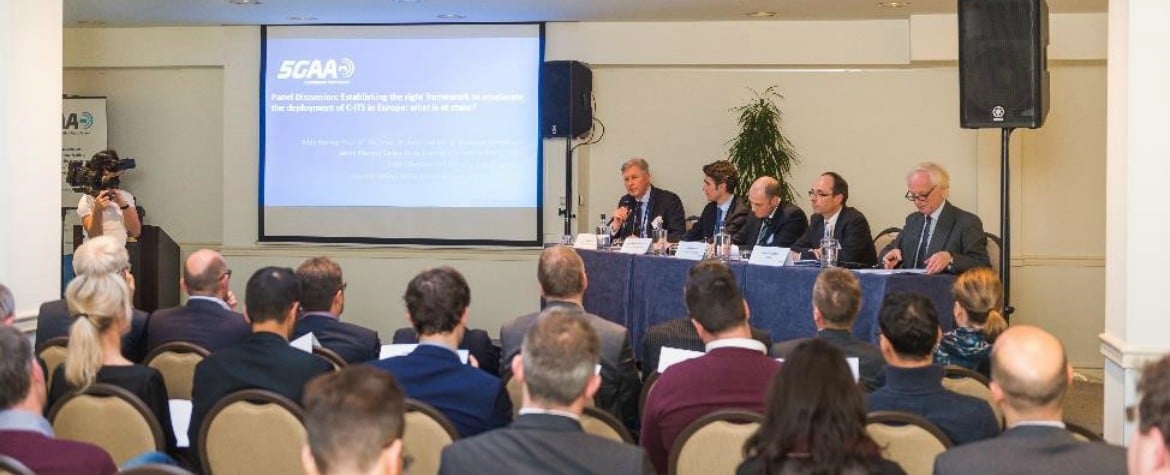
12 December 2017, Brussels, Belgium – The 5G Automotive Association (5GAA), a cross-industry association of the telecoms and automotive industry, held a policy debate on Tuesday 5 December in Brussels to discuss the concrete actions necessary to implement 5G connected and automated vehicles in Europe. A recurring theme in Tuesday’s debate was the cohesive development and implementation of cellular “vehicle to everything” (C-V2X) technology, the technology that will enable automobiles to communicate via cellular networks to other connected devices but also the possibility of ad-hoc communication without any cellular network involvement (e.g. in case of weak coverage). Policymakers and industry face the ongoing challenge of creating a cohesive framework that enables private sector innovation while ensuring a safe and economically viable rollout of new technologies.
Attendees heard from a wide range from various European political and administrative representatives, including Eddy Hartog, EC Head of Unit Smart Mobility and Living, Attila Benedek (Adviser to István Ujhelyi MEP, rapporteur on European C-ITS Strategy), Jaime Moreno García-Cano of the Spanish traffic authority or Andreas Geiss, EC Head of Unit for Spectrum Policy. 5GAA was represented by its Secretary, Markus Dillinger of Huawei and board members, Luke Ibbetson of Vodafone, Joachim Göthel of BMW, Rainer Krumrein of Daimler, and Friedhelm Ramme of Ericsson.
The debate coincides with the Commission’s ongoing public consultation on its European Strategy on Cooperative Intelligent Transport Systems (C-ITS), which runs through January 5, 2018. C-V2X technology stands to significantly improve road safety and facilitate traffic flows in the EU. Ultimately, the benefits of this technology across the EU could save the several billion euros that are lost every year to traffic accidents and congested roadways.
Markus Dillinger, 5GAA Secretary and Member of the Executive Committee: “5GAA was founded to underscore the urgency in developing technology that makes our roads safer and smarter. Today’s debate brought together public and private sector stakeholders to discuss the capabilities of such technology as well as the acceleration of creating a regulatory framework in which the industry can work.”
During the event, analysts from Analysys Mason and SBD Automotive presented the findings of a cost-benefit analysis of implementing the C-V2X technology. The socio-economic returns of deployment of C-ITS systems may amount to EUR 43 billion by 2035 in Europe, if both C-V2X and the Wi-Fi Standard IEEE 802.11p are able to co-exist in the 5.9GHz spectrum band. The 5GAA also presented a study assessing the road safety benefits of LTE–V2X (PC-5) and IEEE 802.11p in the EU, which indicates that LTE-V2X (PC5) outperforms 802.11p in reducing fatalities and serious injuries. In addition, it demonstrates that the absence of interoperability between technologies is unlikely to present a substantive barrier to the reduction of road accidents in the short to medium term. Bill McKinley, 5GAA rapporteur on tests and trials, and Rainer Krumrein of Daimler also presented 5GAA’s perspective on C-V2X performance and future capabilities.
The event culminated in a panel discussion to discuss the right framework to accelerate the deployment of the C-ITS across Europe. Particular attention was given to short-range communications in the 5.9 GHz band and the four guiding policy principles established by the European Commission: uncompromised safety services for all users in case of multiple technologies implementation, technology neutrality of spectrum regulation, efficient spectrum use and introduction in the longer-term of 5G for the further development of cooperative, connected and automated mobility.
Luke Ibbetson, R&D Director Vodafone Group and member of 5GAA: “Both C-V2X and ITS-G5 technologies should peacefully co-exist in the 5.9 GHz band. The socio-economic and road safety studies presented at this event indicate that co-existence offers the highest net benefits for the European economy, amounting to EUR 43 billion by 2035.”
Joachim Göthel, Senior Manager Project 5G-Alliance of BMW and member of 5GAA: “C-V2X offers a strong evolution path to 5G which is absolutely essential to enable full connected and automated driving in the future, while enabling a fast roll-out for many functionalities in the very short-term, utilizing existing cellular networks.”

The presentations made during the Workshop are downloadable here below:
1. Introductory 5GAA Presentation
2. Presentation on cellular V2X socio-economic benefit study
3. LTE-V2X (PC5) and road safety in the EU
4. 5GAA Presentation Trials
5. Daimler view on V2X – 5GAA Policy Debate
About the 5GAA
The 5GAA is a cross-industry association between the cellular and automotive industries to develop, test and promote communications solutions, initiate their standardisation and accelerate their commercial availability and global market penetration, to address society’s connected mobility and road safety needs with applications such as automated driving, ubiquitous access to services and integration into smart city and intelligent transportation.
Pictures credit © Thomas Blairon, 2017. Reproduction of this image is authorised, provided the source is acknowledged

5GAA welcomes AT&T, Jaguar Land Rover, NTT DOCOMO and Samsung Electronics as elected Board members
The 5G Automotive Association announced today the election of its new Board members following the General Assembly held on May 11, 2017. Continuing members AUDI AG, BMW Group, China Mobile, Daimler AG, Ericsson, Ford, Huawei, Intel, Nokia, SAIC Motor, Vodafone Group and Qualcomm Incorporated will be joined by AT&T, Jaguar Land Rover, NTT DOCOMO and Samsung Electronics.
The election of AT&T, Jaguar Land Rover, NTT DOCOMO and Samsung Electronics as Board members will strengthen the position of 5GAA as a global, cross-industry association of automotive, technology and telecommunications companies. It reflects the diversity of 5GAA’s membership, both in terms of geographical spread and expertise.
The Chairperson is Christoph Voigt (Audi) and the Vice Chairperson is Thierry Klein (Nokia), both elected to their second term. The Board of the Association renewed the mandate of the outgoing Executive Committee: Dino Flore (Qualcomm) will continue to serve as Director General, Markus Dillinger (Huawei) as Secretary, and Fathi Arafat Husein El-Dwaik (BMW) as Treasurer. The Board also confirmed the appointment of elected Working Groups Chairs and Vice-Chairs.
“We are very pleased that AT&T, Jaguar Land Rover, NTT DOCOMO and Samsung Electronics have joined the 5GAA Board,” said Christoph Voigt, Chairman of the 5GAA Board. “With their global footprint and diverse expertise, they will contribute to further connect communication and the automotive industry to develop end-to-end solutions for future mobility and transportation services.”

The 5GAA welcomes Elaine Chao as US Secretary of Transportation
Coincident with her confirmation, the 5GAA Board convened this week in California to support the development and deployment of cellular V2X solutions that evolve into 5G.
These solutions enable vehicle connectivity, safety services, and automated driving. The Board notes that our mission to enable safety and efficient travel meets the vision expressed by Secretary Chao. We congratulate the USDOT Secretary and are encouraged by her support of connected cars and autonomous vehicles.
5GAA was created to bridge automotive and communication industries in order to develop, test and promote connected mobility solutions, initiate their standardization and accelerate the commercial availability and global market penetration.

9th WG Meeting Seoul 2019
5GAA will be organizing its next Working Group Meeting in Seoul from Jan 28 – 31, 2019.
Community Building Session
As the community building meeting was a big success in Tokyo and received very good feedback from you, there will be a similar format in Seoul. All speakers need to register until Dec 12, 2018.
Format: “Slam Presentation” focusing on C-V2X or other 5GAA relevant topic of maximum 5 minutes each, with 3 Minutes Q&Ao Should relate to a recent C-V2X or cellular technology development/advancement for ITS (e.g. innovation or deployment, test & trials, R&D project, etc.) and be of general relevance for 5GAAo No commercial/brand promotion (company information can be provided but only for background information purposes)
Date, Time, Location: Tuesday, Jan 29 and Wednesday, Jan 30, 201908:00 – 08:50. Seoul Dragon City Hotel, room Baekje 2-4 (4th floor)
The application process for presentations:
1)Registration as a speaker until Dec 12, 2018. https://www.surveymonkey.co.uk/r/Community_Building_Seoul
2))Submit your presentation with 2 slides only, format 16:9, use the 5GAA template attached. Deadline: Jan 14,2019 EOB CET.Mail to secretariat@5GAA.org with the subject header: “Presentation for 5GAA Community Building Session”
3)Together with these 2 slides, we need one slide (to be distributed up front)
-with a short bio of presenter plus
-image of the presenter (high resolution picture)
-indication which 5GAA working group presenter is focusing on / contributing to Please also use the attached template for this slide.
Selection criteria: In case we will receive more than 8 applications the Executive Committee together with the CTO and WG Chairs will make a selection based on novelty of the contribution, subject variety and with a focus on the region where the meeting takes place (this time Korea and Asia) The committee’s choice will be announced by Jan 18, 2019 EOB CET.
Registration: There is limited seating in the room, so please help us planning by registering via this link: https://www.surveymonkey.co.uk/r/Community_Building_Seoul
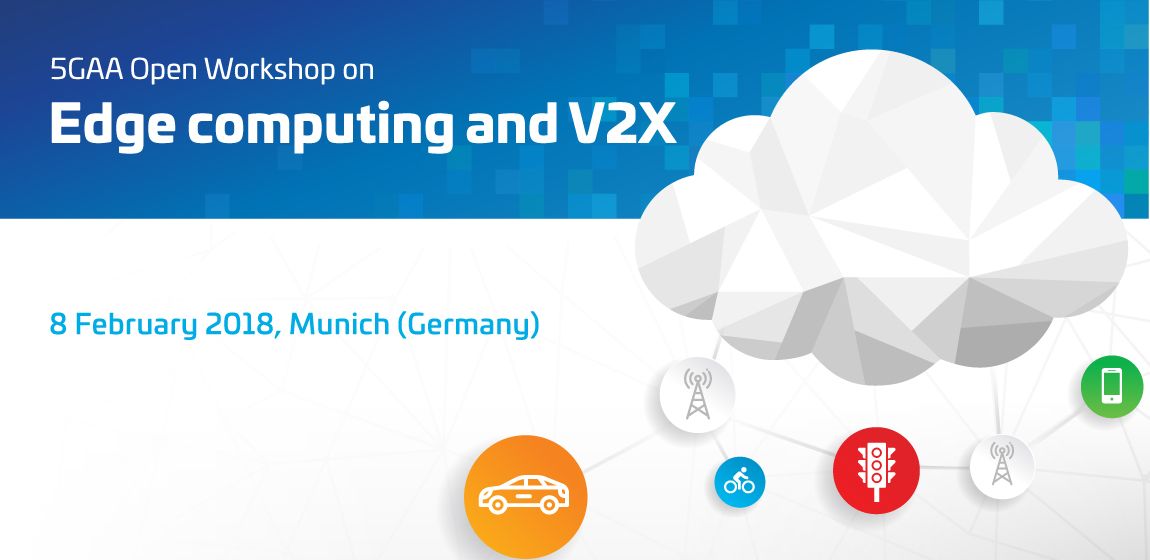
5GAA Open workshop on “edge computing and V2X”
The workshop, open to both 5GAA- and non-5GAA members, aims to provide a discussion platform on the evolution of cloud computing in the automotive sector.
- It presents an opportunity for automotive players to provide customers’ voice on future connected vehicles and automotive applications enabled by distributed cloud.
- It strives to connect different stakeholders from car OEMs and network operators to edge computing technology vendors.
- It will facilitate active dialogue and encourage further collaboration.
RSVP TODAY
If you are not a member of 5GAA, please send an e-mail to secretariat@5gaa.org with first and last name, company and position.
VIEW THE PROGRAM
Download program