
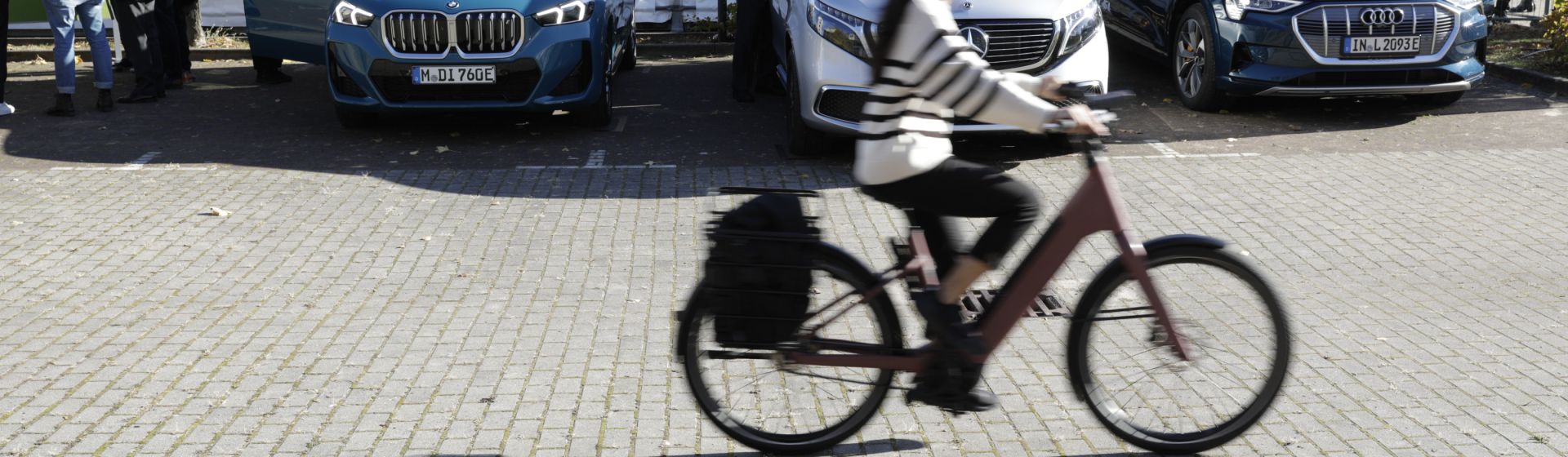
Berlin real-world use cases demonstrate game-changing C-V2X technology
On 25 October 2024 , the 5G Automotive Association (5GAA) demonstrated the latest innovations in the Cellular Vehicle-to-Everything (C-V2X) technology family to help achieve “Vision Zero” for all road users. The demonstrations illustrated the potential of 5G-V2X to enable new use cases integrated across multiple automakers, service providers, and mobile network operators.
For the very first time, 5GAA demonstrated 5G-V2X Direct technology integration in Audi and BMW vehicles with the support of 5GAA members Autotalks, Bosch, Commsignia, and Fraunhofer FOKUS. This demonstration illustrated how technology can alert drivers about pedestrians and cyclists even before they can see them, leveraging sensors and a camera feed from other vehicles. The demonstrations showed the high bandwidth and low latency performance characteristics of 5G-V2X Direct using ETSI Release 2 messages.
5GAA members Bosch, Commsignia, Deutsche Telekom, Ericsson, Keysight Technologies, LG Electronics, Mercedes-Benz and Vodafone, and the Coalition for Cyclist Safety, showcased ready-to-deploy, interoperable applications to increase awareness of vulnerable road users and emergency vehicles on public roads in central Berlin. Safety awareness alerts were delivered via 4G and 5G networks with low latency thanks to Multi-Access-Edge Computing and precise positioning, as verified by Anritsu’s performance measurements. ETSI-standardised messages were shared in real time between apps from various service providers.
“In Germany and across Europe, the ecosystem is ready to leverage the tens of millions of vehicles already connected via mobile networks and is now geared for the 2nd generation technology with 5G-V2X including direct communications,” said 5GAA Chairman Christoph Voigt.
Autotalks and Bosch, together with Commsignia, demonstrated the benefits of collective perception related to vulnerable road users. Ettifos, Keysight Technologies, Rohde & Schwarz and SEA Datentechnik also exhibited 5G-V2X Direct interoperability and conformity solutions and radio performance verification.
To show that C-V2X is about both safety and efficiency, Audi, supported by Commsignia and Autotalks, demonstrated a use case for “cooperative parking” based on 5G-V2X Direct.
In line with 5GAA’s Visionary 2030 Roadmap, 5G is continuously being deployed in many car models and 5G-V2X Direct is expected to be mass-deployed in commercial vehicle models as early as 2026. This week’s event underlined the continuous commitment of major European automakers to 5G-V2X following 5GAA’s Open Statement[1] in 2023.
For more information, watch the video below.

Sustainability benefits of C-V2X
Cellular Vehicle-to-Everything, or C-V2X, communications will make transportation not only safer and smarter but also more sustainable.
Sustainability has three dimensions: environmental, social and economic.
- Environmental: By helping to make every trip smarter, safer and more efficient, C-V2X helps reduce congestion and accidents, thereby reducing air pollution, noise pollution and energy use.
- Social: Saving lives and avoiding injuries are clear social benefits. By enabling real-time communication between pedestrians, cyclists, traffic infrastructure and moving vehicles, including motorcycles and electric scooters, C-V2X will help avoid accidents that otherwise would result in injuries and deaths.
- Economic: By enabling more efficient mobility, C-V2X will save people and employers billions of man-hours currently wasted in traffic jams. Those man-hours can then be dedicated to more rewarding activities.
C-V2X also enables the growth of autonomous mobility, which in turn offers even greater sustainability benefits, for example mobility-as-a-service offerings.
To learn more, watch the short video.
5GAA publishes updated Roadmap for C-V2X
BRUSSELS, 3 December 2024 – The 5G Automotive Association (5GAA) has sketched out an upbeat vision for better transportation safety, efficiency and sustainability with the third edition of its Roadmap for advanced driving use cases, connectivity, and technologies.
The 24-page Roadmap III builds upon a 5GAA white paper first published in 2020 and updated in 2022. It includes both a summary of market and technological developments since the last report as well as a forecast of the market readiness and roll-out of connected mobility technologies through 2030, with a focus on cellular-vehicle-to-everything (C-V2X) technology.
Thanks to the rapid expansion of cellular networks worldwide, about 300 million vehicles, including about two-thirds of all cars sold in the world’s major automotive markets, are now “connected.” Moreover, road and other infrastructure owners and operators have continued to expand a network of roadside sensors, traffic lights and other devices that help make transportation smarter, safer—including for pedestrians, cyclists and other vulnerable road users—and more sustainable.
While most vehicles and infrastructure to-date have relied on C-V2X technology to communicate with one another via cellular networks, the Roadmap also sees a growing role for “direct” vehicle-to-vehicle and related communications as soon as two years from now. 5GAA expects 5G-V2X Direct-enabled vehicles and related services to begin to be mass-deployed between 2026 and 2029, starting in Europe.
In addition, the third edition of the Roadmap for the first time describes a timeline for new use cases enabled by non-terrestrial networks and advanced Multi-Access Edge Computing (MEC). Satellite connectivity could help guarantee ubiquitous service in rural areas and disaster situations as soon as 2027, for example.
“Connected vehicle technologies and the market have both come a long way, since 2000,” said Maxime Flament, 5GAA Chief Technology Officer. “Our latest Roadmap foresees the continuous evolution of C-V2X cellular and direct communications technologies that will help save lives, make transportation more efficient and more sustainable and accelerate the spread of autonomous vehicles,” he said.
5GAA sees the Roadmap as a guide to help vehicle manufacturers, telecommunications network operators, road and other infrastructure owners and operators, as well as governments, understand the investments, speed and spectrum requirements needed to ensure the most efficient deployment of the new technologies and services. This, in turn, can help governments achieve their stated vision of zero road fatalities more quickly and also expedite the deployment of autonomous vehicles.
You can download the full Roadmap here.
About 5GAA
The 5G Automotive Association (5GAA) is a global, cross-industry organization of more than 115 members, including leading global automakers, Tier-1 suppliers, mobile operators, semiconductor companies, and test equipment vendors. 5GAA members work together to develop end-to-end solutions for future mobility and transport services. 5GAA is committed to helping define and develop the next generation of connected mobility, automated vehicles, and intelligent transport solutions based on C-V2X. For more information about 5GAA, please visit www.5GAA.org.
For further information please contact:
5GAA Marketing & Communications – Marcom@5GAA.org
5G Automotive Association’s Position Paper on the eCall Legacy Fleet
5GAA welcomes the renewed attention and subsequent discussions on Next Generation eCall (NG eCall) and the legacy fleet, following the second phase of the IDIADA study, presented on 12 December 2023. Whilst the opportunity to address the critical issue of the legacy fleet is welcome, we wish to draw attention to some key industry concerns.
In this position paper, we underline that industry cannot be held liable for the lack of service continuity of 112-based eCall for the legacy fleet, which result from obsolete legislative requirements. Since both retrofit as well as the extension of 2G/3G networks are implausible, we call for public authorities to take responsibility in informing users in the event of eCall failure, in instances outside industry control. We also encourage further research to be carried out to revise the current eCall regulatory framework so that it becomes future proof and does not lead to the same situation in the future as we have now once NG eCall becomes obsolete, or 4G networks are being transitioned to other technologies. This should be based on a transparent dialogue between authorities and industry to find the right solution.
Read about 5GAA’s position here.
Connected Mobility
Sustainability
Sustainability benefits of C-V2X
Cellular Vehicle-to-Everything, or C-V2X, communications will make transportation not only safer and smarter but also more sustainable.
Sustainability has three dimensions: environmental, social and economic.
C-V2X ticks all three boxes:
- Environmental: By helping to make every trip smarter, safer and more efficient, C-V2X helps reduce congestion and accidents, thereby reducing air pollution, noise pollution and energy use.
- Social: Saving lives and avoiding injuries are clear social benefits. By enabling real-time communication between pedestrians, cyclists, traffic infrastructure and moving vehicles, including motorcycles and electric scooters, C-V2X will help avoid accidents that otherwise would result in injuries and deaths.
- Economic: By enabling more efficient mobility, C-V2X will save people and employers billions of man-hours currently wasted in traffic jams. Those man-hours can then be dedicated to more rewarding activities.
C-V2X also enables the growth of autonomous mobility, which in turn offers even greater sustainability benefits, for example mobility-as-a-service offerings.
To learn more, watch the short video or scroll down for more details.
C-V2X and Sustainability in detail
ENVIRONMENTAL BENEFITS

- Transport still represents about 25% of Europe’s total CO2 emissions. By helping to make every trip smarter, safer and more efficient, C-V2X helpsreduce congestion and accidents, thereby reducing energy use, noise pollution and air pollution.
- C-V2X can help all vehicles operate and deliver people and goods more efficiently, thereby reducing pollution and optimizing the use of valuable energy resources.
- INRIX calculated that each second of reduced delays at traffic signals across the United States would translate to an annual reduction of 800,000 metric tons of CO2.
- Connected vehicle technology can help electric cars calculate an energy-optimised route to a charging station that’s not necessarily the fastest or nearest but requires the least energy to reach.
- Examples of environmental benefits enabled by C-V2X technologies include:
- Current technology permitting smarter routing for all vehicles in both urban and rural areas, for example via automated traffic routing, road, bridge, tunnel and parking availability updates and smart parking.
- Future technology permitting “green waves” for emergency vehicles, cars, trucks, lorries and other vehicles instead of stop-and-go traffic.
- Future technology facilitating manoeuvres and cooperation in traffic.
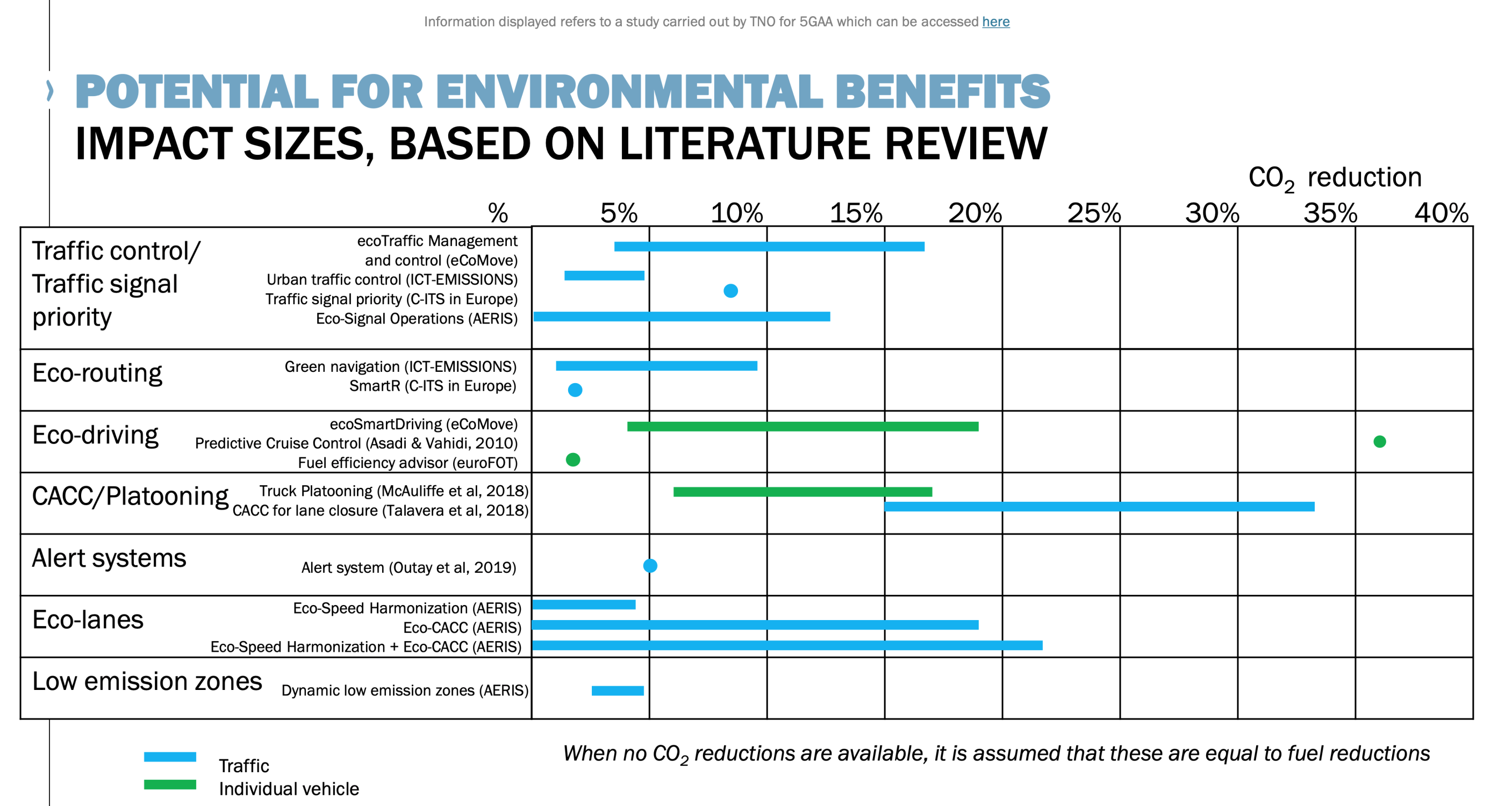
- For more detailed information, please see TNO’s report for 5GAA on the Environmental Benefits of C-V2X.
SOCIAL BENEFITS

- By enabling real-time communication between pedestrians, cyclists, traffic infrastructure and moving vehicles, including motorcycles, C-V2X will help avoid accidents that otherwise would result in injuries and deaths.
- According to the World Health Organisation, there were 1.35 million traffic deaths globally in 2016, the latest year for which global data are available. Road traffic deaths are a leading cause of death among young people, in particular.
- In the European Union, there were about 20,608 road deaths in 2023, or about 46 road deaths per million inhabitants.
- In the United States, an estimated 40,990 people died in road accidents in 2023. The United States Department of Transportation has set an ambitious goal of zero traffic deaths, in part by leveraging advanced technologies to prevent accidents in the first place.
- It says: “The U.S. Department of Transportation’s National Roadway Safety Strategy specifies that zero is the only acceptable number of deaths and serious injuries on our roadways. USDOT is committed to taking substantial, comprehensive action to achieve this goal.”
- By providing real-time hazard notifications and enabling connected cooperative driving, C-V2X makes transportation safer for all road users, including cyclists. As C-V2X makes the roads safer, more people may feel confident in choosing cycling as their primary mode of transportation.
- A U.S. DOT pilot study demonstrated that C-V2X technology can prevent accidents and injury for vulnerable road users.
- Green waves and corridors for emergency vehicles can help save lives and reduce injuries, allowing people to lead longer, healthier and more fulfilling lives.
- Response times are critical for emergency vehicles and first responders to save lives. A 2020 study showed that “green waves” at traffic lights could reduce response times by as much as 30% with little impact on overall traffic conditions.
- By enabling more efficient mobility, C-V2X will save commuters billions of man-hours currently wasted in stressful traffic jams.Those man-hours can be dedicated to more enjoyable and rewarding activities such as doing sports, hobbies, volunteering, education or spending time with friends and family.
- In Europe, the average driver in some cities loses more than 150 hours per year stuck in traffic jams.
- Americans lost as much as 3.4 billion hours in traffic in total in 2021.
- C-V2X helps connect other modes of transport with one another to facilitate a real multi-modal transportation system.
ECONOMIC BENEFITS

- By enabling automated driving and mobility as a service, C-V2X will help create new products and services that help drive more sustainable economic growth.
- For example, anonymous data collected through C-V2X can help governments and policymakers develop more effective infrastructure maintenance programmes and traffic plans.
- By enabling more efficient mobility, C-V2X will save employers and entrepreneurs billions of man-hours currently wasted in traffic jams.Those man-hours can then be dedicated to more rewarding activities.
- For commercial vehicles, C-V2X can help optimise delivery routes and schedules and reduce the number of empty or partially loaded trips. Efficient route management reduces energy use and pollution.
- The deployment of C-V2X technologies in vehicles can increase demand for 5G and future networks, each of which will be more energy-efficient than the technologies they replace.
Want to learn more?
If you want to learn more about the timeline for the introduction of next-generation C-V2X communications technologies, including those with clear environmental benefits, please see our latest C-V2X technology Roadmap here.
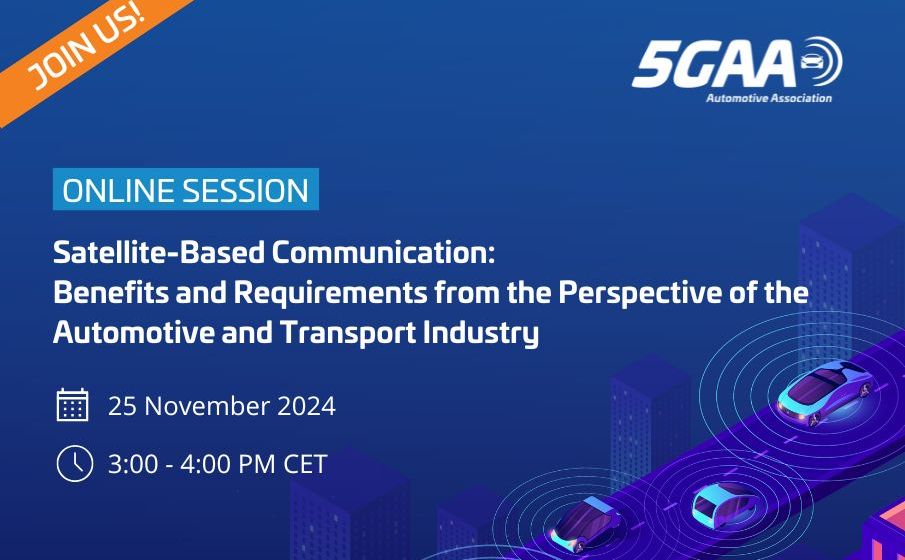
Satellite-Based Communication: Benefits and Requirements from the Perspective of the Automotive and Transport Industry
On Monday 25 November (3-4 PM CET), the 5G Automotive Association is organising an online session on maximising the benefit of future satellite communications for the automotive industry.
The online session will focus on the recently published technical report which outlines a vision for integrating Non-Terrestrial Networks (NTN) as a complementary layer to Terrestrial Networks (TN), enhancing coverage and services for connected vehicles. The online session will also shed light on the report’s comprehensive roadmap for NTN deployment, identifying key phases for narrowband, wideband, and broadband data rate use cases.
Key recommendations around the necessary alignment of global mobile standards, deployment of Low-Earth Orbit (LEO) satellite constellations, and a focus on optimising user terminal parameters and costs will be reiterated and the potential of integrating NTN connectivity for the automotive and telecommunications industries will be discussed.
If you are interested, you can register here.
5G’s transformative role in the automotive industry
Suman Sehra, Global VP, Connectivity Portfolio Management, Harman
Video interview by TelecomTV.
Suman Sehra highlights Harman’s role in enhancing connectivity and user experiences in vehicles, including the importance of collaboration within the 5GAA to address challenges in technology, policy, and standardisation. He explains that to ensure a future where 5G enables autonomous driving and seamless connectivity, driven by advancements in network slicing and edge computing, greater collaboration across the automotive and telecom sectors is needed to overcome barriers and scale innovative technologies.
Recorded October 2024.
5G innovation and collaboration drives connected mobility
Andreas Schaller, Head V2X Technology Strategy, Bosch Mobility
Video interview by TelecomTV.
Andreas Schaller discusses the role of Bosch Mobility in the connected mobility sector and the importance of 5GAA in aligning industry objectives. He highlights current 5G applications in automotive, such as entertainment and automated parking, and explains what advancements we can expect to see with future 5G releases from 3GPP, including non-terrestrial network support. He also calls for scalable solutions that will work globally to ensure successful implementation, and reiterates the need for continuing collaboration between the telecom and automotive industries if we are to achieve fully autonomous driving.
Recorded October 2024.
5GAA and AECC partner on edge and API development for automotive sector
Johannes Springer, 5GAA and Muriel Desaeger, AECC
Video interview by TelecomTV.
Since its formation in 2016, the 5GAA has been actively promoting the adoption of cellular vehicle-to-everything (C-V2X) as the key technology to deliver full connectivity to the automotive market. It brings together automotive manufacturers, Tier 1 suppliers, chipset and communication system providers, mobile operators and infrastructure vendors. During its conference in Berlin last week, the 5GAA signed a memorandum of understanding (MoU) with the Automotive Edge Computing Consortium (AECC) to facilitate cooperation around the use of multi-access edge computing (MEC), as well as the advancement of network APIs and their use by the mobility sector. The AECC is investigating the use and management of big data, mainly via the edge, to make it cost and time effective to the automotive industry. It has already entered into an agreement with the GSMA (read the full story here). Together, the two associations want to ensure that these new capabilities are available on a global basis, and harmonised across different countries and regions.
Featuring:
- Johannes Springer, Ex Director General, 5GAA
- Muriel Desaeger, AECC, and Technical Head of Electronic Engineering Division, Toyota
Recorded October 2024.

Meet Our Members – Interview with Jyoti Sharma, Verizon
In our ongoing “Meet Our Members” series, we explore the unique journeys and expertise of the individuals who make the 5G Automotive Association. Each interview sheds light onto the incredible work, vision, and passion of the people behind our organisation. You can check out our last conversation with Menno Malta, CEO of Monotch, here.
This time, we introduce Jyoti Sharma, Associate Director of Network Planning at Verizon and alternate board member at 5GAA since 2021. Jyoti has brought her deep industry insight to a range of work items, including Vehicle-to-Network-to-Everything (V2N2X) and has led initiatives such as the Vulnerable Road User (VRU) Demo. Her commitment to accelerating the large-scale deployment of V2X technologies make her a valuable contributor to the 5GAA, and we’re excited to learn more about her perspective on the future of 5G and MEC in transportation.
Could you tell us briefly about Verizon’s involvement in 5GAA and how your company benefits from being a member?
Verizon has been an active member of 5GAA since its inception. We started out as a general member and initially contributed at the working group level. We saw tremendous value in taking a leadership role in 5GAA as a major U.S. telecommunications provider and were elected by the members as a gold board member in 2021. Currently, Verizon is a platinum board member of 5GAA and we are playing a critical strategic role as one of the key stakeholders in the V2X ecosystem.
When did you first become part of the 5GAA board? What are some of your responsibilities, and what has been your most rewarding experience so far?
I represent Verizon on the 5GAA board as an alternate board member since 2021. In my role as a board member I have the privilege and responsibility to ensure 5GAA remains focused on key strategic focus areas which will accelerate a large-scale deployment of Vehicle-to-Everything (V2X) across the globe. My most rewarding experience has been to collaborate with other 5GAA members who are leaders from auto OEM customers, their tier 1 suppliers, chipset and module providers and other ecosystem partners. This technical collaboration between all the stakeholders is the key to drive innovation and unlock the full potential of V2X communications at scale and make it a reality.
Can you share any recent examples of how Verizon has collaborated with other 5GAA members to drive innovation in the industry?
Verizon has taken a leadership role in bringing the V2X ecosystem partners together under the 5GAA umbrella. We have demonstrated thought leadership in defining the network architecture to solve challenging V2X requirements leveraging key technology enablers such as 5G, multi-access edge computing (MEC) and Hyper Precise Location. Our recent V2X VRU (Vulnerable Road User) demo in Detroit showcasing interoperability between different network operators and application providers generated a very positive response and engagement from auto OEMs, Departments of Transportation and road operators. The demo was successful due to close collaboration with several 5GAA member companies.
As the lead of the VRU DEMO Work Item, could you elaborate on the significance of demonstrating interoperability in the context of Vulnerable Road User protection solutions?
VRU DEMO is one of the key strategic focus areas at the 5GAA board level that the industry has been trying to address for many decades. We believe the C-V2X and other technology enablers (5G, MEC, Hyper Precise Location) are ready to mitigate the number of road accidents involving vulnerable road users such as pedestrians and cyclists. In order to deploy such a VRU solution at scale it needs to work across multiple operators, multiple auto OEMs, multiple application providers and multiple cloud providers. We reached a significant milestone by demonstrating interoperability amongst different stakeholders and showcased the technology is ready to deploy at scale with existing networks. The learnings from the demo are being replicated in other parts of the world and are informing U.S. DOT V2X Deployment plans.
What criteria were used to select the specific use cases for demonstration in VRU DEMO? How did these use cases represent real-world scenarios and challenges?
There has been extensive discussion within 5GAA to define different VRU scenarios. Different flavors of VRU use cases have been documented in published technical reports. The demo team carefully selected most common real world VRU scenarios such as active pedestrian crossing alert and using roadside cameras and artificial intelligence, machine learning logic in the MEC to detect pedestrians and alert the drivers to avoid potential collision.
Verizon participated in the demos with a showcase of its network solution using multi-access edge computing. How does MEC differ from traditional network-based computing in terms of its benefits for VRU protection applications?
MEC allows us to bring traditional cloud compute and storage within the mobile network closer to the edge where the data is generated reducing the end to end latency. It is well established that MEC is a key differentiator and technology enabler for latency critical use cases such as VRU protection. Verizon has already deployed public MEC across the United States in partnership with cloud providers. We continue to drive innovation by developing standard MEC and Network APIs for application providers. During the VRU demo we demonstrated near real time VRU alerts over 5G and applications hosted on Verizon’s Detroit MEC.