

5GAA | Safety of Life Study
The aim of this study is to explore the impact of different technical solutions for Cooperative Intelligent Transport Systems (C-ITS) communication solutions on EU road safety over time. Three different communication solutions are assessed independently and consist of:
- Cellular vehicle-to-everything (C-V2X) communication based on the evolved LTE technology as defined by 3GPP (a global cellular specifications body), divided into two solutions:
- LTE-PC5: Communication solution that uses direct-mode communication between vehicles, road users and infrastructure operating in ITS bands (e.g. ITS 5.9 GHz) independent of cellular network;
- LTE-Uu (cellular): Network-based communications interface (Uu) operating in the traditional mobile broadband licensed spectrum;
- 802.11p a Wi-Fi technology that supports Vehicle-to-vehicle (V2V) and Vehicle-to-Infrastructure (V2I) communications based on IEEE 802.11p and uses direct-mode communication operating in the ITS band of 5.9 GHz.
 For the purpose of this study, LTE-PC5 and LTE-Uu will be modelled separately. However, it should be noted that these would likely co-exist. When assessing the results presented in this study, it should be considered that in reality, these two technical solutions could complement each other.
A key motivation for introducing C-ITS is the major potential to help improve road safety and decrease the number, as well as the severity, of accidents. For this study we have focused on two specific C-ITS use cases with high accident reduction potential that are on the European Commission’s list of priority C-ITS services. The selected services address vehicle-to-infrastructure (V2I) and pedestrian/cyclist to vehicle (V2P) communications:
- Red signal violation/intersection safety;
- Vulnerable Road User (VRU) protection.
The approach taken in this study separately models the penetration of new vehicles with C-ITS through built-in systems and that of additional equipment in existing vehicles through the driver’s smartphone (referred to as retrofitting).
We consider, as a baseline, the existing statistics of road traffic fatalities in the EU and then evaluate the potential reduction in the number of fatalities resulting from the deployment of each technical solution.
The modelling framework is kept in line with a previous 5GAA study and considers:
- The likelihood that any two ITS stations (vehicles, VRUs, roadside units (RSUs)) involved in a potential accident will be equipped with the same C-ITS communication solution.
- The fraction of fatalities which could be addressed and mitigated by the considered C-ITS communication solution.
- The likelihood that data transmitted from an ITS station via a given C-ITS communication solution is successfully communicated to its intended recipient.
- The effectiveness of a received alert/warning message inappropriately affecting the behaviour of the driver of a vehicle travelling towards a potential accident.
To account for the uncertainty in predicting the extent of future deployment and reliability of C-ITS technologies, we have developed “high” and “low” scenarios showing the sensitivity to key input parameters.
Main results:
The aggregated results for both use cases (without the additional benefit arising from retrofitting of C ITS services through apps on smartphones used in vehicles) illustrate that in the high scenario LTE-Uu shows the highest benefits in terms of the number of avoided fatalities and serious injuries. By 2040 the number of fatalities and serious injuries avoided through the use of the LTE-Uu solution reaches 114,066, compared to 90,380 for LTE-PC5. For the 802.11p solution, the values are significantly lower at 27,144 as VRU protection is not supported through smartphones, leading to a low level of VRU protection (where VRUs are expected be equipped with C-ITS technology through their smartphones). Research carried out for this study showed that the integration of 802.11p into smartphones is highly unlikely; thus, the penetration in smartphones for this technical solution was set to zero.

5GAA Supports Accelerated Deployment of C-V2X in China at MWC Shanghai 2018
28 June, Shanghai, China – The 5G Automotive Association (5GAA), with the strong support of the telecommunications and automotive industries and senior Chinese government officials, presented the latest progress to deploy Cellular-Vehicle-To-Everything (C-V2X) on China’s roads, as well as across the globe, leading the efforts to deliver future connected mobility solutions. The discussion took place during a 5GAA roundtable at the Mobile World Congress in Shanghai.
China’s government officials support immediate deployment of C-V2X
China has been a trailblazer in adopting C-V2X, remaining at the global forefront of rolling out the technology. At the 5GAA “Connected Mobility in Action” roundtable, Ce Zhao, Director of High-Tech Department of Science & Technology Division of MIIT, delivered a keynote address on China’s strong commitment in ensuring the investment, testing, and development of C-V2X. Mr. Zhao announced China’s initial spectrum planning for LTE-based C-V2X in 5905~5925MHZ, and provided updates on the country’s national industry strategy, onsite testing, and deployment plan, as well as the country’s national level cooperation for C-V2X.
The Ministry of Transport’s (MOT) Vice Director of Research Institute of Highway, Mr. Lin Wang, also made a presentation providing updates on China’s intelligent highway progress, as well as test environments and scenarios.
Mr. Zhiqin Wang, Vice President of the China Academy of Information and Communications Technology (CAICT) and Chairman of IMT 2020 highlighted the fruitful progress on China’s standards, test framework and verification plan for C-V2X, stating, “Both standard and industry progress shows China’s readiness for full-scale deployment of C-V2X.”
Strong engagement from industry stakeholders as well
China’s industry stakeholders are also strongly committed to making C-V2X on roads a reality. Leading telecommunications and automotive companies in China are conducting product testing to prepare for the commercial deployment of C-V2X. With commercial chipsets ready to hit the road and various demonstration in the making this year, the path towards the deployment of C-V2X is imminent.
Dr. Dang Xiang, Deputy General Manager of Research and Advanced Technology Department at SAIC Motor and Alternate Board Member of 5GAA, presented during a keynote speech the latest industry advances for the deployment of the technology, including the current leading development of C-V2X and architecture of future mobility with the fusion of internet, transportation and vehicles based on C-V2X.
“SAIC Motor is currently transforming from the traditional OEM to the green smart mobility service provider. C-V2X is one of the key technologies to future mobility and SAIC Motor will cooperate with other C-V2X eco-system partners to accelerate the commercialization of C-V2X,” said Dr. Dang Xiang.
In addition to the progress made at a corporate level, companies such as SAIC Motor and China Mobile have been actively involved in 5GAA in developing the framework, required standards, and the business case for C-V2X and 5G future connected mobility services.
“China Mobile is proud to be part of the 5G Automotive Association. We are an active member of the association and strongly believe that by collaborating with the World’s largest Telecommunications and Automotive companies under the same roof, we will create solutions that will better address society’s transport needs and will help pave the way for a more connected mobility World,” said Gang Huang, Vice President of China Mobile Government and Enterprise Service Company.
Accelerating the deployment of C-V2X around the globe
C-V2X presents an unprecedented opportunity: the ability for vehicles to share real-time safety information and “communicate” with other vehicles, pedestrian, city infrastructure, and the networks will ultimately make transportation safer and more enjoyable.
5GAA member companies demonstrated the many benefits of C-V2X during an exciting panel discussion. The panel was comprised of: Julius Marchwicki, Director, Asia-Pacific, Connected Vehicles and Services at Ford Motor Company; Luke Ibbetson, Senior Director of Vodafone and member of the 5GAA Board; Thierry Klein, Head of Disruptive Innovation Program at Nokia Bell Labs and Vice Chair of the 5GAA Board; and Ed Tiedemann, SVP of Engineering, Qualcomm Technologies, Inc.
All panelists shared their views on the current challenges, opportunities, and next steps in the continued development of C-V2X in other regions such as Europe and North America. They also discussed how C-V2X and its evolution to 5G will play a critical role across the automotive and other industries.
Ed Tiedemann, SVP of Engineering, Qualcomm Technologies, Inc. discussed C-V2X trials in the US. He presented the C-V2X direct communication demonstration organised with 5GAA, Audi, Ford and Qualcomm Technologies this April in Washington D.C. The demonstration showcased the benefit of using C-V2X real-time direct communications for vehicle-to-vehicle (V2V) collision avoidance and vehicle-to-infrastructure (V2I) for improved road safety and traffic efficiency by using 3GPP Release 14 C-V2X direct communications and upper layers as developed by SAE to transmit messages in support of six use cases.
“C-V2X is ready for deployment: China is giving the green light, now it is up to the other regions to accelerate as well,” concluded the panel moderator, Dr. Maxime Flament, Chief Technology Officer of 5GAA.
5GAA provider of a platform for debate for key stakeholders
5GAA presence at this year’s MWC Shanghai last week was successful in outlining the association’s vision in being a global player in facilitating thought leadership platforms for relevant stakeholders driving towards building a better mobility ecosystem.
Join the connected mobility conversation on Twitter @5GAA_Official

C-ITSEU
The Delegated Act currently being drafted by the European Commission will have a significant impact on the future deployment of Cooperative Connected and Automated Mobility in Europe. It will regulate the deployment of Cooperative Intelligent Transport Systems (C-ITS), which enable the communication between vehicles, infrastructure and with other road users.
5GAA is a proponent of Cellular-Vehicle-to-Everything (C-V2X), a unified technology platform for connected vehicles, including connectivity to vulnerable road users and infrastructure, encompassing LTE-V2X and 5G-V2X. C-V2X technology thus offers a direct evolution path to 5G.
As illustrated below, C-V2X includes both direct short-range communication in the 5.9 GHz ITS spectrum band (not requiring network coverage or subscription) and long-range communication in licensed spectrum allocated for 4G and 5G, into a single, cost-effective platform.

While 5GAA fully shares the European Commission’s objective to “make Europe a world leader in the deployment of connected and automated mobility”[1], 5GAA is very concerned that the Delegated Act will rule out C-V2X, the most recent technology for C-ITS.
5GAA strongly advocates for a forward-looking C-ITS regulatory framework, allowing technology neutrality and evolution. The future requirements should ensure an effective, cost-beneficial and proportionate regulatory framework, as per the Commission’s Better Regulation guidelines, ultimately improving road safety, traffic efficiency and air quality, while fostering innovation.
5GAA believes that the future Delegated Act should abide in all its dimensions by the technology neutrality principle to prevent unfair market distortion. This principle should be respected in letter and spirit: requirements, standards or specifications governing the deployment of C-ITS should be non-discriminatory, avoiding any technology lock-in.
The deployment of different connectivity solutions, including C-V2X, should be allowed and embraced by the Delegated Act, on par with any other technology.
[1] “On the road to automated mobility: An EU strategy for mobility of the future” COM(2018) 283
5GAA to introduce “Connected Mobility in Action” at the Mobile World Congress – Shanghai 2018
The 5G Automotive Association (5GAA) will lead the field of connected mobility in the upcoming Mobile World Congress in Shanghai, from 27-29 June 2018.
On Thursday 28 June, the association will host a roundtable discussion with preeminent Chinese government officials. The focus of this forum will be to present their progress in preparing the commercialisation of the Cellular-Vehicle-to-Everything (C-V2X) technology on China’s roads and to discuss the advances in other regions. This event provides a great opportunity to get updates on the current situation and get important insights from both officials and key industry players.
China has been a trailblazer in adopting C-V2X, remaining at the global forefront of rolling out the technology. Since its founding in 2016, 5GAA has collaborated extensively with Chinese organisations and regulators, leading to a strong working relationship and a large representation of Chinese members within the association.
Beyond discussing the accelerated launch of C-V2X in the Chinese market, the roundtable will further reinforce this relationship, supporting the implementation of connected mobility with cellular-based technologies including the future 5G network.
The MWC Shanghai is the premier industry event in Asia for mobile technology advancement. Following the association’s participation at MWC Barcelona this February, 5GAA is proud to continue the facilitation of such thought leadership platform for relevant stakeholders, driving towards building a better mobility ecosystem.
Join us on Thursday 28th June from 09:00 to 13:00 at the Kerry Hotel Pudong at the MWC Shanghai.
Apply here to attend the session
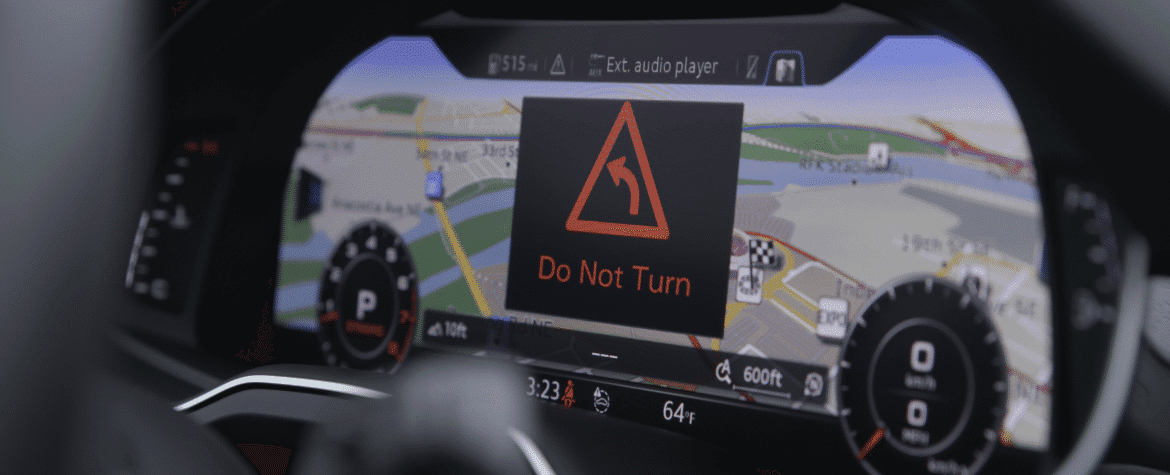
5GAA, Audi, Ford and Qualcomm Showcase C-V2X Direct Communications Interoperability to Improve Road Safety
WASHINGTON, D.C., April 26, 2018 – C-V2X Communications’ Superior Performance, Synergies with Telematics Units and Evolutionary Path Towards 5G Offers Greater Potential to Save Lives; World’s First Showcase Across Vehicle Manufacturers Shows Readiness for Industry Deployment as Early as 2020.
| Downloadable Resources | |
|---|---|
| Photos | |
| Infographic | |
| Video clip 1 | |
| Video clip 2 |
5G Automotive Association (5GAA), Audi AG (NASDAQ: AUDVF), Ford Motor Company (NYSE: F) and Qualcomm Technologies, Inc., a subsidiary of Qualcomm Incorporated (NASDAQ: QCOM), announced today the world’s first demonstration for Cellular Vehicle-to-Everything (C-V2X) direct communications technology operating across vehicles from different manufacturers. C-V2X is a global solution for V2X communications to support improved automotive safety, automated driving, and traffic efficiency, and is the only V2X technology based on globally recognized 3rdGeneration Partnership Project (3GPP) specifications with ongoing evolution designed to offer forward compatibility with 5G, and leveraging upper layer protocols defined by the automotive industry, including Society of Automotive Engineering (SAE) and the European Telecommunications Standards Institute (ETSI) organizations.
The demonstration showcased the benefits of using C-V2X real-time direct communications on the globally harmonized 5.9 GHz ITS spectrum for vehicle-to-vehicle (V2V) collision avoidance and improved road safety without any dependency on cellular operator network involvement, credentials or coverage. The organizations also unveiled initial field test results showing a significant range, reliability and performance advantage of C-V2X direct communications, with more than twice the range and improved reliability compared to 802.11p radio technology. Based on C-V2X’s potential to enhance safety and save lives, the 5GAA, Audi, Ford and Qualcomm Technologies encourage the broad automotive ecosystem to accelerate adoption of C-V2X, which is expected to be deployed as early as 2020.
Featuring Audi and Ford vehicles which incorporate the C-V2X technology utilizing the C-V2X chipset from Qualcomm Technologies, the showcase exhibited various scenarios of how C-V2X communications is beneficial for road safety. These scenarios included situations with obstructed or no visibility, including Left Turn Assist and Emergency Electronic Brake Light use cases, in which vehicle-to-vehicle (V2V) communications alerted surrounding vehicles when cars were turning left or braking. Additional use cases were featured, including a vulnerable road user (VRU) demonstration showcasing what can be possible with future vehicle-to-pedestrian (V2P) communications. Use cases for vehicle-to-infrastructure (V2I) communication were also demonstrated, which showcased how direct communications can work closely with traffic signal controllers to ensure reduction in carbon emissions and optimization of traffic efficiency in cluttered intersections and dense environments.
C-V2X is supported by a broad automotive ecosystem, that includes the fast-growing global organization 5GAA, which currently has over 80 members comprised of leading automakers, Tier-1 suppliers, software developers, mobile operators, semiconductor companies, test equipment vendors, telecom suppliers, traffic signal suppliers and road operators.
Designed with a focus on security, C-V2X benefits from established security transport layers and application protocols defined by the automotive standards communities, including SAE, ETSI, International Standards Organization (ISO), and Institute of Electrical and Electronics Engineers (IEEE) 1609, and Qualcomm’s decades of investment in cellular technologies. C-V2X solutions are expected to be more cost efficient and economical over competing technologies as this functionality gets integrated into the base cellular modem product that automakers equip in every vehicle.
“We are excited to witness this monumental breakthrough in the evolution of C-V2X and the growing momentum behind this life-saving technology,” said Christoph Voigt, Chairman of 5GAA. “After years of development supported by leading carmakers, technology providers and the automotive ecosystem at large, C-V2X is ready to improve road safety with deployment in production vehicles and road infrastructure as soon as 2020, leveraging a state-of-the-art proven radio with decade-long developed automotive software protocols. This unique showcase firstly demonstrates the commitment of our members to ensure that the potential of the C-V2X technology is realized and represents a key step towards the next generation of cellular technology, 5G.”
“C-V2X is critical to enhance road safety and also gives us a look into the key role that vehicle-to-vehicle and 5G wireless technologies play in the future of Audi and the automotive industry in general to support autonomous driving,” said Gerhard Stanzl, Head of Predevelopment Smart Mobility and Machine Learning, Audi Electronics Venture. “This interoperability demonstration marks a major milestone on the road to safer driving and we look forward to working alongside the extensive automotive ecosystem in helping accelerate C-V2X deployment globally.”
“With its ability to safely and securely connect vehicles, along with its evolution into 5G, C-V2X is integral to Ford’s vision for transportation and the cities of the future in which all cars and infrastructure collaborate speaking the same language,” said Don Butler, Executive director connected vehicle platform and product, Ford Motor Company. “We are very encouraged by preliminary test results which support our belief that C-V2X has superior V2X communication capabilities. We are also very pleased to see strong ecosystem support of product roadmaps that accelerates time to market for C-V2X.”
“At Qualcomm Technologies, we are committed to accelerating automotive innovation and enabling carmakers to deliver safe and connected vehicles, and we strongly believe that C-V2X can offer significant improvements in road safety for people worldwide,” said Nakul Duggal, vice president of product management, Qualcomm Technologies, Inc. “After years spearheading the development of C-V2X we are ready for its rollout in collaboration with leading automakers such as Audi and Ford, and the larger auto industry.”
5GAA, Audi, Ford and Qualcomm Technologies are scheduled to showcase another live C-V2X interoperability demonstration at the upcoming Intelligent Transportation Society of America (ITS-A) World Meeting in Detroit from June 4-7. Initial test results showing significant lifesaving benefits of C-V2X direct communications compared against the 802.11p solution can be found here. For more information on C-V2X please visit here.
About 5GAA
The 5G Automotive Association (5GAA) is a global cross-industry organization of companies from the automotive, technology and telecommunications industries (ICT), working together to develop end-to-end solutions for future mobility and transportation services. Created in 2016, the Association is comprised of over 80 members whose mission is to develop, test and promote communications solutions, initiate their standardization and accelerate their commercial availability and global market penetration, to address society’s connected mobility and road safety needs with applications such as automated driving, ubiquitous access to services and integration into smart city and intelligent transportation. For more information, visit 5GAA’s LinkedIn and Twitter pages.
About Audi
The Audi Group, with its brands Audi, Ducati and Lamborghini, is one of the most successful manufacturers of automobiles and motorcycles in the premium segment. It is present in more than 100 markets worldwide and produces at 16 locations in twelve countries. 100 percent subsidiaries of AUDI AG include Audi Sport GmbH (Neckarsulm), Automobili Lamborghini S.p.A. (Sant’Agata Bolognese, Italy) and Ducati Motor Holding S.p.A. (Bologna, Italy).
In 2017, the Audi Group delivered to customers about 1.878 million automobiles of the Audi brand, 3,815 sports cars of the Lamborghini brand and 55,900 motorcycles of the Ducati brand. In the 2017 fiscal year, AUDI AG achieved total revenue of €60.1 billion and an operating profit of €5.1 billion. At present, approximately 90,000 people work for the company all over the world, more than 60,000 of them in Germany. Audi focuses on sustainable products and technologies for the future of mobility.
About Ford Motor Company
Ford Motor Company is a global company based in Dearborn, Michigan. The company designs, manufactures, markets and services a full line of Ford cars, trucks, SUVs, electrified vehicles and Lincoln luxury vehicles, provides financial services through Ford Motor Credit Company and is pursuing leadership positions in electrification, autonomous vehicles and mobility solutions. Ford employs approximately 202,000 people worldwide. For more information regarding Ford, its products and Ford Motor Credit Company, please visit https://www.corporate.ford.com.
About Qualcomm
Qualcomm invents breakthrough technologies that transform how the world connects and communicates. When we connected the phone to the Internet, the mobile revolution was born. Today, our inventions are the foundation for life-changing products, experiences, and industries. As we lead the world to 5G, we envision this next big change in cellular technology spurring a new era of intelligent, connected devices and enabling new opportunities in connected cars, remote delivery of health care services, and the IoT – including smart cities, smart homes, and wearables. Qualcomm Incorporated includes our licensing business, QTL, and the vast majority of our patent portfolio. Qualcomm Technologies, Inc., a subsidiary of Qualcomm Incorporated, operates, along with its subsidiaries, all of our engineering, research and development functions, and all of our products and services businesses, including, the QCT semiconductor business. For more information, visit Qualcomm’s website, OnQ blog, Twitter and Facebook pages.
Media contact:
Lisa Boch-Andersen
Senior Director, Strategic Communication and Marketing, 5GAA
Email: lisa.boch-andersen@5GAA.org / Mobile phone: +32(0)475450972

5GAA Commends European Strategy on C-ITS Report for fostering fair competition, technology neutrality and EU wide cooperation
The 5G Automotive Association (5GAA) commends the European Parliament’s adoption of its C-ITS report, highlighting the key opportunity for European industry to contribute to improving European road safety and making European land transport smarter. We welcome the Parliament’s stance calling for technology neutrality, fair competition and better coordination across Europe while expediting joint industry efforts on the road to 5G.
C-V2X or Cellular Vehicle-to-Anything encompasses both short-range and long-range use of LTE Cellular technology and will form an integral part of forthcoming Cooperative Intelligent Transport Systems by providing the natural path of technology evolution all the way to 5G, which will allow to fulfil the full potential of Cooperative, Connected and Automated Mobility through full integration into the 5G ecosystem.
5GAA believes in the clear legal framework set out in the EU ITS Directive (2010/40/EU), and in all players actively working together within the European Standardization Organizations to ensure timely availability of standards that will benefit consumers, and society more broadly.
‘’5GAA welcomes the efforts and progress made by the European Parliament in the area of C-ITS; and is committed to building upon this Report in partnership with all stakeholder groups, including the European Parliament, European Commission and Member States, to develop the most advanced, efficient and safe ecosystem for Cooperative Intelligent Transport Systems. For this to be achieved, close cooperation will be key for allowing us to unlock the potential of all available technologies to be harnessed with the aim of ultimately making Cooperative, Connected and Automated Mobility a reality, progress towards this ultimate goal which the forthcoming Delegated Acts on C-ITS should not jeopardise or hinder,’’ said Dino Flore, Director General of 5GAA.
Roger C. Lanctot, director, global automotive practice, Strategy Analytics also commented that “As in the case of recent comments from U.S. regulators, the decision by the EU Parliament helps to avoid the balkanization of vehicle safety technology…A technology neutral stance promises to deliver the most rapid adoption and return on investment in the form of lives saved along with collateral improvements in traffic and emissions.”
About 5GAA
The 5G Automotive Association (5GAA) is a global cross-industry organisation of companies from the automotive, technology and telecommunications industries (ICT), working together to develop end-to-end solutions for future mobility and transportation services.
Created in 2016, the Association is comprised of over 75 members whose mission is to develop, test and promote communications solutions, initiate their standardisation and accelerate their commercial availability and global market penetration, to address society’s connected mobility and road safety needs with applications such as automated driving, ubiquitous access to services and integration into smart city and intelligent transportation.

5GAA Announces Deployment of LTE-V2X by 2020
The C-V2X technology tested, validated, and commercially available in vehicles in 2020
The inclusion of cellular communication technologies (V2N – Vehicle2Network) into vehicles (i.e. “Connected Cars”) has been extremely successful, and since early deployments in the last couple of decades, we continue to see an expansion of how these technologies can deliver benefits for the vehicle, the driver, and other participants in the transportation ecosystem.
At present, the automotive manufacturing members of 5GAA operate more than 20 million Connected Cars that have the ability to connect to cellular networks (V2N). This V2N connection is used for a wide variety of application domains including telematics, infotainment, traffic optimization, as well as for safety applications like the recognition of slow or stationary vehicle(s) and warnings for such events as traffic jam ahead, road works and other traffic infrastructure related information, inclement weather conditions, emergency brake light and other hazard warnings. The current understanding, also based on the European C-ITS Platform Final Report, is that the nature of these warning messages is informational and the driver is responsible at all times.
As defined in the approved 3GPP Release 14 in June 2017, cellular networks are able to take another evolutionary step in the pathway to broaden the reach and applicability of benefits.  In particular, this release addresses the challenges of delivering increased data volume, managing greater scale in connected devices, significantly reduced latency and providing higher levels of reliability. These defined attributes and an advanced architecture provide unprecedented support for the support of safety-critical communications, referred to as Cellular Vehicle to Everything (Cellular-V2X or C-V2X). In addition to such V2N enhancements, which rely on existing cellular networks, 3GPP Release-14 introduces the ability to support short-range communications between vehicles (V2V) and vehicle and road side infrastructure (V2I and I2V) without requiring any cellular network coverage.
3GPP Release 14 including C-V2X is also a key step to the next generation of cellular technology, 5G. Naturally C-V2X is already on a backwards compatible evolution path with enhancements being specified beginning with 3GPP Release 15.
The members of 5GAA are wholly committed to collaborating to ensure that the potential of the C-V2X technology is realized. This includes leading efforts to address key technical and regulatory issues, as well as integrating vehicle platforms with advanced cellular connectivity, networking and computing solutions.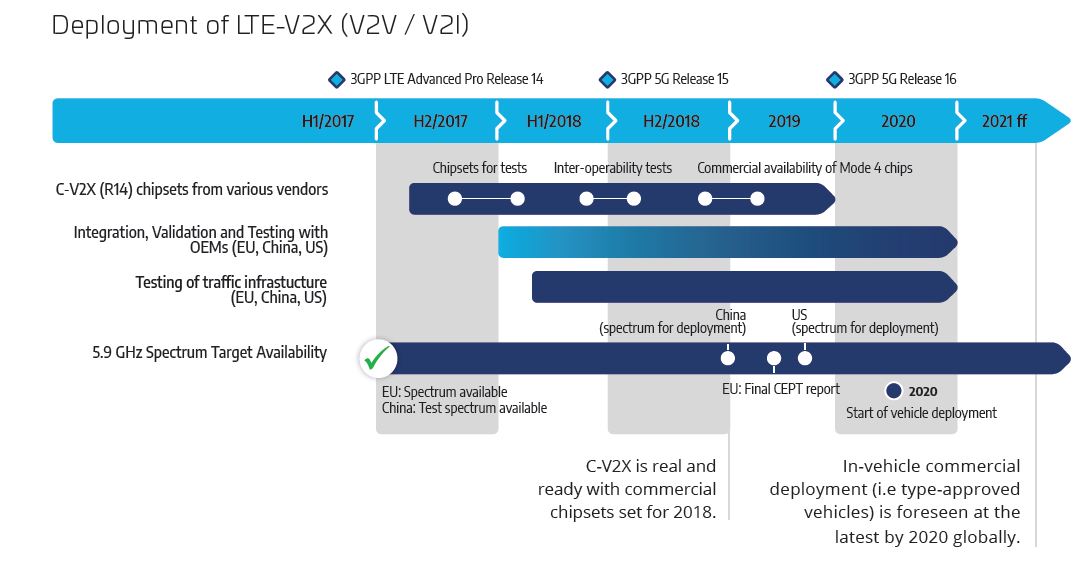
It is with this cooperation, collaboration, and commitment that 5GAA members continue to work to ensure that C-V2X technology is tested, validated, and commercially available in vehicles in 2020.
Peaceful coexistence of C-V2X and ITS-G5 technology offers the highest net benefits for Europe
5GAA and EU policymakers discuss future of 5G for connected and automated vehicles
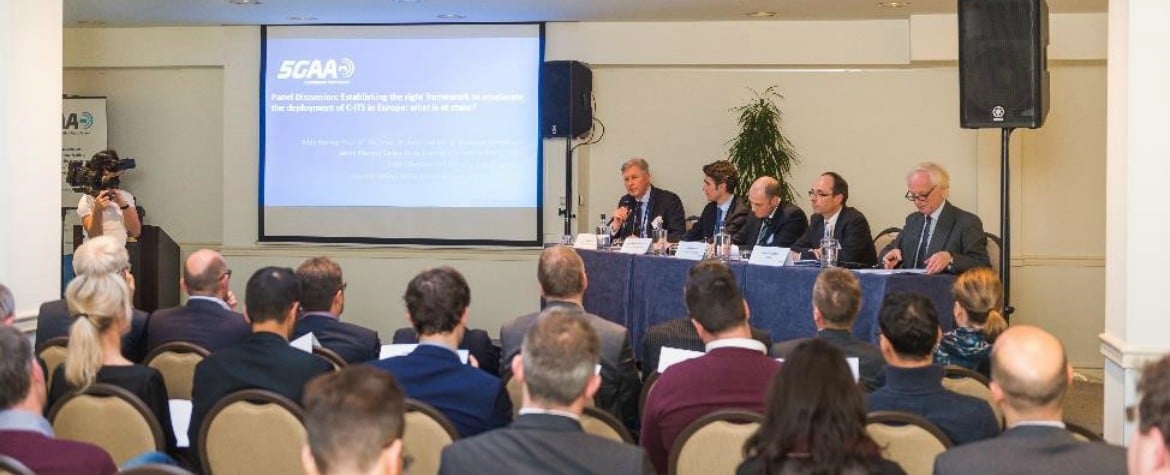
12 December 2017, Brussels, Belgium – The 5G Automotive Association (5GAA), a cross-industry association of the telecoms and automotive industry, held a policy debate on Tuesday 5 December in Brussels to discuss the concrete actions necessary to implement 5G connected and automated vehicles in Europe. A recurring theme in Tuesday’s debate was the cohesive development and implementation of cellular “vehicle to everything” (C-V2X) technology, the technology that will enable automobiles to communicate via cellular networks to other connected devices but also the possibility of ad-hoc communication without any cellular network involvement (e.g. in case of weak coverage). Policymakers and industry face the ongoing challenge of creating a cohesive framework that enables private sector innovation while ensuring a safe and economically viable rollout of new technologies.
Attendees heard from a wide range from various European political and administrative representatives, including Eddy Hartog, EC Head of Unit Smart Mobility and Living, Attila Benedek (Adviser to István Ujhelyi MEP, rapporteur on European C-ITS Strategy), Jaime Moreno García-Cano of the Spanish traffic authority or Andreas Geiss, EC Head of Unit for Spectrum Policy. 5GAA was represented by its Secretary, Markus Dillinger of Huawei and board members, Luke Ibbetson of Vodafone, Joachim Göthel of BMW, Rainer Krumrein of Daimler, and Friedhelm Ramme of Ericsson.
The debate coincides with the Commission’s ongoing public consultation on its European Strategy on Cooperative Intelligent Transport Systems (C-ITS), which runs through January 5, 2018. C-V2X technology stands to significantly improve road safety and facilitate traffic flows in the EU. Ultimately, the benefits of this technology across the EU could save the several billion euros that are lost every year to traffic accidents and congested roadways.
Markus Dillinger, 5GAA Secretary and Member of the Executive Committee: “5GAA was founded to underscore the urgency in developing technology that makes our roads safer and smarter. Today’s debate brought together public and private sector stakeholders to discuss the capabilities of such technology as well as the acceleration of creating a regulatory framework in which the industry can work.”
During the event, analysts from Analysys Mason and SBD Automotive presented the findings of a cost-benefit analysis of implementing the C-V2X technology. The socio-economic returns of deployment of C-ITS systems may amount to EUR 43 billion by 2035 in Europe, if both C-V2X and the Wi-Fi Standard IEEE 802.11p are able to co-exist in the 5.9GHz spectrum band. The 5GAA also presented a study assessing the road safety benefits of LTE–V2X (PC-5) and IEEE 802.11p in the EU, which indicates that LTE-V2X (PC5) outperforms 802.11p in reducing fatalities and serious injuries. In addition, it demonstrates that the absence of interoperability between technologies is unlikely to present a substantive barrier to the reduction of road accidents in the short to medium term. Bill McKinley, 5GAA rapporteur on tests and trials, and Rainer Krumrein of Daimler also presented 5GAA’s perspective on C-V2X performance and future capabilities.
The event culminated in a panel discussion to discuss the right framework to accelerate the deployment of the C-ITS across Europe. Particular attention was given to short-range communications in the 5.9 GHz band and the four guiding policy principles established by the European Commission: uncompromised safety services for all users in case of multiple technologies implementation, technology neutrality of spectrum regulation, efficient spectrum use and introduction in the longer-term of 5G for the further development of cooperative, connected and automated mobility.
Luke Ibbetson, R&D Director Vodafone Group and member of 5GAA: “Both C-V2X and ITS-G5 technologies should peacefully co-exist in the 5.9 GHz band. The socio-economic and road safety studies presented at this event indicate that co-existence offers the highest net benefits for the European economy, amounting to EUR 43 billion by 2035.”
Joachim Göthel, Senior Manager Project 5G-Alliance of BMW and member of 5GAA: “C-V2X offers a strong evolution path to 5G which is absolutely essential to enable full connected and automated driving in the future, while enabling a fast roll-out for many functionalities in the very short-term, utilizing existing cellular networks.”

The presentations made during the Workshop are downloadable here below:
1. Introductory 5GAA Presentation
2. Presentation on cellular V2X socio-economic benefit study
3. LTE-V2X (PC5) and road safety in the EU
4. 5GAA Presentation Trials
5. Daimler view on V2X – 5GAA Policy Debate
About the 5GAA
The 5GAA is a cross-industry association between the cellular and automotive industries to develop, test and promote communications solutions, initiate their standardisation and accelerate their commercial availability and global market penetration, to address society’s connected mobility and road safety needs with applications such as automated driving, ubiquitous access to services and integration into smart city and intelligent transportation.
Pictures credit © Thomas Blairon, 2017. Reproduction of this image is authorised, provided the source is acknowledged

Socio-economic benefits of cellular vehicle-to-everything could amount to 43 Billion Euros by 2035
Brussels, 05th December 2017 – The 5GAA today published a report, authored by independent telecoms, media and technology consultants Analysys Mason together with automotive consultancy SBD Automotive, which assesses the benefits of cellular vehicle to everything (C‑V2X) technology for delivery of vehicle-to-everything (V2X) communication. The report, which has a focus on the benefits of such solutions in Europe, uses qualitative evidence, and describes quantitative cost–benefit analysis that the consultants have undertaken, relating to deployment of C‑V2X.
Publication of the report coincides with policy development on V2X, and use of the 5.9GHz band, in the European Union, where the European Commission is currently undertaking a public consultation on deployment of cooperative intelligent transport systems (C‑ITS).
The study concludes that the deployment of C-ITS systems is beneficial at the European Union level. Net benefits that could be accrued in Europe are estimated to be in the range of EUR20 billion to EUR43 billion in 2035 (with the highest benefits coming from increased road safety, and traffic efficiency), across the four scenarios modelled.
The most favourable scenario of those modelled in the study (amounting to EUR 43 billion net benefits) is where the potential for rapid penetration and economies of scale for C-V2X is maximised and both C-V2X and the Wi-Fi Standard IEEE 802.11p are able to co-exist in the 5.9GHz spectrum band. Such benefits do not arise in a scenario where the use of IEEE 802.11p is mandated for C-ITS services, which would result in less than half these expected net benefits (EUR 20 billion).
The study also indicates benefits of C-V2X for the European market lie in its deployment flexibility, with the ability to provide coverage for both short range and wide area applications, and certainty of future evolution to 5G, potentially facilitating earlier deployment as well as after-market deployment (e.g. V2X services provided in vehicles via a smartphone or other after-market device with C-V2X connectivity).
Reduced infrastructure deployment costs are a further key benefit of C-V2X, from the potential to re-use existing mobile infrastructure, and thus leveraging cellular technology integration and economies of scale, rather than building independently operated roadside infrastructure.
Christoph Voigt, 5GAA Chairman comments: “C-V2X will be fundamental to the deployment of cooperative intelligent transport systems. The benefits highlighted is this report indisputably demonstrate that this technology will lead to major improvements in driving and road safety. It further highlights that the European Commission should take a technology neutral approach and not limit these benefits by mandating the use of the Wi-Fi standard IEEE 802.11p”
The socio-economic benefits study on C-V2X can be found here.
Separately, the 5GAA has also today published a study which carries out a quantitative analysis of LTE–V2X (PC-5) and IEEE 802.11p technologies for short-range ad hoc/direct communications in reducing fatalities and serious injuries caused by motoring accidents in the EU. The modelling underlying this report was peer-reviewed and validated by the technology and policy consultancy, Ricardo. The study find that LTE-V2X (PC5) outperforms 802.11p in reducing fatalities and serious injuries on the EU’s roads. The 5GAA’s study on an assessment of LTE-V2X (PC5) and 802.11p direct communications technologies for improved road safety in the EU can be found here.
About C-V2X
V2X allows vehicles to communicate with each other and the wider transport ecosystem. It will potentially complement on-board sensors by providing enhanced information (such as data from other vehicles) over a longer range.
C‑V2X is a technology developed by the Third Generation Partnership Project (3GPP) to deliver V2X services, using two modes of communication:
- a direct vehicle-to-vehicle mode (called ‘PC5’ in 3GPP specifications) and
- a network communications interface (called ‘Uu’ in 3GPP specifications) for vehicle-to-network (V2N) communication via existing mobile networks.
Download Press Release here.
Co-operating to build a better Mobility Ecosystem: 5GAA and IMT2020 Present their Partnership
The 5G Automotive Association (5GAA) is delighted to announce that it is embarking on a new partnership with the IMT-2020 (5G) Promotion Group.
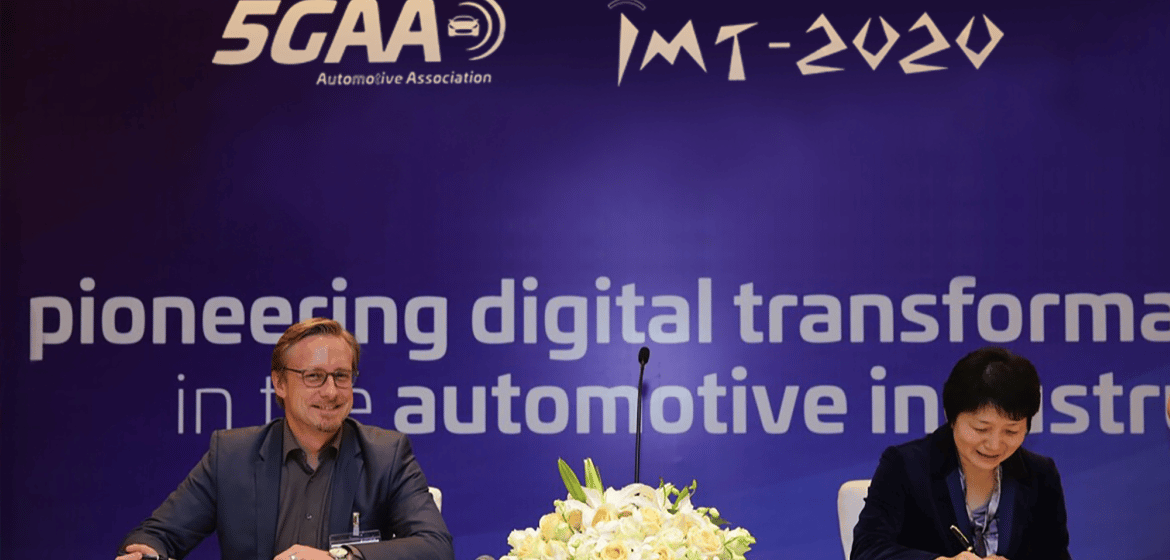
On 16 November 2017, in Shanghai, both parties have signed a Memorandum of Understanding in order to foster cooperation in the field of connected and autonomous driving solutions. This exciting journey of collaboration will also be a unique opportunity to pool resources in technology research and related use cases on a global scale.
Both organisations are advocates for the accelerated development of enhanced mobile communication systems between all road users and vehicles. The focus technologies for both associations are LTE-V2X and 5G-V2X. The 5GAA and IMT-2020 (5G) Promotion Group will harness their joint expertise on a range of projects, such as:
- Further conducting technical research on LTE-V2X and 5G-V2X
- Ensuring the promotion of the applications of 5G based V2X solutions
Since its launch in September 2016, 5GAA has grown exponentially worldwide. Over 60 industry leaders from the automotive, technology and telecommunications industries have teamed up to accelerate C-V2X technology development and its evolution to 5G-V2X for enhanced safety, automated driving and connected mobility. Together, 5GAA members are building a safer, more sustainable and connected transport ecosystem.
The Chairman of 5GAA, Christoph Voigt, is confident that both organisations’ hold a bright future of collaboration together: “5GAA was created to connect the telecom industry and vehicle manufacturers to develop 360-degree solutions for safer and more sustainable mobility systems. We look forward to working with IMT-2020 to define the requirements of C-V2X and to create a successful V2X ecosystem”.
IMT-2020 was established in February 2013. It is the major platform for 5G technology innovation, industry promotion and international cooperation in China. IMT-2020 C-V2X Working Group is established by IMT-2020 Expert Committee in April 2017, who conduct technical research on LTE-V2X and 5G-V2X innovation. Its members include leading operators, vendors, universities and research institutes in the telecommunication and automotive industries.
Wang Zhiqin, Chairman of IMT-2020 welcomed the signature of the Memorandum of Understanding between both organisations: ”IMT-2020 is the major platform for 5G technology innovation, industry promotion and international cooperation in China, and IMT-2020 C-V2X Working Group is responsible for industry integration among ICT, automobile, transportation and etc.. IMT-2020 and 5GAA have a number of partners and working interests in common, we are glad to cooperate with 5GAA together to ensure the successful development and commercialization of C-V2X and future 5G automotive services”.