

Connected Mobility
Sustainability
Sustainability benefits of C-V2X
Cellular Vehicle-to-Everything, or C-V2X, communications will make transportation not only safer and smarter but also more sustainable.
Sustainability has three dimensions: environmental, social and economic.
C-V2X ticks all three boxes:
- Environmental: By helping to make every trip smarter, safer and more efficient, C-V2X helps reduce congestion and accidents, thereby reducing air pollution, noise pollution and energy use.
- Social: Saving lives and avoiding injuries are clear social benefits. By enabling real-time communication between pedestrians, cyclists, traffic infrastructure and moving vehicles, including motorcycles and electric scooters, C-V2X will help avoid accidents that otherwise would result in injuries and deaths.
- Economic: By enabling more efficient mobility, C-V2X will save people and employers billions of man-hours currently wasted in traffic jams. Those man-hours can then be dedicated to more rewarding activities.
C-V2X also enables the growth of autonomous mobility, which in turn offers even greater sustainability benefits, for example mobility-as-a-service offerings.
To learn more, watch the short video or scroll down for more details.
C-V2X and Sustainability in detail
ENVIRONMENTAL BENEFITS

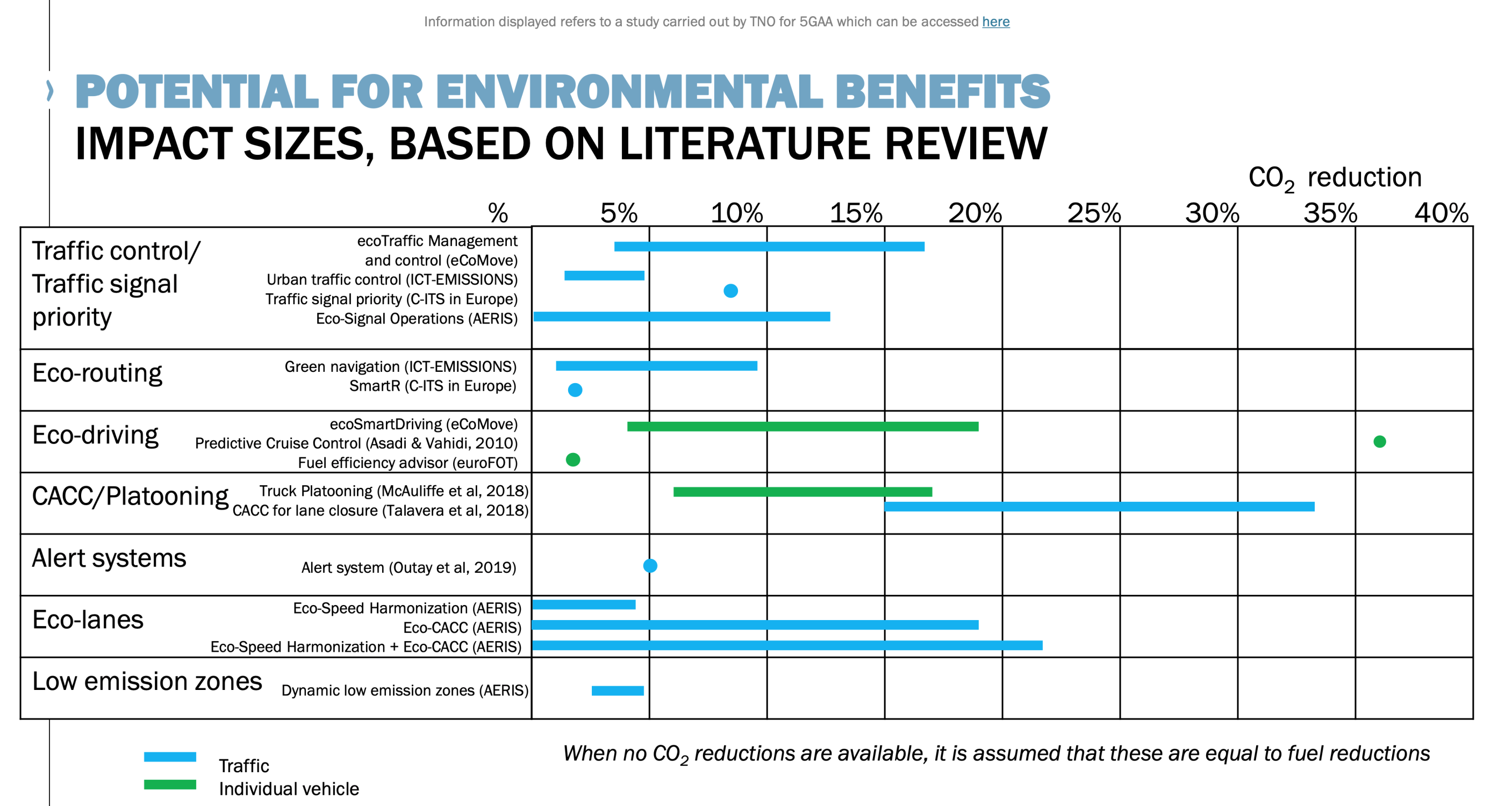
- Transport still represents about 25% of Europe’s total CO2 emissions. By helping to make every trip smarter, safer and more efficient, C-V2X helpsreduce congestion and accidents, thereby reducing energy use, noise pollution and air pollution.
- C-V2X can help all vehicles operate and deliver people and goods more efficiently, thereby reducing pollution and optimizing the use of valuable energy resources.
- INRIX calculated that each second of reduced delays at traffic signals across the United States would translate to an annual reduction of 800,000 metric tons of CO2.
- Connected vehicle technology can help electric cars calculate an energy-optimised route to a charging station that’s not necessarily the fastest or nearest but requires the least energy to reach.
- Examples of environmental benefits enabled by C-V2X technologies include:
- Current technology permitting smarter routing for all vehicles in both urban and rural areas, for example via automated traffic routing, road, bridge, tunnel and parking availability updates and smart parking.
- Future technology permitting “green waves” for emergency vehicles, cars, trucks, lorries and other vehicles instead of stop-and-go traffic.
- Future technology facilitating manoeuvres and cooperation in traffic.
- For more detailed information, please see TNO’s report for 5GAA on the Environmental Benefits of C-V2X.
SOCIAL BENEFITS

- By enabling real-time communication between pedestrians, cyclists, traffic infrastructure and moving vehicles, including motorcycles, C-V2X will help avoid accidents that otherwise would result in injuries and deaths.
- According to the World Health Organisation, there were 1.35 million traffic deaths globally in 2016, the latest year for which global data are available. Road traffic deaths are a leading cause of death among young people, in particular.
- In the European Union, there were about 20,608 road deaths in 2023, or about 46 road deaths per million inhabitants.
- In the United States, an estimated 40,990 people died in road accidents in 2023. The United States Department of Transportation has set an ambitious goal of zero traffic deaths, in part by leveraging advanced technologies to prevent accidents in the first place.
- It says: “The U.S. Department of Transportation’s National Roadway Safety Strategy specifies that zero is the only acceptable number of deaths and serious injuries on our roadways. USDOT is committed to taking substantial, comprehensive action to achieve this goal.”
- By providing real-time hazard notifications and enabling connected cooperative driving, C-V2X makes transportation safer for all road users, including cyclists. As C-V2X makes the roads safer, more people may feel confident in choosing cycling as their primary mode of transportation.
- A U.S. DOT pilot study demonstrated that C-V2X technology can prevent accidents and injury for vulnerable road users.
- Green waves and corridors for emergency vehicles can help save lives and reduce injuries, allowing people to lead longer, healthier and more fulfilling lives.
- Response times are critical for emergency vehicles and first responders to save lives. A 2020 study showed that “green waves” at traffic lights could reduce response times by as much as 30% with little impact on overall traffic conditions.
- By enabling more efficient mobility, C-V2X will save commuters billions of man-hours currently wasted in stressful traffic jams.Those man-hours can be dedicated to more enjoyable and rewarding activities such as doing sports, hobbies, volunteering, education or spending time with friends and family.
- In Europe, the average driver in some cities loses more than 150 hours per year stuck in traffic jams.
- Americans lost as much as 3.4 billion hours in traffic in total in 2021.
- C-V2X helps connect other modes of transport with one another to facilitate a real multi-modal transportation system.
ECONOMIC BENEFITS

- By enabling automated driving and mobility as a service, C-V2X will help create new products and services that help drive more sustainable economic growth.
- For example, anonymous data collected through C-V2X can help governments and policymakers develop more effective infrastructure maintenance programmes and traffic plans.
- By enabling more efficient mobility, C-V2X will save employers and entrepreneurs billions of man-hours currently wasted in traffic jams.Those man-hours can then be dedicated to more rewarding activities.
- For commercial vehicles, C-V2X can help optimise delivery routes and schedules and reduce the number of empty or partially loaded trips. Efficient route management reduces energy use and pollution.
- The deployment of C-V2X technologies in vehicles can increase demand for 5G and future networks, each of which will be more energy-efficient than the technologies they replace.
Want to learn more?
If you want to learn more about the timeline for the introduction of next-generation C-V2X communications technologies, including those with clear environmental benefits, please see our latest C-V2X technology Roadmap here.
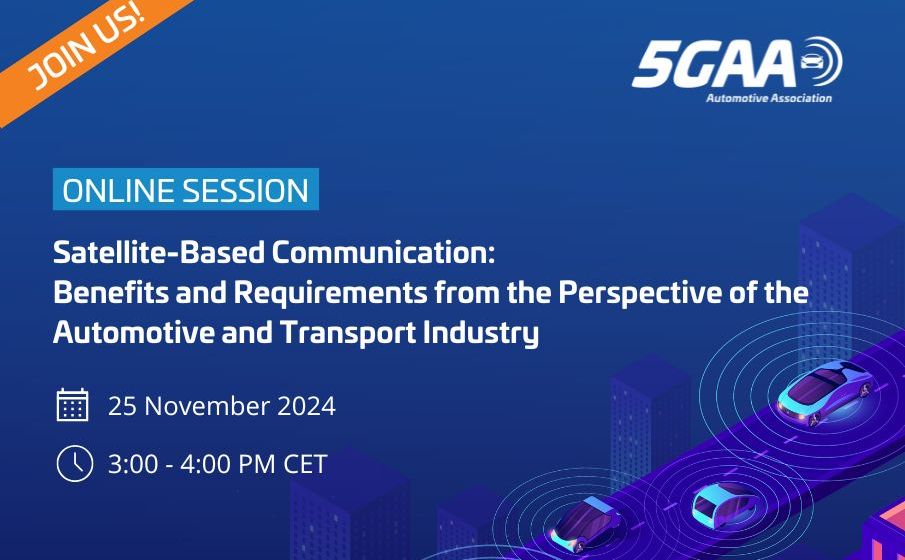
Satellite-Based Communication: Benefits and Requirements from the Perspective of the Automotive and Transport Industry
On Monday 25 November (3-4 PM CET), the 5G Automotive Association is organising an online session on maximising the benefit of future satellite communications for the automotive industry.
The online session will focus on the recently published technical report which outlines a vision for integrating Non-Terrestrial Networks (NTN) as a complementary layer to Terrestrial Networks (TN), enhancing coverage and services for connected vehicles. The online session will also shed light on the report’s comprehensive roadmap for NTN deployment, identifying key phases for narrowband, wideband, and broadband data rate use cases.
Key recommendations around the necessary alignment of global mobile standards, deployment of Low-Earth Orbit (LEO) satellite constellations, and a focus on optimising user terminal parameters and costs will be reiterated and the potential of integrating NTN connectivity for the automotive and telecommunications industries will be discussed.
If you are interested, you can register here.

Automotive Edge Computing Consortium Becomes MoU Partner
On 24 October, the 5G Automotive Association (5GAA) and the Automotive Edge Computing Consortium (AECC) announced a significant partnership to drive innovation in vehicle-to-everything (V2X) technology. By signing a Memorandum of Understanding (MoU), the two organisations aim to harness the power of edge computing to enhance vehicle connectivity.
This collaboration is a crucial step towards realising the full potential of 5G and edge computing in the automotive industry. The partnership will focus on multi-access edge computing (MEC) and network APIs.
By combining their expertise and resources, the 5GAA and AECC will work together to:
- Advance V2X technology: Drive the development of cutting-edge V2X solutions, such as cooperative adaptive cruise control, collision avoidance systems, and traffic management.
- Accelerate deployment: Facilitate the rapid deployment of V2X infrastructure and services, paving the way for a more connected and intelligent transportation ecosystem.
- Improve safety: Enhance road safety by enabling vehicles to communicate with each other and with infrastructure, reducing the risk of accidents.
- Optimise traffic flow: Optimise traffic flow and reduce congestion through real-time data exchange and intelligent traffic management systems.
Johannes Springer, Director General of the 5GAA, and Muriel Desaeger, member of the AECC, expressed their enthusiasm for the partnership. To learn more about it and its potential impact on the future of mobility, watch their interview with TelecomTV here.
How 5GAA is working on the future of V2X communication
Video interview by TelecomTV.
Our CTO Maxime Flament discusses the organisation’s technical work in advancing 5G standards for the automotive sector. He highlights the current applications of 5G in vehicles, including telematics and safety features, and envisions a future with enhanced automation and reliability. Flament also explains the complementary approaches of network-based vehicle-to-everything (V2X) and the emerging 5G-V2X Direct specifications, and how the 5GAA is facilitating the collaboration between the telecom and automotive industries to integrate and harmonise these solutions to enable safer and smarter transportation.
Recorded in October 2024.
Transforming automotive connectivity with 5G and MEC
Jyoti Sharma, Associate Director – Network Planning, Global Networks & Technology, Verizon
Video interview by TelecomTV.
Jyoti Sharma discusses Verizon’s pivotal role in the connected mobility sector and its involvement with 5GAA. She highlights the potential of 5G for the automotive industry, such as the integration of advanced technologies like multi-access edge computing (MEC) and hyper-precise location services. She also outlines future opportunities for connected and autonomous vehicles, the importance of collaboration across industries, and the role of non-terrestrial networks in enhancing connectivity.
Recorded October 2024.
Transforming mobility: How 5GAA helps advance automotive connectivity and safety
Christoph Voigt, Chairman, 5GAA
Video interview by TelecomTV.
At the 2024 5GAA meeting week in Berlin, Christoph Voigt, chairman of 5GAA, discusses the organisation’s role in bridging the automotive and telecoms sectors with 5G technology. He highlights the potential of 5G in enhancing vehicle connectivity and safety through innovations like cellular vehicle-to-everything (C-V2X) technology. He also emphasises the importance of collaboration among industry stakeholders and outlines the ongoing developments and future opportunities for 5G in the automotive sector.
Recorded October 2024.
The role of 5G in enhancing vehicle functionality and safety
Colin Lee, Principal Product Owner VCDP Strategy and Technical Specialist V2X, Digital Product Platform, JLR
Video interview by TelecomTV.
Colin Lee from Jaguar Land Rover (JLR) discusses the critical role of 5G technology in the automotive sector, highlighting how connectivity enhances vehicle functionality, safety and customer experience. He explains the evolution from earlier communication technologies to 5G and calls for collaboration among original equipment manufacturers (OEMs), telecoms and government entities to achieve seamless vehicle-to-everything (V2X) communication.
Recorded October 2024.
5G’s transformative role in the automotive industry
Suman Sehra, Global VP, Connectivity Portfolio Management, Harman
Video interview by TelecomTV.
Suman Sehra highlights Harman’s role in enhancing connectivity and user experiences in vehicles, including the importance of collaboration within the 5GAA to address challenges in technology, policy, and standardisation. He explains that to ensure a future where 5G enables autonomous driving and seamless connectivity, driven by advancements in network slicing and edge computing, greater collaboration across the automotive and telecom sectors is needed to overcome barriers and scale innovative technologies.
Recorded October 2024.
How Vodafone is enhancing road safety through the STEP platform
Graham Rushton, CTO Partner Markets, Vodafone
Video interview by TelecomTV.
As the first mobile operator to join the 5GAA, Graham Rushton discusses Vodafone’s role in the association and its ongoing commitment to the connected mobility sector. He talks about the development of the Safer Transport for Europe (STEP) platform, which enhances road safety through real-time data sharing. Rushton also addresses future opportunities for autonomous vehicles and the challenges of regulation and collaboration among industry players to create a sustainable ecosystem that benefits consumers.
Recorded October 2024.
5G innovation and collaboration drives connected mobility
Andreas Schaller, Head V2X Technology Strategy, Bosch Mobility
Video interview by TelecomTV.
Andreas Schaller discusses the role of Bosch Mobility in the connected mobility sector and the importance of 5GAA in aligning industry objectives. He highlights current 5G applications in automotive, such as entertainment and automated parking, and explains what advancements we can expect to see with future 5G releases from 3GPP, including non-terrestrial network support. He also calls for scalable solutions that will work globally to ensure successful implementation, and reiterates the need for continuing collaboration between the telecom and automotive industries if we are to achieve fully autonomous driving.
Recorded October 2024.