
5GAA, Audi, Ford and Qualcomm Showcase C-V2X Direct Communications Interoperability to Improve Road Safety
WASHINGTON, D.C., April 26, 2018 – C-V2X Communications’ Superior Performance, Synergies with Telematics Units and Evolutionary Path Towards 5G Offers Greater Potential to Save Lives; World’s First Showcase Across Vehicle Manufacturers Shows Readiness for Industry Deployment as Early as 2020.
| Downloadable Resources | |
|---|---|
| Photos | |
| Infographic | |
| Video clip 1 | |
| Video clip 2 |
5G Automotive Association (5GAA), Audi AG (NASDAQ: AUDVF), Ford Motor Company (NYSE: F) and Qualcomm Technologies, Inc., a subsidiary of Qualcomm Incorporated (NASDAQ: QCOM), announced today the world’s first demonstration for Cellular Vehicle-to-Everything (C-V2X) direct communications technology operating across vehicles from different manufacturers. C-V2X is a global solution for V2X communications to support improved automotive safety, automated driving, and traffic efficiency, and is the only V2X technology based on globally recognized 3rdGeneration Partnership Project (3GPP) specifications with ongoing evolution designed to offer forward compatibility with 5G, and leveraging upper layer protocols defined by the automotive industry, including Society of Automotive Engineering (SAE) and the European Telecommunications Standards Institute (ETSI) organizations.
The demonstration showcased the benefits of using C-V2X real-time direct communications on the globally harmonized 5.9 GHz ITS spectrum for vehicle-to-vehicle (V2V) collision avoidance and improved road safety without any dependency on cellular operator network involvement, credentials or coverage. The organizations also unveiled initial field test results showing a significant range, reliability and performance advantage of C-V2X direct communications, with more than twice the range and improved reliability compared to 802.11p radio technology. Based on C-V2X’s potential to enhance safety and save lives, the 5GAA, Audi, Ford and Qualcomm Technologies encourage the broad automotive ecosystem to accelerate adoption of C-V2X, which is expected to be deployed as early as 2020.
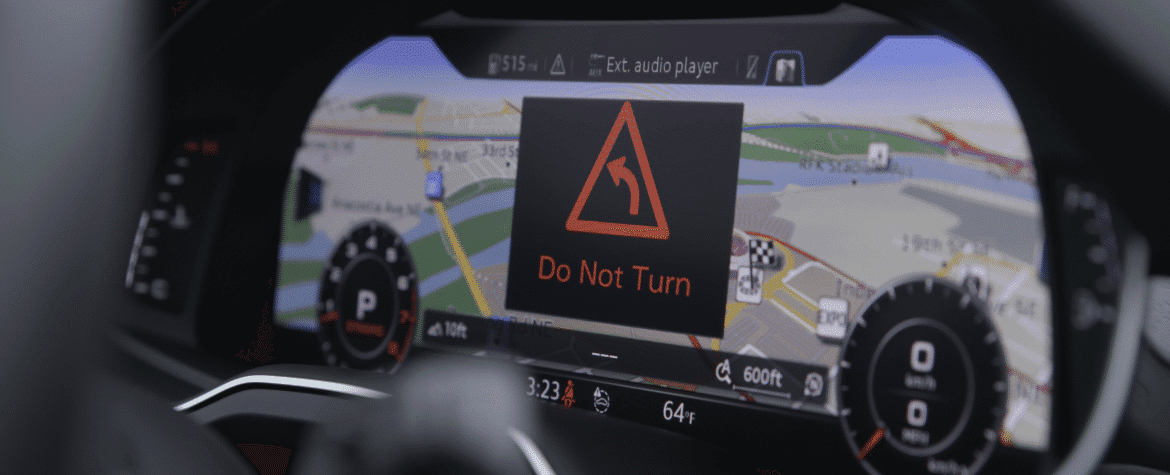
Featuring Audi and Ford vehicles which incorporate the C-V2X technology utilizing the C-V2X chipset from Qualcomm Technologies, the showcase exhibited various scenarios of how C-V2X communications is beneficial for road safety. These scenarios included situations with obstructed or no visibility, including Left Turn Assist and Emergency Electronic Brake Light use cases, in which vehicle-to-vehicle (V2V) communications alerted surrounding vehicles when cars were turning left or braking. Additional use cases were featured, including a vulnerable road user (VRU) demonstration showcasing what can be possible with future vehicle-to-pedestrian (V2P) communications. Use cases for vehicle-to-infrastructure (V2I) communication were also demonstrated, which showcased how direct communications can work closely with traffic signal controllers to ensure reduction in carbon emissions and optimization of traffic efficiency in cluttered intersections and dense environments.
C-V2X is supported by a broad automotive ecosystem, that includes the fast-growing global organization 5GAA, which currently has over 80 members comprised of leading automakers, Tier-1 suppliers, software developers, mobile operators, semiconductor companies, test equipment vendors, telecom suppliers, traffic signal suppliers and road operators.
Designed with a focus on security, C-V2X benefits from established security transport layers and application protocols defined by the automotive standards communities, including SAE, ETSI, International Standards Organization (ISO), and Institute of Electrical and Electronics Engineers (IEEE) 1609, and Qualcomm’s decades of investment in cellular technologies. C-V2X solutions are expected to be more cost efficient and economical over competing technologies as this functionality gets integrated into the base cellular modem product that automakers equip in every vehicle.
“We are excited to witness this monumental breakthrough in the evolution of C-V2X and the growing momentum behind this life-saving technology,” said Christoph Voigt, Chairman of 5GAA. “After years of development supported by leading carmakers, technology providers and the automotive ecosystem at large, C-V2X is ready to improve road safety with deployment in production vehicles and road infrastructure as soon as 2020, leveraging a state-of-the-art proven radio with decade-long developed automotive software protocols. This unique showcase firstly demonstrates the commitment of our members to ensure that the potential of the C-V2X technology is realized and represents a key step towards the next generation of cellular technology, 5G.”
“C-V2X is critical to enhance road safety and also gives us a look into the key role that vehicle-to-vehicle and 5G wireless technologies play in the future of Audi and the automotive industry in general to support autonomous driving,” said Gerhard Stanzl, Head of Predevelopment Smart Mobility and Machine Learning, Audi Electronics Venture. “This interoperability demonstration marks a major milestone on the road to safer driving and we look forward to working alongside the extensive automotive ecosystem in helping accelerate C-V2X deployment globally.”
“With its ability to safely and securely connect vehicles, along with its evolution into 5G, C-V2X is integral to Ford’s vision for transportation and the cities of the future in which all cars and infrastructure collaborate speaking the same language,” said Don Butler, Executive director connected vehicle platform and product, Ford Motor Company. “We are very encouraged by preliminary test results which support our belief that C-V2X has superior V2X communication capabilities. We are also very pleased to see strong ecosystem support of product roadmaps that accelerates time to market for C-V2X.”
“At Qualcomm Technologies, we are committed to accelerating automotive innovation and enabling carmakers to deliver safe and connected vehicles, and we strongly believe that C-V2X can offer significant improvements in road safety for people worldwide,” said Nakul Duggal, vice president of product management, Qualcomm Technologies, Inc. “After years spearheading the development of C-V2X we are ready for its rollout in collaboration with leading automakers such as Audi and Ford, and the larger auto industry.”
5GAA, Audi, Ford and Qualcomm Technologies are scheduled to showcase another live C-V2X interoperability demonstration at the upcoming Intelligent Transportation Society of America (ITS-A) World Meeting in Detroit from June 4-7. Initial test results showing significant lifesaving benefits of C-V2X direct communications compared against the 802.11p solution can be found here. For more information on C-V2X please visit here.
About 5GAA
The 5G Automotive Association (5GAA) is a global cross-industry organization of companies from the automotive, technology and telecommunications industries (ICT), working together to develop end-to-end solutions for future mobility and transportation services. Created in 2016, the Association is comprised of over 80 members whose mission is to develop, test and promote communications solutions, initiate their standardization and accelerate their commercial availability and global market penetration, to address society’s connected mobility and road safety needs with applications such as automated driving, ubiquitous access to services and integration into smart city and intelligent transportation. For more information, visit 5GAA’s LinkedIn and Twitter pages.
About Audi
The Audi Group, with its brands Audi, Ducati and Lamborghini, is one of the most successful manufacturers of automobiles and motorcycles in the premium segment. It is present in more than 100 markets worldwide and produces at 16 locations in twelve countries. 100 percent subsidiaries of AUDI AG include Audi Sport GmbH (Neckarsulm), Automobili Lamborghini S.p.A. (Sant’Agata Bolognese, Italy) and Ducati Motor Holding S.p.A. (Bologna, Italy).
In 2017, the Audi Group delivered to customers about 1.878 million automobiles of the Audi brand, 3,815 sports cars of the Lamborghini brand and 55,900 motorcycles of the Ducati brand. In the 2017 fiscal year, AUDI AG achieved total revenue of €60.1 billion and an operating profit of €5.1 billion. At present, approximately 90,000 people work for the company all over the world, more than 60,000 of them in Germany. Audi focuses on sustainable products and technologies for the future of mobility.
About Ford Motor Company
Ford Motor Company is a global company based in Dearborn, Michigan. The company designs, manufactures, markets and services a full line of Ford cars, trucks, SUVs, electrified vehicles and Lincoln luxury vehicles, provides financial services through Ford Motor Credit Company and is pursuing leadership positions in electrification, autonomous vehicles and mobility solutions. Ford employs approximately 202,000 people worldwide. For more information regarding Ford, its products and Ford Motor Credit Company, please visit https://www.corporate.ford.com.
About Qualcomm
Qualcomm invents breakthrough technologies that transform how the world connects and communicates. When we connected the phone to the Internet, the mobile revolution was born. Today, our inventions are the foundation for life-changing products, experiences, and industries. As we lead the world to 5G, we envision this next big change in cellular technology spurring a new era of intelligent, connected devices and enabling new opportunities in connected cars, remote delivery of health care services, and the IoT – including smart cities, smart homes, and wearables. Qualcomm Incorporated includes our licensing business, QTL, and the vast majority of our patent portfolio. Qualcomm Technologies, Inc., a subsidiary of Qualcomm Incorporated, operates, along with its subsidiaries, all of our engineering, research and development functions, and all of our products and services businesses, including, the QCT semiconductor business. For more information, visit Qualcomm’s website, OnQ blog, Twitter and Facebook pages.
Media contact:
Lisa Boch-Andersen
Senior Director, Strategic Communication and Marketing, 5GAA
Email: lisa.boch-andersen@5GAA.org / Mobile phone: +32(0)475450972
MWC 2018: 5GAA Gaining Speed Toward C-V2X commercialization
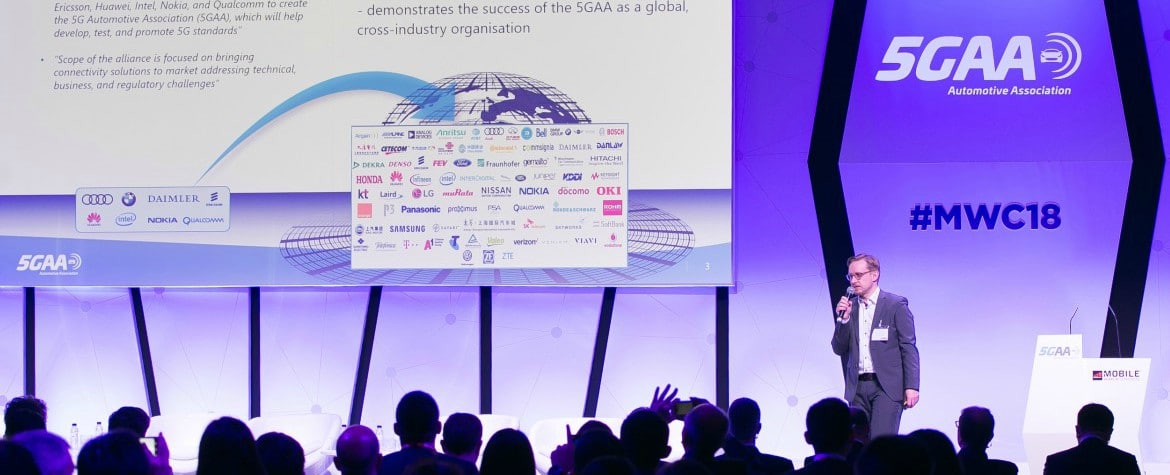
March 2nd, Barcelona, Spain – The 5G Automotive Association (5GAA) presented – during a session at the Mobile World Congress 2018 – the acceleration of C-V2X technology implementation through the widespread support of leading telecommunications and automotive companies. This advanced technology will serve as the lynchpin that will create a connected vehicle ecosystem and enable future mobility solutions. March 1st, Barcelona, Spain – The 5G Automotive Association (5GAA) presented – during a session at the Mobile World Congress 2018 – the acceleration of C-V2X technology implementation through the widespread support of leading telecommunications and automotive companies. This advanced technology will serve as the lynchpin that will create a connected vehicle ecosystem and enable future mobility solutions.
The value of C-V2X technology lies in the fact that it is a unified technology – it can provide short-range and long-range communications. C-V2X technology can, for example, alert drivers of a cyclist around the corner or a traffic jam that is 25 kilometers away.
Christoph Voigt, 5GAA Chairman and Head of R&D Connectivity at Audi announced that: “This effort is now ‘all hands on deck’, meaning that telecommunications and automotive leaders are all working hand-in-hand to deploy C-V2X and to make it hit the road as soon as possible.”
During its session, 5GAA focused on the growing support that C-V2X technology is enjoying among leading companies in the telecommunications and automotive industries and presented the importance that 5G cellular technology will play in enabling smart mobility of the future.
C-V2X gains wide ecosystem support
During the presentation, 5GAA members Qualcomm and Huawei emphasized the growing C-V2X ecosystem support and presented their integrated chipsets that will enable C-V2X commercialization. The start of C-V2X mass market series deployment is predicted to begin as early as 2019/2020.
“We see a growing appetite across the industry for the commercialization of our C-V2X chipset with automakers, Tier-1 suppliers, cellular module manufacturers, ITS providers, integrators, and automakers ready to drive change,” said Jason Ellis, Director of Automotive Business Development at Qualcomm.
Veni Shone, President of LTE product line at Huawei, highlighted that the momentum of C-V2X in China is encouraging – ministries have put their full support behind C-V2X technology on strategy and standardization. Mr. Shone also detailed Huawei’s commitment to accelerate C-V2X, specifically pointing at the releases of its LTE-V2X chipset, T-box prototype, and roadside units.
5GAA plans to support and advocate the work of this technology by speeding up the deployment of C-V2X for the automotive sector while creating a joint ecosystem and implementing key functionalities such as vehicle-to-smart-device.
5G as an enabler for life-saving solutions & new business applications
5GAA members Ericsson and Ford also highlighted exciting use cases and growing business applications for 5G technology in the automotive sector.
Don Butler, Executive Director of Connected Vehicles and Services at Ford stated that: “Creating safer and more personalized journeys through automated driving is the long-term vision of mobility’s future. We believe 5G will enable this by maximizing the in-vehicle experience thanks to high reliability, fast-paced communications. We will create new, compelling experiences and capabilities saving more lives with patient transport monitoring or teleoperated driving.”
With the advancement of 5G technology and its application to connected vehicles, the amount of data created will continue to expand exponentially.
Stefano Sorrentino, Master Researcher at Ericsson presented the fact that: “Connected & automated driving will lead to a data explosion that will definitely challenge the network capacities. This challenge could be remedied through the deployment of scalable and integrated networks and cloud architectures as well as the continuous evolution of radio technology into 5G.”
“We think of 5G as an end-to-end solution starting with the wireless connectivity but also including edge computing, the transport network, artificial intelligence and machine learning. Together they power the applications and the services for intelligent transportation and smart mobility, and ultimately, the ways humans interact with connected and self-driving cars of the future. It is an exciting area for 5GAA to work on and we invite any stakeholder to join us and contribute on this journey.” concluded Thierry Klein, Head of Disruptive Innovation Program at Nokia Bell Labs and Vice Chair of 5GAA Board.
About 5GAA
The 5G Automotive Association (5GAA) is a global cross-industry organization of companies from the automotive, technology and telecommunications industries (ICT), working together to develop end-to-end solutions for future mobility and transportation services. Created in 2016, the Association is comprised of over 75 members whose mission is to develop, test and promote communications solutions, initiate their standardisation and accelerate their commercial availability and global market penetration, to address society’s connected mobility and road safety needs with applications such as automated driving, ubiquitous access to services and integration into smart city and intelligent transportation.

Driving to the Future: The Case for Cellular in Automotive
On the February 9th members of the 5GAA Board traveled to Silicon Valley to introduce 5GAA and describe their joint vision of cellular communications for automotive applications. The objective of the event was to engage a diverse group representing Silicon Valley-based companies in the discussion of how the 5GAA vision may match the culture and innovation of the local ecosystem.
On this occasion, 5GAA hosted the event at the Four Season in Palo Alto, sponsored by Intel, with a panel on “Driving to the Future: The Case for Cellular in Automotive”. Panelists included Jovan Zagajac (Ford), Luke Ibbetson (Vodafone Group), Walter Weigel (Huawei), Thierry Klein (Nokia) and Michael Faerber (Intel), and the discussion was moderated by Jim Misener(Qualcomm).
The audience included representatives from automotive OEMs and Tier 1 suppliers with offices in Silicon Valley, chipmakers, telecommunications research and development personnel, transportation providers, university researchers and several startups.
The discussion was productive and covered a wide range of questions and answers which needed to be addressed. Also discussed was the value of cellular for the automotive and transportation value chain, 3GPP’s release of 14 features and how they are able to transform them to 5G. Also explored in the meeting was how invention and innovation are part of both the panelist and the audience group. The event was well attended by over 40 people who contributed to a very lively debate, it was the first event of its kind organized by 5GAA.

LG, Ford, Verizon, Denso and Gemalto join the 5G Automotive Association
5GAA (www.5gaa.org) welcomes LG, Ford, Verizon, Denso and Gemalto as new members of the association.
“We are very pleased that LG, Ford, Verizon, Denso and Gemalto have joined the association. With their global footprint and diverse expertise across the communications and automotive ecosystems, these companies will contribute to the definition and development of next generation connected mobility and automated vehicle solutions” Dino Flore, Director General of 5GAA, said.
Kookyeon Kwak, Executive Vice President, Head of LG’s Advanced Standard R&D Lab, said, “Cellular communication will play a pivotal role to meet the requirement of safety, convenience, and infotainment for future smart cars. The trend is now being accelerated by the completion of LTE-V2X, the first cellular- based vehicle-communication standard. As a manufacturer in mobile communication and vehicle component areas, LG Electronics would like to contribute to 5GAA for connecting communication and automotive industries”.
“We are excited to work together with other automotive and technology providers to define a future that envisions new and empowering mobility services and solutions. We see the 5GAA as a key enabler to the development of a sustainable connected vehicle ecosystem.” Don Butler, Executive Director of Connected Vehicle and Services at Ford Motor Company, said.
DENSO CTO for the European region, Masato (Max) Nakagawa, commented: “Extending DENSO’s global efforts in the area of vehicular connectivity is strategically aligned to our policy ‘Protecting Lives, Preserving the Planet, and Preparing a Bright Future for Generations to Come’. Reinforcing this
direction, DENSO AUTOMOTIVE Deutschland GmbH has decided to join the 5GAA. We are proud to be accepted as 5GAA member and are looking forward to collaborating in the 5GAA. DENSO considers this engagement viable to complement our long term ongoing global support of 700MHz/5.9GHz V2X safety communication. 5GAA provides the environment for the cross-industry collaboration required to define corresponding future mobile communication systems. In collaboration with the 5GAA partners we plan to explore, define and develop multi-spectral connectivity to support future mobility demands, especially in the area of connected and automated driving.”
“Gemalto is thrilled to join 5GAA and work within this prestigious group of global leaders to enable the world of new mobility that will revolutionize the automotive sector,” says Frederic Vasnier, EVP
Embedded Software and Products. “Gemalto has demonstrated its unrivaled expertise to ensure simple, seamless and ubiquitous connectivity with robust security mechanisms inside the vehicle, between vehicles and with the connected ecosystem of devices, pedestrians, and the cloud.”
5GAA was created to bridge automotive and communication industries in order to develop, test and promote connected mobility solutions, initiate their standardization and accelerate the commercial availability and global market penetration.
Since its inception, 5GAA has been experiencing rapid expansion to include key players with a global footprint in the communication and automotive industries, including car manufacturers, tier-1 suppliers, chipset/communication system providers, mobile operators and infrastructure vendors.
To achieve its long-term goals, the association is creating five Working Groups to address the following areas of work: Use Cases and Technical Requirements; System Architecture and Solution Development; Evaluation, Testbeds and Pilots; Standard & Spectrum; Business Models and Go-To-Market Strategies. In addition, the board is planning the needed policy and advocacy efforts to join the relevant discussions in this space with different regulators, policymakers, and administrations around the world.