

5GAA in Action
The 5G Automotive Association (5GAA) is a global, cross-industry organisation of 128 members made of leading global automakers, Tier-1 suppliers, mobile operators, semiconductor companies and test equipment vendors. It works together to develop end-to-end solutions for future mobility and transport services.
5GAA is committed to defining and developing the next generation of connected mobility, automated vehicle and intelligent transport solutions based on C-V2X.
Learn more about what actions the associations are taking in the video.
5GAA in Action
The 5G Automotive Association (5GAA) is a global, cross-industry organisation of 128 members made of leading global automakers, Tier-1 suppliers, mobile operators, semiconductor companies and test equipment vendors. It works together to develop end-to-end solutions for future mobility and transport services.
5GAA is committed to defining and developing the next generation of connected mobility, automated vehicle and intelligent transport solutions based on C-V2X.
Learn more about what actions the associations are taking in the video.
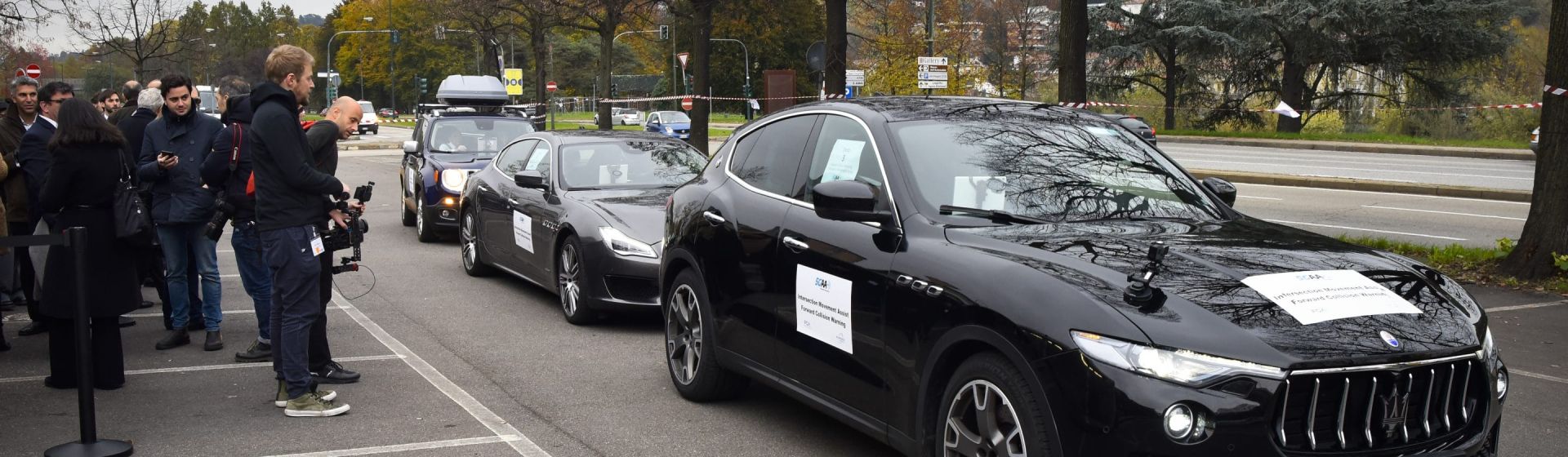
5GAA live demos show C-V2X as a market reality
Turin, 14 November 2019 – Smart mobility technology is a reality today, with ‘Cellular Vehicle-to-Everything’ (C-V2X) allowing connected vehicles to communicate with the cloud, directly with each other and their surroundings. Deployment plans are primarily sustained by the global trend in the automotive industry to adopt 4G LTE cellular technology, followed by the emerging 5G high-speed low latency communications. Beyond infotainment, C-V2X will capitalize on vehicular and smartphone connectivity to contribute to better safety, less congestion and reduced emissions.
During a live demo event in Turin, the 5G Automotive Association (5GAA) showcased ready to deploy use cases in the streets of the city and a sneak preview of what the future has in store on the renowned Lingotto rooftop test track.
Prominent members and partners of the 5GAA including Audi, Continental, Ericsson, Fiat Chrysler Automobiles, Harman Samsung, Marelli, Pirelli, Qualcomm, TIM and Vodafone demonstrated the current state of C-V2X and the road to future, Vehicle-to-Vehicle (V2V), Vehicle-to-Infrastructure (V2I), and Vehicle-to-Network (V2N) applications based on 4G LTE and 5G.
“Connected mobility is a market reality.” says 5GAA Chief Technology Officer, Dr. Maxime Flament. “The use cases demonstrated in the streets of Turin are planned for deployment with a huge industry momentum based on the evolution path to 5G capabilities.”
Using both direct short-range communications and mobile networks, the open-road demonstrations showcased the extensive capabilities of today’s C-V2X technology, ready for deployment. To name a few:
- Protecting vulnerable road users, for instance, by alerting drivers about a pedestrian at a crossing using LTE-connected infrastructure.
- Smoothing traffic by allowing public authorities and road operators to provide real-time warnings to drivers in urban environments concerning roadworks or speed limits, via the network.
- Preventing incidents at dangerous intersections or in the event of unexpected braking, thanks to C-V2X direct-short range communications between vehicles.
The track demonstrations at Lingotto underlined the enhanced safety benefits that can be expected thanks to the versatility of 5G and the wide range of services it enables. To name a few:
- Vehicles will geo-tag dangerous areas for the following cars or provide ‘see-through’ functions to avoid dangerous overtaking.
- Pedestrians will be detected directly via their smartphones and surrounding vehicles will be warned.
- In case of accidents, emergency services will be able to visualize the situation live using on-board cameras of surrounding vehicles, improving response times and providing emergency responders situational awareness prior to arriving at the crash scene.
Furthermore, Intel showcased an “In Vehicle Entertainment” demo at the Museum, in collaboration with Marelli, TerraNet and Equinix, showing how Multi-Access Edge Computing (MEC) can support immersive high-definition (HD) entertainment for all occupants of a moving vehicle, including video streaming, gaming, virtual reality (VR), office work, online education, advertisement.
A short summary on each of the 5GAA C-V2X use cases, demonstrated today in Turin
Demo 1 “Vulnerable Road Users”: open road demos on safety
In this trial – which is part of Torino Smart Roads Initiative patronized by the Municipality of Turin – TIM, Links Foundation and Luxoft showed how the communication between the various actors moving along the roads can help in detecting potentially dangerous situations. The goal of the demos was to demonstrate how the 5G mobile network facilitates the protection of Vulnerable Road Users: pedestrians (“Presence of a pedestrian on a crosswalk”) and cyclists (“Presence of a connected bike on the road”). In the case of a pedestrian approaching a crosswalk, a Roadside Unit connected to the mobile network, equipped with a camera able to detect the event, sent a warning message to the nearby connected vehicles (I2V communication). In the case of a connected bike and a connected vehicle that are approaching each other, the two vehicles received a warning message about their presence when a risk of collision is detected.
Demo 2 “Urban Georeferenced Alerting” in open roads
TIM, FCA, Links Foundation, City of Turin with 5T, and Politecnico di Torino showed how the Local Traffic Authority in Turin intends to notify drivers in real time of possible dangers and special situations on the road (traffic jam, road works warning, dynamic speed limit, etc.). A standard geo-referenced warning message was dispatched to a TIM AMQP broker” at the edge of the 5G mobile network and only the involved vehicles received the geo-localized message from the AMQP Broker using the TIM 5G Network. The warning was read and displayed in an FCA vehicle through the on-board HMI and can for instance notify the driver of upcoming speed reduction. The aim of the trial was to demonstrate how the TIM 5G Network is suitable for realizing smart roads services for connected cars. The solution is compliant with the standards so it can be applied in other locations covered with mobile networks.
Demo 3 Intersection Movement Assist (IMA), Forward collision Warning (FCW)
FCA and Harman Samsung showcased two Vehicle to Vehicle (V2V) demos, by integrating C-V2X direct-short range communication into Maserati Levante and Quattroporte. The vehicles, through a direct radio link (network-less radio link), anonymously communicated basic information such as their position and related direction.
The Forward Collision Warning (FCW), detected possible frontal collision and warned the driver accordingly. The Intersection Movement Assist (IMA), assisted the driver at the cross junctions to avoid a possible lateral collision with an oncoming vehicle.
Demo 4 Emergency Electronic Brake Light (EEBL), Stationary Vehicle Warning (SVW)
FCA, Continental, and Qualcomm demonstrated fast and reliable information exchange between vehicles in emergency situations. The two demos are based on C-V2X direct-short range technology, enabling Vehicle-to-Vehicle (V2V) communication between two Jeep Renegade. There were two portions to this demo:
- “Stationary Vehicle Warning” (SVW): when the hazard lights are activated, the application broadcasted a message to all nearby vehicles so that approaching vehicles could be informed even if the hazard was not visible.
- “Emergency Electronic Brake Light warning” (EEBL): in the event of a sudden braking, the application broadcasted a message to following vehicles, such that approaching vehicles were notified of the potentially dangerous situation.
Demo 5 See-through
Vodafone, FCA, Vodafone Automotive, Marelli and Altran revealed the ‘See Through’ that uses C-V2X long-range cellular network communication to exchange streamed video in real time between vehicles, extending the driver’s visual range under obstructed visibility scenarios and to prevent accidents, especially those that may occur in an overtaking phase. The two involved Jeep Renegades vehicles were equipped with a connectivity solution (Marelli) and high frame-rate cameras (Marelli Motorsport) to detect the road lanes.
A real time tracking system and a space mapping algorithm of the vehicles, specifically developed by Vodafone Automotive, allowed Vodafone’s Multi-access Edge Computing (MEC) to dynamically manage and route the video flows on the basis of the vehicles’ relative positions and to ensure minimal end-to-end latency in the interest of drivers’ safety. Vodafone 5G ultra-low latency and high reliability were paramount to ensure the flow and synchrony of the real-time video exchange between vehicles, also under high traffic and cell saturation conditions.
Demo 6 World-first 5G-enhanced ADAS services
Audi, Ericsson, Italdesign, KTH, Pirelli, Qualcomm, TIM and Tobii showed how smart cars, commercial 5G smartphones and 5G networks jointly improve comfort, safety and efficiency. This unique collaboration combined the power of eye-tracking glasses, intelligent tires, in-vehicle augmented reality and 5G phones to work together over a live 5G network. With its high capacity and low latency, cellular 5G connectivity is ready to enable instantaneous cooperation between vehicles, the IoT ecosystem and more advanced driver assistance services. The live demonstrations at the Turin Lingotto test track were based on TIM’s commercial 5G network delivered in Turin in partnership with Ericsson. Audi cars, equipped with Pirelli Cyber Tyre, and embedded 5G modems provided by Qualcomm and available 5G smartphones were utilized to enhance pedestrian’s safety.
About 5GAA
The 5G Automotive Association (5GAA) is a global, cross-industry organisation of over 130 members comprised of leading global automakers, Tier-1 suppliers, mobile operators, semiconductor companies and test equipment vendors. It works together to develop end-to-end solutions for future mobility and transport services. 5GAA is committed to helping define and develop the next generation of connected mobility, automated vehicle and intelligent transport solutions based on C-V2X.
Learn more on the 5GAA website and follow us on Twitter and LinkedIn.
Media Contacts
5GAA Marketing & Communications
Email: marcom@5gaa.org
Official pictures: Conference – Demonstrations

5GAA comments for ETC national standard in China
The 5G Automotive Association (5GAA) is a global, cross-industry organisation of companies from the automotive and telecommunications industries, working together to develop end-to-end solutions for future mobility and transport services.
Following its vision, 5GAA has rapidly expanded to include key players, namely the automotive manufacturers, Tier-1 suppliers, chipset/communication system providers, mobile operators and infrastructure vendors. More than 120 companies have now joined 5GAA. Diverse both in terms of geography and expertise, 5GAA’s members are committed to helping define and develop the next generation of connected mobility and automated vehicle and intelligent transport solutions.
5GAA is willing to engage with the Chinese government and eco-system to accelerate the growth of the automotive industry and connected-automated driving services in China. Regarding Electronic Toll Collection (ETC) Onboard Unit (open for public comment), 5GAA fully supports the targets to phase out physical tolling stations in China and would like to share some views on introducing C-V2X technology to fulfil this function:
- Our research and field tests indicate that C-V2X offers high network security and reliability, as well as better performance in terms of coverage and latency compared to other existing alternatives. 5GAA believes that enabling electronic toll collection (ETC) via C-V2X would offer significant benefits. 5GAA is acting to include tolling as one of the most critical use cases supported by C-V2X. In addition, we noticed that the Society of Automotive Engineers (SAE) V2X Technical Committee has worked on a similar objective. More importantly, in addition to vehicle-to-infrastructure (V2I), C-V2X supports vehicle-to-pedestrians (V2P), vehicle-to-vehicle (V2V) and vehicle-to-network (V2N), encompassing all scenarios of smart mobility;
- C-V2X is the future-proof technology to evolve from LTE-V2X to NR-V2X and so on;
- C-V2X has matured thanks to broad cross-industry support. Major carmakers are now speeding up the business cases and pre-installation of C-V2X in their vehicles. For example, 5GAA released its C-V2X deployment roadmap at the beginning of 2018 and expects the first batch of C-V2X-equipped cars to be commercialised as early as 2020.
- With regard to industry development, 5GAA believes there are two phases for C-V2X to be implemented and to enable all services needed to realise intelligent transport:
- Phase I: Utilising the existing C-V2X mature products and industry’s support, including chipset, devices, vehicles and communication equipment, to address tolling service for highway scenarios.
- Phase II: Based on C-V2X and its implementation in diverse categories of terminals like mobile phones (pre-installed and after-market), foster V2I synergy for the next ten years, e.g. highway tolling, Mobility as a Service (MaaS), for V2P, as well as road safety and coordinated driving for V2V.
5GAA believes C-V2X technology is a critical technology enabler for in-vehicle ETC technology and recommends including C-V2X into the Chinese national standard covering the Electronic Toll Collection Onboard Unit.
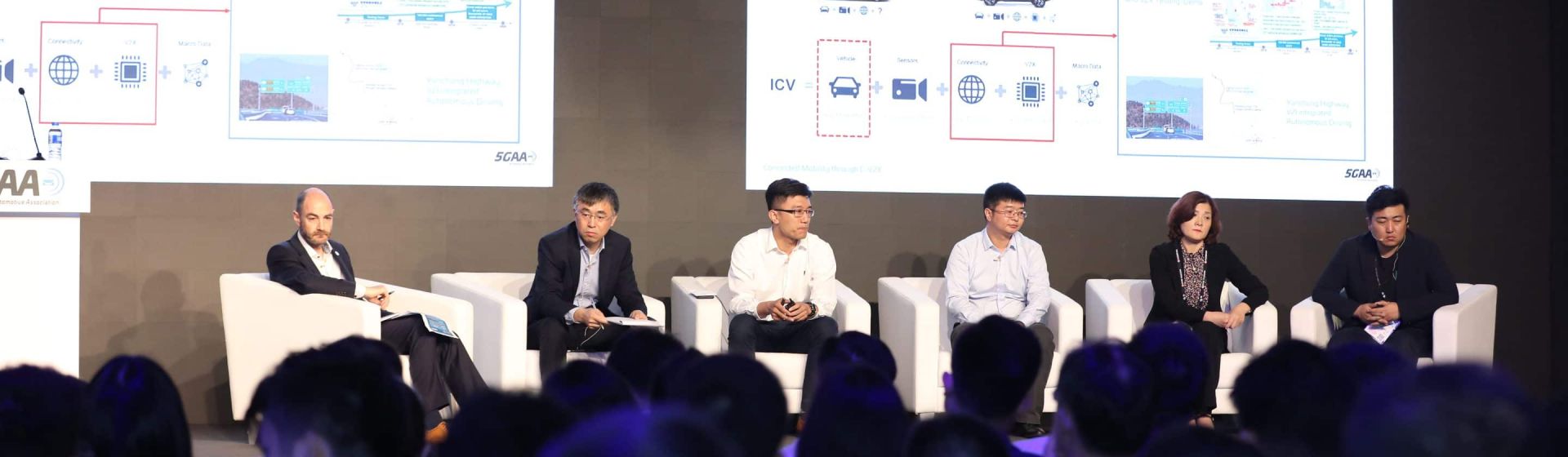
5GAA brings together key actors to share advances on C-V2X deployment in China at MWC Shanghai 2019
SHANGHAI, CHINA, 27 June 2019 – The 5G Automotive Association, with the engagement of relevant ecosystem actors in China, from Government officials to telecom and automaker companies and the larger 5GAA community, took stage today at the MWC Shanghai 2019 to explain the state of deployment of the ‘Cellular Vehicle-to-Everything’ (C-V2X) technology in this region.
“5GAA is instrumental in supporting the implementation of C-V2X technology in different parts of the world including China. The momentum in China reflects the fact that C-V2X is the verified, mature and preferred future proof technology for connected vehicles”, said Luke Ibbetson, 5GAA board member and Vodafone Group’s Head of Research and Development.
C-V2X as part of Chinese C-ITS standards
Representatives from different Chinese public institutions underlined during the conference that after issuing the three-year Industry Development Plans on Intelligent Connected Cars (ICV) and releasing C-V2X 5.9GHz ITS spectrum last year, ministries now accelerate standards system of ICV in order to solve the issue of interoperability in various scenarios. Meanwhile, the definition of smart highway standard has started in terms of infrastructure digitalization, Road-Transport unity, “Internet Plus” comprehensive services and new generation transport control network which will be enabled by C-V2X infrastructure and devices for both long range and short-range communication.
C-V2X Eco-system
There was strong engagement from industry stakeholders in China as well. It has been shared that 15 chipset/modules vendors are committed to support C-V2X for the Chinese market, 35 manufacturers are able to provide C-V2X infrastructure hardware or software, and in particular 15 car OEMs have recently announced the roll-out of C-V2X from 2020 H2 to 2021 H1. In order to improve C-V2X industry maturity, IMT2020’s C-V2X Working Group last year organized a “Three-Cross” interoperability tests for three Chipset vendors and 12 OEMs. Furthermore, an interoperability test called “Four-Cross” will be hosted to address more stakeholders and security by testing and verifying certification and authority system.
C-V2X Trial and Pre-commercial pilot
Many voices from the business side also explained the details for C-V2X deployment on the roads and vehicles in China, to be followed in other regions. There are more than 20 trials and pilot projects taking place where 100KM roads across 10 provinces will be digitalized with C-V2X.
Wuxi has been designated as national ICV pilot certificated by MIIT. C-V2X deployment in Wuxi will be extended from 240 intersections to 400 this year, focusing mainly on use cases of autonomous driving assistance and green waves for buses. It is estimated that 1-2 bus lanes will be completed with green wave deployment by end of this year, so as to improve punctuality, reduce emergent stop and waiting time of red light for buses.
Yanchong Highway will be deployed with C-V2X to embrace the 2022 Winter Olympic Games.
Other regions in China start deploying C-V2X by 2020, for instance, 40KM in Beijing Shunyi district and the international exhibition centre, 42KM in Shanghai Yangshan port, 4.5KM in Xiongan New Area, and the 30KM highway around Hainan province.
On top of showing the strong consolidation of C-V2X in China, the 5GAA event successfully underlined the progress of C-V2X application and services in terms of readiness of the ecosystem and commercialisation. However, China is not alone: 5GAA underlined its dedication to standardization, the eco-system and commercialisation of C-V2X in America, Europe, Japan and South Korea. Once again, 5GAA’s presence at MWC Shanghai successfully outlined the association’s vision in being a global player, and facilitating thought leadership platforms for relevant stakeholders driving towards building a better mobility ecosystem.
About 5GAA
The 5G Automotive Association (5GAA) is a global, cross-industry organisation of 115 members comprised of leading global automakers, Tier-1 suppliers, mobile operators, semiconductor companies, test equipment vendors, etc. working together to develop end-to-end solutions for future mobility and transportation services.
5GAA is committed to helping define and develop the next generation of connected mobility for autonomous based on Cellular-V2X (C-V2X), the family of cellular technology-based communications.
Contact
Marketing and Communications Team
Email: marcom@5gaa.org
Web: www.5gaa.org

5GAA and the City of Turin become official partners
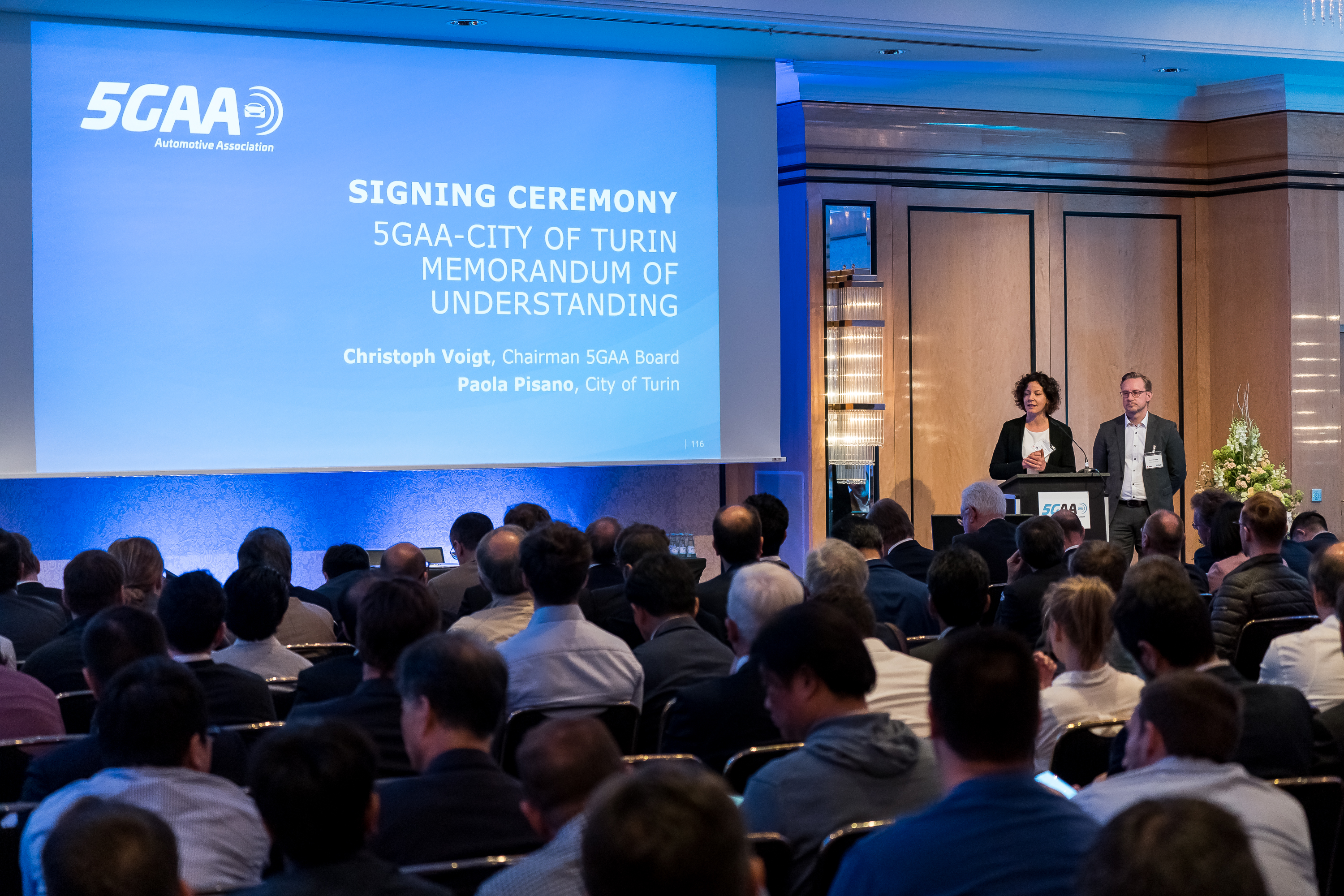
The 5G Automotive Association officially became a partner of the City of Turin through the signature of a Memorandum of Understanding, at the occasion of 5GAA’s Connected and Automated Driving Workshop in Berlin on 23 May 2019.
The City of Turin is the first public authority 5GAA is officially partnering with. The Piedmontese capital, home to the Italian automotive industry, will work together with 5GAA to strengthen the collaboration between industry and the public sector and to facilitate the dialogue to drive innovation in mobility and transport. “The signature of a memorandum of understanding with a public authority, the City of Turin, is a first step towards the development of strategy public partnerships. We look forward to a fruitful collaboration” said 5GAA Chairman Christoph Voigt.
The City of Turin has started a linked strategic path to innovation (Torino City Lab, Smart Road) based on the opening of the city to frontier innovation, testing and experimentation on the whole urban territory using real environments and integrating new solutions within the city’s technological infrastructures, attraction and realization of new services. According to Innovation Counsellor Paola Pisano, “the intention is to place Turin into the innovation maps of 5GAA partners, providing the project with the know-how of the territory and the support of the Torino City Lab policy for the development of innovation in the areas of mobility and telecommunications, with a focus on 5G.”
5GAA’s objectives are fully aligned as the association intends to develop new partnerships with public authorities around C-V2X technical and testing activities to accelerate and support time-to-market and foreseen deployments in Europe and other world regions.
The City of Torino will be hosting the next 5GAA meeting in Europe in November 2019.
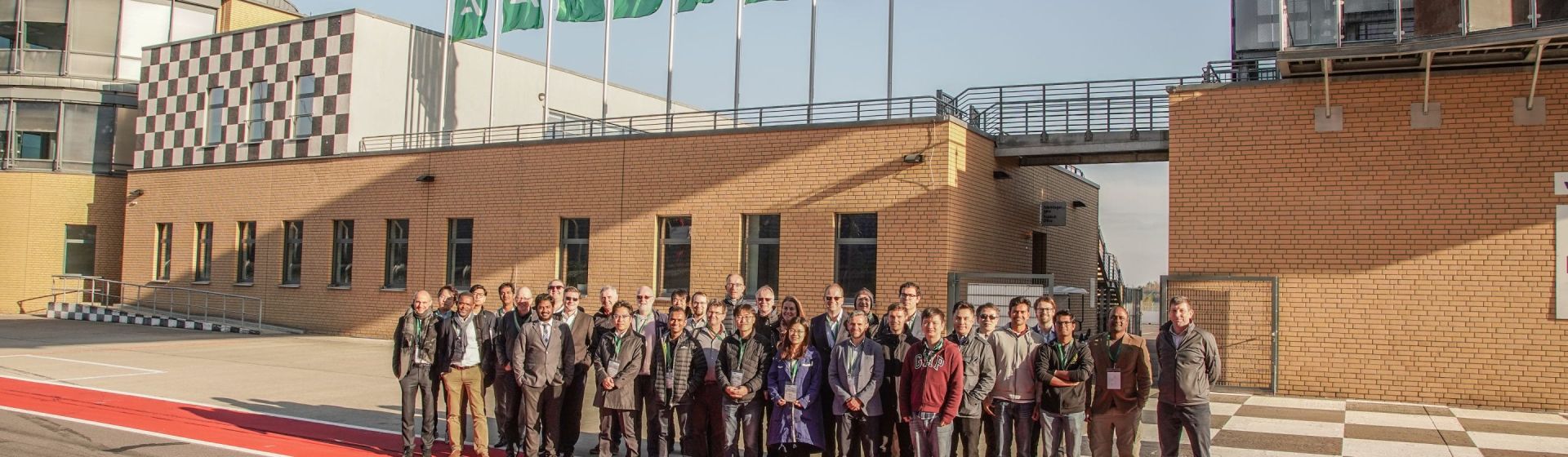
5GAA C-V2X testing event in Europe successfully demonstrates exceptional level of interoperability
KLETTWITZ, GERMANY, 15 April 2019 – 5GAA announced today that multiple technology providers of Cellular-V2X (C-V2X) have achieved successful results showing multi-vendor interoperability. Companies from across the global 5GAA community came together in Klettwitz, Germany, last week to conduct multi-vendor C-V2X interoperability tests at the automotive proving ground of host and 5GAA member DEKRA, a global leader in automotive safety testing.
The event demonstrated a high-level of interoperability across all participating companies with 96% of the 249 C-ITS safety test-cases successfully communicated based on both the ETSI ITS specifications and IEEE/SAE ITS standards for vehicle-to-vehicle (V2V) and vehicle-to-infrastructure (V2I) use cases. As a result, the event validated the automotive industry’s maturity to support the commercial deployment this year of C-V2X solutions throughout the world, with both infrastructure and onboard units.
“Interoperability tests represent a unique opportunity for C-V2X vendors to refine their software implementation. This event has shown very satisfying results and prove the technology readiness of the radios,” stated 5GAA CTO Maxime Flament.
Samsung’s (Harman) leadership within 5GAA as rapporteur was vital in bringing together many of the foremost automotive C-V2X companies and their commercial C-V2X solutions and test equipment from across the globe including Cohda Wireless, Commsignia, Huawei, Qualcomm Technologies, Keysight Technologies, Rohde & Schwarz, Savari, WNC and Vodafone Automotive. Ford, LG Electronics, Neusoft and Sumitomo Electric also attended the event.
Trilateral Interoperability
The event showcased multi-vendor interoperability testing by utilizing commercial C-V2X chipset products from Harman, Huawei and Qualcomm Technologies, marking an important milestone.
The week was viewed as highly successful by all participants, as it brought together many of 5GAA’s C-ITS experts for testing and to validate that C-V2X products are both mature and commercially available today for the cooperative, connected and automated mobility ecosystem.
“I’m delighted that the positive results obtained at the 1st European 5GAA C-V2X Interoperability Test derive from the effective collaboration of global players. With our V2X stack we are now amongst the small group of companies worldwide that are ready to deliver state of the art services in connected, cooperative and digital mobility,” said Gion Baker, CEO Vodafone Automotive.
“DEKRA has been delighted to host this historical 5GAA C-V2X interoperability event. We are very proud to be part of this important development contributing with our technical expertise and unique testing capabilities,” stated Fernando E. Hardasmal, Executive Vice President and Head of the Service Division Product Testing.
“It was a pleasure to support 5GAA in testing C-V2X from radio frequency to region specific ITS applications, forming the basis for interoperability and conformity assessment in a global market,” said Holger Rosier, Technology Manager at Rohde & Schwarz.
“We believe that C-V2X is a cornerstone technology for connected, assisted, and autonomous driving and for seamless user experiences, and is why Harman has launched 3GPP C-V2X globally in all its commercial telematics platforms from 2019″, said Mike Peters, President, Connected Car division, Samsung (Harman).
“5GAA’s C-V2X interoperability event provided an ideal stage to solidify the interworking of various C-V2X solutions, which is essential to realize the full potential of C-V2X,” said Ashok Tipirneni, director of product management, Qualcomm Technologies.
“Together with other participating companies, we are confident to have contributed to the worldwide and European C-V2X ecosystem building. This successful Plugfest has shown the readiness of C-V2X products which will be an important ingredient for the advanced connected and automated mobility.” concluded William Lu, C-V2X Product Line General Manager, Huawei Technologies.
About 5GAA
The 5G Automotive Association (5GAA) is a global, cross-industry organisation of 115 members comprised of leading global automakers, Tier-1 suppliers, mobile operators, semiconductor companies, test equipment vendors, etc. working together to develop end-to-end solutions for future mobility and transportation services.
5GAA is committed to helping define and develop the next generation of connected mobility for autonomous based on Cellular-V2X (C-V2X), the family of cellular technology-based communications.
C-V2X enables both long-range communications via mobile networks as well as direct short-range connectivity for time-critical information (without subscription or network coverage). C-V2X is currently based on 4G/LTE but offers a clear evolution path to 5G.
Contact
Marketing and Communications Team
Email: marcom@5gaa.org
Web: www.5gaa.org
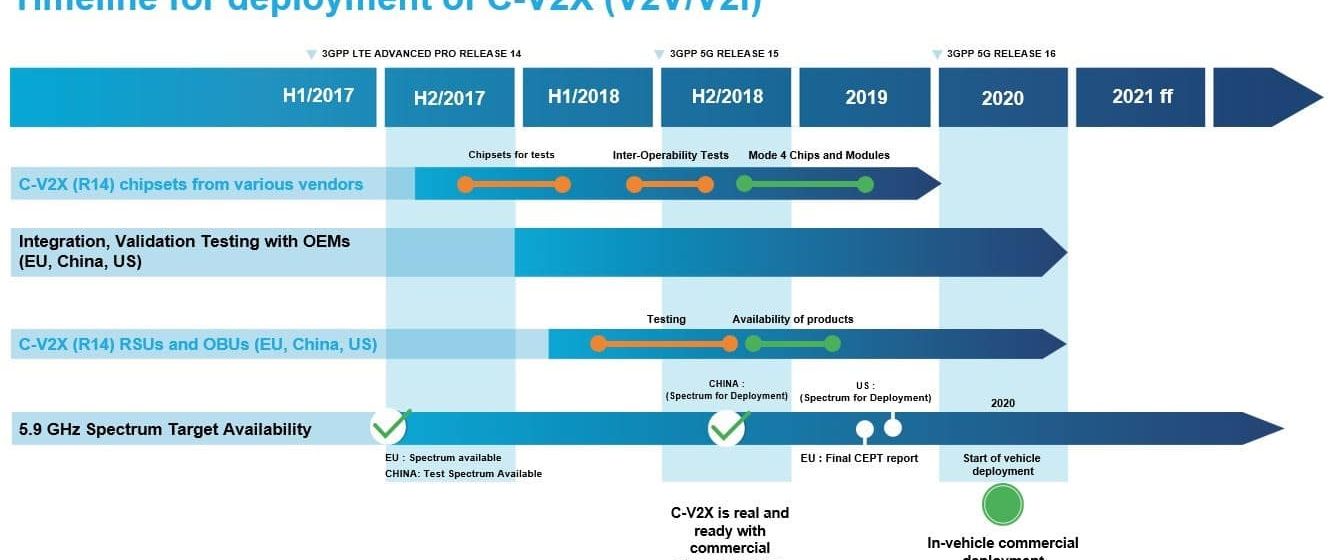
5GAA releases updated white paper on C-V2X Deployment Timeline
In December 2017 5GAA published the white paper “Timeline for deployment of LTE-V2X (V2V/V2I)” focusing on the introduction of direct communications with LTE 3GPP Rel.14. Since then Cellular-V2X (C-V2X) has gained a lot of momentum in the eco-system and we are at the verge of deploying the next generation of mobile network technology – 5G.
This updated timeline of the introduction of C-V2X covers the following topics:
- The extended use of V2N for safety-oriented services in vehicles deployed on the roads
- The comprehensive test and evaluation activities undertaken by the ecosystem consisting of OEMs, tier-1s, chip vendors, road operators, mobile operators as well as their suppliers and test equipment providers
- Outlook on the evolution towards 5G including backward compatibility
- C-V2X use cases for railways and respective test activities
- Progress on regulatory aspects
The inclusion of 2G, 3G and 4G cellular communication technologies (V2N – Vehicle2Network) into vehicles (i.e. “Connected Cars”) has been extremely successful in delivering benefits for the vehicle, the driver, the automaker and other participants in the transportation and emergency services ecosystem.
At present, more than 100 million Vehicles connected to cellular networks (V2N) are on the roads. This V2N connection is used for a wide variety of services including telematics, connected infotainment, real time navigation and traffic optimization, as well as for safety services including automatic crash notification (ACN) such as eCall, the recognition of slow or stationary vehicle(s) and informational alerts for events including traffic jams, road works and other traffic infrastructure related information, inclement weather conditions and other hazardous conditions. Several OEMs[i] share safety related warnings between their vehicles and have started to exchange this information across OEMs using e.g. services from HERE Technologies. Other initiatives to share information by interconnected backend systems are the EU financed projects ‘Nordic Way’, Talking Traffic’ and the ‘Drive Sweden projects. These projects also interconnect Road Traffic Authorities, Road operators, OEMs and smartphone applications to share traffic related info. The current understanding, also based on the European C-ITS Platform Final Report, is that the nature of these warning messages is informational, and the driver is always responsible.
C-V2X is a recent term introduced for cellular technologies optimized for transportation and connected vehicles. In particular, the C refers to both 4G LTE and 5G NR (new radio) releases of specifications, whereas X refers to multiple things’ vehicles may connect with. C-V2X includes both network-based communications that have been in use for decades, such as vehicle-to-network (V2N), as well as a new complementary mode of operation first defined in the 3GPP Release 14 specifications and approved in June 2017, which allows direct communications between vehicles (V2V), as well as between vehicle and road side infrastructure (V2I and I2V) without requiring any cellular network coverage or subscription. It can further support vulnerable road users (e.g. vehicle to pedestrian, or V2P) by integrating the direct communications technology into mobile and other devices. The direct communications functionality is used to specifically support safety critical services to reduce collisions, support automated driving, and improve traffic efficiency. LTE-V2X is the 3GPP nomenclature for direct communications as specified in releases 14 and 15, whereas 5G NR-V2X is from Release 16 onward. 3GPP R14 also added network communications improvements, delivering increased data volumes, managing greater scale of connected devices, and can further reduce latency and provide for higher levels of reliability in V2N. V2N is also technically known as Uu and refers to an endpoint such as a vehicle communicating with network infrastructure over operator licensed spectrum, whereas V2V/V2I/V2P is supported by direct communications operating on the ITS spectrum (e.g. 5.9GHz) and is known technically as PC5.
Click here to read the full version of this updated White Paper.
[i] https://www.autoblog.com/2018/05/07/volvo-cars-volvo-trucks-share-data/?guccounter=1#slide-7324246

Connected car technology: Cellular V2X outperforms DSRC/ITS-G5 in comprehensive tests as mobility industry moves towards 5G
Munich, 9 November 2018: As regulators worldwide are looking into future rules for connected cars technologies, the 5G Automotive Association has conducted tests to compare the performance of 802.11p/DSRC (known in Europe as ITS-G5) and Cellular V2X PC5 radio technologies in delivering V2V (Vehicle-To-Vehicle) safety messages.
The test results show that Cellular Vehicle-to-everything (C-V2X) direct communications technology, consistently – and in many cases overwhelmingly – outperforms 802.11p/DSRC. With a natural evolution path towards the low latency and high bandwidth benefits of 5G NR, C-V2X also demonstrated superior performance in several dimensions, including the following:
- Enhanced reliability over extended communications range;
- Better non-line-of-sight performance; and
- Greater resiliency to interference (e.g. arising from other devices)
These performance advantages are particularly important in the most difficult environments such as non-line-of-sight scenarios (e.g., around a corner, highway queue forming etc.), where resident onboard sensors and radars have certain limitations.
Reliable and timely radio performance is a crucial requirement that all those with a stake in transport safety depend on to deliver critical safety applications. Such test procedures are a prerequisite to comparing the available radio technologies, and the results are very clear: C-V2X direct communications (PC5) performs better. C-V2X is commercially available and reuses the decades’ long investment into protocols and upper layer applications to improve safety, deliver traffic efficiency, and support automated driving.
The design and execution of each experiment were set up to ensure that environmental conditions, radio frequency parameters, system integration details, and physical structures were consistent when comparing 802.11p/DSRC and C-V2X direct communications.
As yet another strong signal about the global momentum behind C-V2X, 5GAA today counts 102 members (40% from Europe, 35% Asia-Pacific and 25% Americas), an increase of 60% since January 2018, quite a movement for a 2-year-old organization.
5GAA brings together the automotive and ICT industry leaders from all world regions among which carmakers, Tier-1 suppliers, mobile network operators, chipset manufacturers, test equipment vendors, telecom suppliers, and traffic signal suppliers in order to continue C-V2X field tests and to accelerate in-vehicle and infrastructure commercial deployments, foreseen beginning in 2019 globally.
Maxime Flament, CTO of the 5G Automotive Association (5GAA) said “these test results demonstrate that C-V2X direct communications, is today’s most cutting-edge technology for connected and automated driving, and the best to finally deliver upon safety and traffic efficiency. Hence why C-V2X ecosystem is growing so rapidly – the 5G Automotive Association has now more than 100 members who all believe in C-V2X as the future of mobility.”
Read the full report here
See the full webinar here
Notes to Editors:
The V2V radio performance tests were conducted by 5GAA members over a period spanning six months from March through September 2018.
Vehicle-to-Everything (V2X) communication is an essential enabler of cooperative, connected and automated mobility that can be supported today by two concurrent technologies: 802.11p (Wi-Fi based) and Cellular V2X (C-V2X).
C-V2X is the family of cellular technologies designed for automotive applications, standardized by 3GPP, the global telecommunications standard development organization.
C-V2X combines on a single technology platform a direct short-range mode operating over ITS spectrum (not requiring any network coverage or subscription) and a long-range mode using traditional cellular networks operating over the mobile network operator licensed spectrum.
The above-mentioned tests were conducted using only the C-V2X direct short-range communication mode without any network involvement.
C-V2X current realization is based on LTE-V2X (3GPP Release 14, completed in March 2017), and will evolve into 5G-V2X (also called 5G New Radio or “5G NR”) to deliver additional capabilities and support new services (as Release 16, to be completed by 3GPP by end 2019).
About 5GAA
The 5G Automotive Association (5GAA) is a global cross-industry organization of companies from the automotive, technology and telecommunications industries (ICT), working together to develop end-to-end solutions for future mobility and transportation services. Created in 2016, the Association is comprised of over 100 members whose mission is to develop, test and promote communications solutions, initiate their standardization and accelerate their commercial availability and global market penetration, to address society’s connected mobility and road safety needs with applications such as automated driving, ubiquitous access to services and integration into smart city and intelligent transportation.
Media Contact:
Marketing and Communications Team
Email: marcom@5gaa.org
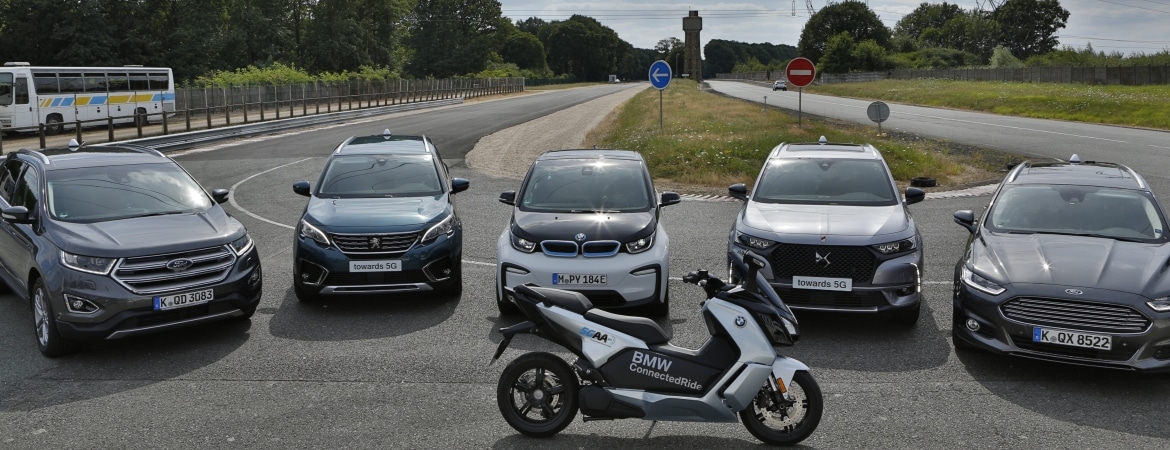
5GAA, BMW Group, Ford and Groupe PSA Exhibit First European Demonstration of C-V2X Direct Communication Interoperability Between Multiple Automakers
- Companies team up with Qualcomm and Savari to showcase C-V2X’s advanced performance for safety, traffic efficiency, and autonomy
- Exhibition includes communication between vehicles, motorcycles, and infrastructure, showing commercial readiness for industry deployments as early as 2020
Downloadable Resources |
Photos |
Infographic |
Soundbite Video Clip |
PARIS — July 11, 2018 – The 5G Automotive Association (5GAA), the BMW Group, Ford Motor Company (NYSE: F), and Groupe PSA — in association with Qualcomm Technologies, Inc., a subsidiary of Qualcomm Incorporated, and Savari, Inc. — announced today Europe’s first live demonstration of C-V2X direct communication technology operating across vehicles from multiple auto manufacturers. The live demonstration also featured a live showcase of C-V2X direct communication technology operating between passenger cars, motorcycles, and roadside infrastructure. C-V2X is a global solution for vehicle-to-everything (V2X) communication in support of improved automotive safety, automated driving and traffic efficiency.
The demonstration exhibited the road safety and traffic efficiency benefits of using C-V2X for Vehicle-to-Vehicle (V2V) collision avoidance, as well as Vehicle-to-Infrastructure (V2I) connectivity to traffic signals and Traffic Management Centers (TMC). C-V2X was operated using real-time direct communications over ITS spectrum and demonstrated its ability to work without cellular network coverage, and underscores its commercial readiness for industry deployment as early as 2020. Superior performance and cost-effectiveness compared to other V2X technologies, along with forward-compatibility with 5G, make C-V2X direct communications a preferred solution for C-ITS applications.
Six demonstrations were shown including Emergency Electronic Brake Light, Intersection Collision Warning, Across Traffic Turn Collision Risk Warning, Slow Vehicle Warning and Stationary Vehicle Warning, Signal Phase and Timing / Signal Violation Warning and Vulnerable Road User (pedestrian) Warning. The vehicles involved included two-wheel e-scooters provided by BMW Group, and automotive passenger vehicles provided by Ford, Groupe PSA, and BMW Group, all of which were equipped with C-V2X direct communication technology using the Qualcomm® 9150 C-V2X chipset solution. V2X software stack and application software, along with roadside infrastructure, were provided by industry leader, Savari.
C-V2X is globally supported by a broad automotive ecosystem, which includes the fast growing 5GAA organization. The 5GAA involves over 90 global members comprised of many leading automakers, Tier-1 suppliers, software developers, mobile operators, semiconductor companies, test equipment vendors, telecom suppliers, traffic signal suppliers and road operators.
Cellular modems will be key to the C-V2X deployment in vehicles to support telematics, eCall, connected infotainment and delivering useful driving/traffic/parking information. As C-V2X direct communication functionality is integrated into the cellular modem, C-V2X solutions are expected to be more cost-efficient and economical over competing technologies, and benefit from accelerated attach rates. C-V2X direct communication field validations are currently underway in Germany, France, Korea, China, Japan and the U.S.
C-V2X currently stands as the only V2X technology based on globally recognized 3rd Generation Partnership Project (3GPP) specifications, with ongoing evolution designed to offer forward compatibility with 5G. C-V2X also leverages and reuses the upper layer protocols defined by the automotive industry, including the European Telecommunications Standards Institute (ETSI) organization. C-V2X includes two complementary transmission modes:
- Direct communication as shown in this demonstration for V2V and V2I use cases
- V2N network communication, which leverages mobile operators for connectivity and delivers cloud-based services, including automated crash notification (ACN, as mandated by eCall), hazard warnings, weather conditions, green light optimal speed advisory (GLOSA), parking spot location, and remote tele-operation to support automated driving, to name a few.
“This demonstration builds on the successful C-V2X showcase we organised with our members Audi, Ford and Qualcomm in Washington DC in April” said Christoph Voigt, Chairman of 5GAA.
“We are excited to witness the growing momentum behind this life-saving technology and to see our members working together to deploy C-V2X, and to make it hit the road as soon as possible.”
“The BMW Group introduced the first C-ITS use cases already in 2013 with the market introduction of the BMW i3. Today most of envisaged C-ITS use-cases are already institutionalized. With the implementation of C-V2X, the BMW Group accomplishes the last set of the puzzle with a practical path to C-ITS showing quick benefits,” said Christoph Grote, Senior Vice President Electronics, BMW Group.
“With its ability to safely and securely connect vehicles, along with its evolution into 5G, C-V2X is integral to Ford’s vision for future transportation in which all cars and infrastructure talk to each other,” said Thomas Lukaszewicz, Manager Automated Driving, Ford of Europe. “We are very encouraged by preliminary test results in Europe and elsewhere which support our belief that C-V2X direct communications has superior V2X communication capabilities.”
“We’re moving forward with seamless communication between cars and their environment for enhancing road safety, as well as our customers’ safety,” said Carla Gohin, Group PSA’s Vice President for Research and Advanced Engineering. “Following the first European C-V2X direct communications demonstration we hosted with Qualcomm Technologies last March, we’re pleased to work with leading automotive and technology companies today to highlight that C-V2X interoperability is a reality.”
“This demonstration of interoperability between multiple automakers is not only another milestone achieved towards C-V2X deployment but also further validates the commercial viability and global compatibility of C-V2X direct communications for connected vehicles,” said Enrico Salvatori, senior vice president & president, Qualcomm Europe, and MEA. “We look forward in continuing to work alongside leaders in the automotive industry, like the 5GAA, BMW Group, Ford, Groupe PSA and Savari, to help advance the automotive industry’s shift towards a safer, connected and more autonomous future.”
“As one of the V2X pioneers, our company is extremely pleased to continue to help enable the next step in the V2X revolution that we helped start back in 2008,” said Ravi Puvvala, CEO of Savari. “For the last year and a half, the Savari team has worked diligently alongside the dedicated C-V2X engineers in the 5GAA partnership. The resulting string of increasingly impressive demonstrations is continuing to convince the world that C-V2X will soon be deployed around the world.”
About 5GAA
The 5G Automotive Association (5GAA) is a global cross-industry organization of companies from the automotive, technology and telecommunications industries (ICT), working together to develop end-to-end solutions for future mobility and transportation services.
Created in 2016, the Association is comprised of over 90 members whose mission is to develop, test and promote communications solutions, initiate their standardization and accelerate their commercial availability and global market penetration, to address society’s connected mobility and road safety needs with applications such as automated driving, ubiquitous access to services and integration into smart city and intelligent transportation. For more information, visit 5GAA’s website, LinkedIn and Twitter pages.
About the BMW Group
With its four brands BMW, MINI, Rolls-Royce and BMW Motorrad, the BMW Group is the world’s leading premium manufacturer of automobiles and motorcycles and also provides premium financial and mobility services. The BMW Group production network comprises 30 production and assembly facilities in 14 countries; the company has a global sales network in more than 140 countries. In 2017, the BMW Group sold over 2,463,500 passenger vehicles and more than 164,000 motorcycles worldwide. The profit before tax in the financial year 2017 was € 10.655 billion on revenues amounting to € 98.678 billion. As of 31 December 2017, the BMW Group had a workforce of 129,932 employees. The success of the BMW Group has always been based on long-term thinking and responsible action. The company has therefore established ecological and social sustainability throughout the value chain, comprehensive product responsibility and a clear commitment to conserving resources as an integral part of its strategy.
Facebook: https://www.facebook.com/BMWGroup
Twitter: https://twitter.com/BMWGroup
YouTube: https://www.youtube.com/BMWGroupview
Google+: https://googleplus.bmwgroup.com
About Ford Motor Company
Ford Motor Company is a global company based in Dearborn, Michigan. The company designs, manufactures, markets and services a full line of Ford cars, trucks, SUVs, electrified vehicles and Lincoln luxury vehicles, provides financial services through Ford Motor Credit Company and is pursuing leadership positions in electrification, autonomous vehicles and mobility solutions. Ford employs approximately 202,000 people worldwide. For more information regarding Ford, its products and Ford Motor Credit Company, please visit www.corporate.ford.com.
About Groupe PSA
Groupe PSA designs unique automotive experiences and delivers mobility solutions to meet all customer expectations. The Group has five car brands, Peugeot, Citroën, DS, Opel and Vauxhall and provides a wide array of mobility and smart services under the Free2Move brand. Its ‘Push to Pass’ strategic plan represents a first step towards the achievement of the Group’s vision to be “a global carmaker with cutting-edge efficiency and a leading mobility provider sustaining lifetime customer relationships”. An early innovator in the field of autonomous and connected cars, Groupe PSA is also involved in financing activities through Banque PSA Finance and in automotive equipment via Faurecia. Find out more at groupe-psa.com/en
Media library: medialibrary.groupe-psa.com / @GroupePSA_EN
About Qualcomm
Qualcomm invents breakthrough technologies that transform how the world connects and communicates. When we connected the phone to the Internet, the mobile revolution was born. Today, our inventions are the foundation for life-changing products, experiences, and industries. As we lead the world to 5G, we envision this next big change in cellular technology spurring a new era of intelligent, connected devices and enabling new opportunities in connected cars, remote delivery of health care services, and the IoT — including smart cities, smart homes, and wearables. Qualcomm Incorporated includes our licensing business, QTL, and the vast majority of our patent portfolio. Qualcomm Technologies, Inc., a subsidiary of Qualcomm Incorporated, operates, along with its subsidiaries, all of our engineering, research and development functions, and all of our products and services businesses, including, the QCT semiconductor business. For more information, visit Qualcomm’s website, OnQ blog, Twitter and Facebook pages.
About Savari
Savari seeks to make the world’s roadways and vehicles automated and safer by deploying advanced wireless sensor technologies and software. Savari builds software and hardware sensor solutions for automotive car manufacturers, the automotive aftermarket and smart cities. The company pioneered V2X radio technology, which is crucial for vehicles to achieve Level 4 and Level 5 of automation. The technology allows vehicles to share data with other vehicles, traffic lights and smartphones. With more than 150 man-years of V2X learning and development and 15 million-plus miles per year of public testing, Savari is a leader in V2X technology. Savari is headquartered in Santa Clara, Calif., and has offices in Detroit, Mich., Munich, Germany, Seoul, Korea and Bengaluru, India. For more information, visit savari.net.
###