
5GAA appoints CTO Dr. Maxime Flament
April 17, Brussels, Belgium – Dr. Flament will help advance the 5GAA mission of developing the framework to support next-generation connected mobility solutions
Since its creation in September 2016, 5GAA has benefited from an accelerated growth including key players with a global footprint in the automotive, technology and telecommunications industries. 5GAA now represents more than 80 members and is globally recognised as a driving force towards the deployment of the C-V2X technology and the future 5G network. This is the right time to bring in a CTO to support 5GAA’s global position. Dr. Flament’s starting date is April 22nd.
Dr. Flament comes from ERTICO – ITS Europe, the European association promoting research and deployment on Intelligent Transportation Systems. For more than a decade, he has been a leading contributor to many European activities on road safety, connected vehicles, automated driving, large-scale pilots, and digital mapping. In his latest role as Head of Department for Connected & Automated Driving (CAD), he worked with the public, private and research sectors to successfully shape the European expert CAD community. His position led him to develop strong collaboration ties with US DOT and the Japan MLIT as well as governments in China, Korea, Singapore, Australia and Canada. As a telecom engineer, ITS and CAD expert, Dr. Flament is the perfect fit for the position of CTO at 5GAA. Dr. Flament’s hire as the 5GAA CTO is a pivotal moment in the associations’ progress.
5GAA Chairman, Christoph Voigt, is confident that Dr. Flament will raise the organisation to the next level:
Maxime Flament’s contribution will be threefold: his experience and knowledge in Intelligent Transport Systems (ITS) will play a major role in bringing new possibilities to 5GAA. He will also broaden our collaboration with the wider mobility ecosystem. Thirdly, he will facilitate our mission to develop the next-generation of connected mobility solutions. We look forward to working in close co-operation with Maxime.
Dr. Flament is excited to join a team of experts at 5GAA:
5GAA is a growing and dynamic association with a promising path ahead. It is with great honour that I take on the challenge to serve as CTO and develop the communication technology that will connect all vehicles in the future. To do so is not a straightforward undertaking; there are numerous technical and non-technical challenges still to be addressed. This is why I am very excited to join a great team of experts involving all 5GAA members.
About 5GAA
The 5G Automotive Association (5GAA) is a global cross-industry organization of companies from the automotive, technology and telecommunications industries (ICT), working together to develop end-to-end solutions for future mobility and transportation services.
Created in 2016, the Association is comprised of over 75 members whose mission is to develop, test and promote communications solutions, initiate their standardisation and accelerate their commercial availability and global market penetration, to address society’s connected mobility and road safety needs with applications such as automated driving, ubiquitous access to services and integration into smart city and intelligent transportation.
Media contact:
Lisa Boch-Andersen
Senior Director, Strategic Communication and Marketing, 5GAA
Email: lisa.boch-andersen@5GAA.org / Mobile phone: +32(0)475450972

5GAA Takes part in Making Smart Cities a Reality at inOut 2018
16 March 2018, Rennes, France – Advanced Mobile technology has the power to transform cities life to make it safer, cleaner, greener, and more efficient. At the 5G Automotive Association (5GAA), we believe cellular vehicle-to-everything (C-V2X) and its planned upgrade path to 5G is the technology with the most potential to allow cities of the future to communicate quickly, safely and securely.
The inOut conference – taking place on 14-18 March in Rennes – focuses on the cutting edge of Smart City innovations in the field of mobility and so does the 5GAA.
We are here to discuss and showcase through our members the substantial progress that has been made in the development and the soon-to-be deployment of C-V2X.
CV2X is a unique, game-changing technology that will be placed in vehicles to make your trip safer for you, your passengers and all other road users. The technology enables vehicles to communicate with surrounding cars, with pedestrians and cyclists, with the infrastructure and the network. It means that vehicles will be able to better carry mission-critical communications for safer and more enjoyable driving experience.
Following on from our showcase event at the Mobile World Congress in Barcelona in February – which communicated the organisation’s vision and the technology that we advocate – we participated in a ‘Technology for new mobility’ roundtable to discuss the latest technological advances and solutions for our future transport.
In addition, our members Groupe PSA (who recently joined 5GAA to further support the global expansion of the C-V2X ecosystem) and Qualcomm Technologies, showcased France’s first C-V2X demonstration. The objective of the trial is to test the technology, as the first step of 5G deployment for automotive applications with direct communication between vehicles.
By taking an active part in the inOut conference we are demonstrating why our members believe advancing connected solutions is essential in helping cities transform into the efficient and connected metropolises of the future.
Learn more about the event here
Read PSA and Qualcomm press release here

5GAA Commends European Strategy on C-ITS Report for fostering fair competition, technology neutrality and EU wide cooperation
The 5G Automotive Association (5GAA) commends the European Parliament’s adoption of its C-ITS report, highlighting the key opportunity for European industry to contribute to improving European road safety and making European land transport smarter. We welcome the Parliament’s stance calling for technology neutrality, fair competition and better coordination across Europe while expediting joint industry efforts on the road to 5G.
C-V2X or Cellular Vehicle-to-Anything encompasses both short-range and long-range use of LTE Cellular technology and will form an integral part of forthcoming Cooperative Intelligent Transport Systems by providing the natural path of technology evolution all the way to 5G, which will allow to fulfil the full potential of Cooperative, Connected and Automated Mobility through full integration into the 5G ecosystem.
5GAA believes in the clear legal framework set out in the EU ITS Directive (2010/40/EU), and in all players actively working together within the European Standardization Organizations to ensure timely availability of standards that will benefit consumers, and society more broadly.
‘’5GAA welcomes the efforts and progress made by the European Parliament in the area of C-ITS; and is committed to building upon this Report in partnership with all stakeholder groups, including the European Parliament, European Commission and Member States, to develop the most advanced, efficient and safe ecosystem for Cooperative Intelligent Transport Systems. For this to be achieved, close cooperation will be key for allowing us to unlock the potential of all available technologies to be harnessed with the aim of ultimately making Cooperative, Connected and Automated Mobility a reality, progress towards this ultimate goal which the forthcoming Delegated Acts on C-ITS should not jeopardise or hinder,’’ said Dino Flore, Director General of 5GAA.
Roger C. Lanctot, director, global automotive practice, Strategy Analytics also commented that “As in the case of recent comments from U.S. regulators, the decision by the EU Parliament helps to avoid the balkanization of vehicle safety technology…A technology neutral stance promises to deliver the most rapid adoption and return on investment in the form of lives saved along with collateral improvements in traffic and emissions.”
About 5GAA
The 5G Automotive Association (5GAA) is a global cross-industry organisation of companies from the automotive, technology and telecommunications industries (ICT), working together to develop end-to-end solutions for future mobility and transportation services.
Created in 2016, the Association is comprised of over 75 members whose mission is to develop, test and promote communications solutions, initiate their standardisation and accelerate their commercial availability and global market penetration, to address society’s connected mobility and road safety needs with applications such as automated driving, ubiquitous access to services and integration into smart city and intelligent transportation.

5GAA recommends the FHWA to rely on C-V2X to advance towards the next generation of North America’s transportation network
As Automatic Driving Systems (ADS) are increasingly being tested and introduced onto public roadways, the Federal Highway Administration (FHWA) made public its interest on hearing from transport-related stakeholders on some of the issues concerning infrastructure requirements and standards that may be necessary to enable safe and efficient ADS operations through a public Request for Information (RFI).
With the objective to contribute to this FHWA request, 5GAA has submitted a series of comments in response to the RFI which try and explain the features and benefits of Cellular-Vehicle-to-Everything technology (C-V2X). Being complementary to ADS technology, C-V2X holds tremendous potential to improve road safety by facilitating the flow of information between vehicles, pedestrians, cyclists, road infrastructure and commercial cellular mobile networks. 5GAA also believes that deployment of C-V2X technology will potentially save taxpayer money which otherwise would be used to deploy, maintain and upgrade roadside units (RSU) utilized by non-cellular technologies.
Moreover, for other benefits such as having the advantage of a higher spectrum efficiency, the capacity to support larger ranges or the fact that the use of C-V2X can make use of already available and deployed cellular networks, 5GAA urges the FHWA to consider further how it can leverage the benefits of C-V2X and synergies between commercial mobile networks and the development of connected transportation safety services.
Read the full publication here.
MWC 2018: 5GAA Gaining Speed Toward C-V2X commercialization
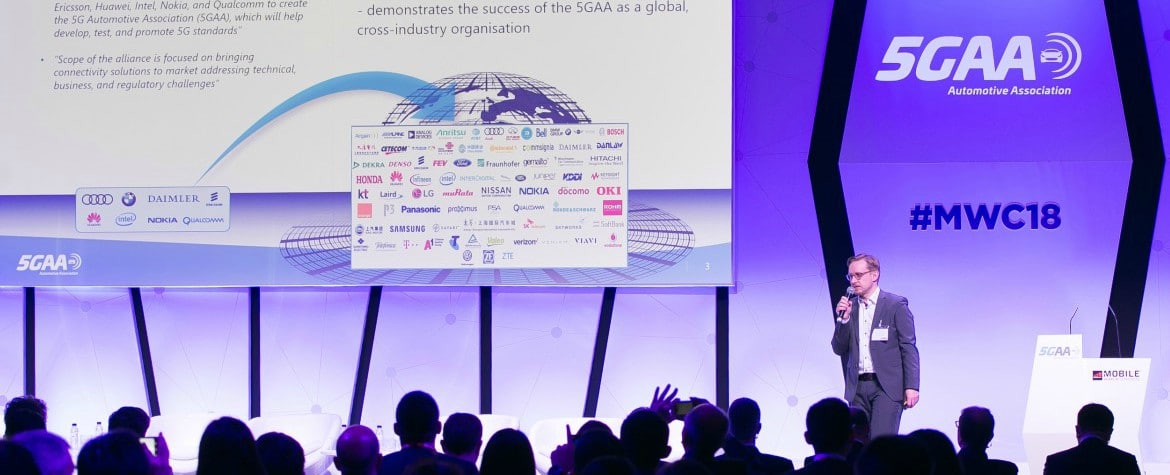
March 2nd, Barcelona, Spain – The 5G Automotive Association (5GAA) presented – during a session at the Mobile World Congress 2018 – the acceleration of C-V2X technology implementation through the widespread support of leading telecommunications and automotive companies. This advanced technology will serve as the lynchpin that will create a connected vehicle ecosystem and enable future mobility solutions. March 1st, Barcelona, Spain – The 5G Automotive Association (5GAA) presented – during a session at the Mobile World Congress 2018 – the acceleration of C-V2X technology implementation through the widespread support of leading telecommunications and automotive companies. This advanced technology will serve as the lynchpin that will create a connected vehicle ecosystem and enable future mobility solutions.
The value of C-V2X technology lies in the fact that it is a unified technology – it can provide short-range and long-range communications. C-V2X technology can, for example, alert drivers of a cyclist around the corner or a traffic jam that is 25 kilometers away.
Christoph Voigt, 5GAA Chairman and Head of R&D Connectivity at Audi announced that: “This effort is now ‘all hands on deck’, meaning that telecommunications and automotive leaders are all working hand-in-hand to deploy C-V2X and to make it hit the road as soon as possible.”
During its session, 5GAA focused on the growing support that C-V2X technology is enjoying among leading companies in the telecommunications and automotive industries and presented the importance that 5G cellular technology will play in enabling smart mobility of the future.
C-V2X gains wide ecosystem support
During the presentation, 5GAA members Qualcomm and Huawei emphasized the growing C-V2X ecosystem support and presented their integrated chipsets that will enable C-V2X commercialization. The start of C-V2X mass market series deployment is predicted to begin as early as 2019/2020.
“We see a growing appetite across the industry for the commercialization of our C-V2X chipset with automakers, Tier-1 suppliers, cellular module manufacturers, ITS providers, integrators, and automakers ready to drive change,” said Jason Ellis, Director of Automotive Business Development at Qualcomm.
Veni Shone, President of LTE product line at Huawei, highlighted that the momentum of C-V2X in China is encouraging – ministries have put their full support behind C-V2X technology on strategy and standardization. Mr. Shone also detailed Huawei’s commitment to accelerate C-V2X, specifically pointing at the releases of its LTE-V2X chipset, T-box prototype, and roadside units.
5GAA plans to support and advocate the work of this technology by speeding up the deployment of C-V2X for the automotive sector while creating a joint ecosystem and implementing key functionalities such as vehicle-to-smart-device.
5G as an enabler for life-saving solutions & new business applications
5GAA members Ericsson and Ford also highlighted exciting use cases and growing business applications for 5G technology in the automotive sector.
Don Butler, Executive Director of Connected Vehicles and Services at Ford stated that: “Creating safer and more personalized journeys through automated driving is the long-term vision of mobility’s future. We believe 5G will enable this by maximizing the in-vehicle experience thanks to high reliability, fast-paced communications. We will create new, compelling experiences and capabilities saving more lives with patient transport monitoring or teleoperated driving.”
With the advancement of 5G technology and its application to connected vehicles, the amount of data created will continue to expand exponentially.
Stefano Sorrentino, Master Researcher at Ericsson presented the fact that: “Connected & automated driving will lead to a data explosion that will definitely challenge the network capacities. This challenge could be remedied through the deployment of scalable and integrated networks and cloud architectures as well as the continuous evolution of radio technology into 5G.”
“We think of 5G as an end-to-end solution starting with the wireless connectivity but also including edge computing, the transport network, artificial intelligence and machine learning. Together they power the applications and the services for intelligent transportation and smart mobility, and ultimately, the ways humans interact with connected and self-driving cars of the future. It is an exciting area for 5GAA to work on and we invite any stakeholder to join us and contribute on this journey.” concluded Thierry Klein, Head of Disruptive Innovation Program at Nokia Bell Labs and Vice Chair of 5GAA Board.
About 5GAA
The 5G Automotive Association (5GAA) is a global cross-industry organization of companies from the automotive, technology and telecommunications industries (ICT), working together to develop end-to-end solutions for future mobility and transportation services. Created in 2016, the Association is comprised of over 75 members whose mission is to develop, test and promote communications solutions, initiate their standardisation and accelerate their commercial availability and global market penetration, to address society’s connected mobility and road safety needs with applications such as automated driving, ubiquitous access to services and integration into smart city and intelligent transportation.

5GAA at Mobile World Congress 2018
5GAA presents the Future of Connected Mobility at Mobile World Congress Barcelona – 27th February
5G Automotive Association (5GAA), is looking forward to hosting an engaging event at this year’s Mobile World Congress (MWC) in Barcelona. The event will take place from 9 am until 1 pm on Tuesday, 27th February in Hall 8.0 NEXTech Theatre B. The event will be one of the only opportunities at MWC to hear about 5G mobility, the roadmap to connected vehicles, and C-V2X technology’s growing ecosystem of supporters.
Every year at the Mobile World Congress, the mobile ecosystem and related industries such as the automotive one meet to discuss and reveal the latest innovation and technology advances within the field. This year, 5GAA takes a centre role in the congress programme.
Tuesday’s event will consist of two sessions, each composed of two presentations and a panel discussion. Speakers from AUDI AG, BMW Group, Qualcomm, Harman, Ericsson, Huawei, Intel, Nokia, and more will debate on the revolution the C-V2X technology and its evolutionary path towards 5G will bring to our future mobility ecosystem. The session will be followed by a networking lunch from 12 – 1pm.
About the 5GAA
The 5GAA is a cross-industry association between the cellular and automotive industries to develop, test and promote communications solutions, initiate their standardisation and accelerate their commercial availability and global market penetration, to address society’s connected mobility and road safety needs with applications such as automated driving, ubiquitous access to services and integration into smart city and intelligent transportation.

5GAA Announces Deployment of LTE-V2X by 2020
The C-V2X technology tested, validated, and commercially available in vehicles in 2020
The inclusion of cellular communication technologies (V2N – Vehicle2Network) into vehicles (i.e. “Connected Cars”) has been extremely successful, and since early deployments in the last couple of decades, we continue to see an expansion of how these technologies can deliver benefits for the vehicle, the driver, and other participants in the transportation ecosystem.
At present, the automotive manufacturing members of 5GAA operate more than 20 million Connected Cars that have the ability to connect to cellular networks (V2N). This V2N connection is used for a wide variety of application domains including telematics, infotainment, traffic optimization, as well as for safety applications like the recognition of slow or stationary vehicle(s) and warnings for such events as traffic jam ahead, road works and other traffic infrastructure related information, inclement weather conditions, emergency brake light and other hazard warnings. The current understanding, also based on the European C-ITS Platform Final Report, is that the nature of these warning messages is informational and the driver is responsible at all times.
As defined in the approved 3GPP Release 14 in June 2017, cellular networks are able to take another evolutionary step in the pathway to broaden the reach and applicability of benefits.  In particular, this release addresses the challenges of delivering increased data volume, managing greater scale in connected devices, significantly reduced latency and providing higher levels of reliability. These defined attributes and an advanced architecture provide unprecedented support for the support of safety-critical communications, referred to as Cellular Vehicle to Everything (Cellular-V2X or C-V2X). In addition to such V2N enhancements, which rely on existing cellular networks, 3GPP Release-14 introduces the ability to support short-range communications between vehicles (V2V) and vehicle and road side infrastructure (V2I and I2V) without requiring any cellular network coverage.
3GPP Release 14 including C-V2X is also a key step to the next generation of cellular technology, 5G. Naturally C-V2X is already on a backwards compatible evolution path with enhancements being specified beginning with 3GPP Release 15.
The members of 5GAA are wholly committed to collaborating to ensure that the potential of the C-V2X technology is realized. This includes leading efforts to address key technical and regulatory issues, as well as integrating vehicle platforms with advanced cellular connectivity, networking and computing solutions.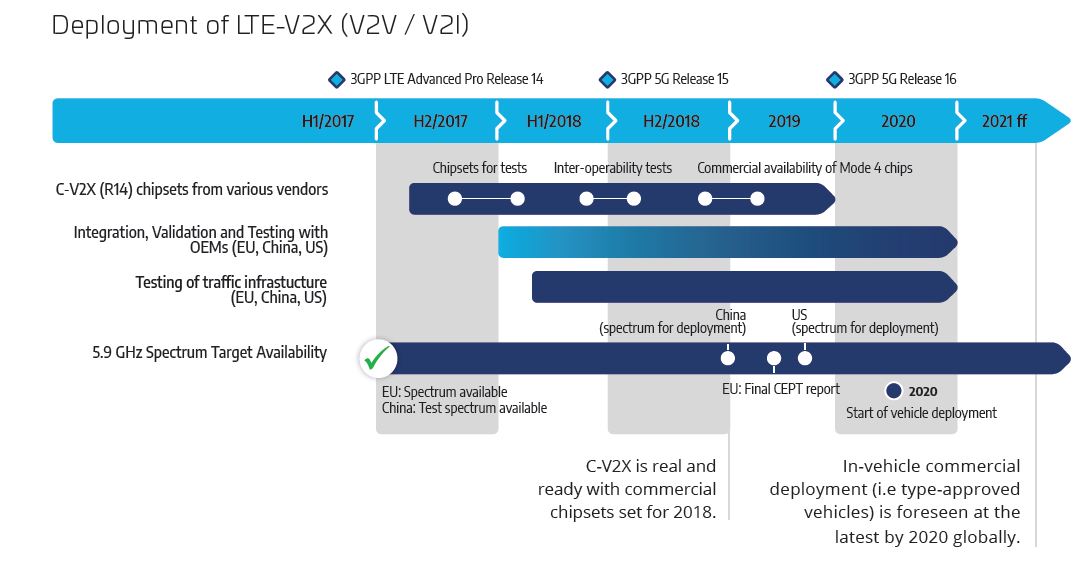
It is with this cooperation, collaboration, and commitment that 5GAA members continue to work to ensure that C-V2X technology is tested, validated, and commercially available in vehicles in 2020.
C-V2X & Edge Computing: The Winning Technologies for Connected Vehicles and Autonomous Driving
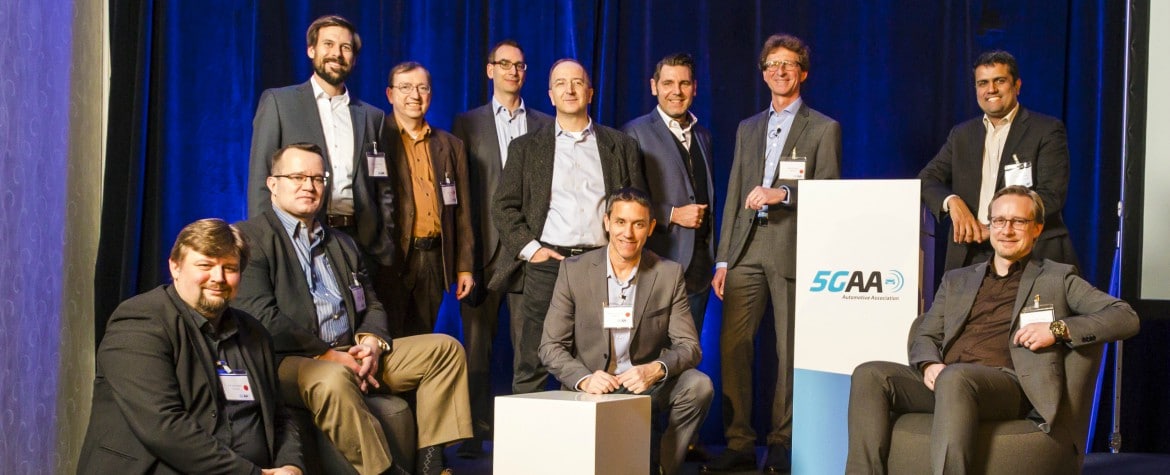
Munich, Germany – On 8th February 2018, the 5G Automotive Association lead a successful Open Workshop on “Edge Computing and V2X“. The workshop – open to both 5GAA members and non-members – aimed to provide a discussion platform for the wide range of stakeholder advocating for the evolution of cloud computing in the automotive sector.
Edge Computing offers cloud computing capabilities at the edge of the network. Several demonstrated C-V2X use case trials have already proven the potential of Edge Computing to serve real C-V2X scenarios. 5GAA considers Edge Computing as one of the key supporting technologies for many of the foreseen V2X services for connected vehicles and for Autonomous Driving.
The Munich workshop brought together industry stakeholders from car OEMs, OEM suppliers, road and mobile network operators to edge computing technology vendors. Edge Computing was covered from various perspectives, illustrating its potential to further expand the competitiveness of C-V2X as the technology of choice for C-ITS. The unique position of 5GAA in the technology and solutions development was again highlighted.
The automotive sector, including OEM suppliers and car makers, shared their thinking and experiences with the technology. The event culminated in the panel discussion which included consideration of use cases and requirements and on how to best utilise the networks and Edge Computing for C-V2X.
Finally, the participating companies concluded a common understanding on the way forward:
- Edge Computing has a great value proposition for C-V2X and its evolution, as it further increases the competitiveness of C-V2X and its infrastructure component (LTE-Uu) over the alternative ITS-G5 technology.
- Technical discussions are to continue in the 5GAA working groups; further collaboration with standardization bodies is encouraged to continue and expand.
- Future workshops similar to this one can be considered, e.g. again collocated with a future 5GAA meeting.
About the 5GAA
The 5GAA is a cross-industry association between the cellular and automotive industries to develop, test and promote communications solutions, initiate their standardisation and accelerate their commercial availability and global market penetration, to address society’s connected mobility and road safety needs with applications such as automated driving, ubiquitous access to services and integration into smart city and intelligent transportation.

Toward fully connected vehicles: Edge computing for advanced automotive communications
Connected Vehicles and especially connected Autonomous Driving (AD) vehicles bring a whole new ecosystem with new requirements on the Cloud and the network architecture to support the new workloads and to satisfy the real-time service requirements. Such ecosystem includes the vehicles, the road infrastructure, the network infrastructure, and the Cloud.
Edge Computing based Vehicle-to-Cloud solutions enable edge cloud capabilities for different levels of autonomous driving, including Highly Autonomous Driving (HAD) and Fully Autonomous Driving (FAD) through providing different services for the driving process (e.g., High Definition real-time Maps, real-time traffic monitoring and alerts, and richer passengers experience), supporting vehicles on roads to drive co-operatively and to be aware of road hazards, and providing better user experience and trust to drivers and passengers.
This white paper provides an overview of automotive use cases and shows how Edge Computing provides compute/storage/networking capabilities at the network edge, and how it can be considered a supporting technology for multiple services for connected AD vehicles. The paper draws the attention to the value of Multi-access Edge Computing (MEC) as a standardized solution for Edge Computing, especially important from automotive stakeholders’ point of view (while also serving other vertical market segments). In particular, from a standardization perspective, some use cases targeting fully connected cars (i.e. FAD with the maximum level of automation) have challenging requirements that may be fulfilled only with the introduction of 5G networks. Finally, this paper also illustrates the opportunities that are here already today in deploying Edge Computing to support AD, using the flagship services as examples.
Read the full paper here.