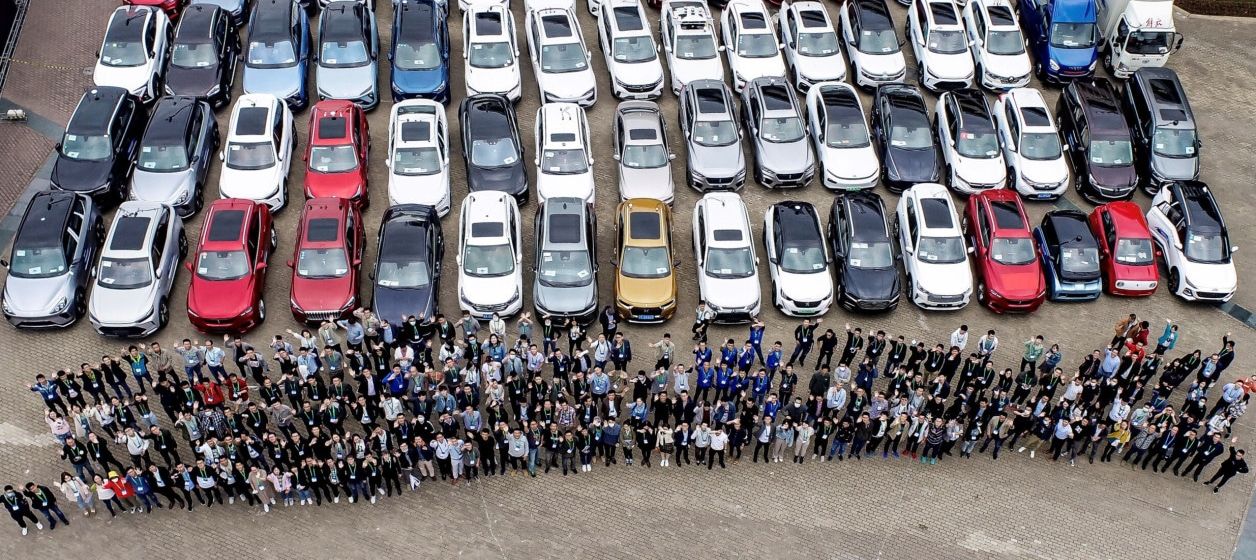
Virtual Showcase | C-V2X Deployment on US Roads

Virtual Showcase | C-V2X Deployment on US Roads

Privacy by Design Aspects of C-V2X

Privacy by Design Aspects of C-V2X

Connected vehicles, as part of the emerging Cooperative Intelligent Transportation Systems (C-ITS) are positioned to transform the future of mobility – a change enabled by the exchange of messages between vehicles and between vehicles and transport infrastructure. As these messages are constantly broadcasting data, including vehicle speed and location, this raises potential concern about how to address privacy and data protection.

In this document, we take a fresh look at the latest technological architectures that feature Privacy by Design. We focus specifically on Cooperative Awareness Messages (CAM) and Decentralised Environmental Notification Messages (DENM), where privacy protection is offered by using pseudonym certificates that do not contain any identifying information. A Public Key Infrastructure (PKI) system takes care of the provision and overall management of the corresponding cryptographic keys. In this document, we review how current PKI system design can help address the risk of tracking from outside and inside attackers, and we identify challenges and privacy risks that remain unresolved. We give some suggestions in terms of future research and conclude the document with general recommendations.

Read the full White Paper

5GAA Statement on FCC Chairman’s Draft Rules for the 5.9 GHz Band

5GAA Statement on FCC Chairman’s Draft Rules for the 5.9 GHz Band

5G Automotive Association Virtual Showcase Highlights Momentum behind C-V2X Technology Deployment for Connected Vehicles and Smart Cities in the U.S.

5G Automotive Association Virtual Showcase Highlights Momentum behind C-V2X Technology Deployment for Connected Vehicles and Smart Cities in the U.S.

5G Automotive Association to Partner with IMT-2020 to Accelerate Deployment of Connected Vehicles in China

5G Automotive Association to Partner with IMT-2020 to Accelerate Deployment of Connected Vehicles in China

C-V2X Use Cases Volume II: Examples and Service Level Requirements

C-V2X Use Cases Volume II: Examples and Service Level Requirements

5G Automotive Association (5GAA) has defined a methodology to describe solution agnostic automotive use cases (UC) and application requirements referred to as Service Level Requirements (SLR).

This White Paper applies the defined methodology to describe use cases, and includes advanced UCs that require complex interactions among vehicles as well as between vehicles and infrastructure in relation to self-driving (autonomous) vehicles. Different road scenarios, actors and service flows are considered in the defined use cases. Detailed analysis of the derived Service Level Requirements is also provided.


Read the White Paper

Virtual Showcase | C-V2X Deployment on US Roads

Virtual Showcase | C-V2X Deployment on US Roads

The 5G Automotive Association (5GAA) is delighted to invite you to the virtual showcase of “C-V2X Deployment on US Roads” on Tuesday, October 27 at 02:00 PM – 03:30 PM EDT / 11:00 AM – 12:30 PM PDT.

We invite you to :
•  See and hear more about existing C-V2X projects in the roads of Virginia, Georgia, Texas, and Michigan
•  Listen to our on-site correspondents from the companies and local authorities involved
•  Join our panel discussion focused on the state of play and future of ITS in the US with a mix of industry, state & local representatives

The virtual showcase will be moderated by industry expert Roger Lanctot while the panel discussion will be lead by Jim Misener, 5GAA Board Member and Senior Director & Global C-V2X Ecosystem Lead for Qualcomm.

Find the full programme here

Watch the recording here

5GAA supports the European Strategic Deployment Agenda for Connected and Automated Mobility

5GAA supports the European Strategic Deployment Agenda for Connected and Automated Mobility

The 5G Automotive Association (5GAA) is proud to announce the publication of the 5G Strategic Deployment Agenda for Connected and Automated Mobility in Europe (EU 5G SDA for CAM), by the 5G Infrastructure Public Private Partnership (5G PPP)a joint European Commission and European ICT industry initiative 

5GAA was among the key contributors to this document which outlines the shared view of a industry and public stakeholders, including other relevant European associations (ACEA, CEDR and GSMA) and experts of the three 5G corridors trial projects, based on eight common principles to stimulate investment in 5G-ecosystems in the field of Connected and Automated Mobility: 

  1. Deployment of the 5G infrastructure for CAM should follow an evolutionary path to cope with future market developments and technological progress. 
  2. The infrastructure should aim at providing boundless connectivity with continuity of service across borders, Mobile Network Operators, vendors/OEMs, as well as traffic managers, road operators and service providers.
  3. The CAM infrastructure, including vehicles and road equipment, needs to have a very high level of cybersecurity.
  4. The 5G infrastructure for CAM will need to be a multi-service/multi-application platform using standardised specifications and/or data interfaces.
  5. The deployment of 5G infrastructure for CAM in Europe should be extensively coordinated with public and private actors in charge of delivering V2X services. 
  6. Road operators, road authorities and mobile network operators should collaborate to create synergies for connectivity deployment along CAM corridors.
  7. It is a necessity to deliver future networks innovatively and with optimal economics.
  8. The digital transformation of industry verticals must be accelerated.
  9. As recognised by the European Commission, 5G is a critical enabler of future mobility solutions and its deployment in transport, including both network and direct communication modes, is a European public policy priority. To that end a strategic partnership with road and transportation stakeholders is critical to fully address society’s connected mobility and road safety needs, as per 5GAA mission and the European Commission’s objectives. 

To accelerate the infrastructure rollout, the stakeholders recognised several key drivers, such as the need for appropriate cooperation models to enable the initial deployment of 5G highways corridors, stabilising the technology roadmap through standardisation, ensuring a high level of cybersecurity, regulatory innovation, data access and data sharing, harmonisation of spectrum, and coordination of deployment initiatives. 

Read the full document here 

5GAA Accelerates Connected Vehicle Development with First ETSI-Approved LTE-V2X System Profile

5GAA Accelerates Connected Vehicle Development with First ETSI-Approved LTE-V2X System Profile

ETSI specifications ensure interoperability, safety, and security of C-V2X technology development

In July 2020, the 5G Automotive Association (5GAA) partnered with global ICT standards organisation ETSI to organise a remote cellular-vehicle-to-everything (C-V2X) Plugtest. The LTE-V2X System Profile is the first of its kind to be specified by an independent, accredited standards organisation in Europe (ETSI TS 103 723).

The system profile provides industry wide upper layer configuration guidelines for C-V2X deployment and employs C-V2X technology from 3GPP Release 14. The system profile and the global standard it represents will lay the foundations for standardised direct cellular communications technology in the automotive sector; making product development faster and ensuring that safety and security are at the core of all new technologies.

LTE-V2X provides a seamless evolution path towards 5G employing new radio V2X (NR-V2X). The latter will allow even better performance and further enhanced features, while keeping backward compatibility with LTE-V2X”, said Maxime Flament, CTO, 5GAA. OEMs will especially benefit as the technology will allow long life cycles, which are essential for automotive products.”

Several automotive LTE-V2X devices were successfully tested during the second ETSI C-V2X Plugtest™ in addition to Intelligent Transport Systems (ITS) stations and Public Key Infrastructure (PKI) vendors in order to assess the level of interoperability of their implementation and to validate the ETSI ITS specifications. An overall interoperability success rate of 94% was achieved during the second ETSI C-V2X Plugtest.

To read the full report from the Plugtest, please click here.

New report released to support vehicle to infrastructure connectivity deployment

New report released to support vehicle to infrastructure connectivity deployment

5GAA, a global cross-industry consortium working to develop end-to-end solutions for future mobility and transportation services, commissioned Ricardo to develop the report to help improve understanding of the costs, challenges and opportunities of different communication technology approaches to Vehicle to Infrastructure (V2I) use cases.

V2I is not a new technology consideration, with research and development activities related to connected vehicle applications ongoing for over two decades. However, there is now growing momentum for wider scale deployment of communication technologies in both vehicles and road infrastructure.

To date deployment activities have been fragmented and relatively slow, due to continued emphasis on research, no common vision of communication technologies and market uncertainty, making it challenging for most stakeholders to develop suitable business cases.

To help support a greater understanding of financial viability of the communication approaches implemented in the EU and US V2I market, Ricardo transport and mobility experts, supported by technical experts from Roke Manor Research, analysed a range options which include the use of a pure cellular network system and using a combination of the cellular network with direct communication interfaces via the radio spectrum.

Using outputs from extensive research and engagement with key ecosystem players, the study weighs up strengths, weaknesses and complementarity of the different communications technologies in terms of their technical performance and costs, aligning them with the different use cases. For example, the cost analysis highlights that a pure cellular deployment approach in Europe and US is 40-45% lower cost compared with deployments that include direct communication roadside units.

To recognise the opportunities and benefits identified, Ricardo’s experts have made a number of recommendations that include increased cooperation and communication of roadmaps between vehicle manufacturers, central government, road operators and cellular technology providers – in particular with the consideration of interoperability of technology solutions. Central government are also identified as playing a key role through effective implementation of financial instruments to leverage private sector investment and support wider deployment.

Denis Naberezhnykh, Ricardo’s transport technical director commented:  “Increased communication and connectivity between vehicle and infrastructure have the potential to create significant benefit, not only to the user of the vehicle, but also through wide-ranging societal benefits that will positively impact the economy, community mobility and the environment. The current fragmentation of technical approaches and stakeholders has the potential to significantly slow V2I market adoption and so we’re proud to develop this report, on behalf of 5GAA, to create greater understanding of financial viability and how that aligns with technology choices, as well as to help identify where increased collaboration is needed”.

Read the full study

Ricardo plc is a global, world-class, multi-industry consultancy for engineering, technology, project innovation and strategy. Our people are committed to providing outstanding value through quality engineering solutions focused on high efficiency, low emission, class-leading product innovation and robust strategic implementation. With a century of delivering excellence and value through technology, our client list includes the world’s major transportation original equipment manufacturers, supply chain organizations, energy companies, financial institutions and governments. Guided by our corporate values of respect, integrity, creativity & innovation and passion, we enable our customers to achieve sustainable growth and commercial success. Ricardo is listed in the FTSE4Good Index, which identifies global companies that demonstrate strong environmental, social and governance (ESG) practices. For more information, visit www.ricardo.com.

Ricardo Energy & Environment is a leading sustainability consultancy, helping clients to respond to environmental challenges and opportunities around the world. Its team of over 450 staff draws on an impressive heritage supporting governments and businesses for over 40 years. The consultancy is an operating division of Ricardo plc. For more information, visit https://ee.ricardo.com/.


Media contacts:

Trevor Glue
Ricardo Energy & Environment
Tel:        +44 (0) 1235 753429
E-mail:   trevor.glue@ricardo.com


Anthony Smith
Ricardo Media Office
Tel:        +44 (0)1273 382710
E-mail:   media@ricardo.com