
Federal Funding Opportunity for Wireless Technology: Safe Streets and Roads for All (SS4A) Grant Program
Through September 15, 2022, a Notice of Funding Opportunity (NOFO) from the U.S. Department of Transportation (USDOT) will be open for Safe Streets and Roads for All (SS4A) grants in FY22. It’s an opportunity for companies to apply for a part of $1 billion per year in FY22-26 grants to prevent roadway deaths and serious injuries.
The timing is fortuitous. Newly released traffic crash estimates from the National Highway Traffic Safety Administration (NHTSA) show that traffic fatality rates in 2021 are the highest since 2005. NHTSA projects a final tally of 42,915 lives lost during 2021 in traffic crashes nationwide.
Making transportation safer and more equitable
To support its goals, the SS4A program funds activities that will help lower fatalities on U.S. roads and highways. The program is also an opportunity to fund regional, local and Tribal initiatives aimed at making transportation equitable for all road users.
Equity is an important element in underserved communities, which are disproportionately affected by fatalities among vulnerable road users (VRUs). These users include pedestrians, cyclists and the growing number people using micro-mobility options such as e-bikes and scooters.
Underserved communities also have higher vehicular traffic volumes, trucking routes and major arterial roads. They are characterized by intersections that are unsafe or impassable by foot or bike, and an overall lower level and quality of walking and cycling infrastructure. NHTSA’s projections for 2021 show alarming increases in fatalities for pedestrians (13 percent), motorcyclists (9 percent) and bicyclists (5 percent), making the SS4A funding opportunity even more fortuitous for VRUs.
Applying C-V2X technology to prevent road fatalities
Many roadway deaths are preventable. Cellular-vehicle-to-everything (C-V2X) is a wireless technology that allows vehicles to communicate directly with each other (V2V), with roadside infrastructure (V2I) and potentially with pedestrians (V2P). C-V2X supports information sharing to facilitate applications that enhance safety for all road users.
NHTSA believes that safety applications supported by V2V and V2I could eliminate or mitigate the severity of up to 80 percent of non-impaired crashes. Also, connected vehicle technology is on the National Transportation Safety Board’s Most Wanted List of transportation safety improvements.
The following use cases illustrate the immediate impact of safety applications that use C-V2X technology:
- Red-light violation warning (RLVW)
More than half of all fatal and injury crashes happen at intersections (source). The most common cause of all urban crashes, drivers running red lights result in an average of seven fatalities and more than 1,000 injuries per day at signalized intersections across the country (source).

- Intersection movement assist (IMA)
Similar to RLVW, IMA safety applications can alert other drivers when someone is running a red light so they can take action to stop before entering the intersection. - Spot weather warnings
Inclement weather, which can result in road hazards such as icy patches on highways, are not easily detected by LIDAR sensors. Infrastructure-to-vehicle (I2V) applications can send a warning to approaching vehicles, reducing the potential for sharp drops in speed that can result in road incidents. - Traffic signal pre-emption
Aimed at shortening emergency response times to help save lives, this use case allows vehicles like ambulances and fire trucks to remotely trigger a green light. Related V2V applications share this information with nearby vehicles so drivers can take action to move out of the way, reducing congestion along the route to improve safety for first responders and road users alike. - School zone safety
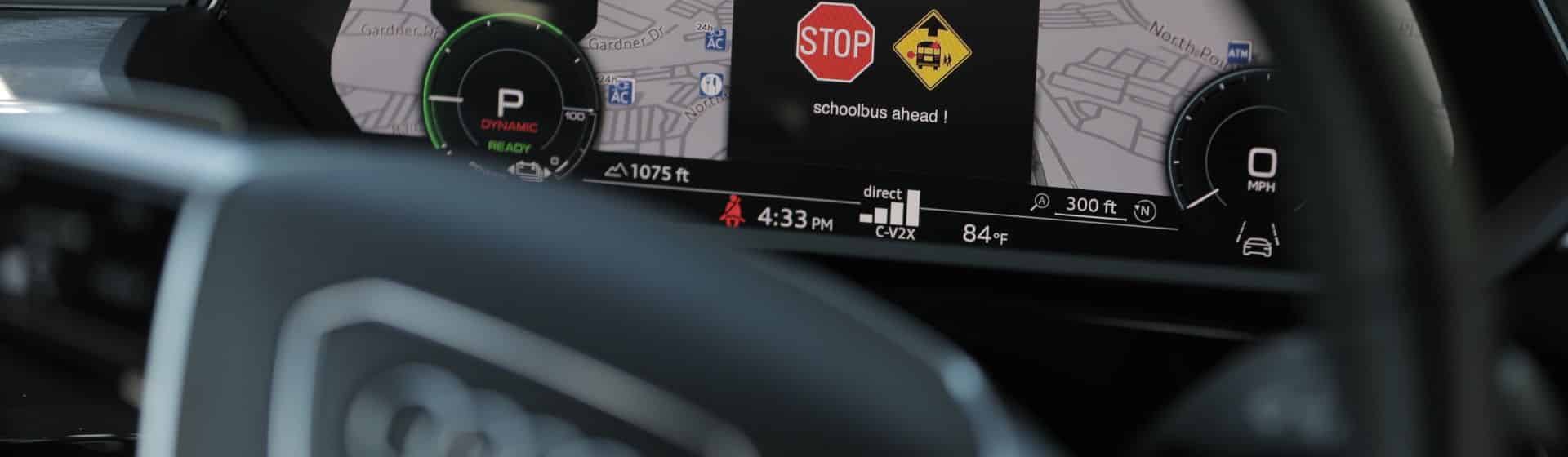
C-V2X alerts drivers when they are entering an active school zone and notifies them of the reduced speed limit. Future applications might include automatically slowing vehicles as they approach an active school zone.
See more use cases below.
What you can’t see can hurt you, and C-V2X plays a critical safety role because it allows the vehicle to see more than the driver can see. Regular sensors keep vehicles safe in immediate surroundings; C-V2X provides more robust signaling to help vehicles see around blind corners and many other types of obstructions. It connects vehicles and roadside infrastructure that are not in each other’s line of sight and allows them to share information about traffic conditions.
How C-V2X fits with SS4A
SS4A accepts both Action Plan Grants and Implementation Grants, with the latter drawing upon the foundation of the former. The program calls out four selection criteria:
- Safety impact
- Equity, engagement, collaboration
- Effective practices and strategies
- Climate and sustainability, and economic competitiveness
Two notable considerations are project readiness and funds to underserved communities.
USDOT lists several sample activities for Implementation Grants that align closely with C-V2X, including these:
- Deploying advanced transportation technologies, such as the installation of connected intersection-based safety solutions and vehicle-to-infrastructure advisory speed limit systems (e.g., intelligent speed assistance — see above)
- Evaluating and improving the safety of intersections by considering innovative design changes, improved delineation, and advanced warning
- Creating safe routes to school and public transit services through multiple activities that lead to people safely walking and biking in underserved communities.
- Promoting the adoption of innovative technologies or strategies for the safety and protection of VRUs in high-traffic areas where commercial motor vehicles (CMVs), pedestrians, bicyclists, and motorcyclists interact.
Next steps
As part of the Bipartisan Infrastructure Law, SS4A is a discretionary program with $5 billion in appropriated funds over the next 5 years. A related opportunity opening up in late 2022 is the $500 million Strengthening Mobility and Revolutionizing Transportation (SMART) Grants from USDOT. Both SS4A and SMART provide a path to federal funding to build novel uses of C-V2X and 5G technologies into the nation’s infrastructure. To provide more visibility for industry stakeholders, USDOT has published a full list of funding opportunities with anticipated dates for 2022.
Applications built around C-V2X can help make intersections safer and reduce fatalities due to speeding in the use cases shown above, as well as in these:
- At-grade rail crossings — alerting emergency vehicles that a rail crossing is closed, enabling early rerouting and avoiding delays in life-saving calls
- Pedestrian crossings — detecting when a VRU is in the crosswalk ahead and warning approaching drivers to proceed with caution
- Incident clearance and response — sending alerts to drivers as they approach an emergency vehicle stopped in or along the roadway ahead, thereby helping to prevent secondary crashes
- Wrong-way driving — detecting drivers who go the wrong way on on-ramps and highways, then alerting the driver, nearby drivers, and law enforcement
These applications can also help make transportation equitable in underserved communities, fulfilling another important goal of SS4A.
Find out how to apply for SS4A grants here and in the USDOT’s “Safe Streets and Roads for All” webinar series.
5GAA releases a special Report on the occasion of its 5th Anniversary
The 5G Automotive Association marks its 5-year anniversary with the publication of an online booklet covering the main achievements from its early days to the present, amidst the “5 Years of 5GAA” celebrations.
Half a decade has passed since the 5G Automotive Association was founded with the aim of building bridges between the automotive, technology and telecommunications industries to develop end-to-end solutions for future mobility and transportation services. To commemorate such a significant date, the association has launched an exclusive booklet, free and available online, which takes the reader on a journey through the history of 5GAA from its very beginnings.
The report contains a series of interviews with founding members and key partners of the association, such as Pearse O’Donohue (Director of Future Networks at DG CONNECT at the EU Commision), Maja Bakran Marcich (Deputy Director-General of DG MOVE), Adrian Scrase (ETSI CTO and Head of the 3GPP Mobile Competence Centre) or Nicola Farronato (Head of Innovation at the City of Turin). It also includes two letters – signed by Christoph Voight, Chairman of the 5GAA Board, and Chief Technology Officer Maxime Flament –, a review of the history of 5GAA in numbers, and a case study on the successful deployment of C-V2X technologies in China. A number of core themes overarch the pages of the report and allow the reader to better understand some of the priority areas and key drivers of members’ join efforts: road safety, sustainability, collaboration, digital transformation, and more.
Join 5GAA on this exciting milestone by checking out the online report, fully available here. You can also follow the social media hashtags #5YearsOf5GAA and #5GAAnniversary both on Twitter and LinkedIn for more updates.
Enjoy the reading!

Report on Automated Valet Parking: technology assessment and use case implementation description
This 5GAA Technical Report presents the results of the 5GAA Work Items Use Case Implementation Description Phase
II (UCID II) and Automated Valet Parking (AVP) with the focus on solutions using cellular public networks. Solutions
using cellular non-public networks or short-range direct communication technologies are also in the scope of these Work
Items, but the results will be published separately at a later stage.
Read the full report.
5GAA discusses the role of non-terrestrial networks in the connectivity of the car of the future
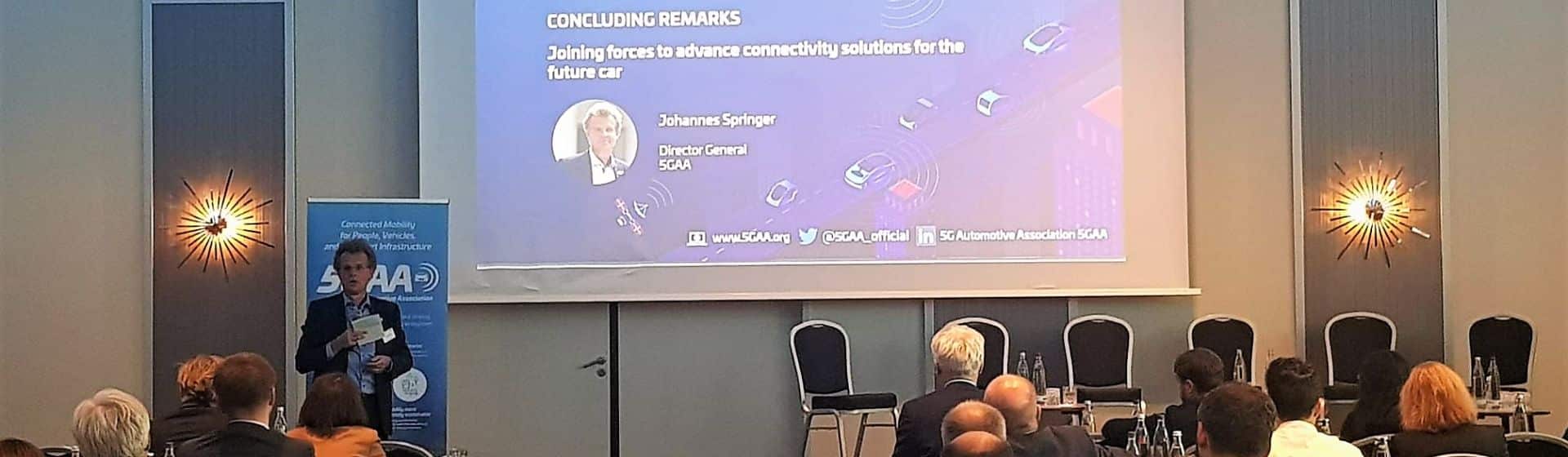
Ubiquitous connectivity is an essential prerequisite to achieving a full-scale digital transformation of the automotive sector. Connectivity challenges and how the seamless integration of terrestrial and non-terrestrial network solutions can foster high-capacity global connectivity were at the heart of the Connectivity for the Car of the Future Symposium, hosted by the 5G Automotive Association (5GAA).
Berlin (Germany), 16 May 2022. The 5G Automotive Association (5GAA) and the European Space Agency discussed the crucial role of ubiquitous connectivity and the opportunities for space technologies to offer future solutions for the automotive sector during its “Connectivity for the Car of the Future Symposium.”
Today, over 200 million connected vehicles worldwide are equipped with applications sharing hazard and traffic warnings on the road. The automotive sector is undergoing a significant transformation: from a focus on vehicle performance to a focus on a fully digital, tailor-made digital experience, and customers increasingly expect a fully connected car. Ubiquitous connectivity is an essential prerequisite to achieving a full-scale digital transformation of the automotive sector. Ensuring the network’s reliability can be a challenge, particularly in rural or remote areas that still experience no or poor band coverage, and non-terrestrial networks can have a crucial role in deploying hybrid connectivity solutions for the car of the future.
To explore the connectivity challenges and how space solutions can support the car industry in connected mobility, the 5G Automotive Association organised a Symposium in collaboration with the European Space Agency (ESA). What does the future car look like? Which connectivity and business models are needed to enable? What is the place of space in the mix? These were some of the questions addressed by industry representatives of car manufacturers, connectivity providers, mobile network operators, satellite connectivity providers and decision-makers.
Satellite connectivity can complement terrestrial solutions in white spots and in case of outages and congestion. In this sense, Europe must accelerate the development of assets and capacities in this field to compete globally, provide the appropriate solutions for the automotive sector and fill in any potential gaps. Therefore, it is essential to ensure that all the stakeholders and their respective innovative roadmaps are aligned, as highlighted by Joseph Aschbacher, Director-General of ESA, in his welcome messagefor the event. As such, the car industry will be able to make the most of cutting-edge developments in the connectivity domain.
“We are pleased to collaborate with 5GAA to promote and build the connected car ecosystem of the future. Vehicles are rapidly becoming fully connected devices and drive investments into new-generation connectivity. Satellites and space-based technologies are key assets to complete terrestrial networks, build smart and hybrid systems and offer ubiquitous, secure, and sustainable connectivity. We look forward to continuing this intense exchange with the automotive value chain to join forces and build a truly European connected car architecture,” added Elodie Viau, Director, Telecommunications and Integrated Applications Directorate, ESA.
During the Symposium, car manufacturers and tier-1 suppliers discussed the mobility-related technology innovations, opportunities, requirements, and challenges, highlighting the crucial role of ubiquitous connectivity for the automotive sector and the increasing number of use-cases already developed by the automotive industry for both private and commercial vehicles.
Including non-terrestrial connectivity in the mix will bring many benefits, such as extending high connectivity to rural areas at a comparatively low cost and enabling digital services and autonomous driving applications. However, space solutions need to be integrated with the existing terrestrial solutions, as they will not replace them. In addition, the seamless integration of antennas technology on the car, and the smooth handover between the networks, are just some of the challenges that still need to be addressed. Therefore, speakers pointed out that these solutions need to be included in the 3GPP standardisation system, which is currently the integrational connectivity path, defining the terrestrial connectivity requirements.
Finally, all the stakeholders engaged in a lively discussion to map how the whole ecosystem can work together to address the connectivity challenges and develop targeted R&D, demonstrators and pilots and expand them into mature business models and strategic partnerships. Indeed, to enable cross-border coordination and integration of terrestrial and satellite connectivity solutions, the cooperation and alignment of various players and investments will be essential. In this area, ESA aims to provide the European automotive sector with the necessary support and expertise to maximise its positive social, economic and environmental impact and develop competitive car connectivity solutions.
“Use cases and requirements are already there, and ubiquitous connectivity will enable their full-scale deployment. Satellite solutions can play a crucial role in achieving this,” concluded Johannes Springer, Director General, 5GAA. “It is crucial to ensure the greatest alignment and cooperation between all the stakeholders involved. Let’s continue working together to bring the 3GPP standards to the satellite solutions and seamlessly integrate them with the terrestrial networks to provide solutions for the car of the future.”
Below the presentations showcased during the first session of the event:
Andreas Schaller, V2X Technology Strategy, Robert Bosch Mobility Solutions
Olaf Eckart, Senior Expert Cooperations R&D, Industry Customers, BMW
Jörg Plechinger, Head of Mobile Connectivity Plattform / Car2X, AUDI AG
Susanne Schulz, Head of Department Cooperative, Connected and Automated Mobility, Autobahn GmbH



SGS North America Inc.
SGS is the world’s leading testing, inspection and certification company working together to enable a better, safer, and more interconnected world.

OKI Electric Industry Co., Ltd.
OKI is a telecommunication equipment manufacturer working to solve a host of social issues, proactively tackle the challenges of new frontiers.

Keysight Technologies UK Limited
Keysight Technologies, Inc. provides electronic design and test solutions to commercial communications, networking, aerospace, defense and government, automotive, energy, semiconductor, electronic.
Join the 5GAA
The 5G Automotive Association (5GAA) is a global association with over +110 member companies from the automotive and telecommunications industries. Partners who are active in the broader telecommunications and automotive ecosystem, such as universities, research bodies, associations, and public authorities also joined the ecosystem. Each of the 5GAA members bring added value to the 5GAA mission through their contributions and visionary mindset. Together, the key partners foster collaboration and exchange to path the way towards the new mobility era.
What our members say

Building a representative membership and driving impactful partnerships
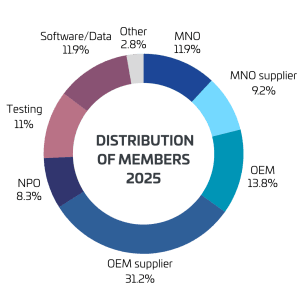
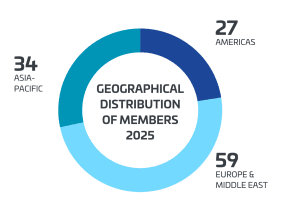
5GAA gathers over 115 member companies from the automotive and telecommunications industries. The association has also welcomed partners who are active in the broader telecommunications and automotive ecosystem, such as universities, research bodies, associations, and public authorities.
Global footprint
Shaping the new mobility globally, powering locally
Map members

Join the community
PLATINUM Members
Full leadership and strategic influence: Guaranteed Board seat, decision-making, authority, and top-tier access to all 5GAA activities and events.
(Currently limited to 12 members, including 8 founding members).
GOLD Members
Strategic influence: Eligible for Board election, priority to events & demonstrations, active, participation in strategy, Working Groups, and
regional activities.
GENERAL Members
Focused participation: contribute to Working Groups & Work Items, vote at the General
Assembly and access to core 5GAA activities.

Live Trial of 5G Connected Car Concept Launches in Blacksburg, Virginia (VA)
The international collaboration of tech leaders and public sector on a live connected car trial will pilot new roaming technology for traffic safety.
March 24th, 2022 – (Blacksburg, VA) On March 24th the Commonwealth of Virginia will host a live trial of new driver and pedestrian safety concept that allows near-real-time notification of roadway hazards through 5G and edge technologies. This trial is one of three conducted internationally by a historic public-private collaboration, organized by the 5G Automotive Association (5GAA) and eight member companies representing leading technology companies from around the globe. A related European live-trial was conducted in the city of Turin, Italy. The North American live trial will be conducted on the Virginia Smart Road operated by the Virginia Tech Transportation Institute in Blacksburg, VA. It is the first of its kind in North America.
“The 5G Automotive Association lives out of cooperation between its members. In this case, eight members led by Intel and Verizon give a perfect example of how we can use connected mobility to increase safety on our roads,” said Maxime Flament, CTO of 5GAA. “5GAA is also global and we are happy that use cases demonstrated here in United States can readily be adapted in any other country supporting 5G and Edge networks.”
5G transmission speeds and so-called “Edge” servers—locally installed, high-powered computers capable of running Artificial Intelligence programs—open the door to smart city technologies like near real-time traffic management and innumerable other business applications. The connected car concept uses this high-speed and Edge computing technology to communicate with car sensors and pedestrian smartphones, via a user-authorized mobile app—about traffic hazards, like accidents and road construction—for Pedestrian and in-vehicle driver safety and efficient navigation.
This live international trial attempts to solve one of the more technical challenges of making the connected car concept a daily reality. The 5G networks underpinning the concept are managed by Communication Service Providers (CoSPs) according to geography, each with different edge solutions that must be able to communicate without interruption of the V2X applications as drivers cross borders. Roaming services—the ability to make a call regardless of the network—is one early success of multi-mobile network operators (MNO). Demonstrating the connected car concept can work in a roaming scenario is the core objective of the live trial and represents the first of any such attempt in the United States.
“Telecom operators will have to play a major role by enabling applications and services for the connected car ecosystem,” says Shamik Mishra, CTO Connectivity, Capgemini Engineering. He further adds: “Capgemini is excited to bring its innovative federated MEC (Multi-Access Edge Computing) platform and applications to this 5GAA trial to demonstrate the true value of intelligent industry, leveraging data in the vehicles and edge-cloud. The trials serve as a stepping-stone for realizing the potential for automakers to provide services to their connected cars from the network.”
The Virginia live trial addresses three objectives:
- Objective 1: Multi-MNO scenario: How can a vehicle, which has radio access to MNO A, use a MEC application, which is operated by MNO B -> Interworking between MNO‘s (by NOT losing the benefits of low latency)
- Objective 2: Global operational Availability: How can an OEM as the MEC application developer be sure, especially on a global basis, that a MEC application works in the same way if it’s operated by MNO A, or if it’s operated by MNO B
- Objective 3: Multi-MNO with roaming scenario: Where the two operators can seamlessly transfer the V2X service from one operator to the other as the car OEM moves from one geo to the other in a roaming scenario. Typically, when an in-vehicle driver does a cross-border travel that involves two operators.
One of the key benefits of the trial is the value demonstrated by bringing in a large ecosystem to help develop not only the technology but also build the business case and model that will help drive the potential market adoption for 5G and C-V2X to help into the digital transformation of smart cities of the future. To succeed in this endeavor, it will need a village and investment from both public and private sectors to help adopt this new technology to provide a quality of life for all citizens.
The demonstration brings new learnings for various players across the value chain and creates a testbed for trying out new 5G connected car services at the Edge in subsequent phases. The U.S. Live Trial will take place in Blacksburg, VA, on March 24th, 2022.
BACKGROUND
In this live trial, Verizon and TELUS are exhibiting the Ultra-reliable low-latency communication (URLLC) 5G networking capabilities, such as hosting Capgemini’s ENSCONCE MEC platform, built upon the Intel Smart Edge Open toolkit, to enable connected car use cases at the edge on Intel Architecture-based EC2 instances on AWS Wavelength. Intel Smart Edge Open (formerly known as OpenNESS) is a royalty-free edge computing software toolkit for building optimized and performant edge platforms.
“Intel is proud to be a leading member of this live trial to build and provision Infrastructure to enhance Connected Vehicle experience in multi-operator scenarios,” said Sameer Sharma, General Manager of Cities & Transportation Business Unit at Intel. “This demonstration shows how cloud service providers and communication service providers can advance road infrastructure deployments at the 5G network edge when powered by Intel technologies. This is just the beginning, as future trial phases will demonstrate additional exciting services”
Capgemini’s ENSCONCE MEC Platform also enables multi-tenancy and multi-MNO MEC federation capabilities based on GSMA Operator Platform requirements and comes with Capgemini V2X Stack built-in support. To realize the Active and Passive Vulnerable Road User (VRU) use cases, the AWS Wavelength EC2 instances are used to demonstrate Virtual-RSU and host V2X applications that are based on the Intel Xeon Scalable Processors. Harman International and Capgemini provide the Virtual-RSU and RSE solutions respectively to realize various V2X use cases with location aware and AI inferencing technologies. Harman also offers a 5G enabled OBU that integrates seamlessly with Stellantis/FCA car and hosts V2X applications. American Tower in collaboration with VTTI is providing the test bed infrastructure at the VTTI intersection where the trial for V-DOT will be performed.
“Since joining 5GAA in 2018, we have worked with public and private partners to help define the ecosystem for scalable cellular-based roadside infrastructure to serve the 5G connected vehicle.” Said Ed Knapp, CTO of American Tower. “By deploying C-V2X in combination with roadside sensors processed at shared multi-access edge computing facilities, also known as MEC4auto, American Tower hopes to enable deployments of seamless multi-operator MEC services to support low latency use cases.”
“The Virginia Tech Transportation Institute (VTTI), along with our Virginia Department of Transportation partners, is excited to support the demonstration of the MEC4Auto solution on the Virginia Smart Roads. The connected car concept provides reliable, low latency communications that can enable a variety of transportation safety use cases. This V2X technology takes a big step towards scalable deployment by demonstrating the seamless transfer of V2X services between operators and geographic locations with no change in performance, functionality, and reliability.” Said Dr. Michael Mollenhauer, Director, Division of Technology Implementation at VTTI.
“The Virginia Department of Transportation (VDOT) has a mission to ensure the safe, efficient, and accessible travel of people and goods across the Commonwealth,” explained Amanda Hamm, VDOT’s Connected and Automated Vehicle Program Manager. “To achieve this mission, VDOT supports innovative solutions and partnerships, like this historic trial, to bring the connected vehicle ecosystem to fruition, as this environment could one day save lives by providing actionable, real-time information to all roadway users so that they better navigate our roadways.”
“Making roads safer for drivers and pedestrians is the ultimate goal of developing these next generation technologies,” said Ned Curic, Stellantis Chief Technology Officer. “The Jeep® Wrangler 4xe plug-in hybrid is the perfect vehicle for these live tests, equipped with vehicle-to-everything (V2X) technologies and driver safety alert. With 5GAA, we are working with industry leaders across the globe to help pave the way for autonomous technology to benefit our products and, ultimately, our customers”
“Verizon 5G Edge with AWS Wavelength brings AWS compute and storage services to the edge of Verizon’s wireless network minimizing the latency and network hops required to connect from an application hosted on AWS to the end user’s device,” said Jyoti Sharma, Senior Manager of Network Planning at Verizon. “Through our partnership with AWS, we are helping customers unlock the true potential of 5G and edge computing which together will enable innovative applications involving computer vision, augmented and virtual reality, and machine learning.”
Connected mobility is quickly becoming a reality, and thanks to ultra-low latency of 5G and power of edge computing, it will deliver on important safety outcomes for everyone on our roads in a near future,” said Ibrahim Gedeon, Chief Technology Officer, TELUS. “TELUS is proud to offer our world-leading connectivity, alongside this prestigious group of partners, in order to realize this trial and maximize our learning for the future.”
“At HARMAN, we are focused on building connectivity solutions at the intersection of 5G, V2X & Edge Computing that will build more equity on the road for all users,” said Mahsa Nakhjiri, Director, Product Management at HARMAN. “While these technologies can unlock many new use cases and experiences, the most important element of any solution in this space is safety. As programs such as this one fueled by the collaboration of industry leaders and organizations like 5GAA bring a new degree of safety to users, they will also lead to a higher level of confidence in autonomous vehicles.”
Source: Harbor Research1.
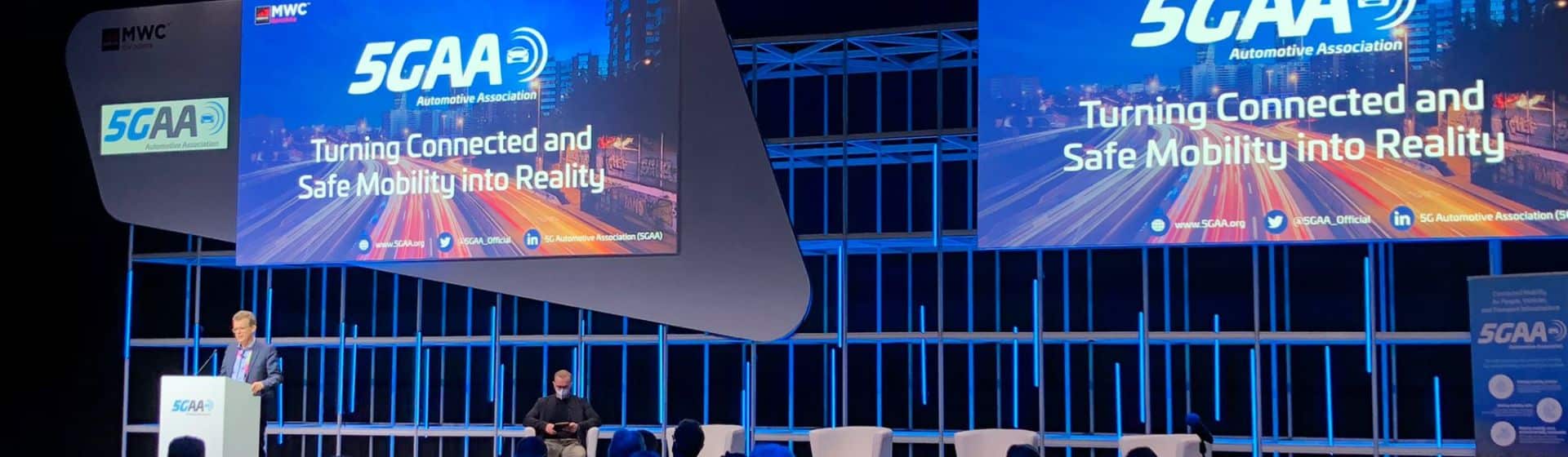
5GAA discusses how C-V2X turns Connected and Safe Mobility into Reality at Mobile World Congress 2022 in Barcelona
Barcelona, 3 March 2022 – The 5G Automotive Association (5GAA), alongside its members, disclosed the latest global deployments of C-V2X technology, highlighting how 5G data will deeply transform the mobility system by making it safer and more efficient at GSMA’s Mobile World Congress 2022 in Barcelona on Wednesday 2 March 2022.
The 5G Automotive Association was back this year at Barcelona’s edition of the Mobile World Congress, the world’s leading exhibition for the connectivity industry, to disclose the cellular technology shaping the future of mobility alongside its member.
Today, connected driving is a reality. Over 200 million connected vehicles are equipped with C-V2X applications sharing hazard and traffic warnings on the road. Applied to the automotive sector, 5G is upgrading revolutionary in-car connectivity, allowing seamless and cooperative communication between vehicles, infrastructure, and surroundings.
On 2nd March, 5GAA experts and member spokespersons shared their views on how the deployment of C-V2X technologies is turning connected and safe mobility into reality from now and in the next few years. Moreover, the association had the pleasure to have Peter Stuckmann, Head of Unit, Future Connectivity Systems, DG CONNECT, European Commission, addressing the participants and highlighting the crucial role of investments in 5G and infrastructures to foster the European green and digital transition.
As noted by Johannes Springer, 5GAA Director-General, the association that celebrates its 5th Anniversary has been working intensely to bridge the gap between automotive, technology, and telecom industries and promote the 5G-V2X (vehicle-to-everything) technology as a comprehensive and integrated platform for connected vehicles, embracing digital transformations as opportunities for mobility innovations.
The conference, moderated by Freddie Holmes, Special Correspondent at Automotive World, offered an overview on the broad-scale improvements that connected mobility can bring to the global automotive system, starting with a first session on the 5G-V2X deployment landscape in different regions, such as Europe, China, and the US. Speakers underlined the need for increased ecosystem cooperation and cross-border projects to ensure reliable access to 5G networks to all users. The second session focused on the safety aspects and benefits brought by the technology, including protecting vulnerable road users.
The event concluded with an insightful panel discussion on mobility data, with the participation of representatives from the entire ecosystem value chain. Panellists discussed how smart cities and infrastructure could help make data-driven decisions that inform how we pave the path for the future of mobility and the crucial role of data standardisation and reliability and new business models to foster investments.
The event welcomed, in person or through virtual messages, high-level representatives of 5GAA’s member companies Deutsche Telekom, Verizon, China Mobile, Harman, Continental, Telefonica, Qualcomm, BMW, Huawei, Intel , ZTE, Stellantis.
In addition,5GAA hosted a Press & Industry guided tour across the booths of key member companies to share their latest C-V2X technology developments with journalists and industry analysts, focusing on road safety and digital infrastructures.
Companies featured in the tour included:
- Deutsche Telekom presented the Automated Valet Parking in a 5G network use case, in partnership with BMW and Valeo, which delivers high reliability and stable latency to ensure the necessary safety requirements. Moreover, the company presented its Mobility Connect solutions, offering drivers 5G seamless connectivity solutions
- ZTE Corporation showcased its 5G-V2X products and solutions, including 5G-V2X module, OBU, RSU, V2X cloud platform and other cases
- Qualcomm presented its Snapdragon Digital Chassis Platform: a set of technology solutions for building connected and intelligent vehicles that are safer, customisable, immersive and continually upgradeable, and Auto Connectivity Platform to support ubiquitous connectivity in and around the vehicle
- Intel with its Superdemo, developed with its partners Capgemini and Advantech for their 5G Road Side Unit solution for Smart City & Transportation use cases focusing on vulnerable users protection Digital Twin infrastructure for sustainable cities
- Rohde & Schwarz showcased its 5G and C-V2X solutions for development in the laboratory and verification in the field to ensure the performance and reliability of critical automotive communications
- Anritsu presented a joint demonstration in partnership with dSPACE. The demonstration showed the use of 5G Network Slicing in an Advanced Intersection Collision Warning (AICW) use case, using Hardware In the Loop (HIL) test and simulation system to provide a realistic sensor simulation to an OBU that is being tested
We would like to thank all our participants, member companies and speakers, for making it such an insightful event, clearly demonstrated the added value of ecosystem cooperation for the future of the transportation system.
Download the agenda of the event here.
For additional information, please get in touch at marcom@5gaa.org.
Please find the video contribution from Ramaswamy Iyer, Senior Vice-President and Head of Connectivity SBU, Harman that unfortunately, we have not been able to show during the conference due to technical problems.