
5GAA shares latest C-V2X developments at ITS World Congress (Hamburg)
5GAA shares the latest C-V2X developments at ITS World Congress (Hamburg): “5G will have the most revolutionary impact by reducing accidents and saving millions of lives.”
HAMBURG, 13 October 2021 – 5G-powered vehicles are foreseen to hit the market this year in Europe. More and more advanced vehicle-to-everything (V2X) use cases geared towards enhanced road safety, improved traffic efficiency, greener environmental impact and more comfortable driving are being deployed worldwide on a large scale. The 5G Automotive Association (5GAA) and its members showed the latest developments during ITS World Congress in Hamburg.
5G-V2X spearheading the path to automated driving
Today, the 5G-V2X (Vehicle-to-Everything) technology already enables fully connected and automated mobility with LTE-V2X technology. Vehicles and infrastructure can exchange relevant information via LTE-V2X through direct communication mode (not requiring network coverage) or mobile network communications mode, creating a real-time connection between all road users.
Many automotive services can be supported by the current global cellular standard LTE-4G, seen as an essential foundation for further progress. Millions of vehicles on the continent are connected via 4G-LTE already, and industry analysts estimate that over 70% of all new vehicles sold are now 4G equipped. That said, 5G-V2X will enable more advanced connected mobility services and offer a clear path to automated driving – while maintaining service-level interoperability with pre-existing LTE-V2X vehicles.
5GAA will help prepare tomorrow with the ITS Directive revision, advocating a neutral approach on technology. Given the strong momentum in China and in the United-States, Europe needs a future-proof framework to stay in a leading role globally. Indeed, advanced driving is taking shape globally. At the moment, China is the only country that has 5G Cellular-Vehicle-to-Everything (C-V2X) enabled vehicles commercially available on the market. To this date, 14 C-V2X vehicle models are commercialized. In the United States, Ford has committed to deploy C-V2X in all new vehicle models from early 2022. In Europe, 5G-powered vehicles are foreseen to hit the market still this year thanks to BMW.
“When applied to the automotive field, 5G will have the most revolutionary impact by saving millions of lives and reducing accidents on roads”, 5GAA CTO Maxime Flament said. “The combination of long- range and short-range connectivity C-V2X offers, delivers the optimal setup for safety and efficiency of traffic, in addition to improving environmental footprints.” Global deployment of C-V2X technology will have a sustainable impact in the world.
In the next two to three years, 5GAA expects to see mass deployment of C-V2X use cases geared towards improving traffic efficiency and road safety around the world. Vehicle commercialization is not enough however: the whole ecosystem – cars, cloud, map, network, positioning but also the road – needs to be C-V2X friendly. Therefore, 5GAA offers a platform to foster collaboration between top tier automotive, technology and telecommunications companies for them to develop end-to-end connectivity solutions for future mobility and transportation services.
Cover more digital roads via enhanced digital mobility services
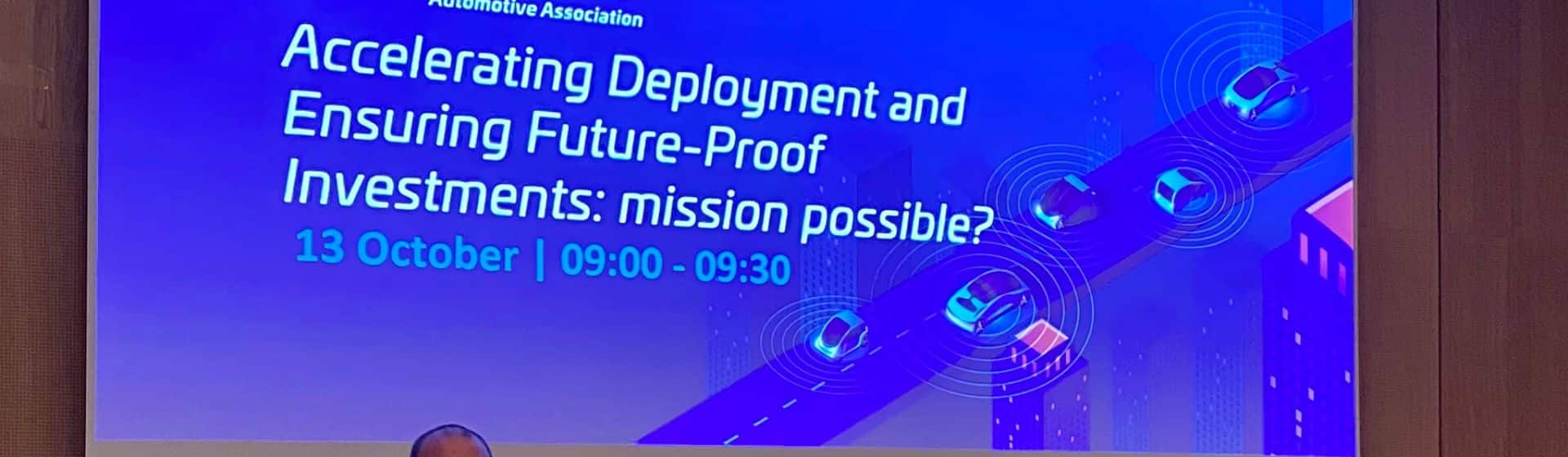
At ITS World Congress, the world’s largest and most prominent event focused on smart mobility and the digitalisation of transportation, 5GAA experts and member spokespersons shared their views on how to accelerate deployment of the latest technology innovations and how to ensure future-proof investments. They shared the needs of road operators for their digital infrastructure and of automakers (OEMs) for digital mobility services, and zoomed in on digital roads in urban areas and cooperation models enabling deployment and use of 5G infrastructures for connected and automated mobility.
Furthermore, key members of the 5GAA shared their latest technology developments with a focus on Vulnerable Road Users (VRUs), among which:
- A system that warns of accidents between and help protect connected vehicles and cyclists – or other vulnerable road users such as pedelec, scooter riders and pedestrians developed by Continental and Deutsche Telekom. The solution calculates the paths taken by cars and bicycles. If they are likely to cross at the same time, the system warns both road users via mobile communications in real-time. Initial road tests have been successful.
- A Location-as-a-Service algorithm that improves the positioning of road users, in which vehicles exchange data via simulated communication (5G) by Fraunhofer Institute FOKUS. The aim is to warn drivers of a collision with a cyclist, an e-scooter rider of road damage, or to guide a blind person to the right government office or the bus door – for which highly accurate localization is always of fundamental importance.
- A demonstration of a connected e-bike, where Qualcomm (alongside company Spoke) is showcasing a new hardware solution designed to enable vehicles to identify VRUs using C-V2X.
And more. Request the full list of demonstrations on demand at 5GAA@teamlewis.com
Download the press release here.



Live Trial of 5G Connected Car Concept To Launch in Turin, Italy
The international collaboration of tech leaders and public sector on a live connected car trial will pilot new roaming technology for traffic safety on 2 December 2021.
2 DECEMBER 2021, Turin (ITALY) – On 2 December, the City of Turin (Italy) will host a live trial of new driver and pedestrian safety technology allowing near-real-time notification of roadway hazards through 5G-Edge networks. This trial is one of a series conducted internationally by a historic public-private collaboration over the next few years, organized by the 5G Automotive Association (5GAA) and eight member companies representing leading technology companies from around the globe.
“This collaboration between the 5G Automotive Association and its member companies is the perfect example of how we can secure safety on roads and build the future of connected mobility,” said Maxime Flament, CTO of 5GAA. “This time, demonstrated use-cases take place in Europe through 5G and Edge networks—I look forward to seeing more in the future in the United States and other continents.”
The promise of 5G and Edge technology has long been anticipated to deliver new connected services that will revolutionize daily life, with the estimated new economic opportunity stretching into the trillions USD over the next 10-years1. The global connected car market size alone is projected to reach USD 191.83 billion by 2028.
5G transmission speeds and so-called “Edge” servers—locally installed, high-powered computers capable of running Artificial Intelligence programs—open the door to smart city technologies like near real-time traffic management and innumerable other business applications. The connected car concept uses this high-speed and Edge computing technology to communicate with car sensors and pedestrian smartphones, via a user-authorized mobile app—about traffic hazards, like accidents and road construction—to Pedestrian and in-vehicle driver safety and efficient navigation.
“The connected car concept is an important validation of the combined value of Edge, of 5G and IOT,” said Paolo Campoli, Head of Global Service Provider sector at Cisco, “We are so excited to take part in this event that creates a platform for innovation in 5G IOT. The integration of 5G mobility, applications and data processing at the Edge requires expertise from very different domains—expertise that Cisco and Partners can bring. It includes elements of automation, intelligent infrastructure and workloads control, cybersecurity protection and end-to-end application observability. The live trial in Turin is a great opportunity to show how the intersection of Edge, 5G and IOT based on Standards creates a platform to connect Service Providers and Industries.”
This live international trial attempts to solve one of the more technical challenges of making the connected car concept a daily reality. The 5G networks underpinning the concept are managed by communication service providers (CoSPs) according to geography, each with different edge solutions that must be able to communicate without interruption of the V2X applications as drivers cross borders. Roaming services—the ability to make a call regardless of the network—is one early success of multi-mobile network operators (MNO). Demonstrating the connected car concept can work in a roaming scenario is the core objective of the live trial and represents the first of any such attempt in Europe.
“Telecom operators will have to play a major role by enabling applications and services for the connected car ecosystem,” says Shamik Mishra, CTO Connectivity, Capgemini Engineering. He further adds: “Capgemini is excited to bring its innovative federated MEC (Multi-Access Edge Computing) platform and applications to this 5GAA trial to demonstrate the true value of intelligent industry, leveraging data in the vehicles and edge-cloud. The trials serve as a stepping-stone for realizing the potential for automakers to provide services to their connected cars from the network”. The trial will demonstrate how the car manufacturers, MNOs and technology providers come together to help overcome the challenge of when a vehicle moves from one network boundary to another or Inter-MNO handover of MEC service.
The Turin live trial addresses three objectives:
- Objective 1: Multi-MNO scenario: How can a vehicle, which has radio access to MNO A, use a MEC application, which is operated by MNO B -> Interworking between MNO‘s (by NOT losing the benefits of low latency)
- Objective 2: Global operational Availability: How can an OEM as the MEC application developer be sure, especially on a global basis, that a MEC application works in the same way if it’s operated by MNO A, or if it’s operated by MNO B
- Objective 3: Multi-MNO with roaming scenario: Where the two operators can seamlessly transfer the V2X service from one operator to the other as the car OEM moves from one geo to the other in a roaming scenario. Typically, when an in-vehicle driver does a cross-border travel that involves two operators.
One of the key benefits of the trial is the value demonstrated by bringing in a large ecosystem to help develop not only the technology but also build the business case and model that will help drive the market adoption for 5G and C-V2X to help into the digital transformation of smart cities of the future. To succeed in this endeavor, it will need a village and investment from both public and private sectors to help adopt this new technology to provide a quality of life for all citizens.
The city of Turin is delighted to facilitate the 5GAA Multi Operator MEC Trial with its Smart Road infrastructure and the technical support of 5T. We see – Chiara Foglietta, Deputy Mayor for Mobility, Ecological and Digital transition, Innovation says – C-V2X services as fundamental to develop a sustainable and safe mobility for all the citizens, whatever transport means they use. In the future, Turin wants to continue the collaboration with 5GAA and offer its Smart Road infrastructure for further scale in the live traffic within Torino City Lab and the new project “ Turin House of emerging Technologies – CTE NEXT”
“As TIM, we are honored to be hosting in Turin such a challenging trial by leveraging our Innovation Lab competencies and our pre-commercial instances of Edge Cloud,” says Daniele Franceschini TIM VP Innovation, Standard and Portfolio. “The federation model implemented with our partners enables a ‘continuum’ between Edge Cloud instances allowing players from the automotive industry and beyond to benefit from a seamless cloud experience across country boundaries.”
“Greater connectivity speeds, improved hardware and expanded software expertise have opened new opportunities for Stellantis with safety systems being one of the many areas we focus on,” said Mamatha Chamarthi, Head of Software Business and Product Management. “Through smart and strategic partnerships such as 5GAA, we will capitalize on next-generation systems and prove out the technology.”
The demonstration brings new learnings for various players across the value chain and creates a testbed for trying out new 5G connected car services at the Edge in subsequent phases. The Turin Live Trial will run throughout the day on 2 December 2021.
BACKGROUND
In this live trial, Telecom Italia (TIM), Telefonica, BT/EE will demonstrate the NSA 5G networking capabilities and the Edge Cloud solution to deliver connected car use cases at the Edge of their networks for their customers. TIM makes its Innovation Lab facilities available and its commercial 5G network with pre-commercial Edge Cloud specific features such as Local Break Out, that together with the federation of edge platforms in TIM, BT/EE and Telefonica make the use cases available for roaming users from BT/EE and Telefonica.
The three companies are hosting Capgemini’s ENSCONCE MEC platform, built upon the Intel Smart Edge Open toolkit, the Intel® Distribution of OpenVINO toolkit, and Intel hardware to enable connected car use cases at the Edge on 2nd Gen Intel Xeon Scalable processor equipped Cisco Servers. Intel Smart Edge Open (formerly known as OpenNESS) is a royalty-free edge computing software toolkit for building optimized and performant edge platforms.
“The international live trial of building and provisioning Connected Car edge services in a multi-operator scenario is a transformative 5G and Edge use case,” said Renu Navale, Vice President and General Manager of Smart Edge Platforms Division at Intel. “This trial demonstrates the possibilities that 5G connectivity and edge computing can bring to connected car solutions, when the broad ecosystem collaborates and uses Intel technologies such as Xeon processors, Smart Edge Open and OpenVINO.”
Capgemini’s ENSCONCE MEC Platform provides multi-tenancy and multi-MNO MEC federation capabilities. The visual compute applications for pedestrian detection and tracking supported by Capgemini’s Orbital Car Situational Awareness V2X platform. To realize the Active and Passive Vulnerable Road User (VRU) use cases, Cisco provides the Edge infrastructure based on CISCO UCS Servers (the Unified Computing Systems that combines computing, network and management in a cohesive architecture) hosting the ESCONCE platform, used to demonstrate Virtual-RSU and host V2X applications that are based on the Intel Xeon Scalable Processors and Intel HDDL-R Visual Accelerators. Harman International and Capgemini provide the Virtual-RSU and RSE solutions respectively to realize various V2X use cases with location-aware and AI inferencing technologies. Harman also offers V2X Application Server and a 5G enabled TCU that integrates seamlessly with Stellantis/FCA car and hosts V2X applications.
“It is key that operators and industry partners collaborate to explore the technical feasibility and benefits to unlock the new business opportunities and services to our customers. In this project, we are jointly evaluating the potential to federate edge cloud compute capabilities across multiple geographies to support low latency use cases, including key connected car use cases being delivered as 5G edge services in a multi-MNO, multi-OEM environment,” said Sunil Joshi, Senior Manager, Global Roaming Products at BT/EE.
“Telecom operators will have a key role in supporting V2X services and this trial demonstrates the value of leveraging mobile architecture, federating edge platforms and allowing local break out in visited network. Such an approach as defined in the GSMA Operator Platform Group allows customers and developers to deploy their applications across multiple operator domains, and our end users to have the best latency and customer experience when accessing their services,” said Juan Carlos Garcia, Senior Vice-President of technology innovation and ecosystems, Telefonica.
“At Harman, we are focused on building connectivity solutions at the intersection of 5G, V2X and Edge Computing that will build more equity on the road for all users,” said Mahsa Nakhjiri, Director, Product Management. “While these technologies can unlock many new use cases and experiences, the most important element of any solution in this space is safety. As programs such as this one fueled by the collaboration of industry leaders and organizations like 5GAA bring a new degree of safety to users, they will also lead to a higher level of confidence in autonomous vehicles.”
Download the event visual here
Watch the video of the event here
Source: Harbor Research1.

List of C-V2X Devices
This document intends to provide an overview of the C-V2X Devices which we understand are already publicly available on the market. This overview is based on publicly available information.
The sources are referenced. 5GAA does not accept any liability for information provided by third parties. 5GAA has not verified whether the information provided by third parties is accurate. 5GAA does not in any way validate the information provided by third parties by including particular devices in this list. This document is only intended to provide an overview, the list of devices is not necessarily complete.
This list does not necessarily include factory-fit telematics/V2X boxes directly under contract with automakers.
Open the list

Updated study of spectrum needs for safety related intelligent transportation systems – day 1 and advanced use cases
This report is an update to the 2020 report that presents a study by the 5GAA on the spectrum needs of so-called day-1 and advanced use cases for intelligent transport systems (ITS) as implemented by LTE-V2X and NR-V2X cellular V2X (C-V2X) technologies, respectively.
The study estimates the amounts of bandwidth required for the introduction of use cases for direct communications (via the cellular V2X PC5 interface in the 5.9 GHz band harmonised globally for ITS) and for network-based communications (via the cellular-V2X Uu interface in spectrum designated for use by mobile communication networks).
This update to the report presents spectrum needs estimates for a number of advanced use cases including “Cooperative Perception”, “Vulnerable Road User”, “Group Start” and “Cooperative Lane Merging”, among others.

Tele-Operated Driving (ToD): System Requirements Analysis and Architecture
Tele-Operated Driving (ToD) technology assists, complements and accelerates semi- and fully automated driving in various scenarios. This 5GAA technical report studies system requirements and corresponding enabler technologies for ToD services using Cellular-V2X (C-V2X) networks. The study covers the vehicle sub-system, ToD operator sub-system, infrastructure sub-system, and C-V2X networks for end-to-end deployment of ToD services. System application layer architectures and the underlying communication network architectures for different ToD use cases and scenarios are presented in this study with the focus on interfaces among different stakeholders and with considerations on service interoperability in multi-OEM, multi-Service Provider, multi-RTA and multi-MNO environments. This study also envisages that market deployment of ToD services will follow a multi-stage roadmap, starting from confined areas, then evolving into dedicated public roads and areas, and finally covering cross-region (long-haul) mobility of automated vehicles.

Vehicular Antenna Test Methodology
The rising demand for connected vehicles as well as the ongoing deployment of vehicle-to-vehicle communication has shown that a unified measurement procedure for the communication subsystem antenna can add benefits for the development of vehicular communication systems. A unified measurement procedure for vehicular antennas (antennas permanently mounted on vehicles) will also ensure conformity assessments of the various regional standards are handled transparently.
5GAA, as an alliance connecting the automotive and telecom domains, developed a methodology to test vehicular antennas for communication and associated aspects (e.g. GNSS). Such a methodology can act as a commonly agreed test procedure for antenna communication subsystems. It is also expected to improve the accuracy of conformity assurance procedures for such vehicular systems.
Read the full report, here.

MEC4AUTO: Use Cases and initial test specifications review
Mobile Edge Computing (MEC) is a key enabler of several Cellular Vehicle-to-Everything (C-V2X) applications that require ultra-low latency and high reliability.
This document analyses the C-V2X Use Cases, in particular those defined by 5GAA WG1, that require the processing of large amounts of data and could benefit from the use of MEC instead of uploading the data to the cloud, which could cause additional round trip delays. The selection of Use Cases is based on inputs from auto OEMs and their key requirements about interoperability between different Mobile Network Providers (MNPs), different vehicle OEMs and different C-V2X application providers
Read the full technical report here.

Tele-Operated Driving (ToD): Business Considerations
The 5GAA cross-working group work item Tele-operated Driving (ToD) aims to describe the requirements and framework needed for remote vehicle operation. The proposed results should reliably enable remote steering and manoeuvring including a human remote driver with both Direct and Indirect Control in an OEM-agnostic, inter-MNO and cross-authority operation. The intention of this work item is to study both use case and scenario definition, technical design, and business considerations. This document focuses on business considerations and aspires to identify the different elements that should be taken into account when considering the deployment of a ToD ecosystem from a business perspective.
Read the full technical report here.

Safety Treatment in V2X Applications
This White Paper describes the new challenges in the treatment of functional safety arising from the introduction of connected and distributed functions, which are typical for cellular vehicle-to-everything (C-V2X) applications. A dedicated 5GAA technical working group performed a detailed analysis to determine, propose, and evaluate possibilities for mobile network operators, vendors, and any further identified stakeholders to provide vehicle original equipment manufacturers (OEMs) what they need to treat safety in new use cases enabled by C-V2X technologies.
Read the full White Paper here.

Deployment band configuration for C-V2X at 5.9 GHz in Europe
This position paper describes 5GAA’s view on deployment band configuration for C-V2X in the 5.9 GHz band. It is our view that the C-V2X industry needs to agree on a commonly applied and unique deployment band configuration for C-V2X direct communications in the 5.9 GHz band. With such an agreement, C-V2X equipment can be configured identically in all vehicles for operation in the 5.9 GHz band, thereby paving the way to interference-free operation of ITS services across Europe.
The deployment band configuration outlined in this paper addresses the initial deployment of C-V2X technologies.