

Live Trial of 5G Connected Car Concept To Launch in Turin, Italy
The international collaboration of tech leaders and public sector on a live connected car trial will pilot new roaming technology for traffic safety on 2 December 2021.
2 DECEMBER 2021, Turin (ITALY) – On 2 December, the City of Turin (Italy) will host a live trial of new driver and pedestrian safety technology allowing near-real-time notification of roadway hazards through 5G-Edge networks. This trial is one of a series conducted internationally by a historic public-private collaboration over the next few years, organized by the 5G Automotive Association (5GAA) and eight member companies representing leading technology companies from around the globe.
“This collaboration between the 5G Automotive Association and its member companies is the perfect example of how we can secure safety on roads and build the future of connected mobility,” said Maxime Flament, CTO of 5GAA. “This time, demonstrated use-cases take place in Europe through 5G and Edge networks—I look forward to seeing more in the future in the United States and other continents.”
The promise of 5G and Edge technology has long been anticipated to deliver new connected services that will revolutionize daily life, with the estimated new economic opportunity stretching into the trillions USD over the next 10-years1. The global connected car market size alone is projected to reach USD 191.83 billion by 2028.
5G transmission speeds and so-called “Edge” servers—locally installed, high-powered computers capable of running Artificial Intelligence programs—open the door to smart city technologies like near real-time traffic management and innumerable other business applications. The connected car concept uses this high-speed and Edge computing technology to communicate with car sensors and pedestrian smartphones, via a user-authorized mobile app—about traffic hazards, like accidents and road construction—to Pedestrian and in-vehicle driver safety and efficient navigation.
“The connected car concept is an important validation of the combined value of Edge, of 5G and IOT,” said Paolo Campoli, Head of Global Service Provider sector at Cisco, “We are so excited to take part in this event that creates a platform for innovation in 5G IOT. The integration of 5G mobility, applications and data processing at the Edge requires expertise from very different domains—expertise that Cisco and Partners can bring. It includes elements of automation, intelligent infrastructure and workloads control, cybersecurity protection and end-to-end application observability. The live trial in Turin is a great opportunity to show how the intersection of Edge, 5G and IOT based on Standards creates a platform to connect Service Providers and Industries.”
This live international trial attempts to solve one of the more technical challenges of making the connected car concept a daily reality. The 5G networks underpinning the concept are managed by communication service providers (CoSPs) according to geography, each with different edge solutions that must be able to communicate without interruption of the V2X applications as drivers cross borders. Roaming services—the ability to make a call regardless of the network—is one early success of multi-mobile network operators (MNO). Demonstrating the connected car concept can work in a roaming scenario is the core objective of the live trial and represents the first of any such attempt in Europe.
“Telecom operators will have to play a major role by enabling applications and services for the connected car ecosystem,” says Shamik Mishra, CTO Connectivity, Capgemini Engineering. He further adds: “Capgemini is excited to bring its innovative federated MEC (Multi-Access Edge Computing) platform and applications to this 5GAA trial to demonstrate the true value of intelligent industry, leveraging data in the vehicles and edge-cloud. The trials serve as a stepping-stone for realizing the potential for automakers to provide services to their connected cars from the network”. The trial will demonstrate how the car manufacturers, MNOs and technology providers come together to help overcome the challenge of when a vehicle moves from one network boundary to another or Inter-MNO handover of MEC service.
The Turin live trial addresses three objectives:
- Objective 1: Multi-MNO scenario: How can a vehicle, which has radio access to MNO A, use a MEC application, which is operated by MNO B -> Interworking between MNO‘s (by NOT losing the benefits of low latency)
- Objective 2: Global operational Availability: How can an OEM as the MEC application developer be sure, especially on a global basis, that a MEC application works in the same way if it’s operated by MNO A, or if it’s operated by MNO B
- Objective 3: Multi-MNO with roaming scenario: Where the two operators can seamlessly transfer the V2X service from one operator to the other as the car OEM moves from one geo to the other in a roaming scenario. Typically, when an in-vehicle driver does a cross-border travel that involves two operators.
One of the key benefits of the trial is the value demonstrated by bringing in a large ecosystem to help develop not only the technology but also build the business case and model that will help drive the market adoption for 5G and C-V2X to help into the digital transformation of smart cities of the future. To succeed in this endeavor, it will need a village and investment from both public and private sectors to help adopt this new technology to provide a quality of life for all citizens.
The city of Turin is delighted to facilitate the 5GAA Multi Operator MEC Trial with its Smart Road infrastructure and the technical support of 5T. We see – Chiara Foglietta, Deputy Mayor for Mobility, Ecological and Digital transition, Innovation says – C-V2X services as fundamental to develop a sustainable and safe mobility for all the citizens, whatever transport means they use. In the future, Turin wants to continue the collaboration with 5GAA and offer its Smart Road infrastructure for further scale in the live traffic within Torino City Lab and the new project “ Turin House of emerging Technologies – CTE NEXT”
“As TIM, we are honored to be hosting in Turin such a challenging trial by leveraging our Innovation Lab competencies and our pre-commercial instances of Edge Cloud,” says Daniele Franceschini TIM VP Innovation, Standard and Portfolio. “The federation model implemented with our partners enables a ‘continuum’ between Edge Cloud instances allowing players from the automotive industry and beyond to benefit from a seamless cloud experience across country boundaries.”
“Greater connectivity speeds, improved hardware and expanded software expertise have opened new opportunities for Stellantis with safety systems being one of the many areas we focus on,” said Mamatha Chamarthi, Head of Software Business and Product Management. “Through smart and strategic partnerships such as 5GAA, we will capitalize on next-generation systems and prove out the technology.”
The demonstration brings new learnings for various players across the value chain and creates a testbed for trying out new 5G connected car services at the Edge in subsequent phases. The Turin Live Trial will run throughout the day on 2 December 2021.
BACKGROUND
In this live trial, Telecom Italia (TIM), Telefonica, BT/EE will demonstrate the NSA 5G networking capabilities and the Edge Cloud solution to deliver connected car use cases at the Edge of their networks for their customers. TIM makes its Innovation Lab facilities available and its commercial 5G network with pre-commercial Edge Cloud specific features such as Local Break Out, that together with the federation of edge platforms in TIM, BT/EE and Telefonica make the use cases available for roaming users from BT/EE and Telefonica.
The three companies are hosting Capgemini’s ENSCONCE MEC platform, built upon the Intel Smart Edge Open toolkit, the Intel® Distribution of OpenVINO toolkit, and Intel hardware to enable connected car use cases at the Edge on 2nd Gen Intel Xeon Scalable processor equipped Cisco Servers. Intel Smart Edge Open (formerly known as OpenNESS) is a royalty-free edge computing software toolkit for building optimized and performant edge platforms.
“The international live trial of building and provisioning Connected Car edge services in a multi-operator scenario is a transformative 5G and Edge use case,” said Renu Navale, Vice President and General Manager of Smart Edge Platforms Division at Intel. “This trial demonstrates the possibilities that 5G connectivity and edge computing can bring to connected car solutions, when the broad ecosystem collaborates and uses Intel technologies such as Xeon processors, Smart Edge Open and OpenVINO.”
Capgemini’s ENSCONCE MEC Platform provides multi-tenancy and multi-MNO MEC federation capabilities. The visual compute applications for pedestrian detection and tracking supported by Capgemini’s Orbital Car Situational Awareness V2X platform. To realize the Active and Passive Vulnerable Road User (VRU) use cases, Cisco provides the Edge infrastructure based on CISCO UCS Servers (the Unified Computing Systems that combines computing, network and management in a cohesive architecture) hosting the ESCONCE platform, used to demonstrate Virtual-RSU and host V2X applications that are based on the Intel Xeon Scalable Processors and Intel HDDL-R Visual Accelerators. Harman International and Capgemini provide the Virtual-RSU and RSE solutions respectively to realize various V2X use cases with location-aware and AI inferencing technologies. Harman also offers V2X Application Server and a 5G enabled TCU that integrates seamlessly with Stellantis/FCA car and hosts V2X applications.
“It is key that operators and industry partners collaborate to explore the technical feasibility and benefits to unlock the new business opportunities and services to our customers. In this project, we are jointly evaluating the potential to federate edge cloud compute capabilities across multiple geographies to support low latency use cases, including key connected car use cases being delivered as 5G edge services in a multi-MNO, multi-OEM environment,” said Sunil Joshi, Senior Manager, Global Roaming Products at BT/EE.
“Telecom operators will have a key role in supporting V2X services and this trial demonstrates the value of leveraging mobile architecture, federating edge platforms and allowing local break out in visited network. Such an approach as defined in the GSMA Operator Platform Group allows customers and developers to deploy their applications across multiple operator domains, and our end users to have the best latency and customer experience when accessing their services,” said Juan Carlos Garcia, Senior Vice-President of technology innovation and ecosystems, Telefonica.
“At Harman, we are focused on building connectivity solutions at the intersection of 5G, V2X and Edge Computing that will build more equity on the road for all users,” said Mahsa Nakhjiri, Director, Product Management. “While these technologies can unlock many new use cases and experiences, the most important element of any solution in this space is safety. As programs such as this one fueled by the collaboration of industry leaders and organizations like 5GAA bring a new degree of safety to users, they will also lead to a higher level of confidence in autonomous vehicles.”
Download the event visual here
Watch the video of the event here
Source: Harbor Research1.

MNO Network Expansion Mechanisms to Fulfil Connected Vehicle Requirements
This paper describes how cellular coverage of roads, to support automotive, road operation and consumer services, can be extended and expedited through cooperation between mobile network operators (MNO), road operators, national and regional governments as well as national road and communications regulators/authorities.
It is primarily a strategy playbook with recommendations on cooperation between mobile network operators and road operators/governments.
The paper should facilitate discussion between road operators, governments and MNO’s, to expedite the deployment of mobile networks alongside roads.

5GAA comments for ETC national standard in China
The 5G Automotive Association (5GAA) is a global, cross-industry organisation of companies from the automotive and telecommunications industries, working together to develop end-to-end solutions for future mobility and transport services.
Following its vision, 5GAA has rapidly expanded to include key players, namely the automotive manufacturers, Tier-1 suppliers, chipset/communication system providers, mobile operators and infrastructure vendors. More than 120 companies have now joined 5GAA. Diverse both in terms of geography and expertise, 5GAA’s members are committed to helping define and develop the next generation of connected mobility and automated vehicle and intelligent transport solutions.
5GAA is willing to engage with the Chinese government and eco-system to accelerate the growth of the automotive industry and connected-automated driving services in China. Regarding Electronic Toll Collection (ETC) Onboard Unit (open for public comment), 5GAA fully supports the targets to phase out physical tolling stations in China and would like to share some views on introducing C-V2X technology to fulfil this function:
- Our research and field tests indicate that C-V2X offers high network security and reliability, as well as better performance in terms of coverage and latency compared to other existing alternatives. 5GAA believes that enabling electronic toll collection (ETC) via C-V2X would offer significant benefits. 5GAA is acting to include tolling as one of the most critical use cases supported by C-V2X. In addition, we noticed that the Society of Automotive Engineers (SAE) V2X Technical Committee has worked on a similar objective. More importantly, in addition to vehicle-to-infrastructure (V2I), C-V2X supports vehicle-to-pedestrians (V2P), vehicle-to-vehicle (V2V) and vehicle-to-network (V2N), encompassing all scenarios of smart mobility;
- C-V2X is the future-proof technology to evolve from LTE-V2X to NR-V2X and so on;
- C-V2X has matured thanks to broad cross-industry support. Major carmakers are now speeding up the business cases and pre-installation of C-V2X in their vehicles. For example, 5GAA released its C-V2X deployment roadmap at the beginning of 2018 and expects the first batch of C-V2X-equipped cars to be commercialised as early as 2020.
- With regard to industry development, 5GAA believes there are two phases for C-V2X to be implemented and to enable all services needed to realise intelligent transport:
- Phase I: Utilising the existing C-V2X mature products and industry’s support, including chipset, devices, vehicles and communication equipment, to address tolling service for highway scenarios.
- Phase II: Based on C-V2X and its implementation in diverse categories of terminals like mobile phones (pre-installed and after-market), foster V2I synergy for the next ten years, e.g. highway tolling, Mobility as a Service (MaaS), for V2P, as well as road safety and coordinated driving for V2V.
5GAA believes C-V2X technology is a critical technology enabler for in-vehicle ETC technology and recommends including C-V2X into the Chinese national standard covering the Electronic Toll Collection Onboard Unit.
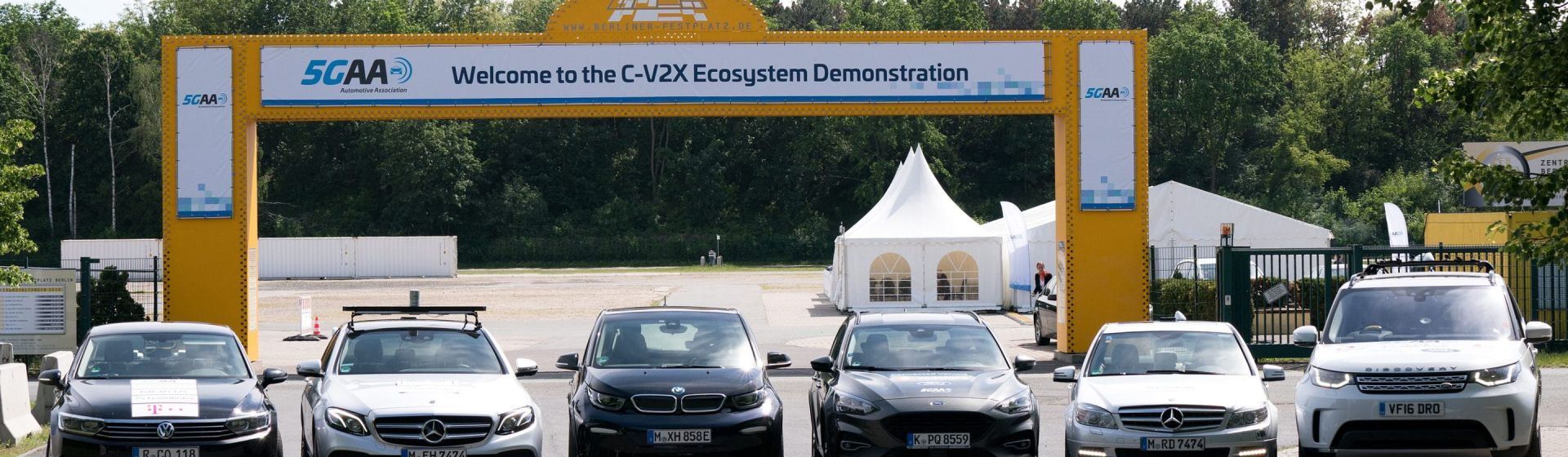
C-V2X contributes to safer roads for everyone: 5GAA live demo event in Berlin
Photos of the workshop can be found here. Click here to see the photos of the live demonstration.
Berlin, 23 May 2019 – Smart mobility technology, which we have been developing over the years, is now a reality. ‘Cellular Vehicle-to-Everything’ (C-V2X) allows vehicles to both communicate with the cloud and also directly with each other and their surroundings. Thanks to 4G LTE cellular technology, as well as the emerging 5G generation of high speed and low latency communications, traffic will be optimized, and emissions will be reduced. Emergency services will navigate smoothly and road safety for everyone, including vulnerable road users, will dramatically enhance.
At a live demo event in Berlin, the 5G Automotive Association (5GAA) presented a deep-dive into a smarter and safer mobility, giving a sneak peek of the technologies ready to be deployed. Prominent 5GAA members including BMW Group, Daimler, Deutsche Telekom, Fraunhofer Institutes FOKUS and ESK, Ford, Huawei, Jaguar Land Rover, Nokia, Qualcomm and Vodafone, demonstrated C-V2X Vehicle-to-Vehicle (V2V), Vehicle-to-Infrastructure (V2I) and Vehicle-to-Network (V2N) applications.
“Connected mobility standards are no longer a vision for the future,” says Maxime Flament, Chief Technology Officer at 5GAA. “The solutions on show are ready to be deployed today and have huge industry momentum based on the forthcoming 5G capabilities. C-V2X technology is a key foundation for a safe and sound driving environment for pedestrians, bicyclists, motorcyclists, cars and commercial heavy trucks. Global field testing is already in its very final stages and the first solutions are now commercially available from multiple suppliers.”
Using both direct short-range communications and mobile networks offers complementary capabilities as showcased in the demos, which involve tele-operated driving and the provision of emergency traffic information between vehicles using multi-access edge computing (MEC) functionality. All the demos use technology that is ready to be deployed.
A short summary on the 5GAA C-V2X use cases, showcased today at Berlin:
1. A. Traffic Management Solutions: Signal Phase and Timing (SPaT) and Red-Light Violation Warning (RLVW) to Vehicle
Waiting at the red light is not only time consuming, but idling, braking and accelerating release more pollutants. The communication between the traffic signal and vehicle is important to improve traffic flow, thus increasing road safety by preventing accidents. During the demo drive, a BMW Group vehicle equipped with a Qualcomm onboard unit running the Savari ITS software stack and the V2X use cases, communicates with a SWARCO traffic signal, showing C-V2X readiness across multiple vendors.
The use case enables the driver to monitor the upcoming traffic light. The center display of the vehicle shows the current signal phase and how long it will remain. In the Red Light Violation Warning (RLVW) use case, the application in the vehicle uses its speed and acceleration profile, along with the signal timing and geometry information from the traffic signal. If the driver is likely to run a red light he/she receives a warning in the vehicle.
B. Traffic Management Solutions: Emergency Electronic Brake light (EEBL)/ Roadworks warning (RWW)
C-V2X provides the driver with information so that he or she can adapt to the upcoming traffic situation in advance. Fraunhofer FOKUS, supported by Daimler, demonstrate an Emergency Electronic Brake Light Warning: Two vehicles equipped with Huawei onboard units are accelerating, and the car ahead brakes hard. The second car instantly receives a warning, demonstrating the advantage of the low-latency C-V2X communication. Furthermore, a Huawei roadside unit communicates ongoing roadwork via C-V2X to the vehicle. Visitors experience both use cases in the car viewing the warnings on the central display.
2. Real Time Emergency Alerts: Vehicle-to-Network and Network-to-Vehicle services
Vodafone Germany and Ford show connected vehicle technology (V2X) that could alert drivers to an accident ahead, moments after it has happened (via eCall Plus). Furthermore, the system provides early warning that emergency vehicles are approaching – and which side of the road other vehicles should move towards to avoid being an obstruction. Experts believe that survival rates for road accident victims can be improved by as much as 40% if they receive treatment just four minutes more quickly.
3. Live data capture and transmission: Expanded network/Vehicle-to-Network capacities via MEC
An ultra-fast, reliable and precise dissemination of safety-relevant information can save lives. Continental, Deutsche Telekom, Fraunhofer ESK and Nokia demonstrate how information is delivered to vehicles almost real-time via a mobile network, utilizing Multi-Access Edge Computing (MEC) technology. All data is processed at the edge of the mobile network to reduce transmission time (latency). As a result, event-related data such as emergency warnings as well as high-definition map data are transmitted in milliseconds, improving driving safety on the path to fully automated driving.
4. Combined Network and Direct solution enables the pinnacle of C-V2X technology
Vodafone Group, Huawei and Jaguar Land Rover demonstrate safety critical use cases by combining different communication modes (short direct via PC5 and longer-range network-based via Uu). The provision of a two-stage warning enables vehicles to be made aware of other vehicles approaching the same junction much earlier and allowing action to taken sooner to avoid a crash. Also, the number of road accidents because of unsafe lane changes and blind spots are significant. Using C-V2X technology helps automotive OEMs keeping the cost of implementing such warnings down by not having to install additional ‘one-off’ radio access systems for such warnings. The demos showcased the value and readiness of C-V2X and its ability to seamlessly combine both long range and short-range direct and longer-range network communication links. Specifically, it was shown that at a T-junction – a key site for accidents – connected cars benefit from longer range cellular network communication to deliver safety-related information beyond what alone can be delivered from short-range technology.
5. Remote-operated driving
Remote-Operated Driving (ROD) smooths the path to automated vehicles, anticipating situations in which remote human operator can intervene with the driving of the vehicle. ROD is enabled by low latency communication equipment e.g. by Huawei to deliver instructions or inputs to the vehicle to help it navigate challenging scenarios. Fraunhofer Institute FOKUS, supported by Daimler, showcase the reliability ROD enables already today.
_______________
Contact
Marketing and Communications Team
Email: marcom@5gaa.org

5GAA Takes part in Making Smart Cities a Reality at inOut 2018
16 March 2018, Rennes, France – Advanced Mobile technology has the power to transform cities life to make it safer, cleaner, greener, and more efficient. At the 5G Automotive Association (5GAA), we believe cellular vehicle-to-everything (C-V2X) and its planned upgrade path to 5G is the technology with the most potential to allow cities of the future to communicate quickly, safely and securely.
The inOut conference – taking place on 14-18 March in Rennes – focuses on the cutting edge of Smart City innovations in the field of mobility and so does the 5GAA.
We are here to discuss and showcase through our members the substantial progress that has been made in the development and the soon-to-be deployment of C-V2X.
CV2X is a unique, game-changing technology that will be placed in vehicles to make your trip safer for you, your passengers and all other road users. The technology enables vehicles to communicate with surrounding cars, with pedestrians and cyclists, with the infrastructure and the network. It means that vehicles will be able to better carry mission-critical communications for safer and more enjoyable driving experience.
Following on from our showcase event at the Mobile World Congress in Barcelona in February – which communicated the organisation’s vision and the technology that we advocate – we participated in a ‘Technology for new mobility’ roundtable to discuss the latest technological advances and solutions for our future transport.
In addition, our members Groupe PSA (who recently joined 5GAA to further support the global expansion of the C-V2X ecosystem) and Qualcomm Technologies, showcased France’s first C-V2X demonstration. The objective of the trial is to test the technology, as the first step of 5G deployment for automotive applications with direct communication between vehicles.
By taking an active part in the inOut conference we are demonstrating why our members believe advancing connected solutions is essential in helping cities transform into the efficient and connected metropolises of the future.
Learn more about the event here
Read PSA and Qualcomm press release here

5GAA recommends the FHWA to rely on C-V2X to advance towards the next generation of North America’s transportation network
As Automatic Driving Systems (ADS) are increasingly being tested and introduced onto public roadways, the Federal Highway Administration (FHWA) made public its interest on hearing from transport-related stakeholders on some of the issues concerning infrastructure requirements and standards that may be necessary to enable safe and efficient ADS operations through a public Request for Information (RFI).
With the objective to contribute to this FHWA request, 5GAA has submitted a series of comments in response to the RFI which try and explain the features and benefits of Cellular-Vehicle-to-Everything technology (C-V2X). Being complementary to ADS technology, C-V2X holds tremendous potential to improve road safety by facilitating the flow of information between vehicles, pedestrians, cyclists, road infrastructure and commercial cellular mobile networks. 5GAA also believes that deployment of C-V2X technology will potentially save taxpayer money which otherwise would be used to deploy, maintain and upgrade roadside units (RSU) utilized by non-cellular technologies.
Moreover, for other benefits such as having the advantage of a higher spectrum efficiency, the capacity to support larger ranges or the fact that the use of C-V2X can make use of already available and deployed cellular networks, 5GAA urges the FHWA to consider further how it can leverage the benefits of C-V2X and synergies between commercial mobile networks and the development of connected transportation safety services.
Read the full publication here.
MWC 2018: 5GAA Gaining Speed Toward C-V2X commercialization
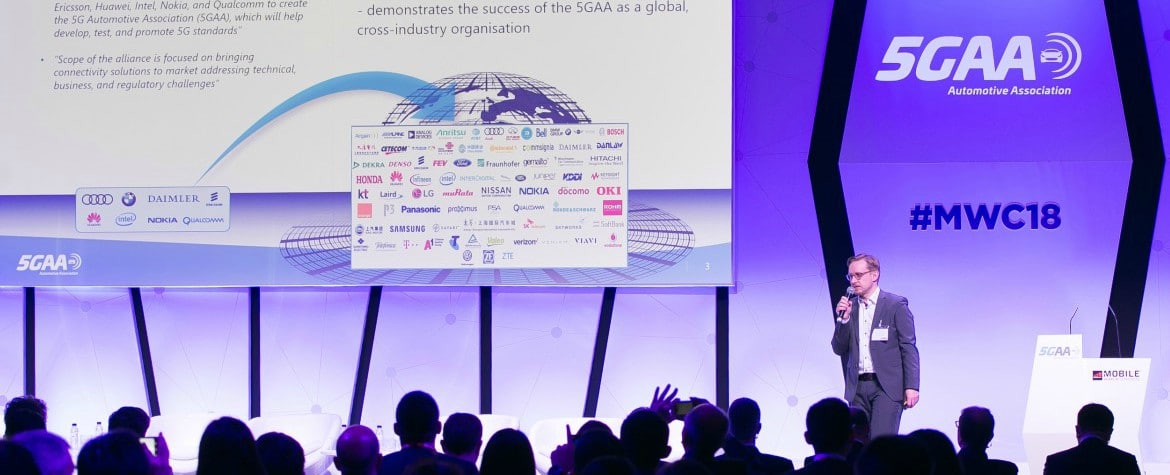
March 2nd, Barcelona, Spain – The 5G Automotive Association (5GAA) presented – during a session at the Mobile World Congress 2018 – the acceleration of C-V2X technology implementation through the widespread support of leading telecommunications and automotive companies. This advanced technology will serve as the lynchpin that will create a connected vehicle ecosystem and enable future mobility solutions. March 1st, Barcelona, Spain – The 5G Automotive Association (5GAA) presented – during a session at the Mobile World Congress 2018 – the acceleration of C-V2X technology implementation through the widespread support of leading telecommunications and automotive companies. This advanced technology will serve as the lynchpin that will create a connected vehicle ecosystem and enable future mobility solutions.
The value of C-V2X technology lies in the fact that it is a unified technology – it can provide short-range and long-range communications. C-V2X technology can, for example, alert drivers of a cyclist around the corner or a traffic jam that is 25 kilometers away.
Christoph Voigt, 5GAA Chairman and Head of R&D Connectivity at Audi announced that: “This effort is now ‘all hands on deck’, meaning that telecommunications and automotive leaders are all working hand-in-hand to deploy C-V2X and to make it hit the road as soon as possible.”
During its session, 5GAA focused on the growing support that C-V2X technology is enjoying among leading companies in the telecommunications and automotive industries and presented the importance that 5G cellular technology will play in enabling smart mobility of the future.
C-V2X gains wide ecosystem support
During the presentation, 5GAA members Qualcomm and Huawei emphasized the growing C-V2X ecosystem support and presented their integrated chipsets that will enable C-V2X commercialization. The start of C-V2X mass market series deployment is predicted to begin as early as 2019/2020.
“We see a growing appetite across the industry for the commercialization of our C-V2X chipset with automakers, Tier-1 suppliers, cellular module manufacturers, ITS providers, integrators, and automakers ready to drive change,” said Jason Ellis, Director of Automotive Business Development at Qualcomm.
Veni Shone, President of LTE product line at Huawei, highlighted that the momentum of C-V2X in China is encouraging – ministries have put their full support behind C-V2X technology on strategy and standardization. Mr. Shone also detailed Huawei’s commitment to accelerate C-V2X, specifically pointing at the releases of its LTE-V2X chipset, T-box prototype, and roadside units.
5GAA plans to support and advocate the work of this technology by speeding up the deployment of C-V2X for the automotive sector while creating a joint ecosystem and implementing key functionalities such as vehicle-to-smart-device.
5G as an enabler for life-saving solutions & new business applications
5GAA members Ericsson and Ford also highlighted exciting use cases and growing business applications for 5G technology in the automotive sector.
Don Butler, Executive Director of Connected Vehicles and Services at Ford stated that: “Creating safer and more personalized journeys through automated driving is the long-term vision of mobility’s future. We believe 5G will enable this by maximizing the in-vehicle experience thanks to high reliability, fast-paced communications. We will create new, compelling experiences and capabilities saving more lives with patient transport monitoring or teleoperated driving.”
With the advancement of 5G technology and its application to connected vehicles, the amount of data created will continue to expand exponentially.
Stefano Sorrentino, Master Researcher at Ericsson presented the fact that: “Connected & automated driving will lead to a data explosion that will definitely challenge the network capacities. This challenge could be remedied through the deployment of scalable and integrated networks and cloud architectures as well as the continuous evolution of radio technology into 5G.”
“We think of 5G as an end-to-end solution starting with the wireless connectivity but also including edge computing, the transport network, artificial intelligence and machine learning. Together they power the applications and the services for intelligent transportation and smart mobility, and ultimately, the ways humans interact with connected and self-driving cars of the future. It is an exciting area for 5GAA to work on and we invite any stakeholder to join us and contribute on this journey.” concluded Thierry Klein, Head of Disruptive Innovation Program at Nokia Bell Labs and Vice Chair of 5GAA Board.
About 5GAA
The 5G Automotive Association (5GAA) is a global cross-industry organization of companies from the automotive, technology and telecommunications industries (ICT), working together to develop end-to-end solutions for future mobility and transportation services. Created in 2016, the Association is comprised of over 75 members whose mission is to develop, test and promote communications solutions, initiate their standardisation and accelerate their commercial availability and global market penetration, to address society’s connected mobility and road safety needs with applications such as automated driving, ubiquitous access to services and integration into smart city and intelligent transportation.

5GAA Announces Deployment of LTE-V2X by 2020
The C-V2X technology tested, validated, and commercially available in vehicles in 2020
The inclusion of cellular communication technologies (V2N – Vehicle2Network) into vehicles (i.e. “Connected Cars”) has been extremely successful, and since early deployments in the last couple of decades, we continue to see an expansion of how these technologies can deliver benefits for the vehicle, the driver, and other participants in the transportation ecosystem.
At present, the automotive manufacturing members of 5GAA operate more than 20 million Connected Cars that have the ability to connect to cellular networks (V2N). This V2N connection is used for a wide variety of application domains including telematics, infotainment, traffic optimization, as well as for safety applications like the recognition of slow or stationary vehicle(s) and warnings for such events as traffic jam ahead, road works and other traffic infrastructure related information, inclement weather conditions, emergency brake light and other hazard warnings. The current understanding, also based on the European C-ITS Platform Final Report, is that the nature of these warning messages is informational and the driver is responsible at all times.
As defined in the approved 3GPP Release 14 in June 2017, cellular networks are able to take another evolutionary step in the pathway to broaden the reach and applicability of benefits.  In particular, this release addresses the challenges of delivering increased data volume, managing greater scale in connected devices, significantly reduced latency and providing higher levels of reliability. These defined attributes and an advanced architecture provide unprecedented support for the support of safety-critical communications, referred to as Cellular Vehicle to Everything (Cellular-V2X or C-V2X). In addition to such V2N enhancements, which rely on existing cellular networks, 3GPP Release-14 introduces the ability to support short-range communications between vehicles (V2V) and vehicle and road side infrastructure (V2I and I2V) without requiring any cellular network coverage.
3GPP Release 14 including C-V2X is also a key step to the next generation of cellular technology, 5G. Naturally C-V2X is already on a backwards compatible evolution path with enhancements being specified beginning with 3GPP Release 15.
The members of 5GAA are wholly committed to collaborating to ensure that the potential of the C-V2X technology is realized. This includes leading efforts to address key technical and regulatory issues, as well as integrating vehicle platforms with advanced cellular connectivity, networking and computing solutions.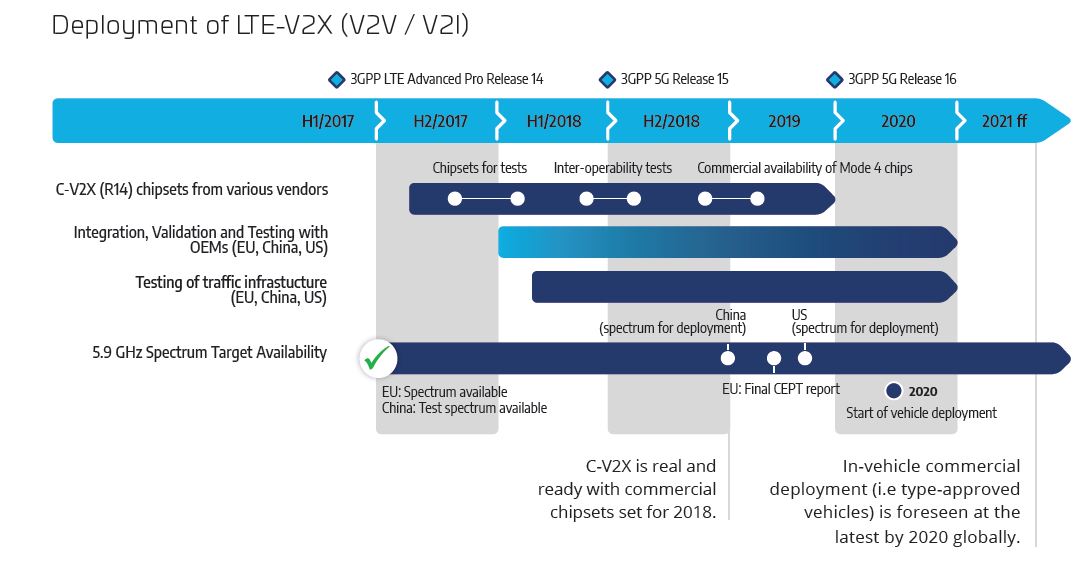
It is with this cooperation, collaboration, and commitment that 5GAA members continue to work to ensure that C-V2X technology is tested, validated, and commercially available in vehicles in 2020.
C-V2X & Edge Computing: The Winning Technologies for Connected Vehicles and Autonomous Driving
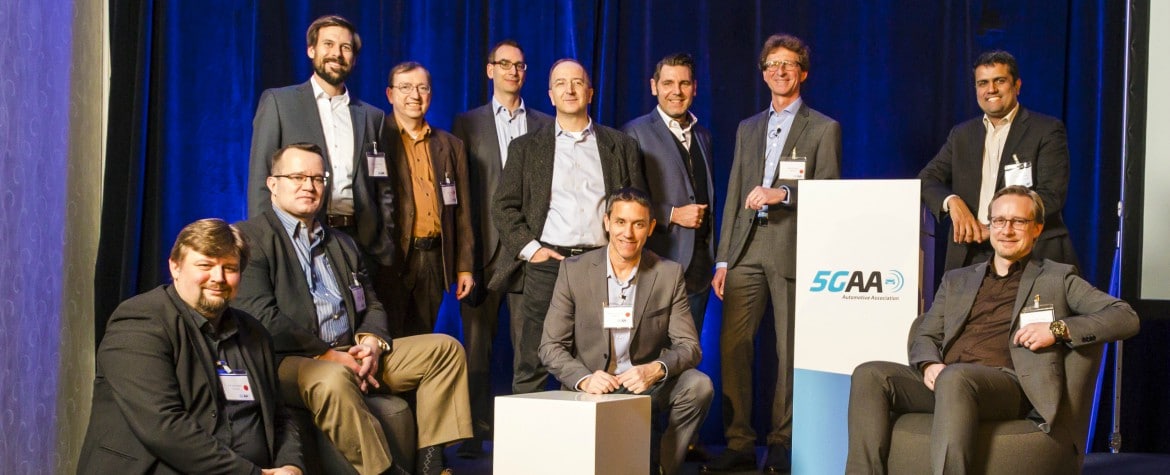
Munich, Germany – On 8th February 2018, the 5G Automotive Association lead a successful Open Workshop on “Edge Computing and V2X“. The workshop – open to both 5GAA members and non-members – aimed to provide a discussion platform for the wide range of stakeholder advocating for the evolution of cloud computing in the automotive sector.
Edge Computing offers cloud computing capabilities at the edge of the network. Several demonstrated C-V2X use case trials have already proven the potential of Edge Computing to serve real C-V2X scenarios. 5GAA considers Edge Computing as one of the key supporting technologies for many of the foreseen V2X services for connected vehicles and for Autonomous Driving.
The Munich workshop brought together industry stakeholders from car OEMs, OEM suppliers, road and mobile network operators to edge computing technology vendors. Edge Computing was covered from various perspectives, illustrating its potential to further expand the competitiveness of C-V2X as the technology of choice for C-ITS. The unique position of 5GAA in the technology and solutions development was again highlighted.
The automotive sector, including OEM suppliers and car makers, shared their thinking and experiences with the technology. The event culminated in the panel discussion which included consideration of use cases and requirements and on how to best utilise the networks and Edge Computing for C-V2X.
Finally, the participating companies concluded a common understanding on the way forward:
- Edge Computing has a great value proposition for C-V2X and its evolution, as it further increases the competitiveness of C-V2X and its infrastructure component (LTE-Uu) over the alternative ITS-G5 technology.
- Technical discussions are to continue in the 5GAA working groups; further collaboration with standardization bodies is encouraged to continue and expand.
- Future workshops similar to this one can be considered, e.g. again collocated with a future 5GAA meeting.
About the 5GAA
The 5GAA is a cross-industry association between the cellular and automotive industries to develop, test and promote communications solutions, initiate their standardisation and accelerate their commercial availability and global market penetration, to address society’s connected mobility and road safety needs with applications such as automated driving, ubiquitous access to services and integration into smart city and intelligent transportation.
LG, Ford, Verizon, Denso and Gemalto join the 5G Automotive Association
5GAA (www.5gaa.org) welcomes LG, Ford, Verizon, Denso and Gemalto as new members of the association.
“We are very pleased that LG, Ford, Verizon, Denso and Gemalto have joined the association. With their global footprint and diverse expertise across the communications and automotive ecosystems, these companies will contribute to the definition and development of next generation connected mobility and automated vehicle solutions” Dino Flore, Director General of 5GAA, said.
Kookyeon Kwak, Executive Vice President, Head of LG’s Advanced Standard R&D Lab, said, “Cellular communication will play a pivotal role to meet the requirement of safety, convenience, and infotainment for future smart cars. The trend is now being accelerated by the completion of LTE-V2X, the first cellular- based vehicle-communication standard. As a manufacturer in mobile communication and vehicle component areas, LG Electronics would like to contribute to 5GAA for connecting communication and automotive industries”.
“We are excited to work together with other automotive and technology providers to define a future that envisions new and empowering mobility services and solutions. We see the 5GAA as a key enabler to the development of a sustainable connected vehicle ecosystem.” Don Butler, Executive Director of Connected Vehicle and Services at Ford Motor Company, said.
DENSO CTO for the European region, Masato (Max) Nakagawa, commented: “Extending DENSO’s global efforts in the area of vehicular connectivity is strategically aligned to our policy ‘Protecting Lives, Preserving the Planet, and Preparing a Bright Future for Generations to Come’. Reinforcing this
direction, DENSO AUTOMOTIVE Deutschland GmbH has decided to join the 5GAA. We are proud to be accepted as 5GAA member and are looking forward to collaborating in the 5GAA. DENSO considers this engagement viable to complement our long term ongoing global support of 700MHz/5.9GHz V2X safety communication. 5GAA provides the environment for the cross-industry collaboration required to define corresponding future mobile communication systems. In collaboration with the 5GAA partners we plan to explore, define and develop multi-spectral connectivity to support future mobility demands, especially in the area of connected and automated driving.”
“Gemalto is thrilled to join 5GAA and work within this prestigious group of global leaders to enable the world of new mobility that will revolutionize the automotive sector,” says Frederic Vasnier, EVP
Embedded Software and Products. “Gemalto has demonstrated its unrivaled expertise to ensure simple, seamless and ubiquitous connectivity with robust security mechanisms inside the vehicle, between vehicles and with the connected ecosystem of devices, pedestrians, and the cloud.”
5GAA was created to bridge automotive and communication industries in order to develop, test and promote connected mobility solutions, initiate their standardization and accelerate the commercial availability and global market penetration.
Since its inception, 5GAA has been experiencing rapid expansion to include key players with a global footprint in the communication and automotive industries, including car manufacturers, tier-1 suppliers, chipset/communication system providers, mobile operators and infrastructure vendors.
To achieve its long-term goals, the association is creating five Working Groups to address the following areas of work: Use Cases and Technical Requirements; System Architecture and Solution Development; Evaluation, Testbeds and Pilots; Standard & Spectrum; Business Models and Go-To-Market Strategies. In addition, the board is planning the needed policy and advocacy efforts to join the relevant discussions in this space with different regulators, policymakers, and administrations around the world.