

5GAA Launches its Second General Assembly and Working Group Meeting in Shanghai
From 13-17 November 2017, the global members and invited guests of the 5G Automotive Association will assemble in Shanghai, China. The aim of the meeting is to promote the advancement of our mobility ecosystem as well as deepening the association’s collaboration with the Chinese automotive and telecommunications industries.
Over the course of the first three days (13-15 November 2017), 5GAA’s members will collaborate in Working Group meetings. This is a unique opportunity for global leaders in the automotive and telecommunications industries to share innovative practices and drive towards progress.
On the 16th November, The General Assembly will take place: a 1-day meeting where the association’s members will reflect on 2017’s achievements as well as outlining a vision for 2018.
5GAA is honoured to welcome illustrious representatives from Public Institutes to participate in the Asia Pacific Roundtable discussion on Thursday, 16 November 2017. The delegation will include Chinese representatives from the Traffic Management Research Institute of Ministry of Public Security, the Research Institute of Highway Ministry of Transport, the China Academy of Information and Communications Technology of Ministry of Industry and Information Technology, and the Road Bureau of Ministry of Land, Infrastructure, and Transport.
Additionally, South Korean delegates from the Road Bureau of Ministry of Land, Infrastructure, and Transport will participate. This Roundtable promises to generate interesting ideas.
Following the Roundtable discussion and in order to gain a greater practical understanding of the transportation advances in China, 5GAA will visit the Shanghai Testbed with a live demonstration of the power of LTE-V2X and 5G-V2X technology in transport.
Chairman of 5GAA, Christoph Voigt, underlines the importance of choosing China as the location for the Second General Assembly: “We are looking forward to further understanding the progress China can offer to advance 5G transport solutions globally. China is a strong supporter of deepening 5G connectivity to deliver safety and sustainability solutions on our roads. Our discussions with representatives from political and academic institutions in China will offer us an opportunity to gain support around the World and to innovate further, faster and more effectively.”
Since its launch in September 2016, 5GAA has grown exponentially worldwide. Over 60 industry leaders from the automotive, technology and telecommunications industries have teamed up to accelerate C-V2X technology development and its evolution to 5G-V2X for enhanced safety, automated driving, and connected mobility. Together, 5GAA members are building a safer, more sustainable and connected transport ecosystem.

5GAA & GSMA Letter to EU Commission
The 5G Automotive Association (5GAA) represents the automotive and telecom industry’s alignment for the global connected and autonomous vehicle, supported by more than 50 member companies including many world class car manufacturers. 5GAA’s mission is to develop, test and promote communication solutions for the future of the 5G automotive economy in Europe and globally. The 5GAA is actively contributing to ETSI, 3GPP and ITU in the fields of standardisation and spectrum-related matters. The 5GAA is committed to accelerating Cellular-V2X (C-V2X) standards seamlessly embracing 4G and 5G, and would like to call on the European Commission to support stakeholders in this collaborative process by providing leadership and timely regulatory support.
The GSMA, which represents the Mobile Network Operators globally, has succeddfully collaborated with the Automotive Industry for many years. Together we have created secure solutions that have advanced the Connected Car market with major benefits to consumers. Cellular V2X will enable further cross-industry collaboration with government agencies in cities and transport. The GSMA believes that C-V2X will contribute to safer vehicles, reduce congestion and pollution. It will build upon the existing 23 million existing Cellular Connected Car market in Europe and drive the deployment of Digital Europe.
The 5GAA is keenly aware of the imperative for road safety and the need for Europe to assert 5G leadership while ensuring spectrum efficiency. Given the longevity of vehicles and the significant industry investment in cellular technologies, C-V2X will be of utmost importance as Europe and the world transitions to 5G in supporting mission critical applications and the massive opportunities associated with the introduction of a new global standard.
We therefore urge the European Commission to allow the ITS-G5 and C-V2X stakeholders to work collaboratively toward an agreement on the future of connected and automated cars, without a premature and cumbersome legislative decision.
The 5GAA is confident that the industry will ultimately align with a pragmatic solution that saves the most lives while embracing technology evolution, and managing complexity and cost. We firmly believe in and pledge to collaboratively work with other stakeholders on solutions that ultimately benefit the European Union. We encourage the European Commission to support technology neutrality, mitigating a significant risk that 5G in the key automotive vertical will struggle, thus impacting the European automotive industry and the future growth and global competitiveness of the EU economy.
Europe is an important pillar for members of the 5GAA and is leading the world in the development of smart transportation solutions. A considerable part of C-V2X innovation occurs in Europe, and will contribute to road safety, the development of smart cities and trans-border corridors, to achieve the efficiency and environmental objectives that ultimately benefit European citizens. 5GAA members are accelerating C-V2X with pre-commercial trials in Europe, and will culminate in global deployments.
We are strongly supportive of 3GPP technologies for direct communications over ITS spectrum to enable vehicle-to-vehicle, vehicle-to-infrastructure, vehicle-to-pedestrian (and other vulnerable road users), i.e. C-V2X, while also leveraging vehicle-to-network over mobile operator spectrum. An important part of the ongoing 5GAA work is to support the European Commission’s policies laid out in the C-ITS Masterplan, as well as Gear2030 for Highly Automated Vehicles and the 5G Action Plan. We strongly rely on the European institutional support to enable a regulatory framework conducive to an industry-driven and swift deployment of the platform of their choice.
The 5GAA looks forward to continuing the dialogue with the European Commission and the various industry stakeholders in order to lay the foundation for a 5G automotive future in Europe.
Download the letter here
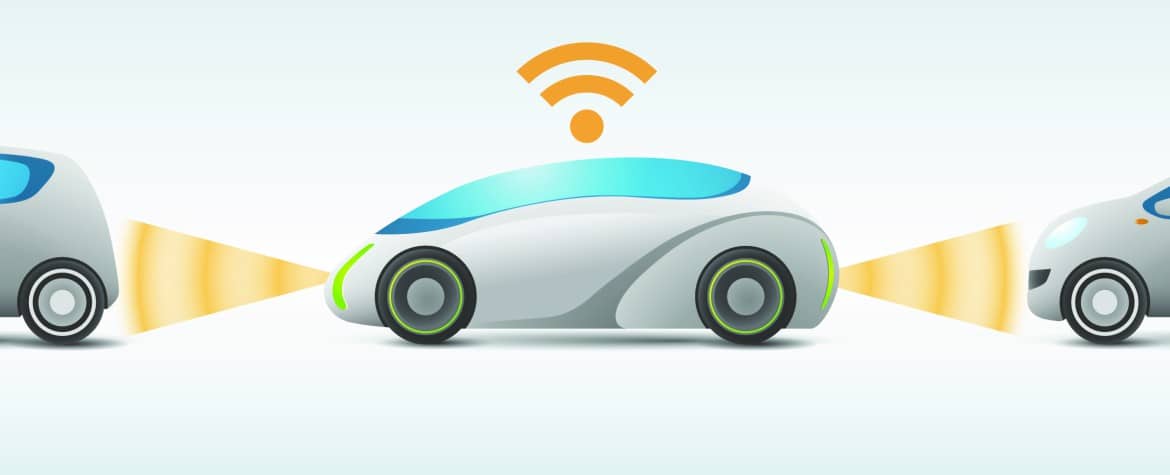
Coexistence of C-V2X and 802.11p at 5.9 GHz
Today the European market has interest in two distinct technologies for Intelligent Transport Systems (ITS) and the provision of vehicle to vehicle communications; namely 3GPP LTE-V2X and IEEE 802.11p.
The technology-neutral nature of spectrum regulations in Europe means that both LTE-V2X1 and 802.11p have equal rights to operate in the 5.9 GHz band, subject to compliance with the relevant regulatory technical conditions.
It is not the objective of this paper to compare and contrast the relative merits of these two technologies, although the 5GAA is a proponent of LTE-V2X as today’s realisation of Cellular V2X (C-V2X), and as a platform to evolve towards 5G technologies.
Instead, in this paper, we address the issue of co-channel coexistence between the two technologies at 5.9 GHz. We note that this is a critically important issue for the ITS industry, and that it is beneficial for all stakeholders to arrive at a proportionate, fair, and pragmatic solution to resolve this matter, and allow the market to proceed with the deployment of ITS equipment.
To this end, we propose a solution – to be agreed among the stakeholders – to be implemented in up to three steps. In all steps, each of C-V2X and 802.11p can operate safety-related ITS services free from co-channel interference from the other technology. The difference between the distinct steps lies in the overall usage efficiency of the spectrum resource: In the short-term, we propose to allocate distinct 10 MHz channels at 5875-5905 MHz to each of the two technologies, while the final configuration will apply full sharing of all available channels across the two technologies. The latter will require further studies on appropriate sharing mechanisms and thus cannot be provided from the beginning.
We further explain how such a first step partitioning of 5875-5905 MHz might be complemented by additional technical mechanisms which would – where needed – allow each of C-V2X and 802.11p to access the remaining 20 MHz in a fair manner, with a reduced risk of harmful co-channel interference.
We believe that the proposed approach would greatly facilitate the coexistence of C-V2X and 802.11p at 5.9 GHz, and we would encourage stakeholders to further develop this proposal and come to a speedy agreement on this for the benefit of the European ITS industry as a whole.
Read the full paper here.

5GAA welcomes AT&T, Jaguar Land Rover, NTT DOCOMO and Samsung Electronics as elected Board members
The 5G Automotive Association announced today the election of its new Board members following the General Assembly held on May 11, 2017. Continuing members AUDI AG, BMW Group, China Mobile, Daimler AG, Ericsson, Ford, Huawei, Intel, Nokia, SAIC Motor, Vodafone Group and Qualcomm Incorporated will be joined by AT&T, Jaguar Land Rover, NTT DOCOMO and Samsung Electronics.
The election of AT&T, Jaguar Land Rover, NTT DOCOMO and Samsung Electronics as Board members will strengthen the position of 5GAA as a global, cross-industry association of automotive, technology and telecommunications companies. It reflects the diversity of 5GAA’s membership, both in terms of geographical spread and expertise.
The Chairperson is Christoph Voigt (Audi) and the Vice Chairperson is Thierry Klein (Nokia), both elected to their second term. The Board of the Association renewed the mandate of the outgoing Executive Committee: Dino Flore (Qualcomm) will continue to serve as Director General, Markus Dillinger (Huawei) as Secretary, and Fathi Arafat Husein El-Dwaik (BMW) as Treasurer. The Board also confirmed the appointment of elected Working Groups Chairs and Vice-Chairs.
“We are very pleased that AT&T, Jaguar Land Rover, NTT DOCOMO and Samsung Electronics have joined the 5GAA Board,” said Christoph Voigt, Chairman of the 5GAA Board. “With their global footprint and diverse expertise, they will contribute to further connect communication and the automotive industry to develop end-to-end solutions for future mobility and transportation services.”
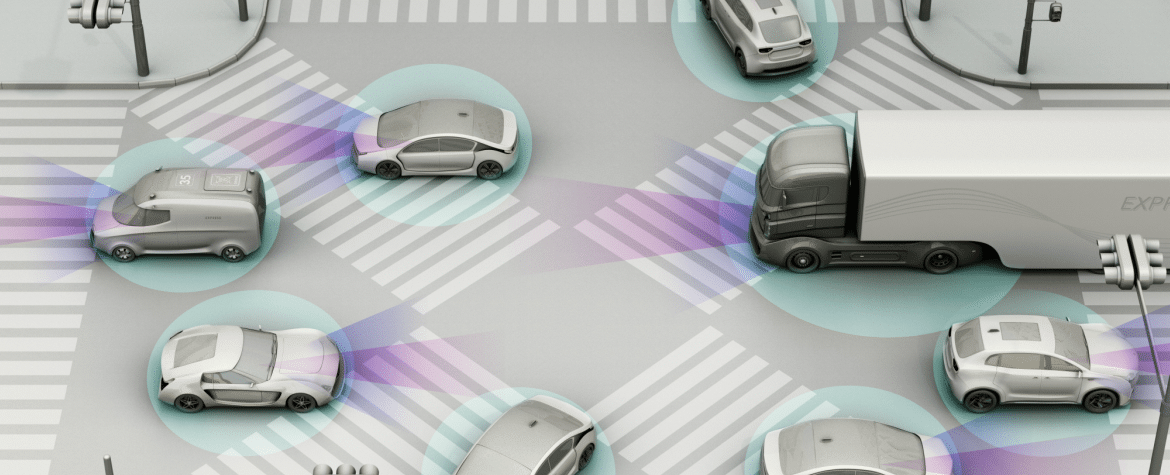
5GAA submitted comments to the National Highway Traffic Safety Administration
The 5G Automotive Association (5GAA) submitted comments to the National Highway Traffic Safety Administration (NHTSA) notice of proposed rulemaking (NPRM), “Federal Motor Vehicle Safety Standards; V2V Communications.” The proposed rule is to mandate new light-duty vehicles to be equipped with dedicated short range communications (DSRC).
The 5GAA is a new global cross-industry association of automotive, technology and telecommunications companies and includes 42 members, of which 8 are founding members (AUDI AG, BMW Group, Daimler AG, Ericsson, Huawei, Intel, Nokia, Qualcomm). Our mission is to enable communications solutions that address society’s connected mobility and road safety needs.
In our submission, 5GAA applauds the concept behind the rule, as V2V safety is important to our technology deployment mission. 5GAA urges NHTSA to not consider just the best technology of today, but also to consider the best technologies of tomorrow. Such an approach will promote innovation and competitive market-based outcomes, ensuring that American drivers and passengers benefit from the best and most advanced safety solutions available as technology evolves. Rigid technology mandates such as specifying DSRC, whether direct or de facto, freeze technology solutions to a past point in time. NS will significantly impede the innovation and evolution path for Vehicle-to-Vehicle (V2V) safety, and positions the US to lag behind the rest of the world in V2V communications specifically as well as V2X broadly. 5GAA elaborates on the following points:
Similar to DSRC, Cellular-V2X technology for V2V safety can transmit BSM in an ad hoc manner without cellular network coverage.
Cellular-V2X technology for V2V safety communications can operate without a SIM card and offers the tools to adopt, evolve or innovate any privacy-preserving security management system including SCRM.
Cellular-V2X technology for V2V safety benefits from a significantly larger link budget than DSRC (e.g., 8 dB at high speeds), corresponding to twice the range of DSRC and higher reliability.
Cellular-V2X technology for V2V safety can support up to 50 messages per second with less than 20 msec latency.
Cellular-V2X enables V2V, and for that matter Vehicle-to-Infrastructure (V2I), Vehicle-to-Pedestrian (V2P) and Vehicle-to-Network (V2N), safety applications to take advantage of the widespread cellular network coverage in the US.
5GAA notes also that the impending launch of 5G will only widen the performance gap between Cellular- V2X and DSRC.
5GAA believes that Rather than moving forward with the proposed regulation, NHTSA should instead undertake an updated, comprehensive technology neutral analysis of V2V solutions, including DSRC and Cellular-V2X, against the performance requirements in the NPRM. If this review indicates that regulatory action is necessary, the U.S. Department of Transportation should move forward with a technology neutral regulation that sets forth minimum V2V safety performance requirements only.
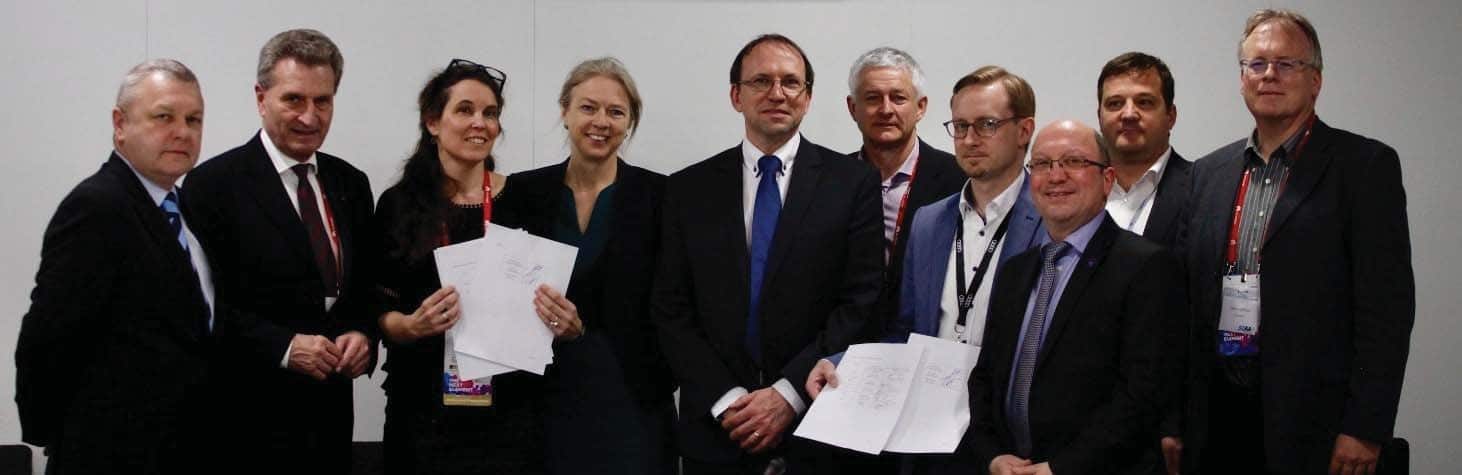
5G Automotive Association and European Automotive Telecom Alliance sign a partnership MoU
(Barcelona, February 27, 2017). The 5G Automotive Association (5GAA) and the European Automotive Telecom Alliance (EATA) have signed a Memorandum of Understanding. The aim of this partnership is to foster cooperation in the field of connected and autonomous driving solutions as well as standardisation, spectrum and related use cases.
The 5GAA and EATA are dedicated to prioritising the use cases identified by the two organisations in order to identify the technical requirements that need to be addressed, both in the short and in the long term. In order to better support standards for connected and automated driving, standardisation prioritisation for standards bodies such as ETSI, 3GPP and SAE International is necessary as well.
It’s beyond dispute that promoting spectrum-related issues (V2X), agreement on usage modalities of certain bands, security, and privacy, as well as vehicle safety requirements to be supported by both mobile network operators (MNOs) and vehicle manufacturers (OEMs) will need to be addressed jointly. Last but not least, the agreement between MNOs and OEMs is also key to developing business models and aligning the timelines of both industries.
The 5GAA includes 33 members, of which 8 are founding members (AUDI AG, BMW Group, Daimler AG, Ericsson, Huawei, Intel, Nokia and Qualcomm Incorporated). The 5GAA is a multi-industry association to develop, test and promote communications solutions, initiate their standardization and accelerate their commercial availability and global market penetration to address the societal need. Focus areas are the development, testing and promotion of communications solutions, the initiation of their standardization and the acceleration of their commercial availability and global market penetration to address society’s connected mobility and road safety needs with applications such as autonomous driving, ubiquitous access to services and integration into smart city and intelligent transportation.
EATA is comprised of six leading associations and 38 companies at present, including telecom operators, vendors, automobile manufacturers and suppliers for both cars and trucks. The main objective of the Alliance is to promote the wide deployment of hybrid connectivity for connected and automated driving in Europe. EATA’s first concrete step is the advancement of a ‘pre-deployment project’ aimed at testing the performance of hybrid communication required for automated driving under real traffic situations.
Furthermore, EATA seeks to identify and address service and technology roadmaps, safety and security
needs, as well as regulatory and business issues. The project will tackle cross-border interoperability, including digital and physical infrastructure, as well as vehicle localisation issues.
“The revolution that connected and automated driving is going to bring about at the societal level is already shaping Europe’s automotive and telecoms sectors at a rapid pace. This Memorandum of Understanding with the 5GAA not only brings the different industry partners closer together but also reinforces the European Commission’s strategy on cooperative, connected and automated mobility that was launched at the end of 2016. Car connectivity and automation will require a mix of communications technologies, but it is clear that 5G technology can become a key enabler of Europe’s digital highways. Together, EATA and 5GAA will contribute to reinventing the driving experience.”
Erik Jonnaert, Chairman of the EATA Steering Committee
“5GAA was created to connect telecom industry and vehicle manufacturers to develop end-to-end solutions for future mobility and transportation services. We look forward to working with EATA to define the requirements of C-V2X and to create a successful V2X ecosystem.”
Christoph Voigt, Chairman of the 5GAA Board
Ficosa, CMCC, Viavi, SAIC, Samsung, Rohde & Schwarz, ZTE, NTT DOCOMO, Continental, Danlaw join the 5G Automotive Association
5GAA welcomes Ficosa, CMCC, Viavi, SAIC, Samsung, Rohde & Schwarz, ZTE, NTT DOCOMO, Continental and Danlaw as new members of the association.
The new members significantly grow 5GAA membership base and diversity, both in term of geography and expertise. This will allow 5GAA to further connect communication and the automotive industry to develop end-to-end solutions for future mobility and transportation services.
Telecommunications and automotive players form global cross-industry 5G Automotive Association
AUDI AG, BMW Group, Daimler AG, Ericsson, Huawei, Intel, Nokia and Qualcomm Incorporated team up to evolve, test and promote communications solutions for connected mobility.
Next generation mobile networks will help to address society’s mobility and road safety needs with applications like connected infotainment features and connected automated driving.
The association is open to further partners.
Munich, September 27, 2016 – Today AUDI AG, BMW Group, Daimler AG, Ericsson, Huawei, Intel, Nokia and Qualcomm Incorporated, announce the formation of the “5G Automotive Association”.
The association will develop, test and promote communications solutions, support standardization and accelerate commercial availability and global market penetration. The goal is to address society’s connected mobility and road safety needs with applications such as connected automated driving, ubiquitous access to services and integration into smart cities and intelligent transportation.
With next generation 5G mobile networks and continued strong LTE evolution, which includes Cellular Vehicle-to-everything (C-V2X) communication, the focus of information and communication technologies (ICT) shifts towards the Internet of Things and the digitalization of industries.
As an evolution to today’s networks, next generation mobile networks are expected to handle much more data volume, connect many more devices, significantly reduce latency and bring new levels of reliability. For example, 5G can better support mission-critical communications for safer driving and will further support enhanced vehicle-to-everything communications and connected mobility solutions.
These new solutions bring new technological and business opportunities for both the automotive and ICT industries, and the members of the association will closely collaborate to realize the full potential together. The association will address key technical and regulatory issues, leveraging next generation mobile networks and integrating vehicle platforms with connectivity, networking and computing solutions. The main activities of the association include:
- Defining and harmonizing use cases, technical requirements and implementation strategies.
- Supporting standardization and regulatory bodies, certification and approval processes.
- Addressing vehicle-to-everything technology requirements, such as wireless connectivity, security, privacy, authentication, distributed cloud architectures and more.
- Running joint innovation and development projects leading to integrated solutions, interoperability testing, large scale pilots and trial deployments.
The 5G Automotive Association is a global association and welcomes more partners who are engaged in the automotive industry, the ICT industry or the broader eco-system and value chain for vehicle and road transportation systems. Several companies have already expressed strong support for the 5GAA and declared their intent to join the Association in the near future.
Christoph Voigt is appointed Chairperson of the Board and Dino Flore is appointed Director General of the Association.
The Association will support and work in close cooperation with national and regional initiatives, such as the European Connected & Automated Driving Pre-Deployment Project.
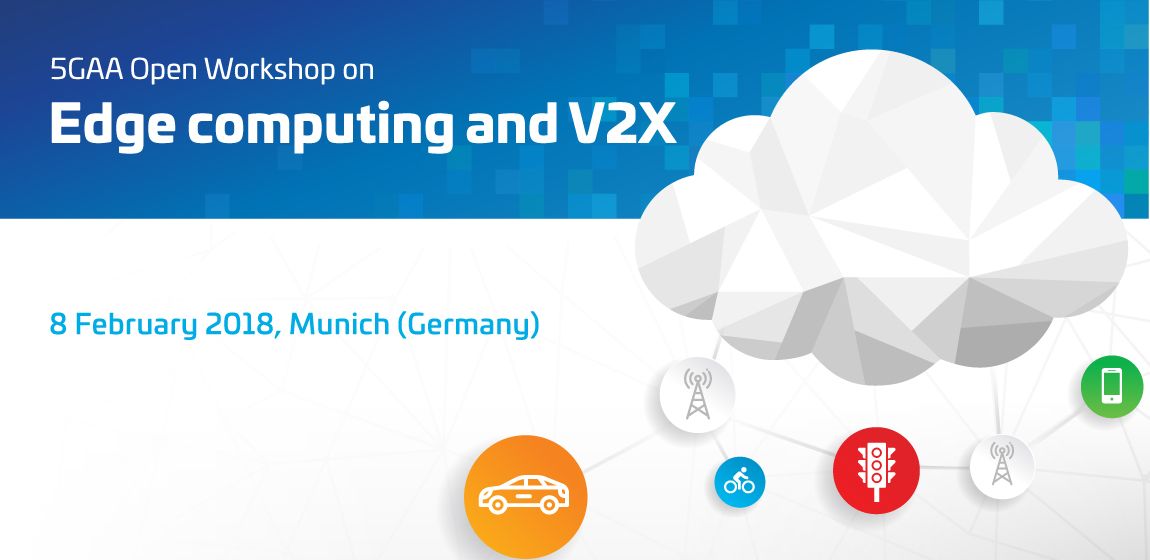
5GAA Open workshop on “edge computing and V2X”
The workshop, open to both 5GAA- and non-5GAA members, aims to provide a discussion platform on the evolution of cloud computing in the automotive sector.
- It presents an opportunity for automotive players to provide customers’ voice on future connected vehicles and automotive applications enabled by distributed cloud.
- It strives to connect different stakeholders from car OEMs and network operators to edge computing technology vendors.
- It will facilitate active dialogue and encourage further collaboration.
RSVP TODAY
If you are not a member of 5GAA, please send an e-mail to secretariat@5gaa.org with first and last name, company and position.
VIEW THE PROGRAM
Download program

5GAA | C-V2X Workshop and Demonstration for North American Transportation Planning and North American Road Operators
5GAA is pleased to present a C-V2X Workshop for North American transportation planning and road operations communities (State DOTs, MPOs, and local agencies).
This workshop is intended to jumpstart a dialog between technology providers, cellular network operators and the transportation community on the capabilities, timeline and the potential role of cellular technologies to transportation systems management and operations (TSMO).
During the workshop, questions from stakeholders and technology providers alike will be asked and answered. In addition to valuable knowledge exchange, a primary output is to define solid next steps to realize the promise of C-V2X on our roads.
WORKSHOP AGENDA
| Time slot | Thursday, 26 April |
|---|---|
| 08:30 – 09:15 | Registration at Hyatt Regency Washington Capitol Hill |
| 09:15 – 09:45 | Introductory Remarks |
| 09:45 – 10:30 | C-V2X: The Basics |
| 10:30 – 11:30 | Roundtable Discussion: Transportation Needs and C-V2X Solutions |
| 11:30 – 12:45 | Luncheon Keynote Speakers: Roger Lanctot, Strategy Analytics and Mike Mollenhauer, Virginia Tech Transportation Institute |
| 12:50 – 13:10 | Product Life Cycle Management |
| 13:10 – 14:00 | Economics of C-V2X: Alternative Models of Deployment |
| 14:00 – 14:20 | Wrap up and Next steps |
| 14:30 | Bus Shuttle to RFK Festival Ground Lot 7 |
| 14:30 – 18:30 | Demonstrations in Groups |
More information about the Agenda here
C-V2X DEMONSTRATION SUPPORTED BY VTTI
The workshop will be followed immediately by a demonstration of six C-V2X technology scenarios (supported by 5GAA members). Location RFK Festival Ground Lot 7.
RSVP INFORMATION
Note: participation is limited to both the workshop and the demo.
Please apply here