

5GAA Study | The cost-benefit analysis on cellular vehicle-to-everything (C-V2X) technology and its evolution to 5G-V2X
This report, authored by independent telecoms, media and technology consultants Analysys Mason together with automotive consultancy SBD Automotive, assesses the benefits of cellular vehicle to everything (C‑V2X) technology for delivery of vehicle-to-everything (V2X) communication. The report, which has a focus on the benefits of such solutions in Europe, uses qualitative evidence, and describes quantitative cost–benefit analysis that the consultants have undertaken, relating to deployment of C‑V2X.
The purpose of the study has been to examine qualitative evidence and perform quantitative analysis, regarding the net benefits of C‑V2X. Quantitative analysis is focused on the European market, where the European Commission (EC) is currently undertaking a public consultation on the deployment of cooperative intelligent transport systems (C‑ITS).
Read the full study here.
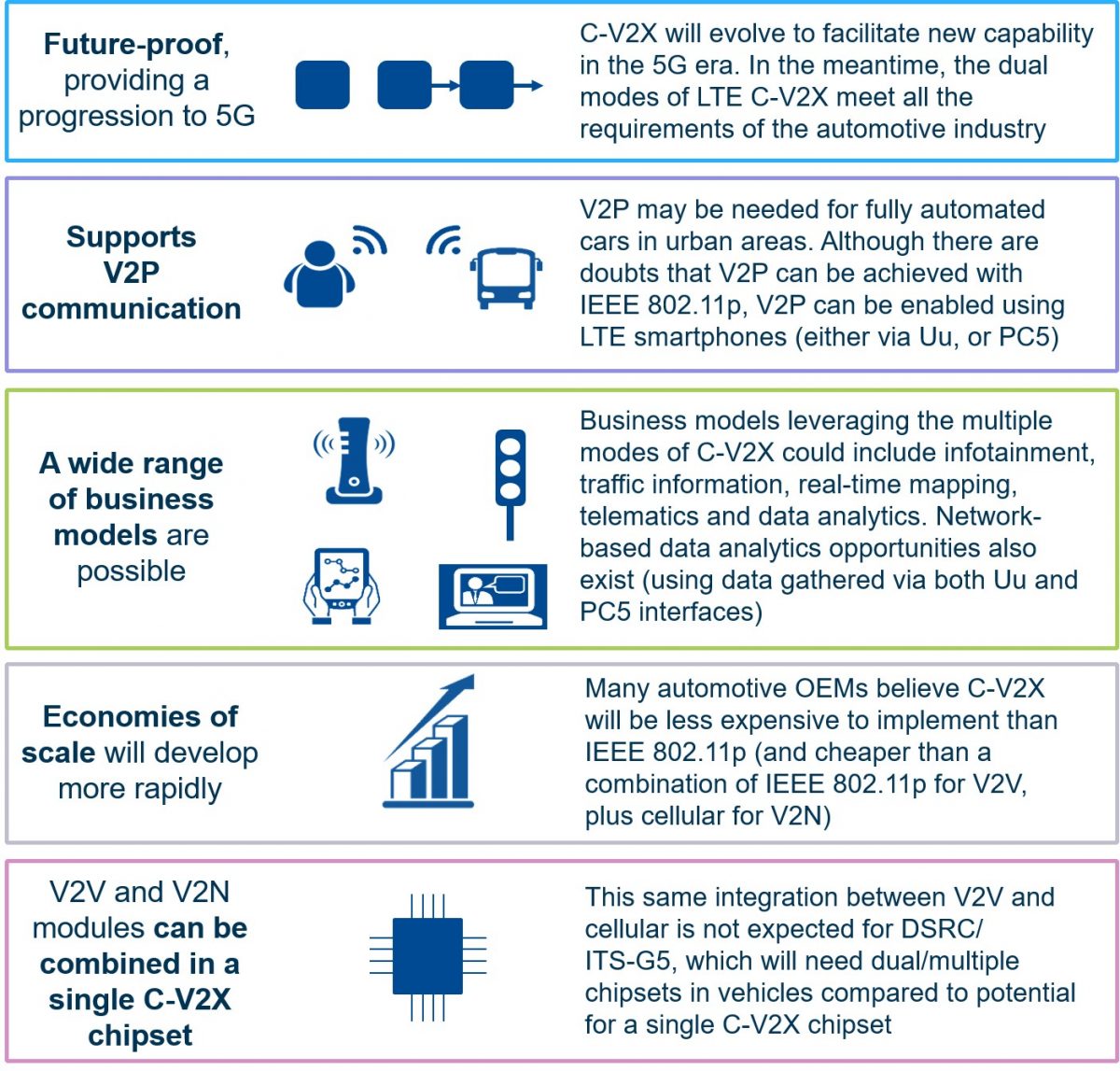
As part of this study, primary research has been conducted to elicit views from the mobile and automotive industries on the benefits of C‑V2X. One-to-one interviews with companies involved in the 5GAA were held, in order to identify several key benefits, as summarised in Figure 1.1 below.
A snippet from the report featuring the benefits of C-V2X [Source: Analysys Mason, 2017]

An assessment of LTE-V2X (PC5) and 802.11p direct communications technologies for improved road safety in the EU
This report by the 5G Automotive Alliance (5GAA) presents a quantitative analysis of the ability of Cooperative Intelligent Transport Systems using short-range ad hoc/direct communications to reduce the number of fatalities/serious injuries caused by motoring accidents in the EU. In this context, the study estimates the number of accidents avoided over time through the use of two short-range wireless technologies, 3GPP LTE-V2X (PC5) and IEEE 802.11p, examining their respective performance and projected take-up among road users. The modelling underlying this report has been peer-reviewed and validated by the technology and policy consultancy, Ricardo.
Specifically, two standardised C-ITS short-range technologies are compared for the purposes of this report, namely 3GPP LTE-V2X PC5 (also known as LTE side-link) and IEEE 802.11p (also known as DSRC or ITS-G5), both operating in the 5.9 GHz band for the provision of direct communications between road users. It should be noted that additional reductions in the number of fatalities and serious injuries are possible via longer-range C-ITS communications enabled through interactions with a LTE cellular network, but that these are not considered in this report. Hence, the analysis is limited to LTE-V2X (PC5) only, in comparison to 802.11p.
This study examines and compares two independent counter-factual scenarios: one where LTE-V2X (PC5) is the only deployed C-ITS technology, and the other where 802.11p is the only deployed C-ITS technology.
We consider, as a baseline, the existing and future projected statistics for road traffic fatalities and serious injuries in the EU. We then evaluate the reduction in the number of fatalities and serious injuries which may occur as a result of C-ITS direct communications between road users, by modelling:
- The expected take-up (penetration) of LTE-V2X (PC5) and 802.11p among road users in the EU over time (including vehicles, motorcycles, bicycles and pedestrians), and
- the radio link performance of LTE-V2X (PC5) and 802.11p in successfully delivering actionable warning messages between road users in a number of collision scenarios.
We identify the following conclusions and recommendations from the results of this report:
- The study indicates that LTE-V2X (PC5) outperforms 802.11p in reducing fatalities and serious injuries on the EU’s roads. This is due to a combination of the superior performance of LTE-V2X (PC5) at the radio link level for ad hoc/direct communications between road users, and the market led conditions which better favour the deployment of LTE-V2X in vehicles and in smartphones, and include a clear evolutionary path towards 5G-V2X. For these reasons, it is essential that EU regulations remain technology neutral and do not hinder the deployment of LTE-V2X (PC5) in favour of 802.11p for the provision of direct communications among vehicles and between vehicles and vulnerable road users.
- An absence of interoperability at radio link level between LTE-V2X (PC5) and 802.11p is unlikely to present a substantive barrier to the reduction of road accidents in the EU in the short to medium term. The relatively low penetration of C-ITS technologies in vehicles in the first half of the next decade (and perhaps even later) means that a vehicle equipped with LTE-V2X (PC5) or 802.11p is far more likely to collide with a vehicle that is not equipped with C-ITS technologies at all – indeed it is not until the middle of the next decade that penetration rates are expected to reach a level which results in significant impacts on accident rates. Any regulations which mandate LTE-V2X (PC5) to be backward interoperable with 802.11p will therefore have only a limited effect in the early years of deployment pre-2025. Such regulations may run the risk of unnecessarily distorting the market in favour of 802.11p, thereby obstructing the adoption of LTE-V2X (PC5) and resulting in greater road fatalities and injuries in the longer term.
Read the full study here.

Socio-economic benefits of cellular vehicle-to-everything could amount to 43 Billion Euros by 2035
Brussels, 05th December 2017 – The 5GAA today published a report, authored by independent telecoms, media and technology consultants Analysys Mason together with automotive consultancy SBD Automotive, which assesses the benefits of cellular vehicle to everything (C‑V2X) technology for delivery of vehicle-to-everything (V2X) communication. The report, which has a focus on the benefits of such solutions in Europe, uses qualitative evidence, and describes quantitative cost–benefit analysis that the consultants have undertaken, relating to deployment of C‑V2X.
Publication of the report coincides with policy development on V2X, and use of the 5.9GHz band, in the European Union, where the European Commission is currently undertaking a public consultation on deployment of cooperative intelligent transport systems (C‑ITS).
The study concludes that the deployment of C-ITS systems is beneficial at the European Union level. Net benefits that could be accrued in Europe are estimated to be in the range of EUR20 billion to EUR43 billion in 2035 (with the highest benefits coming from increased road safety, and traffic efficiency), across the four scenarios modelled.
The most favourable scenario of those modelled in the study (amounting to EUR 43 billion net benefits) is where the potential for rapid penetration and economies of scale for C-V2X is maximised and both C-V2X and the Wi-Fi Standard IEEE 802.11p are able to co-exist in the 5.9GHz spectrum band. Such benefits do not arise in a scenario where the use of IEEE 802.11p is mandated for C-ITS services, which would result in less than half these expected net benefits (EUR 20 billion).
The study also indicates benefits of C-V2X for the European market lie in its deployment flexibility, with the ability to provide coverage for both short range and wide area applications, and certainty of future evolution to 5G, potentially facilitating earlier deployment as well as after-market deployment (e.g. V2X services provided in vehicles via a smartphone or other after-market device with C-V2X connectivity).
Reduced infrastructure deployment costs are a further key benefit of C-V2X, from the potential to re-use existing mobile infrastructure, and thus leveraging cellular technology integration and economies of scale, rather than building independently operated roadside infrastructure.
Christoph Voigt, 5GAA Chairman comments: “C-V2X will be fundamental to the deployment of cooperative intelligent transport systems. The benefits highlighted is this report indisputably demonstrate that this technology will lead to major improvements in driving and road safety. It further highlights that the European Commission should take a technology neutral approach and not limit these benefits by mandating the use of the Wi-Fi standard IEEE 802.11p”
The socio-economic benefits study on C-V2X can be found here.
Separately, the 5GAA has also today published a study which carries out a quantitative analysis of LTE–V2X (PC-5) and IEEE 802.11p technologies for short-range ad hoc/direct communications in reducing fatalities and serious injuries caused by motoring accidents in the EU. The modelling underlying this report was peer-reviewed and validated by the technology and policy consultancy, Ricardo. The study find that LTE-V2X (PC5) outperforms 802.11p in reducing fatalities and serious injuries on the EU’s roads. The 5GAA’s study on an assessment of LTE-V2X (PC5) and 802.11p direct communications technologies for improved road safety in the EU can be found here.
About C-V2X
V2X allows vehicles to communicate with each other and the wider transport ecosystem. It will potentially complement on-board sensors by providing enhanced information (such as data from other vehicles) over a longer range.
C‑V2X is a technology developed by the Third Generation Partnership Project (3GPP) to deliver V2X services, using two modes of communication:
- a direct vehicle-to-vehicle mode (called ‘PC5’ in 3GPP specifications) and
- a network communications interface (called ‘Uu’ in 3GPP specifications) for vehicle-to-network (V2N) communication via existing mobile networks.
Download Press Release here.
Co-operating to build a better Mobility Ecosystem: 5GAA and IMT2020 Present their Partnership
The 5G Automotive Association (5GAA) is delighted to announce that it is embarking on a new partnership with the IMT-2020 (5G) Promotion Group.
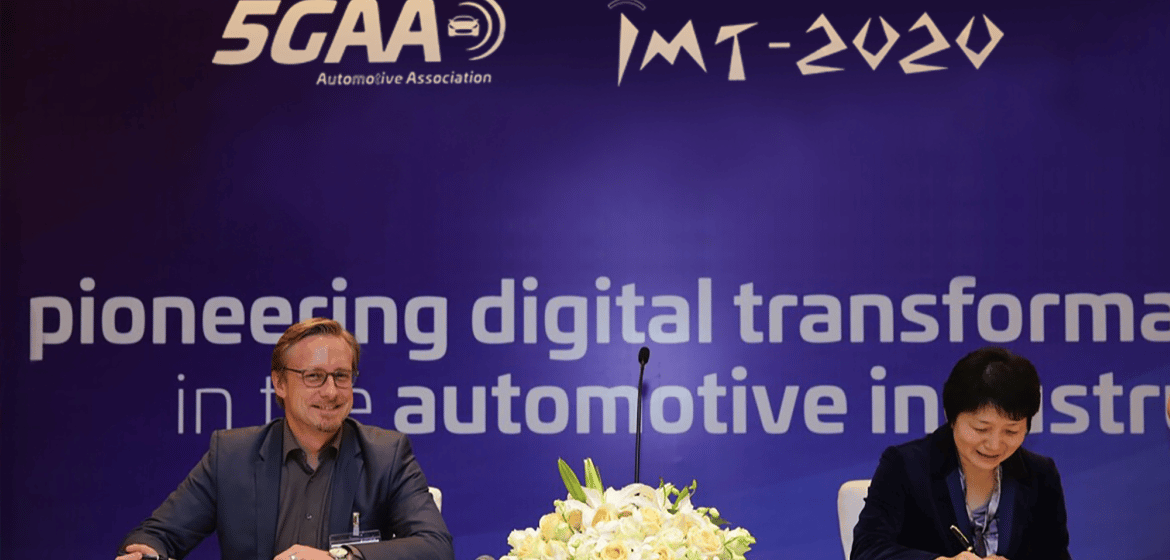
On 16 November 2017, in Shanghai, both parties have signed a Memorandum of Understanding in order to foster cooperation in the field of connected and autonomous driving solutions. This exciting journey of collaboration will also be a unique opportunity to pool resources in technology research and related use cases on a global scale.
Both organisations are advocates for the accelerated development of enhanced mobile communication systems between all road users and vehicles. The focus technologies for both associations are LTE-V2X and 5G-V2X. The 5GAA and IMT-2020 (5G) Promotion Group will harness their joint expertise on a range of projects, such as:
- Further conducting technical research on LTE-V2X and 5G-V2X
- Ensuring the promotion of the applications of 5G based V2X solutions
Since its launch in September 2016, 5GAA has grown exponentially worldwide. Over 60 industry leaders from the automotive, technology and telecommunications industries have teamed up to accelerate C-V2X technology development and its evolution to 5G-V2X for enhanced safety, automated driving and connected mobility. Together, 5GAA members are building a safer, more sustainable and connected transport ecosystem.
The Chairman of 5GAA, Christoph Voigt, is confident that both organisations’ hold a bright future of collaboration together: “5GAA was created to connect the telecom industry and vehicle manufacturers to develop 360-degree solutions for safer and more sustainable mobility systems. We look forward to working with IMT-2020 to define the requirements of C-V2X and to create a successful V2X ecosystem”.
IMT-2020 was established in February 2013. It is the major platform for 5G technology innovation, industry promotion and international cooperation in China. IMT-2020 C-V2X Working Group is established by IMT-2020 Expert Committee in April 2017, who conduct technical research on LTE-V2X and 5G-V2X innovation. Its members include leading operators, vendors, universities and research institutes in the telecommunication and automotive industries.
Wang Zhiqin, Chairman of IMT-2020 welcomed the signature of the Memorandum of Understanding between both organisations: ”IMT-2020 is the major platform for 5G technology innovation, industry promotion and international cooperation in China, and IMT-2020 C-V2X Working Group is responsible for industry integration among ICT, automobile, transportation and etc.. IMT-2020 and 5GAA have a number of partners and working interests in common, we are glad to cooperate with 5GAA together to ensure the successful development and commercialization of C-V2X and future 5G automotive services”.

Bright Regulatory Trends of C-V2X in Asia Pacific Region
Shanghai, China – On 16 November, The 5G Automotive Association (5GAA) hosted its Second General Assembly. Following announcements of the association’s progress and growth worldwide, 5GAA inaugurated the Asia Pacific Roundtable. Here, regulators from China and South Korea joined the discussion, sharing industry trends for the Internet of Vehicles and future Intelligent Transport Systems, as well as a number of real-life demonstrations of technology that is being developed in this region.
5GAA is a unique organisation on the global stage: with leading members of the automotive and telecommunications industry as founders. The association aims to pioneer digital transformation on our roads, creating a safer and more sustainable road environment for all.
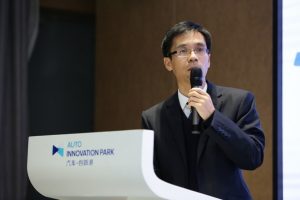
At the Asia Pacific Roundtable, Mr. He Guangjin from the Chinese TMRI (Traffic Management Research Institution) of MPS (Ministry of Public Security), presented the demonstration made at WIOT 2017 (World Internet of Things Expo) in Wuxi. This was the first demonstration from the Chinese public security industry where the LTE-V2X technology was employed. Additionally, it was so a premiere for the official traffic management system to be opened to vehicles on open roads. TMR also announced its plan to build a larger LTE-V2X pre-commercial trial including 20 to 50 intersections in 2018, to verify the broadcasting of real-time traffic conditions of intersections and the reception of information transmitted from vehicles. Additionally, TMRI is actively working on industry and national standards such as “Road Traffic Signal Controller I2V Information Distribution Interface Specifications”, “Adaptive Verification Management Regulation of Intelligent & Connected Vehicles (ICV) on Public Roads”, etc.
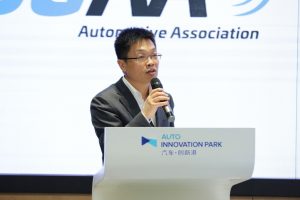
Dr. Cen Yanqing from the Chinese RIOH (Research Institution of Highway) of the MOT (Ministry of Transport) shared the important progress of the MOT. The ministry is paying close attention to automated driving and has already set up a dedicated working group to coordinate the corresponding ministries and guide the work on automated driving technology. In order to achieve automated driving, it is not sufficient to equip autonomous vehicles but it’s also needed to have an intelligent reformation of the road infrastructure and vehicle-to-road, vehicle-to-vehicle, vehicle-to-person communication and interaction in an effective way. To further promote the automated driving, the Ministry of Transport has built test zone for commercial vehicles verification in Tongzhou, Beijing, including specific scenarios e.g. ramps, intersections, and traffic lights.
When Dr. Cen was asked about whether MOT will mandate any technical specifications, he clarified there is no mandatory regulation so far. The MOT – as a department which uses technology – is opened to the utilisation of the V2X technology, but will select the best and most efficient technology eventually, he said. He also claimed that the MOT would support some of the Chinese telecommunication corporate contributions such as CMCC, Huawei, and Datang. Finally, he declared “we cannot implement two technologies but only one”.
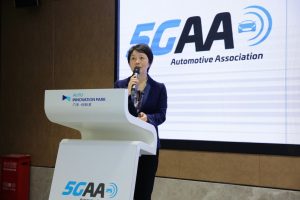
•Vice President of the China Academy of Information and Communications Technology, Ministry of Industry and Information Technology, China
•Chairman of the IMT-2020 (5G) Promotion Group
Ms. Wang Zhiqin, from CAICT (China Academy of Information and Communications Technology) of MIIT(Ministry of Industry and Information Technology), explained that the national CAV (Connected and Automated Vehicles) industry development committee advises to promote the LTE-V2X technology deployment and application, and its evolution to 5G and internet of vehicles integration development. He also announced the release of the Guide to the Construction of Standard Architecture for CAV Industry Development jointly developed by MIIT and NSC (National Standardization Administration), in which the LTE-V2X and 5G technologies are greatly highlighted in the information and communications volume. When asked about the spectrum of the Internet of Vehicles in China, Ms. Wang expressed that the government attaches great importance to it and needs prompt issuance and release of a positive guidance to the industry. She believes China should release this C-V2X spectrum relatively soon.
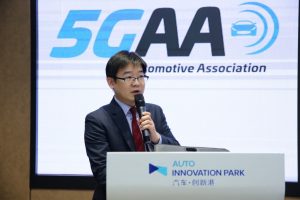
Deputy Director, ITS and Road Safety Division, Road Bureau, Ministry of Land, Infrastructure and Transport, South Korea
Mr. Chang-ki Kim, from the MOLIT (Ministry of Land, Infrastructure, and Transport) explained that his division in Korea is implementing two strategies to promote the commercialisation of Internet of Vehicles. The first strategy consists of focusing on the C-ITS safety aspect by developing and commercialising the RoDAS (Road Driving Assistant Systems) by 2020 in accordance with the National ITS Master Plan. As CAV (Connected and Automated Vehicles) will improve road safety issues under the mixed condition of AV (Automated Vehicles) and LV (Legacy Vehicles) in both highway and urban areas. MOLIT will launch, as its second strategy, the transportation renovation program by promoting and integrating the C-ITS and CAV technologies under their CAD (Connected and Automated Driving) Test-beds. Additionally, he emphasised that deploying those Test-beds in Korea would include the verification of various communication techniques, e.g., C-V2X (LTE, 5G), under the real and dynamic road environment. Mr. Kim expressed his intention to invite all ICT and CAD testing companies to conduct their service applications and to develop their cooperation and sharing models by joining those Test-beds.

5GAA Launches its Second General Assembly and Working Group Meeting in Shanghai
From 13-17 November 2017, the global members and invited guests of the 5G Automotive Association will assemble in Shanghai, China. The aim of the meeting is to promote the advancement of our mobility ecosystem as well as deepening the association’s collaboration with the Chinese automotive and telecommunications industries.
Over the course of the first three days (13-15 November 2017), 5GAA’s members will collaborate in Working Group meetings. This is a unique opportunity for global leaders in the automotive and telecommunications industries to share innovative practices and drive towards progress.
On the 16th November, The General Assembly will take place: a 1-day meeting where the association’s members will reflect on 2017’s achievements as well as outlining a vision for 2018.
5GAA is honoured to welcome illustrious representatives from Public Institutes to participate in the Asia Pacific Roundtable discussion on Thursday, 16 November 2017. The delegation will include Chinese representatives from the Traffic Management Research Institute of Ministry of Public Security, the Research Institute of Highway Ministry of Transport, the China Academy of Information and Communications Technology of Ministry of Industry and Information Technology, and the Road Bureau of Ministry of Land, Infrastructure, and Transport.
Additionally, South Korean delegates from the Road Bureau of Ministry of Land, Infrastructure, and Transport will participate. This Roundtable promises to generate interesting ideas.
Following the Roundtable discussion and in order to gain a greater practical understanding of the transportation advances in China, 5GAA will visit the Shanghai Testbed with a live demonstration of the power of LTE-V2X and 5G-V2X technology in transport.
Chairman of 5GAA, Christoph Voigt, underlines the importance of choosing China as the location for the Second General Assembly: “We are looking forward to further understanding the progress China can offer to advance 5G transport solutions globally. China is a strong supporter of deepening 5G connectivity to deliver safety and sustainability solutions on our roads. Our discussions with representatives from political and academic institutions in China will offer us an opportunity to gain support around the World and to innovate further, faster and more effectively.”
Since its launch in September 2016, 5GAA has grown exponentially worldwide. Over 60 industry leaders from the automotive, technology and telecommunications industries have teamed up to accelerate C-V2X technology development and its evolution to 5G-V2X for enhanced safety, automated driving, and connected mobility. Together, 5GAA members are building a safer, more sustainable and connected transport ecosystem.
5GAA: cellular technology is key enabler for smart mobility of the future
Industry association calls on European Commission to allow stakeholders to work collaboratively towards an agreement on the technology catalyzing the mobility of the future and warns against a “premature and cumbersome legislative decision”.
The 5G Automotive Association (5GAA) encourages the automotive, technology, and telecommunications industries and the European Commission to be ambitious when evaluating technologies for connected, autonomous vehicles. 5GAA is confident that cellular communication technology (C-V2X) has the most benefits when applied to connected, self-driving cars. It has provided its views to the Commission in a workshop and a letter with recommendations. Since its launch one year ago, over 50 industry leaders from the automotive, technology and telecommunications industries have teamed up in 5GAA to accelerate C-V2X technology development and its evolution to 5G-V2X for enhanced safety, automated driving and connected mobility.
Christoph Voigt, Chairman of 5GAA said, “5GAA is confident that cellular technology (including direct vehicle-to-vehicle communication at 5.9 GHz) has the potential to lead to the best outcomes in the long run. We are strongly relying on the European institutional support to put in place a regulatory framework allowing for an industry-driven and swift deployment of this technology. It is crucial to consider how the 5.9 GHz band, the “life blood” of wireless vehicle communication, can be used efficiently in the context of 5G technology evolution, road safety, and economic scalability. The automotive and transportation sectors, both public and private, are making significant investment commitments. Therefore, we are urging the European Commission to allow the ITS-G5 and C-V2X stakeholders to work together towards an agreement on the future of connected and automated cars, without a premature and cumbersome legislative decision.”
5GAA has recently provided its views to the Commission in a workshop and a letter with recommendations.
Christoph Voigt: “We should aim high enough when selecting the solutions to make connected, self-driving vehicles a reality. These are a catalyst to improving the quality of life globally through safer traffic, improved mobility, cleaner air in cities, and a better experience overall for drivers.”
Dino Flore, Director General of 5GAA adds, “Saving lives through improved road safety is obviously the primary positive outcome of deploying communication technology solutions. In addition, we should take into account other aspects when evaluating alternatives. We’re not only talking about reducing congestion and pollution but also optimizing the driving experience. It is our view that cellular technology, including direct vehicle-to-vehicle communication at 5.9 GHz, has the most upward potential in the long run.”
Helping vehicles “understand the environment they are navigating”
Launched in September 2016 by 8 founding members the 5GAA has in less than a year grown to include over 50 leaders from the automotive, technology and telecom industries who collaborate cross-industry on the future of transport. 5GAA’s mission is to develop, test, and promote communications solutions, initiate their standardization and accelerate their commercial availability and global market penetration. The objective is to address society’s connected mobility and road safety needs with applications such as autonomous driving, ubiquitous access to services and integration into smart city and intelligent transportation.
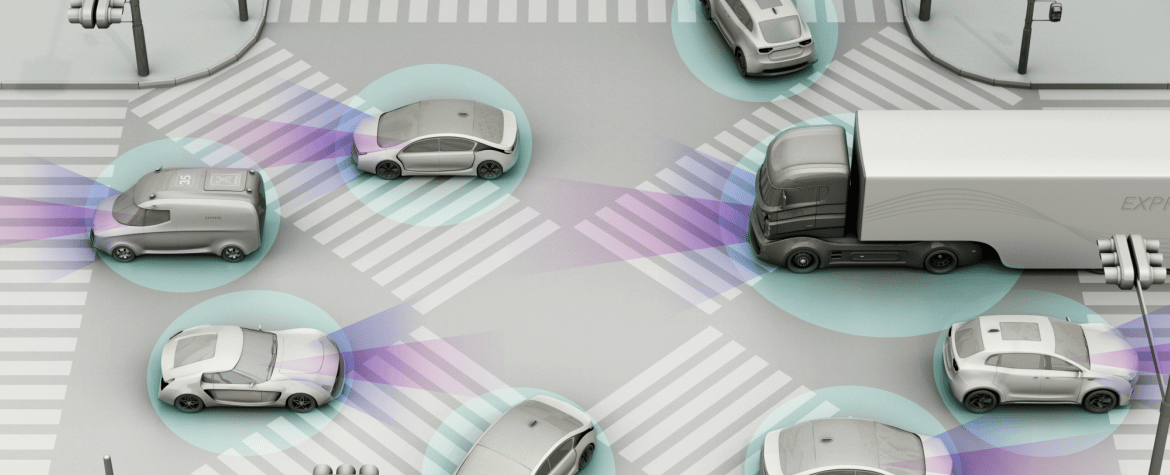
Connected vehicles use communication technology to not only communicate with other vehicles but also with road infrastructure, other road users such as pedestrians, and the Internet – e.g. to provide traffic updates and parking guidance. Use cases include collision warnings, “traffic jam ahead” warnings, green light optimal speed advisory, parking guidance, and assisting drivers in tackling treacherous traffic situations (e.g. turning left at a crossroads). Connected vehicles will eventually reduce pollution, and make traffic more efficient, reducing congestion in cities and improving the flow of goods and people.
Christoph Voigt explains, “Equipping cars with sensors and cameras is one thing, but imagine what is possible when cars use cellular technology to communicate with their entire ecosystem: other vehicles, road users, infrastructure, and central services that give real-time information.”
“It’s the difference between a car that is capable of seeing what is happening in its immediate surroundings and one that can use all available information to allow for a safer and more comfortable driving experience. After all, as drivers we do more than purely react to what’s in front of us. We listen to traffic info, we are aware of the area we’re navigating, and we are alert to traffic jams in rush hour. We use context to guide our driving.”
“This is exactly what cellular connectivity can enable vehicles to make easier, or even take over from us in the case of self-driving vehicles. Except that it will be faster and more accurate,” concludes Christoph Voigt.
-Ends
About 5GAA
The 5G Automotive Association (5GAA) is a global cross-industry organisation of companies from the automotive, technology and telecommunications industries (ICT), working together to develop end-to-end solutions for future mobility and transportation services. Created in 2016, the Association is comprised of over 50 members which mission
is to develop, test and promote communications solutions, initiate their standardization and accelerate their commercial availability and global market penetration to address societal need. For more information please visit 5gaa.org
Contacts
Robbe Libbrecht
FINN PR
robbe.libbrecht@finnpr.com
M +32 497 23 30 38
5GAA Marketing & Communications
marcom@5GAA.org

5GAA welcomes AT&T, Jaguar Land Rover, NTT DOCOMO and Samsung Electronics as elected Board members
The 5G Automotive Association announced today the election of its new Board members following the General Assembly held on May 11, 2017. Continuing members AUDI AG, BMW Group, China Mobile, Daimler AG, Ericsson, Ford, Huawei, Intel, Nokia, SAIC Motor, Vodafone Group and Qualcomm Incorporated will be joined by AT&T, Jaguar Land Rover, NTT DOCOMO and Samsung Electronics.
The election of AT&T, Jaguar Land Rover, NTT DOCOMO and Samsung Electronics as Board members will strengthen the position of 5GAA as a global, cross-industry association of automotive, technology and telecommunications companies. It reflects the diversity of 5GAA’s membership, both in terms of geographical spread and expertise.
The Chairperson is Christoph Voigt (Audi) and the Vice Chairperson is Thierry Klein (Nokia), both elected to their second term. The Board of the Association renewed the mandate of the outgoing Executive Committee: Dino Flore (Qualcomm) will continue to serve as Director General, Markus Dillinger (Huawei) as Secretary, and Fathi Arafat Husein El-Dwaik (BMW) as Treasurer. The Board also confirmed the appointment of elected Working Groups Chairs and Vice-Chairs.
“We are very pleased that AT&T, Jaguar Land Rover, NTT DOCOMO and Samsung Electronics have joined the 5GAA Board,” said Christoph Voigt, Chairman of the 5GAA Board. “With their global footprint and diverse expertise, they will contribute to further connect communication and the automotive industry to develop end-to-end solutions for future mobility and transportation services.”
5GAA joins 3GPP
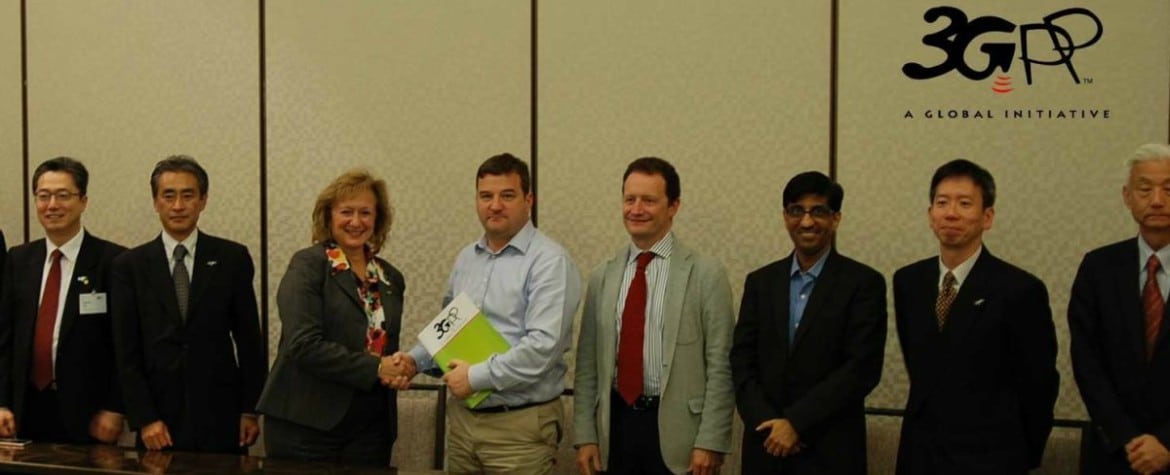
The 5G Automotive Association has become a Market Representation Partner (MRP) in 3GPP, bringing in the influence and expertise of vehicle manufacturers and a variety of important companies from the automotive sector, to the 3GPP environment. Dino Flore, Director General of 5GAA, was present at the 3GPP Organizational Partner’s meeting in West Palm Beach on April 26, to complete the signing of the Partnership Agreement.
The 5GAA application for 3GPP MRP status stated “It is important to connect the telecom industry and vehicle manufacturers, to develop end-to-end solutions for future mobility and transportation services” Dino Flore told the 3GPP OP meeting “The access part is vitally important and we will work on that with 3GPP. In addition to that, we will look at the other pieces required – including the work on upper layers (SDOs including ETSI-ITS, ISO, SAE and IEEE) and security aspects – to develop the system as a whole.”
The work is ongoing in 3GPP, with an initial version of the V2X access specifications in Release 14 and active discussions to define next generation V2X capabilities on-going. Susan Miller (3GPP OP Chair, ATIS President and CEO) welcomed 5GAA as a partner and noted the positive effect that Dino Flore’s vast experience in the 3GPP leadership, most recently as the RAN Chairman, will have for the successful integration of the 5GAA into the 3GPP family. Ms. Miller said “5GAA is bringing in the needs of a key vertical at an important time for the project.”
“5G will be much more than mobile broadband connectivity, it will cover a variety of use-cases and industries” Dino Flore, DG 5GAA.

5GAA comments to the NHTSA on notice of proposed rulemaking
The 5G Automotive Association (5GAA) supports the goal of the National Highway Traffic Safety Administration (NHTSA) to increase motor vehicle safety through the use of communications solutions. 5GAA is a new global cross-industry association of automotive, technology and telecommunications companies. 5GAA includes 42 members, of which 8 are founding members (AUDI AG, BMW Group, Daimler AG, Ericsson, Huawei, Intel, Nokia, Qualcomm). Our mission is to enable communications solutions that address society’s connected mobility and road safety needs.
5GAA, like the U.S. Department of Transportation (USDOT) and National Highway Traffic Safety Administration (NHTSA), values safety first and foremost; this is what makes the immediate proceeding so important to us and why we are moved to offer the sum of our expertise in providing comments. To realize the full safety benefits of vehicle communications, NHTSA’s guiding principle must be one that allows for not only the best technology of today but also for the best technologies of tomorrow. Such an approach will promote innovation and competitive market-based outcomes, ensuring that American drivers and passengers benefit from the best and most advanced safety solutions available as technology evolves. This is particularly essential for regulations touching the communications industry, which has witnessed rapid technological innovation over the past two decades – with 4G cellular prevalent today and 5G on the horizon. By contrast, rigid technology mandates, whether direct or de facto, freeze technology solutions to a past point in time. With the communications market rapidly evolving, any technology NHTSA mandates today will be outdated by the time the mandate goes into effect, if not already outdated. This will significantly impede the innovation and evolution path for Vehicle-to-Vehicle (V2V) safety, and positions the US to lag behind the rest of the world in V2V communications specifically as well as V2X broadly.
For this reason, 5GAA respectfully cannot support the proposed V2V technology mandate predicated on the use of dedicated short-range radio communications (DSRC), a technology originally designed in the 1990s. The proposed direct technology-specific mandate, by definition, is on its face not technology neutral. Similarly, the one-way interoperability requirement in the alternate “if equipped” proposal, where “alternative” technologies would be required to be backwards interoperable with DSRC, is flawed in that it would impose no reverse interoperability requirement on DSRC to ensure backwards interoperability with other technology solutions, including today’s Cellular Vehicle-to-Everything (Cellular-V2X) solutions for V2V safety.
In effect, the “path” for compliance is not a path at all, but instead a dead-end for other technologies, as it creates a non-level playing field in the US V2V market.The 5G Automotive Association (5GAA) supports the goal of the National Highway Traffic Safety Administration (NHTSA) to increase motor vehicle safety through the use of communications solutions. 5GAA is a new global cross-industry association of automotive, technology and telecommunications companies.
5GAA includes 42 members, of which 8 are founding members (AUDI AG, BMW Group, Daimler AG, Ericsson, Huawei, Intel, Nokia, Qualcomm). Our mission is to enable communications solutions that address society’s connected mobility and road safety needs.5GAA, like the U.S. Department of Transportation (USDOT) and National Highway Traffic Safety Administration (NHTSA), values safety first and foremost; this is what makes the immediate proceeding so important to us and why we are moved to offer the sum of our expertise in providing comments. To realize the full safety benefits of vehicle communications, NHTSA’s guiding principle must be one that allows for not only the best technology of today but also for the best technologies of tomorrow. Such an approach will promote innovation and competitive market-based outcomes, ensuring that American drivers and passengers benefit from the best and most advanced safety solutions available as technology evolves. This is particularly essential for regulations touching the communications industry, which has witnessed rapid technological innovation over the past two decades – with 4G cellular prevalent today and 5G on the horizon. By contrast, rigid technology mandates, whether direct or de facto, freeze technology solutions to a past point in time. With the communications market rapidly evolving, any technology NHTSA mandates today will be outdated by the time the mandate goes into effect, if not already outdated. This will significantly impede the innovation and evolution path for Vehicle-to-Vehicle (V2V) safety, and positions the US to lag behind the rest of the world in V2V communications specifically as well as V2X broadly.
For this reason, 5GAA respectfully cannot support the proposed V2V technology mandate predicated on the use of dedicated short-range radio communications (DSRC), a technology originally designed in the 1990s. The proposed direct technology-specific mandate, by definition, is on its face not technology neutral. Similarly, the one-way interoperability requirement in the alternate “if equipped” proposal, where “alternative” technologies would be required to be backwards interoperable with DSRC, is flawed in that it would impose no reverse interoperability requirement on DSRC to ensure backwards interoperability with other technology solutions, including today’s Cellular Vehicle-to-Everything (Cellular-V2X) solutions for V2V safety. In effect, the “path” for compliance is not a path at all, but instead a dead-end for other technologies, as it creates a non-level playing field in the US V2V market.
Read the full paper here.