
5GAA Launches Exclusive Marketplace for Connected Mobility Solutions
The 5G Automotive Association (5GAA) is proud to announce the launch of the 5GAA Marketplace, a dedicated platform showcasing exclusive C-V2X communication solutions developed by 5GAA members. As the mobility sector evolves toward increased automation, connectivity, and safety, this marketplace serves as a central hub for cutting-edge devices, software, and services that enable the future of intelligent transportation.
This launch builds on previous efforts of the 5GAA to gather a comprehensive overview of cellular vehicle-to-everything (C-V2X) devices from its member companies. These efforts took shape in two technical reports published in 2021 and updated in 2024, which captured the rapid evolution of the C-V2X landscape and provided an up-to-date look at the devices currently available on the market or nearing release. With the objective of offering a centralized platform for these advancements, and by incorporating a comprehensive list of software and services, the 5GAA Marketplace now presents these innovative solutions in a user-friendly manner directly to industry stakeholders.
By bringing together innovative solutions from across the 5GAA ecosystem, the marketplace further fosters collaboration between industry leaders, facilitates the adoption of next-generation mobility technologies, and accelerates the deployment of connected and automated transportation systems. In essence, this initiative reflects 5GAA’s ongoing commitment to supporting its members, enabling seamless industry collaboration, and driving forward the adoption of C-V2X mobility solutions worldwide.
Discover the latest innovations from 5GAA members by exploring the marketplace today: Marketplace – 5GAA
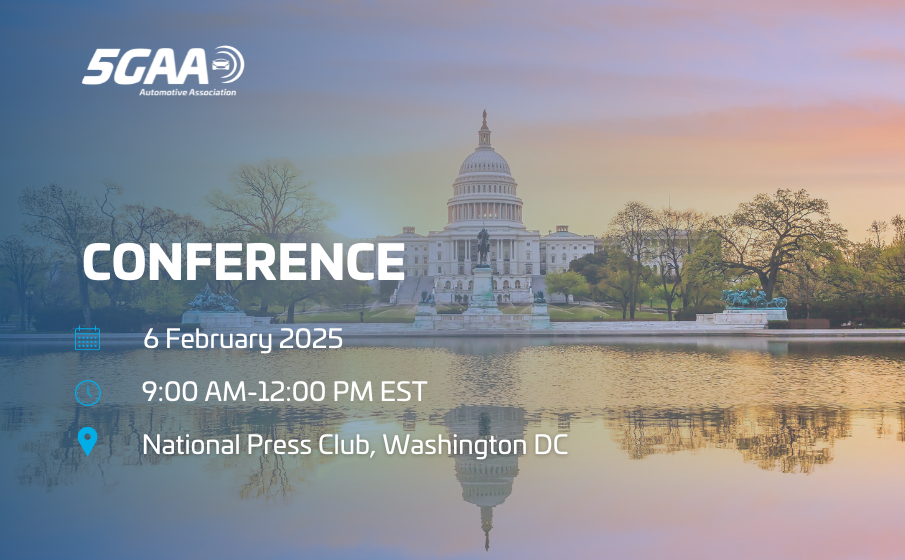
5GAA Conference – US V2X Vision: Bridging Gaps and Accelerating Deployment in the US
The 5G Automotive Association is pleased to announce our upcoming Conference, “US V2X Vision: Bridging Gaps and Accelerating Deployment in the US”, taking place in Washington DC.
The event is scheduled for 9 AM – 12 PM (EST) on 6 February 2025, at the National Press Club. This conference will provide a great platform for discussion with high-level speakers and industry stakeholders.
With the US V2X National Plan and the FCC’s adoption of the Second Report and Order on the use of 5.9 GHz band in November 2024, the US is making significant progress towards realising the National V2X Deployment Plan vision. 5GAA is looking forward to supporting this process and discussing the successes of V2X deployments and the road ahead.
The conference will outline existing achievements and ongoing deployments, as well as priorities for the next administration in the field of connected transportation.
Check out the conference agenda here!
Transforming mobility: How 5GAA helps advance automotive connectivity and safety
Christoph Voigt, Chairman, 5GAA
Video interview by TelecomTV.
At the 2024 5GAA meeting week in Berlin, Christoph Voigt, chairman of 5GAA, discusses the organisation’s role in bridging the automotive and telecoms sectors with 5G technology. He highlights the potential of 5G in enhancing vehicle connectivity and safety through innovations like cellular vehicle-to-everything (C-V2X) technology. He also emphasises the importance of collaboration among industry stakeholders and outlines the ongoing developments and future opportunities for 5G in the automotive sector.
Recorded October 2024.
How Vodafone is enhancing road safety through the STEP platform
Graham Rushton, CTO Partner Markets, Vodafone
Video interview by TelecomTV.
As the first mobile operator to join the 5GAA, Graham Rushton discusses Vodafone’s role in the association and its ongoing commitment to the connected mobility sector. He talks about the development of the Safer Transport for Europe (STEP) platform, which enhances road safety through real-time data sharing. Rushton also addresses future opportunities for autonomous vehicles and the challenges of regulation and collaboration among industry players to create a sustainable ecosystem that benefits consumers.
Recorded October 2024.

Meet Our Members – Interview with Jyoti Sharma, Verizon
In our ongoing “Meet Our Members” series, we explore the unique journeys and expertise of the individuals who make the 5G Automotive Association. Each interview sheds light onto the incredible work, vision, and passion of the people behind our organisation. You can check out our last conversation with Menno Malta, CEO of Monotch, here.
This time, we introduce Jyoti Sharma, Associate Director of Network Planning at Verizon and alternate board member at 5GAA since 2021. Jyoti has brought her deep industry insight to a range of work items, including Vehicle-to-Network-to-Everything (V2N2X) and has led initiatives such as the Vulnerable Road User (VRU) Demo. Her commitment to accelerating the large-scale deployment of V2X technologies make her a valuable contributor to the 5GAA, and we’re excited to learn more about her perspective on the future of 5G and MEC in transportation.
Could you tell us briefly about Verizon’s involvement in 5GAA and how your company benefits from being a member?
Verizon has been an active member of 5GAA since its inception. We started out as a general member and initially contributed at the working group level. We saw tremendous value in taking a leadership role in 5GAA as a major U.S. telecommunications provider and were elected by the members as a gold board member in 2021. Currently, Verizon is a platinum board member of 5GAA and we are playing a critical strategic role as one of the key stakeholders in the V2X ecosystem.
When did you first become part of the 5GAA board? What are some of your responsibilities, and what has been your most rewarding experience so far?
I represent Verizon on the 5GAA board as an alternate board member since 2021. In my role as a board member I have the privilege and responsibility to ensure 5GAA remains focused on key strategic focus areas which will accelerate a large-scale deployment of Vehicle-to-Everything (V2X) across the globe. My most rewarding experience has been to collaborate with other 5GAA members who are leaders from auto OEM customers, their tier 1 suppliers, chipset and module providers and other ecosystem partners. This technical collaboration between all the stakeholders is the key to drive innovation and unlock the full potential of V2X communications at scale and make it a reality.
Can you share any recent examples of how Verizon has collaborated with other 5GAA members to drive innovation in the industry?
Verizon has taken a leadership role in bringing the V2X ecosystem partners together under the 5GAA umbrella. We have demonstrated thought leadership in defining the network architecture to solve challenging V2X requirements leveraging key technology enablers such as 5G, multi-access edge computing (MEC) and Hyper Precise Location. Our recent V2X VRU (Vulnerable Road User) demo in Detroit showcasing interoperability between different network operators and application providers generated a very positive response and engagement from auto OEMs, Departments of Transportation and road operators. The demo was successful due to close collaboration with several 5GAA member companies.
As the lead of the VRU DEMO Work Item, could you elaborate on the significance of demonstrating interoperability in the context of Vulnerable Road User protection solutions?
VRU DEMO is one of the key strategic focus areas at the 5GAA board level that the industry has been trying to address for many decades. We believe the C-V2X and other technology enablers (5G, MEC, Hyper Precise Location) are ready to mitigate the number of road accidents involving vulnerable road users such as pedestrians and cyclists. In order to deploy such a VRU solution at scale it needs to work across multiple operators, multiple auto OEMs, multiple application providers and multiple cloud providers. We reached a significant milestone by demonstrating interoperability amongst different stakeholders and showcased the technology is ready to deploy at scale with existing networks. The learnings from the demo are being replicated in other parts of the world and are informing U.S. DOT V2X Deployment plans.
What criteria were used to select the specific use cases for demonstration in VRU DEMO? How did these use cases represent real-world scenarios and challenges?
There has been extensive discussion within 5GAA to define different VRU scenarios. Different flavors of VRU use cases have been documented in published technical reports. The demo team carefully selected most common real world VRU scenarios such as active pedestrian crossing alert and using roadside cameras and artificial intelligence, machine learning logic in the MEC to detect pedestrians and alert the drivers to avoid potential collision.
Verizon participated in the demos with a showcase of its network solution using multi-access edge computing. How does MEC differ from traditional network-based computing in terms of its benefits for VRU protection applications?
MEC allows us to bring traditional cloud compute and storage within the mobile network closer to the edge where the data is generated reducing the end to end latency. It is well established that MEC is a key differentiator and technology enabler for latency critical use cases such as VRU protection. Verizon has already deployed public MEC across the United States in partnership with cloud providers. We continue to drive innovation by developing standard MEC and Network APIs for application providers. During the VRU demo we demonstrated near real time VRU alerts over 5G and applications hosted on Verizon’s Detroit MEC.
5GAA, Partner Associations Issue Statement on US Department of Commerce’s Inquiry into Connected Vehicles
WASHINGTON D.C., March 7, 2024 – Our organizations, representing the full breadth of the U.S. transportation stakeholder community, fully share the Biden Administration’s commitment to ensuring that connected vehicle technologies operate in a way that is safe and secure, and which protects users’ privacy. We applaud the Department of Commerce and Bureau of Industry and Security for recognizing the many benefits of connected vehicles and noting that its recent Advanced Notice of Proposed Rulemaking does not intend to imply that lifesaving technologies such as vehicle-to-everything (V2X) communications are unsafe for use in the United States. According to the latest estimates from the National Highway Traffic Safety Administration, 42,795 people died in motor vehicle traffic crashes in 2022. We continue to face a national crisis of traffic deaths on U.S. roadways, and we firmly believe that V2X technologies, which allow communication between vehicles, infrastructure, and other road users including pedestrians and bicyclists, can dramatically reduce crashes and resulting fatalities. V2X technology can also help advance climate and sustainability goals by increasing traffic flow and efficiency. We reaffirm our continued support for the rapid, widespread deployment of V2X technologies.
We note that all V2X systems have been designed from the outset with privacy and security in mind, and that V2X has been deployed for a wide variety of use cases in states across the country without incident. Our members have worked closely with U.S. Department of Transportation (USDOT) for several years to proactively develop a robust message security solution for V2X communications. This collaboration has produced a security system that ensures V2X safety messages contain no personal or equipment-identifying information and that utilizes encryption and certificate management methods to limit data collection and prevent unauthorized vehicle manipulation. Privacy and security are also key pillars of our members’ ongoing collaboration with USDOT on the development of a National V2X Deployment Plan. We also note that the supply chain for connected vehicle technology, including V2X direct, is mature, geographically diverse, and not dependent on any particular region or country.
The United States is currently a leader in V2X innovation, but risks falling behind if the government hampers broadscale deployment. We urge the Department of Commerce to work closely with transportation stakeholders to ensure that any resulting regulations that address national security risks are narrowly tailored to minimize unintended consequences or significantly disrupt industry efforts to deploy lifesaving safety technologies.
We look forward to working collaboratively with all stakeholders on this matter to ensure the safe and effective deployment of V2X technologies.
Participating associations: 5G Automotive Association (5GAA), Institute of Transportation Engineers (ITE), Intelligent Transportation Society of America (ITS America), National Electrical Manufacturers Association (NEMA).
Download the joint statement here.
About 5GAA
The 5G Automotive Association (5GAA) is a global, cross-industry organization of over 120 members, including leading global automakers, Tier-1 suppliers, mobile operators, semiconductor companies, and test equipment vendors. 5GAA members work together to develop end-to-end solutions for future mobility and transport services. 5GAA is committed to helping define and develop the next generation of connected mobility, automated vehicles, and intelligent transport solutions based on C-V2X. For more information, visit our website.
Media Contact
John F. Kwant
Executive Director, Americas, 5GAA
john.kwant@5gaa.org
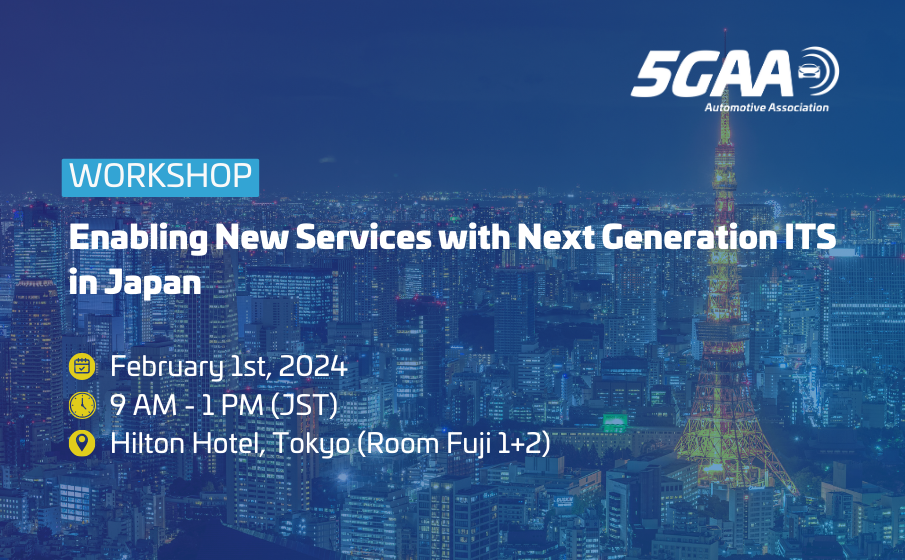
5GAA Workshop ‘Enabling New Services with Next Generation ITS in Japan’
5GAA is hosting its upcoming workshop, ‘Enabling New Services with Next Generation ITS in Japan,’ in the context of its 29th Meeting Week. The event will take place on February 1st at the Hilton Tokyo, between 9AM and 1PM JPT.
In response to the recent release of Japan’s Frequency Reorganisation Plan by the Ministry of Internal Affairs and Communications, assigning the 5.9 GHz spectrum to V2X for next-generation ITS, this workshop aims to explore the potential implications and opportunities. 5GAA welcomes the decision, which aligns with global spectrum allocation.
The workshop will delve beyond technicalities, offering insights into recent government activities, ongoing development efforts, and expectations for new ITS in Japan. It will also serve as a convergence point for local stakeholders and global industry players, encouraging collaboration and setting the stage for a fruitful discussion Japan’s future in this domain.
Find the full programme here. More information available on our News section.
5GAA Workshop Explores Future of Next-Generation ITS in Japan
The 5G Automotive Association (5GAA) is pleased to announce its upcoming workshop, ‘Enabling New Services with Next Generation ITS in Japan,’ scheduled for February 1st in Tokyo. The event will take place at the Hilton Tokyo from 9 AM (JST).
In response to the recent release of Japan’s Frequency Reorganisation Plan by the Ministry of Internal Affairs and Communications, assigning the 5.9 GHz spectrum to V2X for next-generation ITS, this workshop aims to explore the potential implications and opportunities. 5GAA welcomes the decision, which aligns with global spectrum allocation.
The workshop will delve beyond technicalities, offering insights into recent government activities, ongoing development efforts, and expectations for new ITS in Japan. It will also serve as a convergence point for local stakeholders and global industry players, encouraging collaboration and setting the stage for a fruitful discussion Japan’s future in this domain.
The workshop will take place in the context of 5GAA’s 29th Meeting Week, a periodic opportunity for members to meet face-to-face and participate in working sessions and diverse side activities – this time taking place in Tokyo.
Invitations for this collaborative dialogue will be distributed individually. For further information or general inquiries, please contact liaison@5gaa.org.
Programme available here.

New Technical Report: C-V2X standardisation in China
This Technical Report is to shed light on the typical C-V2X-related standardisation organisations and industry alliances in China comprising stakeholders from ICT, automobile, transportation and traffic management industries. It analyses their working scope, main role, list of ongoing standards, etc. to help prioritise 5GAA input.
Read the full report here.
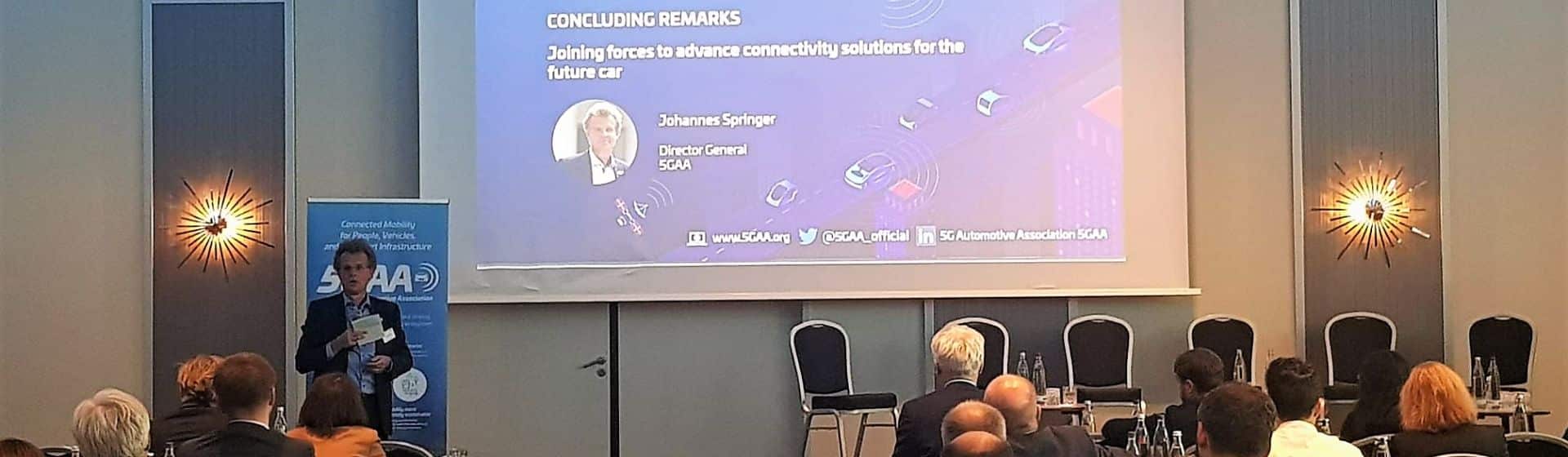
5GAA discusses the role of non-terrestrial networks in the connectivity of the car of the future
Ubiquitous connectivity is an essential prerequisite to achieving a full-scale digital transformation of the automotive sector. Connectivity challenges and how the seamless integration of terrestrial and non-terrestrial network solutions can foster high-capacity global connectivity were at the heart of the Connectivity for the Car of the Future Symposium, hosted by the 5G Automotive Association (5GAA).
Berlin (Germany), 16 May 2022. The 5G Automotive Association (5GAA) and the European Space Agency discussed the crucial role of ubiquitous connectivity and the opportunities for space technologies to offer future solutions for the automotive sector during its “Connectivity for the Car of the Future Symposium.”
Today, over 200 million connected vehicles worldwide are equipped with applications sharing hazard and traffic warnings on the road. The automotive sector is undergoing a significant transformation: from a focus on vehicle performance to a focus on a fully digital, tailor-made digital experience, and customers increasingly expect a fully connected car. Ubiquitous connectivity is an essential prerequisite to achieving a full-scale digital transformation of the automotive sector. Ensuring the network’s reliability can be a challenge, particularly in rural or remote areas that still experience no or poor band coverage, and non-terrestrial networks can have a crucial role in deploying hybrid connectivity solutions for the car of the future.
To explore the connectivity challenges and how space solutions can support the car industry in connected mobility, the 5G Automotive Association organised a Symposium in collaboration with the European Space Agency (ESA). What does the future car look like? Which connectivity and business models are needed to enable? What is the place of space in the mix? These were some of the questions addressed by industry representatives of car manufacturers, connectivity providers, mobile network operators, satellite connectivity providers and decision-makers.
Satellite connectivity can complement terrestrial solutions in white spots and in case of outages and congestion. In this sense, Europe must accelerate the development of assets and capacities in this field to compete globally, provide the appropriate solutions for the automotive sector and fill in any potential gaps. Therefore, it is essential to ensure that all the stakeholders and their respective innovative roadmaps are aligned, as highlighted by Joseph Aschbacher, Director-General of ESA, in his welcome messagefor the event. As such, the car industry will be able to make the most of cutting-edge developments in the connectivity domain.
“We are pleased to collaborate with 5GAA to promote and build the connected car ecosystem of the future. Vehicles are rapidly becoming fully connected devices and drive investments into new-generation connectivity. Satellites and space-based technologies are key assets to complete terrestrial networks, build smart and hybrid systems and offer ubiquitous, secure, and sustainable connectivity. We look forward to continuing this intense exchange with the automotive value chain to join forces and build a truly European connected car architecture,” added Elodie Viau, Director, Telecommunications and Integrated Applications Directorate, ESA.
During the Symposium, car manufacturers and tier-1 suppliers discussed the mobility-related technology innovations, opportunities, requirements, and challenges, highlighting the crucial role of ubiquitous connectivity for the automotive sector and the increasing number of use-cases already developed by the automotive industry for both private and commercial vehicles.
Including non-terrestrial connectivity in the mix will bring many benefits, such as extending high connectivity to rural areas at a comparatively low cost and enabling digital services and autonomous driving applications. However, space solutions need to be integrated with the existing terrestrial solutions, as they will not replace them. In addition, the seamless integration of antennas technology on the car, and the smooth handover between the networks, are just some of the challenges that still need to be addressed. Therefore, speakers pointed out that these solutions need to be included in the 3GPP standardisation system, which is currently the integrational connectivity path, defining the terrestrial connectivity requirements.
Finally, all the stakeholders engaged in a lively discussion to map how the whole ecosystem can work together to address the connectivity challenges and develop targeted R&D, demonstrators and pilots and expand them into mature business models and strategic partnerships. Indeed, to enable cross-border coordination and integration of terrestrial and satellite connectivity solutions, the cooperation and alignment of various players and investments will be essential. In this area, ESA aims to provide the European automotive sector with the necessary support and expertise to maximise its positive social, economic and environmental impact and develop competitive car connectivity solutions.
“Use cases and requirements are already there, and ubiquitous connectivity will enable their full-scale deployment. Satellite solutions can play a crucial role in achieving this,” concluded Johannes Springer, Director General, 5GAA. “It is crucial to ensure the greatest alignment and cooperation between all the stakeholders involved. Let’s continue working together to bring the 3GPP standards to the satellite solutions and seamlessly integrate them with the terrestrial networks to provide solutions for the car of the future.”
Below the presentations showcased during the first session of the event:
Andreas Schaller, V2X Technology Strategy, Robert Bosch Mobility Solutions
Olaf Eckart, Senior Expert Cooperations R&D, Industry Customers, BMW
Jörg Plechinger, Head of Mobile Connectivity Plattform / Car2X, AUDI AG
Susanne Schulz, Head of Department Cooperative, Connected and Automated Mobility, Autobahn GmbH