

5GAA participates in Testbed Visit in Shanghai
Shanghai, China – 16 November 2017 – following the 5G Automotive Association General Assembly Meeting, 5GAA leadership, delegates as well as representatives from Chinese and South Korean government participated in a testbed visit. This practice case was then followed by eight use-cases, demonstrating the success of the LTE-V2X advances. Both of these actions took place at the purpose-built Shanghai district – Testbed F-zone and T-Zone – where the latest developments in vehicle technology are assessed.
1. Realizing LTE-V2X’s capacity: Visit to F-Zone
Huawei LTE-V leader for Research & Development, Mr. Yangyongchao, opened the visit by showcasing LTE-V2X testing reports as well as running a live test result. This series of LTE-V2X performance tests were measured in terms of the technology’s capacity to manage two variables (link level and system level). This analysis was managed by the partnership of China Mobile (CMCC), SIAC and SAIC Motor.
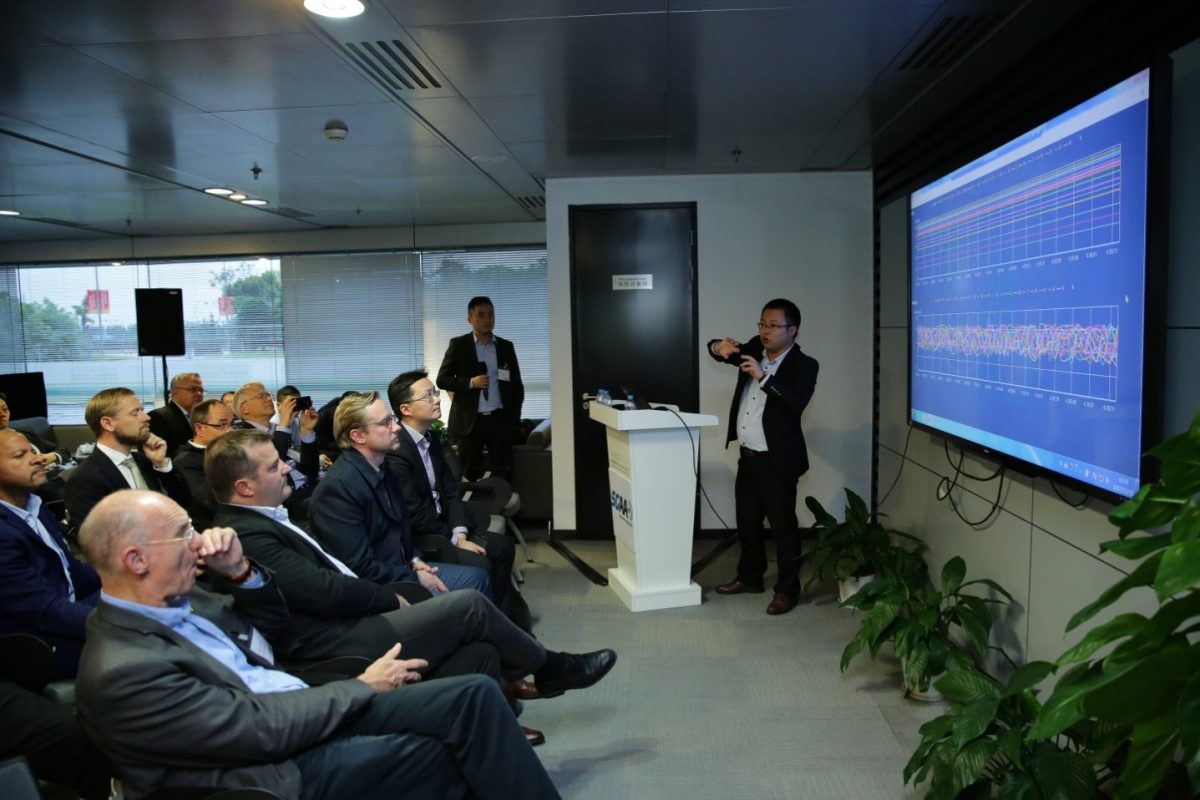
- Link Level Testing: LTE-V2X can support relative vehicle speeds of up to 500km/h, even with correction for timing and frequency errors. LTE-V2X shows excellent link performance with different packet size. The maximum RSU coverage range reaches more than 1km from the test vehicle.
- System Level Testing: 400 vehicles were analysed in this trial environment. Based on this, the capacity and of Vehicle-to-Vehicle and Vehicle- to-Infrastructure is smaller is functional in a range of 20 metres. Messages were transmitted at a success rate of 90% within the demanded communication range in high-density scenarios.
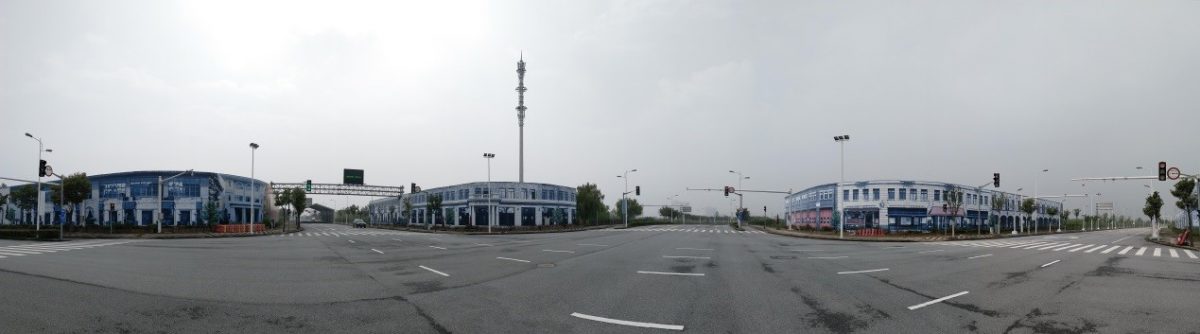
Right after this presentation, SIAC led the delegates to visit the site of F-Zone. Mr. Lilin, director of SIAC explained that F-zone is an enclosed area conducting different scenarios such as parks, urban roads with intersections, simulated highway and related road facilities. Additionally, F-zone is the national level Intelligent and Connected Vehicles test zone equipped with background vehicles, positioning capability and telecommunication infrastructure, including LTE-V2X based RSU, base stations that support both LTE and LTE-V2X, and assisted by operation system.
2. T-Zone visit
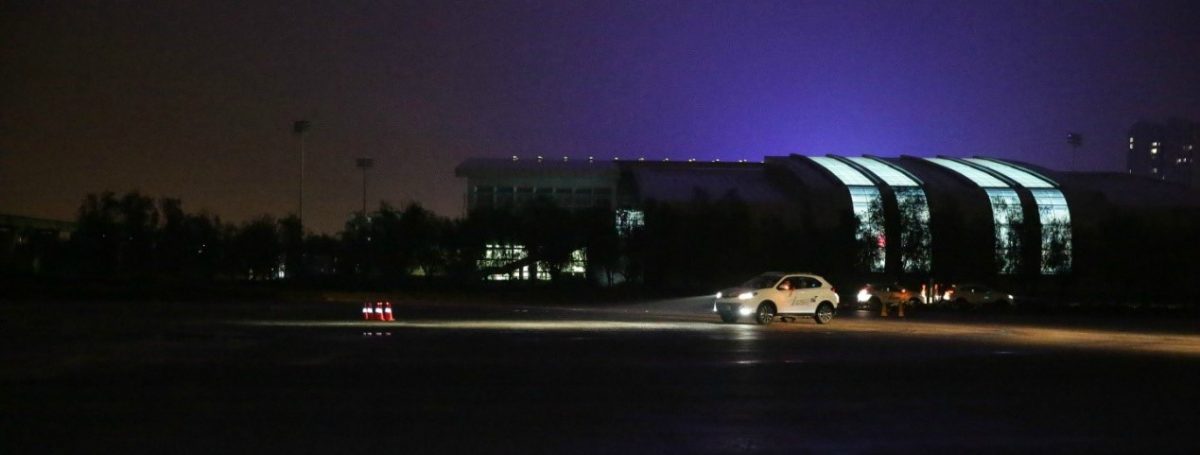
After the inspection of F-Zone, delegates visited C-V2X demonstration in T-Zone and observed eight cases in SAIC Motor’s intelligent connected vehicle operated with China Mobile and Huawei. The technology showcased was powered by 5G-V2X. This opened the vehicle up to possibilities such as Tele-Operated Driving, LTE-V2X based Platooning, Forward collision warning, Traffic light speed advisory and Vulnerable Road user warning. Dr. Liu Fen, also explained that with the abundant communications environment in T-zone and more C-V2X functionality can be realised in the future.
Christoph Voigt, Chairman of 5GAA, views these advances with optimism: “Today’s opportunity to see the fantastic progress from SIAC, SAIC Motor, China Mobile and Huawei is a demonstration of the unlimited possibilities that investing in 5G and LTE -V2X technologies hold. We know that C-V2X technology has the capacity for high-speed, high-density communication between vehicles, infrastructure, and pedestrians. Following further research and collaboration with our members and policy makers in governments around the world, 5GAA is looking forward to introducing this technology globally.”
Dino Flore, Director General of 5GAA is proud of the extensive partnerships that the association has fostered: “5GAA’s aim is to act as a bridge between the automotive and telecommunications industries. I would like to thank our hosts today in Shanghai for their hospitality and proudly showcasing the possibilities promised by C-V2X and 5G. Our organisation is focused on accelerating research and delivering solutions to society to build safer and more sustainable transport for our citizens. Today’s demonstrations are proof of what future holds.”
About the 5GAA
The 5G Automotive Association (5GAA) is a global cross-industry organisation of companies from the automotive, technology and telecommunications industries (ICT), working together to develop end-to-end solutions for future mobility and transportation services. Created in 2016, the Association is comprised of over 67 members which mission is to develop, test and promote communications solutions, initiate their standardization and accelerate their commercial availability and global market penetration to address societal need.
5GAA: cellular technology is key enabler for smart mobility of the future
Industry association calls on European Commission to allow stakeholders to work collaboratively towards an agreement on the technology catalyzing the mobility of the future and warns against a “premature and cumbersome legislative decision”.
The 5G Automotive Association (5GAA) encourages the automotive, technology, and telecommunications industries and the European Commission to be ambitious when evaluating technologies for connected, autonomous vehicles. 5GAA is confident that cellular communication technology (C-V2X) has the most benefits when applied to connected, self-driving cars. It has provided its views to the Commission in a workshop and a letter with recommendations. Since its launch one year ago, over 50 industry leaders from the automotive, technology and telecommunications industries have teamed up in 5GAA to accelerate C-V2X technology development and its evolution to 5G-V2X for enhanced safety, automated driving and connected mobility.
Christoph Voigt, Chairman of 5GAA said, “5GAA is confident that cellular technology (including direct vehicle-to-vehicle communication at 5.9 GHz) has the potential to lead to the best outcomes in the long run. We are strongly relying on the European institutional support to put in place a regulatory framework allowing for an industry-driven and swift deployment of this technology. It is crucial to consider how the 5.9 GHz band, the “life blood” of wireless vehicle communication, can be used efficiently in the context of 5G technology evolution, road safety, and economic scalability. The automotive and transportation sectors, both public and private, are making significant investment commitments. Therefore, we are urging the European Commission to allow the ITS-G5 and C-V2X stakeholders to work together towards an agreement on the future of connected and automated cars, without a premature and cumbersome legislative decision.”
5GAA has recently provided its views to the Commission in a workshop and a letter with recommendations.
Christoph Voigt: “We should aim high enough when selecting the solutions to make connected, self-driving vehicles a reality. These are a catalyst to improving the quality of life globally through safer traffic, improved mobility, cleaner air in cities, and a better experience overall for drivers.”
Dino Flore, Director General of 5GAA adds, “Saving lives through improved road safety is obviously the primary positive outcome of deploying communication technology solutions. In addition, we should take into account other aspects when evaluating alternatives. We’re not only talking about reducing congestion and pollution but also optimizing the driving experience. It is our view that cellular technology, including direct vehicle-to-vehicle communication at 5.9 GHz, has the most upward potential in the long run.”
Helping vehicles “understand the environment they are navigating”
Launched in September 2016 by 8 founding members the 5GAA has in less than a year grown to include over 50 leaders from the automotive, technology and telecom industries who collaborate cross-industry on the future of transport. 5GAA’s mission is to develop, test, and promote communications solutions, initiate their standardization and accelerate their commercial availability and global market penetration. The objective is to address society’s connected mobility and road safety needs with applications such as autonomous driving, ubiquitous access to services and integration into smart city and intelligent transportation.
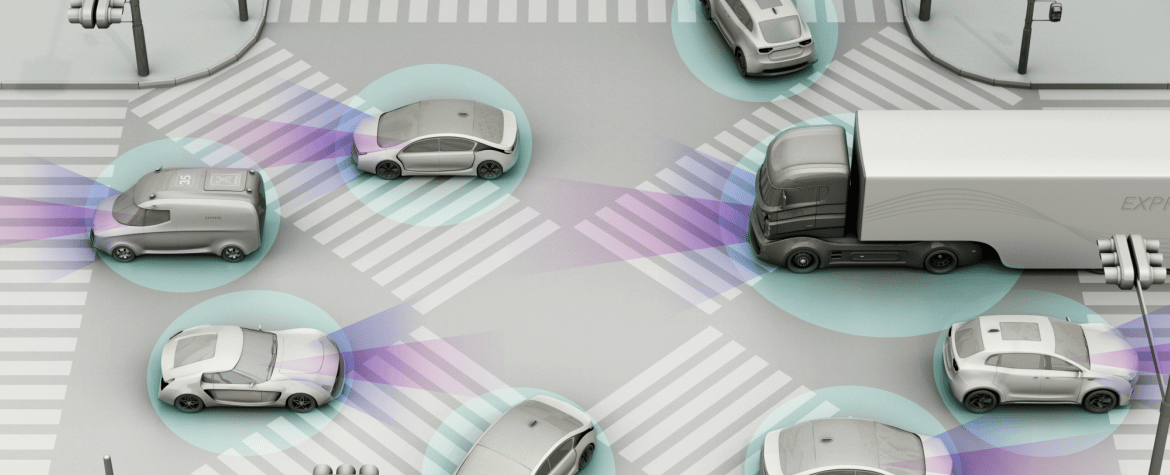
Connected vehicles use communication technology to not only communicate with other vehicles but also with road infrastructure, other road users such as pedestrians, and the Internet – e.g. to provide traffic updates and parking guidance. Use cases include collision warnings, “traffic jam ahead” warnings, green light optimal speed advisory, parking guidance, and assisting drivers in tackling treacherous traffic situations (e.g. turning left at a crossroads). Connected vehicles will eventually reduce pollution, and make traffic more efficient, reducing congestion in cities and improving the flow of goods and people.
Christoph Voigt explains, “Equipping cars with sensors and cameras is one thing, but imagine what is possible when cars use cellular technology to communicate with their entire ecosystem: other vehicles, road users, infrastructure, and central services that give real-time information.”
“It’s the difference between a car that is capable of seeing what is happening in its immediate surroundings and one that can use all available information to allow for a safer and more comfortable driving experience. After all, as drivers we do more than purely react to what’s in front of us. We listen to traffic info, we are aware of the area we’re navigating, and we are alert to traffic jams in rush hour. We use context to guide our driving.”
“This is exactly what cellular connectivity can enable vehicles to make easier, or even take over from us in the case of self-driving vehicles. Except that it will be faster and more accurate,” concludes Christoph Voigt.
-Ends
About 5GAA
The 5G Automotive Association (5GAA) is a global cross-industry organisation of companies from the automotive, technology and telecommunications industries (ICT), working together to develop end-to-end solutions for future mobility and transportation services. Created in 2016, the Association is comprised of over 50 members which mission
is to develop, test and promote communications solutions, initiate their standardization and accelerate their commercial availability and global market penetration to address societal need. For more information please visit 5gaa.org
Contacts
Robbe Libbrecht
FINN PR
robbe.libbrecht@finnpr.com
M +32 497 23 30 38
5GAA Marketing & Communications
marcom@5GAA.org

5GAA & GSMA Letter to EU Commission
The 5G Automotive Association (5GAA) represents the automotive and telecom industry’s alignment for the global connected and autonomous vehicle, supported by more than 50 member companies including many world class car manufacturers. 5GAA’s mission is to develop, test and promote communication solutions for the future of the 5G automotive economy in Europe and globally. The 5GAA is actively contributing to ETSI, 3GPP and ITU in the fields of standardisation and spectrum-related matters. The 5GAA is committed to accelerating Cellular-V2X (C-V2X) standards seamlessly embracing 4G and 5G, and would like to call on the European Commission to support stakeholders in this collaborative process by providing leadership and timely regulatory support.
The GSMA, which represents the Mobile Network Operators globally, has succeddfully collaborated with the Automotive Industry for many years. Together we have created secure solutions that have advanced the Connected Car market with major benefits to consumers. Cellular V2X will enable further cross-industry collaboration with government agencies in cities and transport. The GSMA believes that C-V2X will contribute to safer vehicles, reduce congestion and pollution. It will build upon the existing 23 million existing Cellular Connected Car market in Europe and drive the deployment of Digital Europe.
The 5GAA is keenly aware of the imperative for road safety and the need for Europe to assert 5G leadership while ensuring spectrum efficiency. Given the longevity of vehicles and the significant industry investment in cellular technologies, C-V2X will be of utmost importance as Europe and the world transitions to 5G in supporting mission critical applications and the massive opportunities associated with the introduction of a new global standard.
We therefore urge the European Commission to allow the ITS-G5 and C-V2X stakeholders to work collaboratively toward an agreement on the future of connected and automated cars, without a premature and cumbersome legislative decision.
The 5GAA is confident that the industry will ultimately align with a pragmatic solution that saves the most lives while embracing technology evolution, and managing complexity and cost. We firmly believe in and pledge to collaboratively work with other stakeholders on solutions that ultimately benefit the European Union. We encourage the European Commission to support technology neutrality, mitigating a significant risk that 5G in the key automotive vertical will struggle, thus impacting the European automotive industry and the future growth and global competitiveness of the EU economy.
Europe is an important pillar for members of the 5GAA and is leading the world in the development of smart transportation solutions. A considerable part of C-V2X innovation occurs in Europe, and will contribute to road safety, the development of smart cities and trans-border corridors, to achieve the efficiency and environmental objectives that ultimately benefit European citizens. 5GAA members are accelerating C-V2X with pre-commercial trials in Europe, and will culminate in global deployments.
We are strongly supportive of 3GPP technologies for direct communications over ITS spectrum to enable vehicle-to-vehicle, vehicle-to-infrastructure, vehicle-to-pedestrian (and other vulnerable road users), i.e. C-V2X, while also leveraging vehicle-to-network over mobile operator spectrum. An important part of the ongoing 5GAA work is to support the European Commission’s policies laid out in the C-ITS Masterplan, as well as Gear2030 for Highly Automated Vehicles and the 5G Action Plan. We strongly rely on the European institutional support to enable a regulatory framework conducive to an industry-driven and swift deployment of the platform of their choice.
The 5GAA looks forward to continuing the dialogue with the European Commission and the various industry stakeholders in order to lay the foundation for a 5G automotive future in Europe.
Download the letter here
5GAA submitted comments to the National Highway Traffic Safety Administration
The 5G Automotive Association (5GAA) submitted comments to the National Highway Traffic Safety Administration (NHTSA) notice of proposed rulemaking (NPRM), “Federal Motor Vehicle Safety Standards; V2V Communications.” The proposed rule is to mandate new light-duty vehicles to be equipped with dedicated short range communications (DSRC).
The 5GAA is a new global cross-industry association of automotive, technology and telecommunications companies and includes 42 members, of which 8 are founding members (AUDI AG, BMW Group, Daimler AG, Ericsson, Huawei, Intel, Nokia, Qualcomm). Our mission is to enable communications solutions that address society’s connected mobility and road safety needs.
In our submission, 5GAA applauds the concept behind the rule, as V2V safety is important to our technology deployment mission. 5GAA urges NHTSA to not consider just the best technology of today, but also to consider the best technologies of tomorrow. Such an approach will promote innovation and competitive market-based outcomes, ensuring that American drivers and passengers benefit from the best and most advanced safety solutions available as technology evolves. Rigid technology mandates such as specifying DSRC, whether direct or de facto, freeze technology solutions to a past point in time. NS will significantly impede the innovation and evolution path for Vehicle-to-Vehicle (V2V) safety, and positions the US to lag behind the rest of the world in V2V communications specifically as well as V2X broadly. 5GAA elaborates on the following points:
Similar to DSRC, Cellular-V2X technology for V2V safety can transmit BSM in an ad hoc manner without cellular network coverage.
Cellular-V2X technology for V2V safety communications can operate without a SIM card and offers the tools to adopt, evolve or innovate any privacy-preserving security management system including SCRM.
Cellular-V2X technology for V2V safety benefits from a significantly larger link budget than DSRC (e.g., 8 dB at high speeds), corresponding to twice the range of DSRC and higher reliability.
Cellular-V2X technology for V2V safety can support up to 50 messages per second with less than 20 msec latency.
Cellular-V2X enables V2V, and for that matter Vehicle-to-Infrastructure (V2I), Vehicle-to-Pedestrian (V2P) and Vehicle-to-Network (V2N), safety applications to take advantage of the widespread cellular network coverage in the US.
5GAA notes also that the impending launch of 5G will only widen the performance gap between Cellular- V2X and DSRC.
5GAA believes that Rather than moving forward with the proposed regulation, NHTSA should instead undertake an updated, comprehensive technology neutral analysis of V2V solutions, including DSRC and Cellular-V2X, against the performance requirements in the NPRM. If this review indicates that regulatory action is necessary, the U.S. Department of Transportation should move forward with a technology neutral regulation that sets forth minimum V2V safety performance requirements only.

5GAA comments to the NHTSA on notice of proposed rulemaking
The 5G Automotive Association (5GAA) supports the goal of the National Highway Traffic Safety Administration (NHTSA) to increase motor vehicle safety through the use of communications solutions. 5GAA is a new global cross-industry association of automotive, technology and telecommunications companies. 5GAA includes 42 members, of which 8 are founding members (AUDI AG, BMW Group, Daimler AG, Ericsson, Huawei, Intel, Nokia, Qualcomm). Our mission is to enable communications solutions that address society’s connected mobility and road safety needs.
5GAA, like the U.S. Department of Transportation (USDOT) and National Highway Traffic Safety Administration (NHTSA), values safety first and foremost; this is what makes the immediate proceeding so important to us and why we are moved to offer the sum of our expertise in providing comments. To realize the full safety benefits of vehicle communications, NHTSA’s guiding principle must be one that allows for not only the best technology of today but also for the best technologies of tomorrow. Such an approach will promote innovation and competitive market-based outcomes, ensuring that American drivers and passengers benefit from the best and most advanced safety solutions available as technology evolves. This is particularly essential for regulations touching the communications industry, which has witnessed rapid technological innovation over the past two decades – with 4G cellular prevalent today and 5G on the horizon. By contrast, rigid technology mandates, whether direct or de facto, freeze technology solutions to a past point in time. With the communications market rapidly evolving, any technology NHTSA mandates today will be outdated by the time the mandate goes into effect, if not already outdated. This will significantly impede the innovation and evolution path for Vehicle-to-Vehicle (V2V) safety, and positions the US to lag behind the rest of the world in V2V communications specifically as well as V2X broadly.
For this reason, 5GAA respectfully cannot support the proposed V2V technology mandate predicated on the use of dedicated short-range radio communications (DSRC), a technology originally designed in the 1990s. The proposed direct technology-specific mandate, by definition, is on its face not technology neutral. Similarly, the one-way interoperability requirement in the alternate “if equipped” proposal, where “alternative” technologies would be required to be backwards interoperable with DSRC, is flawed in that it would impose no reverse interoperability requirement on DSRC to ensure backwards interoperability with other technology solutions, including today’s Cellular Vehicle-to-Everything (Cellular-V2X) solutions for V2V safety.
In effect, the “path” for compliance is not a path at all, but instead a dead-end for other technologies, as it creates a non-level playing field in the US V2V market.The 5G Automotive Association (5GAA) supports the goal of the National Highway Traffic Safety Administration (NHTSA) to increase motor vehicle safety through the use of communications solutions. 5GAA is a new global cross-industry association of automotive, technology and telecommunications companies.
5GAA includes 42 members, of which 8 are founding members (AUDI AG, BMW Group, Daimler AG, Ericsson, Huawei, Intel, Nokia, Qualcomm). Our mission is to enable communications solutions that address society’s connected mobility and road safety needs.5GAA, like the U.S. Department of Transportation (USDOT) and National Highway Traffic Safety Administration (NHTSA), values safety first and foremost; this is what makes the immediate proceeding so important to us and why we are moved to offer the sum of our expertise in providing comments. To realize the full safety benefits of vehicle communications, NHTSA’s guiding principle must be one that allows for not only the best technology of today but also for the best technologies of tomorrow. Such an approach will promote innovation and competitive market-based outcomes, ensuring that American drivers and passengers benefit from the best and most advanced safety solutions available as technology evolves. This is particularly essential for regulations touching the communications industry, which has witnessed rapid technological innovation over the past two decades – with 4G cellular prevalent today and 5G on the horizon. By contrast, rigid technology mandates, whether direct or de facto, freeze technology solutions to a past point in time. With the communications market rapidly evolving, any technology NHTSA mandates today will be outdated by the time the mandate goes into effect, if not already outdated. This will significantly impede the innovation and evolution path for Vehicle-to-Vehicle (V2V) safety, and positions the US to lag behind the rest of the world in V2V communications specifically as well as V2X broadly.
For this reason, 5GAA respectfully cannot support the proposed V2V technology mandate predicated on the use of dedicated short-range radio communications (DSRC), a technology originally designed in the 1990s. The proposed direct technology-specific mandate, by definition, is on its face not technology neutral. Similarly, the one-way interoperability requirement in the alternate “if equipped” proposal, where “alternative” technologies would be required to be backwards interoperable with DSRC, is flawed in that it would impose no reverse interoperability requirement on DSRC to ensure backwards interoperability with other technology solutions, including today’s Cellular Vehicle-to-Everything (Cellular-V2X) solutions for V2V safety. In effect, the “path” for compliance is not a path at all, but instead a dead-end for other technologies, as it creates a non-level playing field in the US V2V market.
Read the full paper here.

LG, Ford, Verizon, Denso and Gemalto join the 5G Automotive Association
5GAA (www.5gaa.org) welcomes LG, Ford, Verizon, Denso and Gemalto as new members of the association.
“We are very pleased that LG, Ford, Verizon, Denso and Gemalto have joined the association. With their global footprint and diverse expertise across the communications and automotive ecosystems, these companies will contribute to the definition and development of next generation connected mobility and automated vehicle solutions” Dino Flore, Director General of 5GAA, said.
Kookyeon Kwak, Executive Vice President, Head of LG’s Advanced Standard R&D Lab, said, “Cellular communication will play a pivotal role to meet the requirement of safety, convenience, and infotainment for future smart cars. The trend is now being accelerated by the completion of LTE-V2X, the first cellular- based vehicle-communication standard. As a manufacturer in mobile communication and vehicle component areas, LG Electronics would like to contribute to 5GAA for connecting communication and automotive industries”.
“We are excited to work together with other automotive and technology providers to define a future that envisions new and empowering mobility services and solutions. We see the 5GAA as a key enabler to the development of a sustainable connected vehicle ecosystem.” Don Butler, Executive Director of Connected Vehicle and Services at Ford Motor Company, said.
DENSO CTO for the European region, Masato (Max) Nakagawa, commented: “Extending DENSO’s global efforts in the area of vehicular connectivity is strategically aligned to our policy ‘Protecting Lives, Preserving the Planet, and Preparing a Bright Future for Generations to Come’. Reinforcing this
direction, DENSO AUTOMOTIVE Deutschland GmbH has decided to join the 5GAA. We are proud to be accepted as 5GAA member and are looking forward to collaborating in the 5GAA. DENSO considers this engagement viable to complement our long term ongoing global support of 700MHz/5.9GHz V2X safety communication. 5GAA provides the environment for the cross-industry collaboration required to define corresponding future mobile communication systems. In collaboration with the 5GAA partners we plan to explore, define and develop multi-spectral connectivity to support future mobility demands, especially in the area of connected and automated driving.”
“Gemalto is thrilled to join 5GAA and work within this prestigious group of global leaders to enable the world of new mobility that will revolutionize the automotive sector,” says Frederic Vasnier, EVP
Embedded Software and Products. “Gemalto has demonstrated its unrivaled expertise to ensure simple, seamless and ubiquitous connectivity with robust security mechanisms inside the vehicle, between vehicles and with the connected ecosystem of devices, pedestrians, and the cloud.”
5GAA was created to bridge automotive and communication industries in order to develop, test and promote connected mobility solutions, initiate their standardization and accelerate the commercial availability and global market penetration.
Since its inception, 5GAA has been experiencing rapid expansion to include key players with a global footprint in the communication and automotive industries, including car manufacturers, tier-1 suppliers, chipset/communication system providers, mobile operators and infrastructure vendors.
To achieve its long-term goals, the association is creating five Working Groups to address the following areas of work: Use Cases and Technical Requirements; System Architecture and Solution Development; Evaluation, Testbeds and Pilots; Standard & Spectrum; Business Models and Go-To-Market Strategies. In addition, the board is planning the needed policy and advocacy efforts to join the relevant discussions in this space with different regulators, policymakers, and administrations around the world.
Safe EU Roads Thanks to Technology Forum @ Brussels
We are pleased to announce that the 5G Automotive Association will plunge into the debate on technologies for road safety as it takes part in the Euractiv Forum “Safe EU Roads Thanks to Technology” as an event partner.
As the Cellular-Vehicle-To Everything (C-V2X) technology and its evolution to 5G will enable life-saving communications, the forum will be a source of debate further reinforcing the discussion on the subject. The focus will encompass the cost of deploying the C-V2X technology, the path to 5G, the challenges associated with new technologies as well as the regulations ensuing from its development.
Join us on Thursday 27 September from 17:00 to 20:00 at the Euractiv Network Office in Brussels and attend 5GAA’s CTO Maxime Flament Speech as he opens the Forum.
Register here to attend.

Webinar: Talking Cars: Field Test Results Comparing DSRC & C-V2X Technology
According to World Health Organization figures, more than 1.2 million casualties occur globally as a result of traffic incidents. As vehicles add more sensors to improve safety and advance the readiness of automated driving, vehicle-to-everything communications (V2X) are expected to significantly enhance road safety. As a result, global governments and industry (automotive and telecom) are carefully evaluating two different V2X technologies: IEEE 802.11p-based radio DSRC/ITS-G5 and 3GPP-based C-V2X. 802.11p is an older radio technology, based on specifications dating to 1999, and has been researched over the past decade, whereas C-V2X is a newer radio technology benefiting from many advances in communications. This 5GAA-sponsored webinar will review how each of the technologies performed in an apples-to-apples comparison, executed by Ford and Qualcomm Technologies, Inc in US lab and field testing.
This webinar will review:
1.The reliability, communication range and latency of each V2X technology under the same test conditions
2. Performance comparison in congested environments
3. Resiliency of each technology to adverse deployment conditions, including interference
Speakers:
Steve Bell, Senior Analyst, Heavy Reading
Maxime Flament, CTO, 5GAA
Gautam Savarkar, Senior Director, Engineering, Qualcomm Technologies, Inc
Ivan Vukovic, Technical Specialist, Ford Motor Company
5G Techritory
5G Techritory is the annual Baltic Sea Region 5G Ecosystem Forum organised by the Electronic Communications Office (ECO) of Latvia, aiming at gathering decision makers, major representatives from industry associations, and business leaders to discuss the deployment of the earliest available commercial applications of 5G technology. Its second edition is going to be held in the Latvian capital, Riga, on 27-29 November.
Taking place in a vibrant region for 5G implementation, the 5G Automotive Association is proud to be confirmed once again as one of the main partners of this conference. 5GAA Director General Johannes Springer is going to participate as a speaker in front of an audience of up to a thousand senior professionals invited upon an attentive selection to ensure the highest quality of debate.