
Connected mobility

New Technical Report: Conformity Assessment Strategy Evaluation (CASE)
This 5GAA Technical Report presents the results of the 5GAA Work Item Conformity Assessment Strategy Evaluation (CASE). This study investigates a practical 5GAA strategy along with guidelines for Conformance Assessment (CA). The CASE Report focuses on the PC5 interface and intends to develop a proposal for a cost-effective, voluntary process for C-V2X Conformity Assessment which could be applied globally. In this document, you can read about the position of the Automotive Industry, the regional status of Conformity Assessment (China, Europe, North America, Japan and South Korea), lessons from other CA schemes, cost-benefit analysis, and a harmonised CA framework.
Read the full report.

Report on Automated Valet Parking: technology assessment and use case implementation description
This 5GAA Technical Report presents the results of the 5GAA Work Items Use Case Implementation Description Phase
II (UCID II) and Automated Valet Parking (AVP) with the focus on solutions using cellular public networks. Solutions
using cellular non-public networks or short-range direct communication technologies are also in the scope of these Work
Items, but the results will be published separately at a later stage.
Read the full report.

Live Trial of 5G Connected Car Concept in Blacksburg, Virginia | Video
Last March, the Commonwealth of Virginia held a live trial of a new driver and pedestrian safety concept that allows near-real-time notification of roadway hazards through 5G and edge technologies. The trial was one of the three conducted internationally by a historic public-private collaboration, organised by the 5G Automotive Association (5GAA) and eight member companies representing leading technology companies from around the globe. A related European live trial was conducted in 2021 in the city of Turin, Italy. The North American live trial, on the other hand, was conducted on the Virginia Smart Road operated by the Virginia Tech Transportation Institute in Blacksburg, VA. It was the first of its kind in North America.
To find out more, you can now watch this video explaining the tested concept:
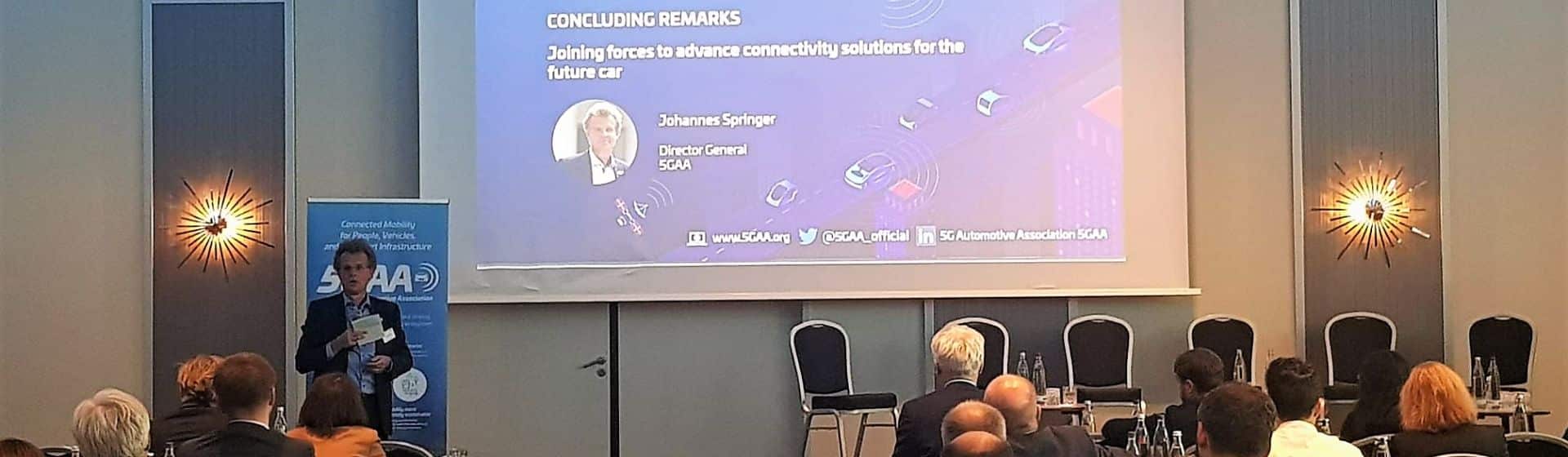
5GAA discusses the role of non-terrestrial networks in the connectivity of the car of the future
Ubiquitous connectivity is an essential prerequisite to achieving a full-scale digital transformation of the automotive sector. Connectivity challenges and how the seamless integration of terrestrial and non-terrestrial network solutions can foster high-capacity global connectivity were at the heart of the Connectivity for the Car of the Future Symposium, hosted by the 5G Automotive Association (5GAA).
Berlin (Germany), 16 May 2022. The 5G Automotive Association (5GAA) and the European Space Agency discussed the crucial role of ubiquitous connectivity and the opportunities for space technologies to offer future solutions for the automotive sector during its “Connectivity for the Car of the Future Symposium.”
Today, over 200 million connected vehicles worldwide are equipped with applications sharing hazard and traffic warnings on the road. The automotive sector is undergoing a significant transformation: from a focus on vehicle performance to a focus on a fully digital, tailor-made digital experience, and customers increasingly expect a fully connected car. Ubiquitous connectivity is an essential prerequisite to achieving a full-scale digital transformation of the automotive sector. Ensuring the network’s reliability can be a challenge, particularly in rural or remote areas that still experience no or poor band coverage, and non-terrestrial networks can have a crucial role in deploying hybrid connectivity solutions for the car of the future.
To explore the connectivity challenges and how space solutions can support the car industry in connected mobility, the 5G Automotive Association organised a Symposium in collaboration with the European Space Agency (ESA). What does the future car look like? Which connectivity and business models are needed to enable? What is the place of space in the mix? These were some of the questions addressed by industry representatives of car manufacturers, connectivity providers, mobile network operators, satellite connectivity providers and decision-makers.
Satellite connectivity can complement terrestrial solutions in white spots and in case of outages and congestion. In this sense, Europe must accelerate the development of assets and capacities in this field to compete globally, provide the appropriate solutions for the automotive sector and fill in any potential gaps. Therefore, it is essential to ensure that all the stakeholders and their respective innovative roadmaps are aligned, as highlighted by Joseph Aschbacher, Director-General of ESA, in his welcome messagefor the event. As such, the car industry will be able to make the most of cutting-edge developments in the connectivity domain.
“We are pleased to collaborate with 5GAA to promote and build the connected car ecosystem of the future. Vehicles are rapidly becoming fully connected devices and drive investments into new-generation connectivity. Satellites and space-based technologies are key assets to complete terrestrial networks, build smart and hybrid systems and offer ubiquitous, secure, and sustainable connectivity. We look forward to continuing this intense exchange with the automotive value chain to join forces and build a truly European connected car architecture,” added Elodie Viau, Director, Telecommunications and Integrated Applications Directorate, ESA.
During the Symposium, car manufacturers and tier-1 suppliers discussed the mobility-related technology innovations, opportunities, requirements, and challenges, highlighting the crucial role of ubiquitous connectivity for the automotive sector and the increasing number of use-cases already developed by the automotive industry for both private and commercial vehicles.
Including non-terrestrial connectivity in the mix will bring many benefits, such as extending high connectivity to rural areas at a comparatively low cost and enabling digital services and autonomous driving applications. However, space solutions need to be integrated with the existing terrestrial solutions, as they will not replace them. In addition, the seamless integration of antennas technology on the car, and the smooth handover between the networks, are just some of the challenges that still need to be addressed. Therefore, speakers pointed out that these solutions need to be included in the 3GPP standardisation system, which is currently the integrational connectivity path, defining the terrestrial connectivity requirements.
Finally, all the stakeholders engaged in a lively discussion to map how the whole ecosystem can work together to address the connectivity challenges and develop targeted R&D, demonstrators and pilots and expand them into mature business models and strategic partnerships. Indeed, to enable cross-border coordination and integration of terrestrial and satellite connectivity solutions, the cooperation and alignment of various players and investments will be essential. In this area, ESA aims to provide the European automotive sector with the necessary support and expertise to maximise its positive social, economic and environmental impact and develop competitive car connectivity solutions.
“Use cases and requirements are already there, and ubiquitous connectivity will enable their full-scale deployment. Satellite solutions can play a crucial role in achieving this,” concluded Johannes Springer, Director General, 5GAA. “It is crucial to ensure the greatest alignment and cooperation between all the stakeholders involved. Let’s continue working together to bring the 3GPP standards to the satellite solutions and seamlessly integrate them with the terrestrial networks to provide solutions for the car of the future.”
Below the presentations showcased during the first session of the event:
Andreas Schaller, V2X Technology Strategy, Robert Bosch Mobility Solutions
Olaf Eckart, Senior Expert Cooperations R&D, Industry Customers, BMW
Jörg Plechinger, Head of Mobile Connectivity Plattform / Car2X, AUDI AG
Susanne Schulz, Head of Department Cooperative, Connected and Automated Mobility, Autobahn GmbH



ZTE Corp.
ZTE Corporation is a Chinese partially state-owned technology company that specializes in telecommunication.

Valeo Telematik und Akustik GmbH
Infineon Technologies AG designs, manufactures, and markets semiconductors, offers products including power semiconductors, microcontrollers, security controllers, radio frequency products, and sensors.

Verizon Communications Inc.
Verizon is one of the largest communication technology companies in the world, offering voice, data and video services and solutions on its award-winning networks and platforms, delivering on customers’ demand for mobility, reliable network connectivity, security and control.

Vodafone Group Services Ltd
Vodafone Group Plc is a telecommunications company providing a range of mobile services, enabling customers to reliably call, text and access data.

Volkswagen AG
MuRata develops, designs and manufactures primary and rechargeable cell batteries.