
Joynext GmbH

Miovision
5GAA Launches Exclusive Marketplace for Connected Mobility Solutions
The 5G Automotive Association (5GAA) is proud to announce the launch of the 5GAA Marketplace, a dedicated platform showcasing exclusive C-V2X communication solutions developed by 5GAA members. As the mobility sector evolves toward increased automation, connectivity, and safety, this marketplace serves as a central hub for cutting-edge devices, software, and services that enable the future of intelligent transportation.
This launch builds on previous efforts of the 5GAA to gather a comprehensive overview of cellular vehicle-to-everything (C-V2X) devices from its member companies. These efforts took shape in two technical reports published in 2021 and updated in 2024, which captured the rapid evolution of the C-V2X landscape and provided an up-to-date look at the devices currently available on the market or nearing release. With the objective of offering a centralized platform for these advancements, and by incorporating a comprehensive list of software and services, the 5GAA Marketplace now presents these innovative solutions in a user-friendly manner directly to industry stakeholders.
By bringing together innovative solutions from across the 5GAA ecosystem, the marketplace further fosters collaboration between industry leaders, facilitates the adoption of next-generation mobility technologies, and accelerates the deployment of connected and automated transportation systems. In essence, this initiative reflects 5GAA’s ongoing commitment to supporting its members, enabling seamless industry collaboration, and driving forward the adoption of C-V2X mobility solutions worldwide.
Discover the latest innovations from 5GAA members by exploring the marketplace today: Marketplace – 5GAA
5GAA Issues Statement of Intent on the Quantum Threat and Mitigation Strategies for the Automotive Sector
As part of its cooperation agreement with GSMA, 5GAA intends to work with the GSMA Post-Quantum Telco Networks (PQTN) Task Force to explore the impacts that quantum computing and the migration to post-quantum cryptography has on the connected automotive sector and its customers. Through this cooperation, 5GAA and the GSMA PQTN Task Force will gain insights to help both the telco and automotive industries strengthen the future of connected automotive security with post-quantum cryptography and crypto-agility. The rapid evolution of automotive E/E architecture and Software-Defined Vehicles has transformed modern vehicles into highly connected computing platforms, enabling advanced functionalities such as Vehicle-to-Everything (V2X) communication, autonomous driving, and over-the-air updates. This increasing connectivity significantly expands the attack surface for bad actors, making vehicles more exposed to cyber threats.
Read and download the full statement here.
V2X State of Play in China II
This Technical Report (TR) covers Vehicle-to-Everything (V2X) developments in China from 2022 to 2024. The TR explores ‘C-V2X policies and regulations in China’, ‘C-V2X standardisation in China’, and ‘C-V2X pilot and demonstration areas in China’. The results and conclusions of this report will effectively reinforce overall comprehension by 5GAA members of the state of play of V2X in China, and then provide more effective C-V2X solutions, which will affect the global development of the Internet of Vehicles.
Download the full document here.

Verizon
Experience the Future of Connected Mobility at MWC 2025 with 5GAA
Join us at Mobile World Congress (MWC) 2025, taking place from March 3-6 at the Fira Gran Via in Barcelona, to explore the latest advancements in connected-vehicle technologies.
Many connected-vehicle services are becoming mission-critical. Customers want ubiquitous connectivity. Today it comes via the cellular networks, tomorrow also via satellite communications. Networks also need to be resilient, or available even under exceptional conditions such as disaster scenarios or periods of overwhelmingly high network usage.
The 5G Automotive Association (5GAA) brings together leading players from the telecommunications, automotive, and technology industries to drive innovation in mobility. This year, At MWCB 2025, 5GAA members will showcase the latest connected vehicle technologies including ubiquitous, reliable, and low latency connectivity using cellular, NTN, multi-access edge computing, and C-V2X Direct.
Visit the 5GAA booth in Hall 6, Stand 6E64, and tour our members’ stands to see firsthand how we are shaping the future of mobility.
Exclusive Press Tour
Media representatives are invited to join a guided press tour, featuring insights from 5GAA CTO Maxime Flament and representatives from BMW and Verizon, along with exclusive visits to the stands of Harman, Deutsche Telekom, Ericsson, Huawei, MediaTek, Nokia, Keysight Technologies, Anritsu, and Rohde & Schwarz. Journalists interested in participating can register by contacting us at marcom@5gaa.org.
5GAA at MWC 2025
Our CTO Maxime Flament will speak at several key sessions throughout the week, including:
– Digital Infrastructure of the Future: Shaping Europe’s Competitive Edge
– Security Summit: Post-Quantum Cryptography and its Relevance to Connected Mobility
– GSMA’s Global 5G Alliances Summit
– GSMA’s Smart Mobility Summit: Building the backbone: The Infrastructure Behind Modern Mobility
For more information, meeting requests, or press inquiries, contact the 5GAA Marketing and Communications team at marcom@5gaa.org.

Integrity Security Services

Intelsat
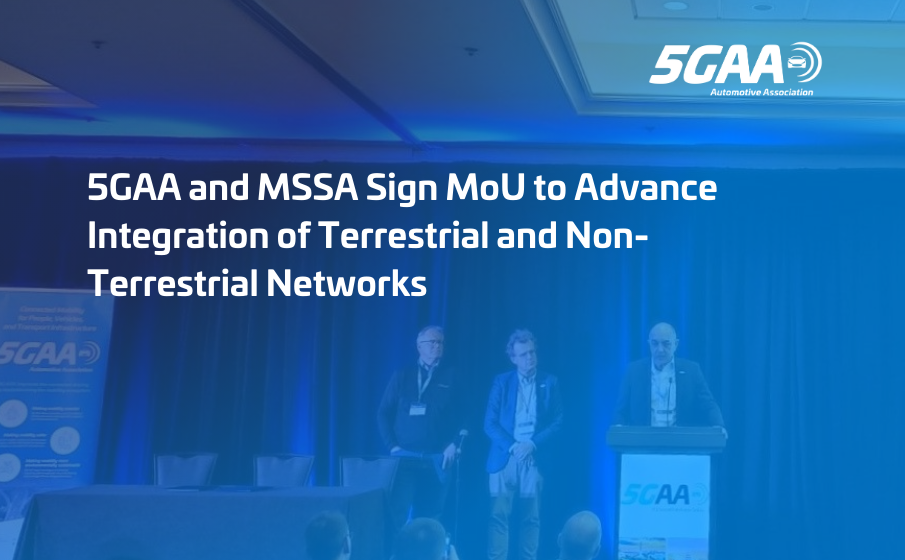
5GAA and MSSA Sign MoU to Advance Integration of Terrestrial and Non-Terrestrial Networks
The 5G Automotive Association (5GAA) has signed a Memorandum of Understanding with the Mobile Satellite Services Association (MSSA) to enhance global collaboration in integrating terrestrial and non-terrestrial networks (NTNs). The agreement was formalised during the Closing Ceremony of the 5GAA Meeting Week in Washington, D.C.
This strategic partnership establishes a framework for cooperation in key areas, including technological research and development, spectrum management, and the convergence of satellite and cellular networks. By leveraging 5GAA’s expertise in automotive connectivity and MSSA’s leadership in standards-based satellite networks, the collaboration aims to improve the reach, resilience, and efficiency of mobile connectivity for mobility and transportation applications.
The integration of NTNs with existing cellular networks is expected to play a crucial role in advancing connected and autonomous driving, enhancing road safety, and optimising intelligent traffic management. This partnership will also support the deployment of next-generation communication technologies such as Cellular Vehicle-To-Everything (C-V2X), essential for future mobility solutions.
Through this collaboration, 5GAA and MSSA will work together to share knowledge, coordinate technical and regulatory activities, and foster the development of innovative applications for both the automotive and broader mobile industries. The agreement highlight a shared commitment to scalable, standards-based solutions that address evolving global connectivity needs.